1010Computers | Computer Repair & IT Support

Instagram thinks you want IGTV previews in your home feed

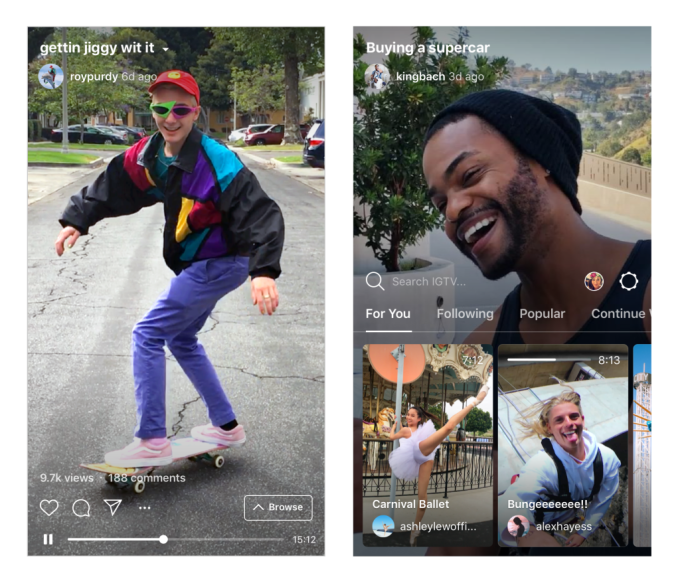
If you can’t beat or join them… force feed ’em? That appears to be Instagram’s latest strategy for IGTV, which is now being shoved right into Instagram’s main feed, the company announced today. Instagram says that it will now add one-minute IGTV previews to the feed, making it “even easier” to discover and watch content from IGTV.

Uh.

IGTV, you may recall, was launched last year as a way for Instagram to woo creators. With IGTV, creators are able to share long-form videos within the Instagram platform instead of just short-form content to the Feed or Stories.

The videos, before today, could be viewed in Instagram itself by tapping the IGTV icon at the top-right of the screen, or within the separate IGTV standalone app.Instagram’s hope was that IGTV would give the company a means of better competing with larger video sites, like Google’s YouTube or Amazon’s Twitch.
Its users, however, haven’t found IGTV as compelling.

As of last fall, few creators were working on content exclusively for IGTV, and rumor was the viewing audience for IGTV content remained quite small, compared with rivals like Snapchat or Facebook. Many creators just weren’t finding it worth investing additional resources into IGTV, so were repurposing content designed for other platforms, like YouTube or Snapchat.

That means the bigger creators weren’t developing premium content or exclusives for IGTV, but were instead experimenting by replaying the content their fans could find elsewhere. Many are still not even sure what the IGTV audience wants to watch.

IGTV’s standalone app doesn’t seem to have gained much of a following either.

The app today is ranked a lowly No. 228 on the U.S. App Store’s “Photo and Video” top chart. Despite being run by Instagram — an app that topped a billion monthly users last summer, and is currently the No. 1 free app on iOS — fewer are downloading IGTV.

After seeing 1.5 million downloads in its first month last year — largely out of curiosity — the IGTV app today has only grown to 3.5 million total installs worldwide, according to Sensor Tower data. While those may be good numbers for a brand-new startup, for a spin-off from one of the world’s biggest apps, they’re relatively small.Instagram’s new video initiative also represents another shot across the bow of Instagram purists.

As BuzzFeed reporter Katie Notopoulos opined last year, “I’m Sorry To Report Instagram Is Bad Now.” Her point of concern was the impact that Stories had on the Instagram Feed — people were sharing to Stories instead of the Feed, which made the Feed pretty boring. At yet, the Stories content wasn’t good either, having become a firehose of the throwaway posts that didn’t deserve being shared directly on users’ profiles.

On top of all this, it seems the Instagram Feed is now going to be cluttered with IGTV previews. That’s. Just. Great.

Instagram says you’ll see the one-minute previews in the Feed, and can tap on them to turn on the audio. Tap the IGTV icon on the preview and you’ll be able to watch the full version in IGTV. When the video is finished, you’re returned to the Feed. Or, if you want to see more from IGTV, you can swipe up while the video plays to start browsing.

IGTV previews is only one way Instagram has been developing the product to attract more views in recent months. It has also integrated IGTV in Explore, allowed the sharing of IGTV videos to Stories, added the ability to save IGTV Videos and launched IGTV Web Embeds.

Powered by WPeMatico
T-Mobile plans to offer à la carte media subscriptions, but no TV ‘skinny bundle’

T-Mobile doesn’t want to compete with other carriers or teleco’s by developing its own “skinny bundle” of streaming TV channels, the company said today on its earnings call with investors, noting the market was already oversaturated on that front. Instead, the mobile operator’s strategy will focus on helping customers pick and choose which paid TV subscriptions they want to access — a move that very much sounds like T-Mobile is going the “Amazon Channels” route with its mobile streaming plans.

According to T-Mobile President Mike Sievert, today’s customers have a number of choices for streaming TV thanks to the massive expansion of OTT (over-the-top) services that are now available.

“It’s subscription-palooza out there. Every single media brand either has or is developing an OTT solution, and most of these companies don’t have a way to bring these products to market,” he said. “They’re learning about that. They don’t have distribution networks like us; they don’t have access to the phone like we have.”

Instead, the exec explained that T-Mobile wants to help customers access paid subscriptions that already exist, by simplifying aspects of that process such as search, discovery and billing.

“We don’t have plans to develop an nth undifferentiated skinny bundle,” Sievert continued. “There are plenty of those. We think there’s a more nuanced role for us to play in helping you get access to the great media brands out there that you love, and to be able to put together your own media subscription — and smaller pieces five, six, seven or eight dollars at a time,” he said, adding that T-Mobile would begin this work in 2019.

The cord cutting-focused news site The Streamable was first to report T-Mobile’s news.

T-Mobile’s announcement comes at a time when the carrier’s mobile TV plans have been more of a focus, as everyone is trying to figure out what the carrier is up to.

Recently, a Cheddar report said T-Mobile would be launching a free mobile TV service in the weeks ahead. But that turned out to be just a “snackable content app” for T-Mobile’s Metro brand, MetroPCS, and only on two phones to start.

T-Mobile’s decision to go with an Amazon Channels-like offering, where consumers build their own “skinny bundles” by mixing and matching paid subscriptions, is not an uncommon choice. This is the same direction that many in the industry are heading, as of late.

This week, for example, Viacom said it would add paid subscriptions to its newly acquired free TV service, Pluto TV. Roku recently rolled out paid subscriptions to its free TV and movies hub, The Roku Channel. And Dish’s Sling TV last year launched à la carte paid subscriptions to premium networks, without requiring the core package subscription.

However, the mobile operators aren’t necessarily going that route. AT&T, for instance, has been leveraging its Time Warner acquisition to launch multiple streaming services. Meanwhile, Verizon (disclosure: TechCrunch parent) saw its some of its streaming TV ambitions dashed with go90’s failure last year.

As the over-the-top streaming TV market is still a sliver of the larger pay TV space, it still remains to be seen which strategies and services will ultimately win over consumers. But companies are placing their bets now, experimenting, and sometimes failing then starting again.

Separately, T-Mobile today discussed its Layer3 home TV service, which was expected to launch nationwide in late 2018. That service is now planned for the first half of 2019, the company said.

Powered by WPeMatico

Netflix launches ‘smart downloads’ feature on iOS to automate offline viewing

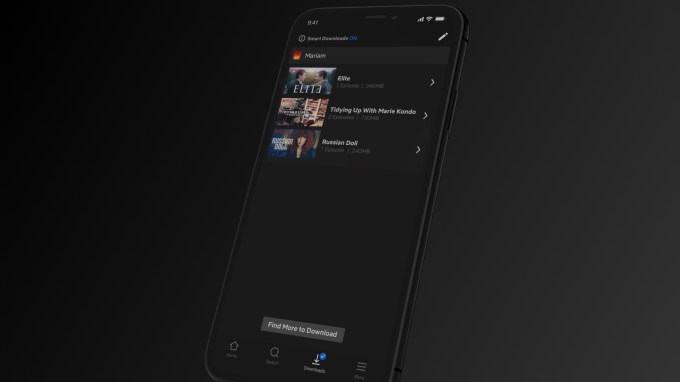
Netflix today is launching a new feature on iOS devices that will help make it easier to watch its shows when you’re offline. The “smart downloads” feature, as it’s called, will automatically delete a downloaded episode after you’ve finished watching, then download the next one — but only when you’re connected to Wi-Fi.

The idea is that users will no longer have to go through the tedious work of managing their downloads — deleting those they’ve watched or downloading new titles, for example. Instead, the app can manage the downloads for you, so people can spend more time watching Netflix shows.

Smart downloads make sense for those who plan for intermittent connectivity — like commuters who take underground trains, for instance, or those who travel through dead spots where wireless coverage drops. It also makes sense for those on limited data plans, who are careful about not using streaming video apps unless they’re on Wi-Fi.

Offline features like this are key to attracting and retaining users in emerging markets where connectivity concerns are the norm. That’s likely why Netflix prioritized Android over iOS, for the initial launch of smart downloads.

The feature had first arrived on Android last summer. It’s now offered across platforms, including iOS and in the Windows 10 Netflix app, the company says.

Offline access is only one area where Netflix is focusing on the needs of those in developing markets. The company late last year also began testing a more affordable, mobile-only subscription.

Non-U.S. users accounted for 7.31 million of the 8.8 million new subscribers Netflix added in the last quarter, as the U.S. market has become more saturated.

To use smart downloads on iOS, you can toggle the option in the Netflix app settings. It then turns itself on when you’re connected to Wi-Fi, to ensure your data plan won’t be used and your device storage won’t fill up as you watch offline. The feature will alert you when the episode in question has been downloaded.

“The faster our members can get to the next episode of their favorite stories, the better. Now, fans on the Netflix iOS app can get in on the fun and convenience of Smart Downloads, spending less time managing their downloads and more time watching,” said a Netflix spokesperson in a statement about the launch. “The feature is one more way we’re making it easier for Netflix fans to take the stories they love wherever they go,” they added.

Powered by WPeMatico

Someone could scoop up Slack before it IPOs

Earlier this week, Slack announced that it has filed the paperwork to go public at some point later this year. The big question is, will the company exit into the public markets as expected, or will one of the technology giants swoop in at the last minute with buckets of cash and take them off the market?

Slack, which raised more than $1 billion on an other-worldly $7 billion valuation, is an interesting property. It has managed to grow and be successful while competing with some of the world’s largest tech companies — Microsoft, Cisco, Facebook, Google and Salesforce. Not coincidentally, these deep-pocketed companies could be the ones that come knock, knock, knocking at Slack’s door.

Slack has managed to hold its own against these giants by doing something in this space that hadn’t been done effectively before. It made it easy to plug in other services, effectively making Slack a work hub where you could spend your day because your work could get pushed to you there from other enterprise apps.

As I’ve discussed before, this centralized hub has been a dream of communications tools for most of the 21st century. It began with enterprise IM tools in the early 2000s, and progressed to Enterprise 2.0 tools in the 2007 time frame. That period culminated in 2012 when Microsoft bought Yammer for $1.2 billion, the only billion-dollar exit for that generation of tools.

I remember hearing complaints about Enterprise 2.0 tools. While they had utility, in many ways they were just one more thing employees had to check for information beyond email. The talk was these tools would replace email, but a decade later email’s still standing and that generation of tools has been absorbed.

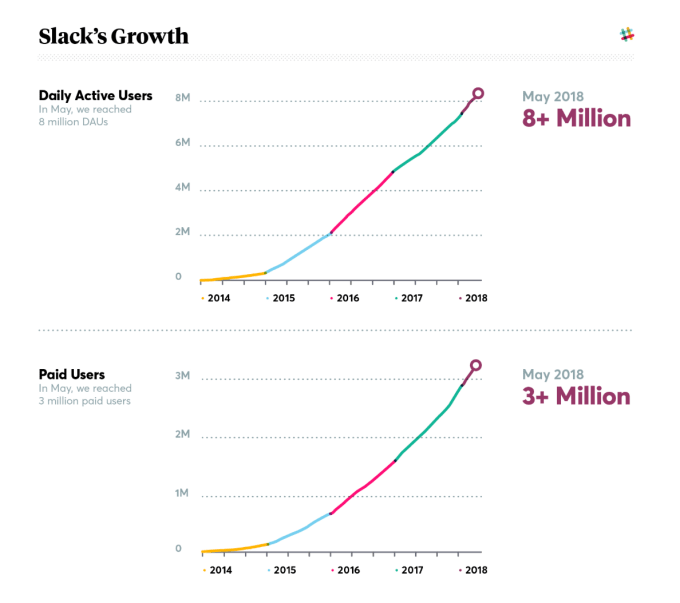
In 2013, Slack came along, perhaps sensing that Enterprise 2.0 never really got mobile and the cloud, and it recreated the notion in a more modern guise. By taking all of that a step further and making the tool a kind of workplace hub, it has been tremendously successful, growing to 8 million daily users in roughly 4 years, around 3 million of which were the paying variety, at last count.

Slack’s growth numbers as of May 2018

All of this leads us back to the exit question. While the company has obviously filed for IPO paperwork, it might not be the way it ultimately exits. Just the other day CNBC’s Jay Yarrow posited this questions on Twitter:

Is there any reason for Microsoft not to buy Slack for $20 billion? Seems like a perfect fit and at $20 billion could be a bargain.

— Jay Yarow (@jyarow) February 6, 2019

Not sure where he pulled that number from, but if you figure 3x valuation, that could be the value for a company of this ilk. There would be symmetry in Microsoft buying Slack six years after it plucked Yammer off the market, and it would remove a major competitive piece from the board, while allowing Microsoft access to Slack’s growing customer base.

Nobody can see into the future, and maybe Slack does IPO and takes its turn as a public company, but it surely wouldn’t be a surprise if someone came along with an offer it couldn’t refuse, whatever that figure might be.

Powered by WPeMatico

Update to iOS 12.1.4 to re-enable Group FaceTime

That nasty FaceTime bug is now a thing of the past. You can now download and update your iPhone and iPad to re-enable Group FaceTime again. iOS 12.1.4 is a bug fix release and doesn’t contain any new feature other than this one.

Shortly after people found out that you could eavesdrop on somebody’s microphone or camera by starting a fake Group FaceTime call, Apple disabled Group FaceTime altogether. If you’re running iOS 12.1.3 or earlier, you simply can’t start or join a FaceTime call with more than two people.

The company has been working on a fix to re-enable Group FaceTime without the nasty bug. And that update is now available.

“We have fixed the Group FaceTime security bug on Apple’s servers and we will issue a software update to re-enable the feature for users next week,” Apple said in a statement last week. “We sincerely apologize to our customers who were affected and all who were concerned about this security issue. We appreciate everyone’s patience as we complete this process.”

Back up your iPhone or iPad to iCloud or your computer first using iTunes. You can then head over to the Settings app. Tap on “General” then “Software Update” to download and install the patch. The update is still propagating on Apple’s servers so it could take a few minutes before you see it.

Powered by WPeMatico

LG’s next flagship is getting a 3D front-facing camera

LG’s never been much on waiting for a big show to announce its latest offering. Mobile World Congress is still weeks away, and the company just dropped what’s likely to be the biggest new feature of its upcoming flagship, the G8 ThinQ.

Clunky naming conventions aside, the handset once again finds LG focusing its efforts on imaging, with a time-of-flight sensor built-in to the front-facing camera array (sensor pictured above, incidentally). Here’s LG on what that means:

While other 3D technologies utilize complex algorithms to calculate an object’s distance from the camera lens, the ToF image sensor chip delivers more accurate measurements by capturing infrared light as it is reflected off the subject. As a result, ToF is faster and more effective in ambient light, reducing the workload on the application processor thereby also reducing power consumption.

For the end-user, that means the camera will be more capable of advanced face recognition than what most Android handsets currently offer. The addition of depth sensing brings more advanced biometric authentication, closer to what you get with the iPhone. The feature also goes a way toward validating earlier leaks of the phone, which bring a larger top notch.

As for the rest of the details — LG’s got to save something for MWC, I guess. 

Powered by WPeMatico

Google open sources ClusterFuzz

Google today announced that it is open sourcing ClusterFuzz, a scalable fuzzing tool that can run on clusters with more than 25,000 machines.

The company has long used the tool internally, and if you’ve paid particular attention to Google’s fuzzing efforts (and you have, right?), then this may all seem a bit familiar. That’s because Google launched the OSS-Fuzz service a couple of years ago and that service actually used ClusterFuzz. OSS-Fuzz was only available to open-source projects, though, while ClusterFuzz is now available for anyone to use.

The overall concept behind fuzzing is pretty straightforward: you basically throw lots of data (including random inputs) at your application and see how it reacts. Often, it’ll crash, but sometimes you’ll be able to find memory leaks and security flaws. Once you start anything at scale, though, it becomes more complicated and you’ll need tools like ClusterFuzz to manage that complexity.

ClusterFuzz automates the fuzzing process all the way from bug detection to reporting — and then retesting the fix. The tool itself also uses open-source libraries like the libFuzzer fuzzing engine and the AFL fuzzer to power some of the core fuzzing features that generate the test cases for the tool.

Google says it has used the tool to find more than 16,000 bugs in Chrome and 11,000 bugs in more than  160 open-source projects that used OSS-Fuzz. Since so much of the software testing and deployment toolchain is now generally automated, it’s no surprise that fuzzing is also becoming a hot topic these days (I’ve seen references to “continuous fuzzing” pop up quite a bit recently).

Powered by WPeMatico

Subscription startup Scroll acquires news aggregator Nuzzel

Tony Haile, who previously led analytics company Chartbeat, is trying to rethink the business model for news at his new startup, Scroll. Now he’s adding aggregation and curation to the mix with the acquisition of Nuzzel.

Scroll is still an invite-only product, but Haile explained the idea succinctly: “We deliver this amazing, clean, ad-free experience, and we do it for a low monthly price.”

In other words, after you subscribe and download Scroll, anytime you load up one of its partner sites (including USA Today, BuzzFeed and Vox), you should get an ad-free experience, which should work regardless of whether you’re accessing the site directly from your desktop or mobile browser, or from social media. In exchange, the publishers share the subscription revenue.

Nuzzel, meanwhile, was founded by Jonathan Abrams (who previously founded Friendster), and its core product allows you to see the stories that are most-shared by the people you follow on social media.

Haile said that by acquiring Nuzzel, Scroll can also start experimenting with different models for news curation — which is particularly important because if “we have just two algorithms determining who gets traffic and who doesn’t, then that’s not a healthy web ecosystem.”

“It’s really hard to [build] a scalable business as an amazing curation service,” he added. With Nuzzel, he hopes to “start finding ways in which we can build in that value and drive a new model for our user experience services.”

Tony Haile

NEW YORK, NY – OCTOBER 01: Tony Haile speaks onstage at the Buyer Beware! panel during AWXI on October 1, 2014 in New York City. (Photo by Andrew Toth/Getty Images for AWXI)

That doesn’t mean existing Nuzzel users shouldn’t expect any dramatic changes to either the app or the newsletters — Haile said they will continue to operate as separate products, and his team is taking the approach of “first do not harm.”

However, Scroll does plan to remove any advertising from the newsletters, and the engineering team behind the Nuzzel Media Intelligence product will be spinning that out as a separate company.

The financial terms of the deal were not disclosed. According to Crunchbase, Nuzzel had raised $5.1 million from investors, including Salesforce CEO Marc Benioff. Scroll, meanwhile, has raised a total of $10 million.

Haile said there won’t be anyone from the Nuzzel team joining Scroll in a full-time capacity, though some of them may remain involved as contractors. Abrams, meanwhile, told me via email that he and Nuzzel COO Kent Lindstrom are starting a new, yet-to-be-announced company.

“I think current Nuzzel users should see this as great news, since Scroll wants to make sure that Nuzzel’s services continue to operate,” Abrams said. “As you know, a lot of other news app and news aggregation startups were unfortunately shutdown between 2015 and 2018, so like I said, this is good news for Nuzzel users.”

Powered by WPeMatico

Microsoft Azure sets its sights on more analytics workloads

Enterprises now amass huge amounts of data, both from their own tools and applications, as well as from the SaaS applications they use. For a long time, that data was basically exhaust. Maybe it was stored for a while to fulfill some legal requirements, but then it was discarded. Now, data is what drives machine learning models, and the more data you have, the better. It’s maybe no surprise, then, that the big cloud vendors started investing in data warehouses and lakes early on. But that’s just a first step. After that, you also need the analytics tools to make all of this data useful.

Today, it’s Microsoft turn to shine the spotlight on its data analytics services. The actual news here is pretty straightforward. Two of these are services that are moving into general availability: the second generation of Azure Data Lake Storage for big data analytics workloads and Azure Data Explorer, a managed service that makes easier ad-hoc analysis of massive data volumes. Microsoft is also previewing a new feature in Azure Data Factory, its graphical no-code service for building data transformation. Data Factory now features the ability to map data flows.

Those individual news pieces are interesting if you are a user or are considering Azure for your big data workloads, but what’s maybe more important here is that Microsoft is trying to offer a comprehensive set of tools for managing and storing this data — and then using it for building analytics and AI services.

(Photo credit:Josh Edelson/AFP/Getty Images)

“AI is a top priority for every company around the globe,” Julia White, Microsoft’s corporate VP for Azure, told me. “And as we are working with our customers on AI, it becomes clear that their analytics often aren’t good enough for building an AI platform.” These companies are generating plenty of data, which then has to be pulled into analytics systems. She stressed that she couldn’t remember a customer conversation in recent months that didn’t focus on AI. “There is urgency to get to the AI dream,” White said, but the growth and variety of data presents a major challenge for many enterprises. “They thought this was a technology that was separate from their core systems. Now it’s expected for both customer-facing and line-of-business applications.”

Data Lake Storage helps with managing this variety of data since it can handle both structured and unstructured data (and is optimized for the Spark and Hadoop analytics engines). The service can ingest any kind of data — yet Microsoft still promises that it will be very fast. “The world of analytics tended to be defined by having to decide upfront and then building rigid structures around it to get the performance you wanted,” explained White. Data Lake Storage, on the other hand, wants to offer the best of both worlds.

Likewise, White argued that while many enterprises used to keep these services on their on-premises servers, many of them are still appliance-based. But she believes the cloud has now reached the point where the price/performance calculations are in its favor. It took a while to get to this point, though, and to convince enterprises. White noted that for the longest time, enterprises that looked at their analytics projects thought $300 million projects took forever, tied up lots of people and were frankly a bit scary. “But also, what we had to offer in the cloud hasn’t been amazing until some of the recent work,” she said. “We’ve been on a journey — as well as the other cloud vendors — and the price performance is now compelling.” And it sure helps that if enterprises want to meet their AI goals, they’ll now have to tackle these workloads, too.

Powered by WPeMatico

Motorola’s G7 line arrives this spring, starting at $199

Weeks of leaks haven’t left much to the imagination. But for those waiting for the real thing, the latest iteration of Motorola’s budget G line just became officially official as of this morning — and with a few weeks to spare ahead of Mobile World Congress. Of course, the Moto G7 line isn’t really aimed at the MWC crowd.

That show tends to be far more focused on premium flagships, while, as Motorola put it to me ahead of launch, this line is for “people who say, ‘I don’t need all this phone.’” In other words, people who don’t want to spend $1,000+ for a flagship. As such, the line starts at $199, putting it in line with earlier models.

As ever, the line will be available in three somewhat convoluted models. There’s the G7, the G7 Play, G7 Power and G7 Plus. The Plus, which brings a number of camera effects that have trickled down from the Moto Z line, won’t be available here in the States. It is, however, available today in Brazil and Mexico and will be rolling out in Europe, Australia and other parts of Latin American, packing a 16-megapixel dual camera, OIS and “auto-smile” image capture.

As for the base-level G7, that sports a 6.2-inch display, 12-megapixel dual cameras and a  3,000 mAh battery, coupled with a middling Snapdragon 632. That, too, is already available in Brazil and Mexico, priced at $299. For $249 you can get the G7 Power, which has the same screen and battery, but drops the dual cameras.

Cheapest of all is the $199 Moto G7 Play. That shrinks the screen down to 5.7 inches and pops a single 13-megapixel camera on back. The G7, G7 Play and G7 Power will be available in the States this spring. 

Powered by WPeMatico