1010Computers | Computer Repair & IT Support

Carbonite to acquire endpoint security company Webroot for $618.5M

Carbonite, the online backup and recovery company based in Boston, announced late yesterday that it will be acquiring Webroot, an endpoint security vendor, for $618.5 million in cash.

The company believes that by combining its cloud backup service with Webroot’s endpoint security tools, it will give customers a more complete solution. Webroot’s history actually predates the cloud, having launched in 1997. The private company reported $250 million in revenue for fiscal 2018, according to data provided by Carbonite . That will combine with Carbonite’s $296.4 million in revenue for the same time period.

Carbonite CEO and president Mohamad Ali saw the deal as a way to expand the Carbonite offering. “With threats like ransomware evolving daily, our customers and partners are increasingly seeking a more comprehensive solution that is both powerful and easy to use. Backup and recovery, combined with endpoint security and threat intelligence, is a differentiated solution that provides one, comprehensive data protection platform,” Ali explained in a statement.

The deal not only enhances Carbonite’s backup offering, it gives the company access to a new set of customers. While Carbonite sells mainly through Value Added Resellers (VARs), Webroot’s customers are mainly 14,000 Managed Service Providers (MSPs). That lack of overlap could increase its market reach through to the MSP channel. Webroot has 300,000 customers, according to Carbonite.

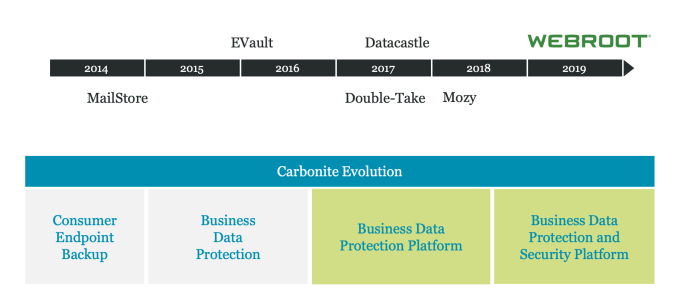
This is not the first Carbonite acquisition. It has acquired several other companies over the last several years, including buying Mozy from Dell a year ago for $145 million. The acquisition strategy is about using its checkbook to expand the capabilities of the platform to offer a more comprehensive set of tools beyond core backup and recovery.

Graphic: Carbonite

The company announced it is using cash on hand and a $550 million loan from Barclays, Citizens Bank and RBC Capital Markets to finance the deal. Per usual, the acquisition will be subject to regulatory approval, but is expected to close this quarter.

Powered by WPeMatico

Item tracking startup Adero is laying off 45% of staff, just weeks after it pivoted

Pivots can be the making of a startup, helping teams refocus on a good idea when previous things haven’t worked. But sometimes, they are just one more step on a difficult track. TechCrunch has learned and confirmed that Adero — an Amazon-backed maker of Bluetooth-enabled tracking tags that until last December was known as TrackR — is laying off at least 45 percent of its staff. The cuts come as Adero refocuses on building software instead of hardware products, and attempts to build a B2B business that reduces its emphasis on the consumer market ahead of plans to raise another round of funding.

The layoffs, which started last week, follow a pivot about two months ago from selling individual tracking tags — a business that had become increasingly commoditized — to developing solutions to organise and track groups of items that tend to be used together (such as the contents of a school backpack).

It’s not clear exactly how many employees are being affected, but when the pivot was announced at the end of November, the company had 60 employees, which would work out to 27 employees in this latest cut.

A spokesperson said that layoffs were being made to put more focus on building software instead of hardware.

“As our new brand grows, we can now move to the next chapter in developing the intelligent organization platform,” he said. “As a result, we’ve parted ways with a portion of the team that was brought on to help design and deliver the consumer product. We will both support the consumer products and focus new energy on developing the platform that powers our consumer products so it can power the experiences of our strategic partners.”

The layoffs and shift at Adero underscore the more general, continuing challenges of building hardware startups. If the product is unique, chances are that the economies of scale to manufacture it will be too capital-intensive for even well-capitalised startups.

But often, the products are just not unique enough. Adero, for example, competes with Tile and a plethora of smaller brands selling tracking dongles that are either very similar or fulfill a similar purpose, and that in turn commoditizes the core product. The mission then becomes building services around the hardware that are in and of themselves distinctive, or at least trying to be.

“It took a superhuman effort to develop and deliver a new product from scratch — hardware, software, cloud — in nine months,” CEO Nate Kelly wrote in an emailed statement when contacted to provide more detail about the layoffs.

“We threw everything we had into that work and are happy to say that not only did we launch but we have, since launch, delivered two updates to iOS, one to Android and will be delivering… a firmware update that increases the reliability of the product and releases new functionality like removing the limits on the number of taglets.”

Adero’s relaunch in December saw the company building a new line of large and small tags that allowed users to group items that often travelled together to help track them more logically, with plans to add more predictive and other intelligent features over time. “We did more than launch new products, we also built a platform, Activefield, that can scale across many products, many companies and unlimited use cases,” Kelly said.

He added that now the company is trying to work with more (unnamed) strategic partners. That B2B shift also has translated to cutting costs and streamlining particularly in “areas where we had bulked up” to launch the consumer product. “We don’t need that level of support anymore,” he said.

“Now that we’ve launched on our website and on Amazon” — which is an investor in Adero — “we will continue to take our product into other channels and countries, but the push in consumer comes second in focus to the further development of the platform and the deployment into a number of strategic partners,” he said. “This is all very ambitious and we are a small company with limited resources so I’m having to make some changes to the org that makes us leaner and sharpens our focus on deploying our ‘powered by Activefield’ strategy.”

He said that while Adero will continue to support its consumer products, “we hope to come back to you soon to share some good news on partnerships.”

He added that Adero also hoped to have more news of a new round of funding later this quarter. To date, the company has raised about $50 million, but its valuation has yo-yoed from $150 million in August 2017, to just $40 million in July 2018. Investors in the company, in addition to Amazon, include Foundry Group, NTT and Revolution.

While the company would only confirm 45 percent of employees were laid off, our tipsters paint a slightly more dire picture of the company. One tip we received described the layoffs as covering “almost everyone” and another noted that “the majority of the team” at the Santa Barbara-based startup are now gone. “Very few remain to help close the business,” it said.

The news caps off a tricky year for Adero. In January 2018, still branded TrackR, it laid off around 42 employees — at the time just under half its employees. The layoffs came as it was emerging that the startup’s core product, its Bluetooth tag, was becoming increasingly commoditized, with dozens of me-too trackers sold alongside it on Amazon and other marketplaces. (Its biggest rival, Tile, has also seen some big changes and also appears to be shifting its focus to a wider home IoT play.)

Around the time of those layoffs, first one and then both of the company’s founders — Chris Herbert and Christian Smith — stepped away from day-to-day roles at the company. Herbert had been CEO and he was replaced by Kelly, who had been the COO.

Then came the funding round at a big devaluation. “Foundry and Revolution [two of the startup’s investors] were hoping that they would put this money in and I could fix and scale things, similar to how I’d scaled Sonos and so on,” Kelly said about the funding in November (his experience includes Sonos, Tesla and Facebook). “But within six weeks, it became evident that we didn’t need to scale but figure out what the future was and where this is going.”

Where this is going continues to be the question as Adero takes its next steps.

Powered by WPeMatico

How to prepare for an investment apocalypse

Micah Rosenbloom
Contributor

Micah Rosenbloom is a venture partner at Founder Collective.

Unlike 2000 and 2008, everyone in the startup world is expecting a crash to come at any moment. But few are taking concrete steps to prepare for it.

If you’re running a venture-backed startup, you should probably get on that. First, go read RIP Good Times from Sequoia to get a sense for how bad it can get, quickly. Then take a look at the checklist below. You don’t need to build a bomb shelter, yet, but adopting a bit of the prepper mentality now will pay dividends down the road.

Don’t wait, prepare

The first step in preparing for a coming downturn is making a plan for how you’d get to a point of sustainability. Many startups have been lulled into a false sense of confidence that profit is something they can figure out “later.” Keep in mind, it has to be done eventually and it’s easier to do when the broader economy isn’t crashing around you. There are two complicating factors to keep in mind.

You’ll have to do it with less revenue

In a downturn, business customers skip investing in capital equipment and new software. Likewise, consumer discretionary spending goes way down. The result is you’ll likely have less revenue than you do now. War-game a variety of scenarios — what you’d do if you lost 20 percent, 50 percent or 80 percent of your revenue, and what decisions would have to be taken to survive.

Sometimes capital can’t be had at any valuation

When a downturn comes, capital markets don’t soften, they seize. Depending on how bad a hypothetical financial crisis got, there’s a good chance that investors would close up their checkbooks and triage. If you aren’t one of your investor’s favorite portfolio companies, there’s a decent chance you may be left in the cold. Don’t even assume you’ll be able to close a down round. Fortunately, showing a plan with a clear path to profitability will allay investors concerns that you’ll need their capital indefinitely and make it more likely you’ll be able to raise.

Planning around these three realities — the need for profits, while experiencing dropping revenue, in a world where capital can’t be had at any valuation — is going to lead to unpleasant conclusions. A dramatically diminished business, major layoffs, and a decisive drop in morale are likely outcomes. Thankfully, you can take steps now to help soften the landing, or if you’re really successful, avoid it entirely.

Avoid “growth at all costs” mentality

Getting acquisition costs under control will help you in two ways. First, it’ll lower your burn rate. Chasing growth for growth’s sake is always a short-sighted decision, but especially during the late part of the business cycle. Avoid this even if you’re VC is encouraging it. Second, by carefully analyzing the inputs to your acquisition cost, it will force you to examine the dynamics of your business. It gives you an opportunity to decide if a poorly performing channel or lackluster sales reps are actually smart investments. Even cutting your payback period from 12 months to nine will provide an increased measure of visibility and control.

Increase the hiring bar

Instagram took over the web with a team of a dozen. Craigslist is a pillar of the internet with a staff of 40 employees. WhatsApp supported hundreds of millions of daily users with fewer than 50 people. Chances are you need fewer people than you think.

In his new book, Scott Belsky shares an algorithm he used building Behance into a $100M company — automate, automate, then hire. His point was that founders should encourage teams to push hard on improving processes and other labor-saving tools before adding more FTEs.

Don’t institute a hiring freeze or take other actions that might spook the staff, but do send the message that new hires should be the last resort, not the first response to a challenge.

Preach discipline — build it into the culture

Founders often try to change spending habits, and in turn culture, when it’s too late. Is there a fair bit of business class flying among the executive team? Do your employees stretch your free dinner policy by staying just past the dinner hour to take advantage of free food? At most tech ventures, everyone is truly an owner. Try to help the entire team to internalize that they are spending their own money.

Get to know your potential acquirers

The week the market drops 50 percent is not the week to start a M&A conversation. You should be getting to know the five most likely buyers of your company, now. Find out who the decision makers at each of the companies are and build relationships. Make it a point to catch up with these people at conferences and even consider sending them regular updates about your company’s progress (but not too much data). You’re not running a formal sales process, but helping build up the internal desire to buy your company if the opportunity presents itself. It may not be the exit of your dreams, but it’s nice to have options if you need them.

Jettison expensive office space

If you’re coming to a T-juncture regarding office space, you may want to prioritize price and lease flexibility over quality and location. I remember one of our offices at my start-up was a twelve month lease with 6 months free. The landlords were desperate, and so were we!

Front-load revenue

If you’re in the kind of business that will support annual contracts, figure out a way to offer them. Pre-sell credits to consumers at a discount. More fundamentally, think about how you might be able to adjust your business model so you can get paid before you deliver services. Plenty of viable businesses are asphyxiated by delays in accounts receivable, don’t allow your ambitions to be thwarted by accounting.

Diversify your customer base

One lesson learned in the 2000 bubble was that startups that serve other startups tend to be hit hardest. It’s important to think about how a downturn will impact your customer base. If more than 30 percent of your revenue comes from one industry (perhaps start-ups!), or heaven help you, a single customer, start thinking about managing risk by diversifying your customer base.

Raise a pre-emptive round (AND DON’T SPEND IT)

Topping up your balance sheet at this point isn’t a bad idea, provided you have the discipline to treat it as a rainy day fund. Communicate this rationale to your investors. It’s also important to use this moment to reflect on valuation. An eye-popping valuation will feel good when you sign the term sheet, but it’s going to feel like a millstone if the economy turns, and the market for blue-chip tech stocks drops precipitously.

Consider venture debt

Many VCs discourage venture debt. They’ll say “if you need more money, we’ll backstop you.” The problem is when things ugly, they may not be there. Debt providers are a good way to extend the runway. The thing is that it’s best to raise debt capital when you don’t need it. Venture debt can add ⅓ to ½ of additional capital to some funding rounds with minimal dilution and relatively modest interest rates. Do note that when things get bad, some debt funds can get aggressive so do your homework before taking the notes.

Don’t panic

It’s tough to predict the top of the market. CNN, Time, The Atlantic, The Wall Street Journal, and many others argued Facebook paying $1 billion for Instagram was a sure sign of a bubble — in 2012. Reputable commentators have claimed that we’re in a bubble every year since, see 2013, 2014, 2015, 2016, 2017, and 2018. Going into survival mode in any of those years would have been a serious mistake for most startups.

Still, we’re only two quarters away from marking the longest economic expansion in US history. The good times have got to end at some point. Venture capital is a hell of a drug and withdrawal can be painful. Keep in mind that there’s no correlation between how much a company raised and how well they did on the public markets. If you’re struggling to make your startup’s economics work, read up on dozens of “invisible unicorns” who show that you can get big without relying on outsized amounts of venture capital.

If your house is in order when the downturn hits, you may actually be able to grow through it. As unprepared competitors go out of business, you’ll find that talent is more plentiful and customer acquisition costs plummet. Some of the best companies have been founded and thrived in the worst of times — if you’re prepared.

Powered by WPeMatico

Apple turns Ariana Grande and other musicians into Memoji for its latest ads

Just in time for the Grammy Awards, Apple has unveiled three new ads for Apple Music, featuring new singles from Ariana Grande, Khalid and Florida Georgia Line.

In each video, the musicians have been transformed in Memoji (the human-style Animoji variant that was announced last year), which lip synch to their latest songs. The ads probably won’t change any minds when it comes to Memoji and Animoji — but if you like the format, they are fun.

Apple actually created similar ads with Animoji lip synching to Childish Gambino and Migos before last year’s Grammys.

As The Verge points out, if you watch to the end of the videos and pay attention to the small print, you’ll notice that these Memoji were “professionally animated.” So don’t feel too bad if your lip-synching Animoji videos don’t look quite as good.

Powered by WPeMatico

Luxury handbag marketplace Rebag raises $25M to expand to 30 more stores

Rebag, an online resale marketplace for luxury handbags, is getting another infusion of capital as it prepares to expand its offline retail operations. The company this week announced $25 million in Series C funding, in a round led by private equity firm Novator, with participation from existing investors General Catalyst and FJ Labs.

The round brings Rebag’s total raise to date to $52 million.

Rebag competes with other luxury goods resellers, like TheRealReal, and to some extent with broader resale marketplaces like ThredUP or Poshmark, which also attract shoppers looking to buy quality pre-owned items. And it exists alongside large marketplaces like eBay, as well as rental shops like Rent the Runway, which offers an alternative to a site focused only on handbags.

In fact, Rebag founder and CEO Charles Gorra spent a brief period at Rent the Runway before leaving to start Rebag in 2014. At the time, he said he saw an immediate opportunity to not just rent the items, but to actually resell them on a secondary market.

Today, Rebag’s shop sells bags from more than 50 designer brands, including all the majors, like Chanel, Louis Vuitton, Hermes, Gucci and others.

However, in the years following Rebag’s launch, the company has expanded its offerings beyond just online resale to include brick-and-mortar retail and, more recently, a service called Rebag Infinity, which allows shoppers to turn in any Rebag handbag purchase within six months in exchange to receive a credit of at least 70 percent off their next purchase.

Last year, Rebag made headlines in the fashion world for selling the rare Hermès White Crocodile Himalayan Birkin collectible — typically a bag that costs more than $100,000 — for “just” $70,000, to celebrate the opening of its 57th Street and Madison Avenue store, its second Manhattan flagship location.

With the new funding, Rebag will expand its offline footprint, it says. The company currently operates five stores in New York and L.A. but plans to launch 30 more locations in the “medium term.” This will include both standalone storefronts, as well as presences within luxury malls.

It’s common for resale marketplaces these days to take their wares to offline shoppers. TheRealReal, Rent the Runway, ThredUP and others all today offer real-world locations, where shoppers can browse in person instead of just online.

Rebag says since it opened its retail stores last year, it moved from being a 100 percent digital operation to 80 percent digital and 20 percent offline. Its sourcing network also grew to include more than 20,000 stylists, partners, shoppers and sales associates.

With the funding, Rebag adds it will also refine its pricing and handbag evaluation tools aimed at standardizing the resale process, something that could represent another business for the brand (or make it attractive to an acquirer).

“We are a technology company first,” noted founder and CEO Charles Gorra, in a statement. “Our goal is to become the standard for the luxury resale industry, just like Kelley Blue Book is the main resource for the auto industry.”

The company plans to triple its team of 100, which today includes newer hires CTO Jay Winters (Delivery.com, Goldman Sachs) and CMO Elizabeth Layne (Bonobos, Appear Here).

Rebag doesn’t share its hard numbers about sales, revenues, valuation, customer base or others, but told us it has tripled revenues since its Series B.

Powered by WPeMatico

Extend Fertility banks $15M Series A to help women freeze their eggs

Fertility services are raising venture cash left and right. Last week, it was Dadi, a sperm storage startup that nabbed a $2 million seed round. This week, it’s Extend Fertility, which helps women preserve their fertility through egg freezing.

Headquartered in New York, the business has secured a $15 million Series A investment from Regal Healthcare Capital Partners to expand its fertility services, which also include infertility treatments, such as in vitro and intrauterine insemination. The company has also appointed Anne Hogarty, the former chief business officer at Prelude Fertility and vice president of international business at BuzzFeed, to the role of chief executive officer. Hogarty replaces Extend Fertility co-founder Ilaina Edison, who had held the C-level title since the business launched in 2016. Edison will remain on the startup’s board of directors.

Extend Fertility, in its New York cryopreservation and embryology lab and treatment center, completed 1,000 egg-freezing cycles in 2018.

“A lot of amazing things have happened for women over the last century,” Hogarty told TechCrunch earlier this week. “Now, women are permitted and encouraged to seek higher education, pursue a career, follow their dreams and end up with a partner who’s the right partner, not just any partner. Doing all those things has pushed the window for when women want to start a family from their 20s to their 30s and unfortunately, one thing that has not changed in that time is the biological clock.”

Hogarty explained Extend’s fertility services are more affordable than other options because the service was built specifically with egg freezing in mind, and the company later expanded to offer infertility treatments, whereas other services were established to provide IVF and other infertility treatments and integrated cryopreservation tools later.

We are really purpose-built to be an egg-freezing-first company, where many legacy institutions that were providing infertility services have legacy costs that come with … inefficiencies bred over decades and outmoded technology in their labs that may not be the most efficient and effective,” she said. “We have a state of the art lab with the latest equipment.”

It’s the classic innovator dilemma,” she added. “Infertility services are extraordinarily expensive and reproductive endocrinology is a new area of medicine. There are a lot of people and institutions that have been taking inordinate amounts of money for their infertility services so they weren’t looking to serve this population of women looking to preserve their fertility.”

One egg-freezing cycle with Extend costs women $5,500, and additional cycles come at a sticker price of $4,000. Each cycle includes a fertility assessment, private consultation, anesthesia and any monitoring a patient may need during their cycle. The costs don’t include medication, however. Extend can prescribe medications — which typically cost between $2,000 and $5,000 for fertility patients — but they still need to go through a third party to get their prescriptions filled and paid for. 

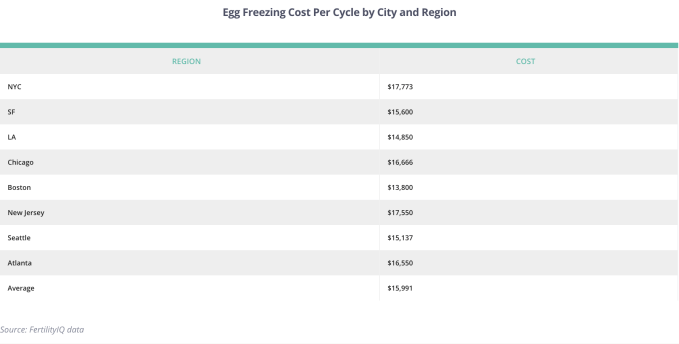
For reference, FertilityIQ, an online platform for researching fertility care providers and treatments, says the typical cost per cycle for egg freezing is more than $17,000 in New York City or $15,600 in San Francisco. Most egg-freezing services, including Extend, do not accept insurance, as most insurance providers don’t cover the steep costs of fertility or infertility treatments.

Some companies, however, are beginning to offer benefits that cover these costs. Facebook and Apple, for example, began subsidizing egg-freezing procedures for employees in 2014. Spotify and eBay, for their part, will pay for an unlimited number of IVF cycles.

Hogarty said Extend’s price point makes it one of the lowest-cost players in the market.

“We want as many women as possible to benefit from the advances from egg-freezing technology,” she said.

Extend Fertility, which has previously raised $10 million, plans to use the latest investment to open labs in new markets and expand its infertility services.

Powered by WPeMatico

Sprint calls AT&T’s 5G E label ‘false advertising’ in new lawsuit

While it’s true that it’s going to take some time before most of us will actually be able to enjoy the benefits of 5G, that doesn’t mean you can’t sit back and enjoy the fireworks right now. AT&T’s adoption of the “5G Evolution” label has already been controversial among industry followers and fellow carriers alike for watering down the meaning of next-gen connectivity — and now Sprint is looking to do something about it.

The carrier filed suit against what it called “false advertising and deceptive acts” relating to AT&T’s 5G E. The suit notes, rightly, that Sprint, AT&T and other major carriers are all jostling to be first to market, “but calling its network 5G E […] does not make it a 5G network.” In fact, the network is more akin to advanced LTE.

AT&T called itself “[the] first U.S. mobile company to introduce mobile 5G service in a dozen markets by late 2018” courtesy of the label, in a much-maligned attempt to plant its flag. It’s similar to tactics used by the carrier ahead of the rollout of LTE. AT&T has largely waved away criticism, stating that it’s happy that such moves have gotten it into the heads of the competition.

That may be true, but anyone who has watched the industry with even passing interest knows that real network advances take time, and this sort of branding goes a ways toward muddying up consumer understanding. The suit goes on to claim that the 5GE label violates state and federal false advertising laws and does damage to competitors like Sprint, which is invested in the slower rollout of true 5G.

Update: AT&T is standing defiant on this one. Here’s their statement:

We understand why our competitors don’t like what we are doing, but our customers love it. We introduced 5G Evolution more than two years ago, clearly defining it as an evolutionary step to standards-based 5G. 5G Evolution and the 5GE indicator simply let customers know when their device is in an area where speeds up to twice as fast as standard LTE are available. That’s what 5G Evolution is, and we are delighted to deliver it to our customers.

We will fight this lawsuit while continuing to deploy 5G Evolution in addition to standards-based mobile 5G. Customers want and deserve to know when they are getting better speeds. Sprint will have to reconcile its arguments to the FCC that it cannot deploy a widespread 5G network without T-Mobile while simultaneously claiming in this suit to be launching ‘legitimate 5G technology imminently.’

Powered by WPeMatico

Dixa, the ‘customer friendship’ platform, raises $14M

Dixa, a Copenhagen-based startup that offers a platform to help companies provide better and more consistent customer service across multiple channels, has raised $14 million in Series A funding. The round is led by Project A Ventures, with participation from early investor SEED Capital.

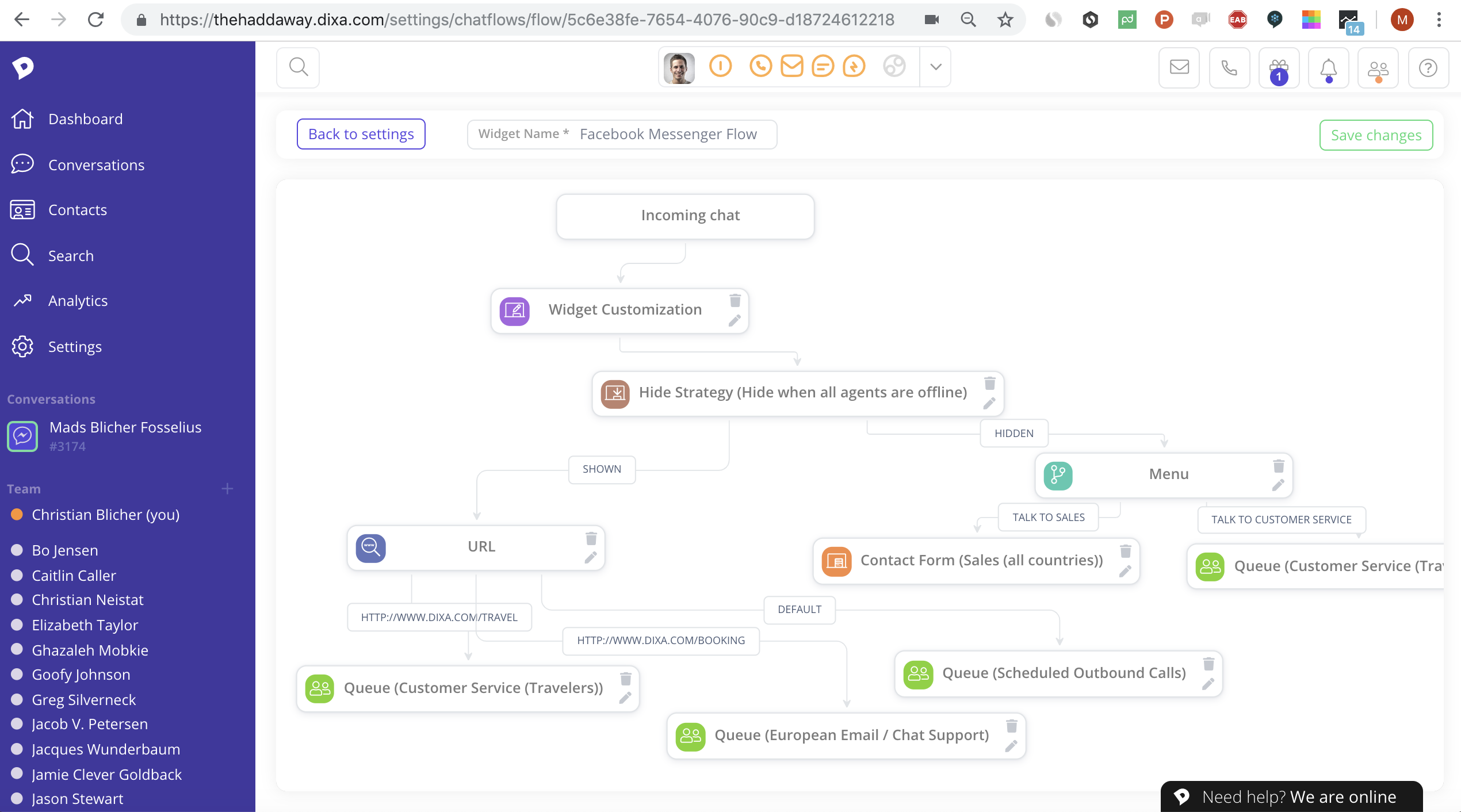
Founded in 2015 by Jacob Vous Petersen and Mads Fosselius, Dixa is on mission to end bad customer service with the help of smarter technology to facilitate more personalised customer support. Dubbed a “customer friendship” platform, the cloud-based software works across multiple channels — including phone, chat, e-mail and Facebook Messenger — and employs a smart routing system so the right support requests reach the right people within an organisation.

“The problem for customer-facing support teams today is that tickets shared in boxes and legacy call center solutions limit a brand’s ability to connect to their customers where they want to and add extra administrative burdens that ultimately harms the customer experience,” co-founder and CEO Mads Fosselius tells me.

“Despite companies and brands promising stellar customer experiences and service, [with] digital transformation and technology vendors promising even more, the facts are that 75 percent of all customers have had a bad customer experience within the past six months and 70 percent say they will leave a brand after just one bad experience,” he says, citing Salesforce’s recent ‘State of the Connected Customer’ 2018 report.

Dixa’s solution is described by Fosselius as a “next-gen” customer engagement platform built for personal and insightful conversations across all channels. To various degrees, it competes with Zendesk, Freshdesk, Salesforce Servicecloud and Avaya, Cisco and 8×8. “Dixa is different as it’s a one channel-neutral platform and it works [how[ friends connect and communicate, but for engagement between brands and their customers. We call it a ‘Customer Friendship’ platform,” says Fosselius.

This sees Dixa help companies ensure that customers can always get the help they need when they need it and on the channel they prefer. The software’s algorithms smartly re-route requests to the correct human or bot based on a raft of data. This includes past conversations, orders, reviews and sentiment. Additionally, the context is taken into account, such as the communication channel used, web page visited, device, etc., and the skills plus availability of the relevant customer-facing employee.

The result, says Dixa, is a system that makes it possible to deliver a consistent level of personal service, regardless of how the customer reaches out.

To that end, the Dixa platform is targeting “customer-centric” brands with 5-500 customer-facing agents, such as scale-ups and companies in the travel, e-commerce, fintech and transport/delivery sectors. Its current customer base spans 23 countries and includes brands like Bosch, Interflora,Trustpilot, Danish design icon Hay and food waste movement company Too Good to Go.

Adds Fosselius: “We don’t believe in tickets and siloed ‘silver bullet’ customer support solutions doing one thing or one channel very well, the world of customer support is moving towards conversational customer engagement or ‘customer friendship’ as we like to call it, where the strong bond and relation between brands and customers are the center piece.”

Powered by WPeMatico

Google makes it easier for cheap phones and smart devices to encrypt your data

Encryption is an important part of the whole securing-your-data package, but it’s easy to underestimate the amount of complexity it adds to any service or device. One part of that is the amount of processing encryption takes — an amount that could be impractical on small or low-end devices. Google wants to change that with a highly efficient new method called Adiantum.

Here’s the problem. While encryption is in a way just transforming one block of data reversibly into another, that process is actually pretty complicated. Math needs to be done, data read and written and reread and rewritten and confirmed and hashed.

For a text message that’s not so hard. But if you have to do the same thing as you store or retrieve megabyte after megabyte of data, for instance with images or video, that extra computation adds up quick.

Lots of modern smartphones and other gadgets are equipped with a special chip that performs some of the most common encryption algorithms and processes (namely AES), just like we have GPUs to handle graphics calculations in games and such.

But what about older phones, or cheaper ones, or tiny smart home gadgets that don’t have room for that kind of thing on their boards? Just like they can’t run the latest games, they might not be able to efficiently run the latest cryptographic processes. They can still encrypt things, of course, but it might take too long for certain apps to work, or drain the battery.

Google, clearly interested in keeping cheap phones competitive, is tackling this problem by creating a special encryption method just for low-power phones. They call it Adiantum, and it will be optionally part of Android distributions going forward.

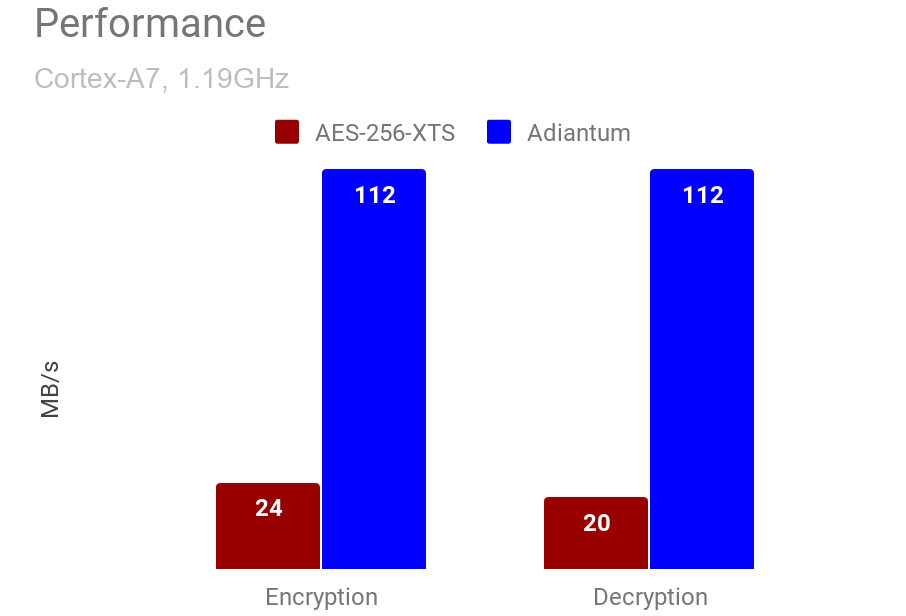
The technical details are all here, but the gist is this. Instead of using AES it relies on a cipher called ChaCha. This cipher method is highly optimized for basic binary operations, which any processor can execute quickly, though of course it will be outstripped by specialized hardware and drivers. It’s well documented and already in use lots of places — this isn’t some no-name bargain bin code. As they show, it performs way better on earlier chipsets like the Cortex A7.

The Adiantum process doesn’t increase or decrease the size of the payload (for instance by padding it or by appending some header or footer data), meaning the same number of bytes come in as go out. That’s nice when you’re a file system and don’t want to have to set aside too many special blocks for encryption metadata and the like.

Naturally new encryption techniques are viewed with some skepticism by security professionals, for whom the greatest pleasure in life is to prove one is compromised or unreliable. Adiantum’s engineers say they have “high confidence in its security,” with the assumption (currently reasonable) that its component “primitives” ChaCha and AES are themselves secure. We’ll soon see!

In the meantime don’t expect any instant gains, but future low-power devices may offer better security without having to use more expensive components — you won’t have to do a thing, either.

Oh, and in case you were wondering:

Adiantum is named after the genus of the maidenhair fern, which in the Victorian language of flowers (floriography) represents sincerity and discretion.

Powered by WPeMatico

Gametime lets you buy tickets for games and concerts that have already started

Ticketing app Gametime is taking its last-minute approach about as far as it can go, with the launch of a new feature called LastCall. This allows users to purchase tickets through Gametime until 90 minutes after an event has started.

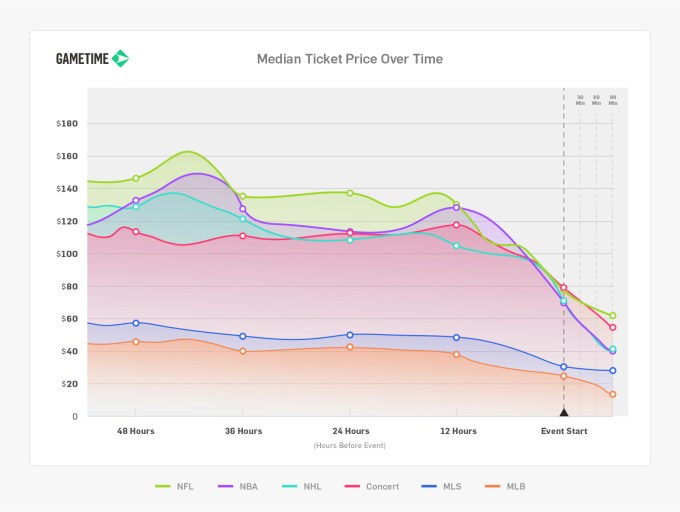
Why would you want to do that? Well, prices usually drop precipitously after the event starts — for example, Gametime said that 48 hours before a game, the median price for a Major League Baseball is (coincidentally?) $48, but it’s dropped to $13 by 90 minutes after the first pitch.

Founder and CEO Brad Griffith acknowledged that most fans probably aren’t interested in just showing up for the fourth quarter or ninth inning of a game, or for the last song in a concert. On the other hand, if you could get a big discount and still catch most of the event, then it might be worth it.

Meanwhile, if you’re a team or a venue with empty seats, or if you’re a ticket-holder who realizes at the last minute that you can’t attend, then it’s good to have one last shot at selling those tickets.

In fact, it sounds like this is one of those “announcements” that’s partly acknowledging what’s already happening, both in the Gametime app and elsewhere. Griffith said the company is “doubling down” on this last-last-minute category of tickets, adding that it’s “constantly working through” what it’s actually including under the LastCall umbrella.

LastCall graphic

“The key element is the research that we’ve done, how it relates to the growth of this phenomenon” he said.

That research includes a survey of 287 event attendees, some who use Gametime and some who don’t. Apparently 27 percent said they’ve already purchased tickets after an event’s start time, and 62 percent of those late buyers were either Generation Z or millennials.

And while Gametime started out with a focus on sports, LastCall will include tickets from a variety of live events. In fact, Griffith said concerts are now the app’s fastest-growing category, and he suggested that this approach could help with the declining number of total concert tickets sold.

“We’re starting to see a bifurcation of windows, where the on-sale is still healthy, is strong, and the middle is maybe cratering in terms of transaction volume,” he said. “And then last-minute is vibrant and growing fast. That is where we aim to do our best work.”

Powered by WPeMatico