1010Computers | Computer Repair & IT Support

Melonport dissolves in favor of its protocol, setting a new bar for the blockchain world

In the world of blockchain, it is the sector of fintech where most think Satoshi’s invention will have the greatest impact. And in finance, there are few more elite worlds than those of asset management. So it’s of some significance that a two-year project to disrupt and open up this world using blockchain has now come to fruition.

Last Friday in Zug — a small provincial Swiss town which has embraced crypto startups — the Melonport startup consciously chose to dissolve itself and release its Melon protocol on the world of asset management. It will now build its company on a blockchain protocol it doesn’t control. The precedence for this kind of move in the tech world are many. It’s not unheard for a startup to release an Open API and let other potential competitors build on it, while hoping they will be good enough to beat others. And Red Hat, long ago, built a huge company on top of the open-source Linux software.

What is different here is that Melonport built the Melon Protocol on the Ethereum blockchain, but it will no longer have the majority say on how that protocol develops. No one will technically “own” the Melon Protocol, but the founders of Melonport have entrusted its development to an independent Melon Council, which will provide governance and direction as it develops. What was Melonport will now morph into a new company called Madeeba to build tools on top of its creation. Madeeba will hold one seat on the Melon Council.

Fans of Stars Wars will have to forgive me, but it’s not unlike Obi-Wan Kenobi becoming stronger in “The Force” by allowing Darth Vader to kill him off. Augur is the only major crypto platform to do the same as Melonport: letting the community run the software. Augur has grown steadily too, showing this methodology can work.

Melon will now be an open-source protocol on the Ethereum blockchain for on-chain asset management. This pioneering blockchain software system is designed to allow literally anyone to set up, and manage, an asset management fund.

Melonport founder and now Madeeba founder Mona El Isa told me: “We always promised we would step back and hand over the protocol to a decentralized governance process. This is designed to consider all the stakeholders, the token holders, the developers, and the users (the managers and investors).”

Blockchain technology has the potential to radically transform business and allow community owned networks. However, getting the governance right is key in this space. That’s why creating a system that prevents co-option and capture by vested interests is so important. Other blockchains, such as EOS, have been criticized for being in thrall to a limited number of nodes, for instance.

The Melon Council is composed of the Melon Technical Council (MTC) and representatives of Melon Exposed Businesses (MEB). The first seats of the MTC have been assigned by the outgoing Melonport team to:

• Will Harborne (Director of Operations at Ethfinex)
• Nick Munoz-McDonald (former Head of Audit at Solidified)
• KR1 (represented by Janos Berghorn)
• Matthew Di Ferrante (founder, ZK Labs)
• Woorton (represented by Zahreddine Touag)
• Martin Lundfall (Formal Verification Researcher at Dapphub/MakerDAO)
• Fabian Gompf (VP Technology Partnerships at Parity)
• Former Melonport team / Madeeba (represented by Jenna Zenk)

Each Melon Council member will be issued a token that represents their membership into the Melon Council. They will then be able to use that token to make proposals and vote on key issues.

The Melon Council will also be powered by aragonOS, a Solidity framework on the Ethereum blockchain, which allows anyone to create, manage and participate in complex decentralized organizations.

The Melon Council DAO says this will allow decision making within the Melon Council to remain secure and transparent to the community. The members of the Melon Council will be able to vote on-chain on matters such as inviting new members into the Council, adjusting the amgu price, updating the Melon protocol.eth ENS subdomains and updating protocol parameters. The Melon Council will also be able to use Aragon tools to make their decisions about inflation spending transparent.

“We’re doing this to show that we were serious about building a decentralized system. If we stuck around everyone would be relying on us to be the sole maintainer of the protocol, or they might suspect we have some kind of bigger influence,” El Isa continued.

In the race toward decentralized asset management, there have been other attempts to create new vehicles, such as Iconomy and CoinBlock, but it’s fair to say none has been as successful or as long-lived as the Melonport project.

Madeeba will now aim to build a user-friendly product, “so anyone could set up a fund and not even feel you’ve entered into the blockchain space,” says El Isa. A sea of hands (belonging to both traditional and non-traditional asset managers) went up in the room when people were asked if they would pilot both Madeeba and the protocol.

Travis Jacobs — the lead Melon protocol developer and who’s worked on blockchain since 2011 — told me he said he decided to work on Melon to have an effect in an industry that is “sort of shuttered and only accessible to an elite few. It was a great opportunity to spread a democratic effect so anyone could set up an investment fund.”

In dissolving itself in favor of anon source protocol on which it plans to build its own products, the example set by Melonport could have wider ramifications in the nascent blockchain world.

The next time anyone sees a startup announce that it’s working on a “blockchain protocol to rule them all,” the next question to be asked should be: how will that protocol operate for others, and how will it be governed? Because governance has become one question, if not the key question, the brave new world of blockchain must answer.

Powered by WPeMatico

PerimeterX secures $43M to protect web apps from bot attacks

We know by now that modern website attacks are typically automated, as armies of bots knock on doors until they inevitably find vulnerabilities and take advantage. PerimeterX, a San Francisco, startup wants to protect sites from these automated assaults. Today, it announced a $43 million Series C.

The round was led by Scale Venture Partners . New investor Adams Street Partners joined existing investors Canaan Partners, Vertex Ventures and Data Collective in the round. Ariel Tseitlin, a partner at Scale, will be joining the company’s board under the terms of the deal. Today’s investment brings the total raised to more than $77 million, according to Crunchbase data.

Omri Iluz, co-founder and CEO at PerimeterX, says bots have become the preferred way of hackers to attack websites and mobile apps, and his company has developed a way to defend against that kind of approach. It uses an approach called behavioral fingerprinting to blunt these automated attacks.

“Once we gain visibility into the behavior of the user, we are able to discern between normal behavior and an anomalous behavior that looks like it’s coming from an automated tool,” he said. The solution looks at attributes like mouse movements and swipes. It also analyzes the hardware to understand the graphics driver and audio driver of whatever device the bot is purporting to be.

To achieve this kind of identification requires massive amounts of data, and PerimeterX uses machine learning to help understand normal behavior and shut down anomalous behavior in an automated fashion.

The company was founded in 2014 and currently has 140 employees. Ariel Tseitlin from Scale Venture Partners, whose firm is leading the round, says as companies reach this level of maturity, the Series C money tends to go into sales and marketing to push the revenue pedal and scale the company.

“While there is a lot of opportunity in R&D, generally at this stage most of the dollars are going for sales and marketing, so hiring more salespeople, hiring more marketers more sales ops. That’s where a big part of the expansion comes from, and that tends to be pretty closely correlated to revenue growth, and pretty closely correlated to just greater growth in general,” Tseitlin explained

We wrote about Signal Sciences’ funding last week, a company that also works to protect web apps using a firewall approach. Iluz says the two companies often work together with the same customers, rather than competing, because they attack the problem differently.

Powered by WPeMatico

Sean Parker’s govtech Brigade breaks up, Pinterest acqhires engineers

Facebook co-founder Sean Parker bankrolled Brigade to get out the vote and stimulate civic debate, but after five years and little progress the startup is splitting up, multiple sources confirm to TechCrunch. We’ve learned that Pinterest has acqhired roughly 20 members of the Brigade engineering team. The rest of Brigade is looking for a potential buyer or partner in the political space to take on the rest of the team plus its tech and product. Pinterest as well as Brigade CEO Matt Mahan confirmed the fate of the startup to TechCrunch.

While Brigade only formally raised $9.3 million in one round back in 2014, the company had quietly expanded that Series A round with more funding. A former employee said it had burned tens of millions of additional dollars over the years. Brigade had also acquired Causes, Sean Parker’s previous community action and charity organization tool. For now, Brigade’s product will continue running managed by a skeleton crew until a partner or buyer can be found.

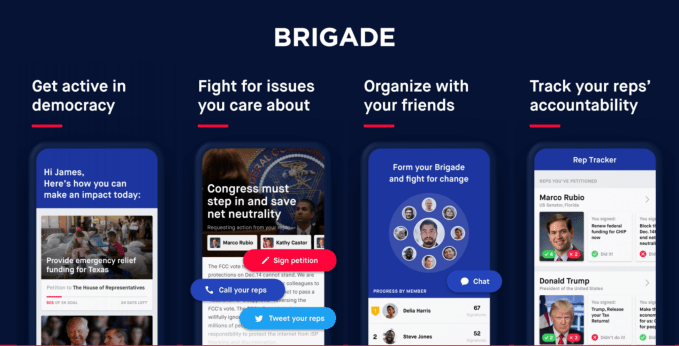
After Brigade launched as an app for debating positions on heated political issues but failed to gain traction, it pivoted into what Causes had tried to be — a place for showing support for social movements. More recently, it’s focused on a Rep Tracker for following the stances and votes of elected officials. Yet the 2016 campaign and 2018 midterms seem to fly over Brigade’s head. It never managed to become a hub of activism, significantly impact voter turnout, or really even be part of the conversation.

After several election cycles, I hear the Brigade team felt like there had to be better ways to influence democracy or at least create a sustainable business. One former employee quipped that Brigade could have made a greater impact by just funneling its funding into voter turnout billboards instead of expensive San Francisco office space and talent.

The company’s mission to spark civic engagement was inadvertently accomplished by Donald Trump’s election polarizing the country and making many on both sides suddenly get involved. It did succeed in predicting Trump’s victory, after its polls of users found many democrats planned to vote against their party. But while Facebook and Twitter weren’t necessarily the most organized or rational places for discourse, it started to seem unnecessary to try to build a new hub for it from scratch.

Brigade accepted that its best bet was to refocus on govtech infrastructure like its voter identification and elected official accountability tools, rather than a being a consumer destination. Its expensive, high-class engineering team was too big to fit into a potential political technology acquirer or partner. Many of those staffers had joined to build consumer-facing products, not govtech scaffolding.

Mahan, Brigade’s co-founder and CEO as well as the former Causes CEO, confirms the breakup and Pinterest deal, telling us “We ended up organizing the acqhire with Pinterest first because we wanted to make sure we took care of as many people on the team as possible. We were incredibly happy to find that through the process, 19 members of our engineering team earned offers and ended up going over to Pinterest. That’s about two-thirds of our engineering team. They were really excited about staying in consumer product and saw career opportunities at Pinterest.” A Pinterest spokesperson told us “We’re excited to welcome Brigade engineers to Pinterest, including former Brigade CTO John Thrall and VP of Engineering Trish Gray. As experts across areas like Growth and Product Engineering, they’ve spent years building products that inspire people to go out into the real world and take action.”

Brigade had interest from multiple potential acqhirers and allowed the engineering team’s leadership to decide to go with Pinterest. Several of Brigade’s engineers and its former VP of Engineering Trish Gray already list on LinkedIn that they’ve moved to Pinterest in the past few months. “We had a bunch of employees that took a risk on a very ambitious plan to improve our democracy and we didn’t want to leave them out to dry” Mahan stresses. “We spent more time and more money and more effort in taking care of employees over the last few months than most companies do and I think that’s a testament to Sean and his values.”

Mahan is currently in talks with several potential hosts for the next phase of Brigade, and hopes to have a transition plan in place in the next month. “We’ve in parallel been exploring where we take the technology and the user base next. We want to be sure that it lives on and can further the mission the we set out to achieve even if it doesn’t look like the way it does today.” Though the company’s output is tough to measure, Mahan tells me that “Brigade built a lot of foundational technology such as high quality voter matching algorithms and an entire model for districting people to their elected representatives. My hope for our legacy is that we were able to solve some of these problems that other people can build on.” Given Parker’s previous work with Marijuana legalization campaign Prop 64 in California and his new Opportunity Zones tax break effort, Brigade’s end won’t be Parker’s exit from politics.

Brigade’s breakup could still cast an ominous shadow over the govtech ecosystem, though. Alongside recent layoffs at grassroots campaign text message tool Hustle, it’s proven difficult for some startups in politics to become sustainable businesses. Exceptions like Palantir succeed by arming governments with data science that can be weaponized against citizens. Yet with the 2020 elections around the corner, fake news and election propaganda still a threat, and technology being applied for new nefarious political purposes, society could benefit from more tools built to amplify social justice and a fair democratic process.

Powered by WPeMatico

What to expect from Mobile World Congress 2019

I’ve said it before, and I’ll say it again: 2019 just might be the year that smartphones get fun again. After years of similar form factors and slight upgrades, the mobile industry’s back is against the wall.

For the first time ever, sales are down, owning to economic factors and slower upgrade cycles. Most people who want good phones have had access to them for a while, and smartphone makers are providing fewer compelling reasons to buy new ones.

With their backs against the wall, handset makers are getting creative. We’ve already seen some early fruits from companies late last year and last month at CES. But MWC is really going to be their time to shine. It’s a much larger mobile show, and all parties know that everyone’s bringing the big guns.

Here’s what we expect to see in Barcelona February 24-28.

Huawei: The company looks to have a lot on tap for the event — in part because the North America-based CES is kind of a non-starter. CEO Richard Yu has hinted at a foldable and a 5G handset — which could well be the same phone. More mainstream are the P30 and P30 Pro. The company’s done a good job keeping it under wraps, but rumors about three or four rear-lenses have made the rounds.

LG: As is its move, LG has already announced the G8 ThinQ. We know that the new flagship will feature a front-facing camera with Time of Flight sensor that brings potential tricks like face unlock, along with AR applications. The V50 is also reportedly on tap, potentially bringing 5G along for the ride.

Microsoft: A surprise addition to this year’s show, Microsoft’s already announced an event for February 24, where we expect the company will show off the HoloLens 2. The next-gen version of the headset will arrive as the rest of the hardware and software world is finally ready to embrace augmented reality in earnest.

Motorola: The recent launch of the G7 may have taken the wind out of MWC’s sails, but rumors of a foldable Razr reboot are making the rounds.

OnePlus: We know that a 5G handset and the OnePlus 7 are both in the pipeline — and, perhaps, one and the same? There’s also tell of a closed-door event at the show, but most aren’t expecting any big unveils from the company.

Samsung: Don’t expect a ton out of Samsung this year. The company (inconveniently) is holding its big event a mere days before. Expect the S10 and all its iterations to get a big unveil that week in San Francisco, along with a preview of the company’s upcoming foldable. That doesn’t leave a heck of a lot for MWC, but perhaps we’ll get a peek into the world of wearables or PCs.

Sony: While Xperia phones have long felt like a bit of a loss leader, the electronics giant has always made a big show of launching flagship devices. Those, in turn, have long been a launchpad for some exciting camera tricks. This year, the Xperia XZ4 appears to be on tap for the event. The handset looks to be an interesting one, with a reported 21:9 aspect ratio display and a beefy 4,400 mAh battery.

Powered by WPeMatico

Startup names may have passed peak weirdness

For years, decades even, startup names have been getting weirder. This isn’t a scientific verdict, but it is how things have seemed to someone who spends a lot of hours perusing this stuff.

Startups have had a long run of branding themselves with creative misspellings, animal names. human first names, made-up words, adverbs and other odd collections of letters. It’s gone on so long it now seems normal. Names like Google, Airbnb and Hulu, which sounded strange at first, are now part of our everyday vocabulary.

Over the past few quarters, however, a peculiar thing has been happening: Startup founders are choosing more conventional-sounding names.

“As we reach the edge of strangeness… they’re saying: ‘It’s too weird. I’m uncomfortable,’” said Athol Foden, president of Brighter Naming, a naming consultancy. While quirky startup monikers haven’t gone away, founders are increasingly comfortable with less-unusual-sounding choices.

Foden’s observations are reflected in our annual Crunchbase News survey of startup naming trends. We’re seeing a proliferation of startups choosing simple words that describe their businesses, including companies like Hitch, an app for long-distance car rides; Duffel, a trip-booking startup named after the popular travel bag; and Coder, a software development platform.

But fortunately for fans of offbeat names, the trend is only toward less weirdness, not no weirdness. Those who wish to patronage seed-stage startups can still buy tampons from Aunt Flow, get parenting tips from an app called Mush or get insurance from a startup called Marshmallow.

Below, we look in more detail at some of the more popular startup naming practices and how they are trending.

Creativv misPelling5

For a long time, it seemed like a vast number of startups selected names largely by disabling the spell checker.

Most desirable dictionary words were already in use as domains or too pricey to acquire. So founders took to dropping vowels, subbing a “y” for an “i” or adding an extra consonant to make it work. The strategy worked well for a lot of well-known companies, including Lyft, Tumblr, Digg, Flickr, Grindr and Scribd.

These days, creative misspellings are still pretty common among early-stage founders. Our name survey unearthed a big number (see partial list) that recently raised funding, including Houwser, an upstart real estate brokerage; Swytch, developer of a kit for converting bikes to e-bikes; and Wurk, a provider of human resources and compliance software for the cannabis industry.

However, creative misspellings are getting less popular, Foden said. Early-stage founders are turned off by the prospect of having to spell out their names to people unfamiliar with the brand (which for seed-stage companies includes pretty much everyone).

Puns

One of the more fun naming styles is the pun. In our perusal of companies that raised seed funding in the past year, we came across a number of startups employing some sort of play-on words.

We put together a list of seven of the punniest names here. In addition to Aunt Flow, the list includes WeeCare, a network of daycare providers, and Serial Box, a digital content producer. Crunchbase News also created its own fictional startup — drone chicken delivery startup Internet of Wings — in an explainer series on startup funding.

Perhaps some day business naming will harken back to the industrial age, when corporate titans had exceedingly boring and obvious names.

Real companies with pun names that have matured to exit were harder to pinpoint. A couple that have gone public are Groupon and MedMen, a cannabis company that went public in Canada and is valued around CA$2 billion.

For some reason, it appears pun names are more popular in the brick-and-mortar world than the tech startup sphere. Restaurants specializing in the Vietnamese noodle soup Pho have dozens of play-on-word names memorialized in lists like this. Ditto for pet stores.

Personally, I’d like to see more internet startups rolling out pun-based names. Foden would, too, and he has even volunteered one suggestion for someone who wants to start a business applying artificial intelligence to artificial insemination: Ai.ai.

Made-up words that sound real

There are more than 170,000 non-obsolete words in the English language, per the Oxford English Dictionary. Startups, however, are convinced we need more.

Hence, one of the more enduringly popular business-naming practices is to come up with something that sounds like an actual word, even if it isn’t.

We put together a list of examples of this naming style among recently seed-funded startups.

It includes Trustology, which is building a platform to safeguard crypto assets; Invocable, a developer of voice design tools for Alexa apps; and Locomation, which focuses on autonomous trucking technology.

Naming advisors like to see the made-up word name trend on the rise, Foden said, because it’s the kind of thing companies pay a consultant to figure out. Another advantage is it’s easier to top search results for a made-up word.

Normal-sounding names

Lastly, let’s look at those rebel startups choosing familiar dictionary words for their names.

We put together a list of some here. Besides the aforementioned Duffel, Hitch and Coder, there’s Decent, a healthcare startup; Chief, a women’s networking group; Journal, a note organizing tool; and many more.

Startups are less concerned than they used to be with snagging a dot-com domain that contains just their name. Commonly, they’ll add a prefix to their domain (joinchief.com, usejournal.com), choose an alternate domain (Hitch.net) or both.

Overall, Foden said, startups today are putting less emphasis on securing a dot-com suffix or an exact domain name match. Google parent Alphabet, in particular, made the alternate domain idea more palatable. It helped to see one of the world’s richest corporations forego Alphabet.com in favor of abc.xyz.

Where is it all going?

They say history repeats itself. If so, perhaps some day business naming will harken back to the industrial age, when corporate titans had exceedingly boring and obvious names like Standard Oil, U.S. Steel and General Electric.

For now, however, we live in era in which the most valuable companies have names like Google and Facebook. And to us, they sound perfectly normal.

Methodology: For the naming data set, we looked primarily at companies in English-speaking countries that raised seed funding after 2018. To broaden the potential list of names, we also included some companies funded in 2017. We also tried to limit the lists, where possible to companies founded in the past three years, although there were occasional exceptions.

Powered by WPeMatico

Startups Weekly: Spotify gets acquisitive and Instacart screws up

Did anyone else listen to season one of StartUp, Alex Blumberg’s OG Gimlet podcast? I did, and I felt like a proud mom this week reading stories of the major, first-of-its-kind Spotify acquisition of his podcast production company, Gimlet. Spotify also bought Anchor, a podcast monetization platform, signaling a new era for the podcasting industry.

On top of that, Himalaya, a free podcast app I’d never heard of until this week, raised a whopping $100 million in venture capital funding to “establish itself as a new force in the podcast distribution space,” per Variety.

The podcasting business definitely took center stage, but Lime and Bird made headlines, as usual, a new unicorn emerged in the mental health space and Instacart, it turns out, has been screwing its independent contractors.

As mentioned, Spotify, or shall we say Spodify, gobbled up Gimlet and Anchor. More on that here and a full analysis of the deal here. Key takeaway: it’s the dawn of podcasting; expect a whole lot more venture investment and M&A activity in the next few years.

This week’s biggest “yikes” moment was when reports emerged that Instacart was offsetting its wages with tips from customers. An independent contractor has filed a class-action lawsuit against the food delivery business, claiming it “intentionally and maliciously misappropriated gratuities in order to pay plaintiff’s wages even though Instacart maintained that 100 percent of customer tips went directly to shoppers.” TechCrunch’s Megan Rose Dickey has the full story here, as well as Instacart CEO’s apology here.

Slack confidentially filed to go public this week, its first public step toward either an IPO or a direct listing. If it chooses the latter, like Spotify did in 2018, it won’t issue any new shares. Instead, it will sell existing shares held by insiders, employees and investors, a move that will allow it to bypass a roadshow and some of Wall Street’s exorbitant IPO fees. Postmates confidentially filed, too. The 8-year-old company has tapped JPMorgan Chase and Bank of America to lead its upcoming float.

Reddit CEO Steve Huffman delivers remarks on “Redesigning Reddit” during the third day of Web Summit in Altice Arena on November 08, 2017 in Lisbon, Portugal. (Horacio Villalobos-Corbis/Contributor)

It was particularly tough to decide which deal was the most notable this week… But the winner is Reddit, the online platform for chit-chatting about niche topics — r/ProgMetal if you’re Crunchbase editor Alex Wilhelm . The company is raising up to $300 million at a $3 billion valuation, according to TechCrunch’s Josh Constine. Reddit has been around since 2005 and has raised a total of $250 million in equity funding. The forthcoming Series D round is said to be led by Chinese tech giant Tencent at a $2.7 billion pre-money valuation.

Runner up for deal of the week is Calm, the app that helps users reduce anxiety, sleep better and feel happier. The startup brought in an $88 million Series B at a $1 billion valuation. With 40 million downloads worldwide and more than one million paying subscribers, the company says it quadrupled revenue in 2018 from $20 million to $80 million and is now profitable — not a word you hear every day in Silicon Valley.

Here’s your weekly reminder to send me tips, suggestions and more to kate.clark@techcrunch.com or @KateClarkTweets

I listened to the Bird CEO’s chat with Upfront Ventures’ Mark Suster last week and wrote down some key takeaways, including the challenges of seasonality and safety in the scooter business. I also wrote about an investigation by Consumer Reports that found electric scooters to be the cause of more than 1,500 accidents in the U.S. I’m also required to mention that e-scooter unicorn Lime finally closed its highly anticipated round at a $2.4 billion valuation. The news came just a few days after the company beefed up its executive team with a CTO and CMO hire.

Databricks raises $250M at a $2.75B valuation for its analytics platform
Retail technology platform Relex raises $200M from TCV
Raisin raises $114M for its pan-European marketplace for savings and investment products
Self-driving truck startup Ike raises $52M
Signal Sciences secures $35M to protect web apps
Ritual raises $25M for its subscription-based women’s daily vitamin
Little Spoon gets $7M for its organic baby food delivery service
By Humankind picks up $4M to rid your morning routine of single-use plastic

We don’t spend a ton of time talking about the growing, venture-funded, tech-enabled logistics sector, but one startup in the space garnered significant attention this week. Turvo poached three key Uber Freight employees, including two of the unit’s co-founders. What’s that mean for Uber Freight? Well, probably not a ton… Based on my conversation with Turvo’s newest employees, Uber Freight is a rocket ship waiting to take off.

Who knew that investing in female-focused brands could turn a profit for investors? Just kidding, I knew that and this week I have even more proof! This is L., a direct-to-consumer, subscription-based retailer of pads, tampons and condoms made with organic materials sold to P&G for $100 million. The company, founded by Talia Frenkel, launched out of Y Combinator in August 2015. According to PitchBook, it was backed by Halogen Ventures, 500 Startups, Fusion Fund and a few others.

Speaking of ladies getting stuff done, Bessemer Venture Partners promoted Talia Goldberg to partner this week, making the 28-year-old one of the youngest investing partners at the Silicon Valley venture fund. Plus, Palo Alto’s Eclipse Ventures, hot off the heels of a $500 million fundraise, added two general partners: former Flex CEO Mike McNamara and former Global Foundries CEO Sanjay Jha.

If you enjoy this newsletter, be sure to check out TechCrunch’s venture-focused podcast, Equity. In this week’s episode, available here, Crunchbase editor-in-chief Alex Wilhelm and I chat about the expanding podcast industry, Reddit’s big round and scooter accidents.

Want more TechCrunch newsletters? Sign up here.

Powered by WPeMatico

Feel the beep: This album is played entirely on a PC motherboard speaker

If you’re craving a truly different sound with which to slay the crew this weekend, look no further than System Beeps, a new album by shiru8bit — though you may have to drag your old 486 out of storage to play it. Yes, this album runs in MS-DOS and its music is produced entirely through the PC speaker — you know, the one that can only beep.

Now, chiptunes aren’t anything new. But the more popular ones tend to imitate the sounds found in classic computers and consoles like the Amiga and SNES. It’s just limiting enough to make it fun, and of course many of us have a lot of nostalgia for the music from that period. (The Final Fantasy VI opening theme still gives me chills.)

But fewer among us look back fondly on the days before sample-based digital music, before even decent sound cards let games have meaningful polyphony and such. The days when the only thing your computer could do was beep, and when it did, you were scared.

Shiru, a programmer and musician who’s been doing “retro” sound since before it was retro, took it upon himself to make some music for this extremely limited audio platform. Originally he was just planning on making a couple of tunes for a game project, but in this interesting breakdown of how he made the music, he explains that it ended up ballooning as he got into the tech.

“A few songs became a few dozens, collection of random songs evolved into conceptualized album, plans has been changing, deadlines postponing. It ended up to be almost 1.5 years to finish the project,” he writes (I’ve left his English as I found it, because I like it).

Obviously the speaker can do more than just “beep,” though indeed it was originally meant as the most elementary auditory feedback for early PCs. In fact, the tiny loudspeaker is capable of a range of sounds and can be updated 120 times per second, but in true monophonic style can only produce a single tone at a time between 100 and 2,000 Hz, and that in a square wave.

Inspired by games of the era that employed a variety of tricks to create the illusion of multiple instruments and drums that in fact never actually overlap one another, he produced a whole album of tracks; I think “Pixel Rain” is my favorite, but “Head Step” is pretty dope too.

You can of course listen to it online or as MP3s or whatever, but the entire thing fits into a 42 kilobyte MS-DOS program you can download here. You’ll need an actual DOS machine or emulator to run it, naturally.

How was he able to do this with such limited tools? Again I direct you to his lengthy write-up, where he describes, for instance, how to create the impression of different kinds of drums when the hardware is incapable of the white noise usually used to create them (and if it could, it would be unable to layer it over a tone). It’s a fun read and the music is… well, it’s an acquired taste, but it’s original and weird. And it’s Friday.

Powered by WPeMatico

Facebook picks up retail computer vision outfit GrokStyle

If you’ve ever seen a lamp or chair that you liked and wished you could just take a picture and find it online, well, GrokStyle let you do that — and now the company has been snatched up by Facebook to augment its own growing computer vision department.

GrokStyle started as a paper — as AI companies often do these days — at 2015’s SIGGRAPH. A National Science Foundation grant got the ball rolling on the actual company, and in 2017 founders Kavita Bala and Sean Bell raised $2 million to grow it.

The basic idea is simple: matching a piece of furniture (or a light fixture, or any of a variety of product types) in an image to visually similar ones in stock at stores. Of course, sometimes the simplest ideas are the most difficult to execute. But Bala and Bell made it work, and it was impressive enough in action that Ikea on first sight demanded it be in the next release of its app. I saw it in action and it’s pretty impressive.

Facebook’s acquisition of the company (no terms disclosed) makes sense on a couple of fronts: First, the company is investing heavily in computer vision and AI, so GrokStyle and its founders are naturally potential targets. Second, Facebook is also trying to invest in its marketplace, and using the camera as an interface for it fits right into the company’s philosophy.

One can imagine how useful it would be to be able to pull up the Facebook camera app, point it at a lamp you like at a hotel and see who’s selling it or something like it on the site.

Facebook did not answer my questions regarding how GrokStyle’s tech and team would be used, but offered the following statement: “We are excited to welcome GrokStyle to Facebook. Their team and technology will contribute to our AI capabilities.” Well!

There’s an “exciting journey” message on GrokStyle’s webpage, so the old site and service is gone for good. But one assumes that it will reappear in some form in the future. I’ve asked the founders for comment and will update the post if I hear back.

Powered by WPeMatico

FDA chief summons Altria and JUUL to Washington to discuss teen vaping

The head of the U.S. Food and Drug Administration is calling Altria and Juul to meet in Washington to discuss their tie-up and how it impacts the companies’ plans to combat teen vaping. Earlier this year, Altria  href=”https://techcrunch.com/2018/12/20/juul-labs-gets-12-8-billion-investment-from-marlboro-maker-altria-group/”>invested $12.8 billion investment in Juul.

“After Altria’s acquisition of a 35 percent ownership interest in JUUL Labs, Inc., your newly announced plans with JUUL contradict the commitments you made to the FDA,” Commissioner Scott Gottlieb wrote in a strongly worded letter addressed to Altria chairman and chief executive, Howard A. Willard III.

“When we meet, Altria should be prepared to explain how this acquisition affects the full range of representations you made to the FDA and the public regarding your plans to stop marketing e-cigarettes and to address the crisis of youth use of e-cigarettes,” Gottlieb wrote.

The commissioner sent a similarly worded message to Juul’s chief executive, Kevin Burns.

As part of that deal, Juul is getting access to Altria’s retail shelf space; the company is sending out direct communications pitching Juul to adult smokers through cigarette pack inserts and mailings to the company’s database of customers; and the two will combine the power of their respective sales and distribution backend which reaches roughly 230,000 retailers across America.

The recent deal comes only months after Juul released its plan to combat teen vaping — something the FDA had required of the company.

In the commitments it made last year, the vape manufacturer and retailer said it would expand its secret shopper program to make sure underage buyers weren’t getting access to its products; pull its campaigns from social media; and limit sales of non-traditional cigarette flavors (menthol, mint, Virginia tobacco, and “classic” tobacco) to the company’s website — which requires age verification.

Gottlieb isn’t the only one who has a problem with Juul. We’ve written about how the company has lowered the barrier to entry for nicotine addiction.

For Gottlieb, the addition of Altria’s marketing firepower and network of 230,000 retail locations likely isn’t an indicator of a company that’s willing to winnow down access to its products.

“I am aware of deeply concerning data showing that youth use of JUUL represents a significant proportion of the overall use of e-cigarette products by children. I have no reason to believe these youth patterns of use are abating in the near term, and they certainly do not appear to be reversing,” Gottlieb wrote. “Manufacturers have an independent responsibility to take action to address the epidemic of youth use of their products. My office will contact you to arrange a meeting to discuss these issues. Pursuant to your request, we intend to schedule this as a joint meeting with both Altria and JUUL.”

Powered by WPeMatico

Athenascope nabs $2.5M seed led by First Round to bring gamers AI-edited highlight reels

As massive cross-platform gaming titles become even larger time-sucks for a lot of people, it’s probably worth reflecting on how to savor your in-game accomplishments.

Streaming of esports celebrities on sites like Twitch has taken off like no one imagined, but for the most part the toil-heavy editing process has left this attention largely focused on those with the ambitions of making gaming their full-time gig.

Athenascope is a small startup aiming to tap computer vision intelligence to record, review and recap what more novice gamers were able to pull off in their latest battle royale with a short, shareable highlight reel. The team is led by Chris Kirmse, who previously founded Xfire, a game messaging client that Viacom bought in 2006 for north of $100 million.

The company announced this week that they’ve closed a $2.5 million seed round led by First Round Capital to grow its tools and its team. They’re also rolling out their AI highlight reel tool for gamers. The tool is pretty customized for individual titles; they’re launching with support for Fortnite, Rocket League and PUBG, but Kirmse hopes to expand that list significantly in the future.

Josh Kopelman, a partner at First Round Capital who is joining Athenascope’s board, highlighted that a lot of existing tools for gaming entertainment are “really skewed towards the high-end.”

“They’re not democratized, they’re for professional gamers,” Kopelman told TechCrunch. “What I think Chris is trying to do with Athenascope is enable anyone to create these high-quality game highlights — what the pros have to do manually.”

The company is tackling a problem familiar to video-editing software companies: how to prevent footage from dying on the device. The answer here is the same as many others have posited, tapping computer vision deep learning to do the heavy lifting in determining which footage is interesting and worthy of a highlight reel. Athenascope has some key advantages over the companies like GoPro that are trying to do the same with real-world video, namely the games they support operate in fundamentally more predictable ways and 2D interface cues offer some pretty healthy indicators of when exciting stuff is going down.

The game isn’t a plug-in that needs pipeline access to your Fortnite account or anything, the product simply analyzes exactly what you’re seeing when you play. The startup is also working on cool tools that allow you to see multiple perspectives of individual moments in gameplay by essentially syncing footage from other people involved in a match that are also Athenascope’s service and giving a sort of multi-view replay.

The company has broader ambitions of how it can evolve these gaming insights with computer vision, including ways to help gamers learn about their strengths and weaknesses in a way that lets Athenascope serve as a sort of computer vision coach. For now though, the big focus is on getting gamers these entertaining snapshots of their gaming experiences in an intelligent way.

Powered by WPeMatico