1010Computers | Computer Repair & IT Support

Paris sues Airbnb for illegal listings and seeks $14.2 million

The City of Paris first warned Airbnb, and it is now taking action. The mayor of Paris, Anne Hidalgo, told the JDD that the city is suing the company for 1,010 illegal listings. The fine could be worth as much as $14.2 million (€12.625 million).

Based on current legislation, you can’t rent an apartment more than 120 days a year. If you want to rent an apartment on Airbnb in Paris, you first must register your apartment with the city. The city then gives you an ID number so they can track how many nights you’re listing your apartment on Airbnb.

And yet, many listings still don’t have that ID number. The mayor’s office flagged around 1,000 apartments back in December 2017 and said Airbnb was dragging its feet. The company had little incentive to comply, as hosts were responsible for their own listings.

Thanks to a new law, the responsibility is now shared between the hosts and the platform. The City of Paris can now fine Airbnb for all those illegal listings, up to €12,500 per listing.

According to Hidalgo, Airbnb has been putting too much pressure on the housing market. She thinks that 65,000 apartments are now reserved for Airbnb in Paris alone. In some areas, it has become quite hard to find an apartment because of that. Local shops also suffer because tourists have different needs. In addition to better monitoring, Hidalgo is also in favor of restricting listings to 30 nights per year.

Airbnb told the JDD that it has complied with regulations and informed all Airbnb hosts about the new rules. The company also says that regulation in Paris doesn’t comply with European regulation. It’s clear that this fight is not over.

Powered by WPeMatico

Taali takes its popped water lily snacks from Y Combinator to the world

Aditya and Aarti Kochhar Kaji didn’t set out to start the snack food business Taali Foods when they were studying for their business degrees at Harvard.

The couple both hail from Mumbai and met at the University of Pennsylvania . They were married before starting at Harvard’s Business School and initially were interested in other areas — Aarti was exploring a career in venture capital and Aditya was looking at the food and beverage industry broadly in his classes at Harvard.

Addicted to snack foods like chips and popcorn to fuel her Harvard study sessions, Aarti started making popped water lily seeds as a snack — a food both she and her husband had grown up eating in India, she said.

The seeds, which are high in anti-oxidants and low in fat, have been a staple of Ayurvedic medicine — thanks to their purported anti-inflammatory properties, and are a staple of Indian snacking traditions. Now, with American consumers on the hunt for healthier snacks, they’re becoming a big business in the U.S. as well.

Y Combinator is very on-trend, with its decision to invest and accelerate Taali as part of its most recent cohort of startups. But in this instance you may call the accelerator a fast follower rather than a progenitor of this trend.

No less auspicious a food tastemaker than Whole Foods named water lily seeds as one of the top 10 new food trends of 2019. With that attention, competitors to Taali abound.

Bohana and AshaPops are just two new snack food companies floating on the popped water lily seed movement. Bohana even managed to nab the attention of PepsiCo’s Nutrition Greenhouse competitive accelerator.

It’s no secret that technology investors are investing more heavily in consumer businesses — everything from snack foods to period products and baby formula — and startups need only point to the success of Amazon as the everything store to show that there’s always money to be made in the category.

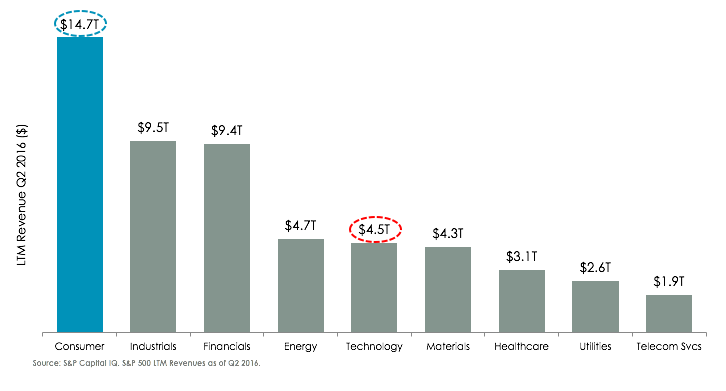
Indeed, at $1.47 trillion, the consumer packaged goods industry dwarfs technology as a share of the nation’s economy.

As Ryan Caldbeck, the head of the consumer-focused investment firm CircleUp noted last year:

The uptick in tech VC dollars going to the CPG market is partly because tech investing is brutally competitive and saturated, and largely because these VCs are awakening to the strong historical returns in CPG, especially with the trend leaning towards small brands stealing market share.

Consumer is a massive market – about 3x the size of tech, as seen below.

Despite the size of the market, the early-stage has historically been underserved by investors due to market inefficiencies like the geographic dispersion of brands and a lack of structured information sources (i.e. there is no Silicon Valley for consumer, and certainly no Crunchbase equivalents – yet).

Strong exits are already possible for consumer brands — and not necessarily from the big-ticket, headline grabbing acquisitions like Dollar Shave Club. Last week This is L. — the condom and period product retailer — sold for roughly $100 million after raising seed funding from investors, including 500 Startups and Y Combinator.

Taali was similarly bootstrapped before it was accepted into Y Combinator. The company is already selling its snacks through Amazon and in retail locations like Fairway in New York and Central Market in Texas. The founders expect to be in stores in California in the next few months.

Powered by WPeMatico

Marketing company Zeta Global hires Ben Hayes as its first chief privacy officer

Zeta Global, the well-funded marketing technology company founded by CEO David A. Steinberg and former Apple CEO John Sculley, has hired its first chief privacy officer — Ben Hayes, who was previously chief privacy officer at Nielsen.

Steinberg said the company already has a “global privacy team” and has been taking the issue “very seriously.” However, he said that by hiring Hayes, he’s hoping to make Zeta a “global thought leader.”

“We want to send a message to the world that the end users that hit our platform are important to us, your privacy is important to us,” he said. And he noted, “When we sit down with our customers — and these are very, very large customers — the first two things they always want to talk about are data security and data privacy.”

For his part, Hayes said Zeta is “poised to deliver a unique value to the marketplace and, in my estimation, disrupt multiple industries in so doing.” He also said he was impressed by Zeta’s approach to protecting user data, specifically the fact that “it’s not a data broker.” In other words, even though it helps marketers target customers based on user data, it’s not selling that data to others.

I wondered whether that distinction might get lost in the broader backlash against the way online companies vacuum up personal data, but Hayes said, “I believe that paranoia grows in the shadows and the privacy backlash is largely about people feeling a loss of control over their data.”

“Explaining the value proposition to users is crucially important,” he added. “People are rational. If they understand it to be a net benefit to themselves they will like that thing.”

Powered by WPeMatico

Reddit confirms $300M Series D led by China’s Tencent at $3B value

Last week TechCrunch reported that Reddit was raising $150 million from Chinese tech giant Tencent and up to $150 million more in a Series D that would value the company at $2.7 billion pre-money or $3 billion post-money. After no-commenting on our scoop, today Reddit confirmed it has raised $300 million at $3 billion post-money, with $150 million from Tencent.

The deal makes for an odd pairing between one of the architects of China’s Great Firewall of censorship and one of America’s most lawless free-speech forums. Some Redditors are already protesting the funding by trying to post content that would rile Chinese’s internet watchdogs, like imagery from Tiananmen Square and Winnie the Pooh memes mocking Chinese President Xi Jinping’s appearance.

The round brings the Conde Nast-majority owned Reddit to $550 million in total funding. Beyond Tencent, the rest of the round came from previous investors potentially including Andreessen Horowitz, Sequoia and Fidelity. Apparently frustrated that we had disrupted its PR plan, Reddit today handed confirmation of the round to CNBC, which re-reported our scoop without citation. While CNBC reported in June 2018 that Reddit would top $100 million in revenue, a reliable source tells us Reddit only brought in $85 million in 2018 revenue.

Reddit’s CEO Steve Huffman has had his own problems with attribution after the exec was caught editing users’ comments to mislead viewers into thinking they were insulting their Subreddit’s moderators. Huffman managed to get off with just an apology and vow not to do it again, though he seemed to laugh off and excuse the abuse of power by saying “I spent my formative years as a young troll on the Internet.”

Reddit will have to compete for ad dollars with the Google-Facebook duopoly despite having less information about its users, who are often anonymous. Reddit sees 330 million users per month across its Subreddit forums for discussing everything from news and entertainment to niche types of pornography, conspiracy theories and other highly brand-unsafe content. Meanwhile, users may be concerned that Reddit’s policy views could be tightened as it cosies up to Tencent.

Reddit has struggled with staff departures and user revolts over the years as it tries to balance freedom of expression with civility. The hope is the cash could help it pay for experienced leaders and more moderation staff to maintain that balance. But without proper oversight, the cash could simply scale up Reddit and its problems along with it.

Powered by WPeMatico

C2A raises $6.5M for its in-car cybersecurity platform

Cars are now essentially computers on wheels — and like every computer, they are susceptible to attacks. It’s no surprise then that there’s a growing number of startups that are working to protect a car’s internal systems from these hacks, especially given that the market for automotive cybersecurity could be worth mor $900 billion by 2026.

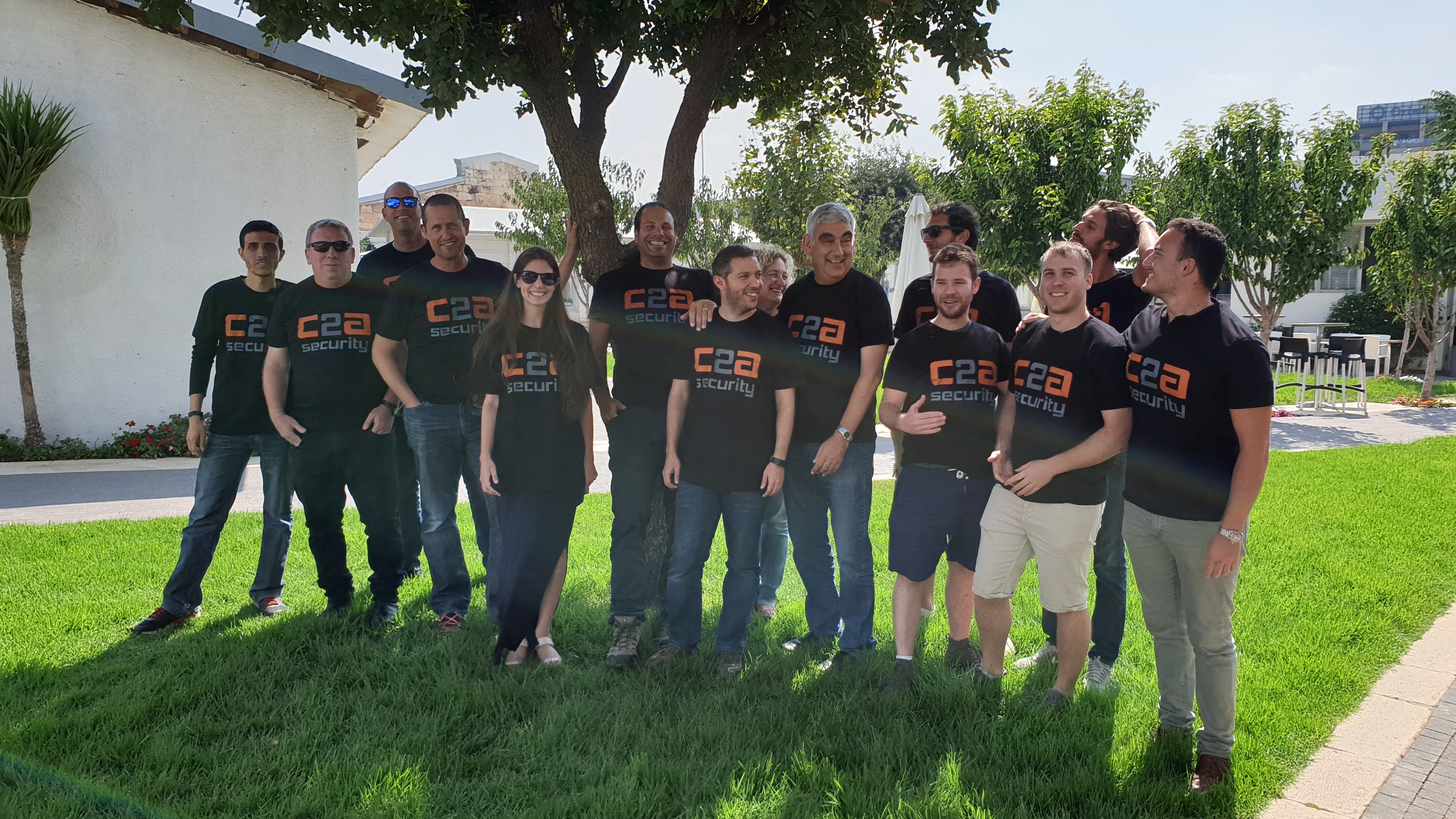
One of these companies is Israel’s C2A Security, which offers an end-to-end security platform for vehicles, which today announced that it has raised a $6.5 million Series A funding round.

The round was led by Maniv Mobility, which previously invested in companies like Hailo, drive.ai and Turo, and ICV, which has invested in companies like Freightos and Vayyar. OurCrowd’s Labs/02 also participated in this round.

Like most companies at the Series A stage, C2A plans to use the new funding to grow its team, especially on the R&D side, and help support its customer base. Sadly, C2A does not currently talk about who its customers are.

The promise of C2A is that it offers a full suite of solutions to detect and mitigate attacks. The team behind the company has an impressive security pedigree, with the company’s CMO Nat Meron being an alumn of Israel’s Unit 8200 intelligence unit, for example. C2A founder and CEO Michael Dick previously co-founded NDS, a content security solution, which Cisco acquired for around $5 billion in 2012 (and then recently sold on to Permira, also for $5 billion).

“We are extremely proud to receive the support of such outstanding investors, who will bring tremendous value to the company,” said Dick. “Maniv’s expertise in autotech and strong network across the industry coupled with ICV’s rich experience in cybersecurity brings the perfect combination of skills to the table.”

Powered by WPeMatico

New figures highlight the iPhone’s rough quarter in China

When Apple issued revised guidance for its quarterly earnings last month, the company singled out China as a primary driver for its disappointing result. Sure enough, iPhone revenue declined 15 percent year over year, and now IDC’s got some more insight into the role the Chinese market may have played in that decline.

New figures out this week show right around a 20 percent dip in shipments in China y-o-y for the quarter. That’s a pretty dramatic drop for a market that’s been a key factor in Apple’s growth plans, going forward. That marks a drop from 12.9 to 11.5 percent of the market. Last month, Tim Cook highlighted some of the reasons for the drop in the world’s largest smartphone market.

Among the reasons cited are international trade tensions and an overall slowing Chinese economy. Of course, Apple’s not alone in seeing a decline. Smartphone shipments are down almost across the board, owing to slower upgrade cycles. Most phones are already pretty good, so people are holding onto them for longer. It’s also worth noting that this year’s XS didn’t mark as dramatic an upgrade as its predecessor. 

Tellingly, however, a number of native smartphone makers are up in the country, including, notably, Huawei, which saw a 23.3 percent uptick for the quarter, suggesting that the ascendant company ate into Apple’s market share.

Powered by WPeMatico

Google Docs gets an API for task automation

Google today announced the general availability of a new API for Google Docs that will allow developers to automate many of the tasks that users typically do manually in the company’s online office suite. The API has been in developer preview since last April’s Google Cloud Next 2018 and is now available to all developers.

As Google notes, the REST API was designed to help developers build workflow automation services for their users, build content management services and create documents in bulk. Using the API, developers can also set up processes that manipulate documents after the fact to update them, and the API also features the ability to insert, delete, move, merge and format text, insert inline images and work with lists, among other things.

The canonical use case here is invoicing, where you need to regularly create similar documents with ever-changing order numbers and line items based on information from third-party systems (or maybe even just a Google Sheet). Google also notes that the API’s import/export abilities allow you to use Docs for internal content management systems.

Some of the companies that built solutions based on the new API during the preview period include Zapier, Netflix, Mailchimp and Final Draft. Zapier integrated the Docs API into its own workflow automation tool to help its users create offer letters based on a template, for example, while Netflix used it to build an internal tool that helps its engineers gather data and automate its documentation workflow.


Powered by WPeMatico

Samsung promises a better look at its folding phone next week

Samsung’s not telling us anything we don’t already know with its latest teaser. But before I hop on yet another flight to San Francisco, it’s good to know I’m getting a little more bang for my (well, Verizon’s) buck.

In addition to the Galaxy S10, Samsung will also be offering a much better glimpse of its long-promised foldable phone at its SF event on February 20. A new animated teaser promises that “The Future Unfolds” at the event that’s currently a little over a week away.

If you’ll recall, the company offered a very fleeting glimpse of the product at its developers conference, but the product was shrouded in mystery — not to mention pretty unwieldy prototype hardware.

The most likely scenario for next week’s event is a more detailed glimpse at the future product, including a name — and perhaps even something approaching a release date. Most likely, however, the company and event will be largely focused on the details around its next flagship.

Powered by WPeMatico

Bumble launches Spotlight, its own version of Tinder’s Boost

Bumble, currently Tinder’s biggest rival in the dating app market, today launched its own version of Tinder’s “Boost” feature. On Bumble, it’s being called “Spotlight,” and allows users to pay to bump their profile to the front of the queue in order to be seen by more people than they would otherwise.

Very much like Tinder Boost, the idea here is that getting to the front of the line will allow you to pick up matches more quickly, as you don’t have to wait until users swipe through other profiles before they see yours. Plus, depending on how far in the back of the line you are typically, Spotlight could help you be seen by those who would have never made it to your profile page at all.

Spotlight — or Boost, for that matter — isn’t something every dating app user needs.

Dating apps today organize their queues with profiles based on a number of factors — including things like profile popularity, whether you swipe right on everyone or are more selective, whether your photos are higher quality or blurry and many other signals. If you tend to get matches easily on the apps, you may not need Spotlight. But if you suspect your profile is farther down the line, or just want to make sure your profile is getting seen, the feature could help.

To use Spotlight, Bumble users must pay two Coins (bought through a separate in-app purchase). One coin is $0.99 in the U.S., or £1.99 in the U.K. Spotlight will then show your profile to more users for the next 30 minutes. Your profile is not flagged or labeled in any way, so no one knows you used Spotlight to be promoted. However, the user who purchased Spotlight will know it’s active as they’ll see stars appear across the top part of the Bumble app while it’s enabled.

Spotlight represents another way that Bumble continues to challenges Tinder head-on by rolling out similar features, after already co-opting the swipe-to-like and the super-like, for example.

The move also comes following another successful quarter by Match Group, led by the earnings from its flagship app, Tinder.

Combined with its other dating app properties, Match pulled in $457 million in revenue, up 21 percent year-over-year, and topping analyst estimates. Tinder reported its paying subscriber base grew to 4.3 million as of year-end, out of a total user base that tops 50 million. (The company doesn’t disclose the number of users it has.)

Bumble, meanwhile, today says it has now reached 50 million worldwide users, with 84,000 new users being added daily.

Spotlight is one of several in-app purchases offered by Bumble, alongside the recently launched option to access more profile filters, for example, as well as free features, like Snooze, which lets you take a digital detox from online dating.

Update, 2/11/19, 6 PM ET:

Shortly after Bumble announced the launch of its new feature, Hey Vina – an app for women who want to make friends – announced that Bumble had stolen the concept and name from them. Notably, Tinder has an investment in Vina.

“Vina launched the ‘Spotlight’ feature version of Tinder Boost a month ago,” wrote Hey Vina CEO Olivia June, in an email to TechCrunch. “I just wanted to point this out given that the feature is so similar to ours, that they named it the same as ours, and that Vina (being Tinder’s move in the friendship space) launched before Bumble BFF.”

Bumble and Tinder have been at odds for some time, following Match’s inability to acquire Bumble. The two are involved in lawsuits, and now regularly rip each other off.

Powered by WPeMatico

Nordic banking app Lunar Way raises €13M

Lunar Way, the Nordic banking app that’s riding new EU regulation to help inject more competition into the region, has raised €13 million in new funding. The round is led by SEED Capital, with participation from Greyhound Capital, Socii Capital and a number of individual investors from the financial services industry.

It also comes shortly after Lunar Way announced it had attained a PISP payments license, meaning that the fintech can offer a more comprehensive banking feature-set, including making payments out of third-party bank accounts on a user’s behalf.

This, says Lunar Way founder Ken Villum Klausen, also paves the way for the startup to crack open the “Nordic clearing system monopoly,” which has traditionally made it difficult for new banking entrants.

“The new payment license grants us the option to instruct underlying banks to do payments, pay bills or even pay in a retail environment from their accounts,” explains Klausen. “So when you sign up, you’re able to connect to an existing bank-account in the sign up flow. And after that control all your finances through our platform.”

In addition, Lunar Way has a PSD2 AISP license, so that it is regulated to “co-own the transaction data,” which Klausen says Lunar Way can use in the company’s PFM features and for new products.

“The [Lunar Way] product offers all the fundamentals from a banking app. You can pay bills, transfer money, set a budget, do saving-goals, manage your card etc. We also have a few subscription-based credit lines, where you pay a monthly fee [for credit],” he says.

In Denmark, Lunar Way also acts as a “NemKonto” — or national Danish account — a type of bank account that the Danish government stipulates by law that all citizens and businesses must have.

Adds Klausen: “It has taken a few years to build our app to suit the different demands of the Nordic countries, but now we are a serious competitor to traditional banks. Our aim is — and have always been — to fundamentally change the status quo of banking. We’re now welcoming more than 10,000 new users a month and counting, which is substantial considering the fact that the Nordics’ total addressable market is 27 million people.”

Meanwhile, Lunar Way says it will use the funding to help accelerate the banking app’s growth, in a bid to reach further scale across the Nordics. I also understand the fintech is already gearing up for a new funding round pegged for later this summer.

Powered by WPeMatico