1010Computers | Computer Repair & IT Support

Apple’s iOS update makes it easier to get to your subscriptions

Apple has made a small but important change to iOS that will allow users an easier way to manage their app subscriptions. In the latest release of the mobile operating system (iOS 12.1.4 and 12.2 beta), the company has relocated the “Manage Subscriptions” setting so it’s only one click away when you tap on your profile in the App Store, instead of being buried more deeply within the settings.

This may seem like a minor change, but it was a much-needed one.

As more mobile apps have adopted subscriptions as a means of generating revenue, it’s become critical to ensure consumers know how to turn off their subscriptions. And, based on a reading of many angry App Store app reviews, many people don’t know how to do this. Most assume they should reach out to the developer to have their subscription disabled — after all, it’s the developer who’s charging them.

It’s not really the customer’s fault for being unaware of how the process works, as Apple had made getting to the subscription management screen far more difficult than it should be.

In iOS Settings, for example, you would have to click iTunes & App Store –> Apple ID: –> View Apple ID –> then scroll all the way to the bottom of the screen to find the hidden setting.

In the iOS App Store app, it was a bit simpler.

You would first have to tap your profile icon on the top right of the Home page, then your Apple ID, then scroll down to the bottom of the page again.

By comparison, Google Play put subscriptions in its top-level navigation with no scrolling or extra clicks required.

With the iOS update, when you now tap your profile icon in the App Store, “Manage Subscriptions” is right there — and it’s accessible without scrolling. That’s a huge help in making this critical feature more accessible.

Unfortunately, Apple hasn’t made a similar change to simplify the path to subscription management in iOS’s main Settings.

The change was first spotted by MacStories Editor-in-Chief Federico Viticci, who shared a screenshot on Twitter.

Apple recently made a change (seems iOS 12.1.4 and 12.2 beta) to make it easier to manage subscriptions for iOS apps.

Now you just need to open the App Store, tap your profile, and choose ‘Manage Subscriptions’. pic.twitter.com/4PtxvAQjTm

— Federico Viticci (@viticci) February 13, 2019

Subscriptions are now one of the main driving forces behind the increase in consumer spending on iPhone.

A recent Sensor Tower report said that iPhone users in the U.S. on average spent $79 on apps in 2018, up 36 percent from last year. Much of that is due to mobile gaming, as always, but subscription-based apps are now playing a large role.

Unfortunately, not all developers have been playing by the rules. Many app makers were using misleading tactics to force users to subscribe — like hiding the true costs, using confusing buttons and user interfaces or suggesting they join a free trial that ends up only lasting three days.

Apple later updated its App Store guidelines to further spell out what is and is not allowed.

But making the rules and enforcing them are two different matters. In the meantime, being able to figure out which subscriptions you have and turning off those you don’t want needed to be simpler.

Also related to this is the fact that Apple is preparing to launch some new subscriptions of its own — presumably, its long-awaited streaming video service and perhaps the news subscription service as well — at a press event in March.

The update to subscriptions appears to be rolled out worldwide for those on the latest version of iOS.

Powered by WPeMatico

Elevate Security announces $8M Series A to alter employee security behavior

It’s well understood that many network breaches begin with phishing emails designed to trick users into giving hackers their credentials. They don’t even have to work to find a vulnerability, they can just waltz in the front door. Elevate Security, a San Francisco startup, wants to change that by helping employees understand phishing attacks better using behavioral techniques. Today, the company announced an $8 million Series A round to build on this idea.

The investment was led by Defy Partners. Existing investor Costanoa Ventures also participated. Today’s round brings the total raised to $10 million, according to the company.

What has the company created to warrant this investment? “We have a solution that motivates, measures and rewards employees to change their security habits, while at the same time giving security teams unprecedented visibility into the security habits and actions of their employees,” co-founder Masha Sedova told TechCrunch.

Specifically, the company has built a Security Behavior platform. “Our platform pulls in data sets that allow employees or security teams to see where the strengths and weaknesses of their organization lie, and then apply a suite of solutions that are rooted in behavioral science that helps them change behavior,” she explained.

Sedova and co-founder Robert Fly started working on this problem when both were part of the Salesforce security team. They began working with the idea of gamifying security to teach employees and customers how to be more security aware.

Elevate Security dashboard

When Fly’s team at Salesforce dug into the root of security problems, it found that it was often simply human error. He said it wasn’t malicious on the employee’s part, but they had jobs to do, and expected the security team to handle these issues. He realized that shifting employees to become more security aware was as much a behavioral psychology problem as a technology one and the roots of Elevate began to take shape.

The first product they built on top of the platform is called Hacker’s Mind, a tool designed to help employees understand how hackers think and operate.

The company launched in 2017 and currently has 15 employees, half of which are women. It also boasts an entirely female board of directors, and the startup plans to continue this trend as it staffs up with the new funding. Its headquarters are in San Francisco, but it just opened an engineering office in Montreal. Current customers include AutoDesk, Exxon and Illumio.

Powered by WPeMatico

Fiverr acquires ClearVoice to double down on content marketing

Fiverr is acquiring ClearVoice, a company that helps customers like Intuit and Carfax find professionals to write promotional content.

The two companies seem like a natural fit, as they both operate marketplaces for freelancers. Fiverr covers a much broader swath of freelance work, but CEO Micha Kaufman (pictured above) said the marketplace’s professional writing category grew 220 percent between the fourth quarters of 2017 and 2018, and he predicted that the need for content marketing will only increase.

“The types of channels that brands and companies need to be involved in and engaging in conversation with their audience are just growing,” Kaufman said. “I think any brand today that wants to be relevant needs to create a lot of engaging, interesting, creative content in their space, and I think that that creates a high demand for good content writers.”

Kaufman also noted that this is Fiverr’s third acquisition in two years, and he said he’s a “big believer … in the consolidation of vertical businesses into horizontal businesses such as ours — the fact that we cover over 200 categories gives us a tremendous amount of power to serve customers across many different types of needs.”

So what does the acquisition bring to the table that Fiverr wasn’t offering already? Kaufman said the ClearVoice team has “a lot of know how, both in technology side and the actual content side,” which will allow Fiverr to “cater to customers of all sizes and all needs.”

ClearVoice editorial calendar

ClearVoice editorial calendar

More specifically, he said most of Fiverr’s content marketing customers are small businesses, while ClearVoice is able to work with large enterprises, especially with its collaboration and workflow tools that allow those enterprises to create content at “high velocity.”

Founded in 2014 by Jay Swansson and Joe Griffin (who still serve as co-CEOs), ClearVoice has raised a total of $3.1 million in funding from investors, including PC Ventures, Desert Angels, Peak Ventures and Service Provider Capital, according to Crunchbase.

Fiverr is not disclosing the financial terms of the acquisition. The company says ClearVoice will continue to operate as an independent subsidiary.

“We are thrilled to be joining a company that is changing how people and companies work together in the modern era,” Swansson said in a statement. “This new chapter is a chance for us to use Fiverr’s depth and knowledge to globally scale our business and advance our mission of creating a platform that allows for worldwide creative collaboration.”

Powered by WPeMatico

DoorDash subsidizes driver wages with tips

It’s true that DoorDash offsets the amount it pays its drivers with customer tip, according to an FAQ page on its own site.

“For each delivery, you will always receive at least $1 from DoorDash plus 100% of the customer tip,” DoorDash states on a Dasher FAQ page. “Where that sum is less than the guaranteed amount, DoorDash will provide a pay boost to make sure you receive the guaranteed amount. Where that sum is more than the guaranteed amount, you pocket the extra amount.”

To be clear, drivers see the guaranteed amount in the app before deciding to accept or reject the order. That amount is based on the size of the order, whether or not you have to place the order in person, distance away, traffic and other factors.

On another page, DoorDash describes its payment structure as follows: $1 plus customer tip plus pay boost, which varies based on the complexity of order, distance to restaurants and other factors. It’s only when a customer doesn’t tip at all, which DoorDash told Fast Company happens about 15 percent of the time, that DoorDash is on the hook to pay the entire guaranteed amount.

But just because DoorDash is upfront about it, it doesn’t mean drivers are happy about it. There’s a webpage, Reddit and Subreddits that all describe DoorDash’s practices.

On the website, No Tip Doordash, it states:

While the tip may technically be going to the driver, it is only replacing the normal delivery pay. Your tip saves doordash money, and it is not increasing the drivers pay. Please tip in cash, if available.

In a statement to Bloomberg, DoorDash said it implemented this policy to “ensure that Dashers are more fairly compensated for every delivery.”

This comes shortly after Instacart apologized and announced it would stop engaging in that practice. In a blog post last week, Instacart CEO Apoorva Mehta said all shoppers will now have a guaranteed higher base compensation, paid by Instacart . Depending on the region, Instacart says it will pay shoppers between $7 to $10 at a minimum for full-service orders (shopping, picking and delivering) and $5 at a minimum for delivery-only tasks. The company will also stop including tips in its base pay for shoppers.

Amazon also reportedly engages in this practice, according to The Los Angeles Times.

I’ve reached out to DoorDash and will update this story if I hear back.

Powered by WPeMatico

Tim Cook-backed shower startup Nebia shows off a warmer, water-saving shower head

I’m not in the habit of getting naked during meetings at startup offices, but this time it felt appropriate.

Nebia, a shower startup that has attracted investments from the likes of Apple CEO Tim Cook and former Google chairman Eric Schmidt’s foundation is back with some new cash (though it won’t divulge how much) and a new generation of its thoughtfully designed shower heads that aim to dramatically reduce the amount of water people use while cleaning up.

After a lengthy chat with Nebia CEO Philip Winter, who discussed all of the nuances of the Nebia’s second-gen “Spa Shower” for which they just launched a crowdfunding campaign today, he asked whether I’d like to try it out. With a couple hours of empty space in my calendar, I said “Why not?” and wandered over to the startup office’s shower showroom.

Shower thoughts

This was probably the most analytical thinking I’ve done in the shower about the process of showering itself.

The shower head in my bathroom at home is pretty standard and basically concentrates the water into a couple dozen streams organized in a circle that are firing at an even pace. It’s nothing fancy, and I couldn’t tell you the brand, but I can say that I spend at least 20-30 minutes in there everyday without exception.

Nebia’s shower is wildly more complicated — as a $499 shower should be — but it’s the combination of different techniques that leads to a shower that feels full and refreshing but is using significantly less water than you’re used to. The customer for this is probably placing a healthier premium on the fact that it’s great for the environment rather than that it’s a spa-type experience; the shower head uses 65 percent less water than your average shower head, the company says.

The Nebia shower is all a very strange feat of engineering and involves the water being “atomized” as they called it, with water droplets being significantly smaller when it exits some nozzles, leading to an enveloping mist, and larger and warmer jets being shot out of the shower head’s center. The big improvement in this generation is that the water is about 29 percent warmer.

How does the shower head even control warmth? Isn’t all the water coming from the same heater? As Winter explained to me, things are a lot more complicated when it comes to how Nebia handles thermodynamics. Smaller water droplets means increased surface area exposed to the room temperature, which means greatly sped up heat dissipation. In practice, this means that the distance the water can travel from the shower head before getting chilly is a much shorter journey than your current shower. To adjust that, Nebia fires the water droplets three times quicker and maintains some larger droplet streams to maintain the heat for longer.

Nebia does a bit of cheating by also having a second shower head firing from the hip. The wand adds to the water being used but still keeps the system using about half of the amount of water that the average shower head uses.

Thankfully, there was also room for a side-by-side comparison as I was able to try out both the gen-1 and gen-2 Spa Shower in the same bathroom. The shower experience didn’t feel wildly distinct, but the difference in water heat when cranked to full blast was notable; my own temperature sensing isn’t quite finely tuned enough to confirm the 29 percent figure, but that doesn’t seem off.

Ultimately, it was the best shower I’ve had in a startup’s office to date, but it was also a shower that didn’t feel as though I was resting my head under a light trickle of cold water like other low-flow showers. It’s a real product, though at this point it’s also a decidedly premium product, even with the $100 crowdfunding discount of the $499 retail price. Beyond the warmer water, the new shower’s easy-install system is now compatible with about 95 percent of American homes, the company says. There’s also a new matte black color option and a little matching shower shelf you can add to keep that high-design look.

The company, which launched out of Y Combinator, has attracted some top investors who seem to be intrigued by the water-saving impact. The company says they’ve already shipped more than 16,000 shower heads and that more than 100 million gallons of water have been saved.

This Series A investment was led by Moen, the faucet and shower head maker that also announced a partnership with the startup. The latest round also boasts follow-on investment from Tim Cook and The Schmidt Family Foundation, as well as some new investors like Airbnb co-founder Joe Gebbia, Starwood Hotels co-founder Barry Sternlicht, Fitbit co-founder James Park and Stanford StartX.

The crowdfunding campaign kicked off today and has already blown past $300,000 in pre-orders (they’ve already sold most of the $349 early-bird deals); the company hopes to ship the first 2.0 shower heads in June.

Powered by WPeMatico

Google expands partnership with Founder Gym to support underrepresented founders

Google for Startups has expanded a partnership with startup training program Founder Gym to better serve underrepresented founders through a new scholarship program.

The program typically charges $396 to participate, but thanks to this partnership with Google for Startups, Google will cover the costs for select scholarship recipients to participate in the six-week program. This partnership is an extension of a pilot program that started last March.

“Google for Startups took an early bet on Founder Gym when we were less than six months old, and as any founder knows, you never forget the first people to say ‘yes’ to your dream,” Mandela Schumacher-Hodge Dixon said in a statement.

“Our team at Founder Gym has used that early vote of confidence to help fuel our efforts to train a groundbreaking number of founders around the world in our inaugural year.”

Founder Gym, co-founded by Mandela Schumacher-Hodge Dixon and Gabriela Zamudio,* unveiled its online platform in November 2017 to support and train underrepresented founders building tech startups.

“We are deeply committed to supporting the growth and success of underrepresented founders,” Google for Startups VP Lisa Gevelber said in a statement. “At Google we know that innovation can come from anywhere, but the resources needed to succeed are not evenly distributed. Founder Gym is truly moving the needle in this space – their unique program delivers the tangible resources necessary to level the playing field for founders and help them grow their businesses.”

Instead of describing it as a school, bootcamp or incubator, Founder Gym describes itself as a topical, six-week training program that covers topics like fundraising, pitching, user growth and problem validation. In Founder Gym’s first 12 months of operation, its cohort has collectively raised $35 million in funding.

“As we enter year two of this journey, we couldn’t be more excited to expand our partnership with Google for Startups, an organization that has a long history of supporting the entrepreneur’s journey,” Schumacher-Hodge Dixon said. “There is no doubt in my mind, this partnership will help us achieve our mission of developing the next generation of great innovators and leaders.”

Update 3:14 pm: This story has been edited to reflect the fact that Zamudio is no longer at Founder Gym. 

Powered by WPeMatico

Google and IBM still trying desperately to move cloud market share needle

When it comes to the cloud market, there are few known knowns. For instance, we know that AWS is the market leader with around 32 percent of market share. We know Microsoft is far back in second place with around 14 percent, the only other company in double digits. We also know that IBM and Google are wallowing in third or fourth place, depending on whose numbers you look at, stuck in single digits. The market keeps expanding, but these two major companies never seem to get a much bigger piece of the pie.

Neither company is satisfied with that, of course. Google so much so that it moved on from Diane Greene at the end of last year, bringing in Oracle veteran Thomas Kurian to lead the division out of the doldrums. Meanwhile, IBM made an even bigger splash, plucking Red Hat from the market for $34 billion in October.

This week, the two companies made some more noise, letting the cloud market know that they are not ceding the market to anyone. For IBM, which is holding its big IBM Think conference this week in San Francisco, it involved opening up Watson to competitor clouds. For a company like IBM, this was a huge move, akin to when Microsoft started building apps for iOS. It was an acknowledgement that working across platforms matters, and that if you want to gain market share, you had better start thinking outside the box.

While becoming cross-platform compatible isn’t exactly a radical notion in general, it most certainly is for a company like IBM, which if it had its druthers and a bit more market share, would probably have been content to maintain the status quo. But if the majority of your customers are pursuing a multi-cloud strategy, it might be a good idea for you to jump on the bandwagon — and that’s precisely what IBM has done by opening up access to Watson across clouds in this fashion.

Clearly buying Red Hat was about a hybrid cloud play, and if IBM is serious about that approach, and for $34 billion, it had better be — it would have to walk the walk, not just talk the talk. As IBM Watson CTO and chief architect Ruchir Puri told my colleague Frederic Lardinois about the move, “It’s in these hybrid environments, they’ve got multiple cloud implementations, they have data in their private cloud as well. They have been struggling because the providers of AI have been trying to lock them into a particular implementation that is not suitable to this hybrid cloud environment.” This plays right into the Red Hat strategy, and I’m betting you’ll see more of this approach in other parts of the product line from IBM this year. (Google also acknowledged this when it announced a hybrid strategy of its own last year.)

Meanwhile, Thomas Kurian had his coming-out party at the Goldman Sachs Technology and Internet Conference in San Francisco earlier today. Bloomberg reports that he announced a plan to increase the number of salespeople and train them to understand specific verticals, ripping a page straight from the playbook of his former employer, Oracle.

He suggested that his company would be more aggressive in pursuing traditional enterprise customers, although I’m sure his predecessor, Diane Greene, wasn’t exactly sitting around counting on inbound marketing interest to grow sales. In fact, rumor had it that she wanted to pursue government contracts much more aggressively than the company was willing to do. Now it’s up to Kurian to grow sales. Of course, given that Google doesn’t report cloud revenue it’s hard to know what growth would look like, but perhaps if it has more success it will be more forthcoming.

As Bloomberg’s Shira Ovide tweeted today, it’s one thing to turn to the tried and true enterprise playbook, but that doesn’t mean that executing on that approach is going to be simple, or that Google will be successful in the end.

To be honest, all of these suggestions for broadening Google Cloud are from the obvious enterprise sales playbook, but it doesn’t mean they are easy.

— Shira Ovide (@ShiraOvide) February 12, 2019

These two companies obviously desperately want to alter their cloud fortunes, which have been fairly dismal to this point. The moves announced today are clearly part of a broader strategy to move the market share needle, but whether they can or the market positions have long ago hardened remains to be seen.

Powered by WPeMatico

Donde Search picks up $6 million to help fashion retailers with visual search

Donde Search has just closed a $6 million Series A investment led by Matrix Partners, with participation from previous investors such as senior leaders from AliExpress, Google and Waze.

Donde first launched in 2014 as a consumer-facing app that helped users search and discover apparel items based on visual characteristics rather than text-based searches. In early 2018, the company pivoted to the enterprise space, helping retailers power suggestions and related items on their websites.

Here’s how it works:

Retailers partnered with Donde hand over their product catalog and run it through the Donde algorithm, which identifies all the visual features associated with each product. Retailers can then add a widget to their site to let users search based on those features (like sleeve length or type, color or material).

As users interact with the products, the website adapts to that behavior to offer personalized product recommendations and related items.

Moreover, Donde offers an analytics dashboard that not only provides insights on the customer’s own website, but a look into trends being featured on competing e-commerce websites to understand the industry in general.

Donde was founded by Liat Zakay, who previously served as a software engineer and R&D team manager in the Israeli intelligence unit 8200. Using her technical expertise, she built Donde to solve her own problem of not having the time or energy to go through the tedious process of online shopping.

Zakay told TechCrunch that Donde is focused on apparel for now, but that the technology can be applied to almost any vertical.

“One of the interesting pieces about Donde is that it’s language agnostic,” said Zakay. “You don’t need to know what it’s called and it doesn’t matter what language you speak, you can still find what you want based on visual features. Which makes us extremely relevant to global retailers.”

The new funding, which will be used to expand the product and the team, came shortly after the announcement of Donde’s partnership with Forever 21. The fast-fashion retailer tested out the Donde platform on its mobile app and, after a month, saw a 20 percent increase in average purchase value and higher conversions. Forever 21 has now expanded the program, putting Donde on the web, as well.

Donde said it is working on pilot programs with several other retailers across the U.S. and Europe.

Fast fashion, in particular, represents a big opportunity for Donde. Because product turnover is so fast, retailers rarely have reliable data around a certain SKU, with the website being run on outdated data from last “season.”

This latest round brings Donde’s total funding to $9.5 million, with backing from UpWest, Afterdox and Golden Seeds.

Powered by WPeMatico

Instagram is now testing a web version of Direct messages

Insta-chat addicts, rejoice. You could soon be trading memes and emojis from your computer. Instagram is internally testing a web version of Instagram Direct messaging that lets people chat without the app. If, or more likely, when this rolls out publicly, users on a desktop or laptop PC or Mac, a non-Android or iPhone or that access Instagram via a mobile web browser will be able to privately message other Instagrammers.

Instagram web DMs was one of the features I called for in a product wish list I published in December alongside a See More Like This button for the feed and an upload quality indicator so your Stories don’t look crappy if you’re on a slow connection.

A web version could make Instagram Direct a more full-fledged SMS alternative rather than just a tacked-on feature for discussing the photo and video app’s content. Messages are a massive driver of engagement that frequently draws people back to an app, and knowing friends can receive them anywhere could get users sending more. While Facebook doesn’t monetize Instagram Direct itself, it could get users browsing through more ads while they wait for replies.

Given Facebook’s own chat feature started on the web before going mobile and getting its own Messenger app, and WhatsApp launched a web portal in 2015 followed by desktop clients in 2016, it’s sensible for Instagram Direct to embrace the web too. It could also pave the way for Facebook’s upcoming unification of the backend infrastructure for Messenger, WhatsApp and Instagram Direct that should expand encryption and allow cross-app chat, as reported by The New York Times’ Mike Isaac.

Mobile reverse-engineering specialist and frequent TechCrunch tipster Jane Manchun Wong alerted us to Instagram’s test. It’s not available to users yet, as it’s still being internally “dogfooded” — used heavily by employees to identify bugs or necessary product changes. But she was able to dig past security and access the feature from both a desktop computer and mobile web browser.

In the current design, Direct on the web is available from a Direct arrow icon in the top right of the screen. The feature looks like it will use an Instagram.com/direct/…. URL structure. If the feature becomes popular, perhaps Facebook will break it out with its own Direct destination website similar to https://www.messenger.com, which launched in 2015. Instagram began testing a standalone Direct app last year, but it’s yet to be officially launched and doesn’t seem exceedingly popular.
Instagram’s web experience has long lagged behind its native apps. You still can’t post Stories from the desktop like you can with Facebook Stories. It only added notifications on the web in 2016 and Explore, plus some other features, in 2017.

Instagram did not respond to requests for comment before press time. The company rarely provides a statement on internal features in development until they’re being externally tested on the public, at which point it typically tells us “We’re always testing ways to improve the Instagram experience.” [Update: Instagram confirms to TechCrunch it’s not publicly testing this, which is its go-to line when a product surfaces that’s still in internal development. Meanwhile, Wong notes that Instagram has now cut off her access to the web Direct feature.]

After cloning Snapchat Stories to create Instagram Stories, the Facebook-owned app decimated Snap’s growth rate. That left Snapchat to focus on premium video and messaging. Last year Instagram built IGTV to compete with Snapchat Discover. And now with it testing a web version of Direct, it seems poised to challenge Snap for chat too.

Powered by WPeMatico

Facebook and Google still offer the best value for mobile advertisers (Singular report)

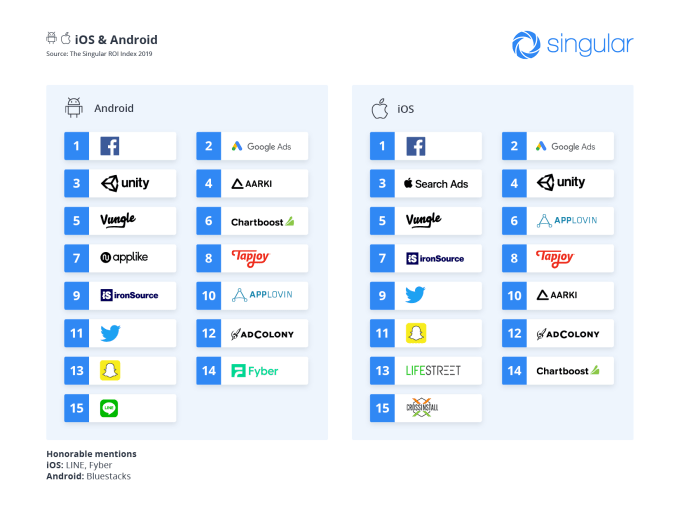
Among mobile ad networks, Facebook and Google remain the best bet for advertisers, according to the latest ROI Index from marketing startup Singular.

To pull together this year’s index, Singular says it sampled $1.5 billion in ad spending (from the $10 billion in spending that the company optimizes annually) and measured which networks are delivering the best return on investment. It also kept an eye out for ad fraud, apparently deleting a record 15 companies from the rankings because of “excessive” fraud.

So yes, Facebook followed by Google topped the list. As the report puts it, “Savvy marketers know they need more than just two media partners, but Google and Facebook are in virtually every mobile marketer’s game plan for good reason: they deliver.”

Singular ROI Index 2019 — iOS-AndroidAt the same time, Singular noted that Snap improved its rankings on virtually all the lists, and is now the No. 3 network for non-gaming ads on both iOS and Android. And Twitter did respectably as well, ranking second on iOS for retention.

Comparing the two big mobile platforms, it seems that Android is more volatile — one-third of the networks on the Android ROI list are appearing for the first time, and 80 percent of the remaining 10 networks changed position on the list. On iOS, on the other hand, 73 percent of the networks changed positions, but there were only two new ones on the list.

You can download the full index here.

Powered by WPeMatico