1010Computers | Computer Repair & IT Support

Qloo acquires cultural recommendation service TasteDive

Qloo announced this morning that it has acquired TasteDive.

The two companies sound pretty similar — according to the announcement, Qloo is “the leading artificial intelligence platform for culture and taste,” while TasteDive is “a cultural recommendation engine and social community.”

What’s the difference? Well TasteDive is a website where you can create a profile, connect with other users and, as you like and dislike things, it will recommend music, movies, TV shows, books and more. Qloo, meanwhile, is trying to understand patterns in consumer taste and then sell that data to marketers.

Or, as Qloo CEO Alex Elias (pictured above) put it in a statement, “TasteDive does for millions of individuals what Qloo has been doing for brands for years – using AI to make better decisions about culture and taste.”

Apparently TasteDive has 4.5 million active users, and it will continue to operate as a separate team and product, with founder Andrei Oghina remaining on-board as CEO. (Elias will become chairman.)

At the same time, the companies say the addition of Qloo technology will allow TasteDive to get smarter and to expand into different categories, while Qloo benefits from TasteDive’s global customer base and its API ecosystem.

The financial terms of the acquisition were not disclosed.

Powered by WPeMatico

Nintendo announces Super Mario Maker 2 for Switch, so goodbye forever

Nintendo has ruined my life, and all our lives, by announcing Super Mario Maker 2, the sequel to the level-constructing game on Wii U that produced thousands of devious levels for those who think the “real” games aren’t hard enough. Gamers have been asking for this basically since the Switch was first rumored.

Mario Maker 2 looks like it’s been updated in a number of helpful ways apart from being on a console that will actually be supported long-term. The interface needed some sprucing up for the lower precision players, who will have to use their fingers instead of a stylus on the touchscreen.

No doubt this will be a huge draw for Nintendo’s Switch Online service, which will likely not only allow you to share your levels and try those of others, but — if Nintendo listened to its player base — compete with ghosts and other multiplayer features. Here’s hoping we can build whole worlds, but let’s not get greedy. But we definitely have slopes now!

Honestly, I could play NES and SNES-era Mario games forever on repeat, and the re-releases of other Marios on Switch has made the newer ones even more accessible. Probably between those and Mario Maker I’ll never leave the house again.

Details are truly scant for now except that the game will come out in June of this year, just in time for summer to arrive — and be shut out with blackout curtains so glare doesn’t get on my greasy Switch. I’ll update this post if any new information becomes available.

Powered by WPeMatico

Medivis has launched its augmented reality platform for surgical planning

After two years of development, Medivis, a New York-based company developing augmented reality data integration and visualization tools for surgeons, is bringing its first product to market.

The company was founded by Osamah Choudhry and Christopher Morley who met as senior residents at NYU Medical Center.

Initially a side-project, the two residents roped in some engineers to help develop their first prototypes and after a stint in NYU’s Summer Launchpad program the two decided to launch the company.

Now, with $2.3 million in financing led by Initialized Capital and partnerships with Dell and Microsoft to supply hardware, the company is launching its first product, called SurgicalAR.

In fact, it was the launch of the HoloLens that really gave Medivis its boost, according to Morley. That technology pointed a way toward what Morley said was one of the dreams for technology in the medical industry.

“The Holy Grail is to be able to holographically render a patient,” he said.

For now, Medivis is able to access patient data and represent it visually in a three-dimensional model for doctors to refer to as they plan surgeries. That model is mapped back to the patient to give surgeons a plan for how best to approach an operation.

“The interface between medical imaging and surgical utility from it is really where we see a lot of innovation being possible,” says Morley.

So far, Medivis has worked with the University of Pennsylvania and New York University to bring their prototypes into a surgical setting.

The company is integrating some machine learning capabilities to be able to identify the most relevant information from patients’ medical records and diagnostics as they begin to plan the surgical process.

“What we’ve been working on over this time is developing this really disruptive 3D pipeline,” says Morley. “What we have seen is that there is a distinct lack of 3D pipelines to allow people to directly interface… very quickly try to automate the entire rendering process.”

For now, Medivis is selling a touchscreen monitor, display and a headset. The device plugs into a hospital network and extracts medical imaging to display from their servers in about 30 seconds, according to Choudhry.

“That’s where we see this immediately being useful in that pre-surgical planning stage,” Choudhry says. “The use in surgical planning and being able to extend this through surgical navigation… Streamline the process that requires a large amount of pieces and components and setups so you only need an AR headset to localize pathology and make decisions off of that.”

Already the company has performed 15 surgeries in consultation with the company’s technology.

“When we first met Osamah and Chris, we immediately understood the magnitude of the problem they were out to solve. Medical imaging as it relates to surgical procedures has largely been neglected, leaving patients open to all sorts of complications and general safety issues,” said Eric Woersching, general partner, Initialized Capital, in a statement. “We took one look at the Medivis platform and knew they were poised to transform the operating room. Not only was their hands-free approach to visualization meeting a real need for greater surgical accuracy, but the team has the passion and expertise in the medical field to bring it all to fruition. We couldn’t be more thrilled to welcome Medivis to the Initialized family.”

Powered by WPeMatico

Lime loses appeal to operate electric scooters in SF

Lime, similar to its competitors Spin and JUMP, just got word that while its appeal to operate electric scooters in phase one of San Francisco’s pilot program was denied, it may be able to deploy scooters during phase two. This comes following San Francisco Municipal Transportation Agency Neutral Hearing Officer James Doyle’s decision regarding Ford’s Spin, Uber’s JUMP and now Lime’s appeals of the permitting process.

Currently, Skip and Scoot are the only two companies permitted to operate shared electric scooter services in the city. After the first six months of the program, in April, the SFMTA can potentially increase the number of scooters from the current max of 625 to 2,500. This juncture, Doyle said, should be able to accommodate the addition of other operators.

“As a well-experienced and well-qualified vendor, I would expect that Lime’s entry into the city’s Pilot Program should result not only in increased services on our streets, but allowing additional capable operators in the Pilot Program can only enhance the probability of an eventual success of the powered scooter share program in San Francisco,” Doyle wrote in his decision.

Moving forward, it’s unclear if the SFMTA will take the recommendation, but SFMTA Communications Manager Ben Jose previously told TechCrunch, “The SFMTA will be consulting with the City Attorney’s Office to determine next steps as we near the second half of the pilot.”

In a statement to TechCrunch, Lime said it appreciates the hearing officer’s recommendation that Lime be considered to operate its shared electric scooters during phase two of the program. A Lime spokesperson also said they appreciate Doyle’s note that Lime has the expertise and operational capacity to meet the SFMTA’s requirements.

“We couldn’t agree more,” the Lime spokesperson said. “Lime looks forward to continuing our work with the SFMTA, and to expanding consumer choice and the quality of the scooter share program in Lime’s hometown.”

Lime has been one of the more outspoken companies following the SFMTA’s electric scooter decision. When, in October, the SFMTA selected Skip and Scoot as the only two electric scooter companies permitted to operate in the city, competitor Lime took legal steps to attempt to prevent Skip and Scoot from deploying. A San Francisco judge, however, promptly denied Lime’s request for a temporary restraining order. Then, in December, Lime held a protest on the steps of SF City Hall to challenge the decision.

In its appeal, Lime argued the SFMTA was biased against it, as well as Spin and Bird, for deploying its scooters without explicit permission back in March. In Doyle’s decision, he said, while the “instances that Lime highlights may establish possible bias on the part of the SFMTA,” there was not a preponderance of evidence to show the SFMTA was biased against Lime.

“My review of Lime’s application proposals, when compared side-by-side with those of Scoot and Skip, confirms my opinion that an even-handed evaluation of Lime’s written descriptions in its application of its planned scooter rollout was conducted by the SFMTA scorers,” he said.

Powered by WPeMatico

Wattpad’s latest deal will turn its stories into TV shows and movies in Korea

Wattpad’s ambitions to grow beyond a storytelling community for young adults took another leap forward today with the announcement of a new partnership that will help expand its reach in Asia. The company has teamed up with Huayi Brothers in Korea, which will now be Wattpad’s exclusive entertainment partner in the region. The two companies will co-produce content sourced from Wattpad’s community as it’s adapted for film, TV and other digital media projects in the country.

Development deals like this are not new to Wattpad at this point.

In the U.S., the storytelling app made headlines for bringing to Netflix the teen hit “The Kissing Booth,” which shot up to become the No. 4 movie on IMDb for a time.

Wattpad also recently announced a second season for “Light as a Feather,” which it produces with AwesomenessTV and Grammnet for Hulu.

It additionally works with eOne, Sony, SYFY, Universal Cable Productions (a division of NBCUniversal) and Germany’s Bavaria Fiction.

Outside the U.S., Wattpad has 26 films in development with iflix in Indonesia.

And WattPad’s feature film “After,” based on Anna Todd’s novel, will arrive in theaters on April 12.

Key to these deals is Wattpad’s ability to source the best content from the 565 million stories on its platform. Do to so, it uses something it calls its “Story DNA Machine Learning technology,” which helps to deconstruct stories by analyzing things like sentence structure, word use, grammar and more in order to help identify the next big hits using more than just readership numbers alone.

The stories it identifies as promising are then sent over to content specialists (aka human editors) for further review.

This same combination of tech and human curation has been used in the past to help source its writing award winners and is now being used to find the next stories to be turned into novels for its new U.S. publishing arm, Wattpad Books.

In addition to its hit-finding technology, studios working with Wattpad also have a way to reach younger users who today are often out of touch with traditional media, as much of youth culture has shifted online.

These days, teens and young adults are more likely to know YouTube stars than Hollywood actors. They’re consuming content online in communities like Reddit, TikTok, Instagram, YouTube, Twitter and elsewhere. And when it comes to reading, they’re doing more of that online, too — whether that’s through chat fiction apps like Hooked or by reading Wattpad’s longer stories.

Wattpad says it now has 70 million users worldwide, who now spend 22 billion combined minutes per month engaged with its website and app.

With the Korean deal, Wattpad is further growing its international footprint after several other moves focused on its international expansions.

For example, today’s news follows Wattpad’s raise of $51 million in funding from Tencent; its appointment of its first Head of Asia for Wattpad Studios, Dexter Ong, last year; and its hiring of its first GM of India, Devashish Sharma, who is working with local partners to turn its stories into movies, TV, digital and print in the region.

Huayi Brothers Korea hasn’t announced any specific projects from the Wattpad deal at this point, but those will follow.

“Wattpad’s model is the future of entertainment, using technology to find great storytellers and bring them to an international audience,” said, Jay Ji, CEO, Huayi Brothers Korea, in a statement. “In an era of entertainment abundance, working with Wattpad means access to the most important things in the industry: a data-backed approach to development, and powerful, proven stories that audiences have already fall in love with,” he said.

Powered by WPeMatico

Asteroid is building a human-machine interaction engine for AR developers

When we interact with computers today we move the mouse, we scroll the trackpad, we tap the screen, but there is so much that the machines don’t pick up on — what about where we’re looking, the subtle gestures we make and what we’re thinking?

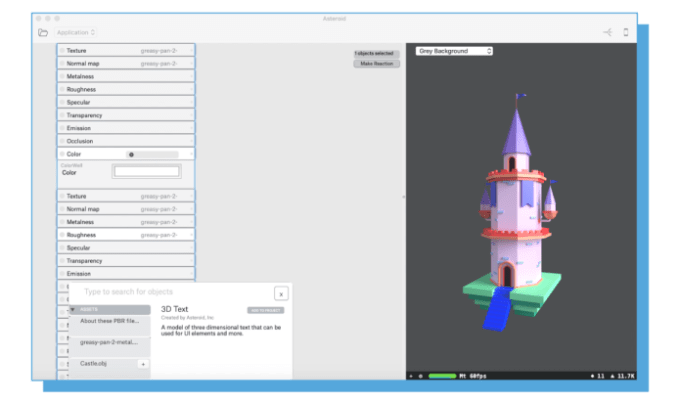
Asteroid is looking to get developers comfortable with the idea that future interfaces are going to take in much more biosensory data. The team has built a node-based human-machine interface engine for macOS and iOS that allows developers to build interactions that can be imported into Swift applications.

“What’s interesting about emerging human-machine interface tech is the hope that the user may be able to ‘upload’ as much as they can ‘download’ today,”Asteroid founder Saku Panditharatne wrote in a Medium post.

To bring attention to their development environment, they’ve launched a crowdfunding campaign that gives a decent snapshot of the depth of experiences that can be enabled by today’s commercially available biosensors. Asteroid definitely doesn’t want to be a hardware startup, but their campaign is largely serving as a way to expose developers to what tools could be in their interaction design arsenal.

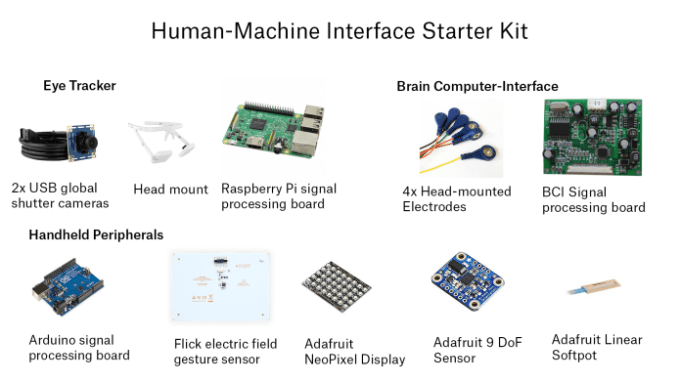
There are dev kits and then there are dev kits, and this is a dev kit. Developers jumping on board for the total package get a bunch of open hardware, i.e. a bunch of gear and cases to build out hacked-together interface solutions. The $450 kit brings capabilities like eye-tracking, brain-computer interface electrodes and some gear to piece together a motion controller. Backers can also just buy the $200 eye-tracking kit alone. It’s all very utility minded and clearly not designed to make Asteroid those big hardware bucks.

“The long-term goal is to support as much AR hardware as we can, we just made our own kit because I don’t think there is that much good stuff out there outside of labs,” Panditharatne told TechCrunch.

The crazy hardware seems to be a bit of a labor of love for the time being, while a couple of AR/VR devices have eye-tracking baked-in, it’s still a generation away from most consumer VR devices, and you’re certainly not going to find too much hardware with brain-computer interface systems built-in. The startup says their engine will do plenty with just a smartphone camera and a microphone, but the broader sell with the dev kit is that you’re not building for a specific piece of hardware, you’re experimenting on the bet that interfaces are going to grow more closely intertwined with how we process the world as humans.

Panditharatne founded the company after stints at Oculus and Andreessen Horowitz where she spent a lot of time focusing on the future of AR and VR. Panditharatne tells us that Asteroid has raised more than $2 million in funding, but that they’re not detailing the source of that cash quite yet.

The company is looking to raise $20,000 from their Indiegogo campaign, but the platform is the clear sell here, exposing people to their human-machine interaction engine. Asteroid is taking sign-ups to join the waiting list for the product on their site.

Powered by WPeMatico

Google says it’ll invest $13B in US data centers and offices this year

Google today announced that it will invest $13 billion in data centers and offices across the U.S. in 2019. That’s up from $9 billion in investments last year. Many of these investments will go to states like Nebraska, Nevada, Ohio, Texas, Oklahoma, South Carolina and Virginia, where Google plans new or expanded data centers. Though like most years, it’ll also continue to expand many of its existing offices in Seattle, Chicago and New York, as well as in its home state of California.

Given Google’s push for more cloud customers, it’s also interesting to see that the company continues to expand its data center presence across the country. Google will soon open its first data centers in Nevada, Nebraska, Ohio and Texas, for example, and it will expand its Oklahoma, South Carolina and Virginia data centers. Google clearly isn’t slowing down in its race to compete with AWS and Azure.

“These new investments will give us the capacity to hire tens of thousands of employees, and enable the creation of more than 10,000 new construction jobs in Nebraska, Nevada, Ohio, Texas, Oklahoma, South Carolina and Virginia,” Google CEO Sundar Pichai writes today. “With this new investment, Google will now have a home in 24 total states, including data centers in 13 communities. 2019 marks the second year in a row we’ll be growing faster outside of the Bay Area than in it.”


Given the current backlash against many tech companies and automation in general, it’s probably no surprise that Google wants to emphasize the number of jobs it is creating (and especially jobs in Middle America). The construction jobs are obviously temporary, though, and data centers don’t need a lot of employees to operate once they are up and running. Still, Google promises that this will give it the “capacity to hire tens of thousands of employees.”

Powered by WPeMatico

Daily Crunch: Apple’s subscription fix

The Daily Crunch is TechCrunch’s roundup of our biggest and most important stories. If you’d like to get this delivered to your inbox every day at around 9am Pacific, you can subscribe here.

1. Apple’s iOS update makes it easier to get to your subscriptions

Moving the Manage Subscriptions menu so that it’s just one click away from your App Store profile might seem like a minor change, but it was needed: As more mobile apps have adopted subscriptions as a means of generating revenue, it’s become critical to ensure consumers know how to turn off their subscriptions.

Plus, Apple is expected to launch some subscriptions of its own, namely for its streaming video and news services.

2. Instagram confirms that a bug is causing follower counts to change

Don’t panic! Instagram says it’s “aware of an issue that is causing a change in account follower numbers for some people right now” and is “working to resolve this as quickly as possible.”

3. Autonomous truck startup TuSimple hits unicorn status in latest round

Today, TuSimple is taking three to five fully autonomous trips per day for customers on three different routes in Arizona.

4. Sixteen percent of US adults own a smartwatch

The latest figures out of NPD show a continued uptick in smartwatch sales here in the States. The category has been a rare bright spot in an overall flagging wearable space, and the new numbers show gains pretty much across the board.

5. JibJab, one of the first silly selfie video makers, acquired by private equity firm Catapult Capital

Founded in 1999 by brothers Evan and Gregg Spiridellis after they saw “an animated dancing doodie streaming over a 56K modem,” JibJab’s big break came during the 2004 presidential campaign, when its satirical “This Land” racked up more than 80 million views.

6. Eight Sleep unveils The Pod, a bed that’s smarter about temperature

Eight has been focused on bed temperature for a while, first by offering a smart mattress cover and then a smart mattress that allows owners to adjust the surface temperature and even set different temperatures for different sides of the bed. But The Pod goes even further, with a smart temperature mode that will change bed temperature throughout the night to improve your sleep.

7. Ubisoft and Mozilla team up to develop Clever-Commit, an AI coding assistant

Clever-Commit is an assistant that learns from your code base’s bug and regression data to analyze and flag potential new bugs as new code is committed.

Powered by WPeMatico

Audio tech supplier to Rolls Royce and Xiaomi secures another $13.2M in funding

As autonomous driving eventually transforms cars from transportation devices to mobile theaters or conference rooms we will need better audio inside them. And we’ve already seen that VCs like Andreessen Horowitz say “audio is the future.”

So it’s interesting that Swedish sound pioneer Dirac has completed a new $13.2 million round of financing led by current investors. Previous investors included Swedish Angel network Club Network Investments, Erik Ejerhed and Staffan Persson.

Dirac makes sophisticated audio technology for customers including BMW, OnePlus, Rolls Royce, Volvo and Xiaomi .

Its platform is used by those firms for everything from capture to playback — regardless of device size or form factor.

“As consumer devices decrease in size and expand in complexity, digital signal processing is the key to unlocking their full audio potential and creating premium sound experiences,” says Dirac CEO Mathias Johansson. “With this new funding, we can take our approach to digitizing sound systems even further — creating more intelligent and adaptive audio processing solutions that establish new standards in both audio playback and capture across a variety of applications.”

Dirac has now appointed former Harman International executive Armin Prommersberger as CTO and opened a Copenhagen Research Development Center.

Johansson says new 5G networks are set to create new use-cases for current and emerging technologies, including audio.

Powered by WPeMatico

Block Kit helps deliver more visually appealing content in Slack

Slack has become a critical communications tool for many organizations. One of the things that has driven its rapid success has been the ability to connect to external enterprise apps inside of Slack, giving employees what is essentially a centralized work hub. This ability has led to some unintended consequences around formatting issues, which Slack addressed today with two new tools, Block Kit and Block Kit Builder.

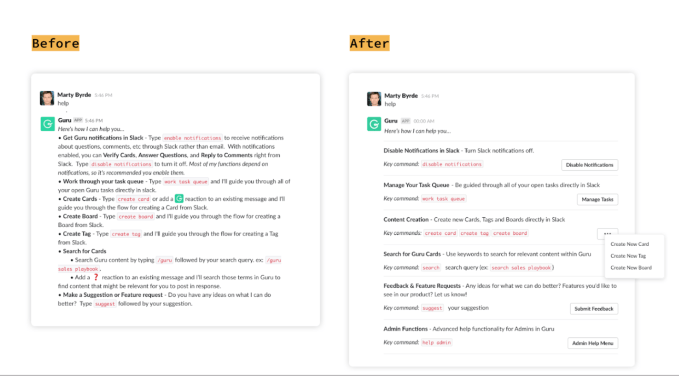
Block Kit lets developers present dense content in a much more visually appealing way, while Block Kit Builder is a prototyping tool for building more attractive apps inside Slack. The idea is to provide a way to deliver content inside of Slack without having to do workarounds to make the content look good.

Before and after applying Block Kit. Screen: Slack

Bear Douglas, who is Slack’s director of developer of relations, says developers have been quite creative up until now when it comes to formatting, but the company has been working to simplify it. Today’s announcement is the culmination of that work.

“Block Kit makes it easier for people to quickly design a customized app in Slack. We’ve launched a no-code builder that will let people design the messages that they show inside Slack,” she explained.

She said that while this tool is really designed for people with some programming or Slack admin-level knowledge, the ultimate goal is to make it easy enough for non-technical end users to build apps in Slack, something that is on the road map. What enhancing these tools does, however, is show people just what is possible inside of Slack.

“When people see Block Kit in action, it is illuminating about what can be done, and it helps them understand that it doesn’t just need to be your communications center or [something that pings you] when your website blows up. You can actually get work done inside of Slack,” she said.

One other advantage of using Block Kit is that apps will display messages consistently, whether you are using the web or mobile. Prior to having these tools, workarounds might have looked fine on the web, but the spacing might have been off on mobile or vice versa. Block Kit lets you design consistent interfaces across platforms.

Among the tools Slack is offering, none is actually earth-shattering, but in total they provide users with the ability to format their content in a way that makes sense using common design elements like image containers, dividers and sections. They are also offering buttons, drop-down menus and a calendar picker.

Both of these tools are available starting today in the Block Kit hub.

Powered by WPeMatico