Insight Partners
Auto Added by WPeMatico
Auto Added by WPeMatico
Weights & Biases, a startup building tools for machine learning practitioners, is announcing that it has raised $45 million in Series B funding.
The company was founded by Lukas Biewald, Chris Van Pelt and Shawn Lewis — Biewald and Van Pelt previously founded CrowdFlower/Figure Eight (acquired by Appen). Weights & Biases says it now has more than 70,000 users at more than 200 enterprises.
Biewald (whom I’ve known since college) argued that while machine learning practitioners are often compared to software developers, “they’re more like scientists in some ways than engineers.” It’s a process that involves numerous experiments, and Weights & Biases’ core product allows practitioners to track those experiments, while the company also offers tools around data set versioning, model evaluation and pipeline management.
“If you have a model that’s controlling a self-driving car and the car crashes, you really want to know what happened,” Biewald said. “If you built that model years ago and you’ve run all these experiments since then, it can be hard to systematically trace through what happened” unless you’re using experiment tracking.
He described the startup as “an early leader” in this market, and as competing tools emerge, he said it’s also differentiated because it is “completely focused on the ML practitioner” rather than top-down enterprise sales. Similarly, he said that as machine learning has been adopted more widely, Weights & Biases is occasionally confronted by a “high-class problem.”
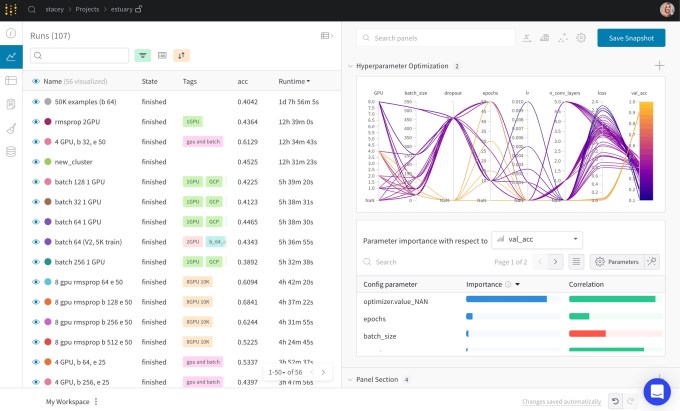
Image Credits: Weights & Biases
“We’re not interested in selling to companies that are doing machine learning for machine learning’s sake,” Biewald said. “With some companies, there’s a mandate from the CEO to sprinkle some machine learning in the company. That’s just really depressing to me, to not have any impact. But I would actually say the vast majority of companies that we talk to really do something useful.”
For example, he said agriculture giant John Deere is using the startup’s platform to continually improve the way it uses robotics to spray fertilizer, rather than pesticides, to kill weeds and pests. And there are pharmaceutical companies using the platform for how they model how different molecules will behave.
Weights & Biases previously raised $20 million in funding. The new round was led by Insight Partners, with participation from Coatue, Trinity Ventures and Bloomberg Beta. Insight’s George Mathew is joining the board of directors.
“I’ve never seen a MLOps category leader with such a high NPS and deep customer focus as Weights and Biases,” Mathew said in a statement. “It’s an honor to make my first investment at Insight to serve an ML practitioner user-base that grew 60x these last two years.”
The startup says it will use the funding to continue hiring in engineering, growth, sales and customer success.
Powered by WPeMatico
SetSail wants to upend the way sales people get compensated by paying them throughout the sales cycle, rather than a single commission after the sale closes. Today, the startup announced a $26 million Series A.
Insight Partners led the round with participation from existing investors Wing Venture Capital, Team8 and Operator Collective. Today’s investment brings the total raised to $37 million, according to the company.
SetSail connects to your CRM, email, calendar and other systems that have signals about the progress of a particular sale, and then using machine learning looks at points in the sales cycle where it would make sense to reward the sales person for the progress they are making.
As CEO and co-founder Haggai Levi told me at the time of the startup’s $7 million seed round in July, the single commission system discourages risk taking:
“If I’m closing the deal, I’m getting my commission. If I’m not closing the deal, I’m getting nothing. That means from a behavioral point of view, I would take the shortest path to win a deal, and I would take the minimum risk possible. So if there’s a competitive situation I will try to avoid that,” he said in July.
He said the idea of changing the way we think about compensation resonated with sales executives during the pandemic, especially as everyone’s role got altered and teams became distributed because of COVID, but he says while rethinking compensation was certainly a big factor so was SetSail’s ability to connect to all of the sales systems to help build these new approaches to pay.
“I think it’s even beyond just compensation. […] It’s also connecting to all of your data using an end-to-end platform that helps you understand what’s happening between you, your reps and your customers and allowing you to tie that back in using behavioral science to machine learning-based compensation,” he explained.
The company began 2020 with five customers, a reasonable start for an early stage startup, but it ended the year with more than 20 including Cisco, Dropbox and HubSpot. It now has over 5000 sales reps using the platform.
In spite of the growing number of users, Levi says they have no plans to aggregate data, leaving each customer’s data as distinct to build the compensation packages that make sense to them. “We try not to play kind of the data, aggregator role because we want to make sure that every customer’s data is encrypted and secured in a completely different container. The trade off between getting knowledge between customers versus receiving their data is is too high in our opinion,” he said.
The company now has 35 employees with five more hired who will be starting in the next several weeks and plans to reach 70 by the end of the year. They are thinking hard about how to hire a diverse workforce. For starters, Levi says that the company board has two female members. He says hiring in general is a challenge for every CEO, especially early on, and hiring a diverse group even more so, but he says it’s important to be thinking about this from the start because from a gender perspective at least, you are losing half the talent pool if you ignore it.
When the pandemic is over, he sees having at least some in-person office presence in spite of being spread out across San Francisco, New York and Tel Aviv, but it will be probably be a hybrid approach and not require as much office space as they might have rented prior to COVID.
Powered by WPeMatico

Run:AI, a Tel Aviv-based company that helps businesses orchestrate and optimize their AI compute infrastructure, today announced that it has raised a $30 million Series B round. The new round was led by Insight Partners, with participation from existing investors TLV Partners and S Capital. This brings the company’s total funding to date to $43 million.
At the core of Run:AI’s platform is the ability to effectively virtualize and orchestrate AI workloads on top of its Kubernetes-based scheduler. Traditionally, it was always hard to virtualize GPUs, so even as demand for training AI models has increased, a lot of the physical GPUs often set idle for long periods because it was hard to dynamically allocate them between projects.

Image Credits: Run.AI
The promise behind Run:AI’s platform is that it allows its users to abstract away all of the AI infrastructure and pool all of their GPU resources — no matter whether in the cloud or on-premises. This also makes it easier for businesses to share these resources between users and teams. In the process, IT teams also get better insights into how their compute resources are being used.
Run:AI says that it is currently working with customers in a wide variety of industries, including automotive, finance, defense, manufacturing and healthcare. These customers, the company says, are seeing their GPU utilization increase from 25 to 75% on average.
“The new funds enable Run:AI to grow the company in two important areas: first, to triple the size of our development team this year,” the company’s CEO Omri Geller told me. “We have an aggressive roadmap for building out the truly innovative parts of our product vision — particularly around virtualizing AI workloads — a bigger team will help speed up development in this area. Second, a round this size enables us to quickly expand sales and marketing to additional industries and markets.”
Powered by WPeMatico
The ongoing push for social distancing to slow the spread of COVID-19 has meant that more people than ever are using internet-based services to get things done. And that is having a direct impact on digital customer service, which is seeing unprecedented traffic and demands when things are not running smoothly. Today, one of the startups that’s built an interesting, very “hands-on” approach to addressing that problem is announcing a round of funding to expand its business.
Glia, which has built a platform that not only integrates and helps manage different customer support channels, but also provides tools to help agents proactively get into a customer’s app or web page to help them find things or fix issues, is today announcing that it has picked up $78 million in a Series C round of funding. Dan Michaeli, the co-founder and CEO who is based out of New York (the company has a substantial operation in Estonia too), said it will be used to continue developing its technology and expanding to address inbound interest for its services after seeing its revenues grow by 150% in 2020.
The company’s original focus was around financial services and it counts a large base of customers in that area, but it is also seeing a lot of activity in adjacent industries like insurance, as well as education, retail and other categories Michaeli said.
“We’ve had overwhelming demand and it’s incredible to see how businesses want to adopt us right now,” he said in an interview. “The plan is to significantly scale up and continue to define and meet that demand for digital customer service.” The company is likely also to use some of the funding for acquisitions in what appears to be a rapidly consolidating market.
The round is being led by Insight Partners, with Don Brown (an entrepreneur in the world of customer service, with his company Interactive Intelligence acquired by Genesys for $1.4 billion) also participating.
Glia isn’t disclosing other investors, but past backers include Tola Capital, Temerity Capital, Grassy Creek and Wildcat Capital, as well as Insight. Prior to this, the company, which has been around since 2012 and was previously known as SaleMove, had raised just $28 million and its valuation was a modest $69 million according to PitchBook data (and it’s not disclosing valuation today).
There are a lot of customer service startups in the market today, and a number of them are seeing huge boosts in their business, and even some consolidation as others snap up tech to make sure they have their own customer service strategies going in the right direction. (Witness Facebook of all companies acquiring omnichannel customer support and CRM leader Kustomer for $1 billion in November.)
Glia is not unlike many of the new guard of these companies, in that its focus is very squarely on providing a platform to be able to manage and interact across whatever digital channel a customer happens to be using. Glia, I should point out, means “glue” in Greek.
What makes Glia quite interesting and different from these are some of the twists it uses to engage with users. One of these involves being able to give agents the ability to actually get on the screen of the user in question, in order to both guide the user around the screen, and to see what the user is doing on that screen.
To be clear, the connection and ability to track what the user is doing is just on the screen in question, and it’s done with the user’s awareness of what is going on. In the demo of the service that I went through, it’s a very smooth service, which reminded me just a little of things like Clippy on Microsoft Word.
Alongside this, Glia provides tools to agents to coach them on questions to ask, phrasing to use and links for answers, and Glia also develops virtual customer service assistants, to help with more basic questions. These also have the ability to interact with people’s screens when they make contact with a company. This in effect sees the company combining a number of technologies in one place, from natural language to suggest (and in some cases run) customer service responses, through to computer vision to help detect what is going on on the remote screen, through to more fundamental CRM technology to run those services across multiple platforms.
While screen sharing has been a well-used tool in other areas — for example in workforce collaboration environments, or for presenting online — Glia is seen as one of the pioneers in leveraging that for customer service. For investors, the interest in Glia has been to tap into that.
“We are proud to expand our investment in Glia as the company continues to lead the evolution of Digital Customer Service for businesses across the globe,” said Lonne Jaffe, managing director at Insight Partners, in a statement. “Glia’s platform provides the modern technology necessary for businesses to meet customers in their digital journeys and communicate through the customer’s channel of choice. With this capital, the company will continue to scale and keep up with skyrocketing demand.”
We are in a key moment of digital transformation in customer services. Surprisingly, there are still many who opt for calling in to ask questions, but as Michaeli noted, these days, even when they are still using phones, customers will do so with “their screens in front of them.”
Brown believes that this is the other opportunity to seize. “Many companies are still focused on moving antiquated, on-premises telephony systems to cloud contact centers that essentially offer the same functionality,” he said in a statement. “Instead, businesses can leapfrog this process and move directly to a digital-first cloud approach by partnering with Glia. If I were to build Interactive Intelligence for today’s contact center, I would take Glia’s approach.”
Powered by WPeMatico
Hinge Health, the San Francisco-based company that offers a digital solution to treat chronic musculoskeletal (MSK) conditions — such as back and joint pain — has closed a $310 million in Series D funding, according to sources.
The round is led by Coatue and Tiger Global, and values 2015-founded Hinge at $3 billion post-money, people familiar with the investment tell me. It comes off the back of a 300% increase in revenue in 2020, with investors told to expect revenue to nearly triple again in 2021 based on the company’s booked pipeline.
I also understand that Hinge’s founders — Daniel Perez and Gabriel Mecklenburg — retain voting control of the board. I’ve reached out to CEO Perez for comment and will update this post should I hear back.
Hinge’s existing investors include Bessemer Venture Partners, which backed the company’s $90 million Series C round in February, along with Lead Edge Capital, Insight Partners (which led the Series B), Atomico (which led the Series A), 11.2 Capital, Quadrille Capital and Heuristic Capital.
Originally based in London, Hinge Health primarily sells into U.S. employers and health plans, billing itself as a digital healthcare solution for chronic MSK conditions. The platform combines wearable sensors, an app and health coaching to remotely deliver physical therapy and behavioral health.
The basic premise is that there is plenty of existing research to show how best to treat chronic MSK disorders, but existing healthcare systems aren’t up to the task due to funding pressures and for other systematic reasons. The result is an over tendency to use opioid-based painkillers or surgery, with poor results and often at even greater cost. Hinge wants to reverse this through the use of technology and better data, with a focus on improving treatment adherence.
Meanwhile, Hinge’s jump in valuation is significant. According to sources, the company’s February round produced a valuation of around $420 million, so the new valuation is more than a 6x increase.
Powered by WPeMatico
As the pandemic has raged on, it has shone a spotlight on the importance of procurement, especially in certain sectors. Fairmarkit, a Boston startup, is working to bring a modern digital procurement system to the enterprise. Today, the company announced a $30 million Series B.
GGV Capital and Insight Partners led the round with help from existing investors 1984 VC, NewStack and NewFund. Today’s investment brings the total raised to $42 million, according to the company.
Fairmarkit wants to replace large procurement software systems from companies like Oracle and SAP that have been around for decades, says company co-founder and CEO Kevin Frechette. When he looked around a couple of years ago, he saw a space full of these legacy vendors and ripe for disruption.
What’s more, he says that these systems have been designed to track only the biggest purchases over $500,000 or $1 million. Anything under that is what’s known as tail spend. “So procurement really focuses on companies’ biggest purchases, say things over a million, but anything under that size just gets forgotten about and neglected. It’s called tail spend, and it’s still 80% of what they buy, 80% of their vendors and 20% of the budget,” he told me.
This spending accounts for billions of dollars, yet Frechette says, it has lacked a good tracking system. He saw an opportunity, and he and his co-founders built a solution. Its first customer was the MBTA, Boston’s mass transit system (a system that could use all the help it can get in terms of getting more efficient). Today the company has more than 50 customers across a variety of industries.
The system acts as a marketplace for vendors and a central buying system for customers where they can find goods and services at this price point below $1 million. It imports a customer’s vendor data, and then combines this with other data to build a huge database of buying information. From that, they can determine what a customer needs and using AI, find the best prices for a particular order.
Frechette says this not only provides a way to save money — he says customers have been able to cut purchase costs by 10% with his system — it also provides a way to surface diverse vendors, whether that’s businesses owned by women, people of color, veterans, local business or however you define that.
He says too often what happens is that these deals aren’t put under typical procurement department scrutiny and they just get passed through, but Fairmarkit helps surface these companies and give them a shot at the business. “So because the core of our technology is a vendor recommendation engine […], we can help to invite those diverse vendors and really just give them a fair shot,” he said.
The company started the year with 40 employees and have added 30 since. The plan is to double that number next year, and as they do, Frechette hopes to reflect the diversity of the company’s product by building a correspondingly diverse employee base.
“It’s really just keeping it at the forefront. We want to make sure that we’re not just doing surveys around how we are doing for diversity and inclusion, but we’re putting programs in place to help out with it. It’s something I’m very very passionate about because it’s been such a sticking point as well on how we’re helping diverse vendors,” he said.
Frechette says that he has managed to grow the company and build a culture in spite of the pandemic not allowing employees to come into an office. He doesn’t see a world where the office will be a requirement in the future.
“We’ve hit an inflection point this year where there’s no world where we need everyone to be in an office […], which once again only helps to accelerate our business because we’re not constricted by everyone in this one small [geographical] sector. We can operate across the board [from anywhere],” he said.
Powered by WPeMatico
San Francisco-based construction startup Versatile is announcing today that it has raised a $20 million Series A. The round was led by Insight Partners and Entree Capital, along with existing investors Robert Bosch Venture Capital GmbH, Root Ventures and Conductive Ventures.
The round follows $8.5 million in funding, including a $5.5 million seed round that arrived in August of last year.
The URBAN-X accelerator alum has developed a piece of hardware designed to be mounted to a crane. From that vantage point, it’s capable of capturing and analyzing data across the construction site.
“You can only improve what you can measure, and at Versatile we are just scratching the surface of what we can do to create value for our users and use data to turn job sites into controlled manufacturing with fast feedback loops,” co-founder and CEO Meirav Oren said in a release tied to the news.
The company says it’s able to use that information to provide a picture of construction progress, with additional information on site materials, while targeting any potential redundancy in the space.
With around $10 trillion currently spent on construction each year, the industry is prime for some big-ticket investments. Particularly those startups that can promise more efficiency in the space.
The company says the round will be spent on accelerating the availability of its technology and developing additional AI components for users.
Powered by WPeMatico
CloudBolt, a Bethesda, Maryland startup that helps companies manage hybrid cloud environments, announced a $35 million Series B investment today. It was split between $15 million in equity investment and $20 million in debt.
Insight Partners provided the equity side of the equation, while Hercules Capital and Bridge Bank supplied the venture debt. The company has now raised more than $61 million in equity and debt, according to Crunchbase data.
CEO Jeff Kukowski says that his company helps customers with cloud and DevOps management including cost control, compliance and security. “We help [our customers] take advantage of the fact that most organizations are already hybrid cloud, multi cloud and/or multi tool. So you have all of this innovation happening in the world, and we make it easier for them to take advantage of it,” he said.
As he sees it, the move to cloud and DevOps, which was supposed to simplify everything, has actually created new complexity, and the tools his company sells are designed to help companies reduce some of that added complexity. What they do is provide a way to automate, secure and optimize their workloads, regardless of the tools or approach to infrastructure they are using.
The company closed the funding round at the end of last quarter and put it to work with a couple of acquisitions — Kumolus and SovLabs — to help accelerate and fill in the road map. Kumolus, which was founded in 2011 and raised $1.7 million, according to Crunchbase, really helps CloudBolt extend its vision from managing on premises to the public cloud.
SovLabs was an early-stage startup working on a very specific problem creating a framework for extending VMware automation.
CloudBolt currently has 170 employees. While Kukowski didn’t want to get specific about the number of additional employees he might be adding to that in the next 12 months, he says that as he does, he thinks about diversity in three ways.
“One is just pure education. So we as a company regularly meet and educate on issues around inclusion, social justice and diversity. We also recruit with those ideas in mind. And then we also have a standing committee within the company that continues to look at issues not only for discussion, but quite frankly for investment in terms of time and fundraising,” he said.
Kukowski says that going remote because of COVID has allowed the company to hire from anywhere, but he still looks forward to a time when he can meet face-to-face with his employees and customers, and sees that as always being part of his company’s culture.
CloudBolt was founded in 2012 and has around 200 customers. Kukowski says that the company is growing between 40% and 50% year over year, although he wouldn’t share specific revenue numbers.
Powered by WPeMatico
This year, more than ever before because of the COVID-19 pandemic, huge droves of workers and consumers have been turning to the internet to communicate, get things done and entertain themselves. That has created a huge bonanza for cybercriminals, but also companies that are building tools to combat them.
In the latest development, an Israel-hatched, Mountain View-based enterprise startup called SentinelOne — which has built a machine learning-based solution that it sells under the brand Singularity that works across the entire edge of the network to monitor and secure laptops, phones, containerised applications and the many other devices and services connected to a network — has closed $267 million in funding to continue expanding its business to meet demand, which has seen business boom this year. Its valuation is now over $3 billion.
Given the large sums the company has now raised — $430 million to date — the funding will likely be used for acquisitions (cyber is a very crowded market and will likely see some strong consolidation in the coming years), as well as more in-house development and sales and marketing. Earlier this year, CEO and founder Tomer Weingarten told me that an IPO “would be the next logical step” for the company. “But we’re not in any rush,” he said at the time. “We have one to two years of growth left as a private company.”
SentinelOne contacted TechCrunch with the above details but said that an official press release was due only to be released at 3 p.m. U.K. time. We’ll update with more details if they’re available when they are published. In the meantime, other outlets such as Calcalist in Israel (in Hebrew) have also published these details. And it should be noted that the round was rumored for almost a month ahead of this, although the sums raised were off by quite a bit: the reports had said $150-200 million.
(Side note: Why the pointless games with timings and exclusives? Who knows — I certainly don’t. )
This round included Tiger Global, Sequoia, Insight Partners, Third Point Ventures and Qualcomm Ventures . It looks like Sequoia — which is currently building up a new European operation to look more closely at opportunities on this side of the globe — is the only new name in that list. The others have all backed SentinelOne in previous rounds.
It was only in February of this year that SentinelOne had raised $200 million at a $1.1 billion valuation.
The rapid fundraising, from a top-shelf list of firms, is a notable aspect of this story.
In the world of startups, we are firmly living in a time when investors are looking for strong opportunities to back companies that are shining in a market that is particularly challenging. COVID-19 has all but decimated the travel industry and live in-person event industry, among others.
But services that are helping people continue to live their lives, and those that are helping find a cure or at least solutions to minimise the impact, are very much in demand.
The cybersecurity market — in particular companies that are providing solutions that can immediately prove to be effective in what is an increasingly sophisticated threat landscape — is incredibly active right now, even more than it already was.
“Around 450 cybersecurity companies are operating in Israel, constituting 5% of the global cybersecurity market, in some cyber segments the two world leaders are by Israeli founders like CheckPoint and Palo Alto,” noted Avihai Michaeli, an advisor who scouts startups for corporate VCs.
Within that, endpoint security, the area where SentinelOne concentrates its efforts, is particularly strong. Last year, endpoint security solutions was estimated to be around an $8 billion market, and analysts project that it could be worth as much as $18.4 billion by 2024.
While SentinelOne has a lot of competitors — they include Microsoft, CrowdStrike, Kaspersky, McAfee and Symantec — it is also a strong player in the market. Relying on the advances of AI and with roots in the Israeli cyberintelligence community, its platform is built around the idea of working automatically not just to detect endpoints and their vulnerabilities, but to apply behavioral models, and various modes of protection, detection and response in one go.
“We are seeing more automated and real-time attacks that themselves are using more machine learning,” Weingarten said to me this year. “That translates to the fact that you need defence that moves in real time as with as much automation as possible.”
As of February, it had 3,500 customers, including three of the biggest companies in the world, and “hundreds” from the global 2,000 enterprises, with 113% year-on-year new bookings growth, revenue growth of 104% year-on-year and 150% growth year-on-year in transactions over $2 million. Those numbers will have likely grown significantly since then. (We’ll update as and when we learn more.)
Powered by WPeMatico
Simple, link-centric user profiles might not sound like a particularly ambitious idea, but it’s been more than big enough for Linktree.
The Melbourne startup says that 8 million users — whether they’re celebrities like Selena Gomez and Dua Lipa or brands like HBO and Red Bull — have created profiles on the platform, with those profiles receiving more than 1 billion visitors in September.
Plus, there are more than 28,000 new users signing up every month.
“This category didn’t exist when we started,” CEO Alex Zaccaria told me. “We created this category.”
Zaccaria said that he and his co-founders Anthony Zaccaria and Nick Humphreys created Linktree to solve a problem they were facing at their digital marketing agency Bolster. Instagram doesn’t allow users to include links in posts — all you get is a single link in your profile, prompting the constant “link in bio” reminder when someone wants to promote something.
Meanwhile, most of Bolster’s clients come from music and entertainment, where a single link can’t support what Zaccaria said is a “quite fragmented” business model. After all, an artist might want to point fans to their latest streaming album, upcoming concert dates, an online store for merchandise and more. A website could do the job in theory, but they can be clunky or slow on mobile, with users probably giving up before they finally reach the desired page.

Linktree founders Anthony Zaccaria, Alex Zaccaria and Nick Humphreys. Image via Linktree.
So instead of constantly swapping out links in Instagram and other social media profiles, a Linktree user includes one evergreen link to their Linktree profile, which they can update as necessary. Selena Gomez, for example, links to her latest songs and videos, but also her Rare Beauty cosmetics brand, her official store and articles about her nonprofit work.
Zaccaria said that after launching the product in 2016, the team quickly discovered that “a lot more people had the same problem,” leading them to fully separate Linktree and Bolster two years ago. Since then, the company hasn’t raised any outside funding — until now, with a $10.7 million Series A led by Insight Partners and AirTree Ventures. (Update: Strategic investors in the round include Twenty Minute VC’s Harry Stebbings, Patreon CTO Sam Yam and Culture Amp CTO Doug English.)
“We had the option to just continue to grow sustainably, but we wanted to pour some fuel on the fire,” Zaccaria said.
In fact, Linktree has already grown from 10 to 50 employees this year. And while the company started out by solving a problem for Instagram users, Zaccaria described it as evolving into a much broader platform that can “unify your entire digital ecosystem” and “democratize digital presence.” He said that while some customers continue to maintain “a giant, brand-immersive website,” for others, Linktree is completely replacing the idea of a standalone website.
Zaccaria added that Instagram only represents a small amount of Linktree’s current traffic, while nearly 25% of that traffic now comes from direct visitors.

Image Credits: Linktree
Black Lives Matter has also been a big part of Linktree’s recent growth, with activists and other users who want to support the movement using their profiles to point visitors to websites where they can donate, learn more and get involved. In fact, Linktree even introduced a Black Lives Matter banner over the summer that anyone could add to their profile.
Linktree is free to use, but you have to pay $6 a month for Pro features like video links, link thumbnails and social media icons.
Zaccaria said that the new funding will allow the startup to add more “functionality and analytics.” He’s particularly eager to grow the data science and analytics team, though he emphasized that Linktree does not collect personally identifiable information or monetize visitor data in any way — he just wants to provide more data to Linktree users.
In a statement, Insight Managing Director Jeff Lieberman said:
As the internet becomes increasingly fragmented, brands, publishers, and influencers need a solution to streamline their content sharing and connect their social media followers to their entire online ecosystem, ultimately increasing brand awareness and revenue. Linktree has successfully created this new “microsite” category enabling companies to monetize the next generation of the internet economy via a single interactive hub. The impressive traction and growing number of customers Linktree has gained over the last few months demonstrates its proven market fit, and we could not be more excited to work with the Linktree team as they transition to the ScaleUp phase of growth.
Powered by WPeMatico