Insight Partners
Auto Added by WPeMatico
Auto Added by WPeMatico
Artificial intelligence is becoming an increasingly common part of how customer service works — a trend that was accelerated in this past year as so many other services went virtual and digital — and today a startup that has built a set of low-code tools to help enterprises integrate more AI into their customer service processes is announcing some funding to fuel its growth.
Cognigy, which provides a low-code conversational AI platform that notably can be used flexibly across a range of applications and geographies — it supports 120 languages; it can be used in external or internal service applications; it can support voice services but also chatbots; it provides real-time assistance for human agents and usage analytics or fully automated responses; it can integrate with standard call center software, and also with RPA packages; and it can be run in the cloud or on-premise — has closed a round of $44 million, funding that it will be using to continue scaling its business internationally.
Insight Partners is leading the Series B investment, with previous backers DN Capital, Global Brain, Nordic Makers, Inventures and Digital Innovation and Growth also participating. The Dusseldorf-based company had previously only raised $11 million and spent the first several years of business bootstrapped.
Cognigy is not disclosing its valuation but it has up to now built up a concentration of customers in areas like transportation, e-commerce and insurance and counts a number of big multinational companies among its customer list, including Lufthansa, Mobily, BioNTech, Vueling Airlines, Bosch and Daimler, with “thousands” of virtual assistants now powered by Cognigy live in the market.
With 25% of Cognigy’s business already coming from the U.S., the plan now is to use some funding to invest in building out its service deeper into the U.S., Asia and across more of Europe, CEO and founder Philipp Heltewig said in an interview.
“Conversational AI” these days appears in many guises: it can be a chatbot you come across on a website when you’re searching for something, or it can be prompts provided to agents or salespeople, information and real-time feedback to help them do their jobs better. Conversational AI can also be a personal assistant on your company’s HR application to help you book time off or deal with any number of other administrative jobs, or a personal assistant that helps you use your phone or set your house alarm.
There are a number of companies in the tech world that have built tools to address these various use cases. Specifically in the area of services aimed at enterprises, some of them, like Gong, are raising huge money right now. What is notable about Cognigy is that it has built a platform that is attempting to address a wide swathe of applications: one platform, many uses, in other words.
Cognigy’s other selling point is that it is playing into the new interest in low- and no-code tools, which in Cognigy’s case makes the integration of AI into a customer assistance process a relatively easy task, something that can be built not just by developers, but data scientists, those working directly on conversation design, and nontechnical business users using the tools themselves.
“The low-code platform helps enterprises adopt what is otherwise complex technology in an easy and flexible way, whether it is a customer or employee contact center,” said Heltewig. As you might expect, there are some direct competitors in the low- and no-code conversational AI space, too, including Ada, Talkie, Snaps and more.
Flexibility seems to be the order of the day for enterprises, and also the companies building tools for them: it means that a company can grow into a larger customer, and that in theory Cognigy will also evolve the platform based on what its customers need. As one example, Heltewig pointed out that a number of its customers are — contrary to the beating drum and march you see every day toward cloud services — running a fair number of applications on-premises, since this appears to be a key way to ensure the security of the customer data that they handle.
“Lufthansa could never run its customer services in the cloud because they handle a lot of sensitive data and they want full ownership of it,” he noted. “We can run cloud services and have a full offering for those who want it, but many large enterprises prefer to run their services on premises.”
Teddie Wardi, an MD at Insight, is joining the board with this round. “We are thrilled to be leading Cognigy’s Series B as the company continues on their ScaleUp journey,” he said in a statement. “Evident by their strong customer retention, Cognigy has created an essential product for global businesses to improve their customer experience in an efficient and effortless manner. With the new funding, Cognigy will be able to expand their leadership position to reach new markets and acquire more customers.”
Powered by WPeMatico
Without good data, it’s impossible to build an accurate predictive machine learning model. Explorium, a company that has been building a solution over the last several years to help data pros find the best data for a given model, announced a $75 million Series C today — just 10 months after announcing a $31 million Series B.
Insight Partners led today’s investment with participation from existing investors Zeev Ventures, Emerge, F2 Venture Capital, 01 Advisors and Dynamic Loop Capital. The company reports it has now raised a total of $127 million. George Mathew, managing partner at Insight, and former president and COO at Alteryx, will be joining the board, giving the company someone with solid operator experience to help guide them into the next phase.
Company co-founder and CEO Maor Shlomo, says that in spite of how horrible COVID has been from a human perspective, it has been a business accelerator for his company and he saw revenue quadruple last year (although he didn’t share specific numbers beyond that). “It’s related to the nature of our business. We’re helping enterprises and data practitioners find new data sources that can help them solve business challenges,” Sholmo explained.
He says that during the pandemic, a lot of companies had to find new data sources because the old data wasn’t especially helpful for predictive models. That meant that customers required new sources to give them visibility into the shifts and movements in the market to help them adjust and make decisions during pandemic. “And given that’s basically what our platform does in its essence, we’ve seen a lot of growth [over the past year],” he says.
With the revenue growth the company has been experiencing, it has been adding employees at rapid clip. When we spoke to Explorium last July, the company had 87 people. Today that number has grown to 130 with plans to get to 200 perhaps by the end of 2021 or early 2022, depending on how the business continues to grow.
The company has offices in Tel Aviv and San Mateo, California with plans to open a new office in New York City whenever it’s possible to do so. While Shlomo wants a flexible workplace, he’s not going fully remote with plans to allow people to work two days from home and three in the office as local rules allow.
Powered by WPeMatico

Israeli security startup Cycode, which specializes in helping enterprises secure their DevOps pipelines and prevent code tampering, today announced that it has raised a $20 million Series A funding round led by Insight Partners. Seed investor YL Ventures also participated in this round, which brings the total funding in the company to $24.6 million.
Cycode’s focus was squarely on securing source code in its early days, but thanks to the advent of infrastructure as code (IaC), policies as code and similar processes, it has expanded its scope. In this context, it’s worth noting that Cycode’s tools are language and use case agnostic. To its tools, code is code.
“This ‘everything as code’ notion creates an opportunity because the code repositories, they become a single source of truth of what the operation should look like and how everything should function, Cycode CTO and co-founder Ronen Slavin told me. “So if we look at that and we understand it — the next phase is to verify this is indeed what’s happening, and then whenever something deviates from it, it’s probably something that you should look at and investigate.”
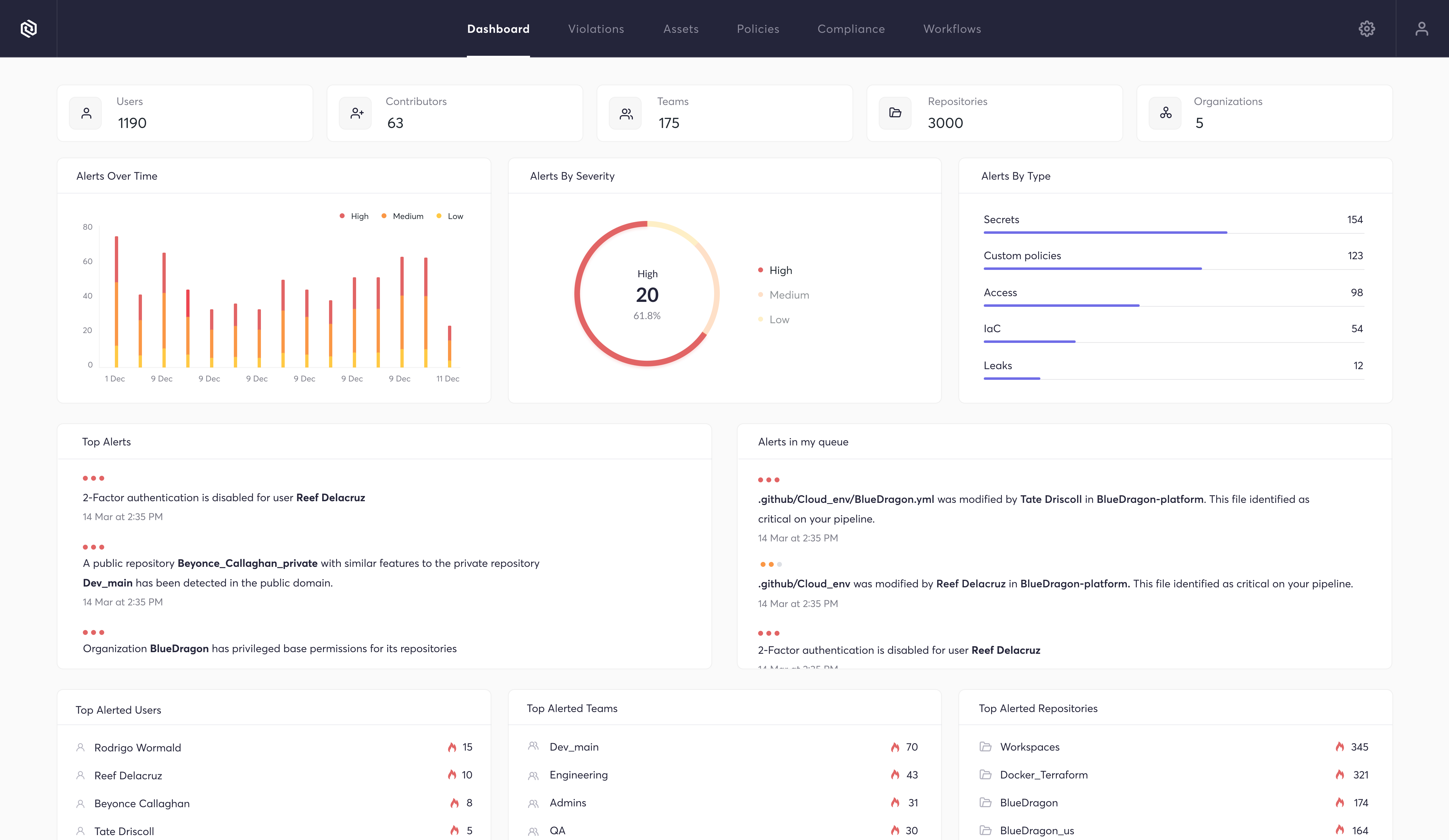
Cycode Dashboard. Image Credits: Cycode
The company’s service already provides the tools for managing code governance, leak detection, secret detection and access management. Recently it added its features for securing code that defines a business’ infrastructure; looking ahead, the team plans to add features like drift detection, integrity monitoring and alert prioritization.
“Cycode is here to protect the entire CI/CD pipeline — the development infrastructure — from end to end, from code to cloud,” Cycode CEO and co-founder Lior Levy told me.
“If we look at the landscape today, we can say that existing solutions in the market are kind of siloed, just like the DevOps stages used to be,” Levy explained. “They don’t really see the bigger picture, they don’t look at the pipeline from a holistic perspective. Essentially, this is causing them to generate thousands of alerts, which amplifies the problem even further, because not only don’t you get a holistic view, but also the noise level that comes from those thousands of alerts causes a lot of valuable time to get wasted on chasing down some irrelevant issues.”
What Cycode wants to do then is to break down these silos and integrate the relevant data from across a company’s CI/CD infrastructure, starting with the source code itself, which ideally allows the company to anticipate issues early on in the software life cycle. To do so, Cycode can pull in data from services like GitHub, GitLab, Bitbucket and Jenkins (among others) and scan it for security issues. Later this year, the company plans to integrate data from third-party security tools like Snyk and Checkmarx as well.
“The problem of protecting CI/CD tools like GitHub, Jenkins and AWS is a gap for virtually every enterprise,” said Jon Rosenbaum, principal at Insight Partners, who will join Cycode’s board of directors. “Cycode secures CI/CD pipelines in an elegant, developer-centric manner. This positions the company to be a leader within the new breed of application security companies — those that are rapidly expanding the market with solutions which secure every release without sacrificing velocity.”
The company plans to use the new funding to accelerate its R&D efforts, and expand its sales and marketing teams. Levy and Slavin expect that the company will grow to about 65 employees this year, spread between the development team in Israel and its sales and marketing operations in the U.S.
Powered by WPeMatico

ZenGo, a mobile app to manage your cryptocurrencies, has raised a $20 million Series A funding round led by Insight Partners. ZenGo is a non-custodial wallet, which means that the company doesn’t manage your crypto assets for you — you remain in control.
Other investors include Distributed Global and Austin Rief Ventures. Existing investors Benson Oak, Samsung Next, Elron, Collider Ventures, FJ Labs and others also participated in today’s funding round.
What makes ZenGo different from other wallet apps is that the company is trying to build something that is more secure than your average crypto wallet while remaining simple to use and understand. It competes with other non-custodial wallets, such as Coinbase Wallet (not Coinbase.com), Argent, etc.
In particular, ZenGo is based on multiparty computation (MPC). When you first create your wallet, ZenGo generates multiple secrets that are stored and encrypted in different ways. It means that the company can’t access your tokens directly and you can recover your wallet if you lose your phone.
Other crypto companies focused on infrastructure and enterprise clients have also opted for MPC as their security model. Fireblocks, a company that has recently raised $133 million, is one example.
But ZenGo is building a consumer app. In 2020, the company has processed more than $100 million in crypto transactions from 100,000 users. ZenGo has reached the same milestone in the first three months of 2021 and added another 100,000 users.
You can browse DeFi projects through ZenGo and access savings pools. The startup takes a cut on these investments.
With today’s funding round, ZenGo plans to expand with the same philosophy in mind. You can expect support for more chains and assets, more partnerships and options to buy cryptocurrencies and convert them to fiat money, etc.
The company recently announced plans to launch a debit card. This way, users will be able to convert their crypto assets and then spend them wherever Visa cards are accepted. In other words, ZenGo is building a crypto super app with a focus on security.

Image Credits: ZenGo
Powered by WPeMatico
With the increase of digital transacting over the past year, cybercriminals have been having a field day.
In 2020, complaints of suspected internet crime surged by 61%, to 791,790, according to the FBI’s 2020 Internet Crime Report. Those crimes — ranging from personal and corporate data breaches to credit card fraud, phishing and identity theft — cost victims more than $4.2 billion.
For companies like Sift — which aims to predict and prevent fraud online even more quickly than cybercriminals adopt new tactics — that increase in crime also led to an increase in business.
Last year, the San Francisco-based company assessed risk on more than $250 billion in transactions, double from what it did in 2019. The company has over several hundred customers, including Twitter, Airbnb, Twilio, DoorDash, Wayfair and McDonald’s, as well a global data network of 70 billion events per month.
To meet the surge in demand, Sift said today it has raised $50 million in a funding round that values the company at over $1 billion. Insight Partners led the financing, which included participation from Union Square Ventures and Stripes.
While the company would not reveal hard revenue figures, President and CEO Marc Olesen said that business has tripled since he joined the company in June 2018. Sift was founded out of Y Combinator in 2011, and has raised a total of $157 million over its lifetime.
The company’s “Digital Trust & Safety” platform aims to help merchants not only fight all types of internet fraud and abuse, but to also “reduce friction” for legitimate customers. There’s a fine line apparently between looking out for a merchant and upsetting a customer who is legitimately trying to conduct a transaction.
Sift uses machine learning and artificial intelligence to automatically surmise whether an attempted transaction or interaction with a business online is authentic or potentially problematic.

Image Credits: Sift
One of the things the company has discovered is that fraudsters are often not working alone.
“Fraud vectors are no longer siloed. They are highly innovative and often working in concert,” Olesen said. “We’ve uncovered a number of fraud rings.”
Olesen shared a couple of examples of how the company thwarted fraud incidents last year. One recently involved money laundering through donation sites where fraudsters tested stolen debit and credit cards through fake donation sites at guest checkout.
“By making small donations to themselves, they laundered that money and at the same tested the validity of the stolen cards so they could use it on another site with significantly higher purchases,” he said.
In another case, the company uncovered fraudsters using Telegram, a social media site, to make services available, such as food delivery, with stolen credentials.
The data that Sift has accumulated since its inception helps the company “act as the central nervous system for fraud teams.” Sift says that its models become more intelligent with every customer that it integrates.
Insight Partners Managing Director Jeff Lieberman, who is a Sift board member, said his firm initially invested in Sift in 2016 because even at that time, it was clear that online fraud was “rapidly growing.” It was growing not just in dollar amounts, he said, but in the number of methods cybercriminals used to steal from consumers and businesses.
“Sift has a novel approach to fighting fraud that combines massive data sets with machine learning, and it has a track record of proving its value for hundreds of online businesses,” he wrote via email.
When Olesen and the Sift team started the recent process of fundraising, Insight actually approached them before they started talking to outside investors “because both the product and business fundamentals are so strong, and the growth opportunity is massive,” Lieberman added.
“With more businesses heavily investing in online channels, nearly every one of them needs a solution that can intelligently weed out fraud while ensuring a seamless experience for the 99% of transactions or actions that are legitimate,” he wrote.
The company plans to use its new capital primarily to expand its product portfolio and to scale its product, engineering and sales teams.
Sift also recently tapped Eu-Gene Sung — who has worked in financial leadership roles at Integral Ad Science, BSE Global and McCann — to serve as its CFO.
As to whether or not that meant an IPO is in Sift’s future, Olesen said that Sung’s experience of taking companies through a growth phase such as what Sift is experiencing would be valuable. The company is also for the first time looking to potentially do some M&A.
“When we think about expanding our portfolio, it’s really a buy/build partner approach,” Olesen said.
Powered by WPeMatico
The longer we continue to work with either all or part of our teams in remote, out-of-physical-office environments, the more imperative it becomes for those teams to have some tools in place to keep the channels of communication and management open, and for the individuals in those teams to have a sense of how well they are performing. Today, one of the startups that provides a team productivity app with that in mind is announcing a round of funding to fuel its growth.
Pathlight, which has built a performance management platform for customer-facing teams — sales, field service and support — to help managers and employees themselves track and analyze how they are doing, to coach them when and where it’s needed and to communicate updates and more, has picked up $25 million — money that it will be using to continue growing its customer base and the functionality across its app.
The funding is being led by Insight Partners, with previous backers Kleiner Perkins and Quiet Capital also participating, alongside Uncorrelated Ventures; Jeremy Stoppelman, CEO of Yelp; David Glazer, CFO of Palantir; and Michael Ovitz, co-founder of CAA and owner of Broad Beach Ventures. Pathlight has now raised $35 million.
Pathlight today provides users with a range of tools to visualize team and individual performance across various parameters set by managers, using data that teams integrate from other platforms like Salesforce, Zendesk and Outreach, among others.
Using that data and specific metrics for the job in question, managers can then initiate conversations with individuals to focus on specific areas where things need attention, and provide some coaching to help fix it. It can also be used to provide team-wide updates and encouragement, which sits alongside whatever other tools a person might use in their daily customer-facing work.
Since launching in March 2020, the startup has picked up good traction, with customers including Twilio, Earnin, Greenhouse and CLEAR. But perhaps even more importantly, the pandemic and resulting switch to remote work has underscored how necessary tools like Pathlight’s have become: The startup says that engagement on its platform has shot up 300% in the last 12 months.
Alexander Kvamme, the CEO of Pathlight, said that he first became aware of the challenges of communicating across customer-facing teams, and having transparency on how they are doing as individuals and as a group, when he was at Yelp. Yelp had acquired his startup, reservations service SeatMe, and used the acquisition to build and run Yelp Reservations.
He was quick to realize that there weren’t really effective tools for him to see how individuals in the sales team were doing, how they were doing compared to goals the company wanted to achieve and based on the sales data they already had in other systems, how to work more effectively with people to communicate when something needed changing, and how to tailor all that in line with new variations in the formula — in their case, how to sell new products like a reservations service alongside advertising and other Yelp services for businesses.
“Whether it’s five or 3,000 people, the problem doesn’t go away,” he said. “Everyone uses their own systems, and it hurts front-line employees when they don’t know how they are doing, or don’t get recognition when they are doing well, or don’t get coaching when they are not. Our thesis was that if software is eating the world, and you as a company are buying more software and analytics, over time managers will be more like data analysts. So we are providing a way for managers to be more data-driven.”
Five years down the line, Kvamme got the bug again to start a company and decided to return to that problem, teaming up with co-founder Trey Doig, the engineer who designed SeatMe and then turned it into Yelp Reservations and is now Pathlight’s CTO.
As they see it, the challenge has still not really been addressed. That’s not to say that there are not a number of companies — competitors to Pathlight — looking to fill that gap as well. Another people management platform called Lattice last year picked up $45 million (I’m guessing it will be raising money again around about now); HubSpot, Zoho, SalesLoft and a number of others also are taking different approaches to the same challenge: front-line customer-facing people spend the majority of their time and attention on interacting with people, and so there need to be better tools in place to help them figure out how to make that communication more effective, figure out what is working and what is not.
And all of this, of course, is not at all new: It’s not like we all woke up one day and suddenly wanted to know how we are doing at work, or managers suddenly felt they needed to communicate with staff.
What has changed, however, is how we work: Many of us have not seen the inside of our offices for more than a year at this point, and for a large proportion of us, we may never return again, or if we do it will be under different circumstances.
All of this means that some of the more traditional metrics and indicators of our performance, praising, management relationships and learning from teammates simply is not there anymore.
In customer-facing areas like sales, support and field service, that lack of contact may be even more acute, since many of the teams working in these environments have long relied on huddles and communication throughout the day, week and month to continuously tweak work and improve it. So while tools like Pathlight’s will be useful as data analytics provision for teams regardless of how we work, it can be argued that they are even more important right now.
“I think people have started to realize that if you can empower front line to be more independent, your numbers will go up and do better,” Kvamme said.
This is part of what went into the investment decision made here.
“With the acceleration of digital transformation across the enterprise, it’s not enough to rethink the way we work — we must also rethink the way we manage,” said Jeff Lieberman, MD at Insight Partners. “Pathlight is ushering in a new age of data-driven management, an ethos that we believe every enterprise will need to embrace — quickly. We are excited to partner with the Pathlight team as they bring their powerful platform to companies across the world.”
Powered by WPeMatico
It’s clear that automated workflow tooling has become increasingly important for companies. Perhaps that explains why Camunda, a Berlin startup that makes open-source process automation software, announced an €82 million Series B today. That translates into approximately $98 million U.S.
Insight Partners led the round with help from A round investor Highland Europe. When combined with the $28 million A investment from December 2018, it brings the total raised to approximately $126 million.
What’s attracting this level of investment says Jakob Freund, co-founder and CEO at Camunda, is the company is solving a problem that goes beyond pure automation. “There’s a bigger thing going on which you could call end-to-end automation or end-to-end orchestration of endpoints, which can be RPA bots, for example, but also micro services and manual work [by humans],” he said.
He added, “Camunda has become this endpoint agnostic orchestration layer that sits on top of everything else.” That means that it provides the ability to orchestrate how the automation pieces work in conjunction with one another to create this full workflow across a company.
The company has 270 employees and approximately 400 customers at this point, including Goldman Sachs, Lufthansa, Universal Music Group and Orange. Matt Gatto, managing director at Insight Partners, sees a tremendous market opportunity for the company and that’s why his firm came in with such a big investment.
“Camunda’s success demonstrates how an open, standards-based, developer-friendly platform for end-to-end process automation can increase business agility and improve customer experiences, helping organizations truly transform to a digital enterprise,” Gatto said in a statement.
Camunda is not your typical startup. Its history actually dates back to 2008 as a business process management (BPM) consulting firm. It began the Camunda open-source project in 2013, and that was the start of pivoting to become an open-source software company with a commercial component built on top of that.
It took the funding at the end of 2018 because the market was beginning to catch up with the idea, and they wanted to build on that. It’s going so well that the company reports it’s cash-flow positive, and will use the additional funding to continue accelerating the business.
Powered by WPeMatico
Many of us are working in distributed environments these days, and in the best scenarios, it might actually have improved rather than impeded our productivity. Today, a company that has built technology that taps into that concept as it applies to computing is announcing a large round of funding to boost its growth after a strong year of business.
Incredibuild, an Israeli startup that provides a way for organizations to implement distributed computing architecture to speed up the processing needed for intensive tasks like software development by tapping into a company’s network of idle CPUs, has picked up $140 million in funding.
“Startup” might be overstating what Incredibuild is: Yes, it’s a privately backed tech company, but it has been around since 2000, and although it counts substantial companies like gaming giants Epic (the company behind Fortnite), Microsoft and Nintendo, as well as Amazon, Citibank, Adobe, Disney, Intel and Samsung among its 800 customers, it’s been somewhat quiet and under the radar.
The company will be using the funding to continue building out its technology and its business model to apply to a wider range of enterprises and use cases.
CEO Tami Mazel Shachar said in an interview that the key concept that Incredibuild created was an efficient way of tapping CPU power in a network of computers regardless of whether they are on-premises or in the cloud. That technology is priced on a per-use basis, but implementing it, Shachar said, brings down a company’s overall computing and equipment costs, and can speed up builds by 8X.
As you can see here, Incredibuild is not available to punters in easy-to-understand tiers: you need to get in touch with the company to sign up. The plan will be to devise and list new pricing tiers, including a freemium tier to bring in more and smaller developer teams.
This round of financing is the first substantial outside investment made in the company since it was picked up by private equity firm Fortissimo in 2018. It comes from a single backer, Insight Partners, and represents a partial spinning out of the business, effectively back into startup mode. From what we understand, Incredibuild was already generating a lot of cash — hence no big fundraising history — and while it is not disclosing its valuation now, we understand from reliable sources that it is between $300 million and $400 million.
Incredibuild was started by two engineers, Uri Mishol and Uri Shaham, who first thought of the concept of speeding up software development processing through a distributed model when they were still in the Israeli army, working in the special forces and finding the processing times for their work to be much too slow, even on the most advanced machines (both are no longer actively involved in the company, although both support it, Shachar said).
The company found early traction with games companies, whose heavy use of media required lots of code processing; longer-term, other companies that deal with graphics, AR, VR, artificial intelligence and other work-intensive loads came to the company as well.
Of course, there are a number of other solutions being built to speed up workloads, from improving processors on devices, through to other DevOps and workload plays such as CircleCI, CloudBees and many more. Nor is distributed computing a new concept: it’s the basis of a lot of peer-to-peer architectures such as those devised early on by the likes of BitTorrent, and it’s equally something that has been taken up by the blockchain community.
Interestingly, Shachar told me that Incredibuild itself does not own any patents on what it has built.
“The barriers are in the technology itself,” she said. “At the end of the day, the IP is in how good we do what we do. It would take many years to try to copy what we have built and we are building on those hooks more now.” It’s also adding in more integrations to improve and expand on all of the use cases for its technology.
For now, the basic idea is predicated on networks of computers that are idle within a specific team of users, and there are no plans for bringing that concept into a wider network of users as you might find in P2P networking models. The privacy issues, for one thing, are a non-starter, Shachar noted.
But, she hinted that there are some concepts in the works to improve processing power using its technology for some of its current partners’ customers. It’s interesting to remember that Microsoft, owner of Azure, and Amazon, owner of AWS, are both in Incredibuild’s client list. Watch this space.
Insight is notable for its other investments in DevOps — its portfolio includes both containerization leader Docker and JFrog — and so it will also be interesting to see whether we see more alignment with these.
“We firmly believe that Incredibuild has built a crucial technology for any business that wants to develop better software, radically faster,” said Teddie Wardi, managing director at Insight Partners, in a statement. “With our long history of investing in the development ecosystem, we are confident that Incredibuild will continue to innovate and build upon their recent momentum.” Both Wardi and managing director Lonne Jaffe, as well as senior associate Brad Fiedler, are joining Incredibuild’s board.
Fortissimo is staying on as a shareholder in the company.
“Fortissimo bought Incredibuild in 2018 with belief in the enormous potential of distributed processing,” said Yoav Hineman, Partner at Fortissimo Capital and board member of Incredibuild, in a statement. “The investment by Insight Partners is a great milestone in delivering unparalleled acceleration for software developers.”
Early Stage is the premier “how-to” event for startup entrepreneurs and investors. You’ll hear firsthand how some of the most successful founders and VCs build their businesses, raise money and manage their portfolios. We’ll cover every aspect of company building: Fundraising, recruiting, sales, product-market fit, PR, marketing and brand building. Each session also has audience participation built-in — there’s ample time included for audience questions and discussion. Use code “TCARTICLE at checkout to get 20% off tickets right here.
Powered by WPeMatico
Roblox, the gaming company that went public this month with a strong debut, changed the game (so to speak) for the role that creative input can play in making a game more loved, more engaging and even more enterprising. Today, a startup that is taking a version of that model — focused on in-game apps and modifications — is announcing some funding and the launch of a new toolkit to double down on that opportunity.
Today, a startup called Overwolf, which has built a popular platform for gaming fans to build modifications (mods) and additional tools for all kinds of PC games, is announcing $52.5 million in growth funding and the launch of a new content creation SDK — underscoring its growth and more specifically the demand in the market to bring more user-generated content variations into the gaming universe.
The company’s platform has some 30,000 creators, 90,000 mods and add-ons and 18 million monthly users across thousands of games, including Fortnite, World of Warcraft and Minecraft. In the last year, which has seen a surge of gaming activity as more people stay home throughout the pandemic, Overwolf’s revenue has grown by 300%, it said.
“We want to be what YouTube is for YouTubers,” said Uri Marchand, the CEO and co-founder of Tel Aviv-based Overwolf, in an interview with TechCrunch. “Just as YouTube is a one-stop shop for video, we want to be a one-stop shop for creating apps and mods.”
The Series C is being co-led by Insight Partners and Griffin Gaming Partners, a VC that specialises in gaming content. Other investors in the round include Ubisoft, Warner Music Group, Meg Whitman and Gen.G co-founder, Kevin Chou. Valuation is not being disclosed.
Importantly, alongside the funding, Overwolf is introducing a new service called CurseForge Core, an SDK that can be integrated directly into a game itself to make it easier for gaming enthusiasts and developers to build user-generated content for it. CurseForge Core is essentially the next iteration of CurseForge, the mods platform that Overwolf acquired from Amazon’s Twitch last year for an undisclosed sum.
The buyer and acquirer here continue to have a close relationship, even as Overwolf also looks to work more closely with others like Discord, which says something about what makes up the bigger ecosystem of communication and activity among gamers outside of the core experience of a game itself.
Prior to launching this SDK, Overwolf already had built out a large community of users — both on its own steam and by way of its acquisition of CurseForge. While that is entirely focused on PC games at the moment, the plan will be to expand its reach to other platforms, including Macs, console games and mobile gaming, in the next year.
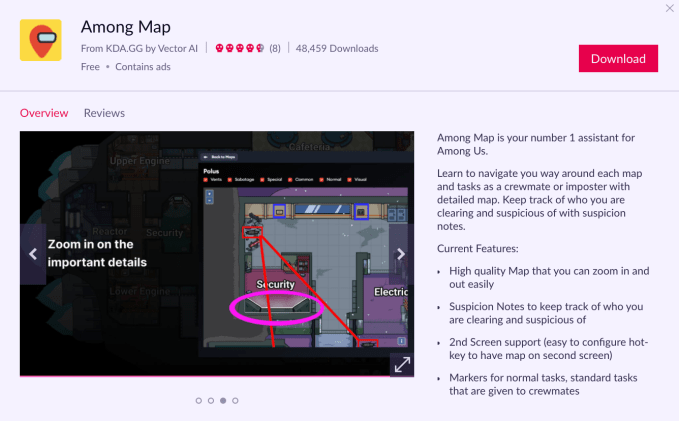
The gap in the market that Overwolf has identified and built for is the demand from avid gamers for more tools to improve their experience of the game, sometimes very specific ones that might not be core to everyone’s experience but definitely wanted by enough people to merit their creation.
These can be, for example, maps to navigate your way around a game, or dashboards or leaderboards to keep better track of various statistics of characters and other players, tools to modify characters, or apps to communicate with other players when you’re inside a game. Marchand points out that he first got into this world as a mod maker himself, years ago creating a Skype app for World of Warcraft.
“We pivoted from making mods to making a platform for others to make mods and additions,” he said. “When you think about all the aspects that need to be addressed — they include telemetry, the interactive UI, analytics, installers — they can be very complicated. So we provided platform essentials to help developers figure it all out.”
While games developers might have a very specific vision of how they would like their games to look at play, as Marchand described it to me, it’s also a big part of PC gaming culture to be able to play around with those experiences to make them unique to each player. But handling the work of third-party ecosystems is not typically in their core competencies.
“The scale and diversity of that content makes it impossible for a game maker to capture and do it all,” said Marchand. “History has proven that while game makers would like to encourage UGC they can’t and that is why we exist.”
Even if building an SDK that sits inside games themselves is a logical next step, it also represents a kind of increased trust between Overwolf and games publishers.
“Overwolf is developing the holy grail of frameworks for UGC for both publishers and in-game creators. Enabling all major publishers like us, to allow the creation of mods in a safe, secure, authorized, and profitable manner; is a game changer for all creators and IP holders,” said Oscar Navarro, head of Corporate Development for Ubisoft, in a statement.
Indeed, the trade-off for games publishers are more tools that will potentially keep users further engaged. The SDK will cover tools such as cross-platform modding, to let players discover and install mods in-game, across all platforms and storefronts; an analytics dashboard to have better visibility on how well various mods are performing; moderation tools to better vet what third-party content gets submitted; and monetization tools to bring in more creators. As with other platforms that incentivize creators, these include an Author Rewards Program, fund investments, developer contests and hackathons.
“We’ve been following UGC in gaming for many years and believe Overwolf has established itself as a leader in this category,” said Teddie Wardi, MD at Insight Partners, in a statement. “AAA game studios will want to allow creators to build and express themselves, and Overwolf is positioned as the platform to make this possible by ensuring that creators are recognized for their contributions, and easily integrating creations into games. Overwolf has proved themselves to be strong champions of the creator community and we look forward to helping them scale up in 2021.”
Financial incentives will continue to stand out for these creators, who today make most of their money not from paid mods and apps, but from in-mod or in-app advertising, a network that is run by Overwolf itself. Marchand said that the most successful developers can bring in revenues of $100,000 each month.
While Marchand likens Overwolf aims to YouTube, investors see a parallel in Unity, another key toolkit for the games developer community.
“Similar to how developers use Unity to build a game, we see Overwolf as the framework for everything UGC related to games. Overwolf allows for one of the only means of monetization for the thousands of creators, in turn, this translates to increased engagement for the publishers and more content for gamers. Services like Overwolf set the stage for the industry to see a new generation of user-generated content and we are excited to invest in the leading company moving this space forward,” commented Nick Tuosto, co-founder of Griffin Gaming Partners and managing director at LionTree, in a statement.
Early Stage is the premier “how-to” event for startup entrepreneurs and investors. You’ll hear firsthand how some of the most successful founders and VCs build their businesses, raise money and manage their portfolios. We’ll cover every aspect of company building: Fundraising, recruiting, sales, product-market fit, PR, marketing and brand building. Each session also has audience participation built-in — there’s ample time included for audience questions and discussion. Use code “TCARTICLE at checkout to get 20% off tickets right here.
Powered by WPeMatico
Aqua Security, a Boston- and Tel Aviv-based security startup that focuses squarely on securing cloud-native services, today announced that it has raised a $135 million Series E funding round at a $1 billion valuation. The round was led by ION Crossover Partners. Existing investors M12 Ventures, Lightspeed Venture Partners, Insight Partners, TLV Partners, Greenspring Associates and Acrew Capital also participated. In total, Aqua Security has now raised $265 million since it was founded in 2015.
The company was one of the earliest to focus on securing container deployments. And while many of its competitors were acquired over the years, Aqua remains independent and is now likely on a path to an IPO. When it launched, the industry focus was still very much on Docker and Docker containers. To the detriment of Docker, that quickly shifted to Kubernetes, which is now the de facto standard. But enterprises are also now looking at serverless and other new technologies on top of this new stack.
“Enterprises that five years ago were experimenting with different types of technologies are now facing a completely different technology stack, a completely different ecosystem and a completely new set of security requirements,” Aqua CEO Dror Davidoff told me. And with these new security requirements came a plethora of startups, all focusing on specific parts of the stack.
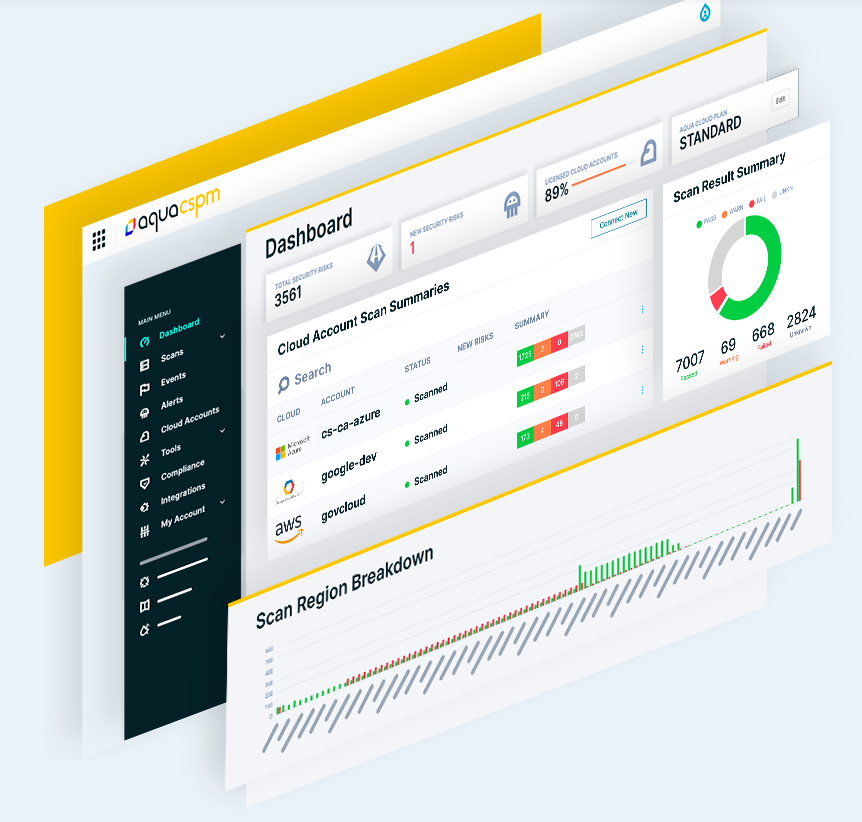
Image Credits: Aqua Security
What set Aqua apart, Dror argues, is that it managed to 1) become the best solution for container security and 2) realized that to succeed in the long run, it had to become a platform that would secure the entire cloud-native environment. About two years ago, the company made this switch from a product to a platform, as Davidoff describes it.
“There was a spree of acquisitions by CheckPoint and Palo Alto [Networks] and Trend [Micro],” Davidoff said. “They all started to acquire pieces and tried to build a more complete offering. The big advantage for Aqua was that we had everything natively built on one platform. […] Five years later, everyone is talking about cloud-native security. No one says ‘container security’ or ‘serverless security’ anymore. And Aqua is practically the broadest cloud-native security [platform].”
One interesting aspect of Aqua’s strategy is that it continues to bet on open source, too. Trivy, its open-source vulnerability scanner, is the default scanner for GitLab’s Harbor Registry and the CNCF’s Artifact Hub, for example.
“We are probably the best security open-source player there is because not only do we secure from vulnerable open source, we are also very active in the open-source community,” Davidoff said (with maybe a bit of hyperbole). “We provide tools to the community that are open source. To keep evolving, we have a whole open-source team. It’s part of the philosophy here that we want to be part of the community and it really helps us to understand it better and provide the right tools.”
In 2020, Aqua, which mostly focuses on mid-size and larger companies, doubled the number of paying customers and it now has more than half a dozen customers with an ARR of over $1 million each.
Davidoff tells me the company wasn’t actively looking for new funding. Its last funding round came together only a year ago, after all. But the team decided that it wanted to be able to double down on its current strategy and raise sooner than originally planned. ION had been interested in working with Aqua for a while, Davidoff told me, and while the company received other offers, the team decided to go ahead with ION as the lead investor (with all of Aqua’s existing investors also participating in this round).
“We want to grow from a product perspective, we want to grow from a go-to-market [perspective] and expand our geographical coverage — and we also want to be a little more acquisitive. That’s another direction we’re looking at because now we have the platform that allows us to do that. […] I feel we can take the company to great heights. That’s the plan. The market opportunity allows us to dream big.”
Powered by WPeMatico