Insight Partners
Auto Added by WPeMatico
Auto Added by WPeMatico
Facetune developer Lightricks, which operates more than a dozen subscription-based photo- and video-editing apps across iOS and Android, now has $130 million in new funding to further grow its business. The company’s newly announced Series D round includes $100 million in primary and $30 million in secondary funding, and now values the company at $1.8 billion. To date, Lightricks has raised $335 million.
The new round was co-led by New York-based VC firm Insight Partners and Hanaco Venture Capital and includes new investors Migdal Insurance, Altshuler Shaham and Shavit Capital. Existing investors Goldman Sachs Asset Management, Claltech, Harel Insurance and Finance, and Greycroft, also participated.
The company’s last round of funding was its pre-pandemic raise of $135 million, which minted the company as a unicorn.
Based in Jerusalem, Lightricks has been best known for its photo-editing app Facetune, which puts Photoshop-like retouching tools into the hands of consumers. The app quickly gained traction as online influencers tweaked their Instagram photos to look more polished, perfected and blemish-free. This growth wasn’t without controversy, however, as some argued how image-editing apps like Facetune took airbrushing too far, contributing to body image issues that now, Facebook’s internal research indicates, could have a negative effect on teenagers’ mental health.
But Facetune was only the beginning for what’s since become a mobile editing empire for Lightricks, at a time when everyone is trying to look their best online and create compelling content. Over the years, the company has rolled out the more powerful Facetune 2, along with other creativity and mobile photo apps that weren’t focused on selfies. It also expanded its product lineup beyond the creator crowd to bring a suite of tools to online marketers and small businesses. And last year, Lightricks more directly responded to the growth in online video as a form of self-expression with a new selfie retouching tool called Facetune Video — essentially Facetune for the TikTok era.

Image Credits: Lightricks
The company benefitted from COVID-19 lockdowns, as well, as more people participated online and creators, as a group, became more well-established as a way for brands to reach consumers. During peak lockdowns, the company saw a 90% increase in usage across its apps in the U.S. Meanwhile, downloads for its popular Videoleap video editing apps jumped 70% since the start of the pandemic, as TikTok adoption also grew.
Across its suite of apps, the company now touts 29 million monthly active users, where over 5 million are paid subscribers. Its users average around 78 million monthly exports, indicating Lightricks’ sizable impact on the creator economy. In 2021, Lightricks is on track for over $200 million in revenue and plans to grow that figure by 40% in the year ahead.
To do so, the company’s strategy will change. Instead of just developing its own apps, it’s now on the hunt for potential acquisitions.
“Our plan is to grow into a one-stop shop creator platform, supporting creators throughout their journey, from content creation to monetization,” says Zeev Farbman, CEO and co-founder of Lightricks. “To do so, we are broadening our acquisition activity, while developing other services in-house — our overall M&A objective is advancing our shift into the creator’s platform. To begin, we are planning between three to five acquisitions, each with a budget of tens of millions of dollars. However, we are also on the lookout for larger ticket size deals if there is enough conviction on both sides,” he notes.

Image Credits: Lightricks
The company will also enhance its own technology to develop tools and services that will help all creators with content production and monetization, and it will grow its team.
Currently, Lightricks has 460 employees and plans to add 60 more by the end of 2021. The longer-term goal is to grow the team to 1,000 employees by the end of 2023, across roles that include developers, designers and marketing. While most of this growth to date has taken place in Jerusalem, over the next two years, the company plans to grow its teams locally in Haifa, as well as internationally in London and Shenzhen. It may add other locations through M&As, as well.
The U.K. office is now the largest outside of Lightricks’ headquarters, with 23 people. This number is expected to climb to 35 by year-end and be closer to 50 or 60 by the end of 2022, with growth focused on the production of the company’s new photography app plus customer experience and marketing teams, which were previously only in Israel.
In the U.S., Lightricks is focused on content.
“Our U.S.-based activity will focus mostly on our content efforts that will provide a vast array of original, acquired and co-produced content to inspire, educate and entertain creators across the entirety of their careers,” notes Farbman. “This includes written, video, audio, short and long-form, fun and informative content,” he says.
Investors say they see the potential for Lightricks to continue to grow as the creator economy booms.
“The creator economy has changed the way we, as a society, experience social networks,” said Pasha Romanovski, co-founding partner of Hanaco Ventures, in a statement. “Audiences constantly consume information through the different content channels daily. Lightricks’ platform enables creators to have a broader, more professional, and higher-quality set of tools to optimize content. At a time when we are seeing content creators monetize content on social media at new levels, it is clear that Lightricks’ platform has the ability to create a one-stop shop that will be meaningful to its users,” he added.
Powered by WPeMatico

When you’re hot, you’re hot. And 1047 Games is making the most of the heat generated by Splitgate, its first game and now a breakout success. After working on a shoestring for years, the team has since May raised three rounds, the latest for a massive $100 million.
Co-founder and CEO Ian Proulx credited a dedicated community and, as he described it, “taking a Silicon Valley approach to running a game business.”
At the time 1047 Games was founded, about five years ago, free to play (F2P) PC games were a niche genre. While games like World of Tanks and Warframe were seeing success, and of course many mobile games relying on in-app purchases, Fortnite had yet to show the industry that F2P could be so ludicrously profitable.
“Five years ago it was very hit-driven: You spend years developing a product, put all this money into hyping the launch and then hope it’s a success,” Proulx explained. “Our process was, there’s no way we can take that risk — if we spent our entire budget and got it wrong, we’re out of business. So we thought, let’s do a soft launch, put it out there and see what happens, learn, listen, look at the data. Why would I spend money marketing a product that I have no idea about whether it will be a success? If we wanted to spend money, and we didn’t have a lot, I’d rather spend it on a product that has great metrics and KPIs.”
If you’re not familiar with it, Splitgate is a multiplayer online competitive shooter with a lot of DNA from the old-school arena shooters like Quake 3, Unreal Tournament and Halo. Those games are frenetic enough, but Splitgate adds the ability to bend space with portals, like the eponymous Portal, adding a truly ridiculous amount of mobility to the action.

Image Credits: 1047 Games
Proulx said investors shut the door on him repeatedly because they didn’t see Splitgate competing in any of the popular genres, battle royales and hero shooters, for instance. But he felt confident that this update to a familiar formula would be a success partly because the demand was there, just sleeping. “People grew up playing these games, and the reason [the market] is dead is not because they stopped loving them,” he said. “No one has moved the needle because there hasn’t been a lot of innovation, and there hasn’t been something that’s accessible to the masses. Quake Arena is great, but it’s extremely difficult. No 12-year-old Fortnite kid is gonna play it. We really do fill this void.”
While gameplay-wise Splitgate is most obviously similar to classic shooters, Proulx said a better comparison would be Rocket League, another huge success story in gaming that took a great concept and provided it as cheaply as possible, making money off cosmetic items and other totally optional perks.
“You can just have fun, turn your brain off and play, but there’s this limitless skill ceiling,” he explained.
It didn’t spring fully formed from 1047 in 2019, though. The team put out the gaming equivalent of a minimum viable product. “It was fun, and the basics were there,” he said, “but we learned there’s way more to running a business and free-to-play than just having a fun game.”
The danger for any game is simply that people stop playing, so the team focused on retention and on listening to feedback from the community to make Splitgate a “forever game” that can go years, with “seasons,” new features and maps, and so on.
The original MVP release saw some traction, around 600,000 downloads in its first month, but the big multiplatform relaunch — still as an “open beta” — this summer made a huge splash, pulling in more than 10 million in July.
Suddenly the tables had turned and 1047 was holding, as Proulx put it, “lightning in a bottle.”
“Our first round six months ago was extremely difficult. We talked to every investor on the planet and they all said no,” he recalled. But the hard work paid off: “We got lucky and ended up with the perfect partners — I can’t stress enough how supportive our investors have been.”
The next round (with Human Capital, just as Splitgate was taking off, went from phone call to funding over a weekend. This third round, with 1047 picking and choosing, was led by Lightspeed Venture Partners with participation from “Insight Partners, Anthos Capital, and earlier seed round investors Galaxy Interactive, VGames, Human Capital, Lakestar, DraperDragon, and Draper University” (from the press release).
One wonders what a team of fewer than 10 people could possibly do with $100 million ($116 million if you count the two previous rounds). But the bet investors are making is not that 1047 is going to suddenly make Assassin’s Creed, but rather that they think 10 million (and rising) people playing a unique game is potentially a huge opportunity — if the developers have the chance to follow through. This post-hype period is the valley of death for many games, the developers starved for cash after streamers and curious casuals move on. But the funding means that, for 1047, it’s license to hire like mad and double down.
“The scope of what we can do is now through the roof,” said Proulx. “There’s so much we couldn’t think about because we were a tiny team with a tiny budget, but now everything is on the table. We’re focusing on the long term — I look at the game as being 25% done. We don’t need to be Fortnite tomorrow, but now it really is about building the next Riot Games, the next big games business.”
In the meantime, Splitgate itself is still on the road to 1.0 and Proulx says the team can now truly focus on making it the game they and the community have been shaping it to be for years. He noted that many players have stuck by the team for years and helped make the game what it is, and that their input is just as important now.
“We read everything, we’re listening — keep the feedback coming. We’re still operating like the indie team that had to stay close with our community. We’re still in that mindset,” Proulx said, “but now we just have a ridiculous amount of money.”
Powered by WPeMatico
Organizations are swimming in data these days, and so solutions to help manage and use that data in more efficient ways will continue to see a lot of attention and business. In the latest development, SingleStore — which provides a platform to enterprises to help them integrate, monitor and query their data as a single entity, regardless of whether that data is stored in multiple repositories — is announcing another $80 million in funding, money that it will be using to continue investing in its platform, hiring more talent and overall business expansion. Sources close to the company tell us that the company’s valuation has grown to $940 million.
The round, a Series F, is being led by Insight Partners, with new investor Hewlett Packard Enterprise, and previous backers Khosla Ventures, Dell Technologies Capital, Rev IV, Glynn Capital and GV (formerly Google Ventures) also participating. The startup has to date raised $264 million, including most recently an $80 million Series E last December, just on the heels of rebranding from MemSQL.
The fact that there are three major strategic investors in this Series F — HPE, Dell and Google — may say something about the traction that SingleStore is seeing, but so too do its numbers: 300%+ increase in new customer acquisition for its cloud service and 150%+ year-over-year growth in cloud.
Raj Verma, SingleStore’s CEO, said in an interview that its cloud revenues have grown by 150% year over year and now account for some 40% of all revenues (up from 10% a year ago). New customer numbers, meanwhile, have grown by over 300%.
“The flywheel is now turning around,” Verma said. “We didn’t need this money. We’ve barely touched our Series E. But I think there has been a general sentiment among our board and management that we are now ready for the prime time. We think SingleStore is one of the best-kept secrets in the database market. Now we want to aggressively be an option for people looking for a platform for intensive data applications or if they want to consolidate databases to one from three, five or seven repositories. We are where the world is going: real-time insights.”
With database management and the need for more efficient and cost-effective tools to manage that becoming an ever-growing priority — one that definitely got a fillip in the last 18 months with COVID-19 pushing people into more remote working environments. That means SingleStore is not without competitors, with others in the same space, including Amazon, Microsoft, Snowflake, PostgreSQL, MySQL, Redis and more. Others like Firebolt are tackling the challenges of handing large, disparate data repositories from another angle. (Some of these, I should point out, are also partners: SingleStore works with data stored on AWS, Microsoft Azure, Google Cloud Platform and Red Hat, and Verma describes those who do compute work as “not database companies; they are using their database capabilities for consumption for cloud compute.”)
But the company has carved a place for itself with enterprises and has thousands now on its books, including GE, IEX Cloud, Go Guardian, Palo Alto Networks, EOG Resources and SiriusXM + Pandora.
“SingleStore’s first-of-a-kind cloud database is unmatched in speed, scale, and simplicity by anything in the market,” said Lonne Jaffe, managing director at Insight Partners, in a statement. “SingleStore’s differentiated technology allows customers to unify real-time transactions and analytics in a single database.” Vinod Khosla from Khosla Ventures added that “SingleStore is able to reduce data sprawl, run anywhere, and run faster with a single database, replacing legacy databases with the modern cloud.”
Powered by WPeMatico
Covering public companies can be a bit of a drag. They grow some modest amount each year, and their constituent analysts pester them with questions about gross margin expansion and sales rep efficiency. It can be a little dull. Then there are startups, which grow much more quickly — and are more fun to talk about.
That’s the case with Shelf.io. The company announced an impressive set of metrics this morning, including that from July 2020 to July 2021, it grew its annual recurring revenue (ARR) 4x. Shelf also disclosed that it secured a $52.5 million Series B led by Tiger Global and Insight Partners.
That’s quick growth for a post-Series A startup. Crunchbase reckons that the company raised $8.2 million before its Series B, while PitchBook pegs the number at $6.5 million. Regardless, the company was efficiently expanding from a limited capital base before its latest fundraising event.
What does the company’s software do? Shelf plugs into a company’s information systems, learns from the data and then helps employees respond to queries without forcing them to execute searches or otherwise hunt for information.
The company is starting with customer service as its target vertical. According to Shelf CEO Sedarius Perrotta, Shelf can absorb information from, say, Salesforce, SharePoint, legacy knowledge management platforms and Zendesk. Then, after training models and staff, the company’s software can begin to provide support staff with answers to customer questions as they talk to customers in real time.
The company’s tech can also power responses to customer queries not aimed at a human agent and provide a searchable database of company knowledge to help workers more quickly solve customer issues.
Per Perrotta, Shelf is targeting the sales market next, with others to follow. How might Shelf fit into sales? According to the company, its software may be able to offer staff already written proposals for similar-seeming deals and other related content. The gist is that at companies that have lots of workers doing similar tasks — clicking around in Salesforce, or answering support queries, say — Shelf can learn from the activity and get smarter in helping employees with their tasks. I presume that the software’s learning ability will improve over time, as well.
Shelf, around 100 people today, hopes to double in size by the end of the year, and then double again next year.
That’s where the new capital comes in. Hiring folks in the worlds of machine learning and data science is very expensive. And because the company wants to scale those hires quickly, it will need a large bank balance to lean on.
Quick ARR growth was not the only reason Shelf was able to secure such an outsized Series B, at least when compared to how much capital it had raised before. Per Perrotta, Shelf has 130% net dollar retention and no churn to report, meaning its customers are both sticky and expand organically.
While Shelf is interesting today and has certainly found niches it can sell into in its current form, I am more curious about how far the company can take its machine learning system, called MerlinAI. If its tech can get sufficiently smart, its ability to prompt and help employees could reduce onboarding time and the overall cost of employee training. That would be a huge market.
This is the sort of deal that we expect to see Tiger in — an outsized investment (compared to prior rounds) into a high-growth company that has lots of market room. Whatever price Tiger just paid for the company’s stock, a few years of continued growth should de-risk the investment. By our read, Tiger is really just the market-leading bull on software market growth in the long term. Shelf fits into that thesis neatly.
Powered by WPeMatico
Open-source business intelligence company Metabase announced Thursday a $30 million Series B round led by Insight Partners.
Existing investors Expa and NEA joined in on the round, which gives the San Francisco-based company a total of $42.5 million in funding since it was founded in 2015. Metabase previously raised $8 million in Series A funding back in 2019, led by NEA.
Metabase was developed within venture studio Expa and spun out as an easy way for people to interact with data sets, co-founder and CEO Sameer Al-Sakran told TechCrunch.
“When someone wants access to data, they may not know what to measure or how to use it, all they know is they have the data,” Al-Sakran said. “We provide a self-service access layer where they can ask a question, Metabase scans the data and they can use the results to build models, create a dashboard and even slice the data in ways they choose without having an analyst build out the database.”
He notes that not much has changed in the business intelligence realm since Tableau came out more than 15 years ago, and that computers can do more for the end user, particularly to understand what the user is going to do. Increasingly, open source is the way software and information wants to be consumed, especially for the person that just wants to pull the data themselves, he added.
George Mathew, managing director of Insight Partners, believes we are seeing the third generation of business intelligence tools emerging following centralized enterprise architectures like SAP, then self-service tools like Tableau and Looker and now companies like Metabase that can get users to discovery and insights quickly.
“The third generation is here and they are leading the charge to insights and value,” Mathew added. “In addition, the world has moved to the cloud, and BI tools need to move there, too. This generation of open source is a better and greater example of all three of those.”
To date, Metabase has been downloaded 98 million times and used by more than 30,000 companies across 200 countries. The company pursued another round of funding after building out a commercial offering, Metabase Enterprise, that is doing well, Al-Sakran said.
The new funding round enables the company to build out a sales team and continue with product development on both Metabase Enterprise and Metabase Cloud. Due to Metabase often being someone’s first business intelligence tool, he is also doubling down on resources to help educate customers on how to ask questions and learn from their data.
“Open source has changed from floppy disks to projects on the cloud, and we think end users have the right to see what they are running,” Al-Sakran said. “We are continuing to create new features and improve performance and overall experience in efforts to create the BI system of the future.
Powered by WPeMatico
Doxel, which has developed software that uses computer vision to help track and monitor progress on construction job sites, announced today that it has raised $40 million in Series B funding.
Insight Partners led the round, which included participation from existing backers Andreessen Horowitz (a16z) and Amplo and brings the startup’s total raised to $56.5 million since its December 2015 inception. A16z has participated in each of Doxel’s rounds — from seed to Series B. In addition to its institutional investors, Robinhood CEO Vladimir Tenev also put money in Doxel’s Series A round as an angel.
Co-founder and CEO Saurabh Ladha said he could not disclose the valuation at which the capital was raised, but that it was “over a 4x multiple” from its $12 million Series A in early 2020. He described the Series B as an “opportunistic raise.”
“We raised because we could, at a phenomenal valuation. The full series A is still in the bank. We didn’t touch it even,” he told TechCrunch. “Our growth and bookings traction has actually been so high that we’ve been cash flow neutral in that period of time.
Ladha was inspired to start Doxel after his family nearly suffered from financial catastrophe after a two-year delay on a major construction project in India in which his father was involved.
“I almost thought we’d lose our house. It was the first time I was made aware of the impact construction can have on livelihoods,” Ladha told TechCrunch. “Even as a child, I realized that predictability is what keeps projects on time and on budget.”
Twenty years later, when Ladha graduated from Stanford University, he learned that 90% of projects are delayed and delivered over budget.
Ladha then teamed up with Robin Singh, Doxel’s CTO, in 2015 to found Doxel to build a “computer-vision-powered predictive analytics platform” designed to help owners and contractors “navigate problems before they happen.” Or put more simply, Doxel is building what it describes as the “Waze for Construction” platform.
The company’s biggest differentiator from competitors, according to Ladha, is that it provides forward-looking insight on the construction field.
“A lot of companies offer backward-looking analytics,” he told TechCrunch. “We’re the only player offering a forward-looking solution that’s predictive…In much the same way drivers have come to rely on satellite technology to avoid traffic accidents and slow-downs ahead of them, Doxel’s customers have come to rely on our AI-powered Project Controls platform.”
Doxel, Ladha added, does monitoring for project teams, so they can focus on solving problems rather than on finding them.
“Our predictive analytics gives building owners and general contractors a way to identify critical risk factors that threaten to derail their project before they even know the risks exist,” he said. “So they are not finding out about problems when it’s too late to actually solve them.”
The premise is that by the time potential risk factors are discovered, it’s too late and cost overruns and project delays are unavoidable. Over the years, with all the data it has gathered, Doxel has built out what it describes as a “Construction Encyclopedia” that helps it in identifying those potential risk factors.
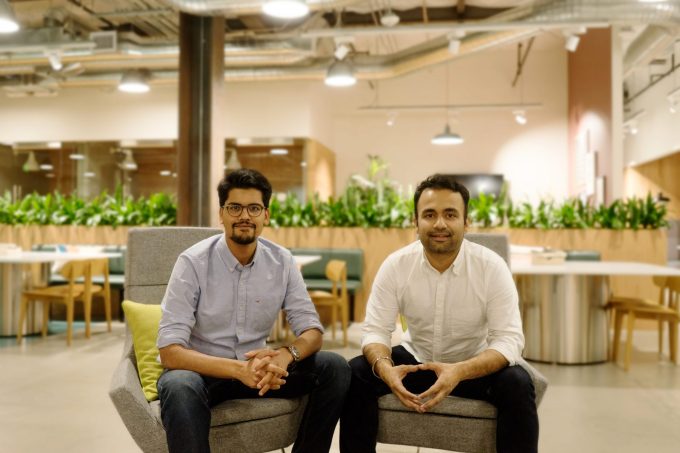
Image Credits: Co-founders Saurabh Ladha (CEO) and Robin Singh (CTO) / Doxel
The company claims that its technology has helped its customers come in up to 11% below budget on projects and see an average 38% increase in productivity, according to Ladha.
Doxel’s platform works by tapping into multiple real-time data sources on a project, such as 360-degree images, Building Information Models (BIM) — also known as 3D designs — as well as budget and schedule in an effort to provide both predictability and control to building owners and contractors. The goal is to help prevent a domino effect of delays and heightened costs, so that building owners and contractors are better able to stay on time and on budget.
“Other companies don’t bridge all silos across field, accounting and schedule management,” Ladha said. “These are three disparate entities that operate separately and without the knowledge silos being bridged.”
Besides cost overruns, the loss of revenue associated with projects not being available for use per plan is exponentially disastrous, Ladha noted. For example, a multifamily developer expecting to make money by selling or renting condo units will lose income the longer it takes for project completion.
Over time, Doxel says it has tracked tens of billions of capital expenditures for “a diverse group” of Fortune 500 companies, including Kaiser Permanente and Royal Dutch Shell. Doxel claims to have saved companies “tens of millions” of dollars with its predictive technology.
“Our users are senior execs tasked with making multibillion-dollar decisions with little information on a week to week basis,” Ladha said. “They need to know if they are on cost and on time.”
Nikhil Sachdev, managing director at Insight Partners, said his firm was really excited about the size of the problem Doxel is going after in addition to the traction the company has “with some of the world’s largest enterprises, and their highly defensible AI-first software.”
Conversations with customers revealed that prior to using Doxel’s technology, they did not have a way to accurately predict the future state of their construction projects.
“Most construction management software tools are still dependent on manual data entry or photos tagged to blueprints, which requires weeks of manual mining to extract insights on a project’s cost & schedule performance,” Sachdev wrote via email. “Doxel is the only tool we’ve found that can ingest all of the relevant data, process it using their AI, and make the leap to what the project will look like in the future.”
Looking ahead, Redwood City, California-based Doxel plans to use its new capital to scale its platform and hire across its engineering, sales, marketing and product staff. Currently, Doxel has 75 employees across offices in the U.S. and Bangalore. It’s looking to roughly double the size of its team over the next year.
Powered by WPeMatico
Among Silicon Valley circles, a fun parlor game is to ask to what extent world GDP levels are held back by a lack of computer science and technical training. How many startups could be built if hundreds of thousands or even millions more people could code and bring their entrepreneurial ideas to fruition? How many bureaucratic processes could be eliminated if developers were more latent in every business?
The answer, of course, is on the order of “a lot,” but the barriers to reaching this world remain formidable. Computer science is a challenging field, and despite proactive attempts by legislatures to add more coding skills into school curriculums, the reality is that the demand for software engineering vastly outstrips the supply available in the market.
Coding is not a bubble, and Bubble wants to empower the democratization of software development and the creation of new startups. Through its platform, Bubble enables anyone — coder or not — to begin building modern web applications using a click-and-drag interface that can connect data sources and other software together in one fluid interface.
It’s a bold bet — and it’s just received a bold bet as well. Bubble announced today that Ryan Hinkle of Insight Partners has led a $100 million Series A round into the company. Hinkle, a longtime managing director at the firm, specializes in growth buyout deals as well as growth SaaS companies.
If that round size seems huge, it’s because Bubble has had a long history as a bootstrapped company before reaching its current scale. Co-founders Emmanuel Straschnov and Josh Haas spent seven years bootstrapping and tinkering with the product before securing a $6.5 million seed round in June 2019 led by SignalFire. Interestingly, according to Straschnov, Insight was the first venture firm to reach out to Bubble all the way back in 2014. Seven years on, the two have now signed and closed a deal.
Since the seed round, Bubble has been expanding its functionality. As a no-code tool, any missing feature could potentially block an application from being built. “In our business, it’s a features game,” Straschnov said. “[Our users] are not technical, but they have high standards.” He noted that the company introduced a plugins system that allows the Bubble community to build their own additions to the platform.
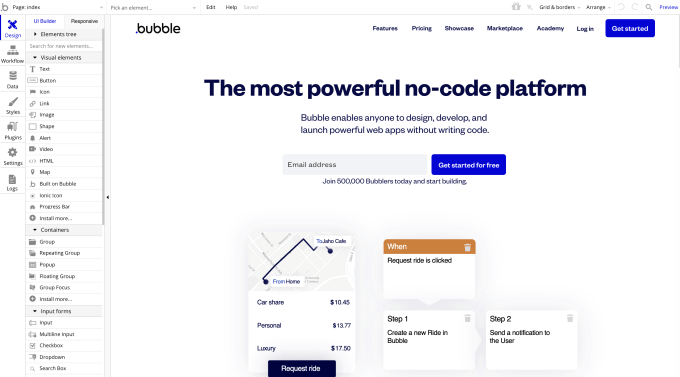
Image Credits: Bubble. Its editor offers a clickable interface for designing dynamic web applications.
As the platform matured, it happened to nail the timing of the COVID-19 pandemic last year, which saw people scrambling for new skills and improving their prospects amid a gloomy job market. Straschnov says that Bubble saw an immediate bump in usage in March and April 2020, and the company has tripled revenue over the past 12 months.
Bubble’s focus for the past eight years has been on helping people turn their ideas into startups. The company’s proposition is that a large number of even venture-backed companies could be built using Bubble without the expense of a large engineering team writing code from scratch.
Unlike other no-code tools, which focus on building internal corporate apps, Straschnov says that the company remains as focused today on these new companies as it has always been. “[We’re] not trying to move upmarket just yet — we are trying to do the same thing that AWS and Stripe did five years ago,” he said. Instead of trying to dominate the enterprise, Bubble wants to grow with its nascent customers as they expand in scale.
The company today charges a range of prices depending on the performance and scale requirements of an application. There’s a free tier, and then professional pricing starts at $25/month all the way to $475/month for its top-listed offering. Enterprise pricing is also available, as is special pricing for students.
On the latter point, Bubble is looking to invest heavily in education using its newly raised capital. While the platform is easy to use, the reality is that any design of a web application can be intimidating for a new user, particularly one who isn’t technical. So the company wants to create more videos and documentation while also heavily investing in partnerships with universities to get more students using the platform.
While the no-code space has seen prodigious investment, Straschnov said that “I don’t look at all the no-code players as competition … the true competition we have is code.” He noted that while the no-code label has been assumed by more and more startups, very few companies are focused on his company’s specific niche, and he believes he offers a compelling value proposition in that category.
The company has doubled headcount since the beginning of the pandemic, growing from around 21 employees to about 45 today. They are lightly concentrated in New York City, but the company operates remotely and has folks in 15 states as well as in France. Straschnov says that the company is looking to aggressively hire technical talent to build out the product using its new funds.
Powered by WPeMatico
The United States estimates of the food produced here approximately 40% is wasted. Globally, $2.6 trillion annually is lost.
Berlin-based Choco, which has built ordering software for restaurants and their suppliers, is working to digitize the food supply chain and announced $100 million in Series B funding, led by Left Lane Capital, to give it a $600 million post-market valuation. Joining in is new investor Insight Partners and existing investors Coatue Management and Bessemer Venture Partners.
The new round comes just over a year after Choco’s $63.7 million Series A, raised at two different periods, a $33.5 million round in 2019 and a $30.2 million round in 2020 — at a $230 million valuation — to bring total funding to $171.5 million since the company was founded in 2018.
The company’s core food procurement technology digitizes ordering workflow and communications for restaurants and suppliers. During the global pandemic, Khachab said Choco became the go-to tool for operators to be more efficient around procurement processes and reducing expenses as they adapted to the changing market conditions.
With the food industry a $6 trillion market, Choco CEO Daniel Khachab told TechCrunch he aims to make the food supply chain more transparent and sustainable in order to help increase margins in the food service sector and combat climate change.
The company did 14 months of food waste research and found that it was central to a lot of other global problems: Food waste is the third-largest driver of climate change and is causing deforestation — as evident by news from the Amazon last year — and the extinction of animals.
“It makes sense to try and solve it,” he added. “The food system is highly fragile, and what was shown in the first and second waves of the pandemic is how fragile and inflexible it was. It made the industry realize that it has to step up and that it can’t continue to work on pen and paper.”
Between the farmer and the end point, there are some nine parties involved, Khachab said. None are connected to another, which often means nine data silos and data not collected along the chain. It is important to connect them on one single platform so decision-making can be data-driven, he added.
As uncertainty swept across the food industry at the beginning of the pandemic, Khachab said Choco could either lay low and wait or invest in the company. He chose the latter, pumping up the team, regions and technology. As a result, Choco’s technology is stronger than it was 15 months ago and proved to be flexible amid the inflexible environment.
Choco saw orders quadruple on the platform in the past year, and gross merchandise value grew to $900 million annualized, up from $230 million, Khachab said.
As the company continues to learn how it can provide value to the food supply chain, half of the Series B funding will go into technology development. It will also go toward doubling its headcount, especially on the engineering side. Choco recently brought on ex-Uber and Facebook executive Vikas Gupta as chief technology officer, and Khachab said Gupta’s expertise will enable the company “to build the best technology team in Europe” and scale faster.
Choco is already operating in six markets, including the United States, Germany, France, Spain, Austria and Belgium. Khachab expects to expand in those markets and gain a footprint in new markets like Latin America, the Middle East and Asia.
Powered by WPeMatico
As the insurance industry adjusts to life in the 21st century (heh), an AI startup that has built computer vision tools to enable remote damage appraisals is announcing a significant round of growth funding.
Tractable, which works with automotive insurance companies to let users take and submit photos of damaged cars that are then “read” to make appraisals, has raised $60 million, a Series D that values Tractable at $1 billion, the company said.
Tractable says it works with more than 20 of the top 100 auto insurers in the world, and it has seen sales grow 600% in the last 24 months, which CEO Alex Dalyac told me translates as “well into eight figures of annual revenue.” He also told me that “we would have grown even faster if it weren’t for COVID.” People staying at home meant far fewer people on the roads, and fewer accidents.
Its business today is based mostly around car accident recovery — where users can take pictures using ordinary smartphone cameras, uploading pictures via a mobile web site (not typically an app).
But Tractable’s plan is to use some of the funding to expand deeper into areas adjacent to that: natural disaster recovery (specifically for appraising property damage), and used car appraisals. It will also use the investment to continue building out its technology, specifically to help build out better, AI-based techniques of processing and parsing pictures that are taken on smartphones — by their nature small in size.
Insight Partners and Georgian Partners co-led the round and it brings the total raised by the company to $115 million.
Dalyac, a deep learning researcher by training who co-founded the company with Razvan Ranca and Adrien Cohen, said that the “opportunity” (if you could call an accident that) Tractable has identified and built to fix is that it’s generally time-consuming and stressful to deal with an insurance company when you are also coping with a problem with your car.
And while a new generation of “insurtech” startups have emerged in recent years that are bringing more modern processes into the equation, typically the incumbent major insurance companies — the ones that Tractable targets — have lacked the technology to improve that process.
It’s not unlike the tension between fintech-fuelled neobanks and the incumbent banks, which are now scrambling to invest in more technology to catch up with the times.
“Getting into an accident can be anything from a hassle to trauma,” Dalyac said. “It can be devastating, and then the process for recovery is pretty damn slow. You’re dealing with so many touch points with your insurance, so many people that need to come and check things out again. It’s hard to keep track and know when things will truly be back to normal. Our belief is that that whole process can be 10 times faster, thanks to the breakthroughs in image classification.”
That process currently also extends not just to taking pictures for claims, but also to help figure out when a car is beyond repair, in which case which parts can be recycled and reused elsewhere, also using Tractable’s computer vision technology. Dalyac noted that this was a popular enough service in the last year that the company helped recycle as many cars “as Tesla sold in 2019.”
Customers that have integrated with Tractable to date include Geico in the U.S., as well as a large swathe of insurers in Japan, specifically Tokio Marine Nichido, Mitsui Sumitomo, Aioi Nissay Dowa and Sompo. Covéa, the largest auto insurer in France, is also a customer, as is Admiral Seguros, the Spanish entity of U.K.’s Admiral Group, as well as Ageas, a top U.K. insurer.
Japan is the company’s biggest market today Dalyac said — the reason being that it has an aging population, but one that is also very strong on mobile usage: combining those two, “automation is more than a value add; it’s a must have,” Dalyac said. He also added that he thinks the U.S. will overtake Japan as Tractable’s biggest market soon.
The new directions into property and other car applications will also open the door to a wider set of use cases beyond working with insurance providers over time. It will also bring Tractable potentially into new competitive environments. There are other companies that have also identified this opportunity.
For example, Hover, which has built a way to create 3D imagery of homes using ordinary smartphone cameras, is also eyeing ways of selling its tech (originally developed to help make estimates on home repairs) to insurance companies.
For now, however, it sounds like the opportunity is a big enough one that the race is more to meet demand than it is to beat competitors to do so.
“Tractable’s accelerating growth at scale is a testament to the power and differentiation of their applied machine learning system, which continues to improve as more businesses adopt it,” said Lonne Jaffe, MD at Insight Partners and Tractable board member, in a statement. “We’re excited to double down on our partnership with Tractable as they work to help the world recover faster from accidents and disasters that affect hundreds of millions of lives.”
Emily Walsh, partner at Georgian Partners added: “Tractable’s industry-leading computer vision capabilities are continuing to fuel incredible customer ROI and growth for the firm. We’re excited to continue to partner with Tractable as they apply their artificial intelligence capabilities to new, multi-billion dollar market opportunities in the used vehicle and natural disaster recovery industries.”
Powered by WPeMatico
Indian cities are home to hundreds of millions of low-skilled workers who hail from villages in search of work. Many of them have lost their jobs amid the coronavirus pandemic that has slowed several economic activities in the world’s second-largest internet market.
Apna, a startup by an Apple alum, is helping millions of such blue and gray-collar workers upskill themselves, find communities and land jobs. On Wednesday it announced its acceptance by the market has helped it raise $70 million in a new financing round as the startup prepares to scale the 16-month-old app across India.
Insight Partners and Tiger Global co-led Apna’s $70 million Series B round, which valued the startup at $570 million. Existing investors Lightspeed India, Sequoia Capital India, Greenoaks Capital and Rocketship VC also participated in the round, which brings Apna’s to-date raise to over $90 million.
The startup, whose name is inspired from a 2019 Bollywood song, at its core is solving the network gap issue for workers. “Someone born in a privileged family goes to the best school, best college and makes acquaintance with influential people. Many born just a few kilometres away are dealt with a whole different kind of life and never see such opportunities,” said Nirmit Parikh, founder and chief executive of Apna, in an interview with TechCrunch.
Apna is building a scalable networking infrastructure, something that doesn’t currently exist in the market, so that these workers can connect to the right employers and secure jobs. “Apna’s focus on digitizing the process of job discovery, application and employer candidate interaction has the potential to revolutionize the hiring process,” said Griffin Schroeder, a partner at Tiger Global, in a statement.

The workers in India “already have a champion in them, we are just helping them find opportunities,” said Nirmit Parikh, founder and chief executive of Apna. (Apna)
The startup’s eponymous Android app, available in multiple languages, features more than 70 communities today for skilled professionals such as carpenters, painters, field sales agents and many others.
On the app, users connect to each other and help with leads and share tips to improve at their jobs. The app also offers people the opportunity to upskill themselves, practice with their interview performance, and become eligible for even more jobs. The startup said it’s building Masterclass-like skilling modules, outcome or job based skilling, and also enabling peer-to-peer learning via its vertical communities. It plans to launch career counselling and resume building feature.
And that bet is working. The startup has amassed over 10 million users and just last month it facilitated more than 15 million job interviews, said Parikh. All jobs listed on the Apna platform are verified by the startup and free of cost for the candidates.
Apna has partnered with some of India’s leading public and private organizations and is providing support to the Ministry of Minority Affairs of India, National Skill Development Corporation and UNICEF YuWaah to provide better skilling and job opportunities to candidates.

Apna app (Apna)
More than 100,000 recruiters — including Byju’s, Unacademy, Flipkart, Zomato, Licious, Burger King, Dunzo, Bharti-AXA, Delhivery, Teamlease, G4S Global and Shadowfax — in the country today use Apna’s platform, where they have to spend less than five minutes to post job posts and are connect to hyperlocal candidates with relevant skills in within two days.
Apna has built the “market leading platform for India’s workforce to establish digital professional identity, network, access skills training, and find high quality jobs,” said Nikhil Sachdev, managing director, Insight Partners, in a statement.
“Employers are engaging with Apna at a rapid pace to help find high quality talent with low friction which is leading to best in class customer satisfaction scores. We believe that our investment will enable Apna to continue their steep growth trajectory, scale up their operations, and improve access to opportunities for India’s workforce.”
The startup plans to deploy the fresh capital to scale across India and eventually take the app to international markets, said Parikh. Apna, which has recently seen high-profile individuals from firms such as Uber, BCG and Swiggy join the firm, is also actively hiring for several tech roles in the South Asian market.
Apna has built the infrastructure and brand awareness in the market that it can launch in a new city within two days and drive over 10,000 interviews there in less than two days, it said.
“Our first goal is to restart India’s economy in the next couple of months and do whatever we can to help,” said Parikh, who was part of the iPhone product-operations team at Apple.
Powered by WPeMatico