india
Auto Added by WPeMatico
Auto Added by WPeMatico
Xiaomi gave Google’s well-intentioned but somewhat-stalled Android One project a major boost last year when it unveiled its first device under the program, Mi A1. That’s now joined by not one but two sequel devices, after the Chinese phone maker unveiled the Mi A2 and Mi A2 Lite at an event in Spain today.
Xiaomi in Spain? Yes, that’s right. International growth is a major part of the Xiaomi story now that it is a listed business, and Spain is one of a handful of countries in Europe where Xiaomi is aiming to make its mark. These two new A2 handsets are an early push and they’ll be available in over 40 countries, including Spain, France, Italy and 11 other European markets.
Both phones run on Android One — so none of Xiaomi’s iOS-inspired MIUI Android fork — and charge via type-C USB. The 5.99-inch A2 is the more premium option, sporting a Snapdragon 660 processor and 4GB or 6GB RAM with 32GB, 64GB or 128GB in storage. There’s a 20-megapixel front camera and dual 20-megapixel and 16-megapixel cameras on the rear. On-device storage ranges between 32GB, 64GB and 128GB.
The Mi A2 Lite is the more budget option that’s powered by a lesser Snapdragon 625 processor with 3GB or 4GB RAM, and 32GB or 64GB storage options. It comes with a smaller 5.84-inch display, there’s a 12- and 5-megapixel camera array on the reverse and a front-facing five-megapixel camera.
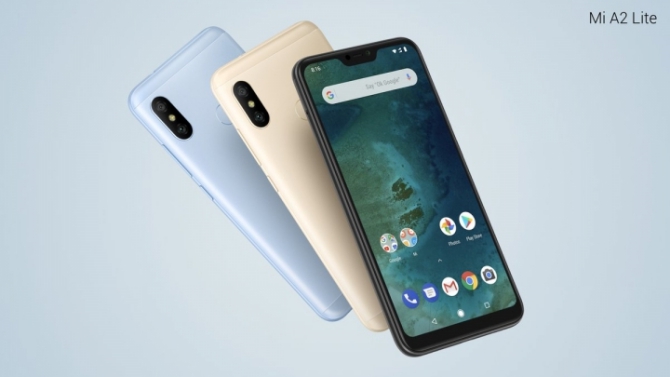
The A2 is priced from €249 to €279 ($291-$327) based on specs. The A2 Lite will sell for €179 or €229 ($210 or $268), against based on RAM and storage selection.
The 40 market availability mirrors the A1 launch last year, but on this occasion, Xiaomi has been busy preparing the ground in a number of countries, particularly in Europe. It has been in Spain for the past year, but it also launched local operations in France and Italy in May and tied up with CK Hutchison to sell phones in other parts of the continent via its 3 telecom business. While it isn’t operational in the U.S., Xiaomi has expanded into Mexico and it has set up partnerships with local retailers in dozens of other countries.
Xiaomi has been successful with its move into India, where it one of the top smartphone sellers, but it has not yet replicated that elsewhere outside of China so far.
China is, as you’d expect, the primary revenue market but Xiaomi is increasingly less dependent on its homeland. For 2017 sales, China represented 72 percent, but it had been 94 percent and 87 percent, respectively, in 2015 and 2016.
Powered by WPeMatico
In a bid to cut down on the spread of false information and spam, WhatsApp recently added labels that indicate when a message has been forwarded. Now the company is sharpening that strategy by imposing limits on how many groups a message can be sent on to.
Originally, users could forward messages on to multiple groups, but a new trial will see that forwarding limited to 20 groups worldwide. In India, however, which is WhatsApp’s largest market with 200 million users, the limit will be just five. In addition, a ‘quick forward’ option that allowed users to pass on images and videos to others rapidly is being removed from India.
“We believe that these changes — which we’ll continue to evaluate — will help keep WhatsApp the way it was designed to be: a private messaging app,” the company said in a blog post.
The changes are designed to help reduce the amount of information that goes viral on the service, although clearly this isn’t a move that will end the problem altogether.
The change is in direct response to a series of incidents in India. The BBC recently wrote about an incident which saw one man dead and two others severely beaten after rumors of their efforts to abduct children from a village spread on WhatsApp. Reportedly 17 other people have been killed in the past year under similar circumstances, with police saying false rumors had spread via WhatsApp.
In response, WhatsApp — which is of course owned by Facebook — has bought full-page newspaper ads to warn about false information on its service.
Beyond concern about firing up vigilantes, the saga may also spill into India’s upcoming national general election next year. Times Internet today reports that Facebook and WhatsApp plan to introduce a fake news verification system that it used recently in Mexico to help combat spam messages and the spreading of incorrect news and information. The paper said that the companies have already held talks with India’s Election Commission.
Powered by WPeMatico
India has quickly become ground zero for the smartphone wars. Last year, the country surpassed the U.S. to become the world’s No. 2 smartphone market, and manufacturers are falling over themselves to plant a flag.
Samsung and Xiaomi have been the two biggest winners in recent quarters, battling it out for the top spot. Earlier this year, the latter edged out the former, but the battle has remained neck and neck for the huge — and growing — market. According to new numbers from Canalys, both companies shipped 9.9 million smartphones for Q2 2018.
Xiaomi held onto the top spot — though just barely, with Samsung growing 47 percent year-over-year. That’s the Korean manufacturer’s biggest growth spurt in the country since late-2015. Look, here’s a graph.
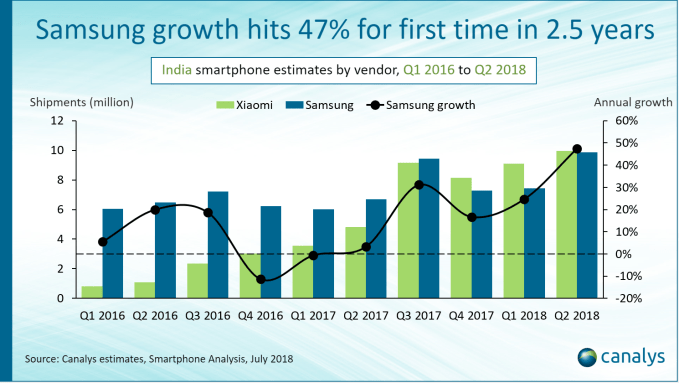
Combined, the two manufacturers comprise 60 percent of shipments in India for the quarter. Vivo and Oppo round out the top four, making Samsung the only non-Chinese company vying for a top spot. The company announced recently that it will be doubling down its efforts in the country with a factory it’s deemed the world’s largest.
ASUS has seem some growth in the country, as well, tripling since the previous quarter. Apple’s shipments, meanwhile, have dipped around 50 percent year-over-year, according to the firm, as the company adjusts its strategy in the country.
“Apple’s paring back of distributor partners and move to a ‘brand-first, volume-next’ strategy will reap rewards as it will ensure better margin per device,” says Rushabh Doshi of Canalys. “Getting priorities right will be important to smartphone vendors, and it will be a choice between profitability and volume growth.”
Powered by WPeMatico
This week Samsung is opening what it’s calling the world’s largest mobile phone factory in the world’s second largest smartphone market. Expansion, which will be fully complete in 2020, is expected to nearly double Noida (New Okhla Industrial Development Authority), India’s current phone producing capabilities from 68- to 120 million phones per year.
The electronics giant has been producing phones in the country for well over a decade (while the original factory dates back to 1996), while much of the competition has mostly been dabbling. Earlier this year, for instance, Apple started a manufacturing trial run of the iPhone 6S, after having previous done a small batch of the iPhone SE.
Along with bringing jobs, such localized manufacturing could also go a ways toward helping bring the cost of devices down. India’s government, naturally, is excitedly embracing the announcement as art of its “Make in India” initiative. As such, Prime Minister Narendra Modi was on-hand for the opening ceremony, along with South Korean president Moon Jae-in, repping his home country’s largest company.
“Our Noida factory, the world’s largest mobile factory, is a symbol of Samsung’s strong commitment to India, and a shining example of the success of the Government’s ‘Make in India’ program,” Samsung India CEO HC Hong said in a release tied to the news. “Samsung is a long-term partner of India. We ‘Make in India’, ‘Make for India’ and now, we will ‘Make for the World’. We are aligned with Government policies and will continue to seek their support to achieve our dream of making India a global export hub for mobile phones.”
India represents a massive — and growing — smartphone market. Last year the country passed the U.S., becoming the number two market after China. A commitment to local manufacturing will no doubt go a long way for Samsung, which currently ranks as the number two smartphone maker in the country, behind Xiaomi.
Powered by WPeMatico
Cashify, a company that buys and sells used smartphones, is the latest India startup to raise capital from Chinese investors after it announced a $12 million Series C round.
Chinese funds CDH Investments and Morningside led the round, which included participation from Aihuishou, a China-based startup that sells used electronics in a similar way to Cashify and has raised more than $120 million. Existing investors, including Bessemer Ventures and Shunwei, also took part in the round.
This new capital takes Cashify to $19 million raised to date.
The business was started in 2013 by co-founders Mandeep Manocha (CEO), Nakul Kumar (COO) and Amit Sethi (CTO) initially as ReGlobe. The business gives consumers a fast way to sell their existing electronics; it deals mainly in smartphones but also takes laptops, consoles, TVs and tablets.
“When we began we saw a lot of transaction for phone sales moving from offline to online,” Manocha told TechCrunch in an interview. “But consumer-to-consumer [for used devices] is highly opaque on price discovery and you never know if you’re making the right decision on price and whether the transaction will take place in the timeframe.”
These days, the company estimates that the average upgrade cycle has shifted from 20 months to 12 months, and now it is doubling down.
With Cashify, sellers simply fill out some details online about their device, then Cashify dispatches a representative who comes to their house to perform diagnostic checks and gives them cash for the device that day. The startup also offers an app which automatically carries out the checks — for example ensuring the camera, Bluetooth module, etc. all work — and offers a higher cash payment for the user since Cashify uses fewer resources.
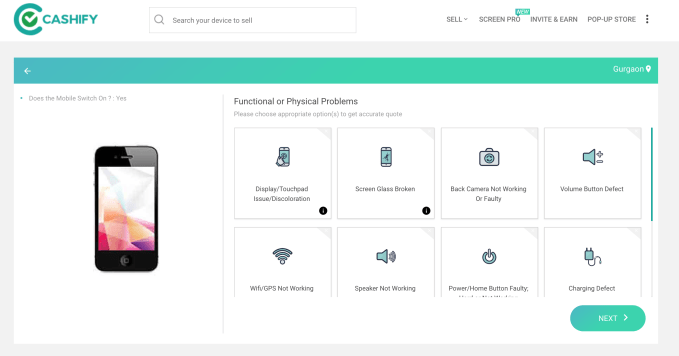
A sample of the Cashify Q&A for selling a device
Beyond its website and app, Cashify gets devices from trade-in programs for Samsung, Xiaomi and Apple in India, as well as e-commerce companies like Flipkart, Amazon and Paytm Mall.
Used device acquired, what happens next is interesting.
The startup has built out a network of offline merchants who specialize in selling used phones. Each phone it acquires is then sold (perhaps after minor refurbishments) to that network, so it might pop up for sale anywhere in India.
With this new money, Cashify CEO Manocha said the company will develop an online resale site that will allow anyone to buy a used phone from the company’s network. Devices sold by Cashify online will be refurbished with new parts where needed, and they’ll include a box and six-month warranty to give a better consumer experience, Manocha added.
Today, Cashify claims to handle 100,000 smartphones a month, but it is planning to grow that to 200,000 by the end of this year. Cashify said its devices are typically low-end, those that retail for sub-$300 when new. A large part of that push comes from the online site, but the startup is also enlarging its offline merchant network and working to reach more consumers who are actually selling their device. That’s where Manocha said he sees particular value in working with Aihuishou.
Cashify is also developing other services. It recently started offering at-home repairs for customers and Manocha said that adding Chinese investors — and Aihuishou in particular — will help it with its sourcing of components for the repairs service and general refurbishments.
Cashify estimates that the used smartphone market in India will see 90 million phones sold this year, with as many as 120 million trading by 2020. That’s close to the 124 million shipments that analysts estimate India saw in 2017, but with surprisingly higher margins.
A reseller can make 10 percent profit on a device, Manocha explained, and Cashify’s own price elasticity — the difference between what it buys from consumers at and what it sells to resellers for — is typically 30-35 percent, he added. That’s more than most OEMs, but that doesn’t take into account costs on the Cashify side, which bring that number down.
“When I sell to a reseller, the margins aren’t that exciting, which is why we want to sell direct to consumers,” the Cashify CEO said.
The startup has plenty going on at home in India, but already it is considering overseas possibilities.
“We will focus on India for at least the next 12 months, but we have had discussions on markets that would make sense to enter,” Manocha said, explaining that the Middle East and Southeast Asia are early frontrunners.
“We are working very closely with one of the Chinese players and figuring out if we can do some business in Hong Kong because that’s the hub for second-hand phones in this part of the world,” he added.
Note: The original version of this article was updated to correct that Amit Sethi is CTO not CFO.
Powered by WPeMatico
Capital Float, the fintech startup that says it is India’s largest online lender, announced today that it has raised $22 million in new funding from Amazon. At the end of last year, reports surfaced that Amazon was considering an investment in Capital Float as an extension of its $45 million Series C, which was announced last August. The Bangalore-based startup confirmed to TechCrunch that Amazon’s investment is indeed an extension of that round and brings the total equity it has raised over the past 12 months to $67 million.
Over the same period, Capital Float also raised $80 million of debt from banks and other financial companies, which it combines with its own balance sheet to finance loans to small businesses and other borrowers. Amazon India is among several e-commerce platforms that the company has partnered with to provide loans to sellers, including Snapdeal and Shopclues.
Since its inception in 2013 by co-founders Sashank Rishyasringa and Gaurav Hinduja, Capital Float has raised a total of about $110 million in equity funding from investors, including Ribbit Capital, SAIF Partners, Sequoia India, Creation Investments and Aspada, as well as total debt lines of $130 million.
During the last six months, Capital Float added 50,000 new customers, bringing its total customer base to more than 80,000 people in more than 300 cities. The startup says it currently disburses more than 10,000 loans each month and now has an outstanding loan portfolio of more than $170 million, with a default rate of about 2 percent. About 70 percent of its loans are microloans ranging from 25,000 rupees to 500,000 rupees (about $376 to $7,530).
With the investment from Amazon, the startup has set an ambitious goal of adding 300,000 new customers and originating more than $800 million in loans this year.
In a press statement, Amazon India’s country manager Amit Agarwal said, “We’re excited to work with Capital Float and invest alongside other investors. We are highly impressed with what Gaurav and Sashank have built and we back missionary entrepreneurs and management teams. Credit in India is highly under-penetrated and Capital Float is bringing the right kind of credit solutions to the underserved and informally served segments of SMEs to help realize their full potential.”
Over the last year, Capital Float expanded into more verticals, including products for small- to mid-sized manufacturers, point-of-sale financing for retailers and loans for school construction and self-employed professionals like doctors. It also added new online payment gateways to make it easier for borrowers to repay loans and began piloting deep learning-based underwriting models that use data points like image processing, geotags and new policies such as the Goods and Service Tax (GST), an indirect tax launched last year that is levied at every step of the production chain and the banknote demonetization started by Prime Minister Narendra Modi’s government in 2016.
Powered by WPeMatico
Coverfox, one of a handful of companies aiming to digitize insurance in India, has landed fresh funding via a $22 million Series C round that will be used to push into more rural parts of the country.
The investment is led by IFC, a sister organization of World Bank, and U.S. insurance firm Transamerica, with participation from existing investors SAIF Partners, Accel and Catamaran Ventures, the fund from Infosys co-founder Narayana Murthy. The company confirmed the round was actually closed in two phases, which explains why media reports around the Transamerica investment surfaced last June.
Based in Mumbai, Coverfox is a digital platform that aggregates insurance options. Currently, it works with 35 partners to offer some 150-plus packages that span health, car, bike, life and travel insurance policies in India.
Today’s announcement takes Coverfox, which was founded in 2013, to $39 million raised from investors.
Many of those same Coverfox backers have also funded digital insurance firm Acko, which was started by Coverfox co-founder Varun Dua last year. Acko and Dua made headlines when, nearly a year ago, the startup announced a $30 million seed investment round that came in before a product had even hit the market.
Acko got its license from the Insurance Regulatory & Development Authority of India (IRDAI) in September to go into business, and it again attracted headlines for its relationship with Amazon. The e-commerce firm was said to be in talks to invest (no deal has been announced) while Dua himself said the company was planning to develop products for the e-commerce giant, and potentially others of that scale too.
To date, though, Coverfox isn’t working with Acko, according to its CEO Premanshu Singh.
“We don’t work with Acko at all, and we don’t plan to work for next three to six months at least,” he said in an interview with TechCrunch, explaining that the company is going after larger insurance providers initially.
He also dismissed the potential for consolidation between the two despite the common investor base.
“Both entities are very different, with separate teams and different office locations. We can’t visualize anything strategic coming up,” Singh added.
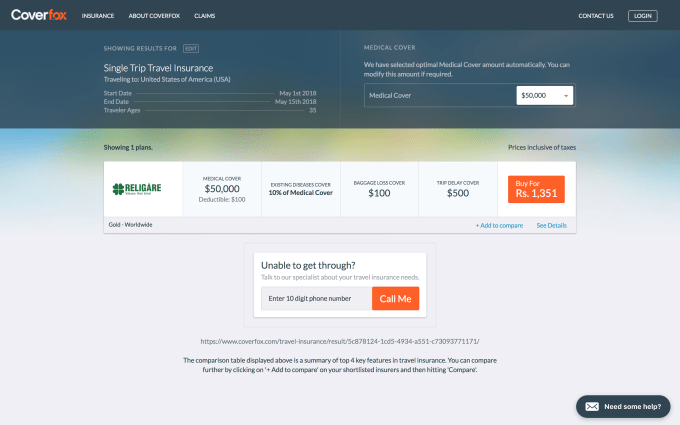
Coverfox itself said it has seen “impressive momentum and scale” lately, which Singh clarified as four-fold revenue growth over the past year, although he declined to give specific figures. The company plans to double down on growth and use the new money to expand into India’s tier-two and tier-three cities, where it said that insurance coverage is 35 percent lower than in urban areas, while coverage among women is lower still at 40 percent below that of men.
The company also plans to put additional capital behind its Coverdrive app for Android, which is designed to equip insurance sales staff, who previously worked almost entirely offline, with digital-first materials to help grow their business using the Coverfox platform.
Coverdrive is a smart addition because it helps the company tackle the long tail of rural India without initial investment upfront. Instead, insurers use its service to boost their own business, thereby growing Coverfox sales at the same time.
Singh said Coverdrive accounts for around one-quarter of Coverfox sales. But that isn’t its only focus in tier-two and tier-three markets, where the company will roll out its own staff and focus on listing related policies.
Citing the growth of mobile data usage in rural India and a growth in digital as internet banking chips away at the bank assurance model used by most insurance brands, Singh said that rural India is better positioned for expansion than in previous years.
Coverfox isn’t yet looking at overseas options despite Singh explaining that there has been a considerable volume of inbound requests.
“It’s going to happen for sure [but] we haven’t decided where to go first,” he said.
Likewise, the model isn’t decided on either. Beyond a straight-up expansion, Coverfox could move into new markets via partnership or franchise.
Powered by WPeMatico
Amazon has quietly launched an Android web browser app for emerging markets, where access to mobile data and high-speed connectivity is more limited. The browser has the rather generic name of: “Internet: fast, lite and private” on Google Play, and promises to be “lighter than the competition.”
The app first appeared on the Play Store in March, and has fewer than 1,000 downloads, according to data from app store intelligence firm Sensor Tower.
It’s only available to users in India for the time being, and is supported on devices running Android 5.0 or higher.
Like most “lite” apps, the new browser is a small download — it’s less than 2 MB in size. That’s much smaller than other browsers, including Chrome (21MB), Edge (54.5MB), Firefox (19.9MB) and Opera (14.7MB), according to an analysis by appFigures.

The browser’s Google Play description also notes that it’s “private,” as it doesn’t ask for extra permissions or collect private data like other browsers do. This seems to indicate that it’s meant to be something of a competitor to other private mobile browsers, like Firefox, which blocks website trackers.
The browser additionally supports Private tabs, so you can browse without saving visits to your history, plus other features like tab previews, an automatic full-screen mode and integrated news reader of sorts.
In fact, the news reading experience is another telling indication that the browser is only meant for Indian users. The app’s description notes the browser homepage is designed to keep you up-to-date with news, cricket and entertainment from top sources. Yep, cricket — the most popular sport in India.

And finally, the “feedback” email on Google Play points to Amazon India, which indicates it was built by that team.
In addition to the new browser, Amazon also offers a Kindle Lite app in India.
The company is not alone in building lightweight mobile apps for emerging markets.
Facebook also offers “lite” versions of its apps, like Facebook Lite and Messenger Lite, to reach users with limited connectivity and access to data. Google has also rolled out a suite of lightweight mobile apps under the “Go” branding. Some of these, like Gmail Go, only come pre-installed on select devices. Others, meanwhile, are available through Google Play for anyone to download, like YouTube Go, Files Go, Google Go, Google Maps and Google Assistant Go.
It is interesting, however, that Amazon didn’t adopt a similar strategy by offering a “lite” version of its existing Silk browser, but has instead built something new.
And if its goal is to offer an alternative to Silk on the Fire tablets it sells in India, it’s odd that the browser isn’t yet available in the Amazon Appstore in India.
Amazon has not yet returned a request for comment about the new app.
Powered by WPeMatico
 WhatsApp has begun testing a new payments feature in India that will allow people to send money to other WhatsApp users, excluding merchant accounts. The feature is currently in beta, according to sources familiar with the company’s plans, but hasn’t been publicly announced because it’s not widely available at this time. The company has been working on support for a… Read More
Powered by WPeMatico
 Xiaomi couldn’t have wished for better timing of two reports that claim it has toppled Samsung to become India’s top-selling smartphone company. The Chinese firm, which is reportedly on a roadshow ahead of an IPO that could value it as high as $100 billion, is said to have beaten Samsung’s sales efforts in India, the world’s second-largest smartphone market behind… Read More
Powered by WPeMatico