Enterprise
Auto Added by WPeMatico
Auto Added by WPeMatico
As the pandemic has shut down in-person meetings, and pushed us online, products like Zoom, Cisco WebEx, Google Meet and Microsoft Teams have become part of our daily lives. Into the fray jumps huddl.ai, a 3.5-year-old startup from a serial entrepreneur who wants to bring a dose of artificial intelligence to meeting technology.
Company co-founder and CEO Krishna Yarlagadda says while these companies have introduced the video meeting concept, his startup has a vision of taking it further. “As we move forward. I think the next [era] is going to be about intelligence,” Yarlagadda told TechCrunch.
That involves using AI tools to transcribe the meeting, pull out the salient points and help users understand what happened without poring over notes to find the key information in a long session. “Primarily there’s a purpose for every meeting, or essentially we’re meeting for outcomes, and that’s where Huddl comes in,” he said.
Yarlagadda said that current solutions simply give you a link to a cloud room and everyone involved clicks and enters. Huddl wants to bring some more structure to that whole process. “We’ve developed a very user-centric architecture and also added a layer called meeting memory, which essentially captures the core aspects of the meeting — the agenda, action items and moments and then added search,” he explained.
They call these meeting elements moments, and they involve capturing three key aspects of the meeting: the agenda and collaborative notes participants take during the meeting, screen captures the user takes using a built-in tool and, finally, audio, which captures a recording of the meeting. Users can search across these elements to find the parts of the meeting that are most relevant to them.

Image Credits: huddl.ai
Further, it integrates with other enterprise applications like Slack or Salesforce to move to applicable tools items discussed during these meetings when it makes sense. “Essentially what we’re trying to do is create a five-minute version of your 60-minute meeting that is stored in your memory and that becomes part of your search. Post-meeting this content has a life, and through APIs and integrations, we can [share it with the right programs],” he said.
For instance, if it’s an action item in a sales meeting, it would go to Salesforce, and if it is a software bug in an engineering meeting, it could be shared with Jira.
The company was started in 2017, and has raised $8.7 million in seed money to date. It has 50 employees, with 10 in the U.S. and the others in India, and has plans to hire 15-20 additional people this year between the U.S. and India offices.
Powered by WPeMatico
At Microsoft Inspire today, the company made several Dynamics 365 announcements, including Dynamics 365 Customer Voice, a real-time customer feedback tool that could compete with Qualtrics, the company SAP bought in 2018 for a cool $8 billion.
Microsoft General Manager Brenda Bown says that as more customers move online during the pandemic, it’s more important than ever to capture real-time customer feedback that you can combine with other data to build a more complete picture of the customer that could lead to more successful interactions in the future.
“Customer Voice is a feedback management solution, and it’s designed to empower businesses and organizations to build better products, deliver better experiences to customers and really build the relationships for the customers with that feedback management tool,” Bown told TechCrunch.
The data gets shared with Microsoft’s customer data platform (CDP), and is built on top of Dynamics 365 and the Power Platform. The latter provides a way to customize the Customer Voice tool to meet the needs of an individual company.
Brent Leary, partner and co-founder at CRM Essentials, says this solves the problem of getting feedback as the interaction is happening. He adds that being able to share that data directly with the CDP makes it even more valuable.
“Customer feedback has to be done as close to the interaction/transaction as possible and as frictionless as possible for it to really work, or else customers won’t give it to you. And then the data has to be integrated into the CDP with all the other data automatically to really be of use. And having a platform to handle both the feedback capture and the data integration optimizes the likelihood of this happening,” Leary said.
The company also announced Dynamics 365 Connected Store, a set of tools designed to help stores manage in-store and curbside traffic, among other things. As the pandemic limits the number of people in a store at one time, using sensors and cameras, Connected Store can help managers understand and manage the number of people inside the store at any given time to help aid in social distancing.
It can also help add a level of automation to curbside pickup, letting an employee know when the customer has pulled up. “It alerts the employee and they can bring out the order for a more seamless and quick pickup. And obviously this scenario is super important today because of [more people wanting] contactless pickup,” Bown said.
Finally, the company announced a fraud protection component. She says that Dynamics 365 Fraud Protection helps protect businesses online or in physical stores from fraudulent activities, which she says is even more important as more transactions are conducted digitally. New capabilities include account protection and loss prevention tooling.
Inspire is the company’s annual partner conference, which is being held virtually this year. Bown says by running it virtually, the company can involve even more partners than a typical in-person conference because companies that couldn’t previously attend because of cost and distance are able to participate this year.
Powered by WPeMatico
Today Jamf, a software company that helps other firms manage their Apple devices, raised its IPO price range.
The company had previously targeted a $17 to $19 per-share range. A new SEC filing from the firm today details a far higher $21 to $23 per-share IPO price interval.
Jamf still intends to sell up to 18.4 million shares in its debut, including 13.5 million in primary stock, 2.5 million shares from existing shareholders and an underwriter option worth 2.4 million shares. The whole whack at $21 to $23 per share would tally between $386.4 million and $423.2 million, though not all those funds would flow to the company.
At the low and high-end of its new IPO range, Jamf is worth between $2.44 billion and $2.68 billion, steep upgrades from its prior valuation range of $1.98 billion to $2.21 billion.
Jamf follows in the footsteps of recent IPOs like nCino, Vroom and others in seeing demand for its public offering allow its pricing to track higher the closer it gets to its public offering. Such demand from public-market investors indicates there is ample demand for debut shares in mid-2020, a fact that could spur other companies to the exit market.
Coinbase, Airbnb and DoorDash are three such companies that are expected to debut in the next year’s time, give or take a quarter or two.
In anticipation of the Jamf debut that should come this week, let’s chat about the company’s recent performance.
Observe the following table from the most-recent Jamf S-1/A:
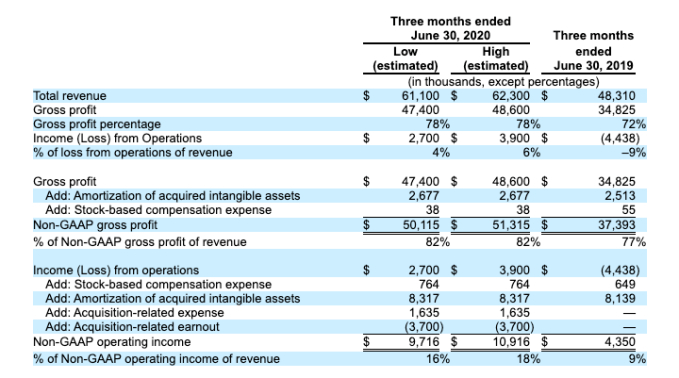
From even a quick glance we can learn much from this data. We can see that Jamf is growing, has improving gross margins and has managed to swing from an operating loss to operating profit in Q2 2020, compared to Q2 2019. And, for you fans out there of adjusted metrics, that Jamf managed to generate more non-GAAP operating income in its most recent period than the year-ago quarter.
In more precise terms:
Profits! Growth! Software! Improving margins! It’s not a huge surprise that Jamf managed to bolster its IPO price range.
Finally, for the SaaS-heads out there, the following:

This data lets us have a little fun. Recall that we have seen possible valuations for Jamf at IPO that started at $1.98 billion to $2.21 billion, and now include $2.44 billion and $2.68 billion? With our two ARR ranges for the end of Q2, we can now come up with eight ARR multiples for Jamf, from the low-end of its initial IPO price estimate, to the top-end of its new range.
Here they are:
From that perspective, the pricing changes feel a bit more modest, even if they work out to a huge spread on a valuation basis.
Regardless, this is the current state of the Jamf IPO. Rackspace also filed a new S-1/A today, but we can’t find anything useful in it. A bit like the Jamf S-1/A from Friday. Perhaps we’ll get a new Rackspace document soon with pricing notes.
And, of course, like the rest of the world we await the Palantir S-1 with bated breath. Consider that our white whale.
Powered by WPeMatico
When Salesforce launched Force.com in 2007, it was the culmination of years of work to bring together a way to customize Salesforce and eventually to build applications on top of the platform. By using a set of Salesforce services, companies could take advantage of work that SFDC had already done, speeding up building time and reducing time to market. Today, the successor of Force.com is called Salesforce Platform.
But going that route didn’t come without some risk, because back in 2007 building atop a Platform as a Service (PaaS) wasn’t a common way of developing software. Even by 2012 when nCino launched its banking software solutions on Force.com, it likely raised some eyebrows by using a cloud platform as the backbone of its fintech offering.
Even though it probably took resolve, the approach worked, as evidenced this week when nCino went public — a debut that was met with a strong investor response. And nCino is notably not the first time that a company built atop Salesforce’s PaaS has gone public; nCino’s own IPO follows Veeva’s 2013 debut.
But astute observers for the Salesforce ecosystem will note that other successful companies have been built on the Salesforce cloud. As you will see, many successful companies have benefited from building on top of Salesforce.
Powered by WPeMatico
Puppet, the Portland, Oregon-based infrastructure automation company, announced a $40 million debt round today from BlackRock Investments.
CEO Yvonne Wassenaar says the company sees this debt round as part of a longer-term relationship with BlackRock . “What’s interesting, and I think part of the reason why we decided to go with BlackRock, is that typically when you look at how they invest this is the first step of a much longer-term relationship that we will have with them over time that has different elements that we can tap into as the company scales,” Wassenaar told TechCrunch.
In terms of the arrangement, rather than BlackRock taking a stake in the company, Puppet will pay back the money. “We’ve borrowed a sum of money that we will pay back over time. BlackRock does have a board observer seat, and that’s really because they’re very interested in working with us on how we grow and accelerate the business,” Wassenaar said.
Puppet has been in the process of rebuilding its executive team, with Wassenaar coming on board about 18 months ago. Last year she brought in industry veterans Erik Frieberg and Paul Heywood as CMO and CRO, respectively. This year she brought in former Cloud Foundry Foundation director Abby Kearns to be CTO.
All of these moves are with an eye to a future IPO, says Wassenaar. “We’re looking at how do we progress ultimately, ideally on a path to an IPO, and what is it going to take for Puppet to go through that journey,” she said.
She points out that in some ways, the pandemic has forced companies to look more closely at automation solutions like the ones that Puppet provides. “What’s really interesting is […] that the pandemic in many ways has put wind in our sails in terms of the need for corporations to automate and think about how they leverage and extend from a technology perspective going forward,” she said.
As Puppet continues to grow, she says that diversity is a core organizational value, and that while the company has made progress from a gender perspective (as illustrated by the presence of her and Kearns in the C Suite), they still are working at being more racially diverse.
“Where I believe we have a lot more work and there’s a lot more focus right now is further complementing that [gender diversity] from a racial perspective. And it’s an area that I have personally taken on, and I’m committed to making changes in the company as we go forward to support more racial diversity as well,” she said.
Previously the company had raised almost $150 million, with the most recent round being a $42 million Series F in 2018, according to Crunchbase data. The company previously took $22 million in debt financing in 2016, prior to Wassenaar coming on board.
Powered by WPeMatico
Qumulo, a Seattle storage startup helping companies store vast amounts of data, announced a $125 million Series E investment today on a $1.2 billion valuation.
BlackRock led the round with help from Highland Capital Partners, Madrona Venture Group, Kleiner Perkins and new investor Amity Ventures. The company reports it has now raised $351 million.
CEO Bill Richter says the valuation is more than 2x its most recent round, a $93 million Series D in 2018. While the valuation puts his company in the unicorn club, he says that it’s more important than simple bragging rights. “It puts us in the category of raising at a billion-plus dollar level during a very complicated environment in the world. Actually, that’s probably the more meaningful news,” he told TechCrunch.
It typically hasn’t been easy raising money during the pandemic, but Richter reports the company started getting inbound interest in March just before things started shutting down nationally. What’s more, as the company’s quarter closed at the end of April, they had grown almost 100% year over year, and beaten their pre-COVID revenue estimate. He says they saw that as a signal to take additional investment.
“When you’re putting up nearly 100% year over year growth in an environment like this, I think it really draws a lot of attention in a positive way,” he said. And that attention came in the form of a huge round that closed this week.
What’s driving that growth is that the amount of unstructured data, which plays to the company’s storage strength, is accelerating during the pandemic as companies move more of their activities online. He says that when you combine that with a shift to the public cloud, he believes that Qumulo is well positioned.
Today the company has 400 customers and more than 300 employees, with plans to add another 100 before year’s end. As he adds those employees, he says that part of the company’s core principles includes building a diverse workforce. “We took the time as an organization to write out a detailed set of hiring practices that are designed to root out bias in the process,” he said.
One of the keys to that is looking at a broad set of candidates, not just the ones you’ve known from previous jobs. “The reason for that is that when you force people to go through hiring practices, you open up the position to a broader, more diverse set of candidates and you stop the cycle of continuously creating what I call ‘club memberships’, where if you were a member of the club before you’re a member in the future,” he says.
The company has been around since 2012 and spent the first couple of years conducting market research before building its first product. In 2014 it released a storage appliance, but over time it has shifted more toward hybrid solutions.
Powered by WPeMatico
Google is launching a major update to its G Suite productivity tools today that will see a deep integration of Gmail, Chat, Meet and Rooms on the web and on mobile, as well as other tools like Calendar, Docs, Sheets and Slides. This integration will become available in the G Suite early adopter program, with a wider roll-out coming at a later time.
The G Suite team has been working on this project for about a year, though it fast-tracked the Gmail/Meet integration, which was originally scheduled to be part of today’s release, as part of its response to the COVID-19 pandemic.
At the core of today’s update is the idea that we’re all constantly switching between different modes of communication, be that email, chat, voice or video. So with this update, the company is bringing all of this together, with Gmail being the focal point for the time being, given that this is where most users already find themselves for hours on end anyway.
Google is branding this initiative as a “better home for work” and in practice, it means that you’ll not just see deeper integrations between products, like a fill calendaring and file management experience in Gmail, but also the ability to have a video chat open on one side of the window while collaboratively editing a document in real time on the other.
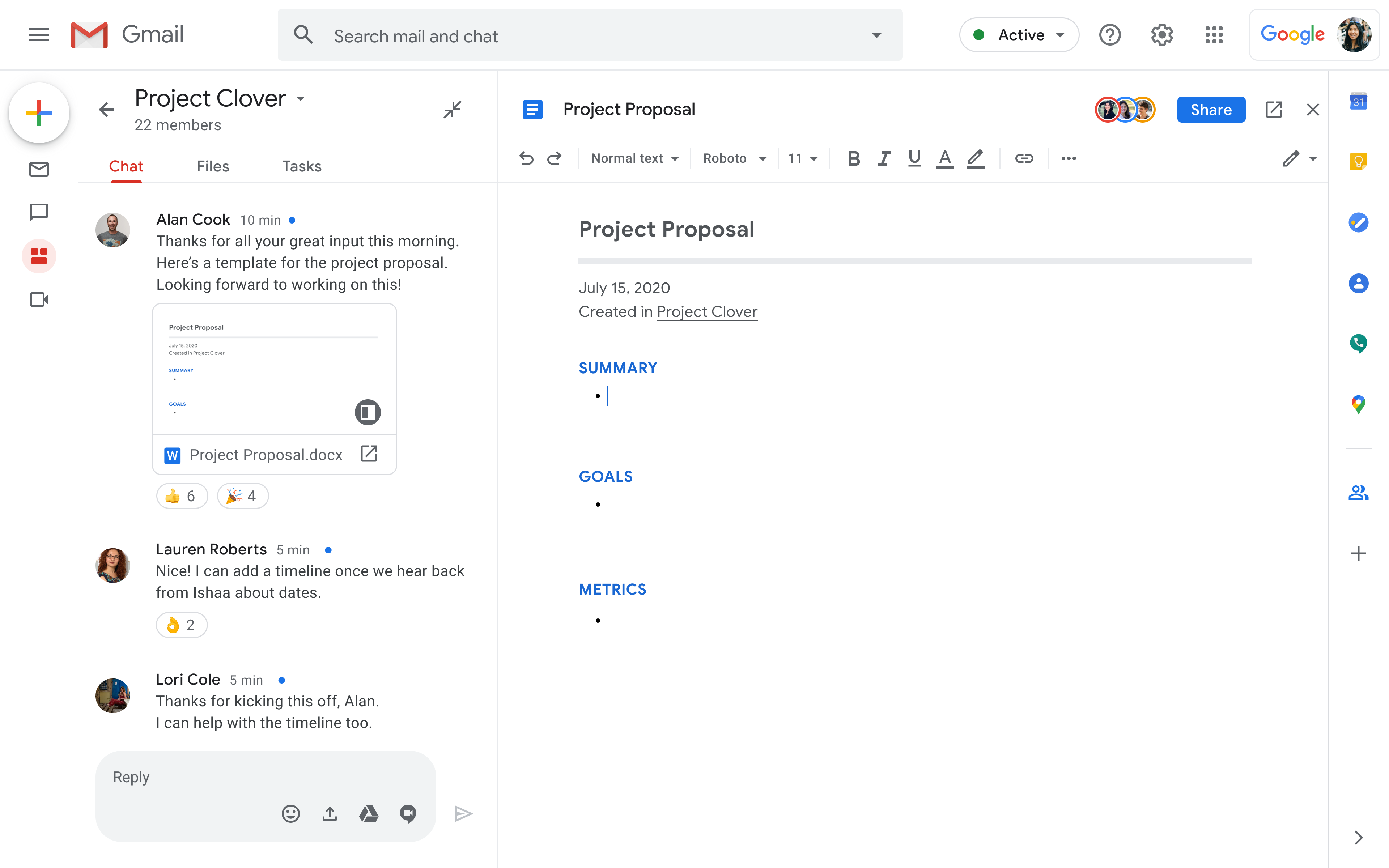
Image Credits: Google
According to G Suite VP and GM Javier Soltero, the overall idea here is not just to bring all of these tools closer together to reduce the task-switching that users have to do.

Image Credits: Google
“We’re announcing something we’ve been working on since a little bit before I even joined Google last year: a new integrated workspace designed to bring together all the core components of communication and collaboration into a single surface that is not just about bringing these ingredients into the same pane of glass, but also realizes something that’s greater than the sum of its parts,” he told me ahead of today’s announcement. “The degree of integration across the different modes of communication, specifically email, chat, and video calling and voice video calling along with our existing physical existing strength in collaboration.”
Just like on the web, Google also revealed some of its plans when it first announced its latest major update to Gmail for mobile in May, with its Meet integration in the form of a new bar at the bottom of the screen for moving between Mail and Meet. With this, it’s expanding to include native Chat and Rooms support as well. Soltero noted that Google thinks of these four products as the “four pillars of the integrated workspace.” Having them all integrated into a single app means you can manage the notification behavior of all of them in a single place, for example, and without the often cumbersome task-switching experience on mobile.
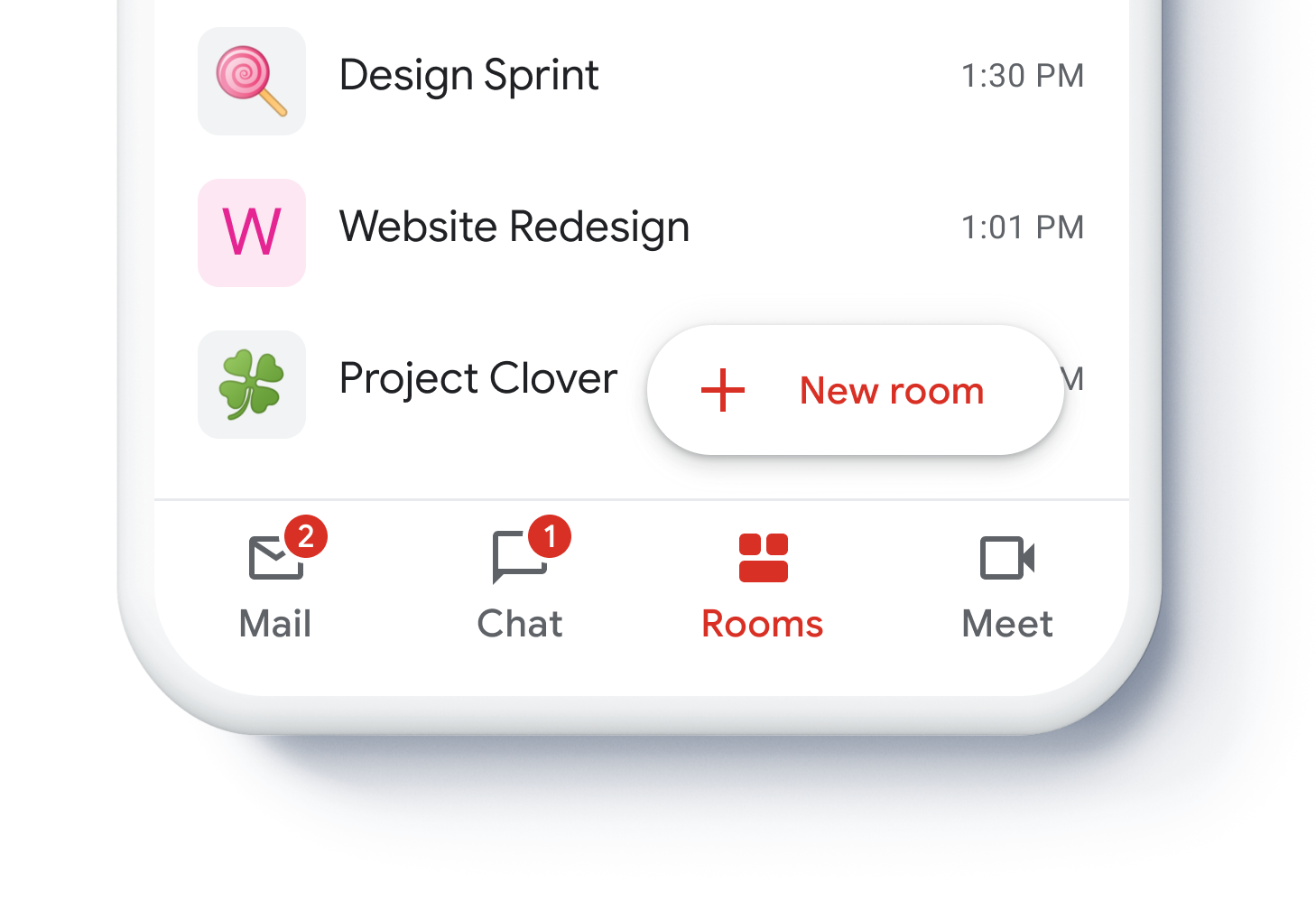
Image Credits: Google
For now, these updates are specific to G Suite, though similar to Google’s work around bringing Meet to consumers, the company plans to bring this workspace experience to consumers as well, but what exactly that will look like still remains to be seen. “Right now we’re really focused. The people who urgently need this are those involved in productivity scenarios. This idea of ‘the new home for work’ is much more about collaboration that is specific to professional settings, productivity and workplace settings,” Soltero said.
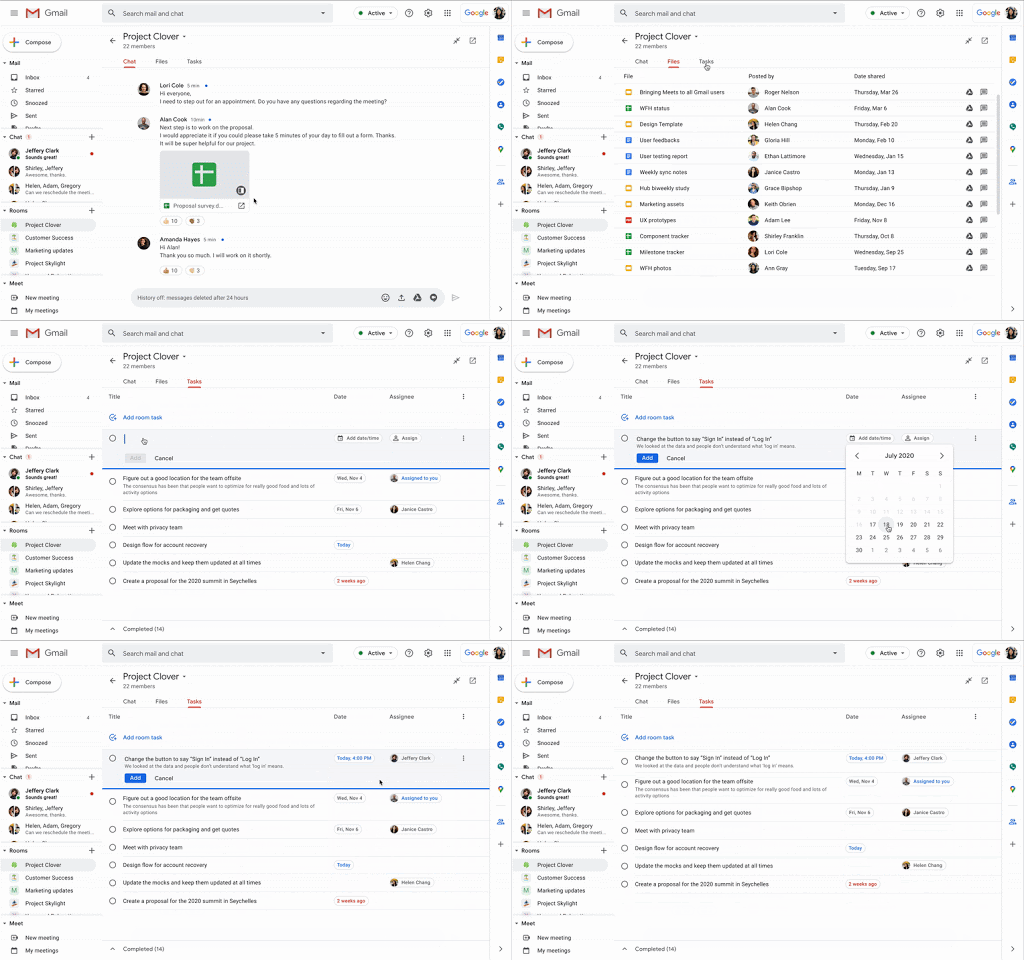
Image Credits: Google
Google is also announcing a few other feature updates to its G Suite line today. Chat rooms, for example, are now getting shared files and tasks, with the ability to assign tasks and to invite users from outside your company into rooms. These rooms now also let you have chats open on one side and edit a document on the other, all without switching to a completely different web app.
Also new is the ability in Gmail to search not just for emails but also chats, as well as new tools to pin important rooms and new “do not disturb” and “out of office” settings.
One nifty new feature of these new integrated workspaces is that Google is also working with some of its partners to bring their apps into the experience. The company specifically mentions DocuSign, Salesforce and Trello. These companies already offer some deep Gmail integrations, including integrations with the Gmail sidebar, so we’ll likely see this list expand over time.
Meet itself, too, is getting some updates in the coming weeks with “knocking controls” to make sure that once you throw somebody out of a meeting, that person can’t come back, and safety locks that help meeting hosts decide who can chat or present in a meeting.

Image Credits: Google
Powered by WPeMatico
Jason Green, co-founder and partner at Emergence, is one of the leading VCs investing in enterprise startups at the moment. But even with the focus on B2B, many of their companies have become household names — Zoom, Yammer, Box and Salesforce among them.
Now, we’re all living in a climate where everything has been turned upside down. Meetings are virtual, the future economy and collective health of the world are unknowns, and being an investor — or a founder — comes with completely new parameters and rules of engagement.
We sat down with Green for an enlightening hour to talk about the challenges of all that, plus making deals, running a business, and suddenly finding your quiet, B2B name being turned into a verb. It was an interesting conversation, worth a read for enterprise startups and investors, but — similar to how B2B can spill into consumer — equally insightful for many more.
Extra Crunch Live is our new virtual speaker series for Extra Crunch members. Folks can ask their own questions live during the chat, with guests that include Aileen Lee, Kirsten Green, Mark Cuban and many, many more. You can check out the schedule here.
Below, you’ll find a lightly edited transcript of our recent chat with Green.
Sourcing is not much different. We follow the same due diligence process, so when we make an investment, the whole team basically dives in and does due diligence. So we make manager references and customer calls and spend time with each of the management team having one-on-ones. In some ways, it was better. First of all, we could very easily do breakout rooms with each of the individual management team members and then come back. So there was this dynamism to the meeting that we hadn’t had before. We were able to basically record it and share it with folks that couldn’t participate. So all of us had all the information when we were making the decision together. That was pretty special, actually. So it took a little bit longer, it probably took about 50% longer than we would have done otherwise. But I think actually, now knowing what we’ve done, we could probably compress it back to our normal timeframe. So I think in a lot of ways, we’ve learned like a lot of folks that we can do things remotely that we probably didn’t think were possible before. Hopefully, we’ll see how the investment turns out, but we’re super excited about it.
Powered by WPeMatico

Atlassian today announced a number of updates to both its Confluence workspace and its Trello collaboration and project management tool. The focus here, the company says, is on supporting “the next phase of remote work.” Trello alone saw a 73% rise in signups in mid-March 2020, just as companies started shifting to work-from-home, compared to the same time a year ago.
The actual new features are pretty straightforward. The highlight for Trello users is surely the beta version of a table view. This marks the first time the service is giving users this spreadsheet-like overview of what is happening across their various Trello boards. It reminds me quite a bit of Airtable, but what’s maybe more important here than the feature itself is that the Trello team says this is the first of a series of new ways to view data across multiple projects in the application.
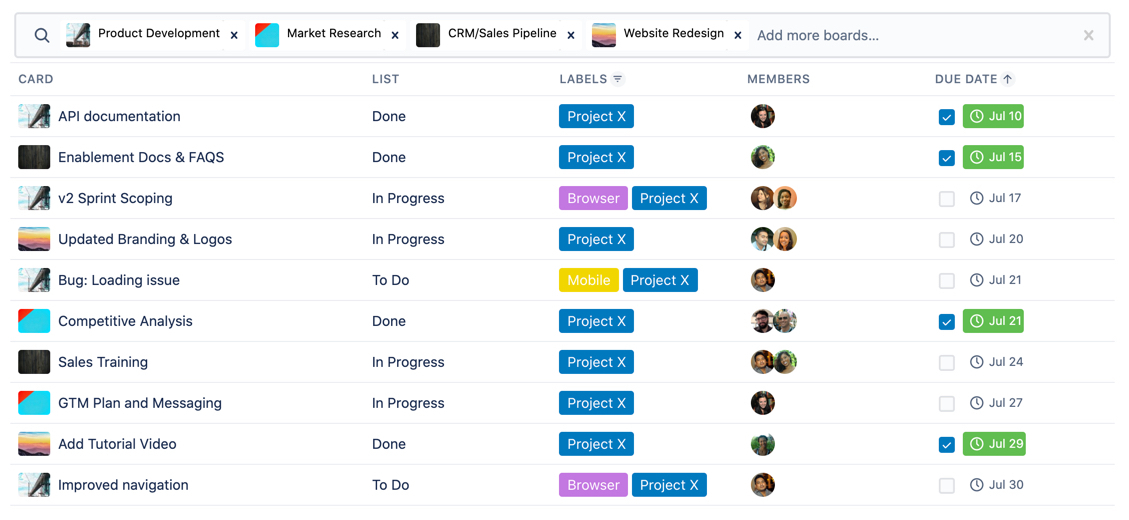
Image Credits: Atlassian
As for Confluence, a lot of the new features here are about saving users time (or measuring it). Coming soon, for example, is a bulk content management feature that will allow users to do things like archive multiple pages with a single click, label them or export them, among other things.
Available now are Confluence Smart Links that let you preview content from across the web so that users don’t have to leave their workspace to see important information, as well as real-time feedback on the content in Confluence, with the ability to view, create and resolve in-line comments while in the service’s edit mode.
Image Credits: AtlassianThe last new Confluence feature is Page Insights, which is all about metrics. With this, Confluence adds estimated read time to its page view counts, “making it easier to form quick decisions about when and how to consume content in a busy workday. […] This simplifies the mental process of navigating the endless sea of content.” Who still has the time and energy to read all of those long documents, after all?
“Teams around the world were forced into working remotely, but now many organizations are considering a permanent move to a more distributed work environment,” said Pratima Arora, head of Confluence at Atlassian. “With so many work streams across departments and individuals, it becomes impossible to rely on the old system of email chains as a vehicle for planning and managing work. Leaders need to look at whether they have the right work management system to support collaboration across the organization for the long term.”
Powered by WPeMatico
The U.S.’s COVID-19 caseload continues to set records as major states move to re-shutter their economies in hopes of stemming its spread. For many workers the situation means more time in the home office and less time in their traditional workplace. My colleague Greg Kumparak spent some time talking to companies about how best to work remotely. You can read that on Extra Crunch here.
What the world will look like when safety eventually returns is not clear, but it’s becoming plain that the workplace will not revert to its old normal. New data details changed employee sentiment, showing that a good portion of the working world doesn’t want to get back to its pre-COVID commute, and, in many cases, is eyeing a move to a different city or state in the wake of the pandemic and its economic disruptions.
The Exchange explores startups, markets and money. You can read it every morning on Extra Crunch, and now you can receive it in your inbox. Sign up for The Exchange newsletter, which will drop every Saturday starting July 25.
The changing workplace has shifted — accelerated, you could say — demand for all sorts of products and services, from grocery delivery to software. The latter category of tools has seen quickening demand as the world moves to support newly remote workforces, helping keep them both productive and secure.
 TechCrunch has covered the accelerating digital transformation — industry slang for companies moving to a more software-and-cloud world — before, noting that investors are making big bets on companies that might benefit from its ramping pace. Thanks to new data from a Twilio-led survey, we have a fresh look at that trend.
Undergirding the digital transformation is how today’s workers are adapting to remote work. If many workers don’t want to stop working from home, the gains that companies serving the digital transformation are seeing could prove permanent. New data from a Qualtrics -led survey may help us understand the new mindset of the domestic and global worker.
At the union of the two datasets is a lens into the future of not only how many information workers, to borrow an old phrase, will labor in the future, but how they’ll feel about it. So, this morning let’s explore the world through two data-driven lenses, helped as we go with notes from interviews with Qualtrics’ CEO Ryan Smith and Twilio’s chief customer officer, Glenn Weinstein.
Powered by WPeMatico