Enterprise
Auto Added by WPeMatico
Auto Added by WPeMatico
Crisp, a demand forecasting platform for the food industry, has today announced the close of a $12 million Series A funding round led by FirstMark Capital, with participation from Spring Capital and Swell Partners.
Crisp launched out of beta in January of this year with a product that aimed to give food suppliers and distributors a clearer picture of customer demand at retailers. Before Crisp, these organizations usually had several data scientists compiling data from various sources into an unintelligible spreadsheet, making it difficult to see general demand outlooks, and nearly impossible to spot anomalies.
Not only does this lead to losses in revenue, but it also contributes to a terrible amount of food waste.
Crisp looks to solve this by giving these suppliers and distributors a visualization of their data instantly and in real time. The company has built integrations with a large number of ERP software, ingesting historical data from food brands and combining them with a wide range of other signals around demand drivers, such as seasonality, holidays, price sensitivity, past marketing campaigns, changes in the competitive landscape and weather that might affect the sale or shipment of ingredients or the product itself.
The end goal is to consolidate data across the industry, from brands to distributors to grocery stores, so that each individual link in the food chain can do a better job of matching their supply with their demand on an individual basis.
Since launching out of beta, Crisp has expanded beyond food brands and suppliers into retail and distributor space. The company has also expanded beyond produce and dairy into verticals like beverages, bakery, CPG, flowers, meat and poultry. The startup says its seen an 80% increase in the number of customers using the platform since January.
Obviously, the coronavirus pandemic brings its own unique challenges and opportunities to Crisp’s business. On the one hand, grocery store shopping is booming and the supply chain behind it is certainly in need of better data science and demand forecasting as user behavior shifts rapidly. On the other hand, user behavior is shifting rapidly.
With state by state, and sometimes county by county, lockdowns and shifts in the restrictions imposed on small businesses, Crisp has had to manually track what’s going on around the country in order to provide clear insights to its customers.
“This period we’re in has increased that willingness to share data and increased collaboration between everybody in the supply chain,” said founder and CEO Are Traasdahl. “We’ve seen a big shift there. Earlier, everyone assumed that everyone else was able to deliver, but now this ability to have a full, top-down visibility across a whole depth of companies, not just the companies next to you in your trading relationships, but being able to unify data and have more insights from multiple steps away from yourself, and get that data in real time been accelerated.”
Crisp currently has 33 employees (with plans to hire on the back of the funding), which is 33% women and 15% people of color. Half of Crisp’s management team are women.
Powered by WPeMatico
SocialChorus, a startup that helps distribute communications internally in a similar way marketers reach customers externally, announced a $100 million investment today led by Sumeru Equity Partners. With this investment, the firm has bought a majority stake in the company. As part of today’s deal, Sumeru will be adding three members to the SocialChorus board.
“Sumeru Equity Partners is making a majority investment in the company but also well capitalizing the business for future growth,” Mark Haller, principal at Sumeru told TechCrunch.
The company previously raised $47 million, according to Crunchbase data. Haller says this is not a buyout, so much as a partnership with those previous investors. “We’re seeing continued partnership with existing investors and we’re coming in and making that majority investment, and we’ll also be making another investment in the balance sheet,” he said.
What Sumeru is getting is a company that helps with internal communications using marketing techniques, says company CEO Gary Nakamura. “You can run campaigns with targeting segmentation and all the telemetry back that you need as a leader, as a manager, as an organization to understand how your communications are landing with your workforce,” Nakamura told TechCrunch.
The target is large companies and customers, including big names like Ford, Archer Daniels Midland and Boeing. The company reports it has 120 large customers around the world, and the business has been growing at 50% year over year.
While the company is getting this infusion of cash from Sumeru, Nakamura says he will continue to try to manage the company in a thoughtful way, and that means being careful about how they hire beyond the 120 employees the company already has.
“What we have built is a business that doesn’t require a lot of heads to run it. We can maintain a 50% growth rate with financial discipline that we’ve implemented. Historically that is what we’ve been able to do,” he said.
Sumeru Equity Partners is a private equity firm based in San Francisco. It targets mid-market companies, according to the company website, and then tries to apply operational efficiency by working with them on areas like product strategy, go-to-market acceleration and organizational development, with the goal of building up the company and taking it to exit.
Powered by WPeMatico
Zoom has become the de facto standard for online communications during the pandemic, but the company has found that it’s still a struggle for many employees to set up the equipment and the software to run a meeting effectively. The company’s answer is an all-in-one communications appliance with Zoom software ready to roll in a simple touch interface.
The device, dubbed the Zoom for Home – DTEN ME, is being produced by partner DTEN. It consists of a standalone 27-inch screen, essentially a large tablet equipped with three wide-angle cameras designed for high-resolution video and 8 microphones. Zoom software is pre-loaded on the device and the interface is designed to provide easy access to popular Zoom features.

Zoom for Home – DTEN ME with screen sharing on. Image Credits: Zoom
Jeff Smith, head of Zoom Rooms, says that the idea is to offer an appliance that you can pull out of the box and it’s ready to use with minimal fuss. “Zoom for Home is an initiative from Zoom that allows any Zoom user to deploy a personal collaboration device for their video meetings, phone calls, interactive whiteboard annotation — all the good stuff that you want to do on Zoom, you can do with a dedicated purpose-built device,” Smith told TechCrunch.
He says this is designed with simplicity in mind, so that you pull it out of the box and launch the interface by entering a pairing code on a website on your laptop or mobile phone. Once the interface appears, you simply touch the function you want, such as making a phone call or starting a meeting, and it connects automatically.
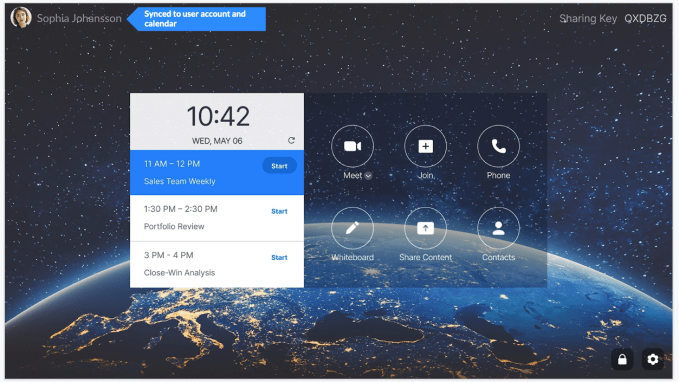
Image Credits: Zoom
You can link it to your calendar so that all your meetings appear in a sidebar, and you just touch the next meeting to connect. If you need to share your screen it includes ultrasonic pairing between the appliance and your laptop or mobile phone. This works like Bluetooth, but instead of sending out a radio signal, it sends out a sound between 18 and 22 kHz, which most people can’t hear, to connect the two devices, Smith said.
Smith says Zoom will launch with two additional partners, including the Neat Bar and the Poly Studio X Series, and could add other partners in the future.
The DTEN appliance will cost $599 and works with an existing Zoom license. The company is taking pre-orders and the devices are expected to ship next month.
Powered by WPeMatico
BlueOcean is a new startup offering companies a relatively fast and affordable way to see how their brands are performing and what they can do to improve.
CEO Grant McDougall and COO/President Liza Nebel (the pair founded BlueOcean with Chief Data Scientist Matthew Gross) told me they’ve been developing the technology for two years. And although the startup is only officially launching now, it has already worked with prominent brands like Microsoft, Panda Express and Pabst Blue Ribbon.
BlueOcean is focused specifically on the world of brand audits, which are basically detailed analyses of the aspects of a brand that are and aren’t working — and according to Nebel (whose experience includes working on brand and digital strategy at Ogilvy), a single audit can cost brands millions of dollars, often resulting in reports “that aren’t even actionable.”
With BlueOcean, on the other hand, a brand provides only two things — their website and a list of their competitors. Then they get their brand audit one week later, for just $17,000, including recommendations for how to improve.
To do this, the company says it’s applying an “automation-first approach.” McDougall said BlueOcean is pulling from hundreds of different data sources, which will vary from industry to industry, and applying algorithms to understand things like, “What’s the right taxonomy? How do we acquire that data?”

BlueOcean founders Grant McDougall and Liza Nebel (Image Credits: BlueOcean)
He added, “Strategically, we tend to move up in the organization,” giving both marketing teams and C-level executives the advice they need.
For example, Nebel said that one of BlueOcean’s clients include a large alcohol holding company, which recently launched a line of hard seltzer under an existing alcohol brand. The startup’s brand audit recommended that the company (which Nebel declined to identify) launch a separate hard seltzer brand instead — and now, the company will be launching three different brands.
Nebel also walked me through what she called the “five-minute version” of a brand audit for TechCrunch, which looked at our performance in terms of potential customers, positioning, messaging, offerings and existing customers. Ultimately, BlueOcean gave us a “moderate” score of 97 (but hey, we scored well on being “memorable” and “inspiring”) and recommended steps like publishing a more “steady drumbeat” of content on social media and improving our app experience.
“BlueOcean has become a great addition to further enable us to sharpen our ability to monitor, understand and act through the lens of brand across all of our commercial offerings,” said Microsoft’s director of brand strategy Tim Hoppin in a statement. “We’re excited to work with BlueOcean and use their tools and expertise to strengthen our relationship with the millions of global customers we connect with daily.”
Powered by WPeMatico
Recurrency, a member of the Summer 2020 Y Combinator cohort, was started by a 21 year old just out of college. He decided to take on a highly established market that is led by giants like SAP, Infor, Oracle and Microsoft, but instead of taking a highly complex area of enterprise software in one big bite, he is starting by helping wholesale businesses.
Sole founder and company CEO Sam Oshay just graduated from the University of Pennsylvania with a dual degree that straddled engineering and business, before joining the summer batch. Oshay is bringing a modern twist to ERP by using machine learning to drive more data-driven decision making.
“What makes us different from other ERPs like SAP, Infor and Epicor is that we can tell the user something that they don’t already know.” He says these traditional ERPs are basically data entry systems. For example, you could enter a pricing list, but you can’t do anything with it in terms of predictions.
“We can scan historical data and make pricing recommendations and predictions. So we are an ERP that not only does data analysis, but also imports external data and matches it to internal data to make recommendations and predictions,” Oshay explained.
While he doesn’t expect to remain confined to just the wholesale side of the business, it makes sense that he started with it because his family has a history of running these kinds of businesses. In fact, his grandfather immigrated to the U.S. after World War II and started a hardware wholesale business that his uncle still runs today. His dad started his own business selling wholesale shipping supplies, and he grew up in the family business, giving him some insight that most recent college grads probably wouldn’t have.
“I learned about the wholesale business at a very deep level. And what I observed is that so many of the issues with my dad’s business came down to issues with his ERP system. It occurred to me that if someone were to build an ERP extension or a better ERP, they could unlock so much of the value that is currently locked inside these legacy systems,” he said.
So he did what good entrepreneurs do, and began building it. For starters, his system plugs into legacy systems like SAP or NetSuite, but the plan is to build a better ERP, one step at a time. For now, it’s about wholesale, but he has a much broader vision for his company.
He originally applied to YC during the Fall 2019 semester of his junior year, and was admitted to the winter batch, but deferred to the Summer 2020 group to complete his studies. He spent his remaining time at UPenn sprinting to early graduation, taking 10 classes to come close to finishing his studies (with just a dissertation standing between him and his degree).
With this batch being delivered remotely, he says that the YC team has taken that into account and is still offering a meaningful experience for the summer group. “All of the events that YC would normally be doing are still happening, just remotely. And to my knowledge, some of the events we’re doing are designed specifically for this weird set of circumstances. The YC team has put quite a bit of thought into making this batch meaningful and I think they’ve succeeded,” he said.
While the pandemic has created new challenges for an early-stage business, he says that in some ways it’s helped him focus better. Instead of going out with friends, he’s home with his head down working on his company with little distraction.
As you would expect, it’s early days for the product, but he has three customers who are operational and two more in the implementation phase. He also has two employees so far, a front end and back end engineer.
For now, he’s going to continue building his product and his business, and he sees the pandemic as a time when businesses might be more open to changing a system like a legacy ERP. “If they want to try something new, and you can make it easier for them to try that, I’ve found that’s a place where you can make a sale,” he said.
Powered by WPeMatico
In this pandemic world, in-person meetings are a thing of the past. Most meetings these days are done via video conference, and no company has capitalized on the shift quite like Zoom.
Macro, a new FirstMark-backed company, is looking to capitalize on the capitalization. To Capitalism!
Sorry. Let’s get back on track. Macro is a native app that employs the Zoom SDK to add depth and analysis to your daily work meetings.
There are two modes. The first is essentially focused on collaboration, which turns the usual Zoom meeting into a light overlay, where folks are shown in small, circular bubbles at the top of the screen. This mode is to be used when folks are working on the same project, such as a wireframe or a collaborative document. The UI is meant to kind of fade into the background, allowing users to click on taps or objects behind other attendees’ bubbles.
The other mode is an Arena or Stadium mode, which is meant for hands-on meetings and presentations. It has two distinct features. The first is an Airtime feature, which shows how much different participants have ‘had the floor’ for the past five minutes, thirty minutes, or in total during the meeting. The second is a text-input system on the right side of the UI that lets people enter Questions, Takeaways, Action Items and Insights from the call.
Macro automatically adds that text to a Google Doc, and formats it into something instantly shareable.
There is no extra hassle involved in getting Macro up and running. When a user installs Macro on their computer, they’re instantly loaded into Macro each time they click a Zoom link, whether it’s in an email, a calendar invite, or in Slack.
Macro cofounders Ankith Harathi and John Keck explained to TechCrunch that this isn’t your usual enterprise play. The product is free to use and, with the Google Doc export, is still useful even as a single-player product. The Google Doc is auto-formatted with Macro messaging, explaining that it was compiled by the company with a link to the product.
In other words, Harathi and Keck want to see individuals within organizations get Macro for themselves and let the product grow organically within an organization, rather than trying to sell to large teams right off the bat.
“A lot of collaborative productivity SaaS applications need your whole team to switch over to get any value out of them,” said Harathi. “That’s a pretty big barrier, especially since so many new products are coming out and teams are constantly switching and that creates a lot of noise. So our plan was to ensure one person can use this and get value out of it, and nobody else is affected. They get the better interface and other team members will want to switch over without any requirement to do so.”
This is possible in large part to the cost of the Zoom SDK, which is $0. The heavy lifting of audio and video is handled by Zoom, as is the high compute cost. This means that Macro can offer its product for free at a relatively low cost to the company as it tries to grow.
Of course, there is some risk involved with building on an existing platform. Namely, one Zoom platform change could wreak havoc on Macro’s product or model. However, the team has plans to expand beyond Zoom to other video conferencing platforms like Google, BlueJeans, WebEx, etc. Roelof Botha told TechCrunch back in May that businesses built on other platforms have a much greater chance of success when there is platform across that sector, as there certainly is here.
And there seems to be some competition for Macro in particular — for one, Microsoft Teams just added some new features to its video conferencing UI to relieve brain fatigue and Hello is looking to offer app-free video chat via browser.
Macro is also looking to add additional functionality to the platform, such as the ability to integrate an agenda into the meeting and break up the accompanying Google doc by agenda item.
The company has raised a total of $4.8 million since launch, including a new $4.3 million seed round from FirstMark Capital, General Catalyst and Underscore VC. Other investors include NextView Ventures, Jason Warner (CTO GitHub), Julie Zhuo (former VP Design Facebook), Harry Stebbings (Founder/Host of 20minVC), Adam Nash (Dropbox, Wealthfront, LinkedIn), Clark Valberg (CEO Invision), among others.
Macro has more than 25,000 users and has been a part of 50,000 meetings to date.
Powered by WPeMatico
Acquia, the commercial company built on top of the open source Drupal content management system has pushed to be more than a publishing platform in recent years, using several strategic acquisitions to move into managing customer experience, and today the company announced a new approach to developing and marketing on the Drupal Cloud.
This involves bringing together developers and marketers under the umbrella of the new Acquia Open DXP platform. This approach has two main components: “What we’ve been working on is deep integration across our suite and pulling together our new foundational Drupal Cloud offering, and our new foundational Marketing Cloud offering,” Kevin Cochrane, senior vice president of product marketing at Acquia said.
The offerings bring together a set of acquisitions the company made over the last year including Mautic for marketing automation in May 2019, Cohesion for low-code developing in September and AgileOne in December for a customer data platform (CDP).
Cochrane says that the company is leveraging these acquisitions along with tools they developed internally and the upcoming release of Drupal 9 to offer a platform approach for customers where they can build content on the Drupal Cloud side and leverage customer data on the Marketing Cloud side.
On the Drupal Cloud, the company is offering a set of tools that includes an integrated development environment (IDE) where developers can build services, while marketers get a low code offering, where they can drag and drop content and design components from a library of offerings that could come from internal sources or the open source community. It also includes other components like security and content management.
The Marketing Cloud is the data layer where companies collect and manage data about customers with the goal of offering a more personalized and meaningful experience in a digital context.
Marketing automation tooling has shifted in recent years with the goal of providing customers with a unique and meaningful experience using the vast amount of data available to build a more complete picture of the customer and give them what they need, when they need it in a digital context. This has involved building a digital experience platform (DXP) and a customer data platform (CDP).
By pulling together these different elements, Acquia is attempting to put itself in a position to compete directly with big players in this space like Adobe and Salesforce offering a similar unified approach.
Vista Equity Partners bought Acquia last September for $1 billion. At the time, company founder Dries Buytaert said one of the advantages of being part of Vista was to get the resources to compete with larger companies in this space, and today’s announcement could be seen in that light.
Powered by WPeMatico
At its virtual Cloud Next ’20 event, Google Cloud today announced Confidential VMs, a new type of virtual machine that makes use of the company’s work around confidential computing to ensure that data isn’t just encrypted at rest but also while it is in memory.
“We already employ a variety of isolation and sandboxing techniques as part of our cloud infrastructure to help make our multi-tenant architecture secure,” the company notes in today’s announcement. “Confidential VMs take this to the next level by offering memory encryption so that you can further isolate your workloads in the cloud. Confidential VMs can help all our customers protect sensitive data, but we think it will be especially interesting to those in regulated industries.”
In the backend, Confidential VMs make use of AMD’s Secure Encrypted Virtualization feature, available in its second-generation EPYC CPUs. With that, the data will stay encrypted when used and the encryption keys to make this happen are automatically generated in hardware and can’t be exported — and with that, even Google doesn’t have access to the keys either.
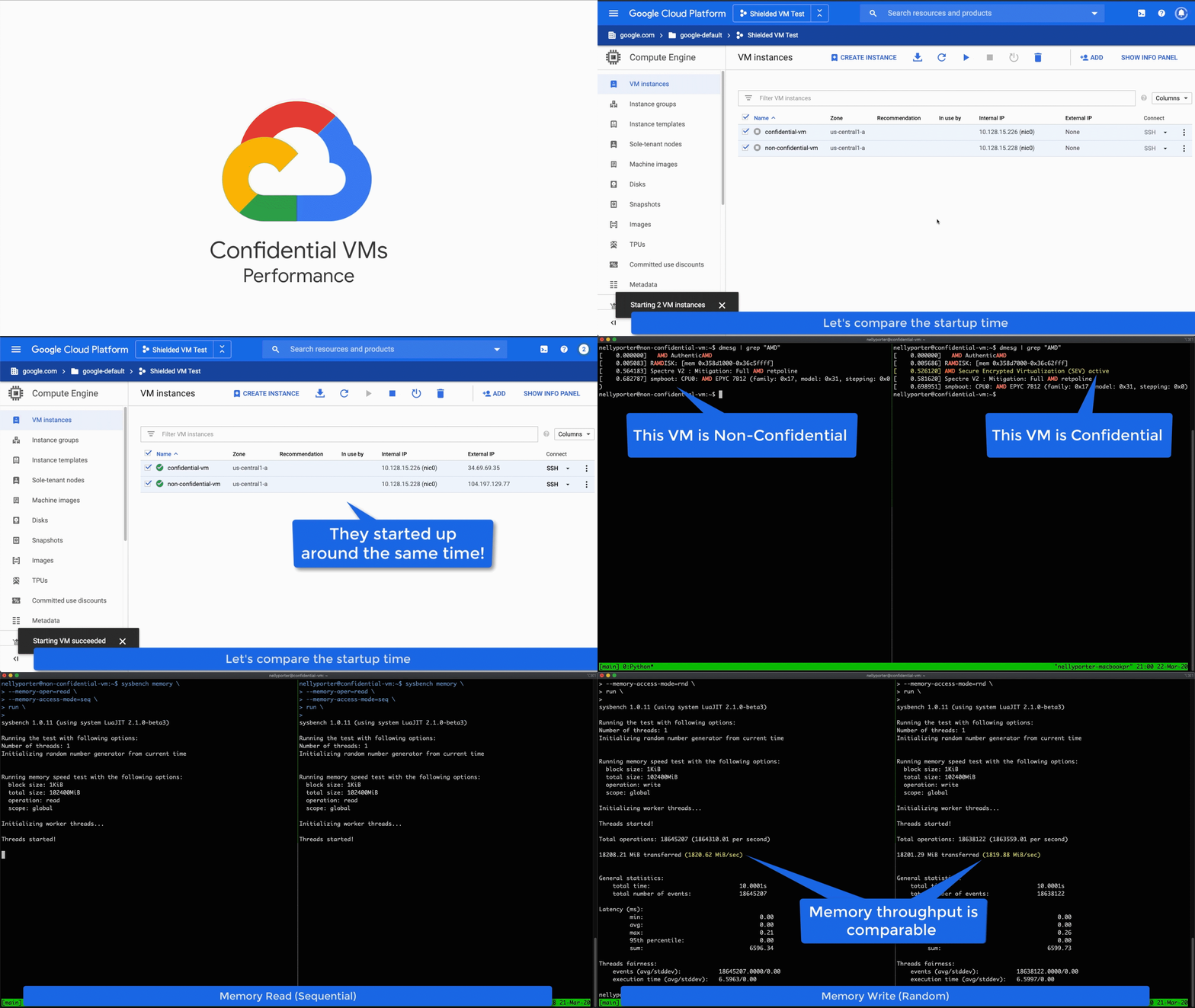
Image Credits: Google
Developers who want to shift their existing VMs to a Confidential VM can do so with just a few clicks. Google notes that it built Confidential VMs on top of its Shielded VMs, which already provide protection against rootkits and other exploits.
“With built-in secure encrypted virtualization, 2nd Gen AMD EPYC processors provide an innovative hardware-based security feature that helps secure data in a virtualized environment,” said Raghu Nambiar, corporate vice president, Data Center Ecosystem, AMD. “For the new Google Compute Engine Confidential VMs in the N2D series, we worked with Google to help customers both secure their data and achieve performance of their workloads.”
That last part is obviously important, given that the extra encryption and decryption steps do incur at least a minor performance penalty. Google says it worked with AMD and developed new open-source drivers to ensure that “the performance metrics of Confidential VMs are close to those of non-confidential VMs.” At least according to the benchmarks Google itself has disclosed so far, both startup times and memory read and throughput performance are virtually the same for regular VMs and Confidential VMs.
Powered by WPeMatico
Apparently, the internet is still popular.
With the novel coronavirus marooning people at home for work and play, those “tubes” carrying our data back and forth have become ever more important to our livelihoods. Yet while we often as consumers think of the internet as what we buy from a service provider like Spectrum or TechCrunch’s parent company Verizon, the reality is that businesses need key network services like DNS and IP Address Management in order to optimize their performance and costs.
That’s where New York City-based NS1 has done particularly well. My colleague Ron Miller first covered the company and its founding story for us two years ago, as part of our in-depth look at the New York City enterprise software ecosystem. Fast forward two years, and NS1 couldn’t be doing better: in just the first quarter of this year, new customer bookings were up 159% year over year according to the company, and it currently serves 600 customers.
That traction in a critical infrastructure segment of the market attracted the attention of even more growth capital. Today, the company announced that Energy Impact Partners, which has traditionally invested in sustainable energy startups but has recently expanded into software and internet services, is leading a $40 million Series D round into the startup, bringing its total fundraising to date to $125 million. The round was led by Shawn Cherian, a partner at EIP who just joined the firm at the beginning of June (nothing like getting a deal done your first day on the job).
Kris Beevers, cofounder and CEO of NS1, said that COVID-19 has had a huge impact on the startup’s growth the past few months. “For example, [a] large software customer of ours [said] that our number two KPI for our coronavirus task force is network performance and saturation as managed by NS1.” Customers have made network management significantly higher priority since degradations in latency and reliability can dramatically limit a service’s viability for stay-at-home workers and consumers.

NS1’s Founding Team
“The quip that I have used a few times recently is digital transformation initiatives have compressed from five or ten years down to months or a year at this point. Everybody’s just having to accelerate all of these things,” Beevers said.
The company has doubled down on its key tools like DNS and IP management, but it has also launched new features using feedback from customers. “For example, we launched a VPN steering capability to help our customers optimize their VPN footprints because obviously those suddenly are more important than they’ve ever been,” he said. Virtual Private Networks (VPNs) allow employees to login to their company’s network as if they were physically present in the office.
While NS1 had money in the bank and increasing appetite from customers, the company was also starting a fundraise in the middle of a global pandemic. Beevers said that it was hard at first to get momentum. “April was a dead zone,” he said. “All the VCs were sort of turtle up.”
The tide began to turn by early May as VCs got a handle on their portfolios and started to survey where the opportunities were in the market given the lessons of the early days of COVID-19. “We actually started to get a huge amount of inbound interest in early May timeframe,” he said.
“Call it like a true coronavirus fundraise,” Beevers explained. It was “end to end like less than a month getting to know [Cherian] to term sheet, and all virtual. Partner meeting was all virtual, diligence all virtual. Not a single in-person interaction in the whole fundraising process, and that was the case with everybody else who was involved in the round too, so all the folks that didn’t in the end write the winning term sheet.”
What made Cherian stand out was Energy Impact Partners’ portfolio, which touches on energy, industry and IoT — sectors that are increasingly being digitized and need the kind of internet infrastructure services that NS1 provides. Also, Cherian led a round into Packet, which is a fellow NYC enterprise company that sold to Equinox for more than $300 million. Packet’s founder Zac Smith and Beevers worked together at Voxel and are part of the so-called “Voxel mafia” of infrastructure engineers in Manhattan.
With the new funding, NS1 intends to continue to expand its traction in the network layer while also doubling down on new markets like IoT.
Powered by WPeMatico
At its virtual Cloud Next ’20 event, Google today announced a number of updates to its cloud portfolio, but the private alpha launch of BigQuery Omni is probably the highlight of this year’s event. Powered by Google Cloud’s Anthos hybrid-cloud platform, BigQuery Omni allows developers to use the BigQuery engine to analyze data that sits in multiple clouds, including those of Google Cloud competitors like AWS and Microsoft Azure — though for now, the service only supports AWS, with Azure support coming later.
Using a unified interface, developers can analyze this data locally without having to move data sets between platforms.
“Our customers store petabytes of information in BigQuery, with the knowledge that it is safe and that it’s protected,” said Debanjan Saha, the GM and VP of Engineering for Data Analytics at Google Cloud, in a press conference ahead of today’s announcement. “A lot of our customers do many different types of analytics in BigQuery. For example, they use the built-in machine learning capabilities to run real-time analytics and predictive analytics. […] A lot of our customers who are very excited about using BigQuery in GCP are also asking, ‘how can they extend the use of BigQuery to other clouds?’ ”
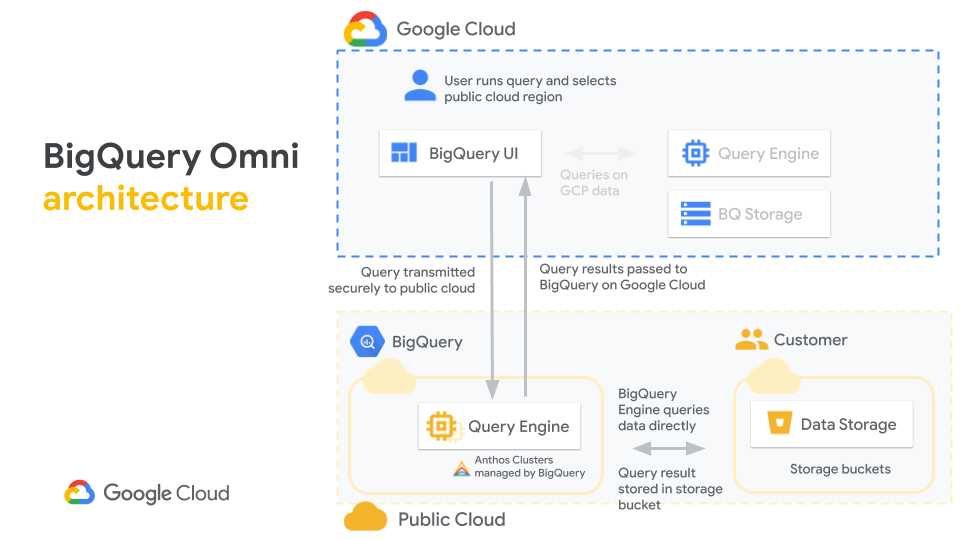
Image Credits: Google
Google has long said that it believes that multi-cloud is the future — something that most of its competitors would probably agree with, though they all would obviously like you to use their tools, even if the data sits in other clouds or is generated off-platform. It’s the tools and services that help businesses to make use of all of this data, after all, where the different vendors can differentiate themselves from each other. Maybe it’s no surprise then, given Google Cloud’s expertise in data analytics, that BigQuery is now joining the multi-cloud fray.
“With BigQuery Omni customers get what they wanted,” Saha said. “They wanted to analyze their data no matter where the data sits and they get it today with BigQuery Omni.”
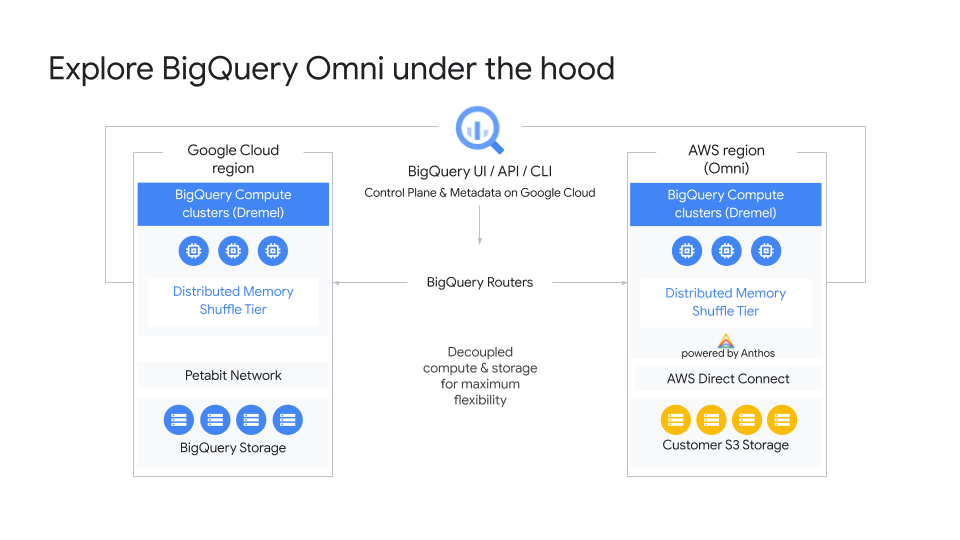
Image Credits: Google
He noted that Google Cloud believes that this will help enterprises break down their data silos and gain new insights into their data, all while allowing developers and analysts to use a standard SQL interface.
Today’s announcement is also a good example of how Google’s bet on Anthos is paying off by making it easier for the company to not just allow its customers to manage their multi-cloud deployments but also to extend the reach of its own products across clouds. This also explains why BigQuery Omni isn’t available for Azure yet, given that Anthos for Azure is still in preview, while AWS support became generally available in April.
Powered by WPeMatico