Enterprise
Auto Added by WPeMatico
Auto Added by WPeMatico
Today after the bell, Salesforce reported its third-quarter earnings for its fiscal 2021, a period that ended October 31, 2020. The CRM giant reported top-line revenue of $5.42 billion, up 20% from the year-ago period. Salesforce also had net income of $1.08 billion and earnings per share of $1.15.
Analysts had expected the company to earn $0.75 per share off revenues of $5.25 billion, according to Yahoo Finance.
Shares of Salesforce were off after-hours, falling around 3.6% at the time of writing. It was not clear if the company’s share price performance was due to its Q3 results, or its raised Q4 guidance, or its new fiscal 2022 expectations, or the newly announced Slack deal.
As TechCrunch reported moments ago, Salesforce will buy Slack for $27.7 billion in a cash and stock deal that was fully priced into shares of the smaller company, which dropped a little over a point on the news, having risen by nearly 50% since the deal’s existence first leaked.
Holders of Slack will be rewarded for their patience. Now it’s up to Salesforce leadership to prove that the huge buy will help boost the company’s growth.
Salesforce told investors today that it anticipates Q4 fiscal 2021 revenues of $5.665 billion to $5.675 billion, which works out to growth of around 17% from the year-ago period. The company also anticipates that it will grow around 17% in Q1 of its fiscal 2022.
But Salesforce expects to grow 21% in all of its fiscal 2022. How does it intend to accelerate? Its projections include Slack:
Full Year FY22 revenue guidance includes contributions from Slack Technologies, Inc. of approximately $600 million, net of purchase accounting, and assumes a closing date in late Q2 and Acumen Solutions, Inc. of approximately $150 million, net of purchase accounting, and assumes a closing date within Q2.
So, Salesforce investors, after two anticipated quarters of 17% growth coming up, your company will accelerate up to 21% growth for the next fiscal year. Is that worth $27.7 billion?
Powered by WPeMatico
Salesforce, the CRM powerhouse that recently surpassed $20 billion in annual revenue, announced today it is wading deeper into enterprise social by acquiring Slack in a $27.7 billion megadeal. Rumors of a pending deal surfaced last week, causing Slack’s stock price to spike.
Salesforce co-founder and CEO Marc Benioff didn’t mince words on his latest purchase. “This is a match made in heaven. Together, Salesforce and Slack will shape the future of enterprise software and transform the way everyone works in the all-digital, work-from-anywhere world,” Benioff said in a statement.
Slack CEO Stewart Butterfield was no less effusive than his future boss. “As software plays a more and more critical role in the performance of every organization, we share a vision of reduced complexity, increased power and flexibility, and ultimately a greater degree of alignment and organizational agility. Personally, I believe this is the most strategic combination in the history of software, and I can’t wait to get going,” Butterfield said in a statement.
Every worker at every company needs to communicate, something that Slack can ably empower. What’s more, it also facilitates external communication with customers and partners, something that should be quite useful for a company like Salesforce and its family of offerings.
Ultimately, Slack was ripe for the taking. Entering 2020 it had lost around 40% of its value since it went public. Consider that after its most recent earnings report, the company lost 16% of its value, and before the Salesforce deal leaked, the company was worth only a few dollars per share more than its direct listing reference price. Toss in net losses of $147.6 million during the two quarters ending July 31, 2020, Slack’s uninspiring public valuation and its winding path to profitability and it was a sitting target for a takeover like this one. The only surprise here is the price.
Slack’s current valuation, according to both Yahoo and Google Finance, is just over $25 billion, which, given its very modest price change after-hours means that the market priced the company somewhat effectively. Slack is up around 48% from its valuation that preceded the deal becoming known.
The new deal also puts Salesforce more on par — and in competition — with its arch rival and sometime friend Microsoft, whose Teams product has been directly challenging Slack in the market. Microsoft, which passed on buying Slack in the past for a fraction of what Salesforce is paying today, has made Teams a key priority in recent quarters, loathe to cede any portion of the enterprise software market to another company.
What really has set Slack apart from the pack, at least initially, was its ability to integrate with other enterprise software. When you combined that with bots, those intelligent digital helpers, the company could potentially provide Salesforce customers with a central place to work without changing focus because everything they need to do can be done in Slack.
Today’s deal comes after Salesforce’s purchase of Quip in 2016 for $750 million. Quip brought to the SaaS giant a way of socially sharing documents, and when paired with the Slack acquisition gives Salesforce a much more robust social story to tell than its internal option Chatter, an early attempt at enterprise social that never really caught on.
It’s worth noting that Salesforce was interested in Twitter in 2016, the same year that Microsoft was reportedly interested in Slack, but eventually walked away from that deal when shareholders objected, not wanting to deal with the controversial side of the social platform.
Slack was founded in 2013, but its origins go back to an online multiplayer game company called Glitch that was founded in 2009. While the game was ultimately a failure, the startup developed an internal messaging system in the process of building that company that later evolved into Slack.
The company’s historic growth helped Slack raise more than $1 billion while private, earning an impressive $7 billion valuation before going public last year. But while the Glitch-to-unicorn story appears simple, Slack has always faced entrenched competition from the likes of not only Microsoft, but also Cisco, Facebook, Google and even Asana and Monday.com.
For Slack, the path to the public markets was fraught with hype and outsized expectation. The company was famous, or as famous as an enterprise software company can be. At the time it felt like its debut was the start of a long tenure as an indie company. Instead, that public life has been cut short by a huge check. Such is the dog-eat-dog world of tech.
Powered by WPeMatico
IT security software company Ivanti has acquired two security companies: Enterprise mobile security firm MobileIron and corporate virtual network provider Pulse Secure.
In a statement on Tuesday, Ivanti said it bought MobileIron for $872 million in stock — with 91% of the shareholders voting in favor of the deal — and acquired Pulse Secure from its parent company Siris Capital Group, but did not disclose the buying price.
The deals have now closed.
Ivanti was founded in 2017 after Clearlake Capital, which owned Heat Software, bought Landesk from private equity firm Thoma Bravo, and merged the two companies to form Ivanti. The combined company, headquartered in Salt Lake City, focuses largely on enterprise IT security, including endpoint, asset and supply chain management. Since its founding, Ivanti went on to acquire several other companies, including U.K.-based Concorde Solutions and RES Software.
If MobileIron and Pulse Secure seem familiar, both companies have faced their fair share of headlines this year after hackers began exploiting vulnerabilities found in their technologies.
Just last month, the U.K. government’s National Cyber Security Center published an alert that warned of a remotely executable bug in MobileIron, patched in June, allowing hackers to break into enterprise networks. U.S. Homeland Security’s cybersecurity advisory unit CISA said that the bug was being actively used by advanced persistent threat (APT) groups, typically associated with state-backed hackers.
Meanwhile, CISA also warned that Pulse Secure was one of several corporate VPN providers with vulnerabilities that have since become a favorite among hackers, particularly ransomware actors, who abuse the bugs to gain access to a network and deploy the file-encrypting ransomware.
Powered by WPeMatico
Google today introduced a new mobile management and security solution, Android Enterprise Essentials, which, despite its name, is actually aimed at small to medium-sized businesses. The company explains this solution leverages Google’s experience in building Android Enterprise device management and security tools for larger organizations in order to come up with a simpler solution for those businesses with smaller budgets.
The new service includes the basics in mobile device management, with features that allow smaller businesses to require their employees to use a lock screen and encryption to protect company data. It also prevents users from installing apps outside the Google Play Store via the Google Play Protect service, and allows businesses to remotely wipe all the company data from phones that are lost or stolen.
As Google explains, smaller companies often handle customer data on mobile devices, but many of today’s remote device management solutions are too complex for small business owners, and are often complicated to get up-and-running.
Android Enterprise Essentials attempts to make the overall setup process easier by eliminating the need to manually activate each device. And because the security policies are applied remotely, there’s nothing the employees themselves have to configure on their own phones. Instead, businesses that want to use the new solution will just buy Android devices from a reseller to hand out or ship to employees with policies already in place.
Though primarily aimed at smaller companies, Google notes the solution may work for select larger organizations that want to extend some basic protections to devices that don’t require more advanced management solutions. The new service can also help companies get started with securing their mobile device inventory, before they move up to more sophisticated solutions over time, including those from third-party vendors.
The company has been working to better position Android devices for use in workplace over the past several years, with programs like Android for Work, Android Enterprise Recommended, partnerships focused on ridding the Play Store of malware, advanced device protections for high-risk users, endpoint management solutions, and more.
Google says it will roll out Android Enterprise Essentials initially with distributors Synnex in the U.S. and Tech Data in the U.K. In the future, it will make the service available through additional resellers as it takes the solution global in early 2021. Google will also host an online launch event and demo in January for interested customers.
Powered by WPeMatico
As we’ve moved to work from home during the pandemic, it’s been challenging for remote workers to feel connected. Loop Team, a new entrant into the enterprise communications space, thinks the way we are communicating needs improvement. That’s why the startup is releasing Loop Team today, a tool that is trying to use software to reproduce the in-office experience.
Company founder and CEO Raj Singh says that he learned about the problems of feeling disconnected first-hand at a previous remote-first company, but in spite of his best attempts to use technology to produce that in-office feel, he said he continued to feel out of the loop (so to speak). That’s when he decided to build the solution he wanted.
“We’ve looked at a lot of the interactions that happen when you’re physically in an office — the visual communication, the background conversations, the hallway chatter, the serendipitous bumping, things like that. And we built an experience that effectively is a virtual office. And so it tries to represent the best parts of what a physical office experience might be like, but in a virtual form,” Singh explained to me.
While he created this company prior to COVID, the pandemic has highlighted the need for a tool like this. Before he created the software, he interviewed hundreds of people who worked from home to understand their issues working outside of the office and he heard a lot of common complaints.
“There was an office and they didn’t necessarily know what was going on. They didn’t know who was available. They didn’t know who was around. It was difficult to connect. Everything was scheduled through a calendar. They were missing some of that presence — and they were feeling lonely or out of touch or out of the loop,” he said.
His company’s solution tries to reproduce the office experience using AI, good old-fashioned presence awareness and other tech to let team members know what you’re doing and if you’re available to chat. So just as you would wander down the hall and see your colleague on the phone or deeply involved with work on the laptop, and know to leave them be, you could get that same feel with Loop.
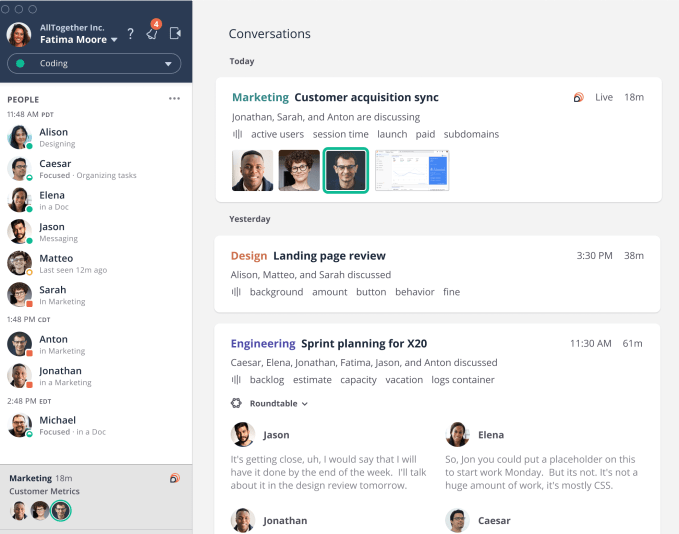
Image Credits: Loop Team
It gives the current status of the person, and you can know from looking at the list of people on your team who’s available to talk and who’s busy. As you go into virtual discussions, the team can see who’s having meetings and individuals can pop in too, just as you might do in the office.
What’s more, you can set up rooms (like in Slack), but these are designed to give you a more personal connection using video and audio for actual discussion. You can work on projects via screen share and people who miss these meetings because of other obligations or time zone differences can always review what they missed.
While you can do all of these things in Slack and Zoom, or in some combination of similar tools, Loop’s layout and presentation is designed to help you see the conversations in a clear way and expose what you want to see, while hiding parts of the day that don’t interest you.
The product is available for free starting today, but Singh wants to introduce a pricing model sometime next year based on team size. He expects there will always be a freemium version for teams with fewer than 10 people.
The company was founded in 2018 and nurtured at the Stanford Research Institute (SRI). It has raised $4.75 million so far. Today it starts on its journey as a startup with its first product, and it’s one that comes with good timing as more teams find themselves working remotely than ever before.
Powered by WPeMatico
There are 12 million small and medium businesses in the U.S., yet they have continued to be one of the most underserved segments of the B2B universe: That volume underscores a lot of fragmentation, and alongside other issues like budget constraints, there are a number of barriers to building for them at scale. Today, however, a startup helping SMBs get online is announcing some significant funding — a sign of how things are changing at a moment when many businesses have realised that being online is no longer an option, but a necessity.
GoSite, a San Diego-based startup that helps small and medium enterprises build websites, and, with a minimum amount of technical know-how, run other functions of their businesses online — like payments, online marketing, appointment booking and accounting — has picked up $40 million in funding.
GoSite offers a one-stop shop for users to build and manage everything online, with the ability to feed in up to 80 different third-party services within that. “We want to help our customers be found everywhere,” said Alex Goode, the founder and CEO of GoSite. “We integrate with Facebook and other consumer platforms like Siri, Apple Maps and search engines like Google, Yahoo and Bing and more.” It also builds certain features like payments from the ground up.
The Series B comes on the back of a strong year for the company. Driven by COVID-19 circumstances, businesses have increasingly turned to the internet to interact with customers, and GoSite — which has “thousands” of SMB customers — said it doubled its customer base in 2020.
This latest round is being led by Left Lane Capital out of New York, with Longley Capital, Cove Fund, Stage 2, Ankona Capital and Serra Ventures also participating. GoSite is clearly striking while the iron is hot: Longley, also based out of San Diego, led the company’s previous round, which was only in August of this year. It has now raised $60 million to date.
GoSite is, in a sense, a play for more inclusivity in tech: Its customers are not companies that it’s “winning” off other providers that provide website building and hosting and other services typically used by SMBs, such as Squarespace and Wix, or GoDaddy, or Shopify.
Rather, they are companies that may have never used any of these: local garages, local landscapers, local hair salons, local accountancy firms, local dentists and so on. Barring the accounting firm, these are not businesses that will ever go fully online, as a retailer might, not least because of the physical aspect of each of those professions. But they will need an online presence and the levers it gives them to communicate in order to survive, especially in times when their old models are being put under strain.
Goode started GoSite after graduating from college in Michigan with a degree in computer science, having previously grown up around and working in small businesses — his parents, grandparents and others in his Michigan town all ran their own stores. (He moved to San Diego “for the weather,” he joked.)
His belief is that while there are and always will be alternatives like Facebook or Yelp to plant a flag, there is nothing that can replace the value and longer-term security and control of building something of your own — a sentiment small business owners would surely grasp.
That is perhaps the most interesting aspect of GoSite as it exists today: It precisely doesn’t see any of what already exists out there as “the competition.” Instead, Goode sees his purpose as building a dashboard that will help business owners manage all that — with up to 80 different services currently available — and more, from a single place, and with minimum need for technical skills and time spent learning the ropes.
“There is definitely huge demand from small businesses for help and something like GoSite can do that,” Goode said. “The space is very fragmented and noisy and they don’t even know where to start.”
This, combined with GoSite’s growth and relevance to the current market, is partly what attracted investors.
“The opportunity we are betting on here is the all-in-one solution,” said Vinny Pujji, partner at Left Lane. “If you are a carpet cleaner or house painter, you don’t have the capacity to understand or work with five or six different pieces of software. We spoke with thousands of SMBs when looking at this, and this was the answer we heard.” He said the other important thing is that GoSite has a customer service team and for SMBs that use it, they like that when they call, “GoSite picks up the phone.”
Powered by WPeMatico
DevOps continues to get a lot of attention as a wave of companies develop more sophisticated tools to help developers manage increasingly complex architectures and workloads. In the latest development, Databand — an AI-based observability platform for data pipelines, specifically to detect when something is going wrong with a datasource when an engineer is using a disparate set of data management tools — has closed a round of $14.5 million.
Josh Benamram, the CEO who co-founded the company with Victor Shafran and Evgeny Shulman, said that Databand plans include more hiring; to continue adding customers for its existing product; to expand the library of tools that it’s providing to users to cover an ever-increasing landscape of DevOps software, where it is a big supporter of open-source resources; as well as to invest in the next steps of its own commercial product. That will include more remediation once problems are identified: that is, in addition to identifying issues, engineers will be able to start automatically fixing them, too.
The Series A is being led by Accel with participation from Blumberg Capital, Lerer Hippeau, Ubiquity Ventures, Differential Ventures and Bessemer Venture Partners. Blumberg led the company’s seed round in 2018. It has now raised around $18.5 million and is not disclosing valuation.
The problem that Databand is solving is one that is getting more urgent and problematic by the day (as evidenced by this exponential yearly rise in zettabytes of data globally). And as data workloads continue to grow in size and use, they continue to become ever more complex.
On top of that, today there are a wide range of applications and platforms that a typical organization will use to manage source material, storage, usage and so on. That means when there are glitches in any one data source, it can be a challenge to identify where and what the issue can be. Doing so manually can be time-consuming, if not impossible.
“Our users were in a constant battle with ETL (extract transform load) logic,” said Benamram, who spoke to me from New York (the company is based both there and in Tel Aviv, and also has developers and operations in Kiev). “Users didn’t know how to organize their tools and systems to produce reliable data products.”
It is really hard to focus attention on failures, he said, when engineers are balancing analytics dashboards, how machine models are performing, and other demands on their time; and that’s before considering when and if a data supplier might have changed an API at some point, which might also throw the data source completely off.
And if you’ve ever been on the receiving end of that data, you know how frustrating (and perhaps more seriously, disastrous) bad data can be. Benamram said that it’s not uncommon for engineers to completely miss anomalies and for them to only have been brought to their attention by “CEO’s looking at their dashboards and suddenly thinking something is off.” Not a great scenario.
Databand’s approach is to use big data to better handle big data: it crunches various pieces of information, including pipeline metadata like logs, runtime info and data profiles, along with information from Airflow, Spark, Snowflake and other sources, and puts the resulting data into a single platform, to give engineers a single view of what’s happening and better see where bottlenecks or anomalies are appearing, and why.
There are a number of other companies building data observability tools — Splunk perhaps is one of the most obvious, but also smaller players like Thundra and Rivery. These companies might step further into the area that Databand has identified and is fixing, but for now Databand’s focus specifically on identifying and helping engineers fix anomalies has given it a strong profile and position.
Accel partner Seth Pierrepont said that Databand came to the VC’s attention in perhaps the best way it could: Accel needed a solution like it for its own internal work.
“Data pipeline observability is a challenge that our internal data team at Accel was struggling with. Even at our relatively small scale, we were having issues with the reliability of our data outputs on a weekly basis, and our team found Databand as a solution,” he said. “As companies in all industries seek to become more data driven, Databand delivers an essential product that ensures the reliable delivery of high-quality data for businesses. Josh, Victor and Evgeny have a wealth of experience in this area, and we’ve been impressed with their thoughtful and open approach to helping data engineers better manage their data pipelines with Databand.”
The company is also used by data teams from large Fortune 500 enterprises to smaller startups.
Powered by WPeMatico
Vista Equity Partners hasn’t been shy about scooping up enterprise companies over the years, and today it added to a growing portfolio with its purchase of Gainsight. The company’s software helps clients with customer success, meaning it helps create a positive customer experience when they interact with your brand, making them more likely to come back and recommend you to others. Sources pegged the price tag at $1.1 billion.
As you might expect, both parties are putting a happy face on the deal, talking about how they can work together to grow Gainsight further. Certainly, other companies like Ping Identity seem to have benefited from joining forces with Vista. Being part of a well-capitalized firm allowed them to make some strategic investments along the way to eventually going public last year.
Gainsight and Vista are certainly hoping for a similar outcome in this case. Monti Saroya, co-head of the Vista Flagship Fund and senior managing director at the firm, sees a company with a lot of potential that could expand and grow with help from Vista’s consulting arm, which helps portfolio companies with different aspects of their business like sales, marketing and operations.
“We are excited to partner with the Gainsight team in its next phase of growth, helping the company to expand the category it has created and deliver even more solutions that drive retention and growth to businesses across the globe,” Saroya said in a statement.
Gainsight CEO Nick Mehta likes the idea of being part of Vista’s portfolio of enterprise companies, many of whom are using his company’s products.
“We’ve known Vista for years, since 24 of their portfolio companies use Gainsight. We’ve seen Gainsight clients like JAMF and Ping Identity partner with Vista and then go public. We believe we are just getting started with customer success, so we wanted the right partner for the long term and we’re excited to work with Vista on the next phase of our journey,” Mehta told TechCrunch.
Brent Leary, principle analyst at CRM Essentials, who covers the sales and marketing space, says that it appears that Vista is piecing together a sales and marketing platform that it could flip or go public in a few years.
“It’s not only the power that’s in the platform, it’s also the money. And Vista seems to be piecing together an engagement platform based on the acquisitions of Gainsight, Pipedrive and even last year’s Acquia purchase. Vista isn’t afraid to spend big money, if they can make even bigger money in a couple years if they can make these pieces fit together,” Leary told TechCrunch.
While Gainsight exits as a unicorn, the deal might not have been the outcome it was looking for. The company raised more than $187 million, according to PitchBook data, though its fundraising had slowed in recent years. Gainsight raised $50 million in April of 2017 at a post-money valuation of $515 million, again per PitchBook. In July of 2018 it added $25 million to its coffers, and the final entry was a small debt investment raised in 2019.
It could be that the startup saw its growth slow down, leaving it somewhere between ready for new venture investment and profitability. That’s a gap that PE shops like Vista look for, write a check, shake up a company and hopefully exit at an elevated price.
Gainsight hired a new chief revenue officer last month, notably. Per Forbes, the company was on track to reach “about” $100 million ARR by the end of 2020, giving it a revenue multiple of around 11x in the deal. That’s under current market norms, which could imply that Gainsight had either lower gross margins than comparable companies, or as previously noted, that its growth had slowed.
A $1.1 billion exit is never something to bemoan — and every startup wants to become a unicorn — but Gainsight and Mehta are well known, and we were hoping for the details only an S-1 could deliver. Perhaps one day with Vista’s help that could happen.
Powered by WPeMatico
On the heels of news that DoorDash is targeting an initial IPO valuation up to $27 billion, C3.ai also dropped a new S-1 filing detailing a first-draft guess of what the richly valued company might be worth after its debut.
C3.ai posted an initial IPO price range of $31 to $34 per share, with the company anticipating a sale of 15.5 million shares at that price. The enterprise-focused artificial intelligence company is also selling $100 million of stock at its IPO price to Spring Creek Capital, and another $50 million to Microsoft at the same terms. And there are 2.325 million shares reserved for its underwriters as well.
The total tally of shares that C3.ai will have outstanding after its IPO bloc is sold, Spring Creek and Microsoft buy in, and its underwriters take up their option, is 99,216,958. At the extremes of its initial IPO price range, the company would be worth between $3.08 billion and $3.37 billion using that share count.
Those numbers decline by around $70 and $80 million, respectively, if the underwriters do not purchase their option.
So is the IPO a win for the company at those prices? And is it a win for all C3.ai investors? Amazingly enough, it feels like the answers are yes and no. Let’s explore why.
If we just look at C3.ai’s revenue history in chunks, you can argue a growth story for the company; that it grew from $73.8 million in the the two quarters of 2019 ending July 31, to $81.8 million in revenue during the same portion of 2020. That’s growth of just under 11% on a year-over-year basis. Not great, but positive.
Powered by WPeMatico
The rumors ignited last Thursday that Salesforce had interest in Slack. This morning, CNBC is reporting the deal is all but done and will be announced tomorrow. Chances are this is going to a big number, but this won’t be Salesforce’s first big acquisition. We thought it would be useful in light of these rumors to look back at the company’s biggest deals.
Salesforce has already surpassed $20 billion in annual revenue, and the company has a history of making a lot of deals to fill in the road map and give it more market lift as it searches for ever more revenue.
The biggest deal so far was the $15.7 billion Tableau acquisition last year. The deal gave Salesforce a missing data visualization component and a company with a huge existing market to feed the revenue beast. In an interview in August with TechCrunch, Salesforce president and chief operating officer Bret Taylor (who came to the company in the $750 million Quip deal in 2016), sees Tableau as a key part of the company’s growing success:
“Tableau is so strategic, both from a revenue and also from a technology strategy perspective,” he said. That’s because as companies make the shift to digital, it becomes more important than ever to help them visualize and understand that data in order to understand their customers’ requirements better.
Next on the Salesforce acquisition hit parade was the $6.5 billion MuleSoft acquisition in 2018. MuleSoft gave Salesforce access to something it didn’t have as an enterprise SaaS company — data locked in silos across the company, even in on-prem applications. The CRM giant could leverage MuleSoft to access data wherever it lived, and when you put the two mega deals together, you could see how you could visualize that data and also give more fuel to its Einstein intelligence layer.
In 2016, the company spent $2.8 billion on Demandware to make a big splash in e-commerce, a component of the platform that has grown in importance during the pandemic when companies large and small have been forced to move their businesses online. The company was incorporated into the Salesforce behemoth and became known as Commerce Cloud.
In 2013, the company made its first billion-dollar acquisition when it bought ExactTarget for $2.5 billion. This represented the first foray into what would become the Marketing Cloud. The purchase gave the company entrée into the targeted email marketing business, which again would grow increasingly in importance in 2020 when communicating with customers became crucial during the pandemic.
Last year, just days after closing the MuleSoft acquisition, Salesforce opened its wallet one more time and paid $1.35 billion for ClickSoftware. This one was a nod to the company’s Service cloud, which encompasses both customer service and field service. This acquisition was about the latter, and giving the company access to a bigger body of field service customers.
The final billion-dollar deal (until we hear about Slack perhaps) is the $1.33 billion Vlocity acquisition earlier this year. This one was a gift for the core CRM product. Vlocity gave Salesforce several vertical businesses built on the Salesforce platform and was a natural fit for the company. Using Vlocity’s platform, Salesforce could (and did) continue to build on these vertical markets giving it more ammo to sell into specialized markets.
While we can’t know for sure if the Slack deal will happen, it sure feels like it will, and chances are this deal will be even larger than Tableau as the Salesforce acquisition machine keeps chugging along.
Powered by WPeMatico