Enterprise
Auto Added by WPeMatico
Auto Added by WPeMatico
While the enterprise world likes to talk about “big data”, that term belies the real state of how data exists for many organizations: the truth of the matter is that it’s often very fragmented, living in different places and on different systems, making the concept of analysing and using it in a single, effective way a huge challenge.
Today, one of the big up-and-coming startups that has built a platform to get around that predicament is announcing a significant round of funding, a sign of the demand for its services and its success so far in executing on that.
SingleStore, which provides a SQL-based platform to help enterprises manage, parse and use data that lives in silos across multiple cloud and on-premise environments — a key piece of work needed to run applications in risk, fraud prevention, customer user experience, real-time reporting and real-time insights, fast dashboards, data warehouse augmentation, modernization for data warehouses and data architectures and faster insights — has picked up $80 million in funding, a Series E round that brings in new strategic investors alongside its existing list of backers.
The round is being led by Insight Partners, with new backers Dell Technologies Capital, Hercules Capital; and previous backers Accel, Anchorage, Glynn Capital, GV (formerly Google Ventures) and Rev IV also participating.
Alongside the investment, SingleStore is formally announcing a new partnership with analytics powerhouse SAS. I say “formally” because they two have been working together already and it’s resulted in “tremendous uptake,” CEO Raj Verma said in an interview over email.
Verma added that the round came out of inbound interest, not its own fundraising efforts, and as such, it brings the total amount of cash it has on hand to $140 million. The gives the startup money to play with not only to invest in hiring, R&D and business development, but potentially also M&A, given that the market right now seems to be in a period of consolidation.
Verma said the valuation is a “significant upround” compared to its Series D in 2018 but didn’t disclose the figure. PitchBook notes that at the time it was valued at $270 million post-money.
When I last spoke with the startup in May of this year — when it announced a debt facility of $50 million — it was not called SingleStore; it was MemSQL. The company rebranded at the end of October to the new name, but Verma said that the change was a long time in the planning.
“The name change is one of the first conversations I had when I got here,” he said about when he joined the company in 2019 (he’s been there for about 16 months). “The [former] name didn’t exactly flow off the tongue and we found that it no longer suited us, we found ourselves in a tiny shoebox of an offering, in saying our name is MemSQL we were telling our prospects to think of us as in-memory and SQL. SQL we didn’t have a problem with but we had outgrown in-memory years ago. That was really only 5% of our current revenues.”
He also mentioned the hang up many have with in-memory database implementations: they tend to be expensive. “So this implied high TCO, which couldn’t have been further from the truth,” he said. “Typically we are ⅕-⅛ the cost of what a competitive product would be to implement. We were doing ourselves a disservice with prospects and buyers.”
The company liked the name SingleStore because it is based a conceptual idea of its proprietary technology. “We wanted a name that could be a verb. Down the road we hope that when someone asks large enterprises what they do with their data, they will say that they ‘SingleStore It!’ That is the vision. The north star is that we can do all types of data without workload segmentation,” he said.
That effort is being done at a time when there is more competition than ever before in the space. Others also providing tools to manage and run analytics and other work on big data sets include Amazon, Microsoft, Snowflake, PostgreSQL, MySQL and more.
SingleStore is not disclosing any metrics on its growth at the moment but says it has thousands of enterprise customers. Some of the more recent names it’s disclosed include GE, IEX Cloud, Go Guardian, Palo Alto Networks, EOG Resources, SiriusXM + Pandora, with partners including Infosys, HCL and NextGen.
“As industry after industry reinvents itself using software, there will be accelerating market demand for predictive applications that can only be powered by fast, scalable, cloud-native database systems like SingleStore’s,” said Lonne Jaffe, managing director at Insight Partners, in a statement. “Insight Partners has spent the past 25 years helping transformational software companies rapidly scale-up, and we’re looking forward to working with Raj and his management team as they bring SingleStore’s highly differentiated technology to customers and partners across the world.”
“Across industries, SAS is running some of the most demanding and sophisticated machine learning workloads in the world to help organizations make the best decisions. SAS continues to innovate in AI and advanced analytics, and we partner with companies like SingleStore that share our curiosity about how data and analytics can help organizations reimagine their businesses and change the world,” said Oliver Schabenberger, COO and CTO at SAS, added. “Our engineering teams are integrating SingleStore’s scalable SQL-based database platform with the massively parallel analytics engine SAS Viya. We are excited to work with SingleStore to improve performance, reduce cost, and enable our customers to be at the forefront of analytics and decisioning.”
Powered by WPeMatico
As a product manager, I’m a true believer that you can solve any problem with the right product and process, even one as gnarly as the multiheaded hydra that is microservice overhead.
Working for Vertex Ventures US this summer was my chance to put this to the test. After interviewing 30+ industry experts from a diverse set of companies — Facebook, Fannie Mae, Confluent, Salesforce and more — and hosting a webinar with the co-founders of PagerDuty, LaunchDarkly and OpsLevel, we were able to answer three main questions:
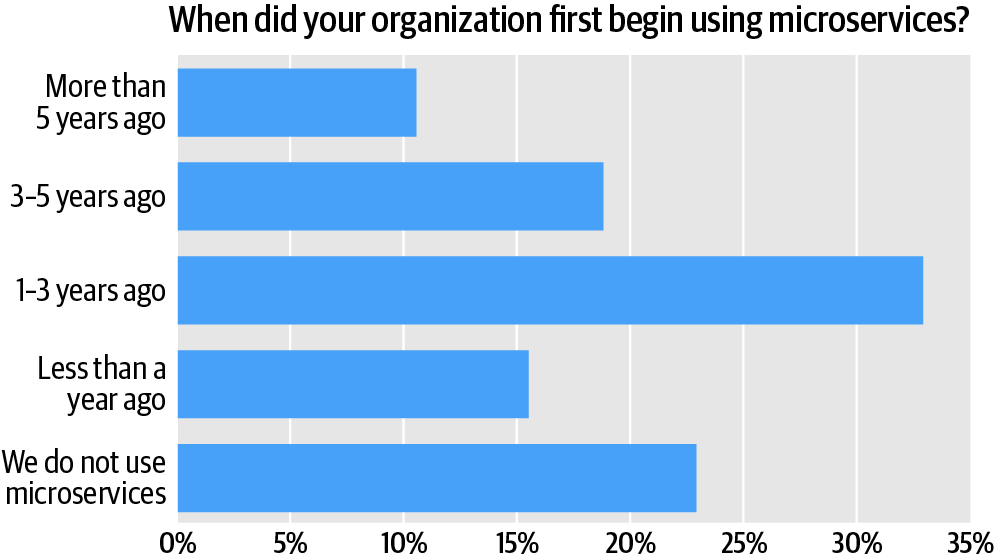
Out of dozens of companies we spoke with, only two had not yet started their journey to microservices, but both were actively considering it. Industry trends mirror this as well. In an O’Reilly survey of 1500+ respondents, more than 75% had started to adopt microservices.
It’s rare for companies to start building with microservices from the ground up. Of the companies we spoke with, only one had done so. Some startups, such as LaunchDarkly, plan to build their infrastructure using microservices, but turned to a monolith once they realized the high cost of overhead.
“We were spending more time effectively building and operating a system for distributed systems versus actually building our own services so we pulled back hard,” said John Kodumal, CTO and co-founder of LaunchDarkly.
“As an example, the things we were trying to do in mesosphere, they were impossible,” he said. “We couldn’t do any logging. Zero downtime deploys were impossible. There were so many bugs in the infrastructure and we were spending so much time debugging the basic things that we weren’t building our own service.”
As a result, it’s more common for companies to start with a monolith and move to microservices to scale their infrastructure with their organization. Once a company reaches ~30 developers, most begin decentralizing control by moving to a microservice architecture.
Teams may take different routes to arrive at a microservice architecture, but they tend to face a common set of challenges once they get there.
Large companies with established monoliths are keen to move to microservices, but costs are high and the transition can take years. Atlassian’s platform infrastructure is in microservices, but legacy monoliths in Jira and Confluence persist despite ongoing decomposition efforts. Large companies often get stuck in this transition. However, a combination of strong, top-down strategy combined with bottoms-up dev team support can help companies, such as Freddie Mac, make substantial progress.
Some startups, like Instacart, first shifted to a modular monolith that allows the code to reside in a single repository while beginning the process of distributing ownership of discrete code functions to relevant teams. This enables them to mitigate the overhead associated with a microservice architecture by balancing the visibility of having a centralized repository and release pipeline with the flexibility of discrete ownership over portions of the codebase.
Teams may take different routes to arrive at a microservice architecture, but they tend to face a common set of challenges once they get there. John Laban, CEO and co-founder of OpsLevel, which helps teams build and manage microservices told us that “with a distributed or microservices based architecture your teams benefit from being able to move independently from each other, but there are some gotchas to look out for.”
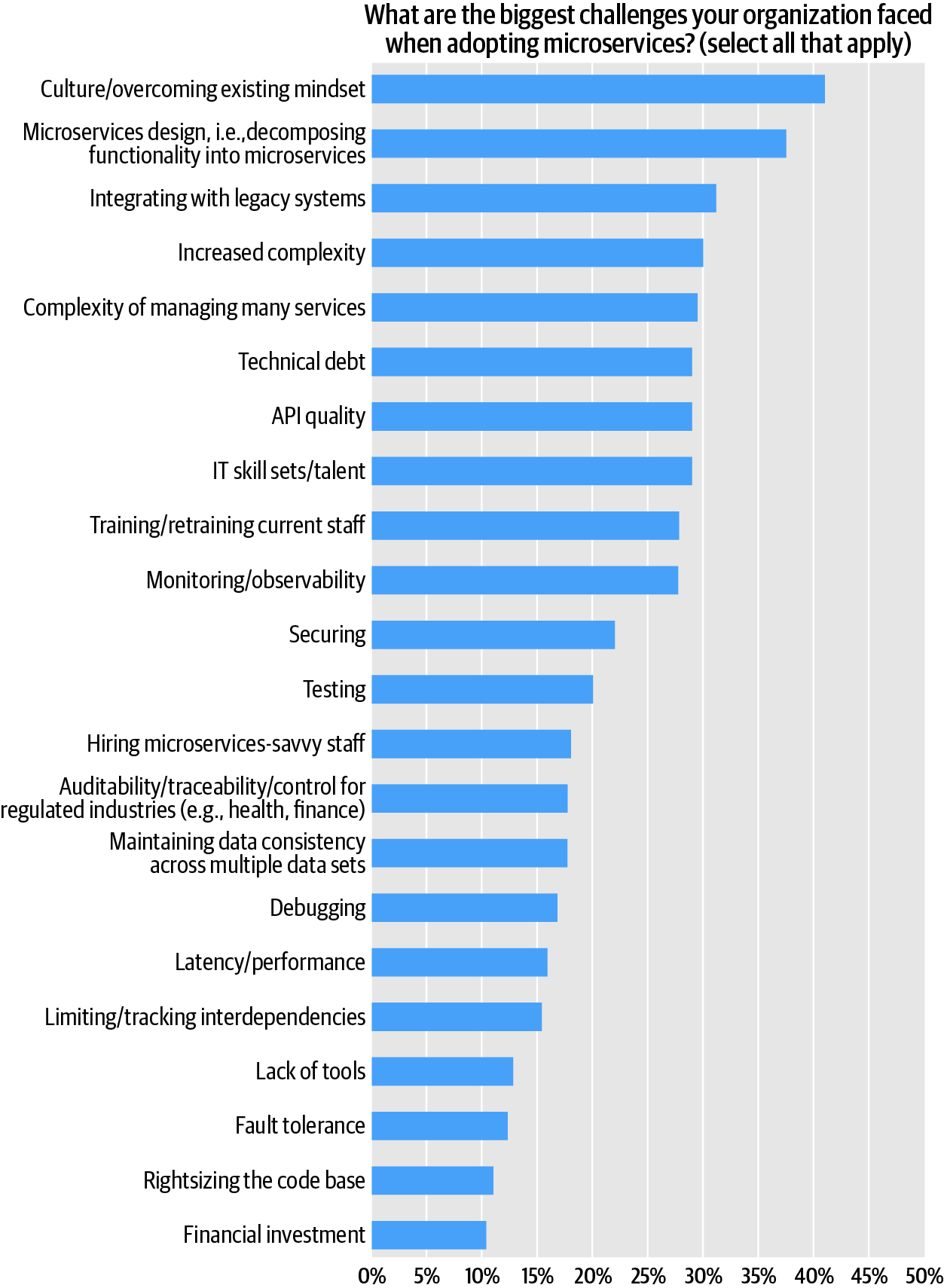
Indeed, the linked O’Reilly chart shows how the top 10 challenges organizations face when adopting microservices are shared by 25%+ of respondents. While we discussed some of the adoption blockers above, feedback from our interviews highlighted issues around managing complexity.
The lack of a coherent definition for a service can cause teams to generate unnecessary overhead by creating too many similar services or spreading related services across different groups. One company we spoke with went down the path of decomposing their monolith and took it too far. Their service definitions were too narrow, and by the time decomposition was complete, they were left with 4,000+ microservices to manage. They then had to backtrack and consolidate down to a more manageable number.
Defining too many services creates unnecessary organizational and technical silos while increasing complexity and overhead. Logging and monitoring must be present on each service, but with ownership spread across different teams, a lack of standardized tooling can create observability headaches. It’s challenging for teams to get a single-pane-of-glass view with too many different interacting systems and services that span the entire architecture.
Powered by WPeMatico
Tecton.ai, the startup founded by three former Uber engineers who wanted to bring the machine learning feature store idea to the masses, announced a $35 million Series B today, just seven months after announcing their $20 million Series A.
When we spoke to the company in April, it was working with early customers in a beta version of the product, but today, in addition to the funding, they are also announcing the general availability of the platform.
As with their Series A, this round has Andreessen Horowitz and Sequoia Capital co-leading the investment. The company has now raised $60 million.
The reason these two firms are so committed to Tecton is the specific problem around machine learning the company is trying to solve. “We help organizations put machine learning into production. That’s the whole goal of our company, helping someone build an operational machine learning application, meaning an application that’s powering their fraud system or something real for them […] and making it easy for them to build and deploy and maintain,” company CEO and co-founder Mike Del Balso explained.
They do this by providing the concept of a feature store, an idea they came up with and which is becoming a machine learning category unto itself. Just last week, AWS announced the Sagemaker Feature store, which the company saw as major validation of their idea.
As Tecton defines it, a feature store is an end-to-end machine learning management system that includes the pipelines to transform the data into what are called feature values, then it stores and manages all of that feature data and finally it serves a consistent set of data.
Del Balso says this works hand-in-hand with the other layers of a machine learning stack. “When you build a machine learning application, you use a machine learning stack that could include a model training system, maybe a model serving system or an MLOps kind of layer that does all the model management, and then you have a feature management layer, a feature store which is us — and so we’re an end-to-end life cycle for the data pipelines,” he said.
With so much money behind the company it is growing fast, going from 17 employees to 26 since we spoke in April, with plans to more than double that number by the end of next year. Del Balso says he and his co-founders are committed to building a diverse and inclusive company, but he acknowledges it’s not easy to do.
“It’s actually something that we have a primary recruiting initiative on. It’s very hard, and it takes a lot of effort, it’s not something that you can just make like a second priority and not take it seriously,” he said. To that end, the company has sponsored and attended diversity hiring conferences and has focused its recruiting efforts on finding a diverse set of candidates, he said.
Unlike a lot of startups we’ve spoken to, Del Balso wants to return to an office setup as soon as it is feasible to do so, seeing it as a way to build more personal connections between employees.
Powered by WPeMatico
When one of AWS’s east coast data centers went down at the end of last month, it had an impact on countless companies relying on its services, including Roku, Adobe and Shipt. When the incident was resolved, the company had to analyze what happened. For most companies, that involves manually pulling together information from various internal tools, not a focused incident platform.
Jeli.io wants to change that by providing one central place for incident analysis, and today the company announced a $4 million seed round led by Boldstart Ventures with participation by Harrison Metal and Heavybit.
Jeli CEO and founder Nora Jones knows a thing or two about incident analysis. She helped build the chaos engineering tools at Netflix, and later headed chaos engineering at Slack. While chaos engineering helps simulate possible incidents by stress-testing systems, incidents still happen, of course. She knew that there was a lot to learn from them, but there wasn’t a way to pull together all of the data around an incident automatically. She created Jeli to do that.
“While I was at Netflix pre-pandemic, I discovered the secret that looking at incidents when they happen — like when Netflix goes down, when Slack goes down or when any other organization goes down — that’s actually a catalyst for understanding the delta between how you think your org works and how your org actually works,” Jones told me.
She began to see that there would be great value in trying to figure out the decision-making processes, the people and tools involved and what companies could learn from how they reacted in these highly stressful situations, how they resolved them and what they could do to prevent similar outages from happening again in the future. With no products to help, Jones began building tooling herself at her previous jobs, but she believed there needed to be a broader solution.
“We started Jeli and began building tooling to help engineers by [serving] the insights to help them know where to look after incidents,” she said. They do this by pulling together all of the data from emails, Slack channels, PagerDuty, Zoom recordings, logs and so forth that captured information about the incident, surfacing insights to help understand what happened without having to manually pull all of this information together.
The startup currently has eight employees, with plans to add people across the board in 2021. As she does this, she is cognizant of the importance of building a diverse workforce. “I am extremely committed to diversity and inclusion. It is something that’s been important and a requirement for me from day one. I’ve been in situations in organizations before where I was the only one represented, and I know how that feels. I want to make sure I’m including that from day one because ultimately it leads to a better product,” she said.
The product is currently in private beta, and the company is working with early customers to refine the platform. The plan is to continue to invite companies in the coming months, then open that up more widely some time next year.
Eliot Durbin, general partner at Boldstart Ventures, says that he began talking to Jones a couple of years ago when she was at Netflix just to learn about this space, and when she was ready to start a company, his firm jumped at the chance to write an early check, even while the startup was pre-revenue.
“When we met Nora we realized that she’s on a lifelong mission to make things much more resilient […]. And we had the benefit of getting to know her for years before she started the company, so it was really a natural continuation to a conversation that we were already in,” Durbin explained.
Powered by WPeMatico
If this year has taught us a lesson about the world of work, it’s that collectively, we weren’t very well-equipped in terms of the technology we use to translate the in-person experience seamlessly to a remote version. That’s led to a rush of companies launching new services to fill that hole — cloud computing and data warehousing startups, collaboration platforms, sales tools and more — and today one of the latest startups in the area of videoconferencing is announcing a round of funding to see its business scale to the next level.
Wonder, a Berlin startup that has built a platform for people to come together in video-based groups to meet up, network and collaborate, while also having a bird’s-eye view of a larger space where they can more serendipitously, or more intentionally, interact with others — not unlike in an office or other business venue — is today announcing that it has raised $11 million (€9 million) in a substantial seed round.
The funding was led by European VC EQT Ventures, with BlueYard Capital — which led a pre-seed round in the startup when it was previously called “YoTribe” — also participating.
It comes on the heels of the young startup seeing some impressive traction this year.
Wonder now has 200,000 monthly users from a pretty diverse set of organizations, including NASA, Deloitte, Harvard and SAP, which are using it for a variety of purposes, from team collaboration through to career fairs. The company will use the funding both to add in more features as requested by current users, as well as to hire more people for its team, co-founder Stephane Roux said in an interview. Those features will include sharing files and other technical services, but they will not be piled on quickly or thickly.
“We think of this less in terms of content and more about people,” he said. “The core experience is about live interaction, not just repositories of stuff. We want to build a place for collaboration and communication. Interesting ways to carve up a group virtually.”
Now, you may be thinking: another workplace video app? Hasn’t this $14 billion space race already been “won” by Zoom (which some of us now use as a verb for videoconferencing, regardless of which app we actually use)? Or Microsoft or Google or BlueJeans, or whatever it is that your organization has inevitably already signed up and paid for?
But it turns out that for all the growth and use that these other platforms have had, they are sorely lacking in their overall experience, as it pertains to what it’s like to be in physical spaces with other people. One of the key points, it turns out, is that a lot of solutions are not really built with the user experience of the larger group in mind.
Wonder is built around the idea of a “shared space” that you enter. That space comes not from a VR experience as you might expect, but something much simpler that takes a tip from more rudimentary but very effective older game dynamics. You get a single window where you can “see” from an aerial view, as it were, all of the other people who are in the same space, and the areas within that space where they might cluster together.
Those clusters could be designed around a specific interest (such as marketing or HR or product) or — if the product is being used at a career fair, for example, at a list of different companies taking part; or — at a conference — different conference sessions, plus an exhibition space.
You can move around all of the clusters, or start your own, or sit in the margins with another person, and when you do come together with one or more people, you can join them in a video chat to interact. In the future, the plan is to do more than just join a video chat; you might also be able to access documents related to that cluster, and more.
The clusters can be “public” for anyone to join, or set to private, as you might have in a physical meeting room. The overall effect is that, without actually being in a physical space, you get the sense of a collective group of people in motion.
The startup was originally the brainchild of Leonard Witteler, who built a version of this last year as a coding project at university before showing it to friends and family and getting positive feedback.
As another co-founder, Pascal Steck, describes it, he, Witteler and Roux, who all knew each other, had been looking to build a startup together, but around a completely different idea — a portal for photographers and other creatives in the wedding industry.
Given how drastically curtailed weddings and other group gatherings have been this year, that didn’t really go anywhere at all. But the three could see an opportunity, a very different one, with the software that Witteler had built while still a student. So in the grand tradition of startups, they pivoted.
Wonder had previously been called YoTribe, which sounds a little like YouTube and also plays on the idea of groups of friends who come together around special interests.
And from how Steck and Roux described it to me in an interview (over Wonder of course), it didn’t sound like the initial idea was to target enterprises at all, but people who found themselves a bit at a loss when music festivals and other events like that suddenly died a death because of COVID-19.
Indeed, they themselves were all too aware of the state of the market for videoconferencing apps: it was very, very crowded.
“The space is very busy and some great products are already out there. But as soon as you zoom into this space” — no pun intended, Steck said — “when it’s about large group meetings, these other tools do not allow for serendipitous conversations or bottom-up gatherings, and the list gets very thin very quickly. Our focus is around improving presentations, but in the case of large groups, there is just not a lot out there. Especially something building an association as we know it to how we do things in the offline world. We think we have a unique spot in the market.
“A meeting for three people can use Zoom or Teams perfectly. There is no need for anything else, but for larger groups, that is not the case and it seems like the market is really open for something like Wonder.”
The name “Wonder” is an interesting choice when the startup rebranded from YoTribe. Wonder’s main meaning is surprise and discovery, but it has long been thought and assumed that “wonder” is also connected to the word “wander”. (In fact, the two are not related etymologically, but have often crossed paths and wandered into each other’s territories over the centuries.) Similarly, the idea with Wonder the app is that you can “wander” around a room, and find who and what you are looking for in the process.
Wonder is not the only upstart video app that has picked up some attention in the last several months. In fact, there has been a wave of them launching or announcing funding (or both) in 2020 to try to address the gaps — or opportunities — that exist as a result of the features from the current leaders.
Other launches have included mmhmm (Phil Libin’s latest startup that adds lots of bells and whistles to make the presentations more than just a talking head); Headroom (founded by ex-Google and ex-Magic Leap entrepreneurs, using AI to get more meaningful insights from the video conversations); Vowel (which lets people search across video chats to follow up items and dig into what people said across different calls); and Descript, Andrew Mason’s audio effort, now also has video features.
But if anything, a lot of these newer tools fail to address the shortcomings of what it’s like being a part of a big group using a video app. In fact, many of these newer entrants highlight another set of challenges, those of the speaker, who is thus graced with better presentation tools in mmhmm, or given way better insights into the audience with Headroom, etc.
In any case, Wonder has found, serendipitously, a lot of traction from people who have identified and lamented the problems with so much else out there today. The app is still free to use, and the plan will be to keep it that way until some time in 2021, Roux said. Ironically, he pointed out that many of its current customers are asking to be charged, not least because it lends using it more credibility, which is important with IT departments and so on. All that might mean the charging plan gets pushed up sooner.
In any case, even if companies are also using something else, they are also adopting Wonder, and that has in turn piqued the interest of investors who are interested to see where it might go next.
“Throughout COVID-19, real-time video has become the default for both private and professional interactions, and hybrid working is here to stay,” said Jenny Dreier, investor at EQT Ventures Berlin, in a statement. “No other video tools come anywhere near as close to replicating real-life interactions as Wonder, so the product has explosive potential, already foreshadowed with the platform’s stellar organic growth. It’s incredibly exciting to be working with the team and to be part of the journey; I can’t wait to be a part of their next chapter.”
Powered by WPeMatico
We learn more about Slack’s future, Revolut adds new payment features and DoorDash pushes its IPO range upward. This is your Daily Crunch for December 4, 2020.
The big story: Slack and Salesforce execs explain their big acquisition
After Salesforce announced this week that it’s acquiring Slack for $27.7 billion, Ron Miller spoke to Slack CEO Stewart Butterfield and Salesforce President and COO Bret Taylor to learn more about the deal.
Butterfield claimed that Slack will remain relatively independent within Salesforce, allowing the team to “do more of what we were already doing.” He also insisted that all the talk about competing with Microsoft Teams is “overblown.”
“The challenge for us was the narrative,” Butterfield said. “They’re just good [at] PR or something that I couldn’t figure out.”
Startups, funding and venture capital
Revolut lets businesses accept online payments — With this move, the company is competing directly with Stripe, Adyen, Braintree and Checkout.com.
Health tech venture firm OTV closes new $170M fund and expands into Asia — This year, the firm led rounds in telehealth platforms TytoCare and Lemonaid Health.
Zephr raises $8M to help news publishers grow subscription revenue — The startup’s customers already include publishers like McClatchy, News Corp Australia, Dennis Publishing and PEI Media.
Advice and analysis from Extra Crunch
DoorDash amps its IPO range ahead of blockbuster IPO — The food delivery unicorn now expects to debut at $90 to $95 per share, up from a previous range of $75 to $85.
Enter new markets and embrace a distributed workforce to grow during a pandemic — Is this the right time to expand overseas?
Three ways the pandemic is transforming tech spending — All companies are digital product companies now.
(Extra Crunch is our membership program, which aims to democratize information about startups. You can sign up here.)
Everything else
WH’s AI EO is BS — Devin Coldewey is not impressed by the White House’s new executive order on artificial intelligence.
China’s internet regulator takes aim at forced data collection — China is a step closer to cracking down on unscrupulous data collection by app developers.
Gift Guide: Games on every platform to get you through the long, COVID winter — It’s a great time to be a gamer.
The Daily Crunch is TechCrunch’s roundup of our biggest and most important stories. If you’d like to get this delivered to your inbox every day at around 3pm Pacific, you can subscribe here.

Powered by WPeMatico
Ever since the pandemic hit the U.S. in full force last March, the B2B tech community keeps asking the same questions: Are businesses spending more on technology? What’s the money getting spent on? Is the sales cycle faster? What trends will likely carry into 2021?
Recently we decided to join forces to answer these questions. We analyzed data from the just-released Q4 2020 Outlook of the Coupa Business Spend Index (BSI), a leading indicator of economic growth, in light of hundreds of conversations we have had with business-tech buyers this year.
A former Battery Ventures portfolio company, Coupa* is a business spend-management company that has cumulatively processed more than $2 trillion in business spending. This perspective gives Coupa unique, real-time insights into tech spending trends across multiple industries.
Tech spending is continuing despite the economic recession — which helps explain why many startups are raising large rounds and even tapping public markets for capital.
Broadly speaking, tech spending is continuing despite the economic recession — which helps explain why many tech startups are raising large financing rounds and even tapping the public markets for capital. Here are our three specific takeaways on current tech spending:
Tech spending ranks among the hottest boardroom topics today. Decisions that used to be confined to the CIO’s organization are now operationally and strategically critical to the CEO. Multiple reasons drive this shift, but the pandemic has forced businesses to operate and engage with customers differently, almost overnight. Boards recognize that companies must change their business models and operations if they don’t want to become obsolete. The question on everyone’s mind is no longer “what are our technology investments?” but rather, “how fast can they happen?”
Spending on WFH/remote collaboration tools has largely run its course in the first wave of adaptation forced by the pandemic. Now we’re seeing a second wave of tech spending, in which enterprises adopt technology to make operations easier and simply keep their doors open.
SaaS solutions are replacing unsustainable manual processes. Consider Rhode Island’s decision to shift from in-person citizen surveying to using SurveyMonkey. Many companies are shifting their vendor payments to digital payments, ditching paper checks entirely. Utility provider PG&E is accelerating its digital transformation roadmap from five years to two years.
The second wave of adaptation has also pushed many companies to embrace the cloud, as this chart makes clear:
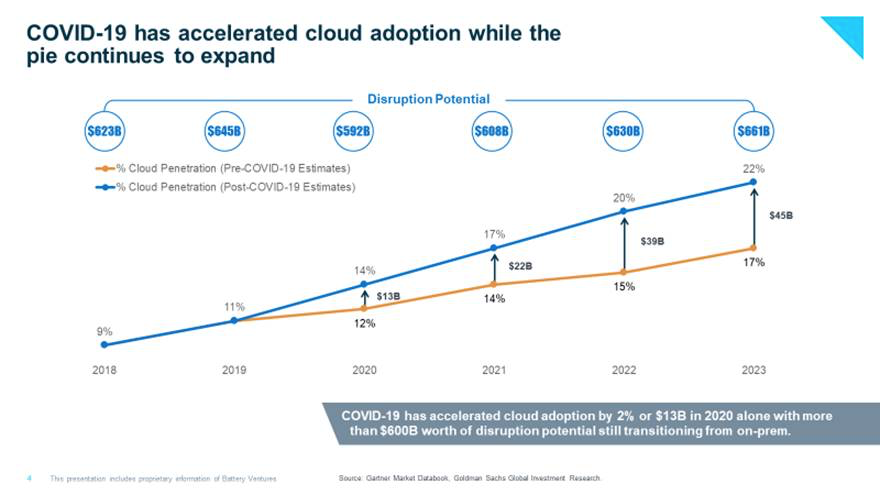
Image Credits: Battery Ventures (opens in a new window)
Similarly, the difficulty of maintaining a traditional data center during a pandemic has pushed many companies to finally shift to cloud infrastructure under COVID. As they migrate that workload to the cloud, the pie is still expanding. Goldman Sachs and Battery Ventures data suggest $600 billion worth of disruption potential will bleed into 2021 and beyond.
In addition to SaaS and cloud adoption, companies across sectors are spending on technologies to reduce their reliance on humans. For instance, Tyson Foods is investing in and accelerating the adoption of automated technology to process poultry, pork and beef.
Mention “digital product company” in the past, and we’d all think of Netflix. But now every company has to reimagine itself as offering digital products in a meaningful way.
Powered by WPeMatico
When Salesforce bought Slack earlier this week for $27.7 billion, it was in some ways the end of a startup fairytale. Slack was the living embodiment of the Silicon Valley startup success fantasy. It started as a pivot from a game company, of all things. It raised $1.4 billion, went from zero to a $7 billion valuation to IPO, checking off every box on the startup founder’s wish list.
Then quite suddenly this week, Slack was part of Salesforce, plucked off the market for an enormous sum of money.
While we might not ever know the back (Slack) room maneuvering that went on to make the deal a reality, it is interesting to note that Slack CEO Stewart Butterfield told me in an interview this week that he was not actually trying to sell the company when he approached Salesforce president and COO Bret Taylor earlier this year. Instead, he wanted to buy something from them.
“I actually talked to Bret in the early days of the pandemic to see if they wanted to sell us Quip because I thought it would be good for us, and I didn’t really know what their plans were [for it]. He said he’d get back to me, and then got back to me six months later or so,” Butterfield said.
At that point, the conversation flipped and the companies began a series of discussions that eventually led to Salesforce acquiring Slack.
From the Salesforce perspective, Taylor says that the Slack deal was worth the money because it really allows his company to bring together all the pieces of their platform, one that has expanded over the years from pure CRM to include marketing, customer service, data visualization, workflow and more. Taylor also said that having Slack gives Salesforce a missing communication layer on top of its other products, something especially important when interactions with customers, partners or fellow employees have become mostly digital.
“When we say we really want Slack to be this next generation interface for Customer 360, what we mean is we’re pulling together all these systems. How do you rally your teams around these systems in this digital work-anywhere world that we’re in right now where these teams are distributed and collaboration is more important than ever,” Taylor said.
Butterfield sees a natural connection between what people do in the course of their work, what machines do behind the scenes in these systems of record and engagement and how Slack can help bridge the gap between humans and machines.
He says that by putting Slack in the middle of business processes, you can begin to eliminate friction that occurs in complex enterprise software like Salesforce. Instead of moving stuff through email, clicking a link, opening a browser, signing in and then finally accessing the tool you want, the approval could be built into a single Slack message.
“If you have hundreds of those kinds of actions a day, there’s a real opportunity to increase the velocity, and that has an impact, and not just in the minutes saved by the person doing the approval, but the speed of how the whole business operates,” Butterfield said.
While neither executive said the deal was about competing with Microsoft, it was likely an underlying reason that the companies decided to join forces. They may prove better together than they are separately, and both have complicated histories with Microsoft.
Slack has had an ongoing battle with Microsoft and its Teams product for years. It filed suit against the company last summer in the EU over what it called unfairly bundling of Teams for free with Office 365. In an interview last year with The Wall Street Journal, Butterfield said that he believes Microsoft sees his company as an existential threat. Hyperbole aside, there is tension and competition between the two enterprise software companies.
Salesforce and Microsoft also have a long history, from lawsuits in the early days to making friends and working together when it makes sense after Satya Nadella took over in 2014, while still competing hard in the market. It’s hard not to see the deal in that context.
In a recent interview with TechCrunch, Battery Ventures general partner Neeraj Agrawal said the deal was at least partially about catching Microsoft.
“To get to a market cap of $1 trillion, Salesforce now has to take MSFT head on. Until now, the company has mostly been able to stay in its own swim lane in terms of products,” Agrawal told TechCrunch.
As for Butterfield, while he saw the obvious competition, he denied the deal was about putting his company in a better position to compete with his rival.
“I don’t think that was really an important part of the rationale, at least for me,” he said, adding “the competition with Microsoft is overblown. The challenge for us was the narrative. They’re just good PR or something that I couldn’t figure out,” he said.
While Butterfield cited a list of large clients in enterprise tech, insurance and banking, the narrative has always been that Slack was favored by developer teams, which is where it initially gained traction. Whatever the reality, with Salesforce, Slack is definitely in a better position to compete with any and all comers in the enterprise communications space, and while it will be part of Salesforce, the two companies also have to figure out how to maintain some separation.
Taylor certainly recognizes that Slack’s current customers are watching closely to see how they handle the acquisition, and his company will have to walk a fine line between respecting the brand and product independence on one hand, while finding ways to create and build upon existing hooks into Salesforce to allow the CRM giant to take full advantage of its substantial investment.
It won’t be easy to do, but you can see a similar level of independence in some of Salesforce’s recent big-money purchases like MuleSoft, the company it bought in 2018 for $6.5 billion, and Tableau, the company it bought last year for more than $15 billion. As Butterfield points out, those two companies have clearly maintained their brand identity and independence, and he sees them as role models for Slack.
“So there’s a layer of independence that’s like that [for Mulesoft and Tableau] because it’s not going to help anyone call us Chat Cloud or something like that. They paid a lot of money for us, so they want us to do more of what we were already doing,” he said.
Taylor, whose opinion matters greatly here, certainly sees it in similar terms.
“We want to make sure we have a real integrated value proposition, a real integrated platform for developers, but also maintain Slack’s technology independence, technology agnostic platform and its brand,” he said.
As for the companies coming together, both men see a lot of potential here to merge Slack communications with Salesforce’s enterprise software prowess to make something better, and Taylor sees Slack helping link the two with workflows and automations.
“When you think about automation, it’s event driven, these long-running processes, automations. If you look at what people are doing with the Slack platform, it’s essentially incorporating workflows and bots and all these things. The combination of the Salesforce platform where I think we have the best automation intelligence capabilities with the Slack platform is incredible,” Taylor said.
The challenge these two men now face as they move forward with this acquisition, and all of the expectations inherent in a deal this large, is making it work. Salesforce has a lot of experience with large acquisitions, and they have handled some well, and some not so well. It’s going to be imperative for both companies that they get this right. It’s now up to Taylor and Butterfield to make sure that happens.
Powered by WPeMatico
Thoma Bravo must really like Flexera, an IT asset management company out of Chicago. The private equity firm bought the company for the second time today. Sources told TechCrunch the price was $2.85 billion.
Technically, Thoma Bravo is getting a majority stake in the company, buying it from previous owners TA Associates and Ontario Teachers’ Pension Plan Board. The firm originally bought Flexera in 2008 from Macrovision for just $200 million. It turned it around just three years later in 2011 for $1 billion profit, according to reports.
While reports last year had the company’s investors looking for $3 billion, they didn’t quite reach that mark, but it’s still a hefty profit as the company continues to change hands, giving each of its owners a substantial return on investment.
At $2.85 billion, Thoma Bravo will have a bigger challenge on its hands to make that same kind of return, but it sees a company it liked before and it still likes it, especially the management team, which to some degree at least remains intact.
“Jim [Ryan] and his team have positioned Flexera for sustained growth by focusing on the strategic challenges enterprises face with complex IT infrastructures,” Seth Boro, managing partner at Thoma Bravo said in a statement.
Ryan was pleased to see the company’s value continue to rise and to connect once again with Thoma Bravo. “This is a resounding vote of confidence in the growth Flexera has shown and the strategic initiatives we’ve undertaken to address the exponential challenges faced by organizations today,” he said in a statement.
Flexera was founded in 2008 and has bought 12 companies along the way, including five in the last couple of years, according to Crunchbase data. The deal is expected to close in the first quarter of next subject to regulatory approvals.
Powered by WPeMatico

Last year, AWS launched the APN Global Startup Program, which is sort of AWS’s answer to an incubator for mid to late-stage startups deeply involved with AWS technology. This year, the company wants to expand that offering, and today it announced some updates to the program at the Partner keynote at AWS re:Invent.
While startups technically have to pay a $2,500 fee if they are accepted to the program, AWS typically refunds that fee, says Doug Yeum, head of the Global Partner Organization at AWS — and they get a lot of benefits for being part of the program.
“While the APN has a $2,500 annual program fee, startups that are accepted into the invite-only APN Global Startup Program get that fee back, as well as free access to substantial additional resources both in terms of funding as well as exclusive program partner managers and co-sell specialists resources,” Yeum told TechCrunch.
And those benefits are pretty substantial, including access to a new “white glove program” that lets them work with a program manager with direct knowledge of AWS and who has experience working with startups. In addition, participants get access to an ISV program to work more directly with these vendors to increase sales and access to data exchange services to move third-party data into the AWS cloud.
What’s more, they can apply to the new AI/ML Acceleration program. As AWS describes it, “This includes up to $5,000 AWS credits to fund experiments on AWS services, enabling startups to explore AWS AI/ML tools that offer the best fit for them at low risk.”
Finally, they get partially free access to the AWS Marketplace, offsetting the normal marketplace listing fees for the first five offerings. Some participants will also get access to AWS sales to help use the power of the large company to drive a startup’s sales.
While you can apply to the program, the company also recruits individual startups that catch its attention. “We also proactively invite mid to late-stage startups built on AWS that, based on market signals, are showing traction and offer interesting use cases for our mutual enterprise customers,” Yeum explained.
Among the companies currently involved in the program are HashiCorp, Logz.io and Snapdocs. Interested startups can apply on the APN Global Startup website.

Powered by WPeMatico