Enterprise
Auto Added by WPeMatico
Auto Added by WPeMatico
Two months ago, Kubernetes observability platform Pixie Labs launched into general availability and announced a $9.15 million Series A funding round led by Benchmark, with participation from GV. Today, the company is announcing its acquisition by New Relic, the publicly traded monitoring and observability platform.
The Pixie Labs brand and product will remain in place and allow New Relic to extend its platform to the edge. From the outset, the Pixie Labs team designed the service to focus on providing observability for cloud-native workloads running on Kubernetes clusters. And while most similar tools focus on operators and IT teams, Pixie set out to build a tool that developers would want to use. Using eBPF, a relatively new way to extend the Linux kernel, the Pixie platform can collect data right at the source and without the need for an agent.
At the core of the Pixie developer experience are what the company calls “Pixie scripts.” These allow developers to write their debugging workflows, though the company also provides its own set of these and anybody in the community can contribute and share them as well. The idea here is to capture a lot of the informal knowledge around how to best debug a given service.
“We’re super excited to bring these companies together because we share a mission to make observability ubiquitous through simplicity,” Bill Staples, New Relic’s chief product officer, told me. “[…] According to IDC, there are 28 million developers in the world. And yet only a fraction of them really practice observability today. We believe it should be easier for every developer to take a data-driven approach to building software and Kubernetes is really the heart of where developers are going to build software.”
It’s worth noting that New Relic already had a solution for monitoring Kubernetes clusters. Pixie, however, will allow it to go significantly deeper into this space. “Pixie goes much, much further in terms of offering on-the-edge, live debugging use cases, the ability to run those Pixie scripts. So it’s an extension on top of the cloud-based monitoring solution we offer today,” Staples said.
The plan is to build integrations into New Relic into Pixie’s platform and to integrate Pixie use cases with New Relic One as well.
Currently, about 300 teams use the Pixie platform. These range from small startups to large enterprises and, as Staples and Pixie co-founder Zain Asgar noted, there was already a substantial overlap between the two customer bases.
As for why he decided to sell, Asgar — a former Google engineer working on Google AI and adjunct professor at Stanford — told me that it was all about accelerating Pixie’s vision.
“We started Pixie to create this magical developer experience that really allows us to redefine how application developers monitor, secure and manage their applications,” Asgar said. “One of the cool things is when we actually met the team at New Relic and we got together with Bill and [New Relic founder and CEO] Lew [Cirne], we realized that there was almost a complete alignment around this vision […], and by joining forces with New Relic, we can actually accelerate this entire process.”
New Relic has recently done a lot of work on open-sourcing various parts of its platform, including its agents, data exporters and some of its tooling. Pixie, too, will now open-source its core tools. Open-sourcing the service was always on the company’s road map, but the acquisition now allows it to push this timeline forward.
“We’ll be taking Pixie and making it available to the community through open source, as well as continuing to build out the commercial enterprise-grade offering for it that extends the New Relic One platform,” Staples explained. Asgar added that it’ll take the company a little while to release the code, though.
“The same fundamental quality that got us so excited about Lew as an EIR in 2007, got us excited about Zain and Ishan in 2017 — absolutely brilliant engineers, who know how to build products developers love,” Benchmark Ventures General Partner Eric Vishria told me. “New Relic has always captured developer delight. For all its power, Kubernetes completely upends the monitoring paradigm we’ve lived with for decades. Pixie brings the same easy to use, quick time to value, no-nonsense approach to the Kubernetes world as New Relic brought to APM. It is a match made in heaven.”
Powered by WPeMatico
Nutanix announced today that it was bringing in former VMware executive Rajiv Ramaswami as president and CEO. Ramaswami replaces co-founder Dheeraj Pandey, who announced his plans to retire in August.
The new CEO brings 30 years of industry experience to the position, including stints with Broadcom, Cisco, Nortel and IBM — in addition to his most recent gig at VMware as chief operating officer of Products and Cloud Services.
At his position at VMware, Ramaswami had the opportunity to see Nutanix up close as a key competitor, and he now has the opportunity to lead the company into its next phase. “I have long admired Nutanix as a formidable competitor, a pioneer in hyperconverged infrastructure solutions and a leader in cloud software,” he said in a statement. He hopes to build on his industry knowledge to continue growing the company.
Sohaib Abbasi, lead independent director of Nutanix, says that as a candidate, Ramaswami’s experience really stood out. “Rajiv distinguished himself among the CEO candidates with his rare combination of operational discipline, business acumen, technology vision and inclusive leadership skills,” he said in a statement.
Holger Mueller, an analyst at Constellation Research, says the hiring makes a lot of sense, as VMware is quickly becoming the company’s primary competitor. “Nutanix and VMware want to be the same in the future — the virtualization and workload portability Switzerland across cloud and on premise compute infrastructures,” he told me.
What’s more, it allows Nutanix to grab a talented executive. “So hiring Ramaswami brings both an expert for multi-cloud to the Nutanix helm, as well as weakening a key competitor from a talent perspective,” he said.
Nutanix was founded in 2009. It raised more than $600 million from firms like Khosla Ventures, Lightspeed Ventures, Sapphire Ventures, Fidelity and Wellington Management, according to Crunchbase data. The company went public in 2016. Investors seem pleased by the announcement, with the company stock price up 1.29% as of publication.
Powered by WPeMatico

Power Automate is Microsoft’s platform for streamlining repetitive workflows — you may remember it under its original name: Microsoft Flow. The market for these robotic process automation (RPA) tools is hot right now, so it’s no surprise that Microsoft, too, is doubling down on its platform. Only a few months ago, the team launched Power Automate Desktop, based on its acquisition of Softomotive, which helps users automate workflows in legacy desktop-based applications, for example. After a short time in preview, Power Automate Desktop is now generally available.
The real news today, though, is that the team is also launching a new tool, the Process Advisor, which is now in preview as part of the Power Automate platform. This new process mining tool provides users with a new collaborative environment where developers and business users can work together to create new automations.
The idea here is that business users are the ones who know exactly how a certain process works. With Process Advisor, they can now submit recordings of how they process a refund, for example, and then submit that to the developers, who are typically not experts in how these processes usually work.
What’s maybe just as important is that a system like this can identify bottlenecks in existing processes where automation can help speed up existing workflows.
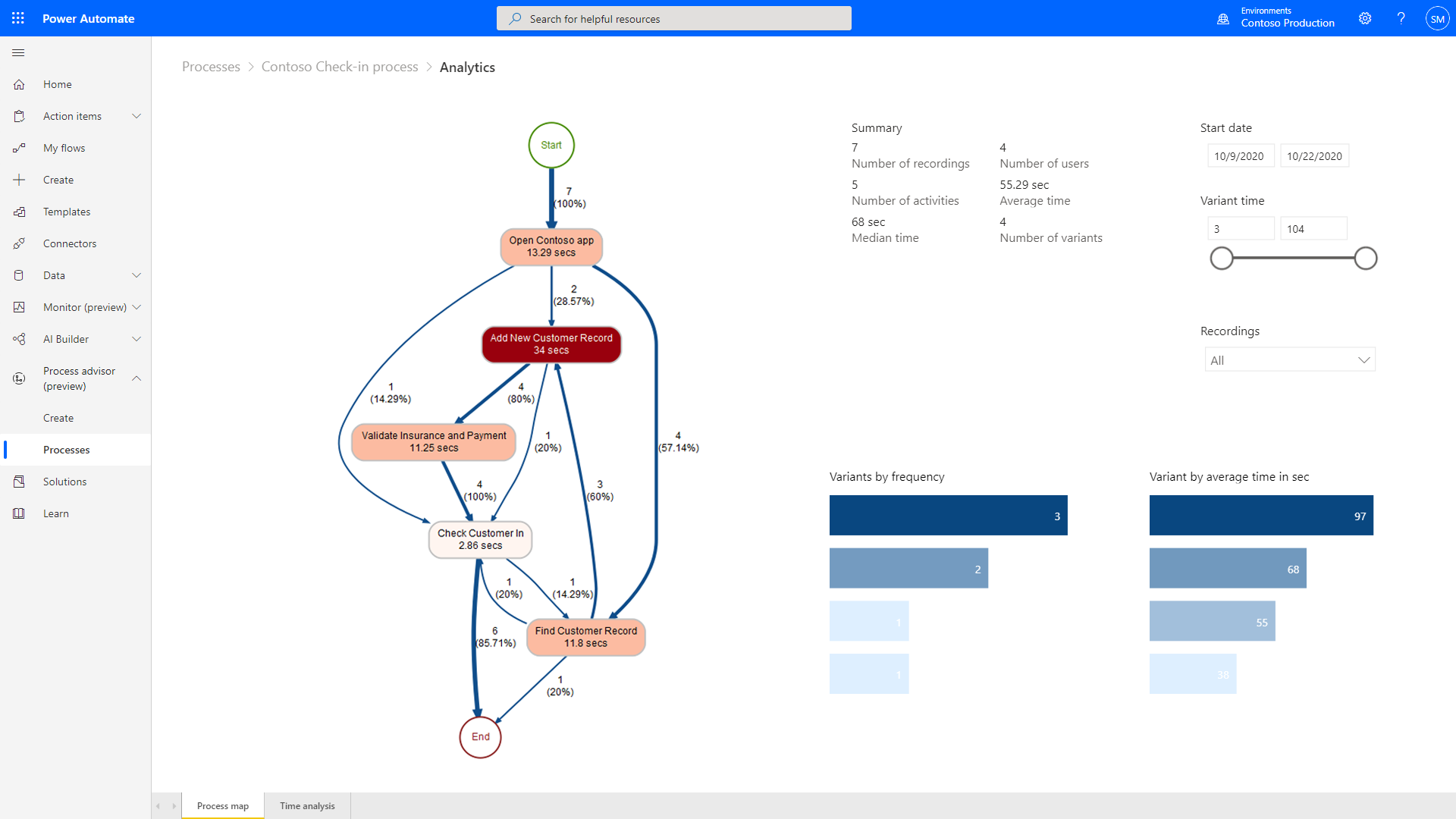
Image Credits: Microsoft
“This goes back to one of the things that we always talk about for Power Platform, which, it’s a corny thing, but it’s that development is a team sport,” Charles Lamanna, Microsoft’s corporate VP for its Low Code Application Platform, told me. “That’s one of our big focuses: how to bring people to collaborate and work together who normally don’t. This is great because it actually brings together the business users who live the process each and every day with a specialist who can build the robot and do the automation.”
The way this works in the backend is that Power Automate’s tools capture exactly what the users do and click on. All this information is then uploaded to the cloud and — with just five or six recordings — Power Automate’s systems can map how the process works. For more complex workflows, or those that have a lot of branches for different edge cases, you likely want more recordings to build out these processes, though.
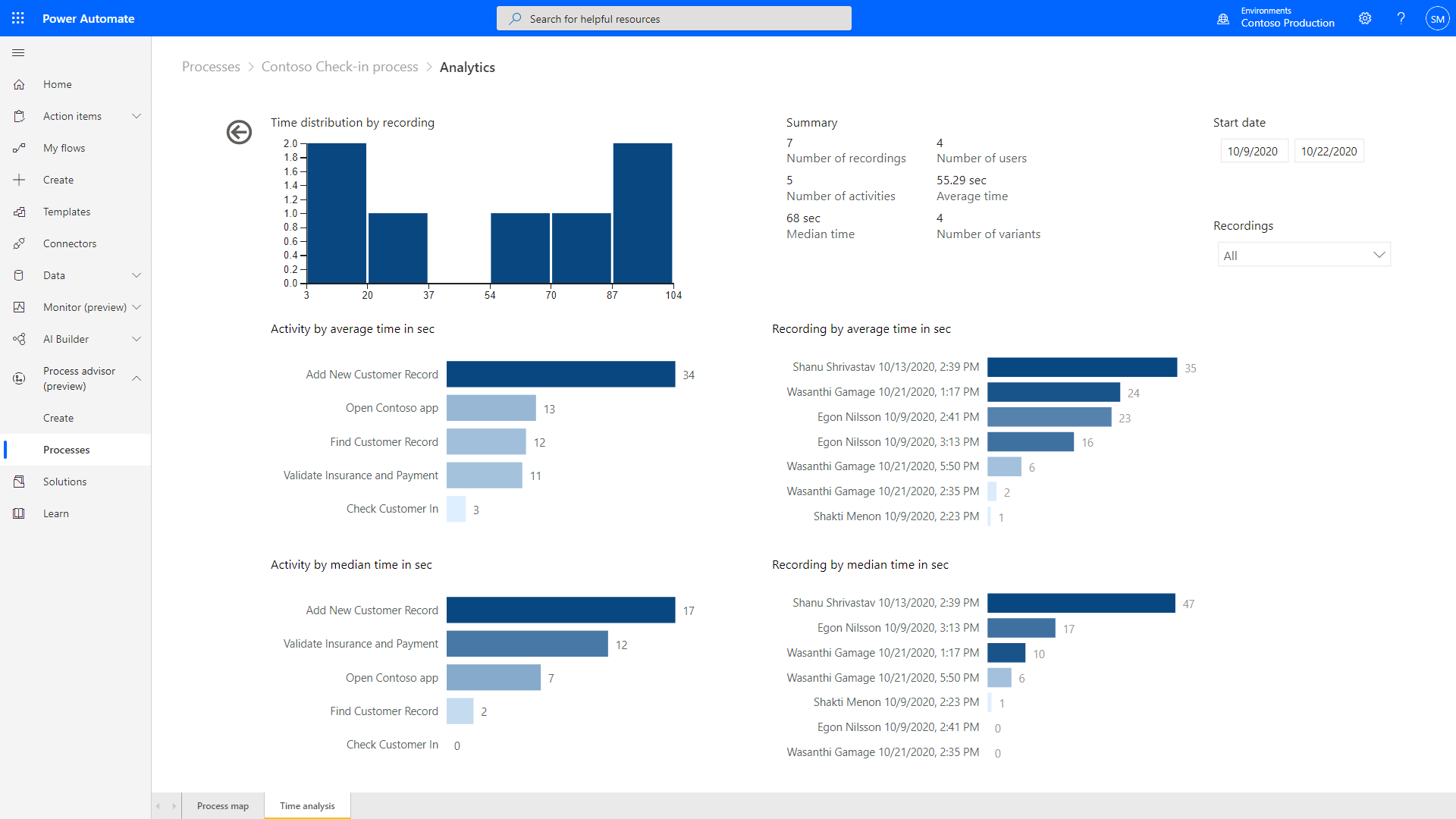
Image Credits: Microsoft
As Lamanna noted, building out these workflows and process maps can also help businesses better understand the ROI of these automations. “This kind of map is great to go build an automation on top of it, but it’s also great because it helps you capture the ROI of each automation you do because you’ll know for each step how long it took you,” Lamanna said. “We think that this concept of Process Advisor is probably going to be one of the most important engines of adoption for all these low-code/no-code technologies that are coming out. Basically, it can help guide you to where it’s worth spending the energy, where it’s worth training people, where it’s worth building an app, or using AI, or building a robot with our RPA like Power Automate.”
Lamanna likened this to the advent of digital advertising, which for the first time helped marketers quantify the ROI of advertising.
The new process mining capabilities in Power Automate are now available in preview.
Powered by WPeMatico
At a time when more companies are building machine learning models, Arthur.ai wants to help by ensuring the model accuracy doesn’t begin slipping over time, thereby losing its ability to precisely measure what it was supposed to. As demand for this type of tool has increased this year, in spite of the pandemic, the startup announced a $15 million Series A today.
The investment was led by Index Ventures with help from newcomers Acrew and Plexo Capital, along with previous investors Homebrew, AME Ventures and Work-Bench. The round comes almost exactly a year after its $3.3 million seed round.
As CEO and co-founder Adam Wenchel explains, data scientists build and test machine learning models in the lab under ideal conditions, but as these models are put into production, the performance can begin to deteriorate under real-world scrutiny. Arthur.ai is designed to root out when that happens.
Even as COVID has wreaked havoc throughout much of this year, the company has grown revenue 300% in the last six months smack dab in the middle of all that. “Over the course of 2020, we have begun to open up more and talk to [more] customers. And so we are starting to get some really nice initial customer traction, both in traditional enterprises as well as digital tech companies,” Wenchel told me. With 15 customers, the company is finding that the solution is resonating with companies.
It’s interesting to note that AWS announced a similar tool yesterday at re:Invent called SageMaker Clarify, but Wenchel sees this as more of a validation of what his startup has been trying to do, rather than an existential threat. “I think it helps create awareness, and because this is our 100% focus, our tools go well beyond what the major cloud providers provide,” he said.
Investor Mike Volpi from Index certainly sees the value proposition of this company. “One of the most critical aspects of the AI stack is in the area of performance monitoring and risk mitigation. Simply put, is the AI system behaving like it’s supposed to?” he wrote in a blog post announcing the funding.
When we spoke a year ago, the company had eight employees. Today it has 17 and it expects to double again by the end of next year. Wenchel says that as a company whose product looks for different types of bias, it’s especially important to have a diverse workforce. He says that starts with having a diverse investment team and board makeup, which he has been able to achieve, and goes from there.
“We’ve sponsored and work with groups that focus on both general sort of coding for different underrepresented groups as well as specifically AI, and that’s something that we’ll continue to do. And actually I think when we can get together for in-person events again, we will really go out there and support great organizations like AI for All and Black Girls Code,” he said. He believes that by working with these groups, it will give the startup a pipeline to underrepresented groups, which they can draw upon for hiring as the needs arise.
Wenchel says that when he can go back to the office, he wants to bring employees back, at least for part of the week for certain kinds of work that will benefit from being in the same space.
Powered by WPeMatico
As the health tech landscape rapidly evolves, another startup is making its presence known. HealNow has closed a $1.3 million round of funding from SoftBank Opportunity Fund and Alabama Futures Fund.
The company was founded by Halston Prox and Joshua Smith. Prox has worked in healthcare for more than a decade with major organizations such as Providence Health, Mount Sinai and Baylor Scott & White, mostly focused on digitizing health records and designing and implementing software for doctors, nurses, etc. Smith, CTO at the company, has been a developer since 2012.
The duo founded HealNow to become the central nervous system for order and delivery of prescriptions, according to Prox. Your average payments processing system isn’t necessarily applicable to pharmacies large and small because of the complexities of health insurance and the regulatory landscape.
Not only is it costly to facilitate online payments for pharmacies, but they also have their own pharmacy management systems and workflows that can be easily disrupted by moving to a new payments system.
HealNow has built a system that’s specifically tailored to pharmacies of any shape or size, from grocery stores to mom and pop pharmacies and everything in between. It’s a white label solution, meaning that any pharmacy can put their brand language on the product.
“We’re embedded in their current workflows and pharmacies don’t have to do anything manual, even if they’re using a pharmacy management system,” said Prox.
When a user looks to get a prescription from their pharmacy, they are sent a link that allows them to securely answer any questions that may be necessary for the pickup, enter insurance info, make a payment and schedule a curbside pickup or a delivery. The tech also integrates with third-party delivery services for pharmacies that offer deliveries.
This technology has been particularly important during the COVID-19 pandemic, giving smaller pharmacies the chance to compete with bigger chains who have digital solutions already set up that allow for curbside pick up. This is especially true now that Amazon has gotten into the space with the launch of Amazon Pharmacy.
HealNow is a SaaS company, charging a monthly subscription fee for use of the platform, as well as a service fee for prescriptions purchased on the platform. However, that service fee is a flat rate that never changes based on the cost of the prescription.
The space is crowded and growing more crowded, with competitors like NimbleRX and Capsule offering their own spin on simplifying and digitizing the pharmacy. One big difference for HealNow, says Prox, is that the startup has no intention of ever being a pharmacy, but rather serving pharmacies in a way that doesn’t disrupt their current workflow or system.
“We’re not a pharmacy, and we want to enable all these pharmacies to be online,” said Prox. “To do that we have to do that in an unbiased way by focusing on being a complete tech company.”
The funding is going primarily toward building out the sales and marketing arms of the company to continue fueling growth. HealNow has a foothold in the West, Southwest and Middle America, and is opening an office in Birmingham to sprint across the East Coast. Prox says the company is processing thousands of orders a day and tens of thousands of orders each month.
HealNow launched in 2018 after graduating from the Entrepreneurs Roundtable Accelerator .
Powered by WPeMatico
Remote learning and training have become a large priority this year for organizations looking to keep employees engaged and up to date on work practices at a time when many of them are not working in an office — and, in the case of those who have joined in 2020, may have never met any of their work colleagues in person, ever. Today one of the startups that’s built a new, more user-friendly approach to creating and provisioning those learning materials is announcing some funding as it experiences a boost in its growth.
WorkRamp, which has built a platform that helps organizations build their own training materials, and then distribute them both to their workforce and to partners, has raised $17 million, a Series B round of funding that’s being led by OMERS Ventures, with Bow Capital also participating.
Its big pitch is that it has built the tools to make it easy for companies to build their own training and learning materials, incorporating tests, videos, slide shows and more, and by making it easier for companies to build these themselves, the materials themselves become more engaging and less stiff.
“We’re disrupting the legacy LMS [learning management system] providers, the Cornerstones of the world, with our bite-size training platform,” said CEO and founder Ted Blosser in an interview. “We want to do what Peloton did for the exercise market, but with corporate training. We are aiming for a consumer-grade experience.”
The company, originally incubated in Y Combinator, has now raised $27 million.
The funding comes on the back of strong growth for WorkRamp . Blosser said that it now has around 250 customers, with 1 million courses collectively created on its platform. That list includes fast-growing tech companies like Zoom, Box, Reddit and Intercom, as well as Disney, GlobalData and PayPal. As it continues to expand, it will be interesting to see how and if it can also snag more legacy, late adopters who are not as focused on tech in their own DNA.
WorkRamp estimates that there is some $20 billion spent annually by organizations on corporate training. Unsurprisingly, that has meant the proliferation of a number of companies building tools to address that market.
Just Google WorkRamp and you’re likely to encounter a number of its competitors who have bought its name as a keyword to snag a little more attention. There are both big and small players in the space, including Leapsome, Capterra, Lessonly, LearnUpon (which itself recently raised a big round), SuccessFactors and TalentLMS.
The interesting thing about what WorkRamp has built is that it plays on the idea of the “creator,” which really has been a huge development in our digital world. YouTube may have kicked things off with the concept of “user-generated content.” but today we have TikTok, Snapchat, Facebook, Twitter and so many more platforms — not to mention smartphones themselves, with their easy facilities to shoot videos and photos of others, or of yourself, and then share with others — which have made the idea of building your own work, and looking at that of others, extremely accessible.
That has effectively laid the groundwork for a new way of conceiving of even more prosaic things, like corporate training. (Can there really be anything more comedically prosaic than that?) Other startups like Kahoot have also played on this idea, by making it easy for enterprises to build their own games to help train their staff.
This is what WorkRamp has aimed to tap into with its own take on the learning market, to help its customers eschew the idea of hiring outside production companies to make training materials, or expect WorkRamp to build those materials for them: Instead, the people who are going to use the training now have the control.
“I think it’s critical to be able to build your own customer education,” Blosser said. “That’s a big trend for clients that want both to rapidly onboard people but also reduce costs.”
The company’s platform includes user-friendly drag-and-drop functionality, which also lets people build slide shows, flip cards and questions that viewers can answer. The plan is to bring on more “Accenture” style consultants, Blosser said, for bigger customers who may not be as tech savvy to help them take better advantage of the tools. It also integrates with third-party packages like Salesforce.com, Workday and Zoom both to build out training as well as distribute it.
“Since 2000, we have seen three major technology shifts in the enterprise: the transition from on-premise to SaaS, the growth of mobile, and the most recent – sweeping digital transformation across almost every part of every business,” said Eugene Lee of OMERS Ventures, in a statement. “The pandemic has forced adoption of a digital-first approach towards customers and employees across virtually all industries. WorkRamp’s platform is foundational to empowering both of these important audiences today and in the future. We are bullish on the massive opportunity in front of the company and are excited to get involved.” Lee is joining the board with this round.
Powered by WPeMatico
For many organizations, the shift to cloud computing has played out more realistically as a shift to hybrid architectures, where a company’s data is just as likely to reside in one of a number of clouds as it might in an on-premise deployment, in a data warehouse or in a data lake. Today, a startup that has built a more comprehensive way to assess, analyse and use that data is announcing funding as it looks to take on Snowflake, Amazon, Google and others in the area of enterprise data analytics.
Firebolt, which has redesigned the concept of a data warehouse to work more efficiently and at a lower cost, is today announcing that it has raised $37 million from Zeev Ventures, TLV Partners, Bessemer Venture Partners and Angular Ventures. It plans to use the funding to continue developing its product and bring on more customers.
The company is officially “launching” today but — as is the case with so many enterprise startups these days operating in stealth — it has been around for two years already building its platform and signing commercial deals. It now has some 12 large enterprise customers and is “really busy” with new business, said CEO Eldad Farkash in an interview.
The funding may sound like a large amount for a company that has not really been out in the open, but part of the reason is because of the track record of the founders. Farkash was one of the founders of Sisense, the successful business intelligence startup, and he has co-founded Firebolt with two others who were on Sisense’s founding team, Saar Bitner as COO and Ariel Yaroshevich as CTO.
At Sisense, these three were coming up against an issue: When you are dealing in terabytes of data, cloud data warehouses were straining to deliver good performance to power its analytics and other tools, and the only way to potentially continue to mitigate that was by piling on more cloud capacity.
Farkash is something of a technical savant and said that he decided to move on and build Firebolt to see if he could tackle this, which he described as a new, difficult and “meaningful” problem. “The only thing I know how to do is build startups,” he joked.
In his opinion, while data warehousing has been a big breakthrough in how to handle the mass of data that companies now amass and want to use better, it has started to feel like a dated solution.
“Data warehouses are solving yesterday’s problem, which was, ‘How do I migrate to the cloud and deal with scale?’ ” he said, citing Google’s BigQuery, Amazon’s RedShift and Snowflake as fitting answers for that issue. “We see Firebolt as the new entrant in that space, with a new take on design on technology. We change the discussion from one of scale to one of speed and efficiency.”
The startup claims that its performance is up to 182 times faster than that of other data warehouses. It’s a SQL-based system that works on principles that Farkash said came out of academic research that had yet to be applied anywhere, around how to handle data in a lighter way, using new techniques in compression and how data is parsed. Data lakes in turn can be connected with a wider data ecosystem, and what it translates to is a much smaller requirement for cloud capacity.
This is not just a problem at Sisense. With enterprise data continuing to grow exponentially, cloud analytics is growing with it, and is estimated by 2025 to be a $65 billion market, Firebolt estimates.
Still, Farkash said the Firebolt concept was initially a challenging sell even to the engineers that it eventually hired to build out the business: It required building completely new warehouses from the ground up to run the platform, five of which exist today and will be augmented with more, on the back of this funding, he said.
And it should be pointed out that its competitors are not exactly sitting still either. Just yesterday, Dataform announced that it had been acquired by Google to help it build out and run better performance at BigQuery.
“Firebolt created a SaaS product that changes the analytics experience over big data sets,” Oren Zeev of Zeev Ventures said in a statement. “The pace of innovation in the big data space has lagged the explosion in data growth rendering most data warehousing solutions too slow, too expensive, or too complex to scale. Firebolt takes cloud data warehousing to the next level by offering the world’s most powerful analytical engine. This means companies can now analyze multi Terabyte / Petabyte data sets easily at significantly lower costs and provide a truly interactive user experience to their employees, customers or anyone who needs to access the data.”
Powered by WPeMatico

Nearly three years after it was first launched, Amazon Web Services’ SageMaker platform has gotten a significant upgrade in the form of new features, making it easier for developers to automate and scale each step of the process to build new automation and machine learning capabilities, the company said.
As machine learning moves into the mainstream, business units across organizations will find applications for automation, and AWS is trying to make the development of those bespoke applications easier for its customers.
“One of the best parts of having such a widely adopted service like SageMaker is that we get lots of customer suggestions which fuel our next set of deliverables,” said AWS vice president of machine learning, Swami Sivasubramanian. “Today, we are announcing a set of tools for Amazon SageMaker that makes it much easier for developers to build end-to-end machine learning pipelines to prepare, build, train, explain, inspect, monitor, debug and run custom machine learning models with greater visibility, explainability and automation at scale.”
Already companies like 3M, ADP, AstraZeneca, Avis, Bayer, Capital One, Cerner, Domino’s Pizza, Fidelity Investments, Lenovo, Lyft, T-Mobile and Thomson Reuters are using SageMaker tools in their own operations, according to AWS.
The company’s new products include Amazon SageMaker Data Wrangler, which the company said was providing a way to normalize data from disparate sources so the data is consistently easy to use. Data Wrangler can also ease the process of grouping disparate data sources into features to highlight certain types of data. The Data Wrangler tool contains more than 300 built-in data transformers that can help customers normalize, transform and combine features without having to write any code.
Amazon also unveiled the Feature Store, which allows customers to create repositories that make it easier to store, update, retrieve and share machine learning features for training and inference.
Another new tool that Amazon Web Services touted was Pipelines, its workflow management and automation toolkit. The Pipelines tech is designed to provide orchestration and automation features not dissimilar from traditional programming. Using pipelines, developers can define each step of an end-to-end machine learning workflow, the company said in a statement. Developers can use the tools to re-run an end-to-end workflow from SageMaker Studio using the same settings to get the same model every time, or they can re-run the workflow with new data to update their models.
To address the longstanding issues with data bias in artificial intelligence and machine learning models, Amazon launched SageMaker Clarify. First announced today, this tool allegedly provides bias detection across the machine learning workflow, so developers can build with an eye toward better transparency on how models were set up. There are open-source tools that can do these tests, Amazon acknowledged, but the tools are manual and require a lot of lifting from developers, according to the company.
Other products designed to simplify the machine learning application development process include SageMaker Debugger, which enables developers to train models faster by monitoring system resource utilization and alerting developers to potential bottlenecks; Distributed Training, which makes it possible to train large, complex, deep learning models faster than current approaches by automatically splitting data across multiple GPUs to accelerate training times; and SageMaker Edge Manager, a machine learning model management tool for edge devices, which allows developers to optimize, secure, monitor and manage models deployed on fleets of edge devices.
Last but not least, Amazon unveiled SageMaker JumpStart, which provides developers with a searchable interface to find algorithms and sample notebooks so they can get started on their machine learning journey. The company said it would give developers new to machine learning the option to select several pre-built machine learning solutions and deploy them into SageMaker environments.

Powered by WPeMatico

As companies rely increasingly on machine learning models to run their businesses, it’s imperative to include anti-bias measures to ensure these models are not making false or misleading assumptions. Today at AWS re:Invent, AWS introduced Amazon SageMaker Clarify to help reduce bias in machine learning models.
“We are launching Amazon SageMaker Clarify. And what that does is it allows you to have insight into your data and models throughout your machine learning lifecycle,” Bratin Saha, Amazon VP and general manager of machine learning told TechCrunch.
He says that it is designed to analyze the data for bias before you start data prep, so you can find these kinds of problems before you even start building your model.
“Once I have my training data set, I can [look at things like if I have] an equal number of various classes, like do I have equal numbers of males and females or do I have equal numbers of other kinds of classes, and we have a set of several metrics that you can use for the statistical analysis so you get real insight into easier data set balance,” Saha explained.
After you build your model, you can run SageMaker Clarify again to look for similar factors that might have crept into your model as you built it. “So you start off by doing statistical bias analysis on your data, and then post training you can again do analysis on the model,” he said.
There are multiple types of bias that can enter a model due to the background of the data scientists building the model, the nature of the data and how they data scientists interpret that data through the model they built. While this can be problematic in general it can also lead to racial stereotypes being extended to algorithms. As an example, facial recognition systems have proven quite accurate at identifying white faces, but much less so when it comes to recognizing people of color.
It may be difficult to identify these kinds of biases with software as it often has to do with team makeup and other factors outside the purview of a software analysis tool, but Saha says they are trying to make that software approach as comprehensive as possible.
“If you look at SageMaker Clarify it gives you data bias analysis, it gives you model bias analysis, it gives you model explainability it gives you per inference explainability it gives you a global explainability,” Saha said.
Saha says that Amazon is aware of the bias problem and that is why it created this tool to help, but he recognizes that this tool alone won’t eliminate all of the bias issues that can crop up in machine learning models, and they offer other ways to help too.
“We are also working with our customers in various ways. So we have documentation, best practices, and we point our customers to how to be able to architect their systems and work with the system so they get the desired results,” he said.
SageMaker Clarify is available starting to day in multiple regions.
Powered by WPeMatico
Low-code workflow has become all the rage among enterprise tech giants and SAP joined the group of companies offering simplified workflow creation today when it announced SAP Cloud Platform Workflow Management, but it didn’t stop there.
It also announced SAP Ruum, a new departmental workflow tool and SAP Intelligent Robotic Process Automation, its entry into the RPA space. The company made the announcements at SAP TechEd, its annual educational conference that has gone virtual this year due to the pandemic.
Let’s start with the Cloud Platform Workflow Management tool. It enables people with little or no coding skills to build operational workflows. It includes predefined workflows like employee onboarding and can be used in combination with Qualtrics, the company it bought for $8 billion 2018, to include experience data.
As SAP CTO Juergen Mueller told me, the company sees these types of activities in a much larger context. In the hiring example, that means it’s more than simply the act of being hired and getting started. “We like to think in end-to-end processes, and the one fitting into the employee onboarding would be recruit to retire. So it would start at talent acquisition,” he said.
Hiring and employee onboarding is the first part of the larger process, but there are other workflows that develop out of that throughout the employee’s time at the company. “Basically this is a collection of different workflow steps that are happening with some in parallel, some in sequence,” he said.
If there are experience questions involved like which benefits you want, you could add Qualtrics questionnaires to that part of the workflow. It’s designed to be very flexible. As with all of these kinds of tools, you can drag and drop components and do some basic configuration and you’re good to go. In reality, the more complex these become, the more expertise would be required, but this type of tool is designed with non-technical end users in mind as a starting point.
SAP Ruum is a simplified version of Cloud Platform Workflow Management designed for building departmental processes, and if there is an automation element involved where you want to let the machine take care of some mundane, repeatable tasks, then the RPA solution comes into play. The latter tends to be more complex and require more IT involvement, but it enables companies to build automation into workflows where the machine pushes data along through the workflow and does at least some of the work for you.
The company joins Salesforce, which announced Einstein Workflow Automation last week at Dreamforce and Google Workflows, the tool the company introduced in August. There are many others out there from companies large and small including Okta, Slack and Airtable, which all have no-code workflow tools built in.
The SAP TechEd conference has been going on for 24 years, and usually takes place in three separate venues — Barcelona, Las Vegas and Bangalore — throughout the year. This year, the company is running a single-combined virtual conference for free to all comers. It runs for 48 hours straight starting today with a worldwide audience of over 60,000 sign-ups as of yesterday.
Powered by WPeMatico