Enterprise
Auto Added by WPeMatico
Auto Added by WPeMatico
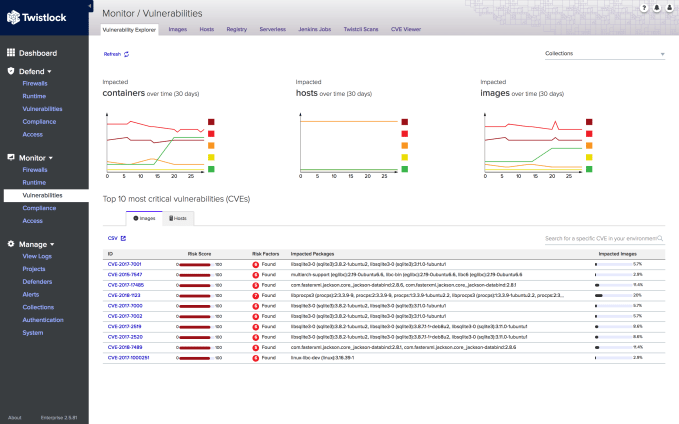
As the world shifts to a cloud native approach, the way you secure applications as they get deployed is changing too. Twistlock, a company built from the ground up to secure cloud native environments, announced a $33 million Series C round today led by Iconiq Capital.
Previous investors YL Ventures, TenEleven, Rally Ventures, Polaris Partners and Dell Technologies Capital also participated in the round. The company reports it has received a total of $63 million in venture investment to date.
Twistlock is solving a hard problem around securing containers and serverless, which are by their nature ephemeral. They can live for fractions of seconds making it hard track problems when they happen. According to company CEO and co-founder Ben Bernstein, his company came out of the gate building a security product designed to protect a cloud-native environment with the understanding that while containers and serverless computing may be ephemeral, they are still exploitable.
“It’s not about how long they live, but about the fact that the way they live is more predictable than a traditional computer, which could be running for a very long time and might have humans actually using it,” Bernstein said.
Screenshot: Twistlock
As companies move to a cloud native environment using Dockerized containers and managing them with Kubernetes and other tools, they create a highly automated system to deal with the deployment volume. While automation simplifies deployment, it can also leave companies vulnerable to host of issues. For example, if a malicious actor were to get control of the process via a code injection attack, they could cause a lot of problems without anyone knowing about it.
Twistlock is built to help prevent that, while also helping customers recognize when an exploit happens and performing forensic analysis to figure out how it happened.
It’s not a traditional Software as a Service as we’ve come to think of it. Instead, it is a service that gets installed on whatever public or private cloud that the customer is using. So far, they count just over 200 customers including Walgreens and Aetna and a slew of other companies you would definitely recognize, but they couldn’t name publicly.
The company, which was founded in 2015, is based in Portland, Oregon with their R&D arm in Israel. They currently have 80 employees. Bernstein said from a competitive standpoint, the traditional security vendors are having trouble reacting to cloud native, and while he sees some startups working at it, he believes his company has the most mature offering, at least for now.
“We don’t have a lot of competition right now, but as we start progressing we will see more,” he said. He plans to use the money they receive today to help expand their marketing and sales arm to continue growing their customer base, but also engineering to stay ahead of that competition as the cloud-native security market continues to develop.
Powered by WPeMatico
Noisy open offices don’t foster collaboration, they kill it, according to a Harvard study that found the less-private floor plan led to a 73 percent drop in face-to-face interaction between employees and a rise in emailing. The problem is plenty of young companies and big corporations have already bought into the open office fad. But a new startup called ROOM is building a prefabricated, self-assembled solution. It’s the IKEA of office phone booths.

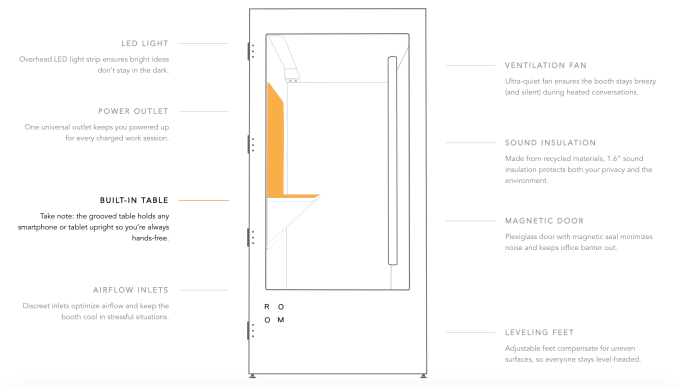
The $3,495 ROOM One is a sound-proofed, ventilated, powered booth that can be built in new or existing offices to give employees a place to take a video call or get some uninterrupted time to focus on work. For comparison, ROOM co-founder Morten Meisner-Jensen says, “Most phone booths are $8,000 to $12,000. The cheapest competitor to us is $6,000 — almost twice as much.” Though booths start at $4,500 from TalkBox and $3,995 from Zenbooth, they tack on $1,250 and $1,650 for shipping, while ROOM ships for free. They’re all dividing the market of dividing offices.
The idea might seem simple, but the booths could save businesses a ton of money on lost productivity, recruitment and retention if it keeps employees from going crazy amidst sales call cacophony. Less than a year after launch, ROOM has hit a $10 million revenue run rate thanks to 200 clients ranging from startups to Salesforce, Nike, NASA and JP Morgan. That’s attracted a $2 million seed round from Slow Ventures that adds to angel funding from Flexport CEO Ryan Petersen. “I am really excited about it since it is probably the largest revenue-generating company Slow has seen at the time of our initial Seed stage investment,” says partner Kevin Colleran.
“It’s not called ROOM because we build rooms,” Meisner-Jensen tells me. “It’s called ROOM because we want to make room for people, make room for privacy and make room for a better work environment.”
You might be asking yourself, enterprising reader, why you couldn’t just go to Home Depot, buy some supplies and build your own in-office phone booth for way less than $3,500. Well, ROOM’s co-founders tried that. The result was… moist.
Meisner-Jensen has design experience from the Danish digital agency Revolt that he started before co-founding digital book service Mofibo and selling it to Storytel. “In my old job we had to go outside and take the call, and I’m from Copenhagen, so that’s a pretty cold experience half the year.” His co-founder Brian Chen started Y Combinator-backed smart suitcase company Bluesmart, where he was VP of operations. They figured they could attack the office layout issue with hammers and saws. I mean, they do look like superhero alter-egos.

Room co-founders (from left): Brian Chen and Morten Meisner-Jensen
“To combat the issues I myself would personally encounter with open offices, as well as colleagues, we tried to build a private ‘phone booth’ ourselves,” says Meisner-Jensen. “We didn’t quite understand the specifics of air ventilation or acoustics at the time, so the booth got quite warm — warm enough that we coined it ‘the sweatbox.’ ”
With ROOM, they got serious about the product. The 10-square-foot ROOM One booth ships flat and can be assembled in less than 30 minutes by two people with a hex wrench. All it needs is an outlet to power its light and ventilation fan. Each is built from 1088 recycled plastic bottles for noise cancelling, so you’re not supposed to hear anything from outside. The box is 100 percent recyclable, plus it can be torn down and rebuilt if your startup implodes and you’re being evicted from your office.
The ROOM One features a bar-height desk with outlets and a magnetic bulletin board behind it, though you’ll have to provide your own stool. It’s actually designed not to be so comfy that you end up napping inside, which doesn’t seem like it’d be a problem with this somewhat cramped spot. “To solve the problem with noise at scale you want to provide people with space to take a call but not camp out all day,” Meisner-Jensen notes.

Booths by Zenbooth, Cubicall and TalkBox (from left)
Couldn’t office managers just buy noise-cancelling headphones for everyone? “It feels claustrophobic to me,” he laughs, but then outlines why a new workplace trend requires more than headphones. “People are doing video calls and virtual meetings much, much more. You can’t have all these people walking by you and looking at your screen. [A booth is] also giving you your own space to do your own work, which I don’t think you’d get from a pair of Bose. I think it has to be a physical space.”
But with plenty of companies able to construct physical spaces, it will be a challenge for ROOM to convey the subtleties of its build quality that warrant its price. “The biggest risk for ROOM right now are copycats,” Meisner-Jensen admits. “Someone entering our space claiming to do what we’re doing better but cheaper.” Alternatively, ROOM could lock in customers by offering a range of office furniture products. The co-founder hinted at future products, saying ROOM is already receiving demand for bigger multi-person prefab conference rooms and creative room divider solutions.

The importance of privacy goes beyond improved productivity when workers are alone. If they’re exhausted from overstimulation in a chaotic open office, they’ll have less energy for purposeful collaboration when the time comes. The bustle could also make them reluctant to socialize in off-hours, which could lead them to burn out and change jobs faster. Tech companies in particular are in a constant war for talent, and ROOM Ones could be perceived as a bigger perk than free snacks or a ping-pong table that only makes the office louder.
“I don’t think the solution is to go back to a world of cubicles and corner offices,” Meisner-Jensen concludes. It could take another decade for office architects to correct the overenthusiasm for open offices despite the research suggesting their harm. For now, ROOM’s co-founder is concentrating on “solving the issue of noise at scale” by asking, “How do we make the current workspaces work in the best way possible?”
Powered by WPeMatico
Uber announced a new program today called Profile Recommendations that takes advantage of machine intelligence to reduce user error when switching between personal and business accounts.
It’s not unusual for a person to have both types of accounts. When you’re out and about, it’s easy to forget to switch between them when appropriate. Uber wants to help by recommending the correct one.
“Using machine learning, Uber can predict which profile and corresponding payment method an employee should be using, and make the appropriate recommendation,” Ronnie Gurion, GM and Global Head of Uber for Business wrote in a blog post announcing the new feature.
Uber has been analyzing a dizzying amount of trip data for so long, it can now (mostly) understand the purpose of a given trip based on the details of your request. While it’s certainly not perfect because it’s not always obvious what the purpose is, Uber believes it can determine the correct intention 80 percent of the time. For that remaining 20 percent, when it doesn’t get it right, Uber is hoping to simplify corrections too.
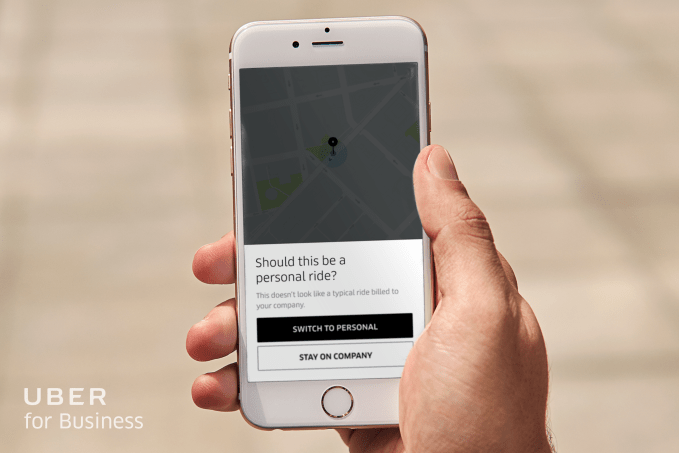
Photo: Uber
Business users can now also assign trip reviewers — managers or other employees who understand the employee’s usage patterns, and can flag questionable rides. Instead of starting an email thread or complicated bureaucratic process to resolve an issue, the employee can now see these flagged rides and resolve them right in the app. “This new feature not only saves the employee’s and administrator’s time, but it also cuts down on delays associated with closing out reports,” Gurion wrote in the blog post announcement.
Uber also announced that it’s supporting a slew of new expense reporting software to simplify integration with these systems. They currently have integrations with Certify, Chrome River, Concur and Expensify. They will be adding support for Expensya, Happay, Rydoo, Zeno by Serko and Zoho Expense starting in September.
All of this should help business account holders deal with Uber expenses more efficiently, while integrating with many of the leading expense programs to move data smoothly from Uber to a company’s regular record-keeping systems.
Powered by WPeMatico
Microsoft announced today that it’s released Azure Stack for Azure Government at a time when it’s battling rivals at Amazon and other cloud companies for the massive winner-take-all $10 billion Pentagon cloud contract known as JEDI.
Azure Stack provides customers with a similar set of cloud services that they would get in the public cloud, but inside the cozy confines of the customer data center. For Azure cloud customers who are looking to manage across public and private environments, often referred to as a hybrid approach, it gives a common look and feel across both public and private.
“As a cornerstone of Microsoft’s hybrid cloud approach, consistency means government customers get the same infrastructure and services with Azure Stack as they do with Azure — the same APIs, DevOps tools, portal, and more,”Natalia Mackevicius, Program Director, Microsoft Azure Stack wrote in a blog post announcing the new program.
In addition, the company announced it had passed a third-party FedRamp certification. FedRamp is a government program that provides a standardized way for government procurement officials to assess cloud security.
“Azure Stack for Azure Government directly addresses many other significant challenges our top federal government customers face. This includes tough regulatory, connectivity and latency requirements,” Mackevicius, wrote in a blog post announcement.
While this product is geared for any government customer, this news could certainly be appealing to the Pentagon, which is looking for one vendor to rule them in its latest mega cloud RFP. While Microsoft wouldn’t comment on JEDI specifically because it’s in the midst of answering that RFP, the timing can’t be a coincidence.
Microsoft, along with other competitors including Oracle and IBM, have been complaining bitterly that the one-vendor contract process unfairly favors Amazon. These companies have recommended that the Pentagon go with a multi-vendor approach to prevent lock-in and take advantage of innovation across sellers. The complaints so far has fallen on deaf ears at the Pentagon.
Regardless, Microsoft is still battling hard for the massive contract and today’s release certainly bolsters their approach as they continue to fight to win the JEDI deal — and other government business.
Powered by WPeMatico
There is a secret behind every open office in Silicon Valley — and it isn’t the drain on productivity.
Tech companies have been the vanguards for pushing corporate culture forward toward “radical transparency.” Mark Zuckerberg works in a fully transparent four-walled glass office surrounded by the rest of Facebook. Valve got rid of managers and titles so everyone can be their own boss. Startup founders host weekly town halls, Friday all-hands, and AMAs. Companies go to painstaking lengths to signal that they trust their employees – to show that this is your company.
But while your company might adopt an open floor plan and give out free snacks so you can feel closer to your coworkers, they likely don’t want you knowing how much they make, who is affected by the impending layoffs, or whether executives are making the right decisions.
The open office has never been more closed, and tech companies are no different than old corporate America in their authoritarian approach to controlling how their employees should think about issues that matter in the workplace. In fact, it may even be more insidious because it’s tucked away behind the veneer of a cheerful, open office.
This is what makes social network Blind so fascinating. Raw and unfiltered, Blind is the antithesis to HR’s utopic vision of a manageable and orderly corporate culture. Instead, it operates outside the walled gardens of IT with no rules and no official corporate supervision.
With Blind, users are completely anonymous, but are required to submit a verified work email to join a company channel. Inside, they are able to freely ask, discuss, prod, and complain without fear of retribution or judgment.
In short, it’s HR’s worst nightmare, and it’s wildly successful.
Blind’s engagement numbers are staggering. It has over 2 million users, including 43K at Microsoft, 28K at Amazon, and 10K at Google. In South Korea, half of all employees at companies over 200 people are active monthly. The typical monthly active user logs in three to four times per day and spends 35 minutes using the app. At the height of the Susan Fowler scandal, Uber employees were spending almost 3 hours a day on Blind. All that, and the entire company is 38 people.
At the heart of Blind’s magic is something universal to every person who has ever been employed — the duality between our personal selves and our “work” selves, and the human drive to be both intimate and in control of our relationships. There is no place more difficult to navigate this duality than the workplace, where we want to feel loved and understood, but also respected.
Hierarchy, politics, and negative career impacts burden conversations about difficult topics, and so Blind tears these barriers down one employee at a time, affording a space for uninhibited dialogue. More importantly, Blind succeeds as a resource for questions not only company-related, but also around career, family, and life decisions.
Blind is in many ways an evolution of a long lineage of ideas in social networking. It’s unique achievement is the recombination of these different ideas to create a platform that is both a safe space for free and open conversation (via anonymity), along with a vetted, contextually relevant community (via workplace email authentication).
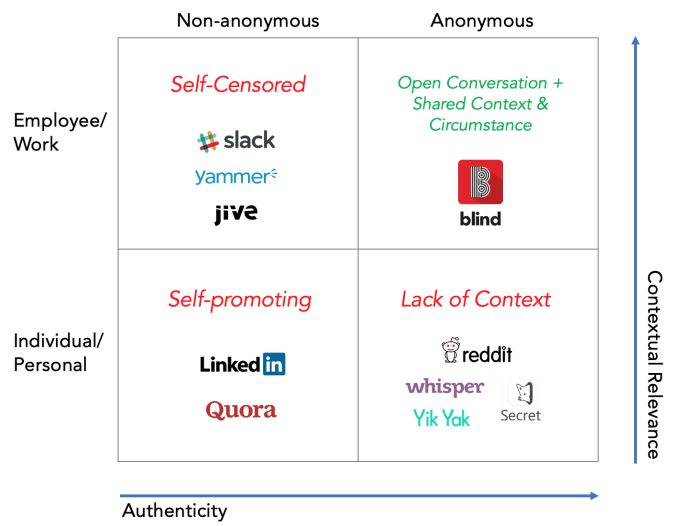
Let’s walk though each of these categories to understand Blind’s success.
Lack of Context (Anonymous + Individual/Personal) – Companies like Yik Yak, Secret, and Whisper pioneered the anonymous social network on the consumer side. However, they were beleaguered by cyberbullying, and served more as a digital exhaust pipe for teenage angst and trolling. Perhaps the most successful semi-anonymous social network today is Reddit, where legions of loyal community members cover every topic imaginable. However, what all of these anonymous communities lack is the critical element of shared context and circumstance.
Put another way, your fellow community members on Reddit may share your interest in ice fishing, but they likely will not understand who you are. As Blind cofounder Kyum Kim puts it, “it’s hard for someone to complain on Reddit about feeling poor while making $200K a year without fear of backlash, but on Blind, your coworkers are in the same income bracket, and likely similar education levels, neighborhoods, etc. They can empathize with your situation.” On Blind, there is a single community (your workplace) that spans multiple topics, and there’s a baseline, tacit understanding of each other’s life circumstances, allowing for deeper conversations.
Self-Promoting (Non-Anonymous + Individual/Personal) – LinkedIn and Quora are useful professional platforms, but because individuals and brands are the stars of these platforms, posturing and self-promotion can be quite frequent. When you ask a question on Quora, you are submitting your inquiry to a body of self-proclaimed experts. While many responses can be genuine, the ultimate currency that drives the platform is credibility and brand building, which inhibit authentic and vulnerable conversations from occurring.
Self-Censored (Non-Anonymous + Employee/Work) – On the enterprise side, Yammer, Jive, and recently Slack have attempted to upgrade the creaky company intranet into the enterprise social network. While these tools might make it easier to connect to your coworkers, the conversations happening on these platforms are no different than before – ultimately, these tools are designed to get work done, not for questioning, debating, or reflecting on how work should be. Conversations about sensitive subjects (e.g. how to deal with a bad manager) are unlikely to happen on a non-anonymous, corporate-sanctioned platform where that same bad manager might well be watching.
Finally, we have Blind. The platform strikes a balance between the freedom of anonymity and the context of a shared workplace. The result is a forum for surprisingly rich, relevant, and authentic conversations. While company channels are accessible only to insiders, a look at Blind’s public site (where you still need a verified work email, but you can chat with anyone outside your company) reveals a flavor for the types of conversations that are possible. An engineer at Amazon recently posted about how to deal with a mid-life crisis, with 42 responses of encouragement and advice. Another employee moving from India has a wife suffering from depression and is seeking help navigating the US healthcare system.
It turns out that where we work is a good proxy for who we are, and our coworkers have been an untapped community of wisdom.

Catalin205 via Getty Images
Blind is by no means perfect. Like all online platforms and particularly anonymous ones, it invites its share of trolls. One look at the “Relationships” section on Blind’s public site and you’ll find questions about how to deal with one-night stands with coworkers and a poll asking guys how many girls they’ve slept with before marriage. While these questions could certainly have come from a genuine place, they are easy fodder for trolls, and the ensuing conversations can be alienating and provide an unnecessary megaphone for toxic bro culture.
Blind acknowledges that these issues exist, but claim that they happen less frequently inside company channels. Because users authenticate with their work emails, cofounders Sunguk and Kim believe that Blind users feel a greater sense of responsibility to each other because they are engaging a real community with shared context and goals.
The vast terrain of cyberspace might suffer from the tragedy of the commons and moral hazard, but within your workplace channel on Blind, your digital community maps onto a physical community – even though you are anonymous. This is evidenced by the successful self-policing on the platform, where 0.5% of all posts have been removed (higher than average for a social media platform), and all of these originated from user-generated flags.
Blind’s success illuminates a reality that is often overlooked: corporations aren’t naturally democratic or transparent. While there are platforms to discuss our roles as individual working professionals (e.g. LinkedIn), there are very few places to gather and organize as employees of companies to collectively bargain for a better workplace.
This is by design. HR, the supposed watchdog of employee wellness, is neither elected nor truly representative, as they must balance the competing goals of being a third party resource for employees while also protecting the company against its employees.
Companies will always be incentivized to maintain an asymmetry of information. Friday all-hands and town halls are heavily scripted by companies. Rarely do we see anyone describing a healthy, transparent culture as a place where employees are freely conversing amongst themselves.
For companies with something to hide, the idea of a public square where conversations happen freely should be alarming. Blind has already been at the center of exposing two major scandals (e.g. the “nut rage” incident by a Korean Air executive and the news that Lyft was spying on its users.)
Blind picks up where labor unions left off and where HR has failed — to serve as a safeguard against corporate overreach, and to provide a protected space for employees to collaborate around solutions to improve the workplace.
For companies, Blind’s rise shouldn’t be seen as bad news. Blind can be a rich source of insight where HR software falls short. While employee engagement surveys have become popular in HR circles (and a crop of well-funded HR tech companies have consequently flooded the market), these practices suffer from the same issues of hosting a town hall. The company decides on the questions asked and interprets the answers given. With Blind, for the first time, HR and executives will have a pulse on employee sentiment that is both real-time and authentic. As Moon puts it, “no company is perfect, and if it was, Blind would not need to exist.”
In short, Blind understands more about your employees than anything in your HR stack.
Where does Blind go from here? Moon and Kyum believe they’re just getting started. Today, Blind is only available in the U.S. and South Korea, and it has been focused on tech companies. Their push into more traditional industries is showing some early signs of success with Johnson & Johnson, Dow Chemical, Barclays, and the US Navy coming online recently. There is still work to do in cleaning up different communities to ensure that conversations are inclusive and not alienating. And of course, Blind has to find a path to becoming a sustainable, revenue-generating company without compromising its integrity with users.
But one can only imagine the potential for Blind if it continues on its path upwards — the anonymous social network that understands who you are, the pulse survey that is authentic and real-time, and the first truly safe and open office made for employees, by employees.
Powered by WPeMatico
Back when Dennis Woodside joined Dropbox as its chief operating officer more than four years ago, the company was trying to justify the $10 billion valuation it had hit in its rapid rise as a Web 2.0 darling. Now, Dropbox is a public company with a nearly $14 billion valuation, and it once again showed Wall Street that it’s able to beat expectations with a now more robust enterprise business alongside its consumer roots.
Dropbox’s second quarter results came in ahead of Wall Street’s expectations on both the earnings and revenue front. The company also announced that Dennis Woodside will be leaving the company. Woodside joined at a time when Dropbox was starting to figure out its enterprise business, which it was able to grow and transform into a strong case for Wall Street that it could finally be a successful publicly traded company. The IPO was indeed successful, with the company’s shares soaring more than 40 percent in its debut, so it makes sense that Woodside has essentially accomplished his job by getting it into a business ready for Wall Street.
“I think as a team we accomplished a ton over the last four and a half years,” Woodside said in an interview. “When I joined they were a couple hundred million in revenue and a little under 500 people. [CEO] Drew [Houston] and Arash [Ferdowsi] have built a great business, since then we’ve scaled globally. Close to half our revenue is outside the U.S., we have well over 300,000 teams for our Dropbox business product, which was nascent there. These are accomplishments of the team, and I’m pretty proud.”
The stock initially exploded in extended trading by rising more than 7 percent, though even prior to the market close and the company reporting its earnings, the stock had risen as much as 10 percent. But following that spike, Dropbox shares are now down around 5 percent. Dropbox is one of a number of SaaS companies that have gone public in recent months, including DocuSign, that have seen considerable success. While Dropbox has managed to make its case with a strong enterprise business, the company was born with consumer roots and has tried to carry over that simplicity with the enterprise products it rolls out, like its collaboration tool Dropbox Paper.
Here’s a quick rundown of the numbers:
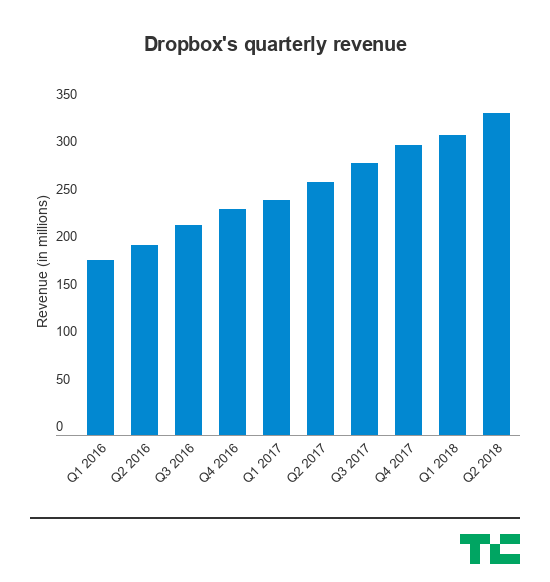
So, not only is Dropbox able to show that it can continue to grow that revenue, the actual value of its users is also going up. That’s important, because Dropbox has to show that it can continue to acquire higher-value customers — meaning it’s gradually moving up the Fortune 100 chain and getting larger and more established companies on board that can offer it bigger and bigger contracts. It also gives it the room to make larger strategic moves, like migrating onto its own architecture late last year, which, in the long run could turn out to drastically improve the margins on its business.
“We did talk earlier in the quarter about our investment over the last couple years in SMR technology, an innovative storage technology that allows us to optimize cost and performance,” Woodside said. “We continue to innovate ways that allow us to drive better performance, and that drives better economics.”
The company is still looking to make significant moves in the form of new hires, including recently announcing that it has a new VP of product and VP of product marketing, Adam Nash and Naman Khan, respectively. Dropbox’s new team under CEO Drew Houston are tasked with continuing the company’s path to cracking into larger enterprises, which can give it a much more predictable and robust business alongside the average consumers that pay to host their files online and access them from pretty much anywhere.
In addition, there are a couple executive changes as Woodside transitions out. Yamini Rangan, currently VP of Business Strategy & Operations, will become Chief Customer Officer reporting to Houston, and comms VP Lin-Hua Wu will also report to Houston.
Dropbox had its first quarterly earnings check-in and slid past the expectations that Wall Street had, though its GAAP gross margin slipped a little bit and may have offered a slight negative signal for the company. But since then, Dropbox’s stock hasn’t had any major missteps, giving it more credibility on the public markets — and more resources to attract and retain talent with compensation packages linked to that stock.
“Our retention has been quite strong,” Woodside said. “We see strong retention characteristics across the customer set we have, whether it’s large or small. Obviously larger companies have more opportunity to expand over time, so our expansion metrics are quite strong in customers of over several hundred employees. But even among small businesses, Dropbox is the kind of product that has gravity. Once you start using it and start sharing it, it becomes a place where your business is small or large is managing all its content, it tends to be a sticky experience.”
Powered by WPeMatico
Blissfully, a New York City startup that helps companies understand their SaaS usage inside their organizations, announced it has received a $3.5 million seed round.
The investment was led by Hummer Winblad Venture Partners. Hubspot, Founder Collective, and several unnamed pre-seed investors also participated. They got a $1.5 million pre-seed investment, bringing the total so far to $5 million, according the company.
Company co-founder and CEO Ariel Diaz says Blissfully actually helped him and his co-founder solve a problem they were having tracking the SaaS usage at their previous startups. Like many companies, they were using spreadsheets to track this information and they found it was untenable as the company grew beyond 30 or 40 people. They figured there had to be a better way, so they built one.
Their product is much more than simply a database of the SaaS products in use inside an organization. It can integrate with existing company systems like single sign-on tools such as Okta and OneLogIn, financial reporting systems and G Suite login information. “We are trying to automate as much of the data collection as possible to discover what you’re using, who’s using it and how much you are spending,” he said.
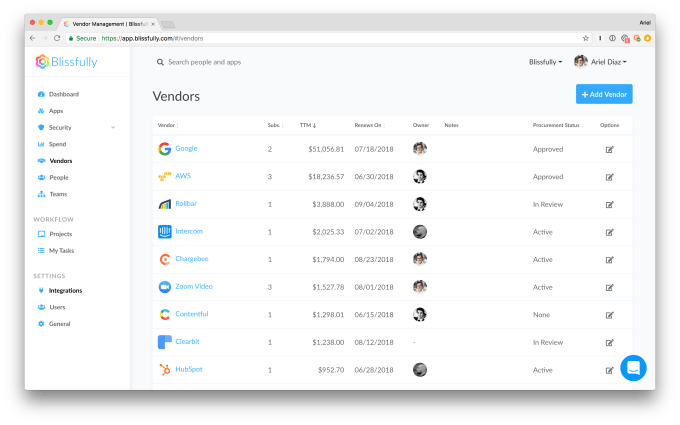
Blissfully SaaS report. Screenshot: Blissfully
Their scans often turn up products customers thought they had canceled or those that IT had asked employees to stop using. More than finding Shadow IT, the product also gives insight to overall SaaS spend, which many companies have trouble getting a grip on. They can find most usage with a scan. Some data such as customized contract information may have to be manually entered into the system, he says.
Hubspot CEO Brian Halligan, whose company is one of the investors in this round, sees a growing need for this kind of tool. “The widespread growth of SaaS across companies of all sizes is a leading indicator of the market need for Blissfully. As business’ investments in SaaS increase, they lose visibility into issues ranging from spending to security,” Halligan said in a statement.
The company offers a freemium and pay model and is available in the G Suite Marketplace. If you go for the free version, you can scan your systems for SaaS usage, but if you want to do more complex integrations with company systems, you have to pay. They currently have 10 employees and 500 customers with a mix of paying and free.
One interesting aspect of the Blissfully tool is that it is built entirely using Serverless architecture on AWS Lambda.
Powered by WPeMatico

After a largely successful IPO, Dropbox is adding another couple of hires today as it looks to continue its consumer-slash-enterprise growth playbook: bringing on a new VP of product in former CEO and president of Wealthfront Adam Nash; and a new VP of product marketing and global campaigns in Naman Khan.
Both have extensive experience from products that span multiple different verticals, with Nash previously working at LinkedIn and eBay and Khan spending time with Microsoft Office and Autodesk. The company went public earlier this year to a pretty successful IPO, though the stock hasn’t seen any dramatic fireworks, and has accumulated more than 500 million registered users in its decade-plus life. But it’s also gone through a kind of transition as it starts expanding into more enterprise-focused collaboration tools as it looks to woo businesses, which represent a substantial opportunity for growth for the company that started off as a dead-simple file-sharing service.
Previously an entrepreneur-in-residence for Greylock, Nash is now going to oversee a wide range of products that span consumer-focused file storage and sharing services all the way up to its Google Docs competitor Paper — each of which has a kind of consumer-born aesthetic that’s targeting use cases within enterprises, whether that’s building tools to get documents into its service or to actually helping teams spec out products within a kind of continuous document like Paper. But as it focuses on simplicity, Dropbox has to take care not to end up feature-creeping its way out of what made it successful initially, so the final product decisions may be a bit different. Naman will also inherit that challenge of marketing a consumer-oriented product that’s targeting businesses.

As Dropbox looks to continue to mature as a public company, it has to ensure that it still brings on talent that understands where it’s going now as it tries to wrangle larger enterprise customers that have a complex set of needs beyond just the typical consumer. Going public certainly helps with that credibility a little bit, but it’s hires like these that will determine what kinds of products actually make it out the door and the messaging that goes with them — and whether larger enterprises will actually adopt them.
Powered by WPeMatico
Oracle executive chairman and CTO Larry Ellison first introduced the company’s autonomous database at Oracle Open World last year. The company later launched an autonomous data warehouse. Today, it announced the next step with the launch of the Oracle Autonomous Transaction Processing (ATP) service.
This latest autonomous database tool promises the same level of autonomy — self-repairing, automated updates and security patches and minutes or less of downtime a month. Juan Loaiza SVP for Oracle Systems at the database giant says the ATP cloud service is a modernized extension of the online transaction processing databases (OLTP) they have been creating for decades. It has machine learning and automation underpinnings, but it should feel familiar to customers, he says.
“Most of the major companies in the world are running thousands of Oracle databases today. So one simple differentiation for us is that you can just pick up your on-premises database that you’ve had for however many years, and you can easily move it to an autonomous database in the cloud,” Loaiza told TechCrunch.
He says that companies already running OLTP databases are ones like airlines, big banks and financial services companies, online retailers and other mega companies who can’t afford even a half hour of downtime a month. He claims that with Oracle’s autonomous database, the high end of downtime is 2.5 minutes per month and the goal is to get much lower, basically nothing.
Carl Olofson, an IDC analyst who manages IDC’s database management practice says the product promises much lower operational costs and could give Oracle a leg up in the Database as a Service market. “What Oracle offers that is most significant here is the fact that patches are applied without any operational disruption, and that the database is self-tuning and, to a large degree, self-healing. Given the highly variable nature of OLTP database issues that can arise, that’s quite something,” he said.
Adam Ronthal, an analyst at Gartner who focuses on the database market, says the autonomous database product set will be an important part of Oracle’s push to the cloud moving forward. “These announcements are more cloud announcements than database announcements. They are Oracle coming out to the world with products that are built and architected for cloud and everything that implies — scalability, elasticity and a low operational footprint. Make no mistake, Oracle still has to prove themselves in the cloud. They are behind AWS and Azure and even GCP in breadth and scope of offerings. ATP helps close that gap, at least in the data management space,” he said.
Oracle certainly needs a cloud win as its cloud business has been heading in the wrong direction the last couple of earnings report to the point they stopped breaking out the cloud numbers in the June report.
Ronthal says Oracle needs to gain some traction quickly with existing customers if it’s going to be successful here. “Oracle needs to build some solid early successes in their cloud, and these successes are going to come from the existing customer base who are already strategically committed to Oracle databases and are not interested in moving. (This is not all of the customer base, of course.) Once they demonstrate solid successes there, they will be able to expand to net new customers,” he says.
Regardless how it works out for Oracle, the ATP database service will be available as of today.
Powered by WPeMatico
InVision continues its slow march toward design world domination, today announcing the hire of Mike Davidson who will take over as Head of Partnerships and Community.
Davidson was previously the VP of Design at Twitter, where he built a 100-person team that was responsible for every aspect of Twitter’s user experience and branding, including web, mobile web, native apps and business tools.
Before Twitter, Davidson worked at ESPN/Disney until 2005, when he founded NewsVine, which was purchased by NBCNews in 2007. Davidson then took on a vice president roll for five years before starting at Twitter.
At InVision, Davidson will oversee partnerships, product integrations, strategic acquisitions and community building. This includes leading InVision’s Design Leadership Forum, which hosts private events for design leaders from big companies like Facebook, Google, Lyft, Disney, etc. Davidson will also work with the new Design Transformation team at InVision to help create educational experiences for InVision’s customers.
Davidson says he plans to spend the next 30 to 60 days talking as little as possible, and listening to the feedback he hears from his team around what can be improved.
“InVision has a seamless workflow that includes everyone in the company in the design process,” said Davidson. “If there’s one goal I’d like to realize, it’s that. Design is a team sport these days, which wasn’t the case 10 or 20 years ago.”
In Davidson’s own words, the position at InVision is “less about business to business and more about designer to designer.” Davidson will be meeting predominantly with the design teams from various companies to discuss not only how InVision can help them build better experiences, but how InVision can incorporate those design teams’ personalities into the product.
InVision was built on the premise that the screen is the most important place in the world, considering that every brand and company is now building digital experiences across the web and through mobile applications. CEO Clark Valberg hopes to turn InVision into the Salesforce of design, and partnerships, acquisitions and product integrations are absolutely vital to that.
“We couldn’t be more excited to have an authentic leader like Mike step into this role to help us further build out our design community — which is as important to us as our product — and to help drive design maturity inside of every organization,” said Valberg. “Digital product design is shaping every industry in the world, and as the leader in the space, we see it as our responsibility to support and foster community and advanced education.”
Powered by WPeMatico