Enterprise
Auto Added by WPeMatico
Auto Added by WPeMatico
In June of this year, Chinese hackers managed to install software into the networks of a contractor for the U.S. Navy and steal information on a roughly $300 million top-secret submarine program.
Two years ago, hackers infiltrated the networks of a vendor servicing the Australian military and made off with files containing a trove of information on Australian and U.S. military hardware and plans. That hacker stole roughly 30 gigabytes of data, including information on the nearly half-a-trillion dollar F-35 Joint Strike Fighter program.
Third-party vendors, contractors and suppliers to big companies have long been the targets for cyber thieves looking for access to sensitive data, and the reason is simple. Companies don’t know how secure their suppliers really are and can’t take the time to find out.
“The Department of Defense can have the best cybersecurity on the planet, but when that moves off to a subcontractor how can the DOD know how the subcontractor is going to protect that data?” says Kelly White, the chief executive of RiskRecon, a new firm that provides audits of vendors’ security profile.
The problem is one that the Salt Lake City-based executive knew well. White was a former security executive for Zion Bank Corporation after spending years in the cybersecurity industry with Ernst & Young and TrueSecure — a Washington, DC-based security vendor.
When White began work with Zion, around 2 percent of the company’s services were hosted by third parties; less than five years later and that number had climbed to over 50 percent. When White identified the problem in 2010, he immediately began developing a solution on his own time. RiskRecon’s chief executive estimates he spent 3,000 hours developing the service between 2010 and 2015, when he finally launched the business with seed capital from General Catalyst .
And White says the tools that companies use to ensure that those vendors have adequate security measures in place basically boiled down to an emailed checklist that the vendors would fill out themselves.
That’s why White built the RiskRecon service, which has just raised $25 million in a new round of funding led by Accel Partners with participation from Dell Technologies Capital, General Catalyst and F-Prime Capital, Fidelity Investments’ venture capital affiliate.
The company’s software looks at what White calls the “internet surface” of a vendor and maps the different ways in which that surface can be compromised. “We don’t require any insider information to get started,” says White. “The point of finding systems is to understand how well an organization is managing their risk.”
White says that the software does more than identify the weak points in a vendor’s security profile, it also tries to get a view into the type of information that could be exposed at different points on a network.
According to White, the company has more than 50 customers among the Fortune 500 that are already using his company’s services across industries like financial services, oil and gas and manufacturing.
The money from RiskRecon’s new round will be used to boost sales and marketing efforts as the company looks to expand into Europe, Asia and further into North America.
“Where there’s not transparency there’s often poor performance,” says White. “Cybersecurity has gone a long time without true transparency. You can’t have strong accountability without strong transparency.”
Powered by WPeMatico
Evolute, a 3-year old startup out of Mountain View, officially launched the Evolute platform today with the goal of helping large organizations migrate applications to containers and manage those containers at scale.
Evolute founder and CEO Kristopher Francisco says he wants to give all Fortune 500 companies access to the same technology that big companies like Apple and Google enjoy because of their size and scale.
“We’re really focused on enabling enterprise companies to do two things really well. The first thing is to be able to systematically move into the container technology. And the second thing is to be able to run operationally at scale with existing and new applications that they’re creating in their enterprise environment,” Francisco explained.
While there are a number of sophisticated competing technologies out there, he says that his company has come up with some serious differentiators. For starters, getting legacy tech into containers has proven a time-consuming and challenging process. In fact, he says manually moving a legacy app and all its dependencies to a container has typically taken 3-6 months per application.
He claims his company has reduced that process to minutes, putting containerization within reach of just about any large organization that wants to move their existing applications to container technology, while reducing the total ramp-up time to convert a portfolio of existing applications from years to a couple of weeks.
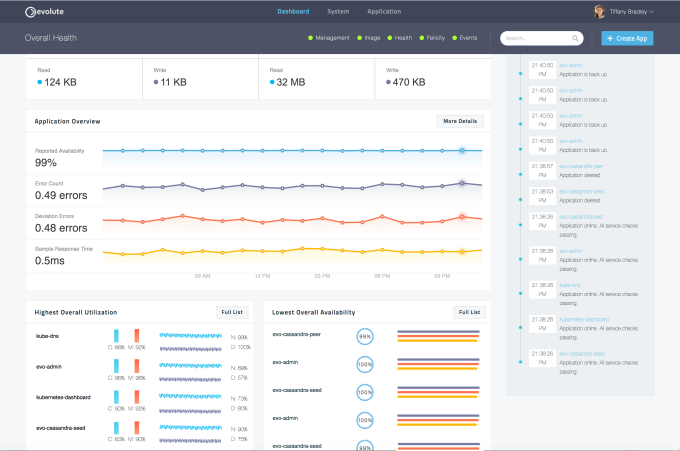
Evolute management console. Screenshot: Evolute
The second part of the equation is managing the containers, and Francisco acknowledges that there are other platforms out there for running containers in production including Kubernetes, the open source container orchestration tool, but he says his company’s ability to manage containers at scale separates him from the pack.
“In the enterprise, the reason that you see the [containerization] adoption numbers being so low is partially because of the scale challenge they face. In the Evolute platform, we actually provide them the native networking, security and management capabilities to be able to run at scale,” he said.
The company also announced that it been invited to join the Chevron Technology Ventures’ Catalyst Program, which provides support for early stage companies like Evolute. This could help push Evolute to business units inside Chevron looking to move into containerization technology and be big boost for the startup.
The company has been around in since 2015 and boasts several other Fortune 500 companies beyond Chevron as customers, although it is not in a position to name them publicly just yet. The company has 5 full time employees and has raised $500,000 in seed money across two rounds, according to data on Crunchbase.
Powered by WPeMatico

Twilio today reported a positive quarter that brought it to profitability — on an adjusted basis — ahead of schedule for Wall Street, sending the stock soaring 16 percent in extended hours after the release came out.
While according to traditional accounting principles Twilio still lost money (this usually includes stock-based compensation, a key component of compensation packages), the company is still showing that it has the capability of being profitable. Born as a go-to tool for startups and larger companies to handle their text- and telephone-related operations, Twilio was among a wave of IPOs in 2016 that has more or less continued into this year. The company’s stock has more than doubled in the past year, and is up nearly 170 percent this year alone. Twilio also brought in revenue ahead of Wall Street expectations.

Still, as a services business, Twilio has to show that it can continue to scale its business while absorbing the cost of the infrastructure required and acquire new customers. It also has to ensure that those customers aren’t leaving, or at least that it’s bringing on enough new developers more quickly than they are leaving. Larger enterprises, as a result, can be more attractive because they’re more predictable and can lead to bigger buckets of revenue for the company — and, well, most larger companies still need communications support in some way still today.
On an adjusted basis, Twilio said it earned 3 cents per share, ahead of the loss of 5 cents that analysts were expecting. It said it brought in $147.8 million in revenue compared to $131.1 million analysts were expecting, so it’s a beat on both lines, and more importantly shows that Twilio may be able to morph its toolkit into a mainline business that can end up as the backbone of any company’s communication with their customers or users.
Powered by WPeMatico
Business travelers have become an increasingly important part of Airbnb’s business, according to a new blog post. The company says that Airbnb for Work, which launched in 2014, has seen bookings triple from 2015 to 2016, and triple again from 2016 to 2017. In fact, Airbnb says that almost 700,000 companies have signed up for and booked with Airbnb for Work.
Interestingly, the breakdown of companies working with Airbnb for traveler lodging are pretty diverse — employees from large enterprise companies (5,000+ employees) and employees from startups and SMBs (one to 250 employees) take a 40-40 split, with the final 20 percent of Airbnb for Work bookings going to mid-sized companies.
In July of 2017, Airbnb started making its listings available via SAP Concur, a tool used by a large number of business travelers. Airbnb says that this integration has been a huge help to growing Airbnb for Work, with Concur seeing a 42 percent increase in employees expensing Airbnb stays from 2016 to 2017. Moreover, 63 percent of Concur’s Fortune 500 clients have booked a business trip on Airbnb.
One interesting trend that Airbnb has noticed is that nearly 60 percent of Airbnb for Work trips had more than one guest.
“We can offer big open areas for collaborations, while still giving employees their own private space,” said David Holyoke, global head of business travel at Airbnb. “We think this offers a more meaningful business trip and it saves the company a lot of money.”
Given the tremendous growth of the business segment, as well as the opportunity it represents, Airbnb is working on new features for business travelers. In fact, in the next week, Airbnb will be launching a new feature that lets employees search for Airbnb listings on a company-specific landing page.
So, for example, a Google employee might search for their lodging on Google.Airbnb.com, and the site would be refined to cater to Google’s preferences, including locations close to the office, budget, and other factors.
While the growth has picked up, Holyoke still sees Airbnb for Work as an opportunity to grow. He said that Airbnb for Work listings only represent 15 percent of all Airbnb trips.
But, the introduction of boutique hotels and other amenity-driven listings such as those on Airbnb Plus are paving the way for business travelers to lean toward Airbnb instead of a business hotel.
Plus, as mobility and relocation become even more important to how a business operates, Airbnb believes it can be a useful tool to help employees get started in a new town before they purchase a home.
Powered by WPeMatico
As employers duke it out over hiring the best possible candidates, especially ones coming out of school, they are starting to get a little bit more creative with their incentive packages — and that includes offering an option for paying down student debt.
Goodly is a new startup that’s looking to help those employers offer that as a benefit. Smaller companies without the resources to create complicated incentive packages especially need tools that help shortcut the process of offering those benefits. It’s following a similar playbook of companies looking to make it easier to get the tools they need in place and focus more on the set of products that are going to make it an actually differentiated company. Goodly is launching out of Y Combinator’s summer class this year.
“We found it to be a really great tool for recruiting and retaining,” co-founder Gregory Poulin said. “When people hear student loan benefits, they instantly think it’s very expensive. You can offer student loan benefits starting $25 to $50 per employee per month, up to $200. Our system is completely flexible. You can offer any company size for any budget. You can offer meaningful benefit for less than the cost of a cup of coffee a day. For the average borrower, when they have an employer contributing an extra $100 per months, it could help your average employee get out of debt almost a decade faster.”
There are more common benefits like stock packages, 401(k) matches, insurance, better time off policies, or others along those lines. But as student debt increasingly becomes a factor in a candidate’s decision on where they work, it’s another way that companies — ones without larger compensation packages or very aggressive recruiting operations like, say, Google or Facebook — can still get the attention and interest of good candidates coming out of school. Like other companies (like Human Interest for 401(k)s, for example), the goal is to make it easy to get started and maintain the whole process.
Employees connect their student loans to Goodly, which takes a few minutes to verify them before setting up the contribution plan. Goodly integrates with payroll operations and gives companies and employees a pretty flexible way to set their spending schedule. Then, it goes from there, without the employees having to manage it on a per-period basis. While it might have the robust tax incentives in place like a retirement plan, it’s still a way to help companies offer some way of showing employees that they’re invested in their employees’ future success, which is another way that those companies might be able to retain that talent. Goodly then brings back detailed reports on the company’s implementation to help it better understand whether the policies are working for their employees.
It’s certainly an area that’s attracted interest — and funding — from a number of startups like Tuition.io which look to help employers get a little more creative about their benefits. Much like contributions to retirement plans, it’s another way to offer employees a way to invest in their future by reducing the financial stress they have through some of their biggest financial decisions like where to go for college. Poulin also said it’s a way to help discover a more diverse talent pool as it surfaces up underrepresented parts of the population that are acutely dealing with student debt as a factor in their decision-making.
Powered by WPeMatico

Arm, the semiconductor firm you probably still remember as ARM, today announced that it has acquired Treasure Data, a data management platform for large enterprise customers. The companies didn’t announce the financial details of the transaction, but earlier reporting by Bloomberg pegged the price at $600 million.
This move strengthens Arm’s IoT nascent play, given that Treasure Data’s specialty is dealing with the large streams of data that these systems produce (as well as data from CRM, e-commerce systems and other third-party services).
This move follows Arm’s recent acquisition of Stream and indeed, the company calls the acquisition of Treasure Data “the final piece” of its “IoT enablement puzzle.” The result of this completed puzzle is the Arm Pelion IoT Platform, which combines Stream, Treasure Data and the existing Arm Mbed Cloud into a single solution for connecting and managing IoT devices and the data they produce.
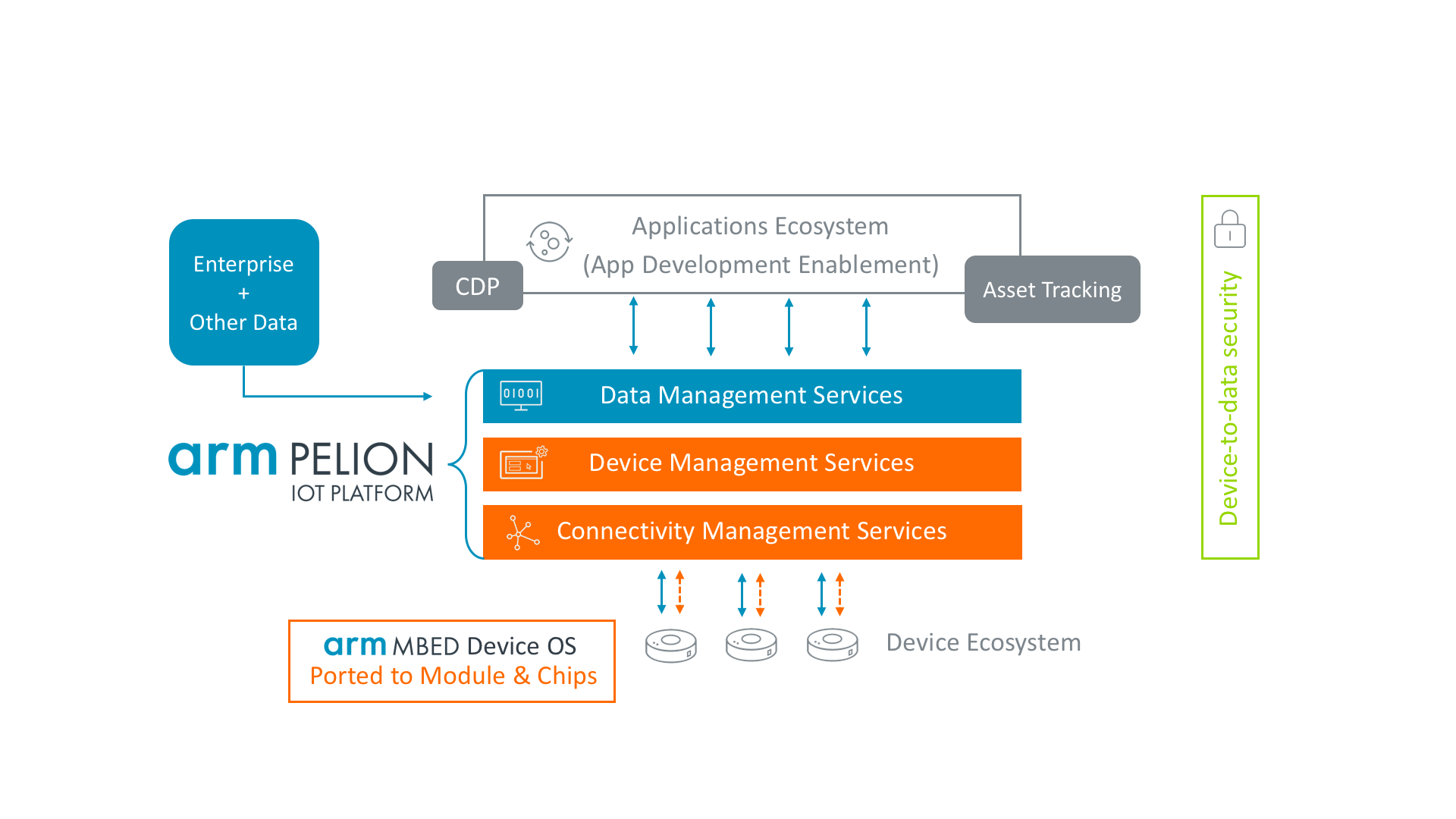
Arm says Treasure Data will continue to operate as before and continue to serve new clients as well as its existing users. “It will remain an important part of industry IoT enablement, providing the ability to harness new, complex edge and device data within a comprehensive customer profile to personalize their products and improve their experiences,” the company says.
Powered by WPeMatico
Marketers are increasingly looking for social media celebrities and influencers who can promote their products with more authenticity (or at least, the appearance of authenticity) than a traditional ad.
So Altru CEO Alykhan Rehmatullah wondered: Why can’t businesses do something similar with recruiting?
And that’s what Altru is trying to accomplish, powering a page on a company’s website that highlights videos from real employees answering questions that potential hires might be asking. The videos are searchable (thanks to Altru’s transcriptions), and they also can be shared on social media.
The startup was part of the recent winter batch at Techstars NYC, and it’s already working with companies like L’Oréal, Dell and Unilever. Today, Altru is announcing that it’s raised $1.3 million in new funding led by Birchmere Ventures.
Rehmatullah contrasted Altru’s approach with Glassdoor, which he said features “more polarized” content (since it’s usually employees with really good or really bad experiences who want to write reviews) and where companies are often forced to “play defense.”
On Altru, on the other hand, employers can take the informal conversations that often take place when someone’s deciding whether to accept a job and turn them into an online recruiting tool. Over time, Rehmatullah said the platform could expand beyond recruiting to areas like on-boarding new employees.
Since these videos are posted to the company website, with the employees’ name and face attached, they may not always feel comfortable being completely honest, particularly about a company’s flaws. But at least it’s a message coming from a regular person, not the corporate-speak of a recruiter or manager.
Rehmatullah acknowledged that there’s usually “an educational process” involved in making employers more comfortable with this kind of content.
“These conversations are already happening outside your organization,” he said. “In the long-term, candidates expect more authenticity, more transparency, more true experiences.”
Powered by WPeMatico
Today WhatsApp launches its first revenue-generating enterprise product and the only way it currently makes money directly from its app. The WhatsApp Business API is launching to let businesses respond to messages from users for free for up to 24 hours, but will charge them a fixed rate by country per message sent after that.
Businesses will still only be able to message people who contacted them first, but the API will help them programatically send shipping confirmations, appointment reminders or event tickets. Clients also can use it to manually respond to customer service inquiries through their own tool or apps like Zendesk, MessageBird or Twilio. And small businesses that are one of the 3 million users of the WhatsApp For Business app can still use it to send late replies one-by-one for free.

After getting acquired by Facebook for $19 billion in 2014, it’s finally time for the 1.5 billion-user WhatsApp to pull its weight and contribute some revenue. If Facebook can pitch the WhatsApp Business API as a cheaper alternative to customer service call centers, the convenience of asynchronous chat could compel users to message companies instead of phoning.
Only charging for slow replies after 24 hours since a user’s last message is a genius way to create a growth feedback loop. If users get quick answers via WhatsApp, they’ll prefer it to other channels. Once businesses and their customers get addicted to it, WhatsApp could eventually charge for all replies or any that exceed a volume threshold, or cut down the free window. Meanwhile, businesses might be too optimistic about their response times and end up paying more often than they expect, especially when messages come in on weekends or holidays.
WhatsApp first announced it would eventually charge for enterprise service last September when it launched its free WhatsApp For Business app that now has 3 million users and remains free for all replies, even late ones.
Importantly, WhatsApp stresses that all messaging between users and businesses, even through the API, will be end-to-end encrypted. That contrasts with The Washington Post’s report that Facebook pushing to weaken encryption for WhatsApp For Business messages is partly what drove former CEO Jan Koum to quit WhatsApp and Facebook’s board in April. His co-founder, Brian Acton, had ditched Facebook back in September and donated $50 million to the foundation of encrypted messaging app Signal.
Today WhatsApp is also formally launching its new display ads product worldwide. But don’t worry, they won’t be crammed into your chat inbox like with Facebook Messenger. Instead, businesses will be able to buy ads on Facebook’s News Feed that launch WhatsApp conversations with them… thereby allowing them to use the new Business API to reply. TechCrunch scooped that this was coming last September, when code in Facebook’s ad manager revealed the click-to-WhatsApp ads option and the company confirmed the ads were in testing. Facebook launched similar click-to-Messenger ads back in 2015.
Finally, WhatsApp also tells TechCrunch it’s planning to run ads in its 450 million daily user Snapchat Stories clone called Status. “WhatsApp does not currently run ads in Status though this represents a future goal for us, starting in 2019. We will move slowly and carefully and provide more details before we place any Ads in Status,” a spokesperson told us. Given WhatsApp Status is more than twice the size of Snapchat, it could earn a ton on ads between Stories, especially if it’s willing to make some unskippable.
Together, the ads and API will replace the $1 per year subscription fee WhatsApp used to charge in some countries but dropped in 2016. With Facebook’s own revenue decelerating, triggering a 20 percent, $120 billion market cap drop in its share price, it needs to show it has new ways to make money — now more than ever.
Powered by WPeMatico

Istio, the service mesh for microservices from Google, IBM, Lyft, Red Hat and many other players in the open-source community, launched version 1.0 of its tools today.
If you’re not into service meshes, that’s understandable. Few people are. But Istio is probably one of the most important new open-source projects out there right now. It sits at the intersection of a number of industry trends, like containers, microservices and serverless computing, and makes it easier for enterprises to embrace them. Istio now has more than 200 contributors and the code has seen more than 4,000 check-ins since the launch of version 0.1.
Istio, at its core, handles the routing, load balancing, flow control and security needs of microservices. It sits on top of existing distributed applications and basically helps them talk to each other securely, while also providing logging, telemetry and the necessary policies that keep things under control (and secure). It also features support for canary releases, which allow developers to test updates with a few users before launching them to a wider audience, something that Google and other webscale companies have long done internally.
 “In the area of microservices, things are moving so quickly,” Google product manager Jennifer Lin told me. “And with the success of Kubernetes and the abstraction around container orchestration, Istio was formed as an open-source project to really take the next step in terms of a substrate for microservice development as well as a path for VM-based workloads to move into more of a service management layer. So it’s really focused around the right level of abstractions for services and creating a consistent environment for managing that.”
Even before the 1.0 release, a number of companies already adopted Istio in production, including the likes of eBay and Auto Trader UK. Lin argues that this is a sign that Istio solves a problem that a lot of businesses are facing today as they adopt microservices. “A number of more sophisticated customers tried to build their own service management layer and while we hadn’t yet declared 1.0, we hard a number of customers — including a surprising number of large enterprise customer — say, ‘you know, even though you’re not 1.0, I’m very comfortable putting this in production because what I’m comparing it to is much more raw.’”
IBM Fellow and VP of Cloud Jason McGee agrees with this and notes that “our mission since Istio’s launch has been to enable everyone to succeed with microservices, especially in the enterprise. This is why we’ve focused the community around improving security and scale, and heavily leaned our contributions on what we’ve learned from building agile cloud architectures for companies of all sizes.”
A lot of the large cloud players now support Istio directly, too. IBM supports it on top of its Kubernetes Service, for example, and Google even announced a managed Istio service for its Google Cloud users, as well as some additional open-source tooling for serverless applications built on top of Kubernetes and Istio.
Two names missing from today’s party are Microsoft and Amazon. I think that’ll change over time, though, assuming the project keeps its momentum.
Istio also isn’t part of any major open-source foundation yet. The Cloud Native Computing Foundation (CNCF), the home of Kubernetes, is backing linkerd, a project that isn’t all that dissimilar from Istio. Once a 1.0 release of these kinds of projects rolls around, the maintainers often start looking for a foundation that can shepherd the development of the project over time. I’m guessing it’s only a matter of time before we hear more about where Istio will land.
Powered by WPeMatico
Every artificial intelligence startup or corporate R&D lab has to reinvent the wheel when it comes to how humans annotate training data to teach algorithms what to look for. Whether it’s doctors assessing the size of cancer from a scan or drivers circling street signs in self-driving car footage, all this labeling has to happen somewhere. Often that means wasting six months and as much as a million dollars just developing a training data system. With nearly every type of business racing to adopt AI, that spend in cash and time adds up.
Labelbox builds artificial intelligence training data labeling software so nobody else has to. What Salesforce is to a sales team, Labelbox is to an AI engineering team. The software-as-a-service acts as the interface for human experts or crowdsourced labor to instruct computers how to spot relevant signals in data by themselves and continuously improve their algorithms’ accuracy.
Today, Labelbox is emerging from six months in stealth with a $3.9 million seed round led by Kleiner Perkins and joined by First Round and Google’s Gradient Ventures.

“There haven’t been seamless tools to allow AI teams to transfer institutional knowledge from their brains to software,” says co-founder Manu Sharma. “Now we have over 5,000 customers, and many big companies have replaced their own internal tools with Labelbox.”
Kleiner’s Ilya Fushman explains that “If you have these tools, you can ramp up to the AI curve much faster, allowing companies to realize the dream of AI.”
Sharma knew how annoying it was to try to forge training data systems from scratch because he’d seen it done before at Planet Labs, a satellite imaging startup. “One of the things that I observed was that Planet Labs has a superb AI team, but that team had been for over six months building labeling and training tools. Is this really how teams around the world are approaching building AI?,” he wondered.
Before that, he’d worked at DroneDeploy alongside Labelbox co-founder and CTO Daniel Rasmuson, who was leading the aerial data startup’s developer platform. “Many drone analytics companies that were also building AI were going through the same pain point,” Sharma tells me. In September, the two began to explore the idea and found that 20 other companies big and small were also burning talent and capital on the problem. “We thought we could make that much smarter so AI teams can focus on algorithms,” Sharma decided.

Labelbox’s team, with co-founders Ysiad Ferreiras (third from left), Manu Sharma (fourth from left), Brian Rieger (sixth from left) Daniel Rasmuson (seventh from left)
Labelbox launched its early alpha in January and saw swift pickup from the AI community that immediately asked for additional features. With time, the tool expanded with more and more ways to manually annotate data, from gradation levels like how sick a cow is for judging its milk production to matching systems like whether a dress fits a fashion brand’s aesthetic. Rigorous data science is applied to weed out discrepancies between reviewers’ decisions and identify edge cases that don’t fit the models.
“There are all these research studies about how to make training data” that Labelbox analyzes and applies, says co-founder and COO Ysiad Ferreiras, who’d led all of sales and revenue at fast-rising grassroots campaign texting startup Hustle. “We can let people tweak different settings so they can run their own machine learning program the way they want to, instead of being limited by what they can build really quickly.” When Norway mandated all citizens get colon cancer screenings, it had to build AI for recognizing polyps. Instead of spending half a year creating the training tool, they just signed up all the doctors on Labelbox.

Any organization can try Labelbox for free, and Ferreiras claims hundreds have. Once they hit a usage threshold, the startup works with them on appropriate SaaS pricing related to the revenue the client’s AI will generate. One called Lytx makes DriveCam, a system installed on half a million trucks with cameras that use AI to detect unsafe driver behavior so they can be coached to improve. Conde Nast is using Labelbox to match runway fashion to related items in their archive of content.
The big challenge is convincing companies that they’re better off leaving the training software to the experts instead of building it in-house where they’re intimately, though perhaps inefficiently, involved in every step of development. Some turn to crowdsourcing agencies like CrowdFlower, which has their own training data interface, but they only work with generalist labor, not the experts required for many fields. Labelbox wants to cooperate rather than compete here, serving as the management software that treats outsourcers as just another data input.
 Long-term, the risk for Labelbox is that it’s arrived too early for the AI revolution. Most potential corporate customers are still in the R&D phase around AI, not at scaled deployment into real-world products. The big business isn’t selling the labeling software. That’s just the start. Labelbox wants to continuously manage the fine-tuning data to help optimize an algorithm through its entire life cycle. That requires AI being part of the actual engineering process. Right now it’s often stuck as an experiment in the lab. “We’re not concerned about our ability to build the tool to do that. Our concern is ‘will the industry get there fast enough?’” Ferreiras declares.
Their investor agrees. Last year’s big joke in venture capital was that suddenly you couldn’t hear a startup pitch without “AI” being referenced. “There was a big wave where everything was AI. I think at this point it’s almost a bit implied,” says Fushman. But it’s corporations that already have plenty of data, and plenty of human jobs to obfuscate, that are Labelbox’s opportunity. “The bigger question is ‘when does that [AI] reality reach consumers, not just from the Googles and Amazons of the world, but the mainstream corporations?’”
Labelbox is willing to wait it out, or better yet, accelerate that arrival — even if it means eliminating jobs. That’s because the team believes the benefits to humanity will outweigh the transition troubles.
“For a colonoscopy or mammogram, you only have a certain number of people in the world who can do that. That limits how many of those can be performed. In the future, that could only be limited by the computational power provided so it could be exponentially cheaper” says co-founder Brian Rieger. With Labelbox, tens of thousands of radiology exams can be quickly ingested to produce cancer-spotting algorithms that he says studies show can become more accurate than humans. Employment might get tougher to find, but hopefully life will get easier and cheaper too. Meanwhile, improving underwater pipeline inspections could protect the environment from its biggest threat: us.
“AI can solve such important problems in our society,” Sharma concludes. “We want to accelerate that by helping companies tell AI what to learn.”
Powered by WPeMatico