Enterprise
Auto Added by WPeMatico
Auto Added by WPeMatico
Spotify’s ad-supported tier has long been one of the service’s differentiators. Naturally, the model’s not nearly as feature-rich as its paid counterpart, though the company’s removing one of those key distinctions as of this morning.
In a press release, the company notes that free users will soon be able to stream music through Spotify Connect-sporting speakers. The newfound integration will work with hardware companies that switch to the new SDK.
Here’s your standard game-changer quote, this time from Senior Product Director Michael Ericsson: “The release of our new eSDK will change the game for Spotify’s Free users who want to enjoy music on their connected speakers. We look forward to supporting our partners over the coming months as they update existing speakers and bring new products to market.”
Most (around 104 million) of Spotify’s 191 million subscribers are free users. The tier has been a tremendous part of the service’s global growth, and it continues to be a difference as Apple Music gains a foothold, particularly here in the U.S.
Earlier this year, Spotify fleshed out its free offering, but Premium continues to offer some marked advantages. Along with getting rid of ads, it includes higher-quality streams and the ability to download offline tracks.
Powered by WPeMatico
Every day, there are around 650,000 emergency service callouts via 911 for medical, police and fire assistance in the U.S.; and by their nature these are some of the most urgent communications that we will ever make.
But ironically for the age of smartphones, connected things and the internet, these 911 calls are also some of the most antiquated — with a typical emergency response center still relying on humans making the calls to tell them the most basic of information about their predicaments before anything can be actioned.
Now a new generation of startups has been emerging to tackle that gap to make emergency responses more accurate and faster; and one of them today is announcing a significant round of funding on the back of very strong growth. RapidSOS, a New York-based startup that helps increase the funnel of information that is transmitted to emergency services alongside a call for help, has raised another $30 million in funding — money that it’s going to use to continue enhancing its product, and also to start pushing into more international markets.
The opportunity internationally is greater than the U.S. alone: while the U.S. sees 240 million calls per year to 911 numbers, globally the figure is 2 billion.
The funding — which comes only about six months after RapidSOS’s href=”https://www.prnewswire.com/news-releases/rapidsos-raises-16m-to-provide-life-saving-data-to-first-responders-300631998.html”>last round of $16 million — is being led by Playground Global, the VC firm and “startup studio” co-founded by Android co-creator Andy Rubin.
Others in the round include a mix of previous and new investors (and a lot of illustrious names): Highland Capital Partners, M12 (Microsoft’s Venture Fund), Two Sigma Ventures, Forte Ventures, The Westly Group, CSAA IG, three former FCC chairmen and Ralph de la Vega, the former AT&T vice chairman and CEO of AT&T Business Solutions and International. It brings the total raised by the startup to $65 million.
Michael Martin, CEO and co-founder of RapidSOS, said the startup is not disclosing its valuation, but he did point me to the company’s stunning growth over the last year. “We went from 10,000 users to 250 million,” he said, noting the range of agencies and other partners the startup is integrating with to provide more detailed information across the emergency services ecosystem.
Partners on the two sides of RapidSOS’s marketplace include, on one side, Apple, Google, Uber, car companies and others making connected devices and apps — which integrate RapidSOS’s technology to provide 911 response centers with more data such as a user’s location and diagnostic details that can help determine what kind of response is needed, where to go, and so on. And on the other side, you have the emergency services that need that information to do their work and organize assistance.
RapidSOS offers a few different products to the market. Its most popular, the RapidSOS NG911 Clearinghouse, works either with a response center’s existing software, or by way of a web application. This product now covers some 180 million people in the U.S. in terms of the number of people touched by those different emergency response services, the company says.
The RapidSOS API, meanwhile, is used by a number of device makers and apps to be able to channel that information into the RapidSOS system, so that when a response center is using RapidSOS and a caller is using a device or app with the API integrated with it, that information gets conveyed.
The startup also offers a rescue and recovery app called Haven, and found its profile getting a huge boost after Haven went viral in the wake of a succession of natural disasters in the U.S.
The company generates revenue in different ways across that range of services. On mobile, the service is free to consumers, with licensing for the integrations paid for by large tech partners like Apple, Google, etc. In the areas of safety and security (including integrations with home security, digital health, medical alert, personal emergency response (PERS) and vehicle crash response providers), RapidSOS is “typically bundled in with the service offering,” Martin said.
Martin — who co-founded the company with now-CTO Nicholas Horelik (respectively Harvard and MIT grads) after Martin said he was mugged in New York City — said that he sees a big opportunity for RapidSOS, and indeed emergency services in general, once we start to join up the dots better between the trove of data that we can now pick up with connected objects, and conveying what’s important in that trove in order to make emergency calls more effective.
“Most emergency communication today uses infrastructure established between the 1960s and the 1980s, and it means that if you need 911 but can’t have a conversation you are in trouble. 911 doesn’t even know your name when you call,” he said in an interview. “But there is all this rich information today, and so our job is to help make that available when you really need it.”
(I should note he spoke to me while driving on a freeway, but he noted that the car he was in was part of a RapidSOS pilot, and so if he did have an accident, at least the responders would be more aware of what happened… Not a huge comfort, but interesting.)
When you consider the number of connected wearables, connected cars and other inanimate objects that are now becoming “smart” through internet-based, wireless controls, sensors and operating systems, you can see the strong potential of harnessing that for this particular use case.
RapidSOS is not the only company that’s addressing this gap in the market. Carbyne out of Israel raised a growth round earlier this year led by Founders Fund in its first investment in an Israeli startup, also to build systems to provide more data for emergency services responders.
(Carbyne, by coincidence, was also borne out of the CEO getting mugged: necessity really is the mother of invention.)
“We are completely different from Carbyne,” Martin said of the other startup. “They are trying to provide more modern software to the industry” — where companies like Motorola have long dominated — “and it’s great to see new innovation on that front. But when we looked at industry, we found the challenge was not software but the data that was being provided. There is a lot of information out there, but no data flow, which is limited by the typical emergency response system to 512 bytes of data.”
He says that RapidSOS, in that regard, works with multiple vendors, including Carbyne, to transmit that data.
And it’s that platform-agnostic approach that interestingly caught the eye of Playground.
“RapidSOS is on the forefront of emergency technology, working with companies like Apple, Google, Uber, and Microsoft to transform emergency communication,” said Bruce Leak, co-founder of Playground Global, in a statement. “We see endless opportunities for connected device data to enhance emergency response and are eager to work with RapidSOS to expand their life-saving platform.”
Powered by WPeMatico
During its big customer event in Europe, VMware announced another acquisition to step up its game in helping enterprises build and run containerised, Kubernetes-based architectures: it has acquired Heptio, a startup out of Seattle that was co-founded by Joe Beda and Craig McLuckie, who were two of the three people who co-created Kubernetes back at Google in 2014 (it has since been open sourced).
Beda and McLuckie and their team will all be joining VMware in the transaction.
Terms of the deal are not being disclosed — VMware said in a release that they are not material to the company — but as a point of reference, when Heptio last raised money — a $25 million Series B in 2017, with investors including Lightspeed, Accel and Madrona — it was valued at $117 million post-money, according to data from PitchBook.
Given the pedigree of Heptio’s founders, this is a signal of the big bet that VMware is taking on Kubernetes, and the belief that it will become an increasing cornerstone in how enterprises run their businesses. The larger company already works with 500,000+ customers globally, and 75,000 partners. It’s not clear how many customers Heptio worked with but they included large, tech-forward businesses like Yahoo Japan.
It’s also another endorsement of the ongoing rise of open source and its role in cloud architectures, a paradigm that got its biggest boost at the end of October with IBM’s acquisition of RedHat, one of the biggest tech acquisitions of all time at $34 billion.
Heptio provides professional services for enterprises that are adopting or already use Kubernetes, providing training, support and building open-source projects for managing specific aspects of Kubernetes and related container clusters, and this deal is about VMware expanding the business funnel and margins for Kubernetes within it its wider cloud, on-premise and hybrid storage and computing services with that expertise.
“Kubernetes is emerging as an open framework for multi-cloud infrastructure that enables enterprise organizations to run modern applications,” said Paul Fazzone, senior vice president and general manager, Cloud Native Apps Business Unit, VMware, in a statement. “Heptio products and services will reinforce and extend VMware’s efforts with PKS to establish Kubernetes as the de facto standard for infrastructure across clouds upon closing. We are thrilled that the Heptio team led by Craig and Joe will be joining VMware to help us guide customers as they move to a multi-cloud world.”
VMware and its Pivotal business already offer Kubernetes-related services by way of PKS, which lets organizations run cloud-agnostic apps. Heptio will become a part of that wider portfolio.
“The team at Heptio has been focused on Kubernetes, creating products that make it easier to manage multiple clusters across multiple clouds,” said Craig McLuckie, CEO and co-founder of Heptio. “And now we will be tapping into VMware’s cloud native resources and proven ability to execute, amplifying our impact. VMware’s interest in Heptio is a recognition that there is so much innovation happening in open source. We are jointly committed to contribute even more to the community—resources, ideas and support.”
VMware has made some 33 acquisitions overall, according to Crunchbase, but this appears to have been the first specifically to boost its position in Kubernetes.
The deal is expected to close by fiscal Q4 2019, VMware said.
Powered by WPeMatico
Amazon, one of the world’s largest companies, has transformed the face of commerce in part because it has managed at once to be “The Everything Store” but still with a route into its sea of products that, for most users, surfaces what they might most want to see (and importantly buy or consume). That kind of personalisation has become a goal not just for e-commerce companies, but for any organization running a digital business: users are constantly distracted, and when their attention is caught, they do not want to spend time figuring out what they most want.
Not every business is Amazon, though, so we are seeing a crop of startups emerging that are working on ways to help the rest of the digital world be just as optimised and personalised as Amazon. Now one of them, an Israeli startup called Dynamic Yield, has raised more money as it continues to expand its business, both to more platforms and to more geographies.
The startup’s Series D has now closed off at $38 million, with the inclusion of a $5 million strategic investment from Naver, Korea’s “Google” (it’s the country’s top search portal) that is also behind messaging apps Line and Snow. The plan is for Naver to help bring Dynamic Yield to Korea and Japan, by incorporating its tech into its own services and those of others that work with Naver.
(Personalisation and aggregators are strong magnets for users in Asia and thus big magnets for funding: ByteDance, which provides news aggregation among other services, was recently valued at $75 billion.)
Naver is not the only search engine that has caught sight of Dynamic Yield over the years. Previous investors include Baidu (“the Google of China”), and we’ve heard that when the startup was younger — it was founded in 2011 — Google had tried to acquire it (Dynamic Yield rejected the offer, and it’s been approached for acquisitions numerous times since then).
Other strategic investors include The New York Times and Deutsche Telekom, alongside other backers like Innovation Endeavors, Bessemer Venture Partners, Marker Capital and more.
Dynamic Yield has raised $85 million to date and is now valued at “hundreds of millions of dollars,” but less than $500 million, a source at the company said, after seeing a strong expansion of its services.
Dynamic Yield says it works with more than 220 global brands, and its tech reaches 600 million unique users each month, across 10 billion page views and 600 billion “events” on those pages. It claims its AI-based personalisation technology can lift revenues (or other engagement metrics) by 10-15 percent.
“It makes us an effective tool for surviving in a market where customer acquisition cost keeps getting more expensive,” co-founder and CEO Liad Agmon said in an interview.
Dynamic Yield doesn’t talk about many of its customers on the record — most don’t like to reveal to rivals who they work with, Agmon said.
But they include a number of big brands across e-commerce, travel, finance, media and other segments that use its tech not just to show more targeted products to prospective shoppers, but to help power advertising, recommend content and position the same information to different people in different ways depending on who is viewing it (for example with different headlines).
There are a lot of personalisation and A/B analytics companies in the market today — others include Adobe, Marketo (which is becoming a part of Adobe), Optimizely and many more. Indeed, I’d be very surprised if Amazon is not working on ways of productising its own personalisation tech in a way that is not intrinsically linked to its own marketplace (because some will never want to sell there, and because personalisation can be used for so much more than just e-commerce).
Dynamic Yield, however, claims that it has an edge over these because of how it works.
Agmon says that the tech sits on top of whichever CMS or other backend server that a site is using and is activated by way of a small amount of code. It uses machine learning to both “read” what is in a site, and matches that up against specific visitors and its own trove of experience.
Agmon added that when a business already has information about that visitor, that is the primary data that is used; otherwise it also incorporates other data sources like Acxiom and others — much the way that other marketing tech does — to form a stronger picture of your tastes.
It then runs this data through its own machine learning algorithms both to recommend content and to help a marketing manager figure out better customer segmentation overall. There is an “autopilot” version of the product where everything is automated based on Dynamic Yield’s algorithms; or options to use the data sources to set up specific marketing campaigns; or (as is common) a combination of the two.
Going forward, Agmon said the plan is to work across an increasing number of interfaces where customers are going today to discover and buy goods and services. Indeed, we’ve described how some of the newest e-commerce startups have eschewed any website or app of their own and work exclusively in third-party messaging apps to acquire customers and sell goods.
But it’s not just these new digital platforms that are becoming targets for personalisation startups like Dynamic Yield.
Agmon said that his company is also working with a major retailer that is using its tech at its in-person payment points. When — for example — a customer comes to order a latte, instead of generic upselling to the latest seasonal flavour, the person taking the order will now know if the customer ever orders a sweet injection, or if she/he is more of a savoury snack sort of person. The cashier will then know what to recommend to eat with that drink that is more likely to be purchased.
The mom-and-pop shop with its reputation for knowing the regulars and what they like might have found its dystopian (but useful) heir.
Powered by WPeMatico
Foursquare, the former location-based social network turned enterprise location data platform, has today announced a new partnership with TripAdvisor.
TripAdvisor will be using Foursquare’s Pilgrim SDK, launched in March 2017, to help the platform better serve users with contextually relevant, real-time information based on their location.
Alongside the 13 billion check-ins accumulated on Foursquare’s apps since inception, the company also has analytics based on a consumer panel of more than 70 million people in the U.S. — 10 million of whom have opted into always-on location sharing. This data is the same data that powers Foursquare’s own apps, like, for example, when you get a push notification with a menu tip as you sit down for dinner at a restaurant.
Pilgrim SDK and Foursquare’s other enterprise products give other apps the ability to communicate with users with contextual relevance, and that’s what TripAdvisor is looking to do through this partnership.
TripAdvisor recently launched a new app and website that focuses on social sharing and personalized recommendations. Foursquare’s Pilgrim SDK complements TripAdvisor technology, ensuring that hyper-personalized recommendations are truly accurate.
TripAdvisor reaches more than half a billion users worldwide, which significantly increases the pool of user data Foursquare can potentially access.
This comes on the heels of Foursquare’s Series F financing round, which was announced last month.
Powered by WPeMatico
The past decade in retail has been the golden age of direct-to-consumer (D2C) and digitally native vertical brands (DNVBs) that use the internet to communicate with customers, execute transactions, handle distribution and offer better economics.
But as small independent startups have scaled into unicorn territory and as countless brands have saturated digital channels, customer acquisition has gotten harder and costlier. Companies are now trying to meet customers with different purchase habits by developing physical stores.
However, building an effective brick-and-mortar presence can be expensive and risky for DNVBs, requiring resources outside their core competencies. Chicago-based startup Leap is hoping to make it easier for digital brands to grow physical retail footprints without the typical risks of store development by taking care of the entire process for them.
Leap offers a full-service platform covering the complete life cycle of a brand’s brick-and-mortar launch. In addition to owning the lease and the financial commitments that come with it, Leap covers everything from staffing, experiential design, tech integration and even day-to-day operations.

(Photo by Alexander Scheuber/Getty Images)
Less than a year since its founding, Leap announced today the launch of its first store and the close of a $3 million seed round, led by Costanoa Ventures, with participation from Equal Ventures and Brand Foundry Ventures.
The debut store will act as the first Chicago location for Koio, the high-end D2C sneaker brand backed by headline-grabbing names like the Winklevoss twins, director Simon Kinberg and actor Miles Teller.
Instead of paying a monthly lease fee, along with all the other variable costs associated with operating a physical store, companies like Koio pay Leap on a percent of sales basis, effectively minimizing risk and incentivizing performance.
On top of minimizing development expense for brands, Leap believes its customer insights and intelligent logistics platform can help improve shopper engagement, increase customer traffic and drive brand lift. If the startup’s thesis proves true, brands can improve both sides of their brick-and-mortar unit economics by reducing customer acquisition costs and amplifying customer value.
At its core, Leap simplifies a DNVB’s physical retail operations into a single line item on its P&L, allowing the company to focus on brand building and supply chain rather than retail strategy, while also allowing them to scale faster.
With the latest fundraise, the company hopes to build out its team and continue new location expansion. Longer-term, Leap’s co-founders hope to build a vast network of sites that can help provide intelligence around new store development and shopper preference.
“We want to be the platform to help brands go to market in the offline space”, said co-founder Amish Tolia. “We want to help brands build direct-to-consumer relationships in local neighborhoods across the country and enable them to focus on what they’re best at. Enable them to focus on product innovation, supply chain management, great marketing and brand building.”
While Leap’s value proposition is straightforward, its business model points to a bigger trend in the world of retail.
By opting to sell its software and brick-and-mortar services rather than creating its own brands, Leap effectively acts as a “retail-as-a-service” platform. The as-a-service strategy is already quietly growing in popularity in the retail space, with companies like b8ta, the Internet of Things gadget retailer, launching its hardware-oriented “Built by b8ta” platform earlier this year.
Though likely heavy in upfront capital costs, retail-as-a-service businesses don’t have the same constant concern around supply chain, manufacturing, consumer acquisition and marketing spend. And in certain pricing models based on a monthly fee or percent of square footage basis, platforms can see more stable revenues relative to pure retail startups.
From a brand perspective, DNVBs have been looking for ways to extend growth runways while minimizing the cost and uncertainty that deterred them from physical stores in the first place. The as-a-service model can make brick-and-mortar retail a much more scalable engine, possibly even cooling rising concern around bubbling consumer valuations.
As more of the young digitally born D2C giants resort to as-a-service companies to find marginal customers, we may see the rise of a new set of startups fighting to establish themselves as the platform on which brands operate.
If the last decade was defined by retail online, it’s possible that the next decade will be defined by retail-as-a-service.
And if you find yourself in Chicago, feel free to check out the Leap-enabled Koio Store at 924 W Armitage in Lincoln Park.
Powered by WPeMatico
Asana, the platform where people can create and track the progress of work projects, made its name originally as a place where individuals and smaller teams can create and track the progress of a specific project. Now, as the startup courts bigger organizations among its 50,000 paying organizations and millions of (paying and free) users globally, it is adding another tier for enterprises that are using Asana for multiple projects: Asana Business, priced at $19.99 per user, per month.
Aimed primarily at teams that have managers or executives overseeing multiple projects simultaneously — sometimes in the thousands for a single organization — the idea is that Business will have extra features to help designated people handle and triage that workload more effectively.

Asana co-founder and CEO Dustin Moskovitz
“Our role is to help leaders understand where their attention can be most useful and what to be focused on,” Dustin Moskovitz, pictured, the co-founder and CEO of Asana, said to me in an interview recently.
That focus on executives and managers is one part of the company’s bigger vision of where it sees its own place in the range of productivity tools that a business might use, alongside other areas like efficient storage (à la Dropbox, Box or another cloud-based service) or communication (e.g. Slack, Workplace, Teams, etc.).
Asana is also not alone in its category; other alternatives include Airtable, Wrike, Trello and Basecamp, another reason the company is on the path to continue innovating and finding ways to make its service more sticky.
The new Asana Business tier includes a couple of specific new tools that will differentiate it from Teams (Asana’s $9.99/user/month tier for groups of more than five) and Enterprise (the tier that you need to speak to an account manager to determine pricing). In all cases, the pricing is based on buying an annual subscription: prices are higher if you pay by the month.
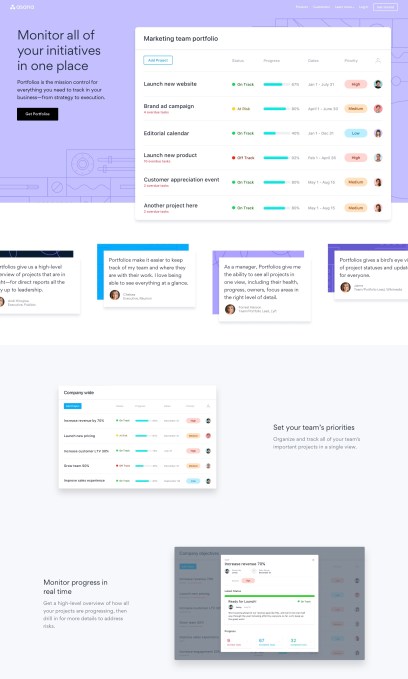 The first, Portfolio, will give a manager a way of viewing what everyone in an organization is working on in Asana — a “mission control” that provides a single view of what is going on, which can be useful for figuring out more big-picture progress or to oversee a larger project that has multiple streams of work within it.
Alongside that, it’s also soon going to launch another feature in Business called Workloads, which will let managers then assign people to projects or redeploy them, based on what they are seeing progress through the Portfolios tool.
The two features, Asana hopes, will mean that organizations will not only get better insights into their current projects on the platform, but might be enticed to buy into using it for more of them. Alex Hood, the company’s head of product (who joined a year ago after many years at Intuit), noted that it’s something that companies had already been trying to address themselves to some degree. “We’ve seen customers hack solutions together,” he said. So, it seemed like time to make it into a more formal tool, Hood said.
The company’s move to add another tier to generate more revenue comes on the heels of Asana raising $75 million on a $900 million valuation earlier this year — money that Moskovitz told TechCrunch is still largely in the bank.
“We’re not yet profitable, but we’re rapidly approaching it,” he said, describing Asana to me as a “high-volume SaaS business, very efficient and very successful.” The company is not in sight of an IPO, he added, but it seems that it is just getting started on what more it might add to the platform to make it more sticky and useful to the average business user.
Key on that roadmap, Hood said, is the use of more machine learning and other artificial intelligence tools in the creation of new features — something that the company first introduced through Timeline, introduced in March, which knits together different project threads to start creating a bigger overview of what is going on.
One new feature that Asana is working on is a way to highlight when projects might not be going to plan, or that there are areas that have yet to be addressed — and then suggest ways of helping to fix things through the redeployment of people.
Another area that Asana is exploring is how to use AI to match people better to projects. Hood said that it’s now working on a system that might be able to suggest where an employee or team member might get assigned — for example, using the profile of a person that invited you into a team as an indicator of where you might be working.
Powered by WPeMatico
HashiCorp, the company that has made hay developing open-source tools for managing cloud infrastructure, obviously has a pretty hefty commercial business going too. Today the company announced an enormous $100 million round on a unicorn valuation of $1.9 billion.
The round was led by IVP, whose investments include AppDynamics, Slack and Snap. Newcomer Bessemer Venture Partners joined existing investors GGV Capital, Mayfield, Redpoint Ventures and True Ventures in the round. Today’s investment brings the total raised to $179 million.
The company’s open-source tools have been downloaded 45 million times, according to data provided by the company. It has used that open-source base to fuel the business (as many have done before).
“Because practitioners choose technologies in the cloud era, we’ve taken an open source-first approach and partnered with the cloud providers to enable a common workflow for cloud adoption. Commercially, we view our responsibility as a strategic partner to the Global 2000 as they adopt hybrid and multi-cloud. This round of funding will help us accelerate our efforts,” company CEO Dave McJannet said in a statement.
To keep growing, it needs to build out its worldwide operations and that requires big bucks. In addition, as the company scales that means adding staff to beef up customer success, support and training teams. The company plans on making investments in these areas with the new funding.
HashiCorp launched in 2012. It was the brainchild of two college students, Mitchell Hashimoto and Armon Dadgar, who came up with the idea of what would become HashiCorp while they were still at the University of Washington. As I wrote in 2014 on the occasion of their $10 million Series A round:
After graduating and getting jobs, Hashimoto and Dadgar reunited in 2012 and launched HashiCorp. They decided to break their big problem down into smaller, more manageable pieces and eventually built the five open source tools currently on offer. In fact, they found as they developed each one, the community let them know about adjacent problems and they layered on each new tool to address a different need.
HashiCorp has continued to build on that early vision, layering on new tools over the years. It is not alone in building a business on top of open source and getting rewarded for their efforts. Just this morning, Neo4j, a company that built a business on top of its open-source graph database project, announced an $80 million Series E investment.
Powered by WPeMatico
Rockset, a startup that came out of stealth today, announced $21.5M in previous funding and the launch of its new data platform that is designed to simplify much of the processing to get to querying and application building faster.
As for the funding, it includes $3 million in seed money they got when they started the company, and a more recent $18.5 million Series A, which was led by Sequoia and Greylock.
Jerry Chen, who is a partner at Greylock sees a team that understands the needs of modern developers and data scientists, one that was born in the cloud and can handle a lot of the activities that data scientists have traditionally had to handle manually. “Rockset can ingest any data from anywhere and let developers and data scientists query it using standard SQL. No pipelines. No glue. Just real time operational apps,” he said.
Company co-founder and CEO Venkat Venkataramani is a former Facebook engineer where he learned a bit about processing data at scale. He wanted to start a company that would help data scientists get to insights more quickly.
Data typically requires a lot of massaging before data scientists and developers can make use of it and Rockset has been designed to bypass much of that hard work that can take days, weeks or even months to complete.
“We’re building out our service with innovative architecture and unique capabilities that allows full-featured fast SQL directly on raw data. And we’re offering this as a service. So developers and data scientists can go from useful data in any shape, any form to useful applications in a matter of minutes. And it would take months today,” Venkataramani explained.
To do this you simply connect your data set wherever it lives to Rockset and it deals with the data ingestion, building the schema, cleaning the data, everything. It also makes sure you have the right amount of infrastructure to manage the level of data you are working with. In other words, it can potentially simplify highly complex data processing tasks to start working with the raw data almost immediately using SQL queries.
To achieve the speed, Venkataramani says they use a number of indexing techniques. “Our indexing technology essentially tries to bring the best of search engines and columnar databases into one. When we index the data, we build more than one type of index behind the scenes so that a wide spectrum of pre-processing can be automatically fast out of the box,” he said. That takes the burden of processing and building data pipelines off of the user.
The company was founded in 2016. Chen and Sequoia partners Mike Vernal joined the Rockset board under the terms of the Series A funding, which closed last August.
Powered by WPeMatico
As car and tech companies continue to make inroads on vehicles and services to build autonomous driving systems, a startup that is creating high-definition maps to help these vehicles move around has quietly picked up a significant round of funding.
DeepMap — a Palo Alto startup co-founded by James Wu and Mark Wheeler, who previously helped build maps and more at Google, Apple and Baidu — has raised a significant round of growth funding at a valuation of at least $475 million to expand its technology stack and its reach into more markets beyond its current footprint of the U.S. and China.
Founded in 2016, DeepMap has been relatively quiet since raising $25 million in 2017, but news about this round has been trickling out for the last few months. In July, the company filed papers for a $60 million Series B round. In August, it noted that Nvidia had joined the round, which by that point was “oversubscribed” but still not closed.
And today, Generation Investment Management — the VC firm that counts former Vice President Al Gore and others among its co-founders — also confirmed that it is part of that Series B, along with previous investors Andreessen Horowitz, Accel Partners and GSR Ventures, and new investor Robert Bosch Venture Capital. PitchBook notes that the round puts the valuation of DeepMap at $450 million post-money. However, with Generation added to the mix, both the size of the Series B and the valuation might be higher.
We’ve asked and Generation and DeepMap are not disclosing those details, but they have said that the investment is being made because the interests of the startup are in line with that of the VC.
“DeepMap and Generation share the deeply-held belief that autonomous vehicles will lead to environmental and social benefits,” said Wu, who is the CEO of DeepMap (Wheeler is the CTO), in a statement. “We are delighted to work with the talented team at Generation. We consider Generation to be a value-added investor, whose insights and mission-aligned network will be of great advantage as we scale, especially in Europe.”
DeepMap is not exactly in stealth mode, but it also doesn’t disclose much about what it is working on specifically, nor how the funding will be used. (But it is hiring, mostly in engineering roles, in Palo Alto and Beijing.)
Companies like Waymo are expanding their autonomous driving tests, Lyft is buying companies to help ingest more driving data more easily and just this week Baidu announced new car plans with Volvo and Ford, but there are still some crucial pieces that need to be put in place for self-driving to become a wide-scale reality, and one of them is building systems that have an accurate reading of the roads they are driving on.
HD mapping will play a key role in that regard, helping make systems more accurate with real-time localization features that respond to road types and driving conditions. DeepMap says that it provides centimeter-specific accuracy using “real-world data, not models” and the ability to incorporate 3D landmark features and full 3D environments using “true LiDAR intensity and RGB values data” for simulation tools.
While DeepMap does not detail its products on its site, one report describes its offering as including hardware tools, software solutions, field data collection services, and a service that is able to translate the self-driving fleet data that companies are now in the process of collecting “into their own personalized HD maps.” The same report claimed that DeepMap charges about $5,000 per kilometer for mapping services in the U.S.
DeepMap is also not the only company working on addressing this need for better and more accurate mapping: mapping startup Camera is also raising money to build its service; DeepMap’s investor Nvidia is also working on this problem; and lvl5 is another name we’ve also seen mentioned in this context.
The funding, and these partnerships, will likely help DeepMap cement its position on the map, so to speak, as all of these continue to grow.
“DeepMap is perfectly placed to address the imminent needs of autonomous vehicles. These vehicles will require HD maps and localization modules which are real-time, scalable, economically-viable, and machine-readable, something which DeepMap can deliver through its unique approach,” said Lilly Wollman, co-head of Generation’s Growth Equity team, in a statement. “We are very excited to partner with one of the most technically impressive and experienced teams in the industry.”
Powered by WPeMatico