Enterprise
Auto Added by WPeMatico
Auto Added by WPeMatico

Google today announced that it will invest $13 billion in data centers and offices across the U.S. in 2019. That’s up from $9 billion in investments last year. Many of these investments will go to states like Nebraska, Nevada, Ohio, Texas, Oklahoma, South Carolina and Virginia, where Google plans new or expanded data centers. Though like most years, it’ll also continue to expand many of its existing offices in Seattle, Chicago and New York, as well as in its home state of California.
Given Google’s push for more cloud customers, it’s also interesting to see that the company continues to expand its data center presence across the country. Google will soon open its first data centers in Nevada, Nebraska, Ohio and Texas, for example, and it will expand its Oklahoma, South Carolina and Virginia data centers. Google clearly isn’t slowing down in its race to compete with AWS and Azure.
 “These new investments will give us the capacity to hire tens of thousands of employees, and enable the creation of more than 10,000 new construction jobs in Nebraska, Nevada, Ohio, Texas, Oklahoma, South Carolina and Virginia,” Google CEO Sundar Pichai writes today. “With this new investment, Google will now have a home in 24 total states, including data centers in 13 communities. 2019 marks the second year in a row we’ll be growing faster outside of the Bay Area than in it.”
Given the current backlash against many tech companies and automation in general, it’s probably no surprise that Google wants to emphasize the number of jobs it is creating (and especially jobs in Middle America). The construction jobs are obviously temporary, though, and data centers don’t need a lot of employees to operate once they are up and running. Still, Google promises that this will give it the “capacity to hire tens of thousands of employees.”
Powered by WPeMatico
Slack has become a critical communications tool for many organizations. One of the things that has driven its rapid success has been the ability to connect to external enterprise apps inside of Slack, giving employees what is essentially a centralized work hub. This ability has led to some unintended consequences around formatting issues, which Slack addressed today with two new tools, Block Kit and Block Kit Builder.
Block Kit lets developers present dense content in a much more visually appealing way, while Block Kit Builder is a prototyping tool for building more attractive apps inside Slack. The idea is to provide a way to deliver content inside of Slack without having to do workarounds to make the content look good.
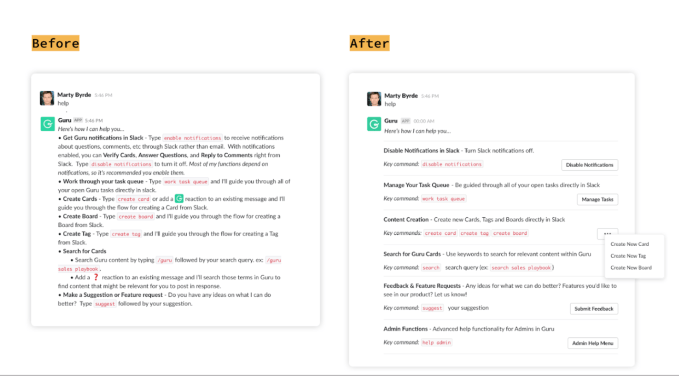
Before and after applying Block Kit. Screen: Slack
Bear Douglas, who is Slack’s director of developer of relations, says developers have been quite creative up until now when it comes to formatting, but the company has been working to simplify it. Today’s announcement is the culmination of that work.
“Block Kit makes it easier for people to quickly design a customized app in Slack. We’ve launched a no-code builder that will let people design the messages that they show inside Slack,” she explained.
She said that while this tool is really designed for people with some programming or Slack admin-level knowledge, the ultimate goal is to make it easy enough for non-technical end users to build apps in Slack, something that is on the road map. What enhancing these tools does, however, is show people just what is possible inside of Slack.
“When people see Block Kit in action, it is illuminating about what can be done, and it helps them understand that it doesn’t just need to be your communications center or [something that pings you] when your website blows up. You can actually get work done inside of Slack,” she said.
One other advantage of using Block Kit is that apps will display messages consistently, whether you are using the web or mobile. Prior to having these tools, workarounds might have looked fine on the web, but the spacing might have been off on mobile or vice versa. Block Kit lets you design consistent interfaces across platforms.
Among the tools Slack is offering, none is actually earth-shattering, but in total they provide users with the ability to format their content in a way that makes sense using common design elements like image containers, dividers and sections. They are also offering buttons, drop-down menus and a calendar picker.
Both of these tools are available starting today in the Block Kit hub.
Powered by WPeMatico
Fiverr is acquiring ClearVoice, a company that helps customers like Intuit and Carfax find professionals to write promotional content.
The two companies seem like a natural fit, as they both operate marketplaces for freelancers. Fiverr covers a much broader swath of freelance work, but CEO Micha Kaufman (pictured above) said the marketplace’s professional writing category grew 220 percent between the fourth quarters of 2017 and 2018, and he predicted that the need for content marketing will only increase.
“The types of channels that brands and companies need to be involved in and engaging in conversation with their audience are just growing,” Kaufman said. “I think any brand today that wants to be relevant needs to create a lot of engaging, interesting, creative content in their space, and I think that that creates a high demand for good content writers.”
Kaufman also noted that this is Fiverr’s third acquisition in two years, and he said he’s a “big believer … in the consolidation of vertical businesses into horizontal businesses such as ours — the fact that we cover over 200 categories gives us a tremendous amount of power to serve customers across many different types of needs.”
So what does the acquisition bring to the table that Fiverr wasn’t offering already? Kaufman said the ClearVoice team has “a lot of know how, both in technology side and the actual content side,” which will allow Fiverr to “cater to customers of all sizes and all needs.”

ClearVoice editorial calendar
More specifically, he said most of Fiverr’s content marketing customers are small businesses, while ClearVoice is able to work with large enterprises, especially with its collaboration and workflow tools that allow those enterprises to create content at “high velocity.”
Founded in 2014 by Jay Swansson and Joe Griffin (who still serve as co-CEOs), ClearVoice has raised a total of $3.1 million in funding from investors, including PC Ventures, Desert Angels, Peak Ventures and Service Provider Capital, according to Crunchbase.
Fiverr is not disclosing the financial terms of the acquisition. The company says ClearVoice will continue to operate as an independent subsidiary.
“We are thrilled to be joining a company that is changing how people and companies work together in the modern era,” Swansson said in a statement. “This new chapter is a chance for us to use Fiverr’s depth and knowledge to globally scale our business and advance our mission of creating a platform that allows for worldwide creative collaboration.”
Powered by WPeMatico
When it comes to the cloud market, there are few known knowns. For instance, we know that AWS is the market leader with around 32 percent of market share. We know Microsoft is far back in second place with around 14 percent, the only other company in double digits. We also know that IBM and Google are wallowing in third or fourth place, depending on whose numbers you look at, stuck in single digits. The market keeps expanding, but these two major companies never seem to get a much bigger piece of the pie.
Neither company is satisfied with that, of course. Google so much so that it moved on from Diane Greene at the end of last year, bringing in Oracle veteran Thomas Kurian to lead the division out of the doldrums. Meanwhile, IBM made an even bigger splash, plucking Red Hat from the market for $34 billion in October.
This week, the two companies made some more noise, letting the cloud market know that they are not ceding the market to anyone. For IBM, which is holding its big IBM Think conference this week in San Francisco, it involved opening up Watson to competitor clouds. For a company like IBM, this was a huge move, akin to when Microsoft started building apps for iOS. It was an acknowledgement that working across platforms matters, and that if you want to gain market share, you had better start thinking outside the box.
While becoming cross-platform compatible isn’t exactly a radical notion in general, it most certainly is for a company like IBM, which if it had its druthers and a bit more market share, would probably have been content to maintain the status quo. But if the majority of your customers are pursuing a multi-cloud strategy, it might be a good idea for you to jump on the bandwagon — and that’s precisely what IBM has done by opening up access to Watson across clouds in this fashion.
Clearly buying Red Hat was about a hybrid cloud play, and if IBM is serious about that approach, and for $34 billion, it had better be — it would have to walk the walk, not just talk the talk. As IBM Watson CTO and chief architect Ruchir Puri told my colleague Frederic Lardinois about the move, “It’s in these hybrid environments, they’ve got multiple cloud implementations, they have data in their private cloud as well. They have been struggling because the providers of AI have been trying to lock them into a particular implementation that is not suitable to this hybrid cloud environment.” This plays right into the Red Hat strategy, and I’m betting you’ll see more of this approach in other parts of the product line from IBM this year. (Google also acknowledged this when it announced a hybrid strategy of its own last year.)
Meanwhile, Thomas Kurian had his coming-out party at the Goldman Sachs Technology and Internet Conference in San Francisco earlier today. Bloomberg reports that he announced a plan to increase the number of salespeople and train them to understand specific verticals, ripping a page straight from the playbook of his former employer, Oracle.
He suggested that his company would be more aggressive in pursuing traditional enterprise customers, although I’m sure his predecessor, Diane Greene, wasn’t exactly sitting around counting on inbound marketing interest to grow sales. In fact, rumor had it that she wanted to pursue government contracts much more aggressively than the company was willing to do. Now it’s up to Kurian to grow sales. Of course, given that Google doesn’t report cloud revenue it’s hard to know what growth would look like, but perhaps if it has more success it will be more forthcoming.
As Bloomberg’s Shira Ovide tweeted today, it’s one thing to turn to the tried and true enterprise playbook, but that doesn’t mean that executing on that approach is going to be simple, or that Google will be successful in the end.
To be honest, all of these suggestions for broadening Google Cloud are from the obvious enterprise sales playbook, but it doesn’t mean they are easy.
— Shira Ovide (@ShiraOvide) February 12, 2019
These two companies obviously desperately want to alter their cloud fortunes, which have been fairly dismal to this point. The moves announced today are clearly part of a broader strategy to move the market share needle, but whether they can or the market positions have long ago hardened remains to be seen.
Powered by WPeMatico
Donde Search has just closed a $6 million Series A investment led by Matrix Partners, with participation from previous investors such as senior leaders from AliExpress, Google and Waze.
Donde first launched in 2014 as a consumer-facing app that helped users search and discover apparel items based on visual characteristics rather than text-based searches. In early 2018, the company pivoted to the enterprise space, helping retailers power suggestions and related items on their websites.
Here’s how it works:
Retailers partnered with Donde hand over their product catalog and run it through the Donde algorithm, which identifies all the visual features associated with each product. Retailers can then add a widget to their site to let users search based on those features (like sleeve length or type, color or material).
 As users interact with the products, the website adapts to that behavior to offer personalized product recommendations and related items.
Moreover, Donde offers an analytics dashboard that not only provides insights on the customer’s own website, but a look into trends being featured on competing e-commerce websites to understand the industry in general.
Donde was founded by Liat Zakay, who previously served as a software engineer and R&D team manager in the Israeli intelligence unit 8200. Using her technical expertise, she built Donde to solve her own problem of not having the time or energy to go through the tedious process of online shopping.
Zakay told TechCrunch that Donde is focused on apparel for now, but that the technology can be applied to almost any vertical.
“One of the interesting pieces about Donde is that it’s language agnostic,” said Zakay. “You don’t need to know what it’s called and it doesn’t matter what language you speak, you can still find what you want based on visual features. Which makes us extremely relevant to global retailers.”
The new funding, which will be used to expand the product and the team, came shortly after the announcement of Donde’s partnership with Forever 21. The fast-fashion retailer tested out the Donde platform on its mobile app and, after a month, saw a 20 percent increase in average purchase value and higher conversions. Forever 21 has now expanded the program, putting Donde on the web, as well.
Donde said it is working on pilot programs with several other retailers across the U.S. and Europe.
Fast fashion, in particular, represents a big opportunity for Donde. Because product turnover is so fast, retailers rarely have reliable data around a certain SKU, with the website being run on outdated data from last “season.”
This latest round brings Donde’s total funding to $9.5 million, with backing from UpWest, Afterdox and Golden Seeds.
Powered by WPeMatico
The founders of Glide, a member of the Y Combinator Winter 2019 class, had a notion that building mobile apps in the enterprise was too hard. They decided to simplify the process by starting with a spreadsheet, and automatically turning the contents into a slick mobile app.
David Siegel, CEO and co-founder at Glide, was working with his co-founders Jason Smith, Mark Probst and Antonio Garcia Aprea at Xamarin, a cross-platform mobile development company that Microsoft acquired for $500 million in 2016. There, they witnessed first-hand the difficulty that companies were having building mobile apps. When their two-year stint at Microsoft was over, the four founders decided to build a startup to solve the problem.
“We saw how desperate some of the world’s largest companies were to have a mobile strategy, and also how painful and expensive it is to develop mobile apps. And we haven’t seen significant progress on that 10 years after the smartphone debuted,” Siegel told TechCrunch.
The founders began with research, looking at almost 100 no-code tools, and were not really satisfied with any of them. They chose the venerable spreadsheet, a business tool many people use to track information, as the source for their mobile app builder, starting with Google Sheets.
“There’s a saying that spreadsheets are the most successful programming model of all time, and smartphones are the most successful computers of all time. So when we started exploring Glide we asked ourselves, can these two forces be combined to create something very valuable to let individuals and businesses build the type of apps that we saw Xamarin customers needed to build, but much more quickly,” Siegel said.
Photo: GlideThe company developed Glide, a service that lets you add information to a Google Sheet spreadsheet, and then very quickly create an app from the contents without coding. “You can easily assemble a polished, data-driven app that you can customize and share as a progressive web app, meaning you can get a link that you can share with anybody, and they can load it in a browser without downloading an app, or you can publish Glide apps as native apps to app stores,” Siegel explained. What’s more, there is a two-way connection between app and spreadsheet, so that when you add information in either place, the other element is updated.
The founders decided to apply at Y Combinator after consulting with former Xamarin CEO, and current GitHub chief executive, Nat Friedman. He and other advisors told them YC would be a great place for first-time founders to get guidance on building a company, taking advantage of the vast YC network.
One of the primary lessons Siegel says they learned is the importance of getting out in the field and talking to customers, and not falling into the trap of falling in love with the act of building the tool. The company has actually helped fellow YC companies build mobile apps using the Glide tool.
Glide is live today and people can create apps using their own spreadsheet data, or by using the templates available on the site as a starting point. There is a free tier available to try it without obligation.
Powered by WPeMatico
Jobvite, the company that was once an early mover in leveraging social networks to help source job opportunities and find interesting candidates for openings, is today announcing two big moves to double down on its ambition to build a bigger platform for recruitment and applicant tracking.
The company has picked up an investment of over $200 million, and it will be using the money to acquire three smaller companies focusing on different aspects of the recruitment process: Talemetry (which specializes in recruitment marketing); RolePoint (for employee referrals and in-company moves); and Canvas (a text-based conversational bot to get the screening process started).
Jobvite is not disclosing its valuation with the funding, which is coming from private equity firm K1, but for a little guidance, in an interview, Dan Finnigan, Jobvite’s CEO, said it was a majority stake but nowhere near a full acquisition. (PitchBook’s last valuation of the company, of around $150 million, is very old, dating from September 2014; and it has never been confirmed by the company.)
The combined company will have 2,000+ customers that include Schneider Electric, Lenovo, Santander, PayPal, Genuine Parts, and Panasonic.
Finnigan says that Jobvite’s growth, and investor interest in backing that, is happening in tandem with two changes, one technological and another the evolution in how organizations handle human resources.
Several years ago, many companies — hoping to cut costs — merged together their personnel and recruitment operations, “and recruiting became an afterthought,” he said. That led to companies tacking on, as a kind of minimum viable solution, applicant tracking software but little or nothing else.
But more recently, the war for talent has escalated — not just because unemployment is low but because there are now multiple different opportunities and shortages of suitable people for specific, often emerging skills. In turn, businesses have started to realise “that recruiting is the backbone of every company, and that applicant tracking is just not enough,” he said.
At the same time, there have been evolutions in the technology. While a lot of recruitment software (and the recruitment process) has traditionally been quite fragmented, a move to cloud solutions has provided an avenue for consolidating the process and using one platform to manage it. (Google’s launch of Hire, which lets users manage job applicants using G Suite apps; LinkedIn’s recruitment platform; Zoho and SmartRecruiter are all prime examples of how cloud platforms are being used to build more complete sourcing and tracking services.)
Coupled with this is a rising use of technology like machine learning to remove some of the more mechanical aspects of a recruiter’s job to speed up processes.
Jobvite’s three acquisitions all play into both of these trends. Canvas, for example, uses a bot to source initial information about a candidate to start the screening process before human recruiters step in to take over.
Talemetry, meanwhile, taps into marketing tech to help identify where the most ideal candidates might be in order to better target job opportunities at them, in the form of ads or other kind of content.
Lastly, RolePoint will add a new feature to tap into referrals from existing employees, and to help manage in-company moves.
Finnigan likens the cloud-based platform approach that we’re seeing in the market to the impact Salesforce has had on the expanding concept of CRM. “We know that marketing and sales software have continued to evolve with new features like content marketing, and the same has happened in recruitment,” he said.
“We are excited to be investing in such an innovative set of technologies,” says Ron Cano, managing partner at K1 Investment Management, in a statement. “The talent acquisition industry is critical to our economy and ripe for disruption with outdated software still prevalent. K1’s investment will create the only true end-to-end talent acquisition platform and will provide our customers with accelerated growth in innovation of product features and services.”
Powered by WPeMatico

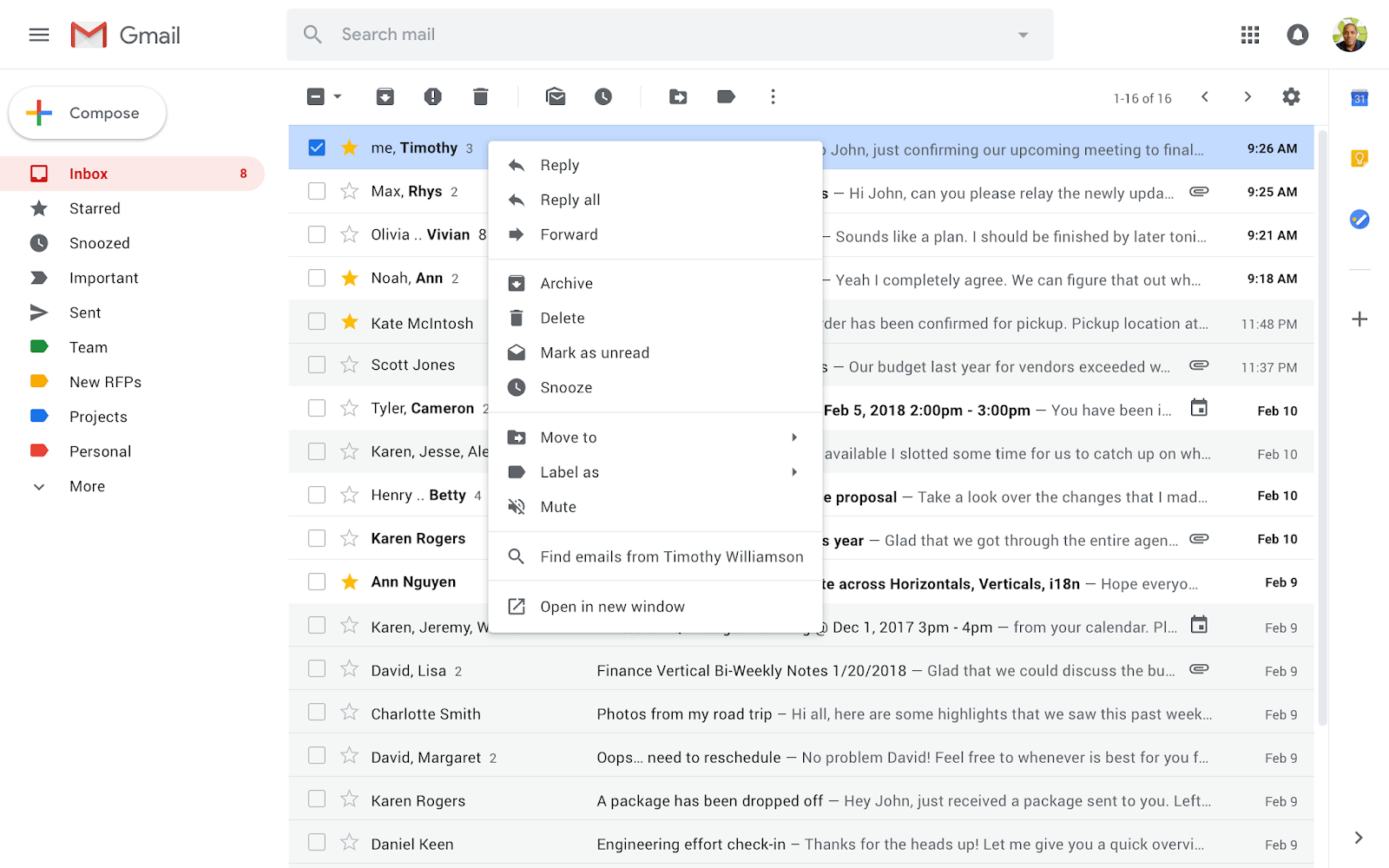
Google is giving Gmail a new right-click menu. And it’s about time. While you’ve long been able to right-click on any email in your inbox, your options were always limited. You could archive an email, mark it as read/unread and delete it, but that was about it. Now, as the company announced today, that’s changing and you’re about to get a fully featured right-click menu that lets you do most of the things that Gmail’s top bar menu lets you do, plus a few extra features.
Soon, when you right-click on a message in your inbox view, you’ll see a long list of features with options to reply to messages and forward them, search for all emails from a sender or with the same subject and open multiple emails in multiple windows at the same time. You’ll also be able to add labels to emails, mute conversations and use Gmail’s snooze feature, all from the same menu.
All of this is pretty straightforward stuff and none of it is especially groundbreaking, which makes you wonder why it took Google so long to implement it.
As usual, Google only tells us that it is rolling out this feature to G Suite users now (starting today for those on the rapid release schedule and on February 22 for those that follow the slower scheduled release cycle). But free users typically see these new features pop up somewhere around that same time frame, too.
Powered by WPeMatico
Google today announced the general availability of a new API for Google Docs that will allow developers to automate many of the tasks that users typically do manually in the company’s online office suite. The API has been in developer preview since last April’s Google Cloud Next 2018 and is now available to all developers.
As Google notes, the REST API was designed to help developers build workflow automation services for their users, build content management services and create documents in bulk. Using the API, developers can also set up processes that manipulate documents after the fact to update them, and the API also features the ability to insert, delete, move, merge and format text, insert inline images and work with lists, among other things.

The canonical use case here is invoicing, where you need to regularly create similar documents with ever-changing order numbers and line items based on information from third-party systems (or maybe even just a Google Sheet). Google also notes that the API’s import/export abilities allow you to use Docs for internal content management systems.
Some of the companies that built solutions based on the new API during the preview period include Zapier, Netflix, Mailchimp and Final Draft. Zapier integrated the Docs API into its own workflow automation tool to help its users create offer letters based on a template, for example, while Netflix used it to build an internal tool that helps its engineers gather data and automate its documentation workflow.
Powered by WPeMatico
Carbonite, the online backup and recovery company based in Boston, announced late yesterday that it will be acquiring Webroot, an endpoint security vendor, for $618.5 million in cash.
The company believes that by combining its cloud backup service with Webroot’s endpoint security tools, it will give customers a more complete solution. Webroot’s history actually predates the cloud, having launched in 1997. The private company reported $250 million in revenue for fiscal 2018, according to data provided by Carbonite . That will combine with Carbonite’s $296.4 million in revenue for the same time period.
Carbonite CEO and president Mohamad Ali saw the deal as a way to expand the Carbonite offering. “With threats like ransomware evolving daily, our customers and partners are increasingly seeking a more comprehensive solution that is both powerful and easy to use. Backup and recovery, combined with endpoint security and threat intelligence, is a differentiated solution that provides one, comprehensive data protection platform,” Ali explained in a statement.
The deal not only enhances Carbonite’s backup offering, it gives the company access to a new set of customers. While Carbonite sells mainly through Value Added Resellers (VARs), Webroot’s customers are mainly 14,000 Managed Service Providers (MSPs). That lack of overlap could increase its market reach through to the MSP channel. Webroot has 300,000 customers, according to Carbonite.
This is not the first Carbonite acquisition. It has acquired several other companies over the last several years, including buying Mozy from Dell a year ago for $145 million. The acquisition strategy is about using its checkbook to expand the capabilities of the platform to offer a more comprehensive set of tools beyond core backup and recovery.
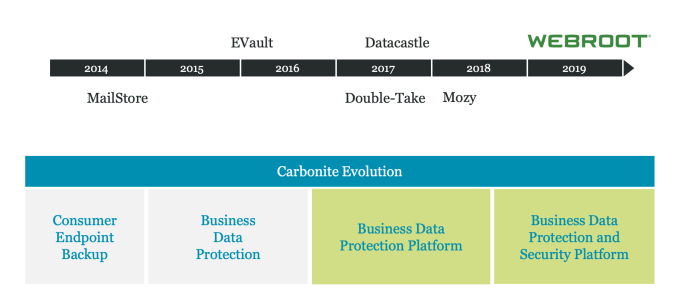
Graphic: Carbonite
The company announced it is using cash on hand and a $550 million loan from Barclays, Citizens Bank and RBC Capital Markets to finance the deal. Per usual, the acquisition will be subject to regulatory approval, but is expected to close this quarter.
Powered by WPeMatico