Enterprise
Auto Added by WPeMatico
Auto Added by WPeMatico
BetterCloud began life as a way to provide an operations layer for G Suite. More recently, after a platform overhaul, it began layering on a handful of other SaaS applications. Today, the company announced, it is now possible to add any SaaS application to its operations dashboard and monitor usage across applications via an API.
As founder and CEO David Politis explains, a tool like Okta provides a way to authenticate your SaaS app, but once an employee starts using it, BetterCloud gives you visibility into how it’s being used.
“The first order problem was identity, the access, the connections. What we’re doing is we’re solving the second order problem, which is the interactions,” Politis explained. In his view, companies lack the ability to monitor and understand the interactions going on across SaaS applications, as people interact and share information, inside and outside the organization. BetterCloud has been designed to give IT control and security over what is occurring in their environment, he explained.
He says they can provide as much or as little control as a company needs, and they can set controls by application or across a number of applications without actually changing the user’s experience. They do this through a scripting library. BetterCloud comes with a number of scripts and provides log access to give visibility into the scripting activity.
If a customer is looking to use this data more effectively, the solution includes a Graph API for ingesting data and seeing the connections across the data that BetterCloud is collecting. Customers can also set event triggers or actions based on the data being collected as certain conditions are met.
All of this is possible because the company overhauled the platform last year to allow BetterCloud to move beyond G Suite and plug other SaaS applications into it. Today’s announcement is the ultimate manifestation of that capability. Instead of BetterCloud building the connectors, it’s providing an API to let its customers do it.
The company was founded in 2011 and has raised more than $106 million, according to Crunchbase.
Powered by WPeMatico
Databricks, the company founded by the original team behind the Apache Spark big data analytics engine, today announced that it has raised a $250 million Series E round led by Andreessen Horowitz. Coatue Management, Green Bay Ventures, Microsoft and NEA, also participated in this round, which brings the company’s total funding to $498.5 million. Microsoft’s involvement here is probably a bit of a surprise, but it’s worth noting that it also worked with Databricks on the launch of Azure Databricks as a first-party service on the platform, something that’s still a rarity in the Azure cloud.
As Databricks also today announced, its annual recurring revenue now exceeds $100 million. The company didn’t share whether it’s cash flow-positive at this point, but Databricks CEO and co-founder Ali Ghodsi shared that the company’s valuation is now $2.75 billion.
Current customers, which the company says number around 2,000, include the likes of Nielsen, Hotels.com, Overstock, Bechtel, Shell and HP.
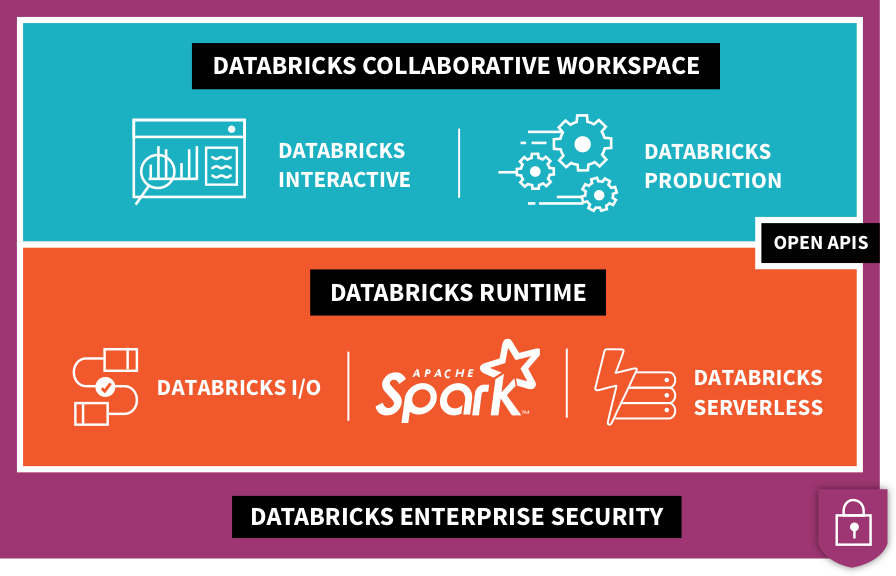
While Databricks is obviously known for its contributions to Apache Spark, the company itself monetizes that work by offering its Unified Analytics platform on top of it. This platform allows enterprises to build their data pipelines across data storage systems and prepare data sets for data scientists and engineers. To do this, Databricks offers shared notebooks and tools for building, managing and monitoring data pipelines, and then uses that data to build machine learning models, for example. Indeed, training and deploying these models is one of the company’s focus areas these days, which makes sense, given that this is one of the main use cases for big data, after all.
On top of that, Databricks also offers a fully managed service for hosting all of these tools.
“Databricks is the clear winner in the big data platform race,” said Ben Horowitz, co-founder and general partner at Andreessen Horowitz, in today’s announcement. “In addition, they have created a new category atop their world-beating Apache Spark platform called Unified Analytics that is growing even faster. As a result, we are thrilled to invest in this round.”
Ghodsi told me that Horowitz was also instrumental in getting the company to re-focus on growth. The company was already growing fast, of course, but Horowitz asked him why Databricks wasn’t growing faster. Unsurprisingly, given that it’s an enterprise company, that means aggressively hiring a larger sales force — and that’s costly. Hence the company’s need to raise at this point.
As Ghodsi told me, one of the areas the company wants to focus on is the Asia Pacific region, where overall cloud usage is growing fast. The other area the company is focusing on is support for more verticals like mass media and entertainment, federal agencies and fintech firms, which also comes with its own cost, given that the experts there don’t come cheap.
Ghodsi likes to call this “boring AI,” since it’s not as exciting as self-driving cars. In his view, though, the enterprise companies that don’t start using machine learning now will inevitably be left behind in the long run. “If you don’t get there, there’ll be no place for you in the next 20 years,” he said.
Engineering, of course, will also get a chunk of this new funding, with an emphasis on relatively new products like MLFlow and Delta, two tools Databricks recently developed and that make it easier to manage the life cycle of machine learning models and build the necessary data pipelines to feed them.
Powered by WPeMatico
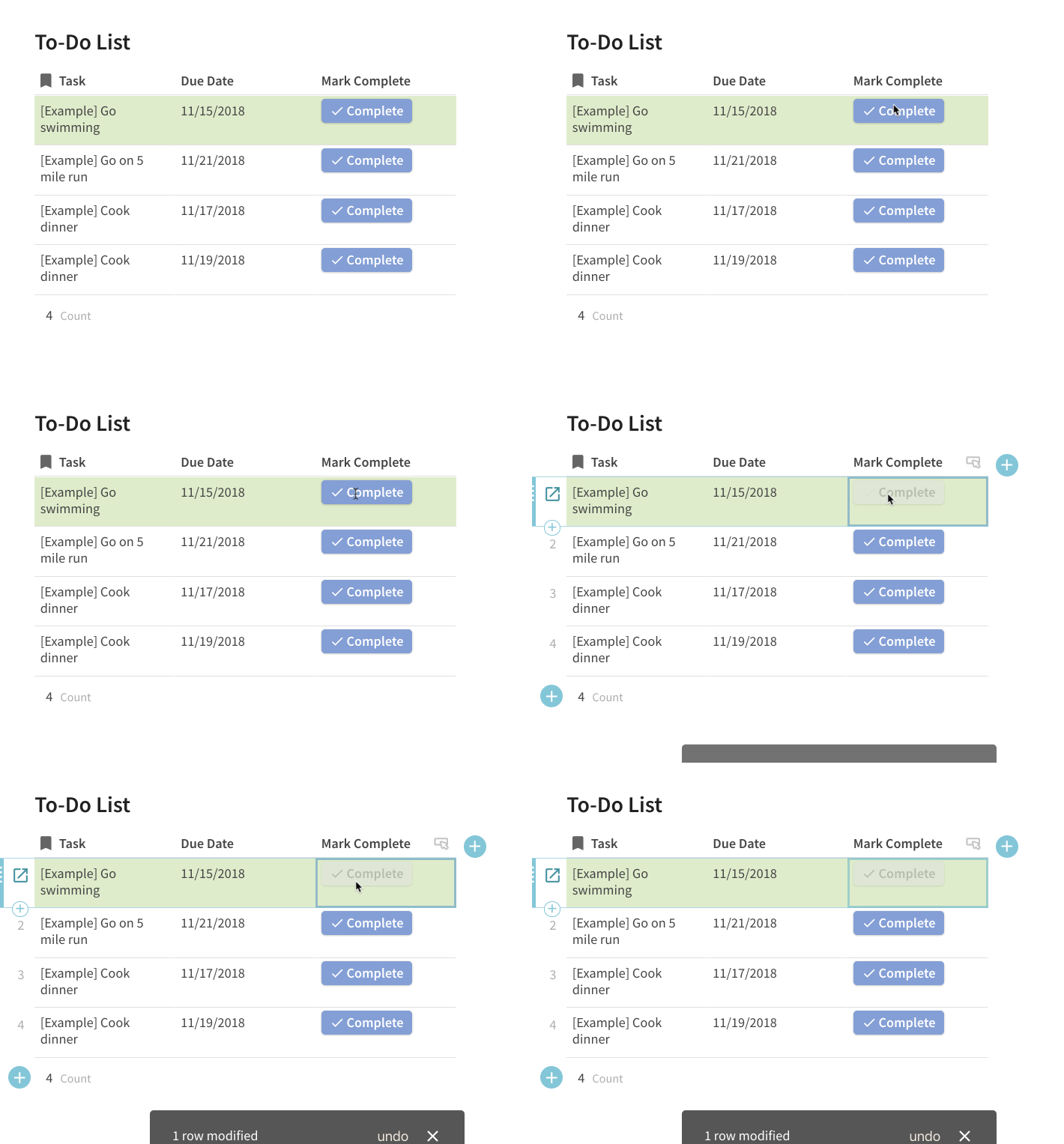
Coda, which is coming out of its limited beta today, wants to reinvent how you think about documents and spreadsheets. That’s about as tough a challenge as you can set yourself, given how ingrained tools like Word, Excel and their equivalents from the likes of Google, Zoho and others are. Coda’s secret weapon is that it combines text and spreadsheet functionality into a single document, with the ability to build some basic programming into them and add features from third-party services as a bonus.
In addition to opening up the service to anyone, Coda also today launched its new mobile app for iOS (with Android following at some point in the future).
“It’s the best of documents, spreadsheets, presentations, applications — all brought into one new surface,” Coda founder and CEO (and former head of product for YouTube Shishir Mehrotra told me. “But the phrase we like to use is that Coda allows anyone to make a doc as powerful as an app.”
You’re not going to use Coda, which was founded in 2017 and received funding from VC heavyweights like Greylock, Khosla Ventures and NEA, as a full-blown low code/no code service. It’s still a bit too limited for that. But you can use it to build your own custom inventory system, for example, or to build a basic CRM or to-do app that fits your specific needs. Or you could just use it as an online text editor and then slowly add features like third-party integrations with the likes of Slack or Figma as needed. All of that is easy enough for anybody who has ever used a function in Excel or Google Sheets.
So far, tens of thousands of people have used the service during its private beta. Mehrotra tells me that about 15 percent of them are from the Bay Area and that a good amount of them simply use the service as a basic document editor.
The new iOS app, unsurprisingly, mostly focuses on consuming content and using the functions that you have built in the web app. It’s unlikely that you’ll want to build a whole new experience on your phone, after all. In the demos I’ve seen, Coda nicely transforms cells and their functions into usable tables and cards on the iPhone.
Powered by WPeMatico
Five years ago today, Satya Nadella took over as CEO at Microsoft, and by most any measure has been wildly successful. It’s common to look at the stock price as the defining metric of Nadella’s tenure, but the stock price triumph has followed something more fundamental and harder to measure: how he changed the culture of the entire organization.
Nadella’s term at Microsoft has paralleled my own here at TechCrunch. I started in April of 2014, and in one of my first posts, I wrote about the difficulty of substantive change inside an organization the size of Microsoft. In those early moments of both our tenures, I recognized a subtle shift was taking place, one toward service, something Microsoft hadn’t been known for under his predecessors Steve Ballmer and Bill Gates.
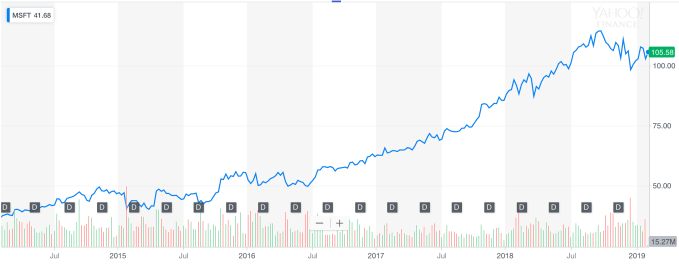
Microsoft’s five-year stock price journey under Satya Nadella. Stock chart: Yahoo Finance
But Nadella’s inauguration came at a time when technology itself was shifting, moving from a monolithic model — where IT shopped mostly at one vendor, and they were a Microsoft shop or an Oracle shop or an IBM shop, buying a full stack of products — to one where they subscribe to cloud services and choose the best of breed.
This was also happening against the backdrop of the Consumerization of IT, where power was shifting from large administrative departments to users and teams. Nadella seemed to understand all of this.
The shift in strategy, as I wrote, probably began long before Nadella was handed the keys to the CEO office, but perhaps it took a different kind of leader, like Nadella, to turn the battleship that was Microsoft Corporation. Every company has its own politics and biases, and I’m sure Microsoft did as well, but Nadella seemed to manage those, reorganizing the company over time, and shifting priorities. It didn’t come without the pain of layoffs, including one in 2017 when thousands of people were let go. Long-time executives like COO Kevin Turner and head of Windows and devices, Terry Myerson, also left the company.
But Microsoft went from a company trying to compel customers to buy an all-Microsoft, all-the-time kind of approach to one that recognized it was important to work across platforms and to partner widely. To show how serious he was, a year after he started, Nadella set aside his differences with Marc Benioff and Salesforce, and appeared at Dreamforce, Salesforce’s massive customer conference. That was hugely symbolic, given the two companies had engaged in dueling lawsuits over the years, but this was a new day at Microsoft, and Nadella was out to prove it.
In a quote I’ve come back to a number of times over the years, Nadella laid out his new vision of cooperation. While he was going to compete fiercely, of course, he also was going to cooperate where it made sense, because customers demanded it — and under Nadella, it’s all about the customer.
“It is incumbent upon us, especially those of us who are platform vendors to partner broadly to solve real pain points our customers have,” Nadella said at the time. He wasn’t ceding markets, or failing to compete when it mattered, but he also recognized to make customers happy, he had to partner when it made sense.
Back in the days before Satya, partners and developers talked about a much more hostile environment, where it was difficult to get things done, to get the resources they needed, and the attitude was not one of cooperation, but almost hostility. That changed under Nadella, and he should get credit for that.
That all matters, of course, because in the age of the cloud, Nadella’s Dreamforce quote is spot on. Customers expect vendors to cooperate. They expect open APIs. They expect the platform to be friendly to developers — and under Nadella’s leadership, all of this has happened.
The company has also paid closer attention to issues like accessibility, with features such as real-time captions and the new Xbox adaptive controller. Microsoft has instituted programs under Nadella to use AI to improve accessibility, and he has also spoken frequently about responsible AI development.
Nadella has also led an aggressive acquisition strategy using his company’s cash to buy companies big and small. The splashiest acquisitions were LinkedIn for a whopping $26.2 billion in 2016 and GitHub for $7.5 billion last year, but there have been a host of much smaller purchases, most for much less than a billion dollars, that have filled in holes around security, developer productivity, gaming and a wide variety of cloud services.
It is exceedingly difficult to successfully navigate these kinds of broad cultural changes inside a large organization, and while it is probably still a work in progress, Nadella has been mostly effective to this point. The stock price has followed that broader change, but it is not the story here. The story is one of leadership and change management inside a large organization.
Powered by WPeMatico
Slack, the provider of workplace communication and collaboration tools, has submitted paperwork with the Securities and Exchange Commission to go public later this year, the company announced on Monday.
This is its first concrete step toward becoming a publicly listed company, five years after it launched.
Headquartered in San Francisco, Slack has raised more than $1 billion in venture capital investment, including a $427 million funding round in August. The round valued the business at $7.1 billion, cementing its position as one of the most valuable privately held businesses in the U.S.
The company counted 10 million daily active users around the world and 85,000 paying users as of January 2019. According to data provided (via email) by SensorTower, Slack’s new users on mobile increased roughly 21 percent last quarter compared to Q4 2017, while total installs on mobile grew 24 million. The company recorded 8 million installs in 2018, up 21 percent year-over-year.
Slack’s investors include SoftBank’s Vision Fund, Dragoneer Investment Group, General Atlantic, T. Rowe Price Associates, Wellington Management, Baillie Gifford, Social Capital and IVP, as well as early investors Accel and Andreessen Horowitz.
Slack is one of several tech unicorns on deck to go public this year. Uber and Lyft have both similarly filed confidentially to go public in what are expected to be traditional initial public offerings. Slack, however, is expected to pursue a direct listing, following in Spotify’s footsteps. Instead of issuing new shares, Slack will sell directly to the market existing shares held by insiders, employees and investors, a move that will allow it to bypass a roadshow and some of Wall Street’s exorbitant IPO fees.
Powered by WPeMatico
Robotics process automation (RPA) is as hot as any enterprise technology at the moment, as companies look for ways to marry their legacy systems with a more modern flavor of automation. Catalytic, a startup from the Midwest, is putting its own flavor on RPA, aiming at more unstructured data. Today it was rewarded with a $30 million Series B investment.
The investment was led by Intel Capital, with participation from Redline Capital and existing investors NEA, Boldstart and Hyde Park Angel. Today’s round brings the total raised to almost $42 million, according to the company.
RPA helps automate highly mundane processes. Sean Chou, Catalytic co-founder and CEO, says there are a couple of ways his company’s solution diverts from his competition, which includes companies like Blue Prism, Automation Anywhere and UIPath.
For starters, Chou says, his company’s solution concentrates on unstructured data, like pulling information from documents or emails using a variety of techniques, depending on requirements. It could be old-fashioned scanning and OCR or more modern natural language process (NLP) to “read” the document, depending on requirements.
It is designed like all RPA tools to take humans out of the loop when it comes to the most mundane business processes, but, as Chou says, his company wants human employees in the loop whenever needed, whether that’s exception processing or tasks that are simply too challenging to program at the moment.
The company launched in 2015 using money Chou had earned from the sale of his previous company, Fieldglass, which he had sold the previous year to SAP for more than $1 billion dollars. Fieldglass helped with outsourcing, and as Chou developed that company, he saw a growing problem around automating certain tedious business processes, especially when they touched legacy systems inside an organization. He raised $3.1 million in seed money from Boldstart Ventures in NYC in 2016 and began building out the product in earnest.
Today, Catalytic has a dozen customers, including Bosch, the German manufacturing conglomerate. It employs 60 people in its Chicago headquarters. While its investors come from the coasts, Catalytic is building a company in the heart of the Midwest, a part of the country that has often been left out of the startup economy.
With $30 million, Catalytic can begin expanding the number of employees, including helping service its large customers, building out it partner network with other software companies and systems integrators and bringing in more engineering talent to continue building out the product.
The product is offered on a subscription basis as a cloud service.
Powered by WPeMatico
Google today announced that Cloud Firestore, its serverless NoSQL document database for mobile, web and IoT apps, is now generally available. In addition, Google is also introducing a few new features and bringing the service to 10 new regions.
With this launch, Google is giving developers the option to run their databases in a single region. During the beta, developers had to use multi-region instances, and, while that obviously has some advantages with regard to resilience, it’s also more expensive and not every app needs to run in multiple regions.
“Some people don’t need the added reliability and durability of a multi-region application,” Google product manager Dan McGrath told me. “So for them, having a more cost-effective regional instance is very attractive, as well as data locality and being able to place a Cloud Firestore database as close as possible to their user base.”
The new regional instance pricing is up to 50 percent cheaper than the current multi-cloud instance prices. Which solution you pick does influence the SLA guarantee Google gives you, though. While the regional instances are still replicated within multiple zones inside the region, all of the data is still within a limited geographic area. Hence, Google promises 99.999 percent availability for multi-region instances and 99.99 percent availability for regional instances.
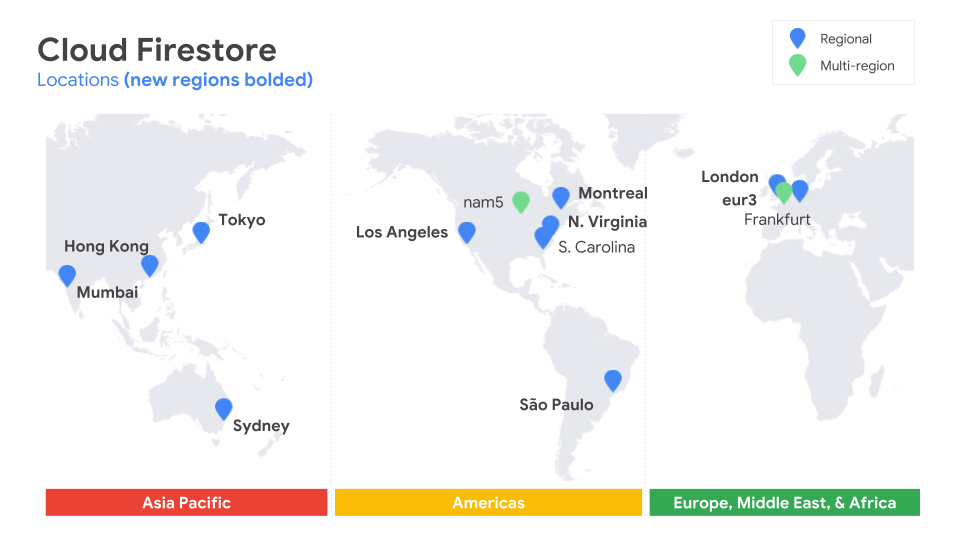
And talking about regions, Cloud Firestore is now available in 10 new regions around the world. Firestore launched with a single location when it launched and added two more during the beta. With this, Firestore is now available in 13 locations (including the North America and Europe multi-region offerings). McGrath tells me Google is still in the planning stage for deciding the next phase of locations, but he stressed that the current set provides pretty good coverage across the globe.
Also new in this release is deeper integration with Stackdriver, the Google Cloud monitoring service, which can now monitor read, write and delete operations in near-real time. McGrath also noted that Google plans to add the ability to query documents across collections and increment database values without needing a transaction.
It’s worth noting that while Cloud Firestore falls under the Google Firebase brand, which typically focuses on mobile developers, Firestore offers all of the usual client-side libraries for Compute Engine or Kubernetes Engine applications, too.
“If you’re looking for a more traditional NoSQL document database, then Cloud Firestore gives you a great solution that has all the benefits of not needing to manage the database at all,” McGrath said. “And then, through the Firebase SDK, you can use it as a more comprehensive back-end as a service that takes care of things like authentication for you.”
One of the advantages of Firestore is that it has extensive offline support, which makes it ideal for mobile developers but also IoT solutions. Maybe it’s no surprise, then, that Google is positioning it as a tool for both Google Cloud and Firebase users.
Powered by WPeMatico

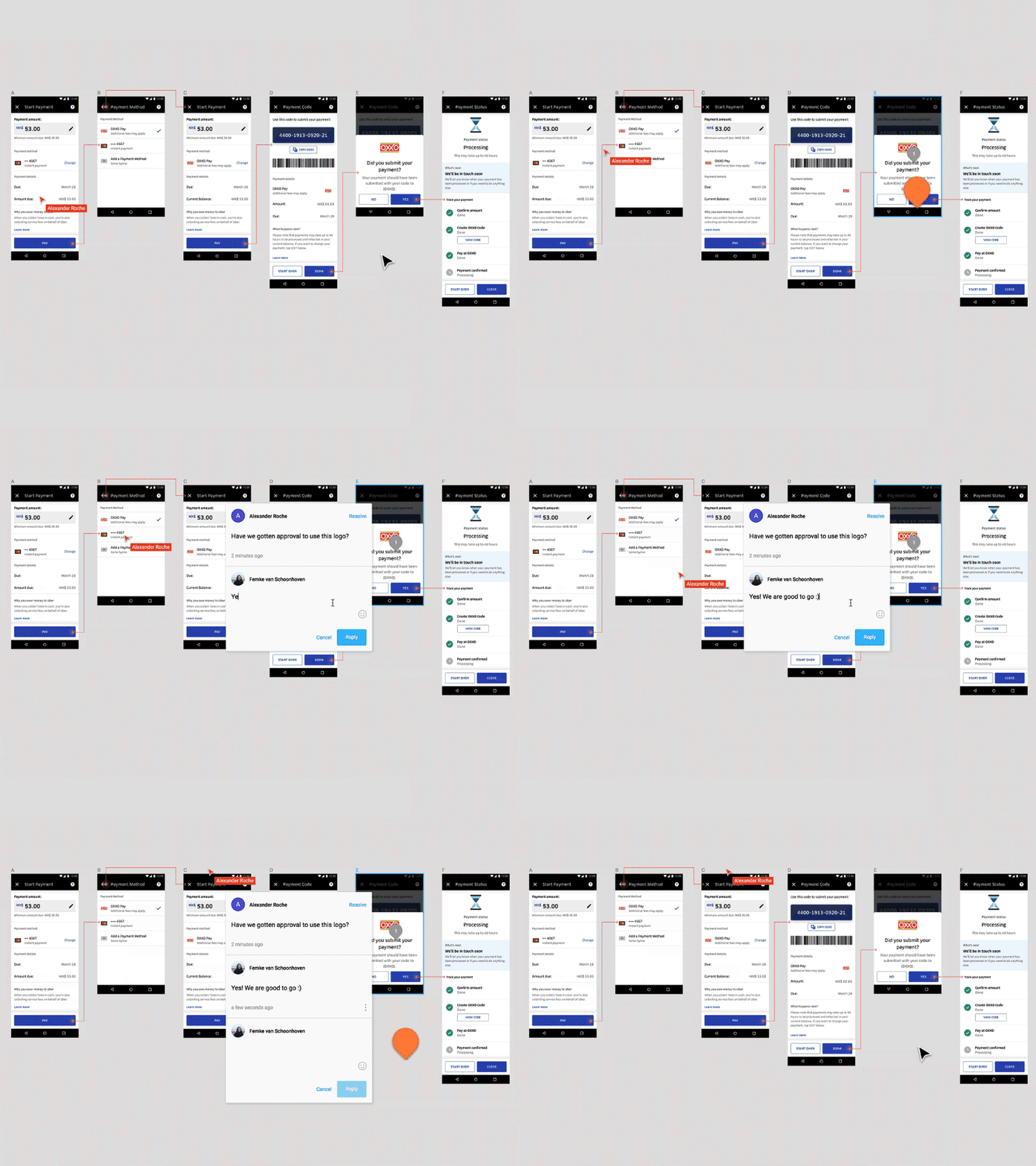
Figma, the design and prototyping tool that aims to offer a web-based alternative to similar tools from the likes of Adobe, is launching a few new features today that will make the service easier to use to collaborate across teams in large organizations. Figma Organization, as the company calls this new feature set, is the company’s first enterprise-grade service that features the kind of controls and security tools that large companies expect. To develop and test these tools, the company partnered with companies like Rakuten, Square, Volvo and Uber, and introduced features like unified billing and audit reports for the admins and shared fonts, browsable teams and organization-wide design systems for the designers.
For designers, one of the most important new features here is probably organization-wide design systems. Figma already had tools to create design systems, of course, but this enterprise version now makes it easier for teams to share libraries and fonts with each other to ensure that the same styles are applied to products and services across a company.
 Businesses can now also create as many teams as they would like and admins will get more controls over how files are shared and with whom they can be shared. That doesn’t seem like an especially interesting feature, but because many larger organizations work with customers outside of the company, it’s something that will make Figma more interesting to these large companies.
After working with Figma on these new tools, Uber, for example, moved all of its company over to the service and 90 percent of its product design work now happens on the platform. “We needed a way to get people in the right place at the right time — in the right team with the right assets,” said Jeff Jura, staff product designer who focuses on Uber’s design systems. “Figma does that.”
Other new enterprise features that matter in this context are single sign-on support, activity logs for tracking activities across users, teams, projects and files, and draft ownership to ensure that all the files that have been created in an organization can be recovered after an employee leaves the company.
Figma still offers free and professional tiers (at $12/editor/month). Unsurprisingly, the new Organization tier is a bit more expensive and will cost $45/editor/month.
Powered by WPeMatico
As traditional enterprise companies like IBM, Oracle and SAP try to transform into more modern cloud companies, they are finding that making that transition, while absolutely necessary, could require difficult adjustments along the way. Just this morning, SAP announced that it was restructuring in order to save between €750 million and €800 million (between approximately $856 million and $914 million).
While the company tried to put as positive a spin on the announcement as possible, it could involve up to 4,000 job cuts as SAP shifts into more modern technologies. “We are going to move our people and our focus to the areas where the new economy needs SAP the most: artificial intelligence, deep machine learning, IoT, blockchain and quantum computing,” CEO Bill McDermott told a post-earnings press conference.
If that sounds familiar, it should. It is precisely the areas on which IBM has been trying to concentrate its transformation over the last several years. IBM has struggled to make this change and has also framed workforce reduction as moving to modern skill sets. It’s worth pointing out that SAP’s financial picture has been more positive than IBM’s.
CFO Luka Mucic tried to stress this was not about cost-cutting, so much as ensuring the long-term health of the company, but did admit it did involve job cuts. These could include early retirement and other incentives to leave the company voluntarily. “We still expect that there will be a number probably slightly higher than what we saw in the 2015 program, where we had around 3,000 employees leave the company, where at the end of this process will leave SAP,” he said.
The company believes that in spite of these cuts, it will actually have more employees by this time next year than it has now, but they will be shifted to these new technology areas. “This is a growth company move, not a cost-cutting move; every dollar that we gain from a restructuring initiative will be invested back into headcount and more jobs,” McDermott said. SAP kept stressing that cloud revenue will reach $35 billion in revenue by 2023.
Holger Mueller, an analyst who watches enterprise companies like SAP for Constellation Research, says the company is doing what it has to do in terms of transformation. “SAP is in the midst of upgrading its product portfolio to the 21st century demands of its customer base,” Mueller told TechCrunch. He added that this is not easy to pull off, and it requires new skill sets to build, operate and sell the new technologies.
McDermott stressed that the company would be offering a generous severance package to any employee leaving the company as a result of today’s announcement.
Today’s announcement comes after the company made two multi-billion-dollar acquisitions to help in this transition in 2018, paying $8 billion for Qualtrics and $2.4 billion for CallidusCloud.
Powered by WPeMatico
It’s a big day for Timescale, makers of the open-source time-series database, TimescaleDB. The company announced a $15 million investment and a new enterprise version of the product.
The investment is technically an extension of the $12.4 million Series A it raised last January, which it’s referring to as A1. Today’s round is led by Icon Ventures, with existing investors Benchmark, NEA and Two Sigma Ventures also participating. With today’s funding, the startup has raised $31 million.
Timescale makes a time-series database. That means it can ingest large amounts of data and measure how it changes over time. This comes in handy for a variety of use cases, from financial services to smart homes to self-driving cars — or any data-intensive activity you want to measure over time.
While there are a number of time-scale database offerings on the market, Timescale co-founder and CEO Ajay Kulkarni says that what makes his company’s approach unique is that it uses SQL, one of the most popular languages in the world. Timescale wanted to take advantage of that penetration and build its product on top of Postgres, the popular open-source SQL database. This gave it an offering that is based on SQL and is highly scalable.
Timescale admittedly came late to the market in 2017, but by offering a unique approach and making it open source, it has been able to gain traction quickly. “Despite entering into what is a very crowded database market, we’ve seen quite a bit of community growth because of this message of SQL and scale for time series,” Kulkarni told TechCrunch.
In just over 22 months, the company has more than a million downloads and a range of users from older guard companies like Charter, Comcast and Hexagon Mining to more modern companies like Nutanix and and TransferWise.
With a strong base community in place, the company believes that it’s now time to commercialize its offering, and in addition to an open-source license, it’s introducing a commercial license. “Up until today, our main business model has been through support and deployment assistance. With this new release, we also will have enterprise features that are available with a commercial license,” Kulkarni explained.
The commercial version will offer a more sophisticated automation layer for larger companies with greater scale requirements. It will also provide better lifecycle management, so companies can get rid of older data or move it to cheaper long-term storage to reduce costs. It’s also offering the ability to reorder data in an automated fashion when that’s required, and, finally, it’s making it easier to turn the time series data into a series of data points for analytics purposes. The company also hinted that a managed cloud version is on the road map for later this year.
The new money should help Timescale continue fueling the growth and development of the product, especially as it builds out the commercial offering. Timescale, which was founded in 2015 in NYC, currently has 30 employees. With the new influx of cash, it expects to double that over the next year.
Powered by WPeMatico