Enterprise
Auto Added by WPeMatico
Auto Added by WPeMatico
Salesforce has been using the notion of trailblazers as a learning metaphor for several years, ever since it created Trailhead, a platform to teach customers Salesforce skills. Today, the company announced the availability of myTrailhead, a similar platform that enables a company to create branded, fully customizable training materials based on the Trailhead approach.
It’s worth noting that the company originally announced this idea at Dreamforce in November, 2017, and after testing it on 13 pilot customers (including itself) for the last year is making the product generally available today.
While Trailhead is all about teaching Salesforce skills, myTrailhead is about building on that approach to teach whatever other skills a company might find desirable with its own culture, style, branding and methodologies.
It builds on the whole Trailhead theme of blazing a learning trail, providing a gamified approach to self-paced training, where users are quizzed throughout to reinforce the lessons, awarded badges for successfully completing modules and given titles like Ranger for successfully completing a certain number of courses.
By gamifying the approach, Salesforce hopes people will have friendly competition within companies, but it also sees these skills as adding value to an employee’s resume. If a manager is looking for an in-house hire, they can search by skills in myTrailhead and find candidates who match their requirements. Additionally, employees who participate in training can potentially advance their careers with the their enhanced skill sets.

While you can continue to teach Salesforce skills in myTrailhead, it’s really focused on the customization and what companies can add on top of the Salesforce materials to make the platform their own. Salesforce envisions companies using the platform for new employee onboarding, sales enablement or customer service training, but if a company is ambitious, it could use this as a broader training tool.
There is an analytics component in myTrailhead, so management can track when employees complete required training modules, understand how well they are doing as they move through a learning track or recognize when employees have updated their skill sets.
The idea is to build on the Trailhead platform concept to provide companies with a methodology for creating a digital approach to learning, which Salesforce sees as an essential ingredient of becoming a modern company. The product is available immediately.
Powered by WPeMatico
Massive-scale predictive analytics is a relatively new phenomenon, one that challenges both decades of law as well as consumer thinking about privacy.
As a technology, it may well save thousands of lives in applications like predictive medicine, but if it isn’t used carefully, it may prevent thousands from getting loans, for instance, if an underwriting algorithm is biased against certain users.
I chatted with Dennis Hirsch a few weeks ago about the challenges posed by this new data economy. Hirsch is a professor of law at Ohio State and head of its Program on Data and Governance. He’s also affiliated with the university’s Risk Institute.
“Data ethics is the new form of risk mitigation for the algorithmic economy,” he said. In a post-Cambridge Analytica world, every company has to assess what data it has on its customers and mitigate the risk of harm. How to do that, though, is at the cutting edge of the new field of data governance, which investigates the processes and policies through which organizations manage their data.
You’re reading the Extra Crunch Daily. Like this newsletter? Subscribe for free to follow all of our discussions and debates.
“Traditional privacy regulation asks whether you gave someone notice and given them a choice,” he explains. That principle is the bedrock for Europe’s GDPR law, and for the patchwork of laws in the U.S. that protect privacy. It’s based around the simplistic idea that a datum — such as a customer’s address — shouldn’t be shared with, say, a marketer without that user’s knowledge. Privacy is about protecting the address book, so to speak.
The rise of “predictive analytics,” though, has completely demolished such privacy legislation. Predictive analytics is a fuzzy term, but essentially means interpreting raw data and drawing new conclusions through inference. This is the story of the famous Target data crisis, where the retailer recommended pregnancy-related goods to women who had certain patterns of purchases. As Charles Duhigg explained at the time:
Many shoppers purchase soap and cotton balls, but when someone suddenly starts buying lots of scent-free soap and extra-big bags of cotton balls, in addition to hand sanitizers and washcloths, it signals they could be getting close to their delivery date.
Predictive analytics is difficult to predict. Hirsch says “I don’t think any of us are going to be intelligent enough to understand predictive analytics.” Talking about customers, he said “They give up their surface items — like cotton balls and unscented body lotion — they know they are sharing that, but they don’t know they are giving up their pregnancy status. … People are not going to know how to protect themselves because they can’t know what can be inferred from their surface data.”
In other words, the scale of those predictions completely undermines notice and consent.
Even though the law hasn’t caught up to this exponentially more challenging problem, companies themselves seem to be responding in the wake of Target and Facebook’s very public scandals. “What we are hearing is that we don’t want to put our customers at risk,” Hirsch explained. “They understand that this predictive technology gives them really awesome power and they can do a lot of good with it, but they can also hurt people with it.” The key actors here are corporate chief privacy officers, a role that has cropped up in recent years to mitigate some of these challenges.
Hirsch is spending significant time trying to build new governance strategies to allow companies to use predictive analytics in an ethical way, so that “we can achieve and enjoy its benefits without having to bear these costs from it.” He’s focused on four areas: privacy, manipulation, bias and procedural unfairness. “We are going to set out principles on what is ethical and and what is not,” he said.
Much of that focus has been on how to help regulators build policies that can manage predictive analytics. Because people can’t understand the extent that inferences can be made with their data, “I think a much better regulatory approach is to have someone who does understand, ideally some sort of regulator, who can draw some lines.” Hirsch has been researching how the FTC’s Unfairness Authority may be a path forward for getting such policies into practice.
He analogized this to the Food and Drug Administration. “We have no ability to assess the risks of a given drug [so] we give it to an expert agency and allow them to assess it,” he said. “That’s the kind of regulation that we need.”
Hirsch overall has a balanced perspective on the risks and rewards here. He wants analytics to be “more socially acceptable,” but at the same time, sees the needs for careful scrutiny and oversight to ensure that consumers are protected. Ultimately, he sees that as incredibly beneficial to companies that can take the value out of this tech without risking provoking consumer ire.

Jaap Arriens/NurPhoto via Getty Images
Talking about data ethics, Europe is in the middle of a superpower pincer. China’s telecom giant Huawei has made expansion on the continent a major priority, while the United States has been sending delegation after delegation to convince its Western allies to reject Chinese equipment. The dilemma was quite visible last week at MWC Barcelona, where the two sides each tried to make their case.
It’s been years since the Snowden revelations showed that the United States was operating an enormous eavesdropping infrastructure targeting countries throughout the world, including across Europe. Huawei has reiterated its stance that it does not steal information from its equipment, and has repeated its demands that the Trump administration provide public proof of flaws in its security.
There is an abundance of moral relativism here, but I see this as increasingly a litmus test of the West on China. China has not hidden its ambitions to take a prime role in East Asia, nor has it hidden its intentions to build a massive surveillance network over its own people or to influence the media overseas.
Those tactics, though, are straight out of the American playbook, which lost its moral legitimacy over the past two decades from some combination of the Iraq War, Snowden, WikiLeaks and other public scandals that have undermined trust in the country overseas.
Security and privacy might have been a competitive advantage for American products over their Chinese counterparts, but that advantage has been weakened for many countries to near zero. We are increasingly going to see countries choose a mix of Chinese and American equipment in sensitive applications, if only to ensure that if one country is going to steal their data, it might as well be balanced.

To every member of Extra Crunch: thank you. You allow us to get off the ad-laden media churn conveyor belt and spend quality time on amazing ideas, people and companies. If I can ever be of assistance, hit reply, or send an email to danny@techcrunch.com.
This newsletter is written with the assistance of Arman Tabatabai from New York.
You’re reading the Extra Crunch Daily. Like this newsletter? Subscribe for free to follow all of our discussions and debates.
Powered by WPeMatico
Scytale, a startup that wants to bring identity and access management to application-to-application activities, announced a $5 million Series A round today.
The round was led by Bessemer Venture Partners, a return investor that led the company’s previous $3 million round in 2018. Bain Capital Ventures, TechOperators and Work-Bench are also participating in this round.
The company wants to bring to applications and services in a cloud native environment the same kind of authentication that individuals are used to having with a tool like Okta. “What we’re focusing on is trying to bring to market a capability for large enterprises going through this transition to cloud native computing to evolve the existing methods of application to application authentication, so that it’s much more flexible and scalable,” company CEO Sunil James told TechCrunch.
To help with this, the company has developed the open-source, cloud-native project, Spiffe, which is managed by the Cloud Native Computing Foundation (CNCF). The project is designed to provide identity and access management for application-to-application communication in an open-source framework.
The idea is that as companies transition to a containerized, cloud-native approach to application delivery, there needs to a smooth automated way for applications and services to very quickly prove they are legitimate, in much the same way individuals provide a username and password to access a website. This could be, for example, as applications pass through API gateways, or as automation drives the use of multiple applications in a workflow.
Webscale companies like Google and Netflix have developed mechanisms to make this work in-house, but it’s been out of reach of most large enterprise companies. Scytale wants to bring to any company this capability to authenticate services and applications.
In addition to the funding announcement, the company announced Scytale Enterprise, a tool that provides a commercial layer on top of the open-source tools the company has developed. The enterprise version helps companies that might not have the personnel to deal with the open-source version on their own by providing training, consulting and support services.
Bain Capital Venture’s Enrique Salem sees a startup solving a big problem for companies that are moving to cloud-native environments and need this kind of authentication. “In an increasingly complex and fragmented enterprise IT environment, Scytale has not only built Spiffe’s amazing open-source community but has also delivered a commercial offering to address hybrid cloud authentication challenges faced by Fortune 500 identity and access management engineering teams,” Salem said in a statement.
Based in the Bay Area, Scytale launched in 2017 and currently has 24 employees.
Powered by WPeMatico
Rackspace, the hosted private cloud vendor, let go around 200 workers or 3 percent of its worldwide workforce of 6,600 employees this week. The company says that it’s part of a recalibration where it is trying to find workers who are better suited to their current business approach.
A Rackspace spokesperson told TechCrunch that it is “a stable and profitable company.” In fact, it hired 1,500 employees in 2018 and currently has 200 job openings. “We continue to invest in our business based on market opportunity and our customers’ needs – we take actions on an ongoing basis in some areas where we are over-invested and hire in areas where we are under invested,” a company spokesperson explained.
The company, which went public in 2008 and private again for $4.3 billion in 2016, has struggled in a cloud market dominated by giants like Amazon, Microsoft and Google, but according to Synergy Research, a firm that keeps close watch on the cloud market, it is one of the top three companies in the Hosted Private Cloud category.
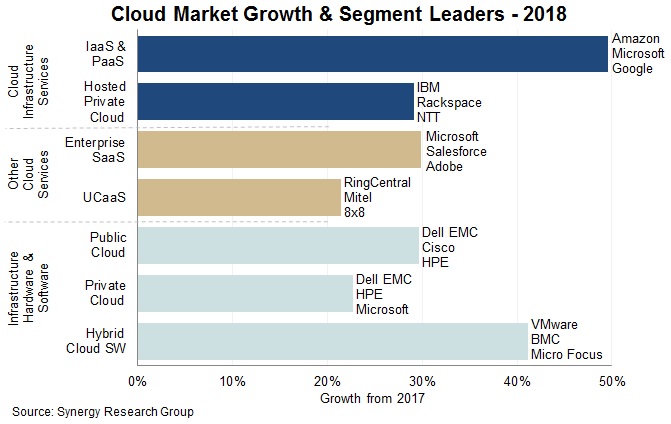
It’s worth noting that the top company in this category is IBM, and Rackspace could be a good target for Big Blue if it wanted to use its checkbook to get a boost in market share. IBM is in third or fourth place in the cloud infrastructure market, depending on whose numbers you look at, but it could move the needle a bit by buying a company like Rackspace. Neither company is suggesting this, however, and IBM bought Red Hat at the end of last year for $34 billion, making it less likely it will be in a spending mood this year.
For now the layoffs appear to be a company tweaking its workforce to meet current market conditions, but whatever the reason, it’s never a happy day when people lose their jobs.
Powered by WPeMatico
When you think of MWC Barcelona, chances are you’re thinking about the newest smartphones and other mobile gadgets, but that’s only half the story. Actually, it’s probably far less than half the story because the majority of the business that’s done at MWC is enterprise telco business. Not too long ago, that business was all about selling expensive proprietary hardware. Today, it’s about moving all of that into software — and a lot of that software is open source.
It’s maybe no surprise then that this year, the Linux Foundation (LF) has its own booth at MWC. It’s not massive, but it’s big enough to have its own meeting space. The booth is shared by the three LF projects: the Cloud Native Computing Foundation (CNCF), Hyperleger and Linux Foundation Networking, the home of many of the foundational projects like ONAP and the Open Platform for NFV (OPNFV) that power many a modern network. And with the advent of 5G, there’s a lot of new market share to grab here.
 To discuss the CNCF’s role at the event, I sat down with Dan Kohn, the executive director of the CNCF.
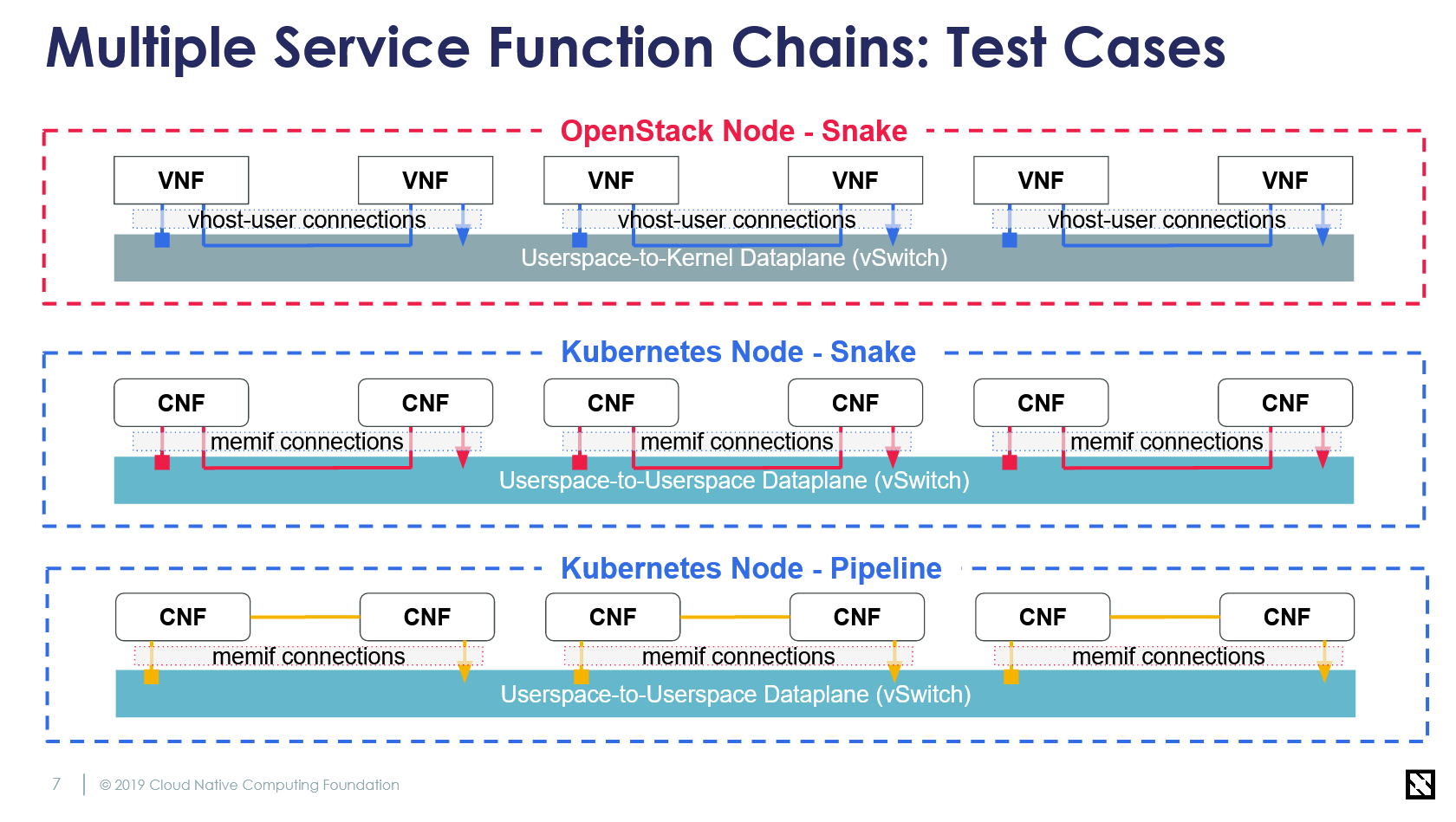
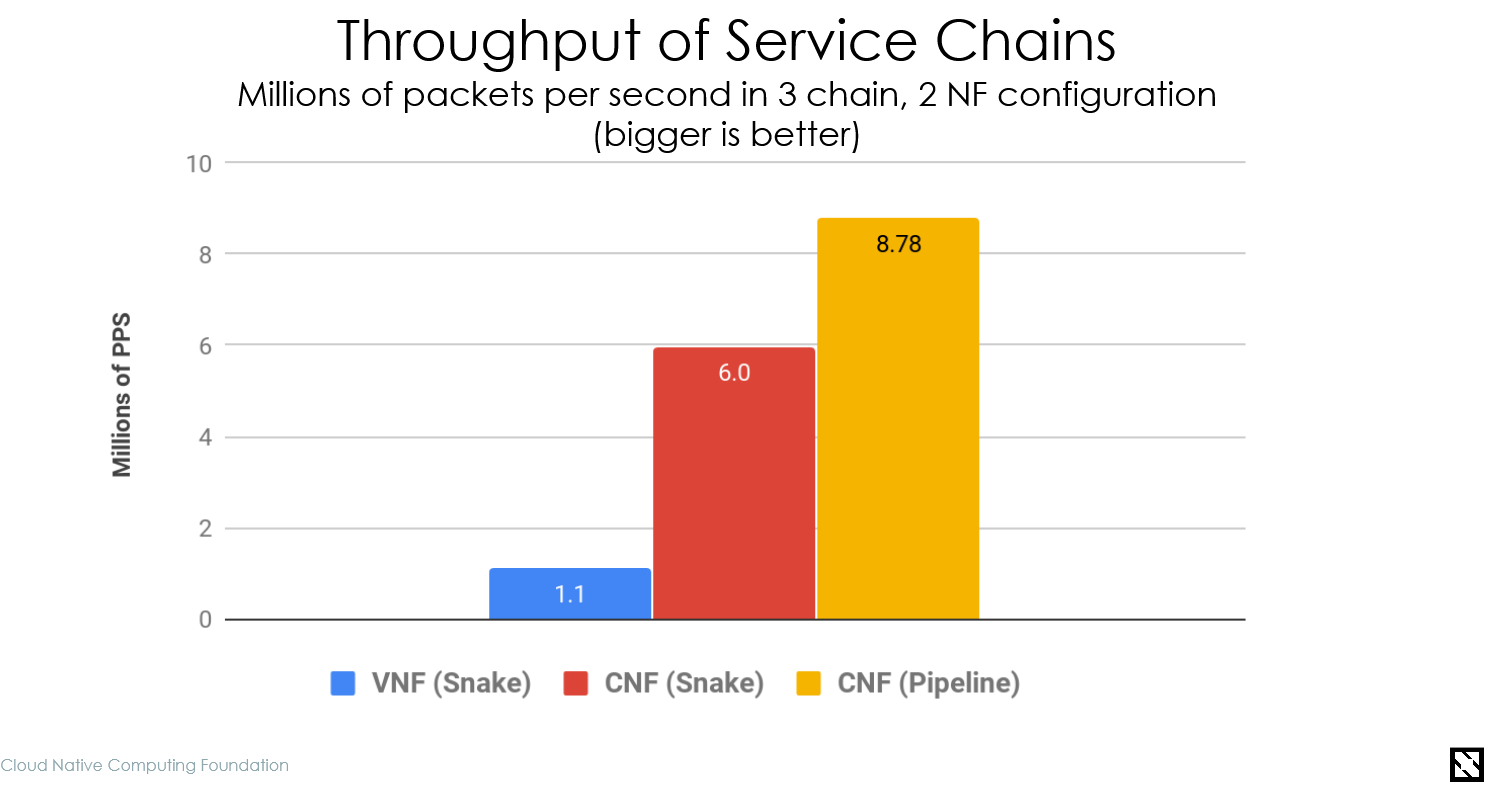
At MWC, the CNCF launched its testbed for comparing the performance of virtual network functions on OpenStack and what the CNCF calls cloud-native network functions, using Kubernetes (with the help of bare-metal host Packet). The project’s results — at least so far — show that the cloud-native container-based stack can handle far more network functions per second than the competing OpenStack code.
“The message that we are sending is that Kubernetes as a universal platform that runs on top of bare metal or any cloud, most of your virtual network functions can be ported over to cloud-native network functions,” Kohn said. “All of your operating support system, all of your business support system software can also run on Kubernetes on the same cluster.”
OpenStack, in case you are not familiar with it, is another massive open-source project that helps enterprises manage their own data center software infrastructure. One of OpenStack’s biggest markets has long been the telco industry. There has always been a bit of friction between the two foundations, especially now that the OpenStack Foundation has opened up its organizations to projects that aren’t directly related to the core OpenStack projects.
I asked Kohn if he is explicitly positioning the CNCF/Kubernetes stack as an OpenStack competitor. “Yes, our view is that people should be running Kubernetes on bare metal and that there’s no need for a middle layer,” he said — and that’s something the CNCF has never stated quite as explicitly before but that was always playing in the background. He also acknowledged that some of this friction stems from the fact that the CNCF and the OpenStack foundation now compete for projects.
OpenStack Foundation, unsurprisingly, doesn’t agree. “Pitting Kubernetes against OpenStack is extremely counterproductive and ignores the fact that OpenStack is already powering 5G networks, in many cases in combination with Kubernetes,” OpenStack COO Mark Collier told me. “It also reflects a lack of understanding about what OpenStack actually does, by suggesting that it’s simply a virtual machine orchestrator. That description is several years out of date. Moving away from VMs, which makes sense for many workloads, does not mean moving away from OpenStack, which manages bare metal, networking and authentication in these environments through the Ironic, Neutron and Keystone services.”
Similarly, ex-OpenStack Foundation board member (and Mirantis co-founder) Boris Renski told me that “just because containers can replace VMs, this doesn’t mean that Kubernetes replaces OpenStack. Kubernetes’ fundamental design assumes that something else is there that abstracts away low-level infrastructure, and is meant to be an application-aware container scheduler. OpenStack, on the other hand, is specifically designed to abstract away low-level infrastructure constructs like bare metal, storage, etc.”
This overall theme continued with Kohn and the CNCF taking a swipe at Kata Containers, the first project the OpenStack Foundation took on after it opened itself up to other projects. Kata Containers promises to offer a combination of the flexibility of containers with the additional security of traditional virtual machines.
“We’ve got this FUD out there around Kata and saying: telco’s will need to use Kata, a) because of the noisy neighbor problem and b) because of the security,” said Kohn. “First of all, that’s FUD and second, micro-VMs are a really interesting space.”
He believes it’s an interesting space for situations where you are running third-party code (think AWS Lambda running Firecracker) — but telcos don’t typically run that kind of code. He also argues that Kubernetes handles noisy neighbors just fine because you can constrain how many resources each container gets.
It seems both organizations have a fair argument here. On the one hand, Kubernetes may be able to handle some use cases better and provide higher throughput than OpenStack. On the other hand, OpenStack handles plenty of other use cases, too, and this is a very specific use case. What’s clear, though, is that there’s quite a bit of friction here, which is a shame.

Powered by WPeMatico
By most common sense measurements, Box had a pretty good earnings report today, reporting revenue up 20 percent year over year to $163.7 million. That doesn’t sound bad, yet Wall Street was not happy with the stock getting whacked, down more than 22 percent after hours as we went to press. It appears investors were unhappy with the company’s guidance.
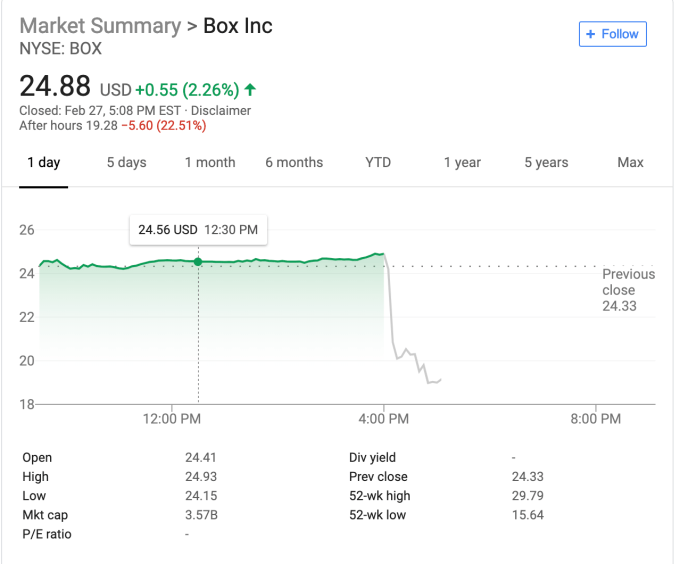
Part of the problem, says Alan Pelz-Sharpe, principal analyst at Deep Analysis, a firm that watches the content management space, is that the company failed to hit its projections, combined with weaker guidance; a tough combination, but he points out the future does look bright for the company.
“Box did miss its estimates and got dinged pretty hard today; however, the bigger picture is still of solid growth. As Box moves more and more into the enterprise space, the deal cycle takes longer to close and I think that has played a large part in this shift. The onus is on Box to close those bigger deals over the next couple of quarters, but if it does, then that will be a real warning shot to the legacy enterprise vendors as Box starts taking a chunk out of their addressable market,” Pelz-Sharpe told TechCrunch.
This fits with what company CEO Aaron Levie was saying. “Wall Street did have higher expectations with our revenue guidance for next year, and I think that’s totally fair, but we’re very focused as a company right now on driving reacceleration in our growth rate and the way that we’re going to do that is by really bringing the full suite of Box’s capabilities to more of our customers,” Levie told TechCrunch.
Holger Mueller, an analyst with Constellation Research says failing to hit guidance is always going to hurt a company with Wall Street. “It’s all about hitting the guidance, and Box struggled with this. At the end of the day, investors don’t care for the reasons, but making the number is what matters. But a booming economy and the push to AI will help Box as enterprises need document automation solutions,” Mueller said.
On the positive side, Levie pointed out that the company achieved positive non-GAAP growth rate for the first time in its 14-year history, with projections for the first full year of non-GAAP profitability for FY20 that it just kicked off.
The company was showing losses on a cost per share of 14 cents a share for the most recent quarter, but even that was a smaller loss than the 24 cents a share from the previous fiscal year. It would seem that the revenue is heading generally in the correct direction, but Wall Street did not see it that way, flogging the cloud content management company.
Chart: Box
Wall Street tends to try to project future performance. What a company has done this quarter is not as important to investors, who are apparently not happy with the projections, but Levie pointed out the opportunity here is huge. “We’re going after 40 plus billion dollar market, so if you think about the entirety of spend on content management, collaboration, storage infrastructure — as all of that moves to the cloud, we see that as the full market opportunity that we’re going out and serving,” Levie explained.
Pelz-Sharpe also thinks Wall Street could be missing the longer-range picture here. “The move to true enterprise started a couple of years back at Box, but it has taken time to bring on the right partners and infrastructure to deal with these bigger and more complex migrations and implementations,” Pelz-Sharpe explained. Should that happen, Box could begin capturing much larger chunks of that $40 billion addressable cloud content management market, and the numbers could ultimately be much more to investor’s liking. For now though, they are clearly not happy with what they are seeing.
Powered by WPeMatico
Compass, the real estate tech platform that is now worth $4.4 billion, has made an acquisition to give its agents a boost when it comes to looking for good leads on properties to sell. It is acquiring Contactually, an AI-based CRM platform designed specifically for the industry, which includes features like linking up a list of homes sold by a brokerage with records of sales in the area and other property indexes to determine which properties might be good targets to tap for future listings.
Contactually had already been powering Compass’s own CRM service that it launched last year, so there is already a degree of integration between the two.
Terms of the deal are not being disclosed. Crunchbase notes that Contactually had raised around $18 million from VCs that included Rally Ventures, Grotech and Point Nine Capital, and it was last valued at around $30 million in 2016, according to PitchBook. From what I understand, the startup had strong penetration in the market, so it’s likely that the price was a bit higher than this previous valuation.
The plan is to bring over all of Contactually’s team of 32 employees, led by Zvi Band, the co-founder and CEO, to integrate the company’s product into Compass’s platform completely. They will report to CTO Joseph Sirosh and head of product Eytan Seidman. It will also mean a bigger operation for Compass in Washington, DC, which is where Contactually had been based.
“The Contactually team has worked for the past 8 years to build a best-in-class CRM that aggregates relationships and automatically documents every touchpoint,” said Band in a statement “We are proud that our investment into machine learning has resulted in new features like Best Time to Email and other data-driven, follow-up recommendations which help agents be more effective in their day-to-day. After working extensively with the Compass team, it was apparent that joining forces would accelerate our missions of building the future of the industry.”
For the time being, customers who are already using the product — and a large number of real estate brokers and agents in the U.S. already were, at prices that ranged from $59/month to $399/month depending on the level of service — will continue their contracts as before.
I suspect that the longer-term plan, however, will be a little different: You have to wonder if agents who compete against Compass would be happy to use a service where their data is being processed by it, and for Compass itself. I would suspect that having this tech for itself would give it an edge over the others.
Compass, I understand from sources, is on track to make $2 billion in revenues in 2019 (its 2018 targets were $1 billion on $34 billion in property sales, and it had previously said it would be doubling that this year). Now in 100 cities, it’s come a long way from its founding in 2012 by Ori Allon and Robert Reffkin.
The bigger picture beyond real estate is that, as with many other analog industries, those who are tackling them with tech-first approaches are sweeping up not only existing business, but in many cases helping the whole market to expand. Contactually, as a tool that can help source potential properties for sale that owners hadn’t previously considered putting on the market, could end up serving that very end for Compass.
The focus on using tech to storm into a legacy industry is also coming at an interesting time. As we’ve pointed out before, the housing market is predicted to cool this year, and that will put the squeeze on agents who do not have strong networks of clients and the tools to maximise whatever opportunities there are out there to list and sell properties.
The likes of Opendoor — which appears to be raising money and inching closer to Compass in terms of valuation — is also trying out a different model, which essentially involves becoming a middle part in the chain, buying properties from sellers and selling them on to buyers, to speed up the process and cut out some of the expenses for the end users. That approach underscores the fact that, while the infusion of technology is an inevitable trend, there will be multiple ways of applying that.
This appears to be Compass’s first full acquisition of a tech startup, although it has made partial acqui-hires in the past.
Powered by WPeMatico
The rapid rise of Slack has ushered in a new wave of apps, all aiming to solve one challenge: creating a user-friendly platform where coworkers can have productive conversations. Many of these are based around real-time notifications and “instant” messaging, but today a new startup called Threads coming out of stealth to address the other side of the coin: a platform for asynchronous communication that is less time-sensitive, and creating coherent narratives out of those conversations.
Armed with $10.5 million in funding led by Sequoia, the company is launching a beta of its service today.
Rousseau Kazi, the startup’s CEO who co-founded threads with Jon McCord, Mark Rich and Suman Venkataswamy, cut his social teeth working for six years at Facebook (with a resulting number of patents to his name around the mechanics of social networking), says that the mission of Threads is to become more inclusive when it comes to online conversations.
“After a certain number of people get involved in an online discussion, conversations just break and messaging becomes chaotic,” he said. (McCord and Rich are also Facebook engineering alums, while Venkataswamy is a Bright Roll alum.)
And if you have ever used Twitter, or even been in a popular channel in Slack, you will understand what he is talking about. When too many people begin to talk, the conversation gets very noisy and it can mean losing the “thread” of what is being discussed, and seeing conversation lurch from one topic to another, often losing track of important information in the process.
There is an argument to be made for whether a platform that was built for real-time information is capable of handling a difference kind of cadence. Twitter, as it happens, is trying to figure that out right now. Slack, meanwhile, has itself introduced threaded comments to try to address this too — although the practical application of its own threading feature is not actually very user friendly.
Threads’ answer is to view its purpose as addressing the benefit of “asynchronous” conversation.
To start, those who want to start threads first register as organizations on the platform. Then, those who are working on a project or in a specific team creates a “space” for themselves within that org. You can then start threads within those spaces. And when a problem has been solved or the conversation has come to a conclusion, the last comment gets marked as the conclusion.
The idea is that topics and conversations that can stretch out over hours, days or even longer, around specific topics. Threads doeesn’t want to be the place you go for red alerts or urgent requests, but where you go when you have thoughts about a work-related subject and how to tackle it.
These resulting threads, when completed or when in progress, can in turn be looked at as straight conversations, or as annotated narratives.
For now, it’s up to users themselves to annotate what might be important to highlight for readers, although when I asked him, Kazi told me he would like to incorporate over time more features that might use natural language processing to summarize and pull out what might be worth following up or looking at if you only want to skim read a longer conversation. Ditto the ability to search threads. Right now it’s all based around keywords but you can imagine a time when more sophisticated and nuanced searches to surface conversations relevant to what you might be looking for.
Indeed, in this initial launch, the focus is all about what you want to say on Threads itself — not lots of bells and whistles, and not trying to compete against the likes of Slack, or Workplace (Facebook’s effort in this space), or Yammer or Teams from Microsoft, or any of the others in the messaging mix.
There are no integrations of other programs to bring data into Threads from other places, but there is a Slack integration in the other direction: you can create an alert there so that you know when someone has updated a Thread.
“We don’t view ourselves as a competitor to Slack,” Kazi said. “Slack is great for transactional conversation but for asynchronous chats, we thought there was a need for this in the market. We wanted something to address that.”
It may not be a stated competitor, but Threads actually has something in common with Slack: the latter launched with the purpose of enabling a certain kind of conversation between co-workers in a way that was easier to consume and engage with than email.
You could argue that Threads has the same intention: email chains, especially those with multiple parties, can also be hard to follow and are in any case often very messy to look at: something that the conversations in Threads also attempt to clear up.
But email is not the only kind of conversation medium that Threads thinks it can replace.
“With in-person meetings there is a constant tension between keeping the room small for efficiency and including more people for transparency,” said Sequoia partner Mike Vernal in a statement. “When we first started chatting with the team about what is now Threads, we saw an opportunity to get rid of this false dichotomy by making decision-making both more efficient and more inclusive. We’re thrilled to be partnering with Threads to make work more inclusive.” Others in the round include Eventbrite CEO Julia Hartz, GV’s Jessica Verrilli, Minted CEO Mariam Naficy, and TaskRabbit CEO Stacy Brown-Philpot.
The startup was actually formed in 2017, and for months now it has been running a closed, private version of the service to test it out with a small amount of users. So far, the company sizes have ranged between 5 and 60 employees, Kazi tells me.
“By using Threads as our primary communications platform, we’ve seen incredible progress streamlining our operations,” said one of the testers, Perfect Keto & Equip Foods Founder and CEO, Anthony Gustin. “Internal meetings have reduced by at least 80 percent, we’ve seen an increase in participation in discussion and speed of decision making, and noticed an adherence and reinforcement of company culture that we thought was impossible before. Our employees are feeling more ownership and autonomy, with less work and time that needs to be spent — something we didn’t even know was possible before Threads.”
Kazi said that the intention is ultimately to target companies of any size, although it will be worth watching what features it will have to introduce to help handle the noise, and continue to provide coherent discussions, when and if they do start to tackle that end of the market.
Powered by WPeMatico
VMware announced a new Kubernetes product today called VMware Essential PKS, which has been created from its acquisition of Heptio for $550 million at the end of last year.
VMware already had two flavors of Kubernetes, a fully managed cloud product and an enterprise version with all of the components, such as registry and network, pre-selected by VMware. What this new version does is provide a completely open version of Kubernetes where the customer can choose all the components, giving a flexible option for those who want it, according to Scott Buchanan, senior director of product marketing for cloud-native apps at VMware.
Buchanan said the new product comes directly from the approach that Heptio had taken to selling Kubernetes prior to the acquisition. “We’re introducing a new offering called VMware Essential PKS, and that offering is a packaging of the approach that Heptio took to market and that gained a lot of traction, and that approach is a natural complement to the other Kubernetes products in the VMware portfolio,” he explained.
Buchanan acknowledged that a large part of the market is going to go for the fully managed or fully configured approaches, but there is a subset of buyers that will want more choice in their Kubernetes implementation.
“Larger enterprises with more complex infrastructure want to have a very customized approach to how they build out their architecture. They don’t want to be integrated. They just want a foundation on which to build because the organizations are larger and more complex and they’re also more likely to have an internal DevOps or SREOps team to operate the platform on a day-to-day basis,” he explained.
While these organizations want flexibility, they also require more of a consultative approach to the sale. Heptio had a 40-person field service engineering team that came over in the acquisition, and VMware is in the process of scaling that team. These folks consult with the customer and help them select the different components that make up a Kubernetes installation to fit the needs of each organization.
Buchanan, who also came over in the acquisition, says that being part of VMware (which is part of the Dell family of companies) means they have several layers of sales with VMware, Pivotal and Dell all selling the product.
Heptio is the Kubernetes startup founded by Craig McLuckie and Joe Beda, the two men who helped develop the technology while they were at Google. Heptio was founded in 2016 and raised $33.5 million prior to the acquisition, according to Crunchbase data.
Powered by WPeMatico
Today’s Mobile World Congress kickoff event was all about the next Hololens, but Microsoft still had some surprises up its sleeve. One of the more interesting additions is the Azure Kinect, a new enterprise camera system that leverages the company’s perennially 3D imaging technology to create a 3D camera for enterprises.
The device is actually a kind of companion hardware piece for Hololens in the enterprise, giving business a way to capture depth sensing and leverage its Azure solutions to collect that data.

“Azure Kinect is an intelligent edge device that doesn’t just see and hear but understands the people, the environment, the objects and their actions,” Azure VP Julia White said at the kick off of today’s event. “The level of accuracy you can achieve is unprecedented.”
What started as a gesture-based gaming peripheral for the Xbox 360 has since grown to be an incredibly useful tool across a variety of different fields, so it tracks that the company would seek to develop a product for business. And unlike some of the more far off Hololens applications, the Azure Kinect is the sort of product that could be instantly useful, right off the the shelf.
A number of enterprise partners have already begun testing the technology, including Datamesh, Ocuvera and Ava, representing an interesting cross-section of companies. The system goes up for pre-order today, priced at $399.
Powered by WPeMatico