Enterprise
Auto Added by WPeMatico
Auto Added by WPeMatico
As the biggest sales and marketing technology firms mature, they are all turning to AI and machine learning to advance the field. This morning it was Oracle’s turn, announcing several AI-fueled features for its suite of sales tools.
Rob Tarkoff, who had previous stints at EMC, Adobe and Lithium, and is now EVP of Oracle CX Cloud says that the company has found ways to increase efficiency in the sales and marketing process by using artificial intelligence to speed up previously manual workflows, while taking advantage of all the data that is part of modern sales and marketing.
For starters, the company wants to help managers and salespeople understand the market better to identify the best prospects in the pipeline. To that end, Oracle is announcing integration with DataFox, the company it purchased last fall. The acquisition gave Oracle the ability to integrate highly detailed company profiles into their Customer Experience Cloud, including information such as SEC filings, job postings, news stories and other data about the company.
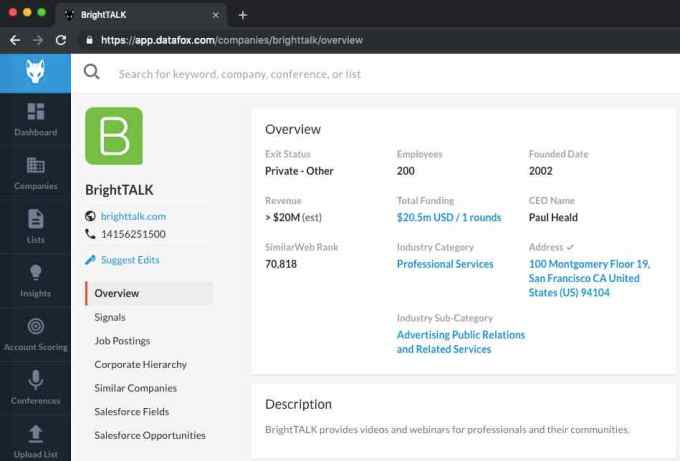
DataFox company profile. Screenshot: Oracle
“One of the things that DataFox helps you you do better is machine learning-driven sales planning, so you can take sales and account data and optimize territory assignments,” he explained.
The company also announced an AI sales planning tool. Tarkoff says that Oracle created this tool in conjunction with its ERP team. The goal is to use machine learning to help finance make more accurate performance predictions based on internal data.
“It’s really a competitor to companies like Anaplan, where we are now in the business of helping sales leaders optimize planning and forecasting, using predictive models to identify better future trends,” Tarkoff said.

Sales forecasting tool. Screenshot: Oracle
The final tool is really about increasing sales productivity by giving salespeople a virtual assistant. In this case, it’s a chatbot that can help handle tasks like scheduling meetings and offering task reminders to busy sales people, while allowing them to use their voices to enter information about calls and tasks. “We’ve invested a lot in chatbot technology, and a lot in algorithms to help our bots with specific dialogues that have sales- and marketing-industry specific schema and a lot of things that help optimize the automation in a rep’s experience working with sales planning tools,” Tarkoff said.
Brent Leary, principal at CRM Essentials, says that this kind of voice-driven assistant could make it easier to use CRM tools. “The Smarter Sales Assistant has the potential to not only improve the usability of the application, but by letting users interact with the system with their voice it should increase system usage,” he said.
All of these enhancements are designed to increase the level of automation and help sales teams run more efficiently with the ultimate goal of using data to more sales and making better use of sales personnel. They are hardly alone in this goal as competitors like Salesforce, Adobe and Microsoft are bringing a similar level of automation to their sales and marketing tools
The sales forecasting tool and the sales assistant are generally available starting today. The DataFox integration will GA in June.
Powered by WPeMatico

Atlassian today announced that it has acquired AgileCraft, a service that aims to help enterprises plan their strategic projects and workstreams. The service provides business leaders with additional insights into the current status of technical projects and gives them insights into the bottlenecks, risks and dependencies of these projects. Indeed, the focus of AgileCraft is less on technical teams than on the business teams that support them and help them manage the digital transformation of their businesses.
The price total of the acquisition is about $166 million, with $154 million in cash and the remainder in restricted shares.
“Many leaders are still making mission-critical decisions using their instincts and best guesses instead of data,” said Scott Farquhar, Atlassian’s co-founder and co-CEO, in today’s announcement. “As Atlassian tools spread through organizations, technology leaders need better visibility into work performed by their teams. With AgileCraft joining Atlassian, we believe we’re the best company to help executives align the work across their organization – providing an all-encompassing view that connects strategy, work, and outcomes.”

As the name implies, AgileCraft focuses on the Agile methodology, though it also offers a bit of flexibility there with support for frameworks like SAFe, LeSS and Spotify. It supports pulling in data from tools like Atlassian’s Jira, but also Microsoft’s Team Foundation Server, IBM’s RTC and other services.
Atlassian will continue to operate AgileCraft, which had raised about $10.1 million before the acquisition as a standalone service. “We will continue to focus relentlessly on our customers’ success,” writes AgileCraft’s founder and CEO Steve Elliott. “We remain dedicated to pioneering enterprise agility and are thrilled to team up with the outstanding people at Atlassian to help our customers thrive.”
Over the years, Atlassian started embracing users and use cases for its tools that go beyond its core tools for developers. Jira and Confluence are the prime examples for this. Today’s acquisition continues this trend in that AgileCraft aims to bring to the rest of the company many of the methodologies that tech teams use.
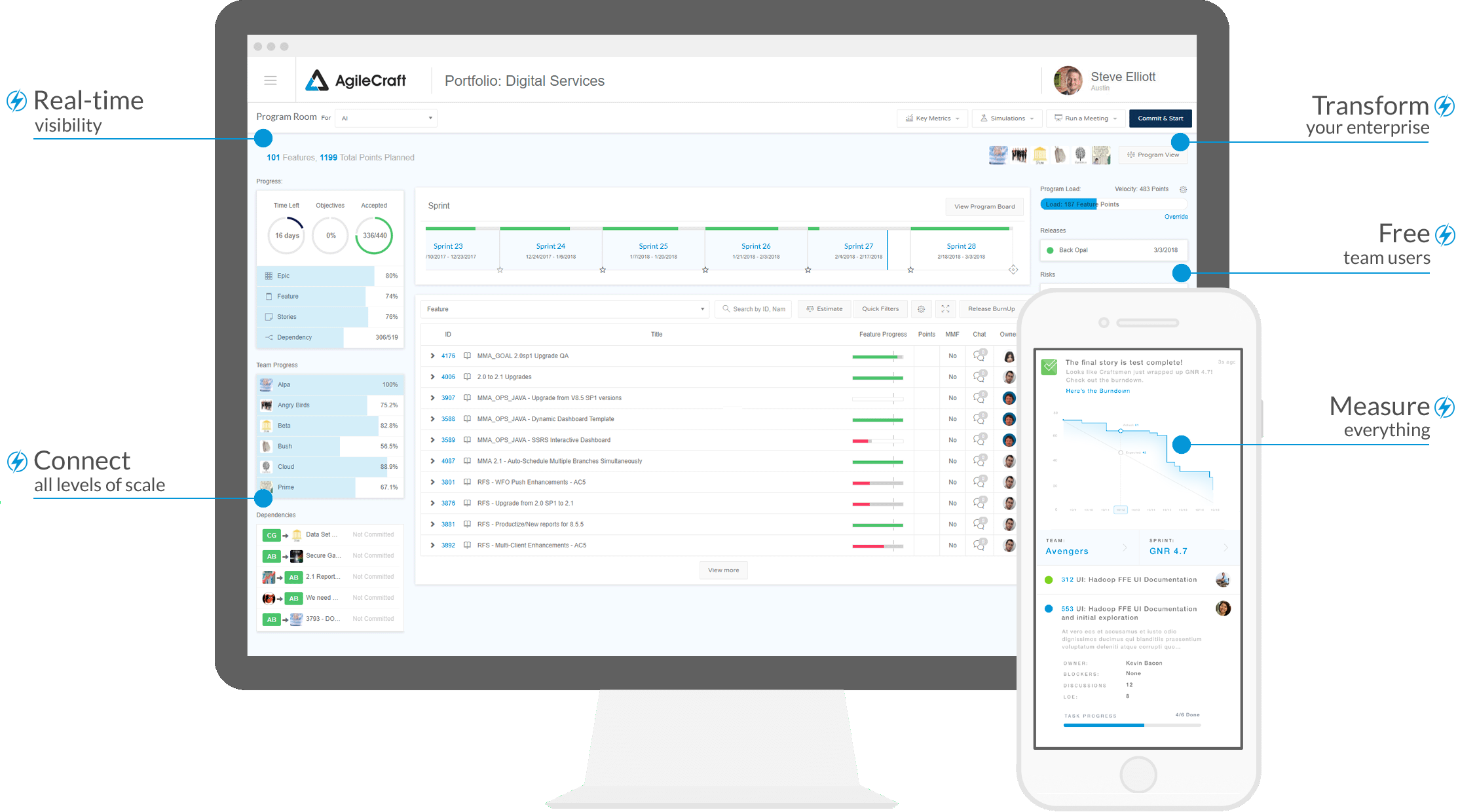
“One of the critical roles we play for lots of organizations is in helping drive this kind of digital transformation where we’re really empowering the teams that are building and developing the kind of technology that moves our customers forward,” Atlassian president Jay Simons told me. “AgileCraft basically complements all of that by extending visibility into what teams are using Atlassian products to do up into key stakeholders and leaders in the business that are trying to manage better visibility at a portfolio or program level.”
Simons also stressed that AgileCraft already has very strong integrations into the existing Atlassian tools — and indeed, that was one of the main drivers of the acquisition. He noted that the company plans to improve those and think about additional patterns. “We’ll continue doing what we’re doing,” he said.
Simons also noted that he expects that a lot of Jira customers will now look at AgileCraft as an additional tool in helping the businesses manage their business’s digital transformation.
Atlassian doesn’t typically make a lot of acquisitions. Its pace is close to about one major buy per year. Last year, the company picked up OpsGenie for $295 million. In 2017, it acquired Trello for $425 million, the company’s biggest acquisition to date. Other major products the company has acquired include StatusPage, BlueJimp, HipChat and Bitbucket (all the way back in 2010).
Powered by WPeMatico

To accurately forecast the weather, you first need lots of data — not just to train your forecasting models but also to generate more precise and granular forecasts. Typically, this has been the domain of government agencies, thanks to their access to this data and the compute power to run the extremely complex models. Anybody can now buy compute power in the cloud, though, and as the Boston and Tel Aviv-based startup ClimaCell is setting out to prove, there are now also plenty of other ways to get climate data thanks to a variety of relatively non-traditional sensors that can help generate more precise local weather predictions.
Now you may say that others, like Dark Sky, for example, are already doing that with their hyperlocal forecasts. But ClimaCell’s approach is very different, and with that has attracted as clients airlines like Delta, JetBlue and United, sports teams like the New England Patriots and agtech companies like Netafim.
“The biggest problem is that to predict the weather, you need to have observations and you need to have models,” ClimaCell CEO Shimon Elkabetz told me. “The entire industry is basically repackaging the data and models of the government [agencies]. And the governments don’t create the relevant infrastructure everywhere in the world. Even in the U.S., there’s room for improvement.”

And that’s where ClimaCell’s main innovation comes in. Instead of relying on government sensors, it’s using the Internet of Things to gather more weather data from far more places than would otherwise be possible. This kind of sensing technology could turn millions of existing connected devices — like cell phones, connected vehicles, street cameras, airplanes and drones — into virtual weather stations. It’s easy enough to see how this would work. If a driver turns on a windshield wiper or fog lights, you know it’s probably raining or foggy. Often, these cars also relay temperature data. If a street camera sees rain, it’s raining.
What’s more complex is that ClimaCell has also developed the technology to gather data from how atmospheric conditions impact the signal propagation between cell phones and their base stations. And to take this one step further — and beyond the ground level — it has also figured out how to gather similar data from satellite-to-ground microwave signals.
“The idea is that everything is sensitive to weather and we can turn everything into a weather sensor,” said Elkabetz. “That’s why we call it the weather of things. It enables us to put in place virtual sensors everywhere.”
Using all this data, ClimaCell is providing its customers, like airlines, ridesharing companies and energy companies, with real-time weather data and forecasts.
Using all of this data the company also recently launched flood alerts for about 500 cities that can provide 24 to 48-hour warnings ahead of major flood events. To do this, the company combined its weather data with its own hydrological model.
For now, most of ClimaCell’s business model focuses on selling its data and predictions to other businesses. The company plans to launch a consumer app in May, though. I got a sneak peek of the app; while I can’t vouch for the forecasts, it’s a very well-designed application that you’ll probably want to look at, no matter whether you’re a weather geek or just want to see if you can get a quick bike ride in before the rain starts.
Why a consumer app? “We want to become the biggest weather technology company in the world,” Elkabetz said. To get to this point, the company has raised a total of $68 million to date from investors that include Clearvision Ventures, JetBlue Technology Ventures, Ford Smart Mobility, Envision Ventures, Canaan Partners, Fontinalis Partners and Square Peg Capital.
Powered by WPeMatico
Factory software tools are often out of reach of small manufacturers, forcing them to operate with inefficient manual systems. WorkClout, a member of the Y Combinator Winter 2019 class, wants to change that by offering a more affordable SaaS alternative to traditional manufacturing software solutions.
Company co-founder and CEO Arjun Patel grew up helping out in his Dad’s factory and saw first-hand how difficult it is for small factory owners to automate. He says that traditional floor-management tools are expensive and challenging to implement.
“What motivated me is when my dad was trying to implement a similar system,” Patel said, noting that his father’s system had cost more than $240,000, took over a year to get going and wasn’t really doing what he wanted it to do. That’s when he decided to help.
He teamed up with Bryan Trang, who became the CPO, and Richard Girges, who became the CTO, to build the system that his dad (and others in a similar situation) needed. Specifically, the company developed a cloud software solution that helps manufacturers increase their operational efficiency. “Two things that we do really well is track every action on the factory floor and use that data to make suggestions on how to increase efficiency. We also determine how much work can be done in a given time period, taking finite resources into consideration,” Patel explained.
He said that one of the main problems that small-to-medium sized manufacturers face is a lack of visibility into their businesses. WorkClout looks at orders, activities, labor and resources to determine the best course of action to complete an order in the most cost-effective way.
“WorkClout gives our customers a better way to allocate resources and greater visibility of what’s actually happening on the factory floor. The more data that they have, the more accurate picture they have of what’s going on,” Patel said.
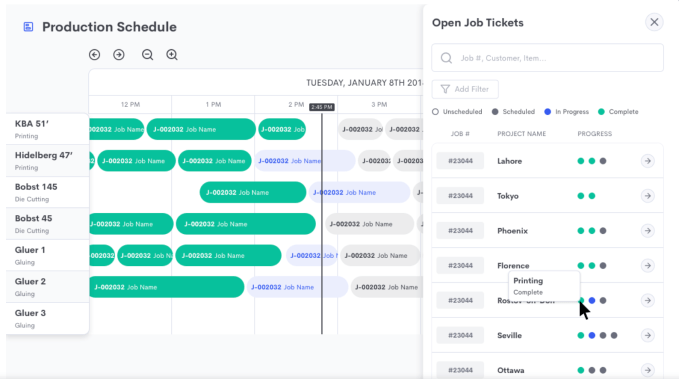
Production Schedule view. Screenshot: WorkClout
The company is still working on the pricing model, but today it charges administrative users like plant management, accounting and sales. Machine operators get access to the data for free. The current rate for paid users starts at $99 per user per month. There is an additional one-time charge for implementation and training.
As for the Y Combinator experience, Patel says that it has helped him focus on what’s important. “It really makes you hone in on building the product and getting customers, then making sure those two things are leading to customer happiness,” he said.
While the company does have to help customers get going today, the goal is to make the product more self-serve over time as they begin to understand the different verticals for which they are developing solutions. The startup launched in December and already has 13 customers, generating $100,000 in annual recurring revenue (ARR), according to Patel.
Powered by WPeMatico
Slack announced today that it is launching Enterprise Key Management (EKM) for Slack, a new tool that enables customers to control their encryption keys in the enterprise version of the communications app. The keys are managed in the AWS KMS key management tool.
Geoff Belknap, chief security officer (CSO) at Slack, says the new tool should appeal to customers in regulated industries who might need tighter control over security. “Markets like financial services, healthcare and government are typically underserved in terms of which collaboration tools they can use, so we wanted to design an experience that catered to their particular security needs,” Belknap told TechCrunch.
Slack currently encrypts data in transit and at rest, but the new tool augments this by giving customers greater control over the encryption keys that Slack uses to encrypt messages and files being shared inside the app.
He said that regulated industries in particular have been requesting the ability to control their own encryption keys, including the ability to revoke them if it was required for security reasons. “EKM is a key requirement for growing enterprise companies of all sizes, and was a requested feature from many of our Enterprise Grid customers. We wanted to give these customers full control over their encryption keys, and when or if they want to revoke them,” he said.
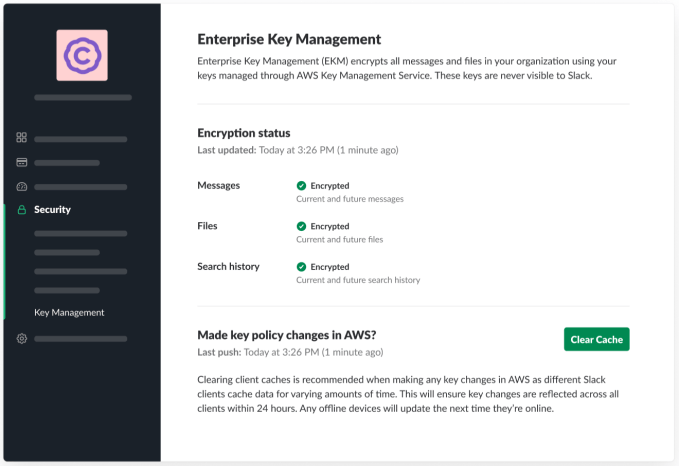
Screenshot: Slack
Belknap says this is especially important when customers involve people outside the organization, such as contractors, partners or vendors in Slack communications. “A big benefit of EKM is that in the event of a security threat or if you ever experience suspicious activity, your security team can cut off access to the content at any time if necessary,” Belknap explained.
In addition to controlling the encryption keys, customers can gain greater visibility into activity inside of Slack via the Audit Logs API. “Detailed activity logs tell customers exactly when and where their data is being accessed, so they can be alerted of risks and anomalies immediately,” he said. If a customer finds suspicious activity, it can cut off access.
EKM for Slack is generally available today for Enterprise Grid customers for an additional fee. Slack, which announced plans to go public last month, has raised more than $1 billion on a $7 billion valuation.
Powered by WPeMatico
Open-source infrastructure and application delivery vendor Suse — the company behind one of the oldest Linux distributions — today announced that it is once again an independent company. The company today finalized its $2.5 billion acquisition by growth investor EQT from Micro Focus, which itself had acquired it back in 2014.
Few companies have changed hands as often as Suse and yet remained strong players in their business. Suse was first acquired by Novell in 2004. Novell was then acquired by Attachmate in 2010, which Micro Focus acquired in 2014. The company then turned Suse into an independent division, only to then announce its sale to EQT in the middle of 2018.
It took a while for Micro Focus and EQT to finalize the acquisition, though, but now, for the first time since 2004, Suse stands on its own.
Micro Focus says that when it acquired Attachmate Group for $2.35 billion, Suse generated just 20 percent of the group’s total revenues. Since then, Suse has generated quite a bit more business as it expanded its product portfolio well beyond its core Linux offerings and into the more lucrative open-source infrastructure and application delivery business by, among other things, offering products and support around massive open-source projects like Cloud Foundry, OpenStack and Kubernetes.
 Suse CEO Nils Brauckmann will remain at the helm of the company, but the company is shaking up its executive ranks a bit. Enrica Angelone, for example, has been named to the new post of CFO at Suse, and Sander Huyts is now the company’s COO. Former Suse CTO Thomas Di Giacomo is now president of Engineering, Product and Innovation. All three report directly to Brauckmann.
“Our genuinely open, open source solutions, flexible business practices, lack of enforced vendor lock-in and exceptional service are more critical to customer and partner organizations, and our independence coincides with our single-minded focus on delivering what is best for them,” said Brauckmann in today’s announcement. “Our ability to consistently meet these market demands creates a cycle of success, momentum and growth that allows SUSE to continue to deliver the innovation customers need to achieve their digital transformation goals and realize the hybrid and multi-cloud workload management they require to power their own continuous innovation, competitiveness and growth.”
Since IBM recently bought Red Hat for $34 billion, though, it remains to be seen how long Suse’s independent future will last. The market for open source is only heating up, after all.
Powered by WPeMatico
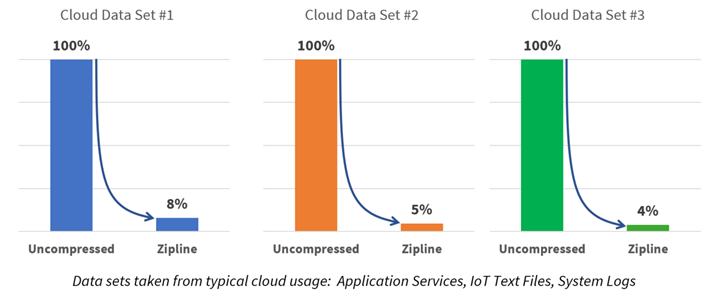
The amount of data that the big cloud computing providers now store is staggering, so it’s no surprise that most store all of this information as compressed data in some form or another — just like you used to zip your files back in the days of floppy disks, CD-ROMs and low-bandwidth connections. Typically, those systems are closely guarded secrets, but today, Microsoft open sourced the algorithm, hardware specification and Verilog source code for how it compresses data in its Azure cloud. The company is contributing all of this to the Open Compute Project (OCP).
Project Zipline, as Microsoft calls this project, can achieve 2x higher compression ratios compared to the standard Zlib-L4 64KB model. To do this, the algorithm — and its hardware implementation — were specifically tuned for the kind of large data sets Microsoft sees in its cloud. Because the system works at the systems level, there is virtually no overhead and Microsoft says that it is actually able to manage higher throughput rates and lower latency than other algorithms are currently able to achieve.
Microsoft stresses that it is also contributing the Verilog source code for register transfer language (RTL) — that is, the low-level code that makes this all work. “Contributing RTL at this level of detail as open source to OCP is industry leading,” Kushagra Vaid, the general manager for Azure hardware infrastructure, writes. “It sets a new precedent for driving frictionless collaboration in the OCP ecosystem for new technologies and opening the doors for hardware innovation at the silicon level.”
Microsoft is currently using this system in its own Azure cloud, but it is now also partnering with others in the Open Compute Project. Among these partners are Intel, AMD, Ampere, Arm, Marvell, SiFive, Broadcom, Fungible, Mellanox, NGD Systems, Pure Storage, Synopsys and Cadence.
“Over time, we anticipate Project Zipline compression technology will make its way into several market segments and usage models such as network data processing, smart SSDs, archival systems, cloud appliances, general purpose microprocessor, IoT, and edge devices,” writes Vaid.
Powered by WPeMatico
ProdPerfect, a Boston-based startup focused on automating QA testing for web apps, has announced the close of a $2.6 million Seed round co-led by Eniac Ventures and Fika Ventures, with participation from Entrepreneurs Roundtable Accelerator.
ProdPerfect started when co-founder and CEO Dan Widing was VP of engineering at WeSpire, where he saw firsthand the pain points associated with web application QA testing. Whereas there were all kinds of product analytics tools for product engineers, the same data wasn’t there for the engineers building QA tests that are meant to replicate user behavior.
He imagined a platform that would use live data around real user behavior to formulate these QA tests. That’s how ProdPerfect was born. The platform sees user behavior, builds and delivers test scripts to the engineering team.
The service continues to build on what it knows about a product, and can then simulate new tests when new features are added based on aggregated flows of common user behavior. This data doesn’t track any information about the user, but rather anonymizes them and watches how they move through the web app. The hope is that ProdPerfect gives engineers the opportunity to keep building the product instead of spreading their resources across building a QA testing suite.
The new funding will go toward expanding the sales team and further building out the product. For now, ProdPerfect simply offers functional testing, which uses a single virtual user to test whether a product breaks or not. But president and co-founder Erik Fogg sees an opportunity to build more integrated testing, including performance, security and localization testing.
Fogg says the company is growing 40 percent month over month in booked revenue.
The company says it can deploy within two weeks of installing a data tracker, and provide more than 70 percent coverage of all user interactions with 95 percent+ test stability.
“The greatest challenge is going to be finding people who share our company’s core values and are of high enough talent, ambition and autonomy in part because our hiring road map is so steep,” said Fogg. “Growing pains catch up with businesses as a team expands quickly and we have to make sure that we’re picky and that we reinforce the values we have.”
Powered by WPeMatico
Deep learning involves a highly iterative process where data scientists build models and test them on GPU-powered systems until they get something they can work with. It can be expensive and time-consuming, often taking weeks to fashion the right model. New startup Determined AI wants to change that by making the process faster, cheaper and more efficient. It emerged from stealth today with $11 million in Series A funding.
The round was led by GV (formerly Google Ventures) with help from Amplify Partners, Haystack and SV Angel. The company also announced an earlier $2.6 million seed round from 2017, for a total $13.6 million raised to date.
Evan Sparks, co-founder and CEO at Determined AI, says that up until now, only the largest companies like Facebook, Google, Apple and Microsoft could set up the infrastructure and systems to produce sophisticated AI like self-driving cars and voice recognition technologies. “Our view is that a big reason why [these big companies] can do that is that they all have internal software infrastructure that enables their teams of machine learning engineers and data scientists to be effective and produce applications quickly,” Sparks told TechCrunch.
Determined’s idea is to create software to handle everything from managing cluster compute resources to automating workflows, thereby putting some of that big-company technology within reach of any organization. “What we exist to do is to build that software for everyone else,” he said. The target market is Fortune 500 and Global 2000 companies.
The company’s solution is based on research conducted over the last several years at AmpLab at the University of California, Berkeley (which is probably best known for developing Apache Spark). It used the knowledge generated in the lab to build sophisticated solutions that help make better use of a customer’s GPU resources.
“We are offering kind of a base layer that is scheduling and resource sharing for these highly expensive resources, and then on top of that we’ve layered some services around workflow automation.” Sparks said the team has generated state of the art results that are somewhere between five and 50 times faster than the results from tools that are available to most companies today.
For now, the startup is trying to help customers move away from generic kinds of solutions currently available to more customized approaches, using Determined AI tools to help speed up the AI production process. The money from today’s round should help fuel growth, add engineers and continue building the solution.
Powered by WPeMatico
Automation Hero, formerly SalesHero, has secured $14.5 million in new funding led by Atomico, with participation by Baidu Ventures and Cherry Ventures. As part of the deal, Atomico principal Ben Blume will join the company’s board of directors.
The automation startup launched in 2017 as SalesHero, giving sales orgs a simple way to automate back-office processes like filing an expense report or updating the CRM. It does this through an AI assistant called Robin — “Batman and Robin, it worked with the superhero theme, and it’s gender neutral,” co-founder and CEO Stefan Groschupf explained — that can be configured to go through the regular workflow and take care of repetitive tasks.
“We brought computers into the workplace because we believed they could make us more productive,” said Groschupf. “But in many companies, people spend a lot of time entering data and doing painful manual processes to make these machines happy.”
The idea was to give salespeople more time to actually do their job, which is selling to clients. If all the administrative and repetitive “paperwork” is done by a computer, human employees can become more productive and efficient at skilled tasks.
By weaving together click robots, Automation Hero users can build out their own workflows through a no-code interface, tying together a wide variety of both structured and unstructured data sources. Those workflows are then presented in the inbox each morning by Robin, the AI assistant, and are executed as soon as the user gives the go-ahead.
After launch, the team realized that other types of organizations, beyond sales departments, were building out automations. Insurance firms, in particular, were using the software to automate some of the repetitive tasks involved with filing and assessing claims.
This led to today’s rebrand to Automation Hero.
Groschupf said that by automating the process of filling out a single closing form, it saved one insurance firm’s 430 sales reps 18.46 years per year.
Automation Hero has now raised a total of $19 million.
“We’re really excited with Atomico to bring on a great VC and good people,” said Groschupf. “I’ve raised capital before and I’ve worked with some of the more questionable VCs, as it turns out. We’re super-excited we’ve found an investor that really bakes important things, like a diversity policy and a family leave policy, right into the company’s investment agreement.”
Though he didn’t confirm, it’s likely that Groschupf is referring to KPCB, which has run into its fair share of controversy over the past few years and was an investor in Groschupf’s previous startup, Datameer.
Powered by WPeMatico