Enterprise
Auto Added by WPeMatico
Auto Added by WPeMatico
Microsoft today announced that it is bringing its Microsoft Defender Advanced Threat Protection (ATP) to the Mac. Previously, this was a Windows solution for protecting the machines of Microsoft 365 subscribers and assets of the IT admins that try to keep them safe. It was also previously called Windows Defender ATP, but given that it is now on the Mac, too, Microsoft decided to drop the “Windows Defender” moniker in favor or “Microsoft Defender.”
“For us, it’s all about experiences that follow the person and help the individual be more productive,” Jared Spataro, Microsoft’s corporate VP for Office and Windows, told me. “Just like we did with Office back in the day — that was a big move for us to move it off of Windows-only — but it was absolutely the right thing. So that’s where we’re headed.”
He stressed that this means that Microsoft is moving off its “Windows-centric approach to life.” He likened it to bringing the Office apps to the iPad and Android. “We’re just headed in that same direction of saying that it’s our intent that we can secure every endpoint so that this Microsoft 365 experience is not just Windows-centric,” Spataro said. Indeed, he argued that the news here isn’t even so much the launch of this service for the Mac but that Microsoft is reorienting the way it thinks about how it can deliver value for Microsoft 365 clients.
Given that Microsoft Defender is part of the Microsoft 365 package, you may wonder why those users would even care about the Mac, but there are plenty of enterprises that use a mix of Windows machines and Mac, and which provide all of their employees with Office already. Having a security solution that spans both systems can greatly reduce complexity for IT departments — and keeping up with security vulnerabilities on one system is hard enough to begin with.
In addition to the launch of the Mac version of Microsoft Defender ATP, the company also today announced the launch of new threat and vulnerability management capabilities for the service. Over the last few months, Microsoft had already launched a number of new features that help businesses proactively monitor and identify security threats.
“What we’re hearing from customers now is that the landscape is getting increasingly sophisticated, the volume of alerts that we’re starting to get is pretty overwhelming,” Spataro said. “We really don’t have the budget to hire the thousands of people required to sort through all this and figure out what to do.”
So with this new tool, Microsoft uses its machine learning smarts to prioritize threads and present them to its customers for remediation.
To Spataro, these announcements come down to the fact that Microsoft is slowly morphing into more of a security company than ever before. “I think we’ve made a lot more progress than people realize,” he said. “And it’s been driven by the market.” He noted that its customers have long asked Microsoft to help them protect their endpoints. Now, he argues, customers have realized that Microsoft is moving to this person-centric approach (instead of a Windows-centric one) and that the company may now be able to help them protect large parts of their systems. At the same time, Microsoft realized that it could use all of the billions of signals it gets from its users to better help its customers proactively.
Powered by WPeMatico

Skedulo, a service that helps businesses manage their mobile employees, today announced that it has raised a $28 million Series B funding round led by M12, Microsoft’s venture fund. Existing investors Blackbird and Castanoa Ventures also participated in this round.
The company’s service offers businesses all the necessary tools to manage their mobile employees, including their schedules. A lot of small businesses still use basic spreadsheets and email to do this, but that’s obviously not the most efficient way to match the right employee to the right job, for example.
“Workforce management has traditionally been focused on employees that are sitting at a desk for the majority of their day,” Skedulo CEO and co-founder Matt Fairhurst told me. “The overwhelming majority — 80 percent — of workers will be deskless by 2020 and so far, there has been no one that has addressed the needs of this growing population at scale. We’re excited to help enterprises confront these challenges head-on so they can compete and lean into rapidly changing customer and employee expectations.”
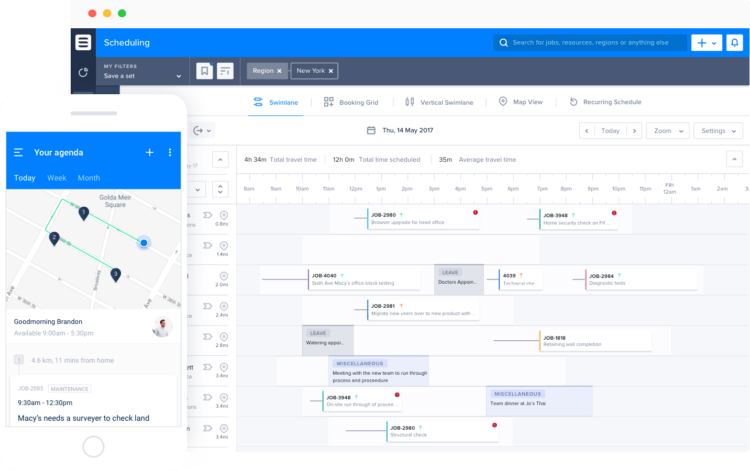
At the core of Skedulo, which offers both a mobile app and web-based interface, is the company’s so-called “Mastermind” engine that helps businesses automatically match the right employee to a job based on the priorities the company has specified. The company plans to use the new funding to enhance this tool through new machine learning capabilities. Skedulo will also soon offer new analytics tools and integrations with third-party services like HR and financial management tools, as well as payroll systems.
The company also plans to use the new funding to double its headcount, which includes hiring at least 60 new employees in its Australian offices in Brisbane and Sydney.
As part of this round, Priya Saiprasad, principal of M12, will join Skedulo’s board of directors. “We found a strong sense of aligned purpose with Priya Saiprasad and the team at M12 — and their desire to invest in companies that help reduce cycles in a person’s working day,” Fairhurst said. “Fundamentally, Skedulo is a productivity company. We help companies, the back-office and mobile workforce, reduce the number of cycles it takes to get work done. This gives them time back to focus on the work that matters most.”
Powered by WPeMatico
Atlanta-based Movius, a company that allows companies to assign a separate business number for voice calls and texting to any phone, today announced that it has raised a $45 million Series D round led by JPMorgan Chase, with participation from existing investors PointGuard Ventures, New Enterprise Associates and Anschutz Investment company. With this, the company has now raised a total of $100 million.
In addition to the new funding, Movius also today announced that it has brought on former Adobe and Sun executive John Loiacono as its new CEO. Loiacono was also the founding CEO of network analytics startup Jolata.
“The Movius opportunity is pervasive. Almost every company on planet Earth is mobilizing their workforce but are challenged to find a way to securely interact with their customers and constituents using all the preferred communication vehicles – be that voice, SMS or any other channel they use in their daily lives,” said Loiacono. “I’m thrilled because I’m joining a team that features highly passionate and proven innovators who are maniacally focused on delivering this very solution. I look forward to leading this next chapter of growth for the company.”
Sanjay Jain, the chief strategy officer at Hyperloop Transportation Technologies, and Larry Feinsmith, the head of JPMorgan Chase’s Technology Innovation, Strategy & Partnerships office, are joining the company’s board.
Movius currently counts more than 1,400 businesses as its customers, and its carrier partners include Sprint, Telstra and Telefonica. What’s important to note is that Movius is more than a basic VoIP app on your phone. What the company promises is a carrier-grade network that allows businesses to assign a second number to their employees’ phones. That way, the employer remains in charge, even as employees bring their own devices to work.
Powered by WPeMatico
When Salesforce bought Quip in 2016 for $750 million, it was fair to wonder what it planned to do with it. While company founder Bret Taylor has moved up the ladder to chief product officer, Quip remained a standalone product. Today that changed when the company announced it was embedding Quip directly into its sales and customer service clouds.
Quip is a collaboration tool with built-in office suite functionality, including word processing, spreadsheet and presentation software. As a standalone product, it enables teams to collaborate around a rich set of documents. Quip for Salesforce is embedding that kind of functionality at the platform level.
Alan Lepofsky, who recently joined Salesforce as VP of Salesforce Quip, says the announcement is the culmination of a desire to embed the tool into Salesforce. “By bringing productivity directly into the context of business workflows, sales and customer support teams can collaborate in brand new ways, enabling them to be better aligned and more efficient, ultimately providing a better customer experience,” Lepofsky told TechCrunch.
Quip appears as a tab in the Sales or Service Cloud interface. There, employees can collaborate on documents and maintain all of their information in a single place without switching between multiple applications or losing context, an increasingly important goal for collaboration tools, including Slack.
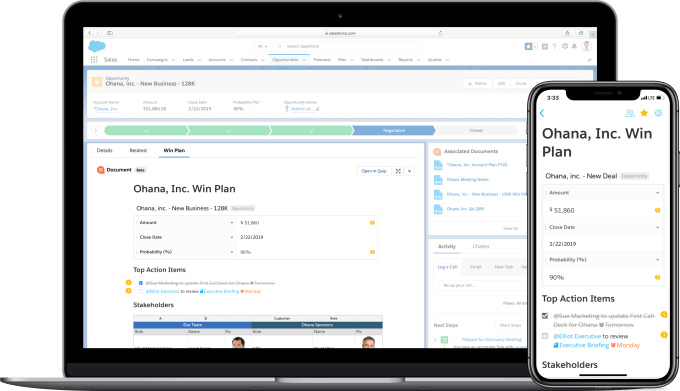
Photo: Salesforce
Administrators can build templates to quickly facilitate team building. The templates enable you to start a page pre-populated with information about a specific account or set of accounts. You can take this a step further by creating templates with a set of filters to refine each one to meet the needs of a particular team, based on factors like deal size, industry or location.
In the service context, customer service agents can set up pages to discuss different kinds of issues or problems and work together to get answers quickly, even while chatting with a customer.
Salesforce has various partnerships with Microsoft, Dropbox, Google, Slack and others that provide a similar kind of functionality, and those customers that want to continue using those tools can do that, but 2.5 years after the Quip acquisition, Salesforce is finally putting it to work as a native productivity and collaboration tool.
“As an industry analyst, I spent years advising vendors on the importance of purpose and context as two key drivers for getting work done. Salesforce is delivering both by bringing productivity from Quip directly to CRM and customer service,” Lepofsky said.
The idea of providing a single place to collaborate without task switching is certainly attractive, but it remains to be seen if customers will warm to the idea of using Quip instead of one of the other tools out there. In the meantime, Quip will still be sold as a standalone tool.
Powered by WPeMatico
Electric-vehicle chargers, heads-up displays for soldiers and the Costco of weed were some of our favorites from prestigious startup accelerator Y Combinator’s Winter 2019 Demo Day 1. If you want to take the pulse of Silicon Valley, YC is the place to be. But with more than 200 startups presenting across two stages and two days, it’s tough to keep track.
You can check out our write-ups of all 85 startups that launched on Demo Day 1, and come back later for our full index and picks from Day 2. But now, based on feedback from top investors and TechCrunch’s team, here’s our selection of the top 10 companies from the first half of this Y Combinator batch, and why we picked each.
Looking around corners is one of the most dangerous parts of war for infantry. Ravn builds heads-up displays that let soldiers and law enforcement see around corners thanks to cameras on their gun, drones or elsewhere. The ability to see the enemy while still being behind cover saves lives, and Ravn already has $490,000 in Navy and Air Force contracts. With a CEO who was a Navy Seal who went on to study computer science, plus experts in augmented reality and selling hardware to the Department of Defense, Ravn could deliver the inevitable future of soldier heads-up displays.
Why we picked Ravn: The AR battlefield is inevitable, but right now Microsoft’s HoloLens team is focused on providing mid-fight information, like how many bullets a soldier has in their clip and where their squad mates are. Ravn’s tech was built by a guy who watched the tragic consequences of getting into those shootouts. He wants to help soldiers avoid or win these battles before they get dangerous, and his team includes an expert in selling hardened tech to the U.S. government.

It’s difficult to know if a business’ partners have paid their taxes, filed for bankruptcy or are involved in lawsuits. That leads businesses to write off $120 billion a year in uncollectable bad debt. Middesk does due diligence to sort out good businesses from the bad to provide assurance for B2B deals, loans, investments, acquisitions and more. By giving clients the confidence that they’ll be paid, Middesk could insert itself into a wide array of transactions.
Why we picked Middesk: It’s building the trust layer for the business world that could weave its way into practically every deal. More data means making fewer stupid decisions, and Middesk could put an end to putting faith in questionable partners.

Convictional helps direct-to-consumer companies approach larger retailers more simply. It takes a lot of time for a supplier to build a relationship with a retailer and start selling their products. Convictional wants to speed things up by building a B2B self-service commerce platform that allows retailers to easily approach brands and make orders.
Why we picked Convictional: There’s been an explosion of D2C businesses selling everything from suitcases to shaving kits. But to drive exposure and scale, they need retail partners who’re eager not to be cut out of this growing commerce segment. Playing middleman could put Convictional in a lucrative position, while also making it a nexus of valuable shopping data.

Dyneti has invented a credit card scanner SDK that uses a smartphone’s camera to help prevent fraud by more than 50 percent and improve conversion for businesses by 5 percent. The business was started by a pair of former Uber employees, including CEO Julia Zheng, who launched the fraud analytics teams for Account Security and UberEATS. Dyneti’s service is powered by deep learning and works on any card format. In the two months since it launched, the company has signed contracts with Rappi, Gametime and others.
Why we picked Dyneti: Cybersecurity threats are growing and evolving, yet underequipped businesses are eager to do more business online. Dyneti is one of those fundamental B2B businesses that feels like Stripe — capable of bringing simplicity and trust to a complex problem so companies can focus on their product.

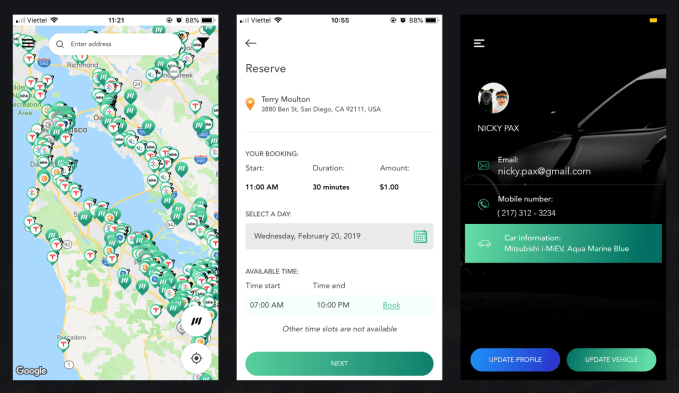
The “Airbnb for electric-vehicle chargers,” ampUp is preparing for a world in which the majority of us drive EVs — it operates a mobile app that connects a network of thousands of EV chargers and drivers. Using the app, an electric-vehicle owner can quickly identify an available and compatible charger, and EV charger owners can earn cash sharing their charger at their own price and their own schedule. The service is currently live in the Bay Area.
Why we picked ampUp: Electric vehicles are inevitable, but reliable charging is one of the leading fears dissuading people from buying. Rather than build out some massive owned network of chargers that will never match the distributed gas station network, ampUp could put an EV charger anywhere there’s someone looking to make a few bucks.
Flockjay operates an online sales academy that teaches job seekers from underrepresented backgrounds the skills and training they need to pursue a career in tech sales. The 12-week bootcamp offers trainees coaching and mentorship. The company has launched its debut cohort with 17 students, 100 percent of whom are already in job interviews and 40 percent of whom have already secured new careers in the tech industry.
Why we picked Flockjay: Unlike coding bootcamps that can require intense prerequisites, killer salespeople can be molded from anyone with hustle. Those from underrepresented backgrounds already know how to expertly sell themselves to attain opportunities others take for granted. Flockjay could provide economic mobility at a crucial juncture when job security is shaky.

Twenty million international contractors work with U.S. companies, but it’s difficult to onboard and train them. Deel handles the contracts, payments and taxes in one interface to eliminate paperwork and wasted time. Deel charges businesses $10 per contractor per month and a 1 percent fee on payouts, which earns it an average of $560 per contractor per year.
Why we picked Deel: The destigmatization of remote work is opening new recruiting opportunities abroad for U.S. businesses. But unless teams can properly integrate these distant staffers, the cost savings of hiring overseas are negated. As the globalization megatrend continues, businesses will need better HR tools.

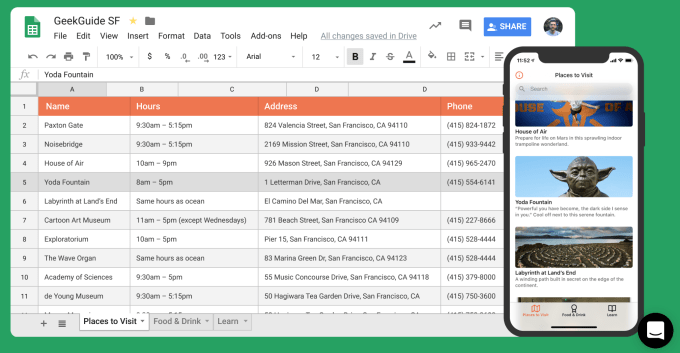
There has been a pretty major trend toward services that make it easier to build web pages or mobile apps. Glide lets customers easily create well-designed mobile apps from Google Sheets pages. This not only makes it easy to build the pages, but simplifies the skills needed to keep information updated on the site.
Why we picked Glide: While desktop website makers is a brutally competitive market, it’s still not easy to make a mobile site if you’re not a coder. Rather than starting from a visual layout tool with which many people would still be unfamiliar, Glide starts with a spreadsheet that almost everyone has used. And as the web begins to feel less personal with all the brands and influencers, Glide could help people make bespoke apps that put intimacy and personality first.
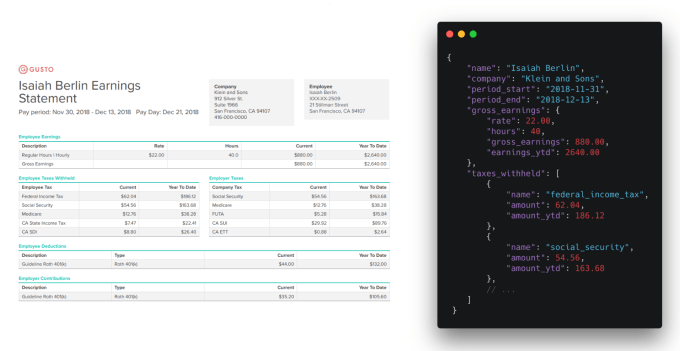
The platform, co-founded by former Uber product manager Minh Tri Pham, turns documents into structured data a computer can understand to accurately automate document processing workflows and take away the need for human data entry. Docucharm’s API can understand various forms of documents (like paystubs, for example) and will extract the necessary information without error. Its customers include tax prep company Tributi and lending business Aspire.
Why we picked Docucharm: Paying high-priced, high-skilled workers to do data entry is a huge waste. And optical character recognition like Docucharm’s will unlock new types of businesses based on data extraction. This startup could be the AI layer underneath it all.
Flower Co provides memberships for cheaper weed sales and delivery. Most dispensaries cater to high-end customers and newbies that want expensive products and tons of hand-holding. In contrast, Flower Co caters to long-time marijuana enthusiasts who want huge quantities at low prices. They’re currently selling $200.000 in marijuana per month to 700 members. They charge $100 a year for membership, and take 10 percent on product sales.
Why we picked Flower Co: Marijuana is the next gold rush, a once-in-a-generation land-grab opportunity. Yet most marijuana merchants have focused on hyper-discerning high-end customers despite the long-standing popularity of smoking big blunts of cheap weed with a bunch of friends. For those who want to make cannabis consumption a lifestyle, and there will be plenty, Flower Co could become their wholesaler.

Atomic Alchemy – Filling the shortage of nuclear medicine
Yourchoice – Omni-gender non-hormonal birth control
Prometheus – Turning CO2 into gas
Lumos – Medical search engine for doctors
Heart Aerospace – Regional electric planes
Boundary Layer Technologies – Super-fast container ships
Additional reporting by Kate Clark, Greg Kumparak and Lucas Matney
Powered by WPeMatico
Artificial intelligence and machine learning has become essential if you are selling sales, customer service and marketing software, especially in large enterprises. The biggest vendors from Adobe to Salesforce to Microsoft to Oracle are jockeying for position to bring automation and intelligence to these areas.
Just today, Oracle announced several new AI features in its sales tools suite and Salesforce did the same in its customer service cloud. Both companies are building on artificial intelligence underpinnings that have been in place for several years.
All of these companies want to help their customers achieve their business goals by using increasing levels of automation and intelligence. Paul Greenberg, managing principal at The 56 Group, who has written multiple books about the CRM industry, including CRM at the Speed of Light, says that while AI has been around for many years, it’s just now reaching a level of maturity to be of value for more businesses.
“The investments in the constant improvement of AI by companies like Oracle, Microsoft and Salesforce are substantial enough to both indicate that AI has become part of what they have to offer — not an optional [feature] — and that the demand is high for AI from companies that are large and complex to help them deal with varying needs at scale, as well as smaller companies who are using it to solve customer service issues or minimize service query responses with chatbots,” Greenberg explained.
This would suggest that injecting intelligence in applications can help even the playing field for companies of all sizes, allowing the smaller ones to behave like they were much larger, and for the larger ones to do more than they could before, all thanks to AI.
The machine learning side of the equation allows these algorithms to see patterns that would be hard for humans to pick out of the mountains of data being generated by companies of all sizes today. In fact, Greenberg says that AI has improved enough in recent years that it has gone from predictive to prescriptive, meaning it can suggest the prospect to call that is most likely to result in a sale, or the best combination of offers to construct a successful marketing campaign.
Brent Leary, principle at CRM Insights, says that AI, especially when voice is involved, can make software tools easier to use and increase engagement. “If sales professionals are able to use natural language to interact with CRM, as opposed to typing and clicking, that’s a huge barrier to adoption that begins to crumble. And making it easier and more efficient to use these apps should mean more data enters the system, which result in quicker, more relevant AI-driven insights,” he said.
All of this shows that AI has become an essential part of these software tools, which is why all of the major players in this space have built AI into their platforms. In an interview last year at the Adobe Summit, Adobe CTO Abhay Parasnis had this to say about AI: “AI will be the single most transformational force in technology,” he told TechCrunch. He appears to be right. It has certainly been transformative in sales, customer service and marketing.
Powered by WPeMatico

Trello, Atlassian’s project management tool, is doubling down on its efforts to become a better service for managing projects at work. To do so, the team is launching thirteen new features in Trello Enterprise today, making this one of the company’s biggest feature releases since the launch of the enterprise version in 2015.
As the company also announced today, one million teams now actively use the service.
Most of these new features are for paying users, but even Trello’s free users are getting access to a few new goodies. In return, though, Trello is taking away the ability to create an unlimited number of boards for free Teams users (not regular users outside of a team). Going forward, they can only have 10 boards open in Trello at any given time. Teams without a subscription that already use more than 10 boards will continue to use them but will have to subscribe to a paid plan to add more. To help make all of this a bit easier, Trello will let existing free teams add up to 10 additional boards until May 1, 2019 — and they’ll be able to keep them going forward.
“We’re making this change to accelerate our ability to bring world-class business features to market, and Trello Business Class and Enterprise will get more useful and powerful to address our customers’ pain points in the workplace,” the company’s co-founder and today’s head of Trello Michael Pryor writes in today’s announcement — and to do bring those feature to market, it surely helps to convert a few more free users into paying ones.
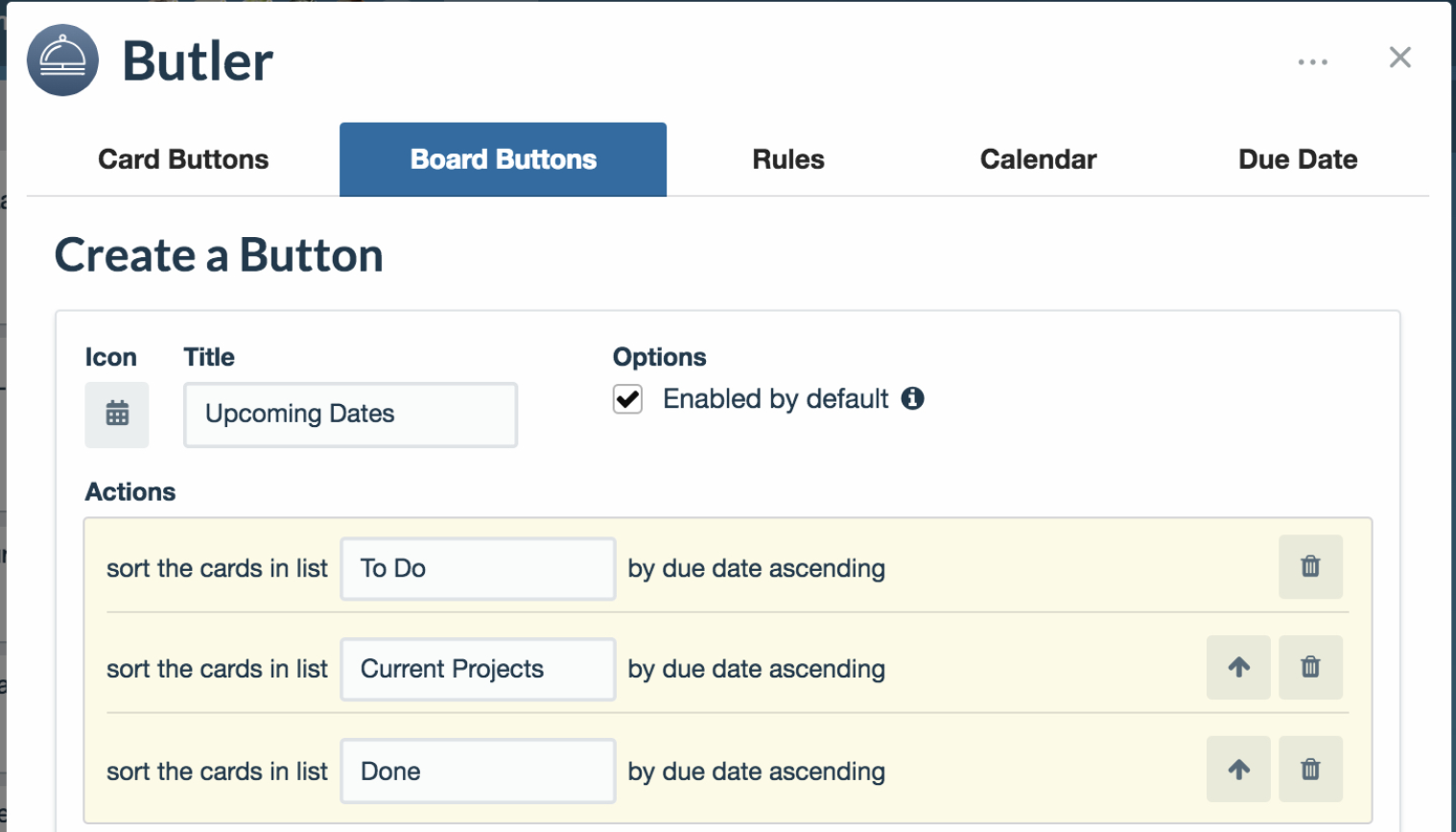
One of the main new feature announcements here is that the Power-Up Butler is now available for free, for both paying and free users (though with some limitations if you aren’t on a subscription plan). Power-Up Butler is an automation extension for Trello that the company acquired in December. It makes it easier to automate workflows and other repetitive tasks in Trello — and that’s clearly something the service’s enterprise users were asking for.
With this update, Trello is also now getting a new board setting beyond ‘private,’ ‘team’ and ‘public.’ This new setting, ‘organization,’ allows you to share a board with the entire company, including those who are not on a particular team. Until now, that wasn’t really an option and creating a public board was obviously not an option for many companies.
Since IT admins love nothing more than access controls, the new version of Trello Enterprise also features a lot of new ways for them to create visibility controls, membership restrictions, board creation restrictions and more. Admins now also get tools to enforce the use of single sign-on solutions and new ways to manage public boards and users, as well as which power-up extensions employees can use.
The company also today announced that it has received SOX and SOC2 Type 1 compliance.

Powered by WPeMatico
Microsoft Teams, the collaboration platform that Microsoft built to complement its Office 365 suite of productivity apps for workers — which also ensures a way of keeping those workers staying within its own ecosystem — is hitting a milestone on its second birthday.
Today, the company announced that over 500,000 organizations are now using Teams. The company is not spelling out what that works out to in total users but notes that 150 of them have more than 10,000 users apiece, putting its total user numbers well over 1.5 million.
Alongside this, Microsoft also announced a number of new features that will be coming to Teams as it works on native integrations of more of Microsoft’s own tools to give Teams more functionality and more relevance for a wider range of use cases.
“The rigid hierarchy of the workplace has evolved, and environments are now about inclusivity and transparency,” said Lori Wright, General Manager of Workplace Collaboration at Microsoft, in an interview. “We see these trends playing out all over the world, and this is giving rise to new forms of technology.”
The new features indeed speak to that trend of inclusivity and making platforms more personalised to users. They include customized backgrounds; and support for cameras to capture content to bring in new ways of interacting in Teams beyond text — something that will be further explored with the eventual integration Microsoft Whiteboard, for people to create and ingest presentations that are hand-written into the system.
For those who are either hearing-impaired or cannot use or hear the audio, Microsoft’s adding live captions. And to speak to the purview of CSOs, it’s adding secure channels for private chats as well as “information barriers” that can be put in place for compliance purposes and to make sure that any potential conflicts of interest between channels are kept out; screening for data-loss prevention to prevent sensitive information from being shared.
Finally, it is adding live events support, which will let users create broadcasts on Teams for up to 10,000 people (who do not need to be registered Teams users to attend).
All in all, this is a significant list of product updates. The company kicked off its service as very much a Slack-style product for “knowledge workers” but has since emphasized a more inclusive approach, for all kinds of employees, from front line to back-office.
No updates today to the number of third-party applications that are being incorporated into Teams — an area where Slack has particularly excelled — but Microsoft is focused on making sure that as many users as it has already captured in Office 365, which today number 155 million — eventually also turn on to Teams. “We using as many as the Microsoft services as we can, tapping the Microsoft Graph to feed in services and structure information,” Wright said.
Microsoft is somewhat of a late comer to the collaboration space, coming in the wake of a number of other efforts, but these user figures put the company’s effort well within striking distance of notable, and large, competitors. Last month, Facebook noted that Workplace, its own Slack rival, had 2 million users, also with 150 organizations with more than 10,000 users each included in the number. Slack, meanwhile, in January said it had over 10 million daily active users with the number of organizations on the platform at 85,000.
(Notably, just yesterday Slack made a timely announcement in its bid to court more large enterprises: they will now give regulated customers access to their encrypted keys, an important component to win more business in those sectors.)
Powered by WPeMatico

Chances are you still mostly think of Vonage as a consumer VOIP player, but in recent years, the company also launched its Vonage Business Cloud (VBC) platform and acquired Nexmo, an API-based communications service that competes directly with many of Twilio’s core services. Today, Vonage is bringing its VBC service and Nexmo a bit closer with the launch of number programmability for its business customers.
What this means is that enterprises can now take any VBC number and extend it with the help of Nexmo’s APIs. To enable this, all they have to do is toggle a switch in their management console and then they’ll be able to programmatically route calls, create custom communications apps and workflows, and integrate third-party systems to build chatbots and other tools.
“About four years ago we made a pretty strong pivot to going from residential — a lot of people know Vonage as a residential player — to the business side,” Vonage senior VP of product management Jay Patel told me. “And through a series of acquisitions [including Nexmo], we’ve kind of built what we think is a very unique offering.” In many ways, those different platforms were always separated from each other, though. With all of the pieces in place now, however, the team started thinking about how it could use the Nexmo APIs to allow its customers in the unified communications and contact center space to more easily customize these services for them.
About a year ago, the team started working on this new functionality that brings the programmability of Nexmo to VBC. “We realized it doesn’t make sense for us to create our own new sets of APIs on our unified communications and contact center space,” said Patel. “Why don’t we use the APIs that Nexmo has already built?”
As Patel also stressed, the phone number is still very much linked to a business or individual employee — and they don’t want to change that just for the sake of having a programmable service. By turning on programmability for these existing numbers, though, and leveraging the existing Nexmo developer ecosystem and the building blocks those users have already created, the company believes that it’s able to offer a differentiated service that allows users to stay on its platform instead of having to forward a call to a third-party service like Twilio, for example, to enable similar capabilities.
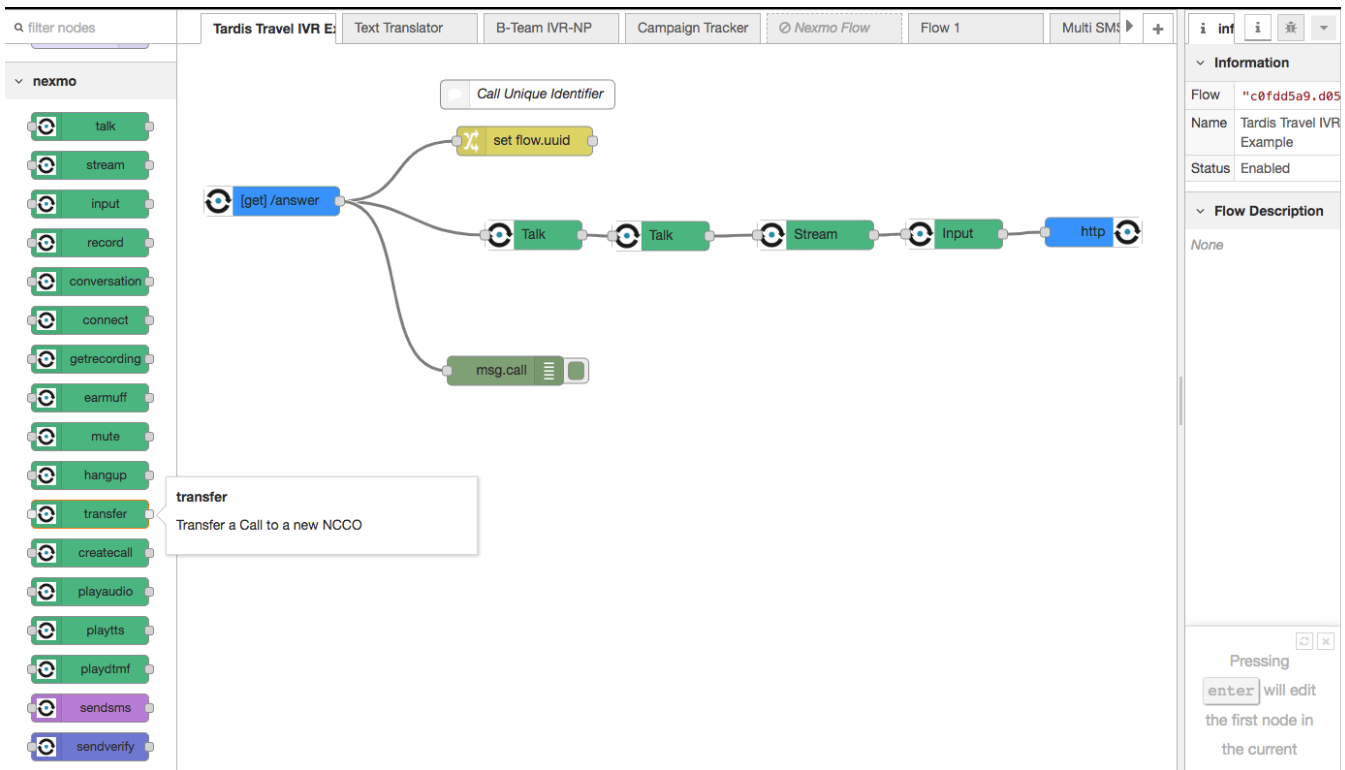
In terms of those capabilities, users can pretty much do anything they want with these calls — and that’s important because every company has different processes and requirements. Maybe that’s logging info into multiple CRM systems in parallel or taking a clip of a call and pushing it into a different system for training purposes. Or you could have the system check your calendar when there are incoming calls and then, if it turns out you are in a meeting, offer the caller a callback whenever your calendar says you’re available again. All of that should only take a few lines of code or, if you want to avoid most of the coding, a few clicks in the company’s GUI for building these flows.
Vonage believes that these new capabilities will attract quite a few new customers. “It’s our value-add when we’re selling to new customers,” he said. “They’re looking for this kind of capability or are running into brick walls. We see a lot of companies that have an idea but they don’t know how to do it. They’re not engineers or they don’t have a big staff of developers, but because of the way we’ve implemented this, it brings the barrier of entry to create these solutions much lower than if you had a legacy system on-prem where you had to be a C++ developer to build an app.
Powered by WPeMatico
When Salesforce introduced Einstein, its artificial intelligence platform in 2016, it was laying the ground work for artificial intelligence underpinnings across the platform. Since then the company has introduced a variety of AI enhancements to the Salesforce product family. Today, customer service got some AI updates.
The goal of any customer service interaction is to get the customer answers as quickly as possible. Many users opt to use chat over phone, and Salesforce has added some AI features to help customer service agents get answers more quickly in the chat interface. (The company hinted that phone customer service enhancements are coming.)
For starters, Salesforce is using machine learning to deliver article recommendations, response recommendations and next best actions to the agent in real time as they interact with customers. “With Einstein article recommendations, we can use machine learning on past cases and we can look at how articles were used to successfully solve similar cases in the past, and serve up the best article right in the console to help the agent with the case,” Martha Walchuk, senior director of product marketing for Salesforce Service Cloud explained.
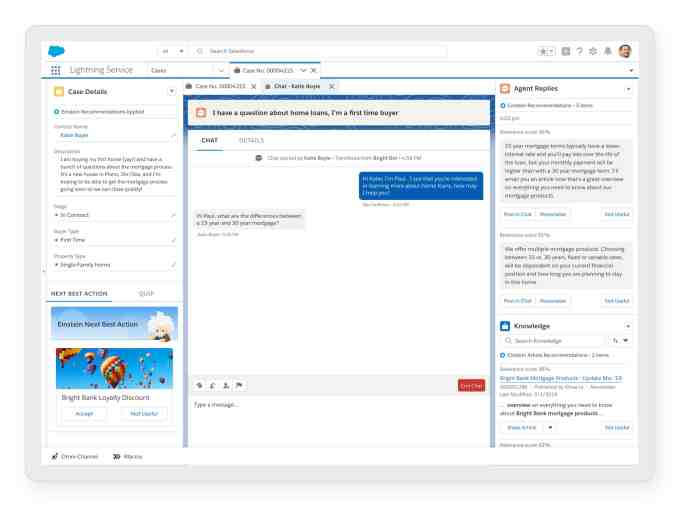
Salesforce Service Console. Screenshot: Salesforce
The company is also using similar technology to provide response recommendations, which the agent can copy and paste into the chat to speed up the time to response. Before the interaction ends, the company can offer the next best action (which was announced last year) based on the conversation. For example, they could offer related information, an upsell recommendation or whatever type of action the customer defines.
Salesforce is also using machine learning to help route each person to the most appropriate customer service rep. As Salesforce describes it, this feature uses machine learning to filter cases and route them to the right queue or agent automatically, based on defined criteria such as best qualified agent or past outcomes.
Finally, the company is embedding Quip, the company it acquired in 2016 for $750 million, into the customer service console to allow agents to communicate with one another to find answers to difficult problems. That not only helps solve the issues faster, the conversations themselves become part of the knowledge base, which Salesforce can draw upon to help teach the machine learning algorithms about the correct responses to commonly asked questions in the future.
As with the Oracle AI announcement this morning, this use of artificial intelligence in sales, service and marketing is part of a much broader industry trend, as these companies try to inject intelligence into workflows to make them run more efficiently.
Powered by WPeMatico