Enterprise
Auto Added by WPeMatico
Auto Added by WPeMatico
One of the great things about enterprise chat applications, beyond giving employees a common channel to communicate, is the ability to integrate with other enterprise applications. Today, Workplace, Facebook’s enterprise collaboration and communication application, and ServiceNow announced a new chatbot to make it easier for employees to navigate a company’s help desks inside Workplace Chat.
The beauty of the chatbot is that employees can get answers to common questions whenever they want, wherever they happen to be. The Workplace-ServiceNow integration happens in Workplace Chat and can can involve IT or HR help desk scenarios. A chatbot can help companies save time and money, and employees can get answers to common problems much faster.
Previously, getting these kind of answers would have required navigating multiple systems, making a phone call or submitting a ticket to the appropriate help desk. This approach provides a level of convenience and immediacy.
Companies can brainstorm common questions and answers and build them in the ServiceNow Virtual Agent Designer. It comes with some standard templates, and doesn’t require any kind of advanced scripting or programming skills. Instead, non-technical end users can adapt pre-populated templates to meet the needs, language and workflows of an individual organization.

Screenshot: ServiceNow
This is all part of a strategy by Facebook to integrate more enterprise applications into the tool. In May at the F8 conference, Facebook announced 52 such integrations from companies like Atlassian, SurveyMonkey, HubSpot and Marketo (the company Adobe bought in September for $4.75 billion).
This is part of a broader enterprise chat application trend around making these applications the center of every employee’s work life, while reducing task switching, the act of moving from application to application. This kind of integration is something that Slack has done very well and has up until now provided it with a differentiator, but the other enterprise players are catching on and today’s announcement with ServiceNow is part of that.
Powered by WPeMatico
Alibaba has made an acquisition as it continues to square up to the opportunity in enterprise services in China and beyond, akin to what its U.S. counterpart Amazon has done with AWS. TechCrunch has confirmed that the e-commerce and cloud services giant has acquired Teambition, a Microsoft and Tencent-backed platform for co-workers to plan and collaborate on projects, similar to Trello and Asana.
There were rumors of an acquisition circulating yesterday in Chinese media. Alibaba has now confirmed the acquisition to TechCrunch but declined to provide any other details.
Teambition had raised about $17 million in funding since 2013, with investors including Tencent, Microsoft, IDG Capital and Gobi Ventures. Gobi also manages investments on behalf of Alibaba, and that might have been one route to how the two became acquainted. Alibaba’s last acquisition in enterprise was German big data startup Data Artisans for $103 million.
As with others in the project management and collaboration space, Teambition provides users with mobile and desktop apps to interact with the service. In addition to the main planning interface, there is one designed for CRM, called Bingo, as well as a “knowledge base” where businesses can keep extra documentation and other collateral.

The deal is another sign of how Alibaba has been slowly building a business in enterprise powerhouse over the last several years as it races to keep its pole position in the Chinese market, as well as gain a stronger foothold in the wider Asian region and beyond.
In China alone, it has been estimated that enterprise services is a $1 billion opportunity, but with no clear leader at the moment across a range of verticals and segments that fall under that general umbrella, there is a lot to play for, and likely a lot more consolidation to come. (And it’s not the only one: ByteDance — more known for consumer services like TikTok — is rumored to be building a Slack competitor, and Tencent also has its sights on the sector, as does Baidu.)
As with AWS, Alibaba’s enterprise business stems out of the cloud-based infrastructure Alibaba has built for its own e-commerce powerhouse, which it has productised as a service for third parties that it calls Alibaba Cloud, which (like AWS) offers a range of cloud-storage and serving tiers to users.
On top of that, Alibaba has been building and integrating a number of apps and other services that leverage that cloud infrastructure, providing more stickiness for the core service as well as the potential for developing further revenue streams with customers.
These apps and services range from the recently launched “A100” business transformation initiative, where Alibaba proposes working with large companies to digitise and modernize (and help run) their IT backends, through to specific products, such as Alibaba’s Slack competitor DingTalk.
With Alibaba declining to give us any details beyond a confirmation of the acquisition, and Teambition not returning our requests for comment, our best guess is that this app could be a fit in either area. That is to say, one option for Alibaba would be to integrate it and use it as part of a wider “business transformation” and modernization offering, or as a standalone product, as it currently exists.
Teambition today counts a number of Chinese giants, and giants with Chinese outposts, as customers, including Huawei, Xiaomi, TCL and McDonald’s in its customer list. The company currently has nothing on its site indicating an acquisition or any notices regarding future services, so it seems to be business as usual for now.
The opportunity around collaboration and workplace communication has become a very hot area in the last few years, spurred by the general growth of social media in the consumer market and people in business environments wanting to bring in the same kinds of tools to help them get work done. Planning and project management — the area that Teambition and its competitors address — is considered a key pillar in the wider collaboration space alongside cloud services to store and serve files and real-time communication services.
Slack, which is now valued at more than $7 billion, has said it has filed paperwork for a public listing, while Asana is now valued at $1.5 billion and Trello’s owner Atlassian now has a market cap of nearly $26 billion.
Powered by WPeMatico
As I walked the long halls of Adobe Summit this week in Las Vegas and listened to the company’s marketing and data integration story, I thought about the obvious disconnect that happens between brands and their customers. With tons of data, a growing set of tools to bring it together and a desire to build an optimal experience, you would think we have been set up for thrilling consumer experiences, yet we all know that is not always what happens when the rubber meets the road.
Maybe part of the problem is that data sitting in databases doesn’t always translate into employee action when dealing directly with consumers. In many cases, the experience isn’t smooth, data isn’t passed from one source to another and when you do eventually reach a person, they aren’t always knowledgeable or even nice.
It’s to the point that when my data does get passed smoothly from bot to human CSA, and I’m not asked for the same information for the second or even third time, I’m pleasantly surprised, even a little shocked.
That’s probably not the story marketing automation vendors like Adobe and Salesforce want to hear, but it is probably far more common than the one about delighted customers. I understand the goal is to provide APIs to connect systems. It’s to stream data in real time from a variety of channels. It’s about understanding that data better by applying intelligent analytics, and to some extent I’m sure that’s happening and there are brands that truly do want to delight us.
The disconnect could be happening because brands can control what happens in the digital world much better than the real one. They can know at a precise level when you interact with them and try to right wrongs or inconsistencies as quickly as possible. The problem is when we move to human interactions — people talking to people at the point of sale in a store, or in an office or via any communications channel — all of that data might not be helpful or even available.
The answer to that isn’t to give us more digital tools, or more tech in general, but to work to improve human-to-human communication, and maybe arm those human employees with the very types of information they need to understand the person they are dealing with when they are standing in front of them.
If brands can eventually get these human touch points right, they will build more loyal customers who want to come back, the ultimate goal, but right now the emphasis seems to be more on technology and the digital realm. That may not always achieve the desired results.
This is not necessarily the fault of Adobe, Salesforce or any technology vendor trying to solve this problem, but the human side of the equation needs to be a much stronger point of focus than it currently seems to be. In the end, all the data in the world isn’t going to save a brand from a rude or uninformed employee in the moment of customer contact, and that one bad moment can haunt a brand for a long, long time, regardless of how sophisticated the marketing technology it’s using may be.
Powered by WPeMatico

It’s not uncommon to hear CEOs and business leaders talk about focusing on the consumer. But the only way to build for the consumer is to hear what they want, which can be a resource-intensive thing to retrieve.
User Interviews, an ERA-backed company out of New York, is looking to lighten that load with a fresh $5 million in seed funding from Accomplice, Las Olas, FJ Labs and ERA.
User Interviews actually started out as Mobile Suites, an amenities logistics platform for hotels. It was a dud, and the team — Basel Fakhoury, Dennis Meng and Bob Saris — decided to do far more user research before determining the next product.
In the process of talking to customers to understand their pain points, they realized just how difficult collecting user feedback could be.
That’s how User Interviews was born. The platform’s first product, called Recruit, offers a network of non-users that can be matched with companies to provide feedback. In fact, User Interviews’ first sales were made by simply responding to Craigslist ads posted by companies looking for non-users from which they could collect feedback.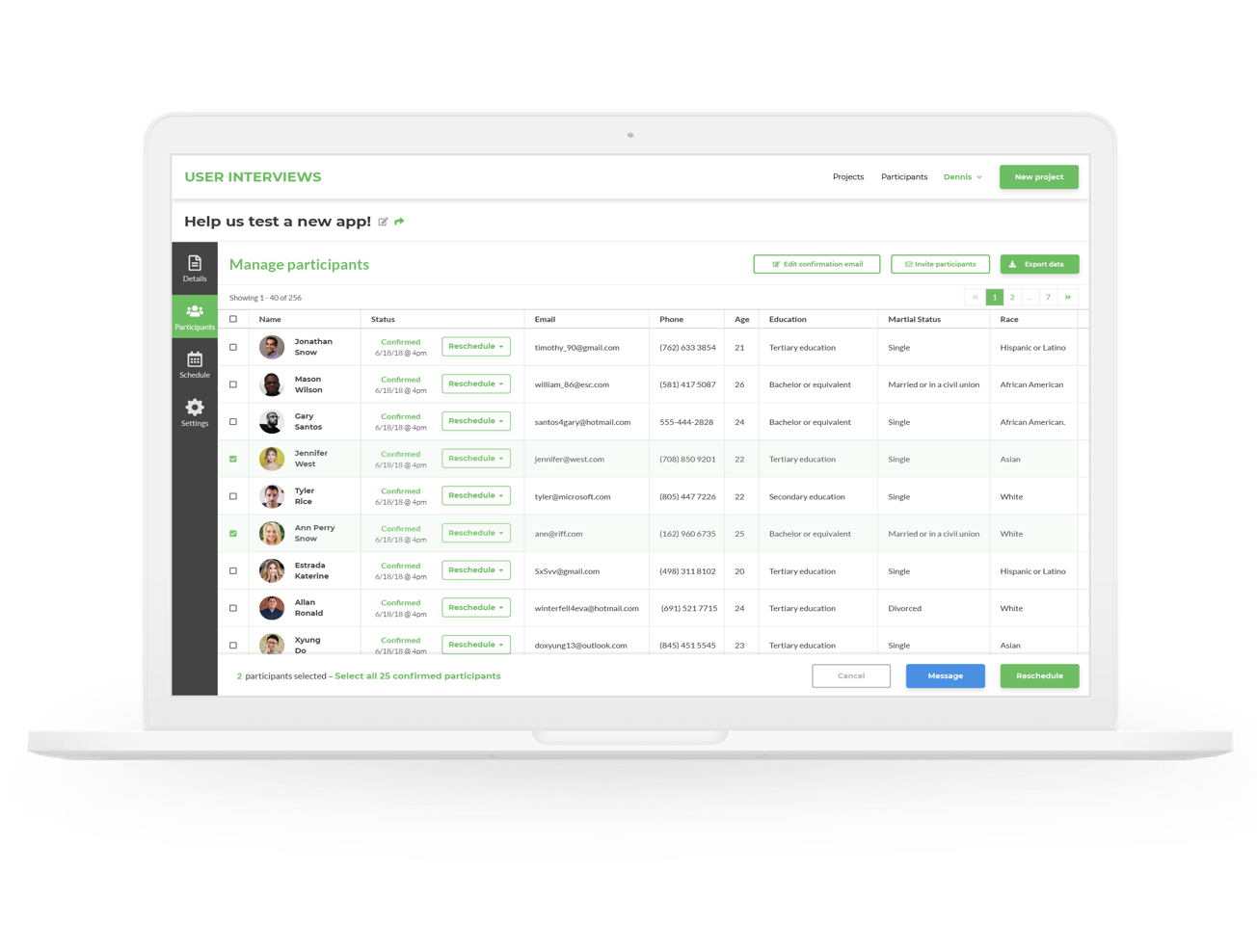 But because the majority of user research is based on existing users, the company also built Research Hub, which is essentially a CRM system for user feedback and research. To be clear, User Interviews doesn’t facilitate the actual interviews with users, but tracks the feedback, facilitates sending emails and ensures that no one from the research team is reaching out to a single user too often.
With Recruit, User Interviews charges $30/person that it matches with a company for feedback. Research Hub costs starts at $150/month.
“Right now, our greatest challenge is that our clients are the best product people in the world, and we have a huge pipeline of amazing ideas that are very valuable and no one is doing yet that our clients would love,” said CEO and cofounder Basel Fakhoury. “But we have to build it fast enough.”
No mention of what those forthcoming products might be, but the current iteration sure seems attractive enough. User Interviews clients include Eventbrite, Glassdoor, AT&T, DirecTV, Lola, LogMeIn, Thumbtack, Casper, ClassPass, Fandango, NNG, Pinterest, Pandora, Colgate, Uber and REI, to name a few.
Powered by WPeMatico

Setting up Elasticsearch, the open-source system that many companies large and small use to power their distributed search and analytics engines, isn’t the hardest thing. What is very hard, though, is to provision the right amount of resources to run the service, especially when your users’ demand comes in spikes, without overpaying for unused capacity. Vizion.ai’s new Elasticsearch Service does away with all of this by essentially offering Elasticsearch as a service and only charging its customers for the infrastructure they use.
Vizion.ai’s service automatically scales up and down as needed. It’s a managed service and delivered as a SaaS platform that can support deployments on both private and public clouds, with full API compatibility with the standard Elastic stack that typically includes tools like Kibana for visualizing data, Beats for sending data to the service and Logstash for transforming the incoming data and setting up data pipelines. Users can easily create several stacks for testing and development, too, for example.

Vizion.ai GM and VP Geoff Tudor
“When you go into the AWS Elasticsearch service, you’re going to be looking at dozens or hundreds of permutations for trying to build your own cluster,” Vision.ai’s VP and GM Geoff Tudor told me. “Which instance size? How many instances? Do I want geographical redundancy? What’s my networking? What’s my security? And if you choose wrong, then that’s going to impact the overall performance. […] We do balancing dynamically behind that infrastructure layer.” To do this, the service looks at the utilization patterns of a given user and then allocates resources to optimize for the specific use case.
What VVizion.ai hasdone here is take some of the work from its parent company Panzura, a multi-cloud storage service for enterprises that has plenty of patents around data caching, and applied it to this new Elasticsearch service.
There are obviously other companies that offer commercial Elasticsearch platforms already. Tudor acknowledges this, but argues that his company’s platform is different. With other products, he argues, you have to decide on the size of your block storage for your metadata upfront, for example, and you typically want SSDs for better performance, which can quickly get expensive. Thanks to Panzura’s IP, Vizion.ai is able to bring down the cost by caching recent data on SSDs and keeping the rest in cheaper object storage pools.
He also noted that the company is positioning the overall Vizion.ai service, with the Elasticsearch service as one of the earliest components, as a platform for running AI and ML workloads. Support for TensorFlow, PredictionIO (which plays nicely with Elasticsearch) and other tools is also in the works. “We want to make this an easy serverless ML/AI consumption in a multi-cloud fashion, where not only can you leverage the compute, but you can also have your storage of record at a very cost-effective price point.”
Powered by WPeMatico
Kong, the open core API management and life cycle management company previously known as Mashape, today announced that it has raised a $43 million Series C round led by Index Ventures. Previous investors Andreessen Horowitz and Charles River Ventures (CRV), as well as new investors GGV Capital and World Innovation Lab, also participated. With this round, Kong has now raised a total of $71 million.
The company’s CEO and co-founder Augusto Marietti tells me the company plans to use the funds to build out its service control platform. He likened this service to the “nervous system for an organization’s software architecture.”
Right now, Kong is just offering the first pieces of this, though. One area the company plans to especially focus on is security, in addition to its existing management tools, where Kong plans to add more machine learning capabilities over time, too. “It’s obviously a 10-year journey, but those two things — immunity with security and machine learning with [Kong] Brain — are really a 10-year journey of building an intelligent platform that can manage all the traffic in and out of an organization,” he said.
In addition, the company also plans to invest heavily in its expansion in both Europe and the Asia Pacific market. This also explains the addition of World Innovation Lab as an investor. The firm, after all, focuses heavily on connecting companies in the U.S. with partners in Asia — and especially Japan. As Marietti told me, the company is seeing a lot of demand in Japan and China right now, so it makes sense to capitalize on this, especially as the Chinese market is about to become more easily accessible for foreign companies.
Kong notes that it doubled its headcount in 2018 and now has more than 100 enterprise customers, including Yahoo! Japan, Ferrari, SoulCycle and WeWork.
It’s worth noting that while this is officially a Series C investment, Marietti is thinking of it more like a Series B round, given that the company went through a major pivot when it moved from being Mashape to its focus on Kong, which was already its most popular open-source tool.
“Modern software is now built in the cloud, with applications consuming other applications, service to service,” said Martin Casado, general partner at Andreessen Horowitz . “We’re at the tipping point of enterprise adoption of microservices architectures, and companies are turning to new open-source-based developer tools and platforms to fuel their next wave of innovation. Kong is uniquely suited to help enterprises as they make this shift by supporting an organization’s entire service architecture, from centralized or decentralized, monolith or microservices.”
Powered by WPeMatico
Microsoft today announced a major expansion of its Azure IP Advantage program, which provides its Azure users with protection against patent trolls. This program now also provides customers who are building IoT solutions that connect to Azure with access to 10,000 patents to defend themselves against intellectual property lawsuits.
What’s maybe most interesting here, though, is that Microsoft is also donating 500 patents to startups in the LOT Network. This organization, which counts companies like Amazon, Facebook, Google, Microsoft, Netflix, SAP, Epic Games, Ford, GM, Lyft and Uber among its close to 400 members, is designed to protect companies against patent trolls by giving them access to a wide library of patents from its member companies and other sources.
“The LOT Network is really committed to helping address the proliferation of intellectual property lawsuits, especially ones that are brought by non-practicing entities, or so-called trolls,” Microsoft CVP and Deputy General Counsel Erich Andersen told me.
This new program goes well beyond basic protection from patent trolls, though. Qualified startups who join the LOT Network can acquire Microsoft patents as part of their free membership and as Andersen stressed, the startups will own them outright. The LOT network will be able to provide its startup members with up to three patents from this collection.
There’s one additional requirement here, though: To qualify for getting the patents, these startups also have to meet a $1,000 per month Azure spend. As Andersen told me, though, they don’t have to make any kind of forward pledge. The company will simply look at a startup’s last three monthly Azure bills.
“We want to help the LOT Network grow its network of startups,” Andersen said. “To provide an incentive, we are going to provide these patents to them.” He noted that startups are obviously interested in getting access to patents as a foundation of their companies, but also to raise capital and to defend themselves against trolls.
The patents we’re talking about here cover a wide range of technologies as well as geographies. Andersen noted that we’re talking about U.S. patents as well as European and Chinese patents, for example.
“The idea is that these startups come from a diverse set of industry sectors,” he said. “The hope we have is that when they approach LOT, they’ll find patents among those 500 that are going to be interesting to basically almost any company that might want a foundational set of patents for their business.”
As for the extended Azure IP Advantage program, it’s worth noting that every Azure customer who spends more than $1,000 per month over the past three months and hasn’t filed a patent infringement lawsuit against another Azure customer in the last two years can automatically pick one of the patents in the program’s portfolio to protect itself against frivolous patent lawsuits from trolls (and that’s a different library of patents from the one Microsoft is donating to the LOT Network as part of the startup program).
As Andersen noted, the team looked at how it could enhance the IP program by focusing on a number of specific areas. Microsoft is obviously investing a lot into IoT, so extending the program to this area makes sense. “What we’re basically saying is that if the customer is using IoT technology — regardless of whether it’s Microsoft technology or not — and it’s connected to Azure, then we’re going to provide this patent pick right to help customers defend themselves against patent suits,” Andersen said.
In addition, for those who do choose to use Microsoft IoT technology across the board, Microsoft will provide indemnification, too.
Patent trolls have lately started acquiring IoT patents, so chances are they are getting ready to make use of them and that we’ll see quite a bit of patent litigation in this space in the future. “The early signs we’re seeing indicate that this is something that customers are going to care about in the future,” said Andersen.
Powered by WPeMatico
Here’s an interesting twist on the story from last week about the break-up between Shopify and Mailchimp, after the two said they were at odds over how customer data was shared between the two companies. It turns out that before it parted ways with Shopify, Mailchimp quietly made an acquisition of LemonStand, one of the e-commerce platform’s smaller competitors, to bring more integrated e-commerce features into its platform.
After news broke of the rift between Mailchimp and Shopify, rumors started to circulate among people in the world of e-commerce about Mailchimp buying Vancouver-based LemonStand, which announced on March 5 that it was shutting down its service in 90 days, on June 5, without much of an explanation why.
We were tipped off on those rumors, so we contacted Ross Paul, LemonStand’s VP of growth and an investor in the startup, who suggested we contact Mailchimp. (Paul now lists Mailchimp as his employer on his LinkedIn profile.) Mailchimp confirmed the deal, describing it as an acqui-hire, with the team now working on light e-commerce functionality.
“Mailchimp acqui-hired the team behind LemonStand at the end of February,” Mailchimp said in a statement provided to TechCrunch. It did not provide any financial terms for the deal.
Mailchimp — which is privately held and based in Atlanta — said it made the acquisition to provide more features to its customers, specifically those in e-commerce.
“Mailchimp helps small businesses grow, and our e-commerce customers have been asking us to add more functionality to our platform to help them market more effectively,” the company said in a statement. “The LemonStand team is helping us build out our e-commerce light functionality.”
But Mailchimp is clear to say that its acqui-hire was not related to ending its relationship with Shopify.
“Our decision to discontinue our partnership with Shopify last week is unrelated to LemonStand,” Mailchimp said. “Shopify knew we were working on e-commerce features long before we hired the LemonStand team. In fact, we launched Shoppable Landing Pages last fall in partnership with Square, and Shopify chose not to partner with us on the launch.”
But even if the LemonStand deal is not related to its rift with Shopify, the acquisition of one and the breakup with the other both point to the same thing: the growing role of Mailchimp’s e-commerce business.
The company — which provides email marketing and other marketing services to business — has been slowly building a revenue stream in e-commerce by integrating a number of features into its platform to let its customers, for example, sell items as part of the marketing process. These are less about building full check-out experiences or commerce backends, but for offering, say, one-off sale items as part of a particular promotion or campaign.
Last year, when Mailchimp launched those new shoppable landing pages with Square, it said that 50 percent of its revenues were now coming from e-commerce, with its customers selling more than $22 billion worth of products in the first half of 2018. Mailchimp made some $600 million in revenue in 2018, which — if its 50 percent e-commerce figure remained consistent — meant that it made $300 million last year just from e-commerce-related services.
The Square partnership is instructive in light of this acquisition. While Mailchimp is indeed building some native e-commerce features for its platform, it will continue to work with third parties (if not Shopify, the biggest of them all) to provide other functionality.
“We believe small businesses are best served when they can choose which technology they use to run their businesses, which is why we integrate with more than 150 different apps and platforms including e-commerce platforms,” Mailchimp said in its statement to TechCrunch.
“We’re not trying to become an e-commerce platform or compete directly with companies like Shopify,” it added, “and we think that adding e-commerce features in Mailchimp will help our e-commerce partners. Companies will be able to start their businesses with Mailchimp and have a seamless experience, and eventually use Mailchimp along with one of our e-commerce partners.”
Powered by WPeMatico
You know how kings used to have trumpeters heralding their arrival wherever they went? Proxy wants to do that with Bluetooth. The startup lets you instantly unlock office doors and reserve meeting rooms using Bluetooth Low Energy signal. You never even have to pull out your phone or open an app. But Proxy is gearing up to build an entire Bluetooth identity layer for the world that could invisibly hover around its users. That could allow devices around the workplace and beyond to instantly recognize your credentials and preferences to sign you into teleconferences, pay for public transit or ask the barista for your usual.
Today, Proxy emerges from stealth after piloting its keyless, badgeless office entry tech with 50 companies. It’s raised a $13.6 million Series A round led by Kleiner Perkins to turn your phone into your skeleton key. “The door is a forcing function to solve all the hard problems — everything from safety to reliability to the experience to privacy,” says Proxy co-founder and CEO Denis Mars. “If you’re gonna do this, it’s gonna have to work right, and especially if you’re going to do this in the workplace with enterprises where there’s no room to fix it.”

But rather than creepily trying to capitalize on your data, Proxy believes you should own and control it. Each interaction is powered by an encrypted one-time token so you’re not just beaming your unprotected information out into the universe. “I’ve been really worried about how the internet world spills over to the physical world. Cookies are everywhere with no control. What’s the future going to be like? Are we going to be tracked everywhere or is there a better way?” He figured the best path to the destiny he wanted was to build it himself.
Mars and his co-founder Simon Ratner, both Australian, have been best buddies for 10 years. Ratner co-founded a video annotation startup called Omnisio that was acquired by YouTube, while Mars co-founded teleconferencing company Bitplay, which was bought by Jive Software. Ratner ended up joining Jive where the pair began plotting a new startup. “We asked ourselves what we wanted to do with the next 10 or 20 years of our lives. We both had kids and it changed our perspective. What’s meaningful that’s worth working on for a long time?”
They decided to fix a real problem while also addressing their privacy concerns. As he experimented with Internet of Things devices, Mars found every fridge and light bulb wanted you to download an app, set up a profile, enter your password and then hit a button to make something happen. He became convinced this couldn’t scale and we’d need a hands-free way to tell computers who we are. The idea for Proxy emerged. Mars wanted to know, “Can we create this universal signal that anything can pick up?”
Most offices already have infrastructure for badge-based RFID entry. The problem is that employees often forget their badges, waste time fumbling to scan them and don’t get additional value from the system elsewhere.
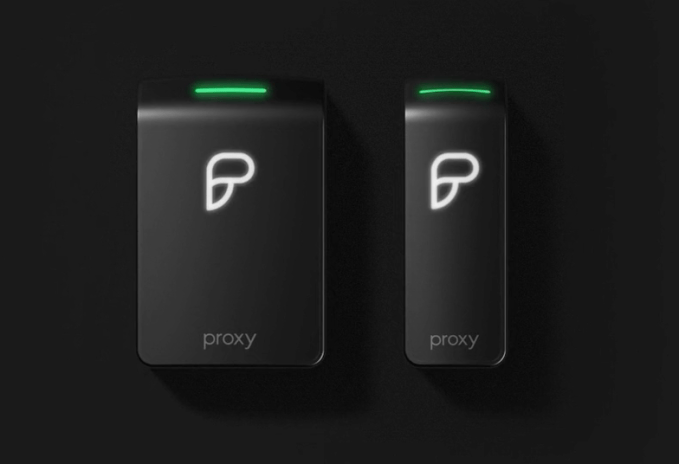
So rather than re-invent the wheel, Proxy integrates with existing access control systems at offices. It just replaces your cards with an app authorized to constantly emit a Bluetooth Low Energy signal with an encrypted identifier of your identity. The signal is picked up by readers that fit onto the existing fixtures. Employees can then just walk up to a door with their phone within about six feet of the sensor and the door pops open. Meanwhile, their bosses can define who can go where using the same software as before, but the user still owns their credentials.
“Data is valuable, but how does the end user benefit? How do we change all that value being stuck with these big tech companies and instead give it to the user?” Mars asks. “We need to make privacy a thing that’s not exploited.”
Mars believes now’s the time for Proxy because phone battery life is finally getting good enough that people aren’t constantly worried about running out of juice. Proxy’s Bluetooth Low Energy signal doesn’t suck up much, and geofencing can wake up the app in case it shuts down while on a long stint away from the office. Proxy has even considered putting inductive charging into its sensors so you could top up until your phone turns back on and you can unlock the door.

Opening office doors isn’t super exciting, though. What comes next is. Proxy is polishing its features that auto-reserve conference rooms when you walk inside, that sign you into your teleconferencing system when you approach the screen and that personalize workstations when you arrive. It’s also working on better office guest check-in to eliminate the annoying iPad sign-in process in the lobby. Next, Mars is eyeing “Your car, your home, all your devices. All these things are going to ask ‘can I sense you and do something useful for you?’ ”
After demoing at Y Combinator, thousands of companies reached out to Proxy, from hotel chains to corporate conglomerates to theme parks. Proxy charges for its hardware, plus a monthly subscription fee per reader. Employees are eager to ditch their keycards, so Proxy sees 90 percent adoption across all its deployments. Customers only churn if something breaks, and it hasn’t lost a customer in two years, Mars claims.
The status quo of keycards, competitors like Openpath and long-standing incumbents all typically only handle doors, while Proxy wants to build an omni-device identity system. Now Proxy has the cash to challenge them, thanks to the $13.6 million from Kleiner, Y Combinator, Coatue Management and strategic investor WeWork. In fact, Proxy now counts WeWork’s headquarters and Dropbox as clients. “With Proxy, we can give our employees, contractors and visitors a seamless smartphone-enabled access experience they love, while actually bolstering security,” says Christopher Bauer, Dropbox’s physical security systems architect.

The cash will help answer the question of “How do we turn this into a protocol so we don’t have to build the other side for everyone?,” Mars explains. Proxy will build out SDKs that can be integrated into any device, like a smoke detector that could recognize which people are in the vicinity and report that to first responders. Mars thinks hotel rooms that learn your climate, wake-up call and housekeeping preferences would be a no-brainer. Amazon Go-style autonomous retail could also benefit from the tech.
When asked what keeps him up at night, Mars concludes that “the biggest thing that scares me is that this requires us to be the most trustworthy company on the planet. There is no ‘move fast, break things’ here. It’s ‘move fast, do it right, don’t screw it up.’ “
Powered by WPeMatico
Microsoft and Adobe have been building a relationship for some time, and today at Adobe Summit in Las Vegas the two companies announced a deeper integration between the two platforms.
It involves sharing Marketo data, the company that Adobe acquired last September for $4.75 billion. Because it’s marketers, they were duty-bound to give it a new name. This data-sharing approach is being dubbed Account Based Experience, or ABX for short. The two companies are sharing data account data between a number of sources, including Marketo Engage in Adobe Experience Cloud and Microsoft Dynamics 365 for Sales, as well as the LinkedIn, the business social platform Microsoft bought in 2016 for a whopping $26.2 billion.
Microsoft has been trying to find ways to put that LinkedIn data to work, and tools like Marketo can use the data in LinkedIn to understand their account contacts better. Steve Lucas, former CEO at Marketo, who is now senior vice president and head of the Marketo team at Adobe, says accounts tend to be much more complex sales than selling to individuals, involving multiple decision makers. It’s a sales cycle that can stretch on for months, and having access to additional data about the account contacts can have a big impact.
“With these new account-based capabilities, marketing and sales teams will have increased alignment around the people and accounts they are engaging, and new ways to measure that business impact,” Lucas explained in a statement.
Brent Leary, principal at CRM Essentials, who has been working in CRM, customer service and marketing for years, sees this as a useful partnership for customers from both vendors. “Integrating Microsoft Dynamics and LinkedIn more closely with Marketo gives Adobe’s Experience Cloud some great data to leverage in order to have a more complete picture of B2B customers,” Leary told TechCrunch.
The goal is to close complex sales, and having access to more complete data across the two product sets can help achieve that.
Powered by WPeMatico