Enterprise
Auto Added by WPeMatico
Auto Added by WPeMatico
Fleetsmith launched in 2016 with a mission to manage Apple devices in the cloud. It simplified an IT activity that had previously been complex, with help from Apple’s Device Enrollment Program. Over the last year, the startup has beefed up its offering considerably, and today it announced a $30 million Series B round led by Menlo Ventures.
Tiger Global Management, Upfront Ventures and Harrison Metal also participated. Under the terms of the deal, Naomi Pilosof Ionita, a partner at Menlo, will join the company board. Her colleague Matt Murphy will become a board observer. With today’s announcement, the startup has now raised more than $40 million, according to data supplied by the company.
Company co-founder and CEO Zack Blum says the original mission was about solving a pain point he and his co-founders were feeling around finding a modern approach to managing Apple devices. “From a customer perspective, they can ship devices directly to their employees. The employee unwraps it, connects to Wi-Fi and the device is enrolled automatically in Fleetsmith,” Blum explained.
He says that this automated approach, combined with the product’s security and intelligence capabilities, means that IT doesn’t have to worry about devices being registered and up-to-date, regardless of where an employee happens to be in the world.
It has moved from solving that problem for SMBs to having a broader mission for companies of all sizes, especially those with distributed work forces, which can benefit from enrolling in this automated fashion from anywhere. Once enrolled, companies can push security updates to all of the company’s employees and force updates if desired (or at least send strong reminders to avoid updating in the middle of a client meeting).
Over the last year, the company developed a dashboard for IT to monitor all of the devices under its management, including providing an overall health score with any potential problems it has found. For example, there may be a number of MacBook Pros without disk encryption enabled.
The dashboard ties into the identity management component of Office 365 and G Suite. IT can import the employee directory into the dashboard from either tool, and employees can sign into Fleetsmith with either set of credentials, providing a quick way to manage all employees in an organization.
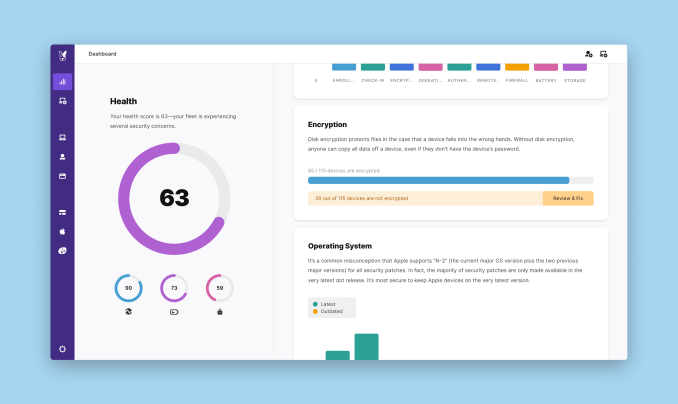
Screenshot: Fleetsmith
Fleetsmith has also set up a partner program with Managed Service Providers (MSPs) to expand its reach further. MSPs manage IT for SMBs, and building a relationship with these types of companies can help it expand much more quickly.
The approach seems to be working, as the company has 30 employees and 1,500 customers. With the new cash in pocket, it intends to hire more people and continue building out the product’s capabilities, while expanding beyond the U.S. to markets overseas.
Powered by WPeMatico
Today’s startups have a distinct advantage when it comes to launching a company because of the public cloud. You don’t have to build infrastructure or worry about what happens when you scale too quickly. The cloud vendors take care of all that for you.
But last month when Pinterest announced its IPO, the company’s cloud spend raised eyebrows. You see, the company is spending $750 million a year on cloud services, more specifically for AWS. When your business is primarily focused on photos and video, and needs to scale at a regular basis, that bill is going to be high.
That price tag prompted Erica Joy, a Microsoft engineer, to publish this tweet and start a little internal debate here at TechCrunch. Startups, after all, have a dog in this fight, and it’s worth exploring if the cloud is helping feed the startup ecosystem, or sending your bills soaring, as they have with Pinterest.
after discussion with some folks about this article and the generally ridiculous amount of money startups pay for aws, i am wondering if there is an effective, easy to use, open source tool that helps startups reduce aws spend. https://t.co/GBh40b4UOH
— EricaJoy (@EricaJoy) March 25, 2019
For starters, it’s worth pointing out that Ms. Joy works for Microsoft, which just happens to be a primary competitor of Amazon’s in the cloud business. Regardless of her personal feelings on the matter, I’m sure Microsoft would be more than happy to take over that $750 million bill from Amazon. It’s a nice chunk of business; but all that aside, do startups benefit from having access to cloud vendors?
Powered by WPeMatico
During my recent conversation with Peter Kraus, which was supposed to be focused on Aperture and its launch of the Aperture New World Opportunities Fund, I couldn’t help veering off into tangents about the market in general. Below is Kraus’ take on the availability of alpha generation, the Fed, inflation versus Amazon, housing, the cross-ownership of U.S. equities by a few huge funds and high-frequency trading.
Gregg Schoenberg: Will alpha be more available over the next five years than it has been over the last five?
To think that at some point equities won’t become more volatile and decline 20% to 30%… I think it’s crazy.
Peter Kraus: Do I think it’s more available in the next five years than it was in the last five years? No. Do I think people will pay more attention to it? Yes, because when markets are up to 30 percent, if you get another five, it doesn’t matter. When markets are down 30 percent and I save you five by being 25 percent down, you care.
GS: Is the Fed’s next move up or down?
PK: I think the Fed does zero, nothing. In terms of its next interest rate move, in my judgment, there’s a higher probability that it’s down versus up.
Powered by WPeMatico
Celonis created the idea of process mining, the act of automating the understanding and improvement of internal processes. But understanding the process in and of itself only gets you so far. Ultimately, companies need to use that information to improve the customer experience, and a new operational layer announced today could help them do that.
When we think about managing the customer experience, we tend to look at the consumer-facing app or the website. If that isn’t working right, or there is unnecessary friction in the buying process, then you can lose the customer.
But Celonis co-CEO and co-founder Alexander Rinke says that eliminating friction at the front end of the process is only part of the equation. If there is a problem anywhere in the delivery system, from the manufacturer or warehouse to back-end systems, then that kind of friction can be just as problematic, he says.
“Where process mining really helps is it reveals where there’s friction. The biggest challenge companies face is that there’s a ton of operational friction. Things get stuck. Things get delivered late. Customer promises get broken,” he said.
Part of what makes Amazon work so well isn’t just that customers can easily place orders on a website or app, but also that Amazon has figured out how to pick the order and get it to the customer in the promised amount of time. If there were any delays in that process, people wouldn’t gravitate toward Amazon as much as they do.
But most companies don’t have the operational excellence of Amazon, and that’s where Celonis thinks it can help — by identifying the bumps in the operational road and finding ways to smooth those out in an automated fashion. “Initially, we sold a product for discovery, laying the land, understanding what’s going on in complex companies. And now we see more and more companies moving into operationalizing these insights, so acting on them, fixing things that are broken, and wanting to automate these fixes,” Rinke explained.
The company’s answer to this is the beta of Workflow Engine, a tool that is designed to help companies improve that operational flow. As it describes it, “The no-code, point-and-click workflow allows business analysts to arrange process steps and connect process flows across systems.” It includes templates out of the box for common tools like SAP, Oracle, Salesforce.com, ServiceNow, Jira, etc.
He says as an example, a company may have switched to electronic payments, but it’s finding customers aren’t moving with them. They can use the tool to identify those customers and offer a discount on their next order if they pay electronically without bothering the folks who are already doing it.
The company also announced a new tool to help connect easily to SAP systems. As Rinke points out, there are hundreds of these systems running the back end (finance, inventory, HR, etc.) at companies all over the world. It’s not always easy to connect to them because of their age and complexity.
To that end, the company revealed it has bought Banyas, a tool designed to help automate workflow from SAP systems, and one that should fit in nicely with the company’s vision to automate and understand process flows across large organizations.
Celonis was founded in 2011. Today it has more than 700 employees, and has raised almost $78 million.
Powered by WPeMatico
Managed by Q, the office management platform based out of New York, has today been acquired by The We Company, formerly known as WeWork.
Financial terms were not disclosed. The WSJ reports that it was a cash and stock deal. Managed by Q, which has 500 employees, will remain as a wholly owned separate entity and CEO Dan Teran will remain following the acquisition to join WeWork leadership.
Upon its latest financing in January, Managed by Q was valued at $249 million, according to PitchBook.
Here’s what Teran had to say in a prepared statement:
We are excited for this incredible opportunity to deepen our commitment to realizing our ambitious vision of building an operating system for the built world. WeWork is uniquely positioned to invest in workplace technology and services, and I look forward to partnering with their team to build more robust products for our clients and create a global platform to help companies push the bounds on our collective potential.
Managed by Q was founded in 2014 with a plan to change the way that offices run. The platform allowed office managers and other decision-makers to handle supply stocking, cleaning, IT support and other non-work related tasks in the office by simply using the Managed by Q dashboard. Managed by Q serves the demand through a combination of in-house operators and third-party vendors and service providers.
Notably, Managed by Q took a different tack than most other logistics companies, employing their operators as W2 workers instead of 1099 contractors. Moreover, Managed by Q offered a stock option plan to operators that gives 5 percent of the company back to those employees.
The company has raised a total of $128.25 million since launch from investors such as GV, RRE and Kapor Capital. Managed by Q currently serves the markets of New York, San Francisco, Los Angeles, Chicago, Boston and Silicon Valley, with plans to aggressively expand following the acquisition, according to the WSJ.
Not only has Managed by Q swiftly matured into a big player in the NY tech scene and Future of Work space, but it has also fostered interesting competition and consolidation within the space. Managed by Q has itself made several acquisitions, including the purchase of NVS (an office space planning and project management service) and Hivy (an internal comms tool to let employees tell office managers what they need).
Powered by WPeMatico
Google today announced a few new workflow integrations for its Drive file storage service that’ll bring to the service support for some features from DocuSign and process automation platforms K2 and Nintex.
None of these new integrations are all that unusual, but if you use a combination of Drive and the newly supported tools, they will undoubtedly make your daily work a little bit easier.
For DocuSign, the new integration lets you prepare, sign and store your documents right in Google Drive, as well as trigger actions like billing, account activation and payments after an agreement has been signed.
The K2 integration is a bit different and focuses on that company’s machine learning tools. It’ll allow users to train models on a workflow (using Google machine learning tools) and then, for example, determine whether a loan should be automatically approved or denied, with all of the information about those requests and the approval process stored in a Google Sheet. The integration also supports more pedestrian use cases, though, including the ability to make lots of documents in Drive more easily discoverable.
“K2 is committed to simplifying the way in which our customers connect and manage their information, whether it resides on-premise or in the cloud,” said Eyal Inbar, vice president of Global Technology Alliances at K2. “By integrating with Google Drive, we are able to put the next-generation of content management services in the hands of our customers so they can build and implement powerful workflows into their applications.”
Nintex’s solution seems to be a bit more specialized, with a focus on contract management lifecycles for HR, legal and sales use cases. There’s nothing exciting about managing contracts, but that’s probably a good thing, and ideally, adding more automation will help to keep it that way.
Powered by WPeMatico
When everyone always tells you “yes,” you can become a monster. Leaders especially need honest feedback to grow. “If you look at rich people like Donald Trump and you neglect them, you get more Donald Trumps,” says Torch co-founder and CEO Cameron Yarbrough about our gruff president. His app wants to make executive coaching (a polite word for therapy) part of even the busiest executive’s schedule. Torch conducts a 360-degree interview with a client and their employees to assess weaknesses, lays out improvement goals and provides one-on-one video chat sessions with trained counselors.
“Essentially we’re trying to help that person develop the capacity to be a more loving human being in the workplace,” Yarbrough explains. That’s crucial in the age of “hustle porn,” where everyone tries to pretend they’re working all the time and constantly “crushing it.” That can leave leaders facing challenges feeling alone and unworthy. Torch wants to provide a private place to reach out for a helping hand or shoulder to cry on.
Now Torch is ready to lead the way to better management for more companies, as it’s just raised a $10 million Series A round led by Norwest Venture Partners, along with Initialized Capital, Y Combinator and West Ventures. It already has 100 clients, including Reddit and Atrium, but the new cash will fuel its go-to market strategy. Rather than trying to democratize access to coaching, Torch is doubling-down on teaching founders, C-suites and other senior executives how to care… or not care too much.
“I came out of a tough family myself and I had to do a ton of therapy and a ton of meditation to emerge and be an effective leader myself,” Yarbrough recalls. “Philosophically, I care about personal growth. It’s just true all the way down to birth for me. What I’m selling is authentic to who I am.”
Torch’s co-founders met when they were in grad school for counseling psychology degrees, practicing group therapy sessions together. Yarbrough went on to practice clinically and start Well Clinic in the Bay Area, while Keegan Walden got his PhD. Yarbrough worked with married couples to resolve troubles, and “the next thing I know I was working with high-profile startup founders, who like anybody have their fair share of conflicts.”

Torch co-founders (from left): Cameron Yarbrough and Keegan Walden
Coaching romantic partners to be upfront about expectations and kind during arguments translated seamlessly to keep co-founders from buckling under stress. As Yarbrough explains, “I was noticing that they were consistently having problems with five different things:
1. Communication – Surfacing problems early with kindness
2. Healthy workplace boundaries – Making sure people don’t step on each others’ toes
3. How to manage conflict in a healthy way – Staying calm and avoiding finger-pointing
4. How to be positively influential – Being motivational without being annoying or pushy
5. How to manage one’s ego, whether that’s insecurity or narcissism – Seeing the team’s win as the first priority
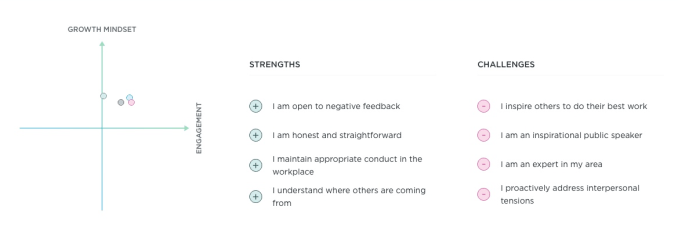
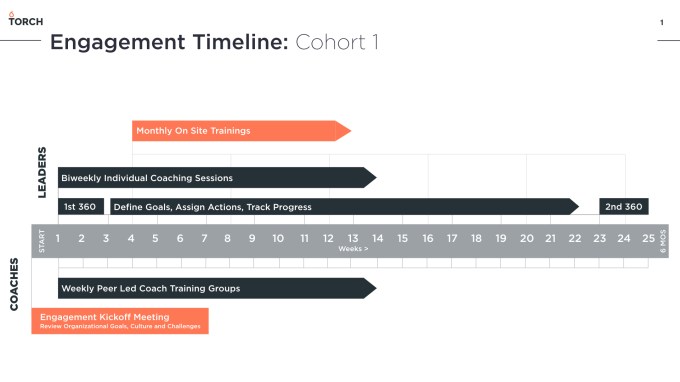
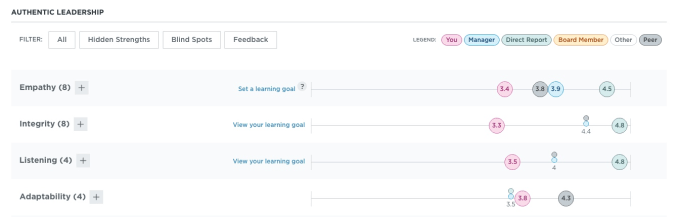
To address those, companies hire Torch to coach one or more of their executives. Torch conducts extensive 360-degree interviews with the exec, as well as their reports, employees and peers. It seeks to score them on empathy, visionary thinking, communication, conflict, management and collaboration, Torch then structures goals and improvement timelines that it tracks with follow-up interviews with the team and quantifiable metrics that can all be tracked by HR through a software dashboard.
To make progress on these fronts, execs do video chat sessions through Torch’s app with coaches trained in these skills. “These are all working people with by nature very tight schedules. They don’t have time to come in for a live session so we come to them in the form of video,” Yarbrough tells me. Rates vary from $500 per month to $1,500 per month for a senior coach in the U.S., Europe, APAC or EMEA, with Torch scoring a significant margin. “We’re B2B only. We’re not focused on being the most affordable solution. We’re focused on being the most effective. And we find that there’s less price sensitivity for senior leaders where the cost of their underperformance is incredibly high to the organization.” Torch’s top source of churn is clients’ going out of business, not ceasing to want its services.
Here are two examples of how big-wigs get better with Torch. “Let’s say we have a client who really just wants to be liked all the time, so much so that they have a hard time getting things done. The feedback from the 360 would come back like ‘I find that Cameron is continually telling me what I want to hear but I don’t know what the expectations are of me and I need him to be more direct,’ ” Yarbrough explains. “The problem is those leaders will eventually fire those people who are failing, but they’ll say they had no idea they weren’t performing because he never told them.” Torch’s coaches can teach them to practice tough-love when necessary and to be more transparent. Meanwhile, a boss who storms around the office and “is super-direct and unkind” could be instructed on how to “develop more empathic attunement.”
Yarbrough specifically designed Torch’s software to not be too prescriptive and leave room for the relationship between the coach and client to unfold. And for privacy, coaches don’t record notes and HR only sees the performance goals and progress, not the content of the video chats. It wants execs to feel comfortable getting real without the worry their personal or trade secrets could leak. “And if someone is bringing in something about trauma or that’s super-sensitive about their personal life, their coach will refer them out to psychotherapists,” Yarbrough assures me.
Torch’s direct competition comes from boutique executive coaching firms around the world, while on the tech side, BetterUp is trying to make coaching scale to every type of employee. But its biggest foe is the stubborn status quo of stiff-upper-lipping it.
The startup world has been plagued by too many tragic suicides, deep depression and paralyzing burnout. It’s easy for founders to judge their own worth not by self-confidence or even the absolute value of their accomplishments, but by their status relative to yesterday. That means one blown deal, employee quitting or product delay can make an executive feel awful. But if they turn to their peers or investors, it could hurt their partnership and fundraising prospects. To keep putting in the work, they need an emotional outlet.
“We ultimately have to create this great software that super-powers human beings. People are not robots yet. They will be someday, but not yet,” Yarbrough concludes with a laugh. IQ alone doesn’t make people succeed. Torch can help them develop the EQ, or emotional intelligence quotient, they need to become a boss that’s looked up to.
Powered by WPeMatico
Slack and other consumer-grade productivity tools have been taking off in workplaces large and small — and data governance hasn’t caught up.
Whether it’s litigation, compliance with regulations like GDPR or concerns about data breaches, legal teams need to account for new types of employee communication. And that’s hard when work is happening across the latest messaging apps and SaaS products, which make data searchability and accessibility more complex.
Here’s a quick look at the problem, followed by our suggestions for best practices at your company.
The increasing frequency of reported data breaches and expanding jurisdiction of new privacy laws are prompting conversations about dark data and risks at companies of all sizes, even small startups. Data risk discussions necessarily include the risk of a data breach, as well as preservation of data. Just two weeks ago it was reported that Jared Kushner used WhatsApp for official communications and screenshots of those messages for preservation, which commentators say complies with record keeping laws but raises questions about potential admissibility as evidence.
Powered by WPeMatico
Densify, a Toronto company that helps customers optimize their cloud resources to control usage and spending, announced a new tool today specifically designed to optimize container usage in the cloud.
Company CEO Gerry Smith says that as containerization proliferates, it’s getting more difficult to track and control cloud infrastructure resource usage as software development and deployment happens with increasing speed.
“The whole basis upon which people buy and use cloud and container resources has become wildly expensive because of the lack of a resource management system,” Smith said.
The Densify solution looks at the consumption and for ways to cut costs and usage. “We have analytics in the cloud, any of various common cloud services that you can connect to, and then we use machine learning to analyze the resources and your cloud and container consumption,” he said.
Densify continuously makes recommendations on how to make better use of resources and to find the cheapest computing, whether that’s reserved instances, spot instances or other discounted cloud resources.
What’s more, it can help you identify whether you are providing too few resources to accommodate the number of containers you are deploying, as well as too many.
This may sound a bit like what Spotinst and Cloudyn, the company Microsoft bought a couple of years ago, do in terms of helping control costs in the cloud, but Smith says for his company it’s more about understanding the resources than pure cost.
“We look at ourselves as a resource management platform. So what we do is characterize the applications, demands of CPU and all the other resources, and use machine learning to predict what it’s going to need at any given minute, at any given day of a week of the year, so that we can then better predictively match the right supply,” Smith explained.
It’s providing information about each container at a highly detailed level, including “what’s running, what resources are being allocated, and the true utilization of an organization’s Kubernetes environment at a cluster, namespace and container level,” according to the company. All of this information should help DevOps teams better understand the resources required by their container deployments.
The company has actually been around since 2006 under the name Cirba. In its early guise it helped companies manage VMware installations. In 2016, it pivoted to cloud resource management and changed the company name to Densify. It has raised around $60 million since inception, with about half of that coming after the company changed to Densify in 2016.
The company is based in Toronto, but has offices in London and Melbourne, as well.
Powered by WPeMatico
FireHydrant, an NYC startup, wants to help companies recover from IT disasters more quickly, and understand why they happened — with the goal of preventing similar future scenarios from happening again. Today, the fledgling startup announced a $1.5 million seed investment from Work-Bench, a New York City venture capital firm that invests in early-stage enterprise startups.
In addition to the funding, the company announced it was opening registration for its FireHydrant incident management platform. The product has been designed with Google’s Site Reliability Engineering (SRE) methodology in mind, but company co-founder and CEO Bobby Ross says the tool is designed to help anyone understand the cause of a disaster, regardless of what happened, and whether they practice SRE or not.
“I had been involved in several fire fighting scenarios — from production databases being dropped to Kubernetes upgrades gone wrong — and every incident had a common theme: absolute chaos,” Ross wrote in a blog post announcing the new product.
The product has two main purposes, according to Ross. It helps you figure out what’s happening as you attempt to recover from an ongoing disaster scenario, and once you’ve put out the fire, it lets you do a post-mortem to figure out exactly what happened with the hope of making sure that particular disaster doesn’t happen again.
As Ross describes it, a tool like PagerDuty can alert you that there’s a problem, but FireHydrant lets you figure out what specifically is going wrong and how to solve it. He says that the tool works by analyzing change logs, as a change is often the primary culprit of IT incidents. When you have an incident, FireHydrant will surface that suspected change, so you can check it first.
“We’ll say, hey, you had something change recently in this vicinity where you have an alert going off. There is a high likelihood that this change was actually causing your incident. And we actually bubble that up and mark it as a suspect,” Ross explained.
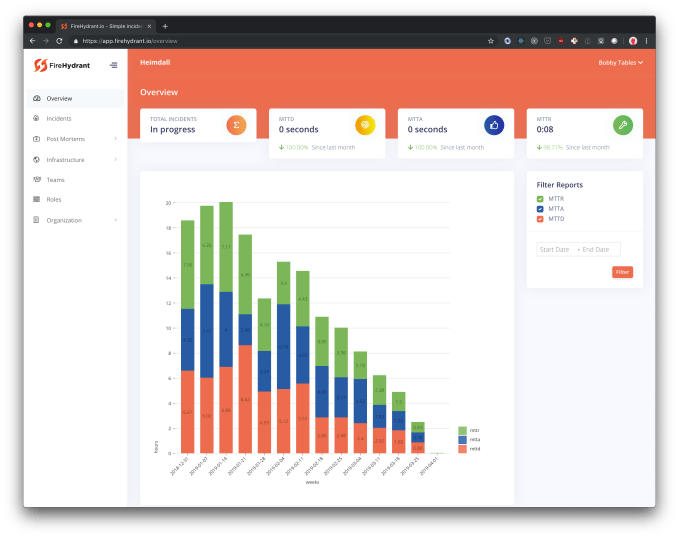
Screenshot: FireHydrant
Like so many startups, the company developed from a pain point the founders were feeling. The three founders were responsible for solving major outages at companies like Namely, DigitalOcean, CoreOS and Paperless Post.
But the actual idea for the company came about almost accidentally. In 2017, Ross was working on a series of videos and needed a way to explain what he was teaching. “I began writing every line of code with live commentary, and soon FireHydrant started to take the shape of what I envisioned as an SRE while at Namely, and I started to want it more than the video series. 40 hours of screencasts recorded later, I decided to stop recording and focus on the product…,” Ross wrote in the blog post.
Today it integrates with PagerDuty, GitHub and Slack, but the company is just getting started with the three founders, all engineers, working on the product and a handful of beta customers. It is planning to hire more engineers to keep building out the product. It’s early days, but if this tool works as described, it could go a long way toward solving the fire-fighting issues that every company faces at some point.
Powered by WPeMatico