Enterprise
Auto Added by WPeMatico
Auto Added by WPeMatico

Ticketmaster’s dominance has led to ridiculous service fees, scalpers galore and exclusive contracts that exploit venues and artists. The moronic approval of venue operator and artist management giant Live Nation’s merger with Ticketmaster in 2010 produced an anti-competitive juggernaut. It pressures venues to sign ticketing contracts under veiled threat that artists would otherwise be routed to different concert halls. Now it’s become difficult for venues, artists and fans to avoid Ticketmaster, which charges fees as high as 50% that many see as a ripoff.
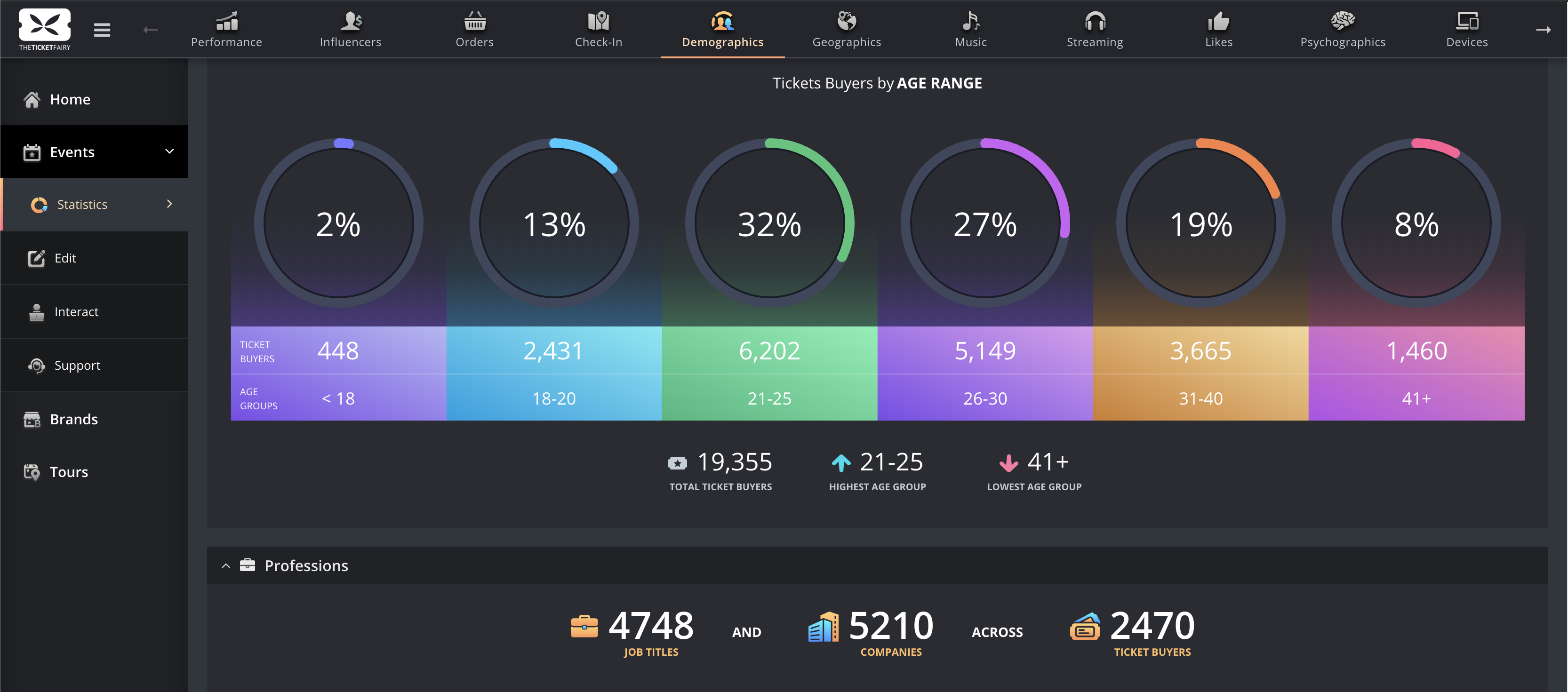
The Ticket Fairy wants to wrestle away from Ticketmaster control of venues while giving fans ways to earn tickets for referring their friends. The startup is doing that by offering the most technologically advanced ticketing platform that not only handles sales and check-ins, but acts as a full-stack Salesforce for concerts that can analyze buyers and run ad campaigns while thwarting scalpers. Co-founder Ritesh Patel says The Ticket Fairy has increased revenue for event organizers by 15% to 25% during its private beta focused on dance music festivals.
Now after 850,000 tickets sold, it’s officially launching its ticketing suite and actively poaching venues from Eventbrite as it moves deeper into esports and conventions. With a little more scale, it will be ready to challenge Ticketmaster for lucrative clients.
Ritesh’s combination of product and engineering skills, rapid progress and charismatic passion for live events after throwing 400 of his own has attracted an impressive cadre of angel investors. They’ve delivered a $2.5 million seed round for Ticket Fairy, adding to its $485,000 pre-seed from angels like Twitch/Atrium founder Justin Kan, Twitch COO Kevin Lin and Reddit CEO Steve Huffman.
The new round includes YouTube founder Steve Chen, former Kleiner Perkins partner (and Mark’s sister) Arielle Zuckerberg and funds like 500 Startups, ex-Uber angels Fantastic Ventures, G2 Ventures, Tempo Ventures and WeFunder. It’s also scored music industry angels like Serato DJ hardware CEO AJ Bertenshaw, Spotify’s head of label licensing Niklas Lundberg, and celebrity lawyer Ken Hertz, who reps Will Smith and Gwen Stefani.
“The purpose of starting The Ticket Fairy was not to be another Eventbrite, but to reduce the risk of the person running the event so they can be profitable. We’re not just another shopping cart,” Patel says. The Ticket Fairy charges a comparable rate to Eventbrite’s $1.59 + 3.5% per ticket plus payment processing that brings it closer to 6%, but Patel insists it offers far stronger functionality.
Constantly clad in his golden disco hoodie over a Ticket Fairy t-shirt, Patel lives his product, spending late nights dancing and taking feedback at the events his clients host. He’s been a savior of SXSW the past two years, injecting the aging festival that shuts down at 2am with multi-night after-hours raves. Featuring top DJs like Pretty Lights in creative locations cab drivers don’t believe are real, The Ticket Fairy’s parties have won the hearts of music industry folks.

The Ticket Fairy co-founders. Center and inset left: Ritesh Patel. Inset right: Jigar Patel
Now the Y Combinator startup hopes its ticketing platform will do the same thanks to a slew of savvy features:

Still, the biggest barrier to adoption remains the long exclusive contracts Ticketmaster and other giants like AEG coerce venues into in the U.S. Abroad, venues typically work with multiple ticket promoters who sell from the same pool, which is why 80% of The Ticket Fairy’s business is international right now. In the U.S., ticketing is often handled by a single company, except for the 8% of tickets artists can sell however they want. That’s why The Ticket Fairy has focused on signing up non-traditional venues for festivals, trade convention halls, newly built esports arenas, as well as concert halls.
“Coming from the event promotion background, we understand the risk event organizers take in creating these experiences,” The Ticket Fairy’s co-founder and Ritesh’s brother Jigar Patel explains. “The odds of breaking even are poor and many are unable to overcome those challenges, but it is sheer passion that keeps them going in the face of financial uncertainty and multi-year losses.” As competitors’ contracts expire, The Ticket Fairy hopes to swoop in by dangling its sales-boosting tech. “We get locked out of certain things because people are locked in a contract, not because they don’t want to use our system.”
The live music industry can be brutal, though. Events can have slim margins, organizers are loathe to change their process and it’s a sales-heavy process convincing them to try new software. But while the record business has been redefined by streaming, ticketing looks a lot like it did a decade ago. That makes it ripe for disruption.
“The events industry is more important than ever, with artists making the bulk of their income from touring instead of record sales, and demand from fans for live experiences is increasing at a global level,” Jigar concludes. “When events go out of business, everybody loses, including artists and fans. Everything we do at The Ticket Fairy has that firmly in mind – we are here to keep the ecosystem alive.”
Powered by WPeMatico
Google Cloud made two significant pricing announcements today. Those, you’ll surely be sad to hear, don’t involve the usual price drops for compute and storage. Instead, Google Cloud today announced that it is extending its committed-use discounts, which give you a significant discount when you commit to using a certain number of resources for one or three years, to GPUs, Cloud TPU Pods and local SSDs. In return for locking yourself into a long-term plan, you can get discounts of 55% off on-demand prices.
In addition, Google is launching a capacity reservation system for Compute Engine that allows users to reserve resources in a specific zone for later use to ensure that they have guaranteed access to these resources when needed.
At first glance, capacity reservations may seem like a weird concept in the cloud. The promise of cloud computing, after all, is that you can just spin machines up and down at will — and never really have to think about availability.
So why launch a reservation system? “This is ideal for use cases like disaster recovery or peace of mind, so a customer knows that they have some extra resources, but also for retail events like Black Friday or Cyber Monday,” Google senior product manager Manish Dalwadi told me.
These users want to have absolute certainty that when they need the resources, they will be available to them. And while many of us think of the large clouds as having a virtually infinite amount of virtual machines available at any time, some machine types may occasionally only be available in a different availability zone, for example, that is not the same zone as where the rest of your compute resources are.
Users can create or delete reservations at any time and any existing discounts — including sustained use discounts and committed use discounts — will be applied automatically.
As for committed-use discounts, it’s worth noting that Google always took a pretty flexible approach to this. Users don’t have to commit to using a specific machine type for three years, for example. Instead, they commit to using a specific number of CPU cores and memory, for example.
“What we heard from customers was that other commit models are just too inflexible and their utilization rates were very low, like 70, 60% utilization,” Google product director Paul Nash told me. “So one of our design goals with committed-use discounts was to figure out how we could provide something that gives us the capacity planning signal that we need, provides the same amount of discounts that we want to pass on to customers, but do it in a way that customers actually feel like they are getting a great deal and so that they don’t have to hyper-manage these things in order to get the most out of them.”
Both the extended committed-use discounts and the new capacity reservation system for Compute Engine resources are now live in the Google Cloud.
Powered by WPeMatico
There’s lots of data in the world these days, and there are a number of companies vying to store that data in data warehouses or lakes or whatever they choose to call it. Old-school companies have tended to be on prem, while new ones like Snowflake are strictly in the cloud. Yellowbrick Data wants to play the hybrid angle, and today it got a healthy $81 million Series C to continue its efforts.
The round was led by DFJ Growth with help from Next47, Third Point Ventures, Menlo Ventures, GV (formerly Google Ventures), Threshold Ventures and Samsung. New investors joining the round included IVP and BMW i Ventures. Today’s investment brings the total raised to a brisk $173 million.
Yellowbrick sees a world that many of the public cloud vendors like Microsoft and Google see, one where enterprise companies will be living in a hybrid world where some data and applications will stay on prem and some in the cloud. They believe this situation will be in place for the foreseeable future, so its product plays to that hybrid angle, where your data can be on prem or in the cloud.
The company did not want to discuss valuation in spite of the high amount of raised dollars. Neither did it want to discuss revenue growth rates, other than to say that it was growing at a healthy rate.
Randy Glein, partner at DFJ Growth, did say one of the things that attracted his company to invest in Yellowbrick was its momentum along with the technology, which in his view provides a more modern way to build data warehouses. “Yellowbrick is quickly providing a new generation of ultra-high performance data warehouse capabilities for large enterprises. The technology is a step function improvement on every dimension compared to legacy solutions, helping modern enterprises digest and interpret massive data workloads in a fraction of the time at a fraction of the cost,” he said in a statement.
It’s interesting that a company with just 100 employees would require this kind of money, but as company COO Jason Snodgress told TechCrunch, it costs a lot of money to build out a data warehouse. He’s not wrong. Snowflake, a company that’s building a cloud data warehouse, has raised almost a billion dollars.
Powered by WPeMatico
LinkedIn has long eyed China as an important country to offset slowing growth in more mature markets. But now it’s calling time on a localized effort after failing to see it pick up steam. The company has announced that it will be shutting down Chitu — a Chinese-only app it had built targeting younger people and those who had less of a need to network with people outside of the country — at the end of July.
The closure is notable for a couple of reasons.
First, it marks a retreat of sorts for LinkedIn in the country from building standalone apps to target younger users, and specifically those targeting young professionals, at the same time that LinkedIn also faces stiff competition from other services like Maimai and Zhaopin.
Second, Chitu was a rare (and possibly the only) example of an app from LinkedIn built specifically to target one non-English market — and a very big one at that — by building a social graph independent of LinkedIn’s. Chitu’s shutdown is therefore a sign of how LinkedIn ultimately didn’t succeed in that effort.
The company posted an announcement of the change in Chinese on Chitu’s website, and a spokesperson for LinkedIn confirmed the changes further in a statement provided to TechCrunch, where it described Chitu — which has been around since 2015 — as “one of many experiments.”
It also noted that it will be upgrading the LinkedIn core app as a “one-stop shop,” incorporating some of Chitu’s features, presumably in an effort to attract Chitu’s users rather than lose them altogether.
“Chitu will officially go offline at the end of July 2019,” the company noted in the statement. “In the future, we will focus on the continuous optimization and upgrade of the LinkedIn app, serving as a one-stop shop to accompany Chinese professionals along each step of their career development and connect to more opportunities.” We’ll post the full statement LinkedIn sent us at the bottom of this article.
LinkedIn first officially set up shop in China back in 2014 as “领英”. Its branding firm pointed out at the time that the characters’ pronunciation, “ling ying,” sounding a bit like “LinkedIn” and loosely meant “to lead elites.” It was initially established as a joint venture with Sequoia and CBC as it was still an independent company and not owned by Microsoft at the time.
LinkedIn already had users in the country at that point — some 4 million individuals and 80,000 companies were already using the English-language version of the site at the time — but the idea was to set up a local operation to seize the opportunity of creating services more tailored to the world’s biggest mobile market, which would include local language support, and to meet the regulatory demands of needing to establish local operations to do that. It included efforts to build integrations with other sites like WeChat, as well as bigger partnerships with the likes of Didi.
 A year later, Derek Shen, the LinkedIn executive who led the launch of LinkedIn China, spearheaded the launch of Chitu.
The idea was to build a new app that could tap into the smartphone craze that had swept the country, in particular among younger users who had foregone using computers in favor of their hand-held devices that they used to regularly check in on apps like WeChat.
“In the past year, we have done a lot of localization efforts and achieved great results, such as deep integration with WeChat, Weibo, QQ mailbox, and Alibaba,” he wrote in an essay at the time (originally in Chinese).
“However, in general, we are still maintaining a global platform that is not evolving fast enough, and localization is not determined. We believe that only a product that is independent of the global platform can fully meet the unique needs of social networking in China, so that we can really run like a startup.”
LinkedIn would at the same time continue to build out the Chinese version of LinkedIn itself, targeting older and more premium users who might be interacting with people in other languages, like English.
From what we understand, Chitu had a good start, with millions of users signing up in the early years, beating LinkedIn itself on user retention rates and engagement.
But a source says that internally it faced some issues for trying to develop an ecosystem independent of the LinkedIn platform, which only became more challenging after Microsoft acquired the company, the source said. (He didn’t say why, but for starters it would have been more lucrative to monetise a single user base, and develop new features for a single platform, rather than do either across multiple apps.)
“After Microsoft acquired LinkedIn, independence became unthinkable,” the source said. “People with entrepreneurial DNA have all left, so it’s natural to shut down Chitu at this point.” It didn’t help that Shen himself left the company in 2017.
It’s unclear how many users Chitu ultimately picked up, but LinkedIn says that it has 47 million LinkedIn members in China, out of a total of 610 million globally. Notably, observers point out that its two big rivals Maimai and Zhaopin are both growing faster.
 More generally, and likely to better compete against local players, LinkedIn tells us that it rebooted its growth strategy in the country last month. That new strategy appears to be based fundamentally on any new services or partnerships now stemming from one centralised platform.
“2.0 [as the new strategic effort is called] is built on LinkedIn’s vast global network of professionals with real identities and profiles as the foundation and providing a one-stop-shop services to our members and constructing an ecosystem in China,” a spokesperson said in response to a question we had about whether the company will continue to build out more partnerships with third parties. “We do not exclude any partners who participate in building this ‘one-stop-shop’ and eventually construct a powerful ecosystem.”
Here is the full statement on the shut-down of Chitu:
China is core to LinkedIn’s mission and vision globally – creating economic opportunity to every member of the global workforce. Since entering China in 2014, LinkedIn has explored its development path within the Chinese market, adjusting short-term strategies according to changes in the market environment. This includes Chitu, which launched in 2015, to help LinkedIn expand the social network market through the mobile app.
Chitu is one of many experiments we conducted to continue to learn and provide more value to members. Other efforts include WeChat integration, Sesame Credit partnership etc. Based on user feedback and data analysis, we find that Chinese professionals are proactively seeking for career development opportunities. We incorporate many learnings and insights from Chitu into our new offerings on LinkedIn app that we believe will cover different needs and stages in professional and career development.
Chitu will officially go offline at the end of July 2019, following the completion of its historical mission. In the future, we will focus on the continuous optimization and upgrade of the LinkedIn app, serving as a one-stop shop to accompany Chinese professionals along each step of their career development and connect to more opportunities.
Powered by WPeMatico
Aion Network, a nonprofit dedicated to creating tools to promote blockchain technologies, announced a new virtual machine today that’s built on top of the popular Java Virtual Machine. Its ultimate goal is increasing the popularity of blockchain with developers.
Aion CEO Matthew Spoke says one of the barriers to more widespread blockchain adoption has been a lack of tooling for developers in a common language like Java. The company believed if they could build a virtual machine specifically for blockchain on top of the Java Virtual Machine (JVM), which has been in use for years, it could help promote more extensive use of blockchain.
Today, it’s announcing the Aion Virtual Machine (AVM), a virtual machine that sits on top of the JVM. AVM makes it possible for developers to use their familiar toolset while building in the blockchain bits like smart contracts in the AVM without having to alter the JVM at all.
“We didn’t want to modify the JVM. We wanted to build some sort of supplementary software layer that can interact with the JVM. Blockchains have a set of unique criteria. They need to be deterministic; the computing needs to happen across the distributed network of nodes; and the JVM was never designed with this in mind,” Spoke explained.
Aion set out to build a virtual machine for blockchain without reinventing the wheel. It recognized that Java remains one of the most popular programming languages around, and it didn’t want to mess with that. In fact, it wanted to take advantage of the popularity by building a kind of blockchain interpreter that would sit on top of the JVM without getting in the way of it.
“Rather than trying to convince people of the merits of a new system, can we just get the system they’re already familiar with on top of the blockchain? So we started engineering towards that solution. And we’ve been working on that since for about a year at this point, leading up to our release this week to prove that we can solve that problem,” Spoke told TechCrunch.
Up to this point, Aion has been focusing on the crypto community, but the company felt to really push the blockchain beyond the realm of the true believers, it needed to come up with a way for developers who weren’t immersed in this to take advantage of it.
“Our big focus now is how do we take this message of building blockchain apps and take it into a more traditional software industry audience. Instead of trying to compete for the attention of crypto developers, we want the blockchain to become almost a micro service layer to what normal software developers are solving on a day-to-day basis,” he said.
The company is hoping that by providing this way to access blockchain services, it can help popularize blockchain concepts with developers who might not otherwise have been familiar with them. It’s but one attempt to bring blockchain to more business-oriented use cases, but the company has given this a lot of thought and believes it will help them evangelize this approach with a wider audience of developers moving forward.
Powered by WPeMatico
The big social networks and video games have failed to prioritize user well-being over their own growth. As a result, society is losing the battle against bullying, predators, hate speech, misinformation and scammers. Typically when a whole class of tech companies have a dire problem they can’t cost-effectively solve themselves, a software-as-a-service emerges to fill the gap in web hosting, payment processing, etc. So along comes AntiToxin Technologies, a new startup that wants to help web giants fix their abuse troubles with its safety-as-a-service.
It all started on Minecraft. AntiToxin co-founder Ron Porat is cybersecurity expert who’d started ad blocker Shine. Yet right under his nose, one of his kids was being mercilessly bullied on the hit children’s game. If even those most internet-savvy parents were being surprised by online abuse, Porat realized the issue was bigger than could be addressed by victims trying to protect themselves. The platforms had to do more, research confirmed.

A recent Ofcom study found almost 80% of children had a potentially harmful online experience in the past year. Indeed, 23% said they’d been cyberbullied, and 28% of 12 to 15-year-olds said they’d received unwelcome friend or follow requests from strangers. A Ditch The Label study found of 12 to 20-year-olds who’d been bullied online, 42% were bullied on Instagram.
Unfortunately, the massive scale of the threat combined with a late start on policing by top apps makes progress tough without tremendous spending. Facebook tripled the headcount of its content moderation and security team, taking a noticeable hit to its profits, yet toxicity persists. Other mainstays like YouTube and Twitter have yet to make concrete commitments to safety spending or staffing, and the result is non-stop scandals of child exploitation and targeted harassment. Smaller companies like Snap or Fortnite-maker Epic Games may not have the money to develop sufficient safeguards in-house.
“The tech giants have proven time and time again we can’t rely on them. They’ve abdicated their responsibility. Parents need to realize this problem won’t be solved by these companies” says AntiToxin co-founder and CEO Zohar Levkovitz, who previously sold his mobile ad company Amobee to Singtel for $321 million. “You need new players, new thinking, new technology. A company where ‘Safety’ is the product, not an after-thought. And that’s where we come-in.” The startup recently raised a multimillion-dollar seed round from Mangrove Capital Partners and is allegedly prepping for a double-digit millions Series A.

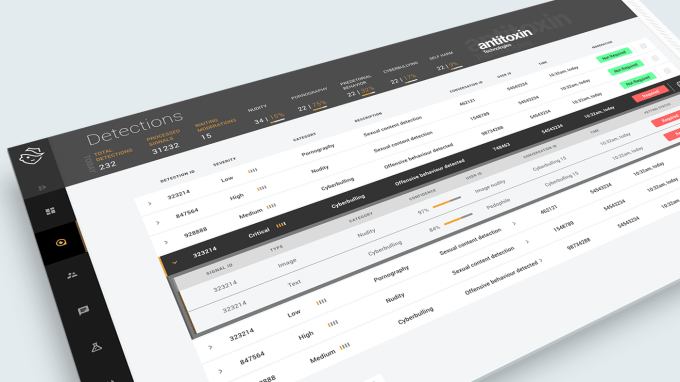
AntiToxin’s technology plugs into the backends of apps with social communities that either broadcast or message with each other and are thereby exposed to abuse. AntiToxin’s systems privately and securely crunch all the available signals regarding user behavior and policy violation reports, from text to videos to blocking. It then can flag a wide range of toxic actions and let the client decide whether to delete the activity, suspend the user responsible or how else to proceed based on their terms and local laws.
Through the use of artificial intelligence, including natural language processing, machine learning and computer vision, AntiToxin can identify the intent of behavior to determine if it’s malicious. For example, the company tells me it can distinguish between a married couple consensually exchanging nude photos on a messaging app versus an adult sending inappropriate imagery to a child. It also can determine if two teens are swearing at each other playfully as they compete in a video game or if one is verbally harassing the other. The company says that beats using static dictionary blacklists of forbidden words.
AntiToxin is under NDA, so it can’t reveal its client list, but claims recent media attention and looming regulation regarding online abuse has ramped up inbound interest. Eventually the company hopes to build better predictive software to identify users who’ve shown signs of increasingly worrisome behavior so their activity can be more closely moderated before they lash out. And it’s trying to build a “safety graph” that will help it identify bad actors across services so they can be broadly deplatformed similar to the way Facebook uses data on Instagram abuse to police connected WhatsApp accounts.
“We’re approaching this very human problem like a cybersecurity company, that is, everything is a Zero-Day for us” says Levkowitz, discussing how AntiToxin indexes new patterns of abuse it can then search for across its clients. “We’ve got intelligence unit alums, PhDs and data scientists creating anti-toxicity detection algorithms that the world is yearning for.” AntiToxin is already having an impact. TechCrunch commissioned it to investigate a tip about child sexual imagery on Microsoft’s Bing search engine. We discovered Bing was actually recommending child abuse image results to people who’d conducted innocent searches, leading Bing to make changes to clean up its act.

AntiToxin identified publicly listed WhatsApp Groups where child sexual abuse imagery was exchanged
One major threat to AntiToxin’s business is what’s often seen as boosting online safety: end-to-end encryption. AntiToxin claims that when companies like Facebook expand encryption, they’re purposefully hiding problematic content from themselves so they don’t have to police it.
Facebook claims it still can use metadata about connections on its already encrypted WhatApp network to suspend those who violate its policy. But AntiToxin provided research to TechCrunch for an investigation that found child sexual abuse imagery sharing groups were openly accessible and discoverable on WhatsApp — in part because encryption made them hard to hunt down for WhatsApp’s automated systems.
AntiToxin believes abuse would proliferate if encryption becomes a wider trend, and it claims the harm that it causes outweighs fears about companies or governments surveiling unencrypted transmissions. It’s a tough call. Political dissidents, whistleblowers and perhaps the whole concept of civil liberty rely on encryption. But parents may see sex offenders and bullies as a more dire concern that’s reinforced by platforms having no idea what people are saying inside chat threads.
What seems clear is that the status quo has got to go. Shaming, exclusion, sexism, grooming, impersonation and threats of violence have started to feel commonplace. A culture of cruelty breeds more cruelty. Tech’s success stories are being marred by horror stories from their users. Paying to pick up new weapons in the fight against toxicity seems like a reasonable investment to demand.
Powered by WPeMatico
Slack wants to be the new operating system for teams, something it has made clear on more than one occasion, including in its recent S-1 filing. To accomplish that goal, it put together an in-house $80 million venture fund in 2015 to invest in third-party developers building on top of its platform.
Weeks ahead of its direct listing on The New York Stock Exchange, it continues to put that money to work.
Troops is the latest to land additional capital from the enterprise giant. The New York-based startup helps sales teams communicate with a customer relationship management tool plugged directly into Slack. In short, it automates routine sales management activities and creates visibility into important deals through integrations with employee emails and Salesforce.
Troops founder and chief executive officer Dan Reich, who previously co-founded TULA Skincare, told TechCrunch he opted to build a Slackbot rather than create an independent platform because Slack is a rocket ship and he wanted a seat on board: “When you think about where Slack will go in the future, it’s obvious to us that companies all over the world will be using it,” he said.
Troops has raised $12 million in Series B funding in a round led by Aspect Ventures, with participation from the Slack Fund, First Round Capital, Felicis Ventures, Susa Ventures, Chicago Ventures, Hone Capital, InVision founder Clark Valberg and others. The round brings Troops’ total raised to $22 million.
Launched in 2015 by New York tech veterans Reich, Scott Britton and Greg Ratner, the trio weren’t initially sure of Slack’s growth trajectory. It wasn’t until Slack confirmed its intent to support the developer ecosystem with a suite of developer tools and a fund that the team focused its efforts on building a Slackbot.
“People sometimes thought of us, at least in the early days, as a little bit crazy,” Reich said. “But now Slack is the fastest-growing SaaS company ever.”
“We think the biggest opportunity in the [enterprise SaaS] category is going to be tools oriented around the customer-facing employee (CRM), and that’s where we are innovating,” he added.
Troops’ tools are helpful for any customer-facing team, Reich explains. Envoy, WeWork, HubSpot and a few hundred others are monthly paying subscribers of the tool, using it to interact with their CRM in a messaging interface and to receive notifications when a deal has closed. Troops integrates with Salesforce, so employees can use it to search records, schedule automatic reports and celebrate company wins.
Slack, in partnership with a number of venture capital funds, including Accel, Kleiner Perkins and Index, has also deployed capital to a number of other startups, like Lattice, Drafted and Loom.
With Slack’s direct listing afoot, the Troops team is counting on the imminent and long-term growth of the company’s platform.
“We think it’s still early days,” Reich said. “In the future, we see every company using something like Troops to manage their day-to-day.”
Powered by WPeMatico
Open source has become the de facto standard for building the software that underpins the complex infrastructure that runs everything from your favorite mobile apps to your company’s barely usable expense tool. Over the course of the last few years, a lot of new software is being deployed on top of Kubernetes, the tool for managing large server clusters running containers that Google open-sourced five years ago.
Today, Kubernetes is the fastest growing open-source project, and earlier this month, the bi-annual KubeCon+CloudNativeCon conference attracted almost 8,000 developers to sunny Barcelona, Spain, making the event the largest open-source conference in Europe yet.
To talk about how Kubernetes came to be, I sat down with Craig McLuckie, one of the co-founders of Kubernetes at Google (who then went on to his own startup, Heptio, which he sold to VMware); Tim Hockin, another Googler who was an early member on the project and was also on Google’s Borg team; and Gabe Monroy, who co-founded Deis, one of the first successful Kubernetes startups, and then sold it to Microsoft, where he is now the lead PM for Azure Container Compute (and often the public face of Microsoft’s efforts in this area).
To set the stage a bit, it’s worth remembering where Google Cloud and container management were five years ago.
Powered by WPeMatico
Zuora has been known throughout its 12-year history as a company that helps manage subscription-based businesses. Today, at its Subscribed San Francisco customer conference, it announced that it’s adding a new twist to the platform with a new service called the Zuora Central developer platform.
The latest offering gives developers a workflow tool to build connections between systems that extend the given service using both Zuora’s service set and any external services that make sense. Tien Tzuo, founder and CEO at Zuora, sees this as a way for his customers to offer a set of integrated services that take advantage of the fact that these individual things are connected to the internet, whether that’s a car, an appliance, a garage door opener or a multimillion-dollar medical device.
And this isn’t even necessarily about taking advantage of your smartphone, although it could include that. It’s about extending the device or service to automate a set of related tasks beyond the subscription service itself. “So you create a workflow diagram in Zuora Central that’s going to convey all of the logic of this,” Tzuo said.

Zuora Central lets developers connect to both Zuora services and external services (Diagram: Zuora)
As an example, Tzuo says imagine you are renting a car. You have reserved a Ford Focus, but when you get to the lot, you decide you want the Mustang convertible. You don’t have to pull out your phone. You simply walk up to the car and touch the handle. It understands who you are and begins to make a series of connections. There may be a call to unlock the car, a call to the music system to play your driving playlist on Spotify, a call to your car preferences that can set the seats and mirrors and so forth. All of this is possible because the car itself is connected to the internet.

Zuora workflow in action (Screenshot: Zuora)
Under the hood, the workflow tool takes advantage of a number of different technologies to make all of this happen, including a custom object model, an events and notifications system and a data query engine. All of these tools combine to let developers build these complex workflows and connect to a number of tasks, greatly enhancing the capabilities of the base Zuora platform.
As Tzuo sees it, it’s not unlike what happened when he was chief marketing officer at Salesforce, before starting Zuora, when they launched Force.com and the AppExchange as a way to allow developers to extend the Salesforce product beyond its base capabilities.
Tzuo also sees this platform play as a logical move for any company that aspires to be a billion-dollar-revenue company. The company has a ways to go in that regard. In its most recent report at the end of May, it reported $64.1 million in revenue for the quarter. Whether this new capability will do for Zuora what extending the platform did for Salesforce remains to be seen, but this is certainly a big step for the company.
Powered by WPeMatico
Foursquare just made its first acquisition. The location tech company has acquired Placed from Snap Inc. on the heels of a fresh $150 million investment led by The Raine Group. The terms of the deal were not disclosed. Placed founder and CEO David Shim will become president of Foursquare.
Placed is the biggest competitor to Foursquare’s Attribution product, which allows brands to track the physical impact (foot traffic to store) of a digital campaign or ad. Up until now, Placed and Attribution by Foursquare combined have measured more than $3 billion in ad-to-store visits.
Placed launched in 2011 and raised $13.4 million (according to Crunchbase) before being acquired by Snap Inc. in 2017.
As part of the deal with Foursquare, the company’s Attribution product will henceforth be known as Placed powered by Foursquare. The acquisition also means that Placed powered by Foursquare will have more than 450 measureable media partners, including Twitter, Snap, Pandora and Waze. Moreover, more than 50% of the Fortune 100 are partnered with Placed or Foursquare.
It’s also worth noting that this latest investment of $150 million is the biggest financing round for Foursquare ever, and comes following a $33 million Series F last year.
Here’s what Foursquare CEO Jeff Glueck had to say about the financing in a prepared statement:
This is one of the largest investments ever in the location tech space. The investment will fund our acquisition and also capitalize us for our increased R&D and expansion plans, allowing us to focus on our mission to build the world’s most trusted, independent location technology platform.
That last bit, about an independent location technology platform, is important here. Foursquare is 10 years old and has transformed from a consumer-facing location check-in app — a game, really — into a location analytics and development platform.
Indeed, when Glueck paints his vision for the company, he lists five key areas of focus:
You’ll notice that its consumer apps, Foursquare and Swarm, are at the bottom of the list. But that’s because Foursquare’s real technological and strategic advantage isn’t in building the best social platform. In fact, Glueck said that more than 90% of the company’s revenue came from the enterprise side of the business. Foursquare’s advantage is in the accuracy of its technology, as afforded by the decade of data that has come from Foursquare, Swarm and the users who have expressly verified their location.
The Pilgrim SDK fits into that top item on the list: developer tools. The Pilgrim SDK allows developers to embed location-smart experiences and notifications into their apps and services. But it also expands Foursquare’s access to data from beyond its own apps to the greater ecosystem, yielding the data it needs to power analytics tools for brands and publishers.
With this acquisition, Placed will be able to leverage Foursquare’s existing map of 105 million places of interest across 190 countries, as well as tap into the measured U.S. audience of more than 100 million monthly devices:
Foursquare and Placed share a similar philosophy of building against a truth set of real consumer responses. Getting real people to confirm the name of their location is the only way to know if your technology is accurate or not. Placed has leveraged over 135 million survey responses in its first-party Placed survey apps, all from consumers opted-in to its rewards app. Foursquare expands the truth set for machine learning exponentially by adding in our over 13 billion consumer confirmations.
The hope is that Foursquare is accurate enough to become the de facto location analytics and services company for measuring ad spend. With enough scale, that may allow the company to break into the walled gardens where most of that ad spend is going: Facebook and Google.
Of course, to win as the “world’s most trusted, independent location technology platform,” consumers have to trust the platform. After all, one’s location may be the most sensitive piece of data about them. Foursquare has taken steps to be clear about what its technology is capable of. In fact, at SXSW this year, Foursquare offered a limited run of a product called Hypertrending, which was essentially an anonymized view of real-time location data showing activity in the Austin area.
Here’s what executive chairman and co-founder Dennis Crowley had to say at the time:
We feel the general trend with internet and technology companies these days has been to keep giving users a more and more personalized (albeit opaquely personalized) view of the world, while the companies that create these feeds keep the broad “God View” to themselves. Hypertrending is one example of how we can take Foursquare’s aggregate view of the world and make it available to the users who make it what it is. This is what we mean when we talk about “transparency” – we want to be honest, in public, about what our technology can do, how it works, and the specific design decisions we made in creating it.
With regards to today’s acquisition of Placed, Jeff Glueck had this to say:
Both companies also share a commitment to privacy and consumers being in control. Our Foursquare credo of “data as a privilege” only deepens as our company expands. We believe location should only be shared when consumers can see real value and visible benefits driven by location. We remain dedicated to elevating the industry through respect for transparency, user control, and instituting layers of privacy safeguards.
This new financing brings Foursquare’s total funding to $390.4 million.
Powered by WPeMatico