Enterprise
Auto Added by WPeMatico
Auto Added by WPeMatico
Let’s rewind a decade. It’s 2009. Vancouver, Canada.
Stewart Butterfield, known already for his part in building Flickr, a photo-sharing service acquired by Yahoo in 2005, decided to try his hand — again — at building a game. Flickr had been a failed attempt at a game called Game Neverending followed by a big pivot. This time, Butterfield would make it work.
To make his dreams a reality, he joined forces with Flickr’s original chief software architect Cal Henderson, as well as former Flickr employees Eric Costello and Serguei Mourachov, who like himself, had served some time at Yahoo after the acquisition. Together, they would build Tiny Speck, the company behind an artful, non-combat massively multiplayer online game.
Years later, Butterfield would pull off a pivot more massive than his last. Slack, born from the ashes of his fantastical game, would lead a shift toward online productivity tools that fundamentally change the way people work.

In mid-2009, former TechCrunch reporter-turned-venture-capitalist M.G. Siegler wrote one of the first stories on Butterfield’s mysterious startup plans.
“So what is Tiny Speck all about?” Siegler wrote. “That is still not entirely clear. The word on the street has been that it’s some kind of new social gaming endeavor, but all they’ll say on the site is ‘we are working on something huge and fun and we need help.’”
Maybe I make a terrible boss, but at least I know it. Work with me: http://tinyspeck.com/jobs/cptl/
— Stewart Butterfield (@stewart) July 10, 2009
Siegler would go on to invest in Slack as a general partner at GV, the venture capital arm of Alphabet .
“Clearly this is a creative project,” Siegler added. “It almost sounds like they’re making an animated movie. As awesome as that would be, with people like Henderson on board, you can bet there’s impressive engineering going on to turn this all into a game of some sort (if that is in fact what this is all about).”
After months of speculation, Tiny Speck unveiled its project: Glitch, an online game set inside the brains of 11 giants. It would be free with in-game purchases available and eventually, a paid subscription for power users.
Powered by WPeMatico
The Valley’s rocky history with cleantech investing has been well-documented.
Startups focused on non-emitting-generation resources were once lauded as the next big cash cow, but the sector’s hype quickly got away from reality.
Complex underlying science, severe capital intensity, slow-moving customers and high-cost business models outside the comfort zones of typical venture capital ultimately caused a swath of venture-backed companies and investors in the cleantech boom to fall flat.
Yet, decarbonization and sustainability are issues that only seem to grow more dire and more galvanizing for founders and investors by the day, and more company builders are searching for new ways to promote environmental resilience.
While funding for cleantech startups can be hard to find nowadays, over time we’ve seen cleantech startups shift down the stack away from hardware-focused generation plays toward vertical-focused downstream software.
A far cry from past waves of venture-backed energy startups, the downstream cleantech companies offered more familiar technology with more familiar business models, geared toward more recognizable verticals and end users. Now, investors from less traditional cleantech backgrounds are coming out of the woodwork to take a swing at the energy space.
An emerging group of non-traditional investors getting involved in the clean energy space are those traditionally focused on fintech, such as New York and Europe-based venture firm Anthemis — a financial services-focused team that recently sat down with our fintech contributor Gregg Schoenberg and I (check out the full meat of the conversation on Extra Crunch).
The tie between cleantech startups and fintech investors may seem tenuous at first thought. However, financial services have long played a significant role in the energy sector and is now becoming a more common end customer for energy startups focused on operations, management and analytics platforms, thus creating real opportunity for fintech investors to offer differentiated value.
Though the conversation around energy resources and decarbonization often focuses on politics, a significant portion of decisions made in the energy generation business is driven by pure economics — is it cheaper to run X resource relative to resources Y and Z at a given point in time? Based on bid prices for request for proposals (RFPs) in a specific market and the cost-competitiveness of certain resources, will a developer be able to hit their targeted rate of return if they build, buy or operate a certain type of generation asset?
Alternative generation sources like wind, solid oxide fuel cells or large-scale or even rooftop solar have reached more competitive cost levels — in many parts of the U.S., wind and solar are in fact often the cheapest form of generation for power providers to run.
Thus as renewable resources have grown more cost competitive, more infrastructure developers and other new entrants have been emptying their wallets to buy up or build renewable assets like large-scale solar or wind farms, with the American Council on Renewable Energy even forecasting cumulative private investment in renewable energy possibly reaching up to $1 trillion in the U.S. by 2030.
A major and swelling set of renewable energy sources are now led by financial types looking for tools and platforms to better understand the operating and financial performance of their assets, in order to better maximize their return profile in an increasingly competitive marketplace.
Therefore, fintech-focused venture firms with financial service pedigrees, like Anthemis, now find themselves in pole position when it comes to understanding cleantech startup customers, how they make purchase decisions, and what they’re looking for in a product.
In certain cases, fintech firms can even offer significant insight into shaping the efficacy of a product offering. For example, Anthemis portfolio company kWh Analytics provides a risk management and analytics platform for solar investors and operators that helps break down production, financial analysis and portfolio performance.
For platforms like kWh analytics, fintech-focused firms can better understand the value proposition offered and help platforms understand how their technology can mechanically influence rates of return or otherwise.
The financial service customers for clean energy-related platforms extends past just private equity firms. Platforms have been and are being built around energy trading, renewable energy financing (think financing for rooftop solar) or the surrounding insurance market for assets.
When speaking with several of Anthemis’ cleantech portfolio companies, founders emphasized the value of having a fintech investor on board that not only knows the customer in these cases, but that also has a deep understanding of the broader financial ecosystem that surrounds energy assets.
Founders and firms seem to be realizing that various arms of financial services are playing growing roles when it comes to the development and access to clean energy resources.
By offering platforms and surrounding infrastructure that can improve the ease of operations for the growing number of finance-driven operators or can improve the actual financial performance of energy resources, companies can influence the fight for environmental sustainability by accelerating the development and adoption of cleaner resources.
Ultimately, a massive number of energy decisions are made by financial services firms and fintech firms may often know the customers and products of downstream cleantech startups more than most. And while the financial services sector has often been labeled as dirty by some, the vital role it can play in the future of sustainable energy offers the industry a real chance to clean up its image.
Powered by WPeMatico

Startups are often associated with the benefits and toys provided in their offices. Foosball tables! Free food! Dog friendly! But what if the future of startups was less about physical office space and more about remote-first work environments? What if, in fact, the most compelling aspect of a startup work environment is that the employees don’t have to go to one?
A remote-first company model has been Seeq’s strategy since our founding in 2013. We have raised $35 million and grown to more than 100 employees around the globe. Remote-first is clearly working for us and may be the best model for other software companies as well.
So, who is Seeq and what’s been the key to making the remote-first model work for us? And why did we do it in the first place?
Seeq is a remote-first startup – i.e. it was founded with the intention of not having a physical headquarters or offices, and still operates that way – that is developing an advanced analytics application that enables process engineers and subject matter experts in oil & gas, pharmaceuticals, utilities, and other process manufacturing industries to investigate and publish insights from the massive amounts of sensor data they generate and store.
To succeed, we needed to build a team quickly with two skill sets: 1) software development expertise, including machine learning, AI, data visualization, open source, agile development processes, cloud, etc. and 2) deep domain expertise in the industries we target.
Which means there is no one location where we can hire all the employees we need: Silicon Valley for software, Houston for oil & gas, New Jersey for fine chemicals, Seattle for cloud expertise, water utilities across the country, and so forth. But being remote-first has made recruiting and hiring these high-demand roles easier much easier than if we were collocated.
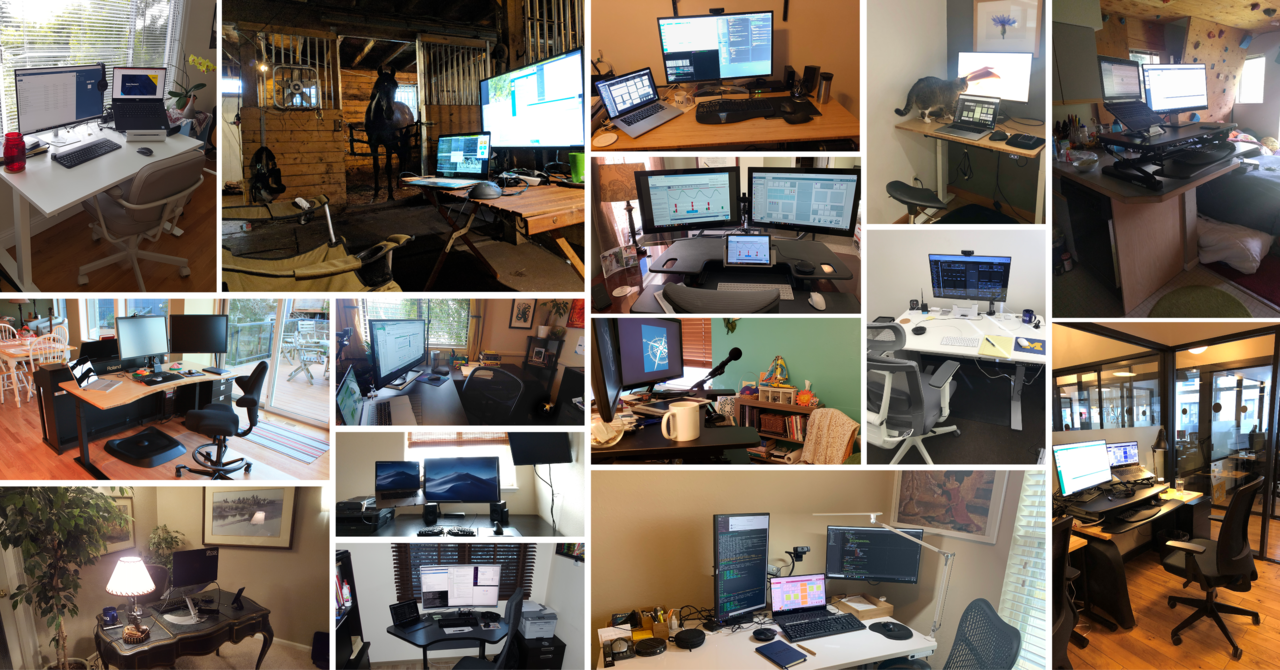
Image via Seeq Corporation
Job postings on remote-specific web sites like FlexJobs, Remote.co and Remote OK typically draw hundreds of applicants in a matter of days. This enables Seeq to hire great employees who might not call Seattle, Houston or Silicon Valley home – and is particularly attractive to employees with location-dependent spouses or employees who simply want to work where they want to live.
But a remote-first strategy and hiring quality employees for the skills you need is not enough: succeeding as a remote-first company requires a plan and execution around the “3 C’s of remote-first”.
Powered by WPeMatico
Talkspace, the platform that lets patients and therapists communicate online, has today announced the close of a $50 million financing round led by Revolution Growth. Existing investors, such as Norwest Venture Partners, Omura Capital, Spark Capital and Compound Ventures, are also participating in the round.
As part of the deal, Revolution Growth’s Patrick Conroy will join the Talkspace board of directors.
Talkspace launched back in 2012 with a mission to make therapy accessible to as many people as possible. The platform allows users to pay a subscription fee for unlimited messaging with one of the company’s 5,000 healthcare professionals. Since launch, Talkspace has rolled out products specific to certain users, such as teenagers or couples.
The company also partners with insurance providers and employers to offer Talkspace services to their members/employees as part of a commercial business. Today, Talkspace has announced a partnership with Optum Health. This expands Talkspace’s commercial reach to 5 million people.
According to the release, Talkspace will use the funding to accelerate the growth of its commercial business.
Here’s what Talkspace CEO and co-founder Oren Frank had to say in a prepared statement:
Our advanced capabilities in data science enable us to not only open access to therapy, but also identify the attributes of successful therapeutic relationships and apply that knowledge throughout the predictive products we build, to the therapists that use our platform, and in the content we provide.
This brings Talkspace’s total funding to $110 million.
Powered by WPeMatico
Logz.io announced a $52 million Series D investment today. The round was led by General Catalyst.
Other investors participating in the round included OpenView Ventures, 83North, Giza Venture Capital, Vintage Investment Partners, Greenspring Associates and Next47. Today’s investment brings the total raised to nearly $100 million, according to Crunchbase data.
Logz.io is a company built on top of the open-source tools Elasticsearch, Logstash and Kibana (collectively known by the acronym ELK) and Grafana. It’s taking those tools in a typical open-source business approach, packaging them up and offering them as a service. This approach enables large organizations to take advantage of these tools without having to deal with the raw open-source projects.
The company’s solutions intelligently scan logs looking for anomalies. When it finds them, it surfaces the problem and informs IT or security, depending on the scenario, using a tool like PagerDuty. This area of the market has been dominated in recent years by vendors like Splunk and Sumo Logic, but company founder and CEO Tomer Levy saw a chance to disrupt that space by packaging a set of open-source logging tools that were rapidly increasing in popularity. They believed they could build on that growing popularity, while solving a pain point the founders had actually experienced in previous positions, which is always a good starting point for a startup idea.
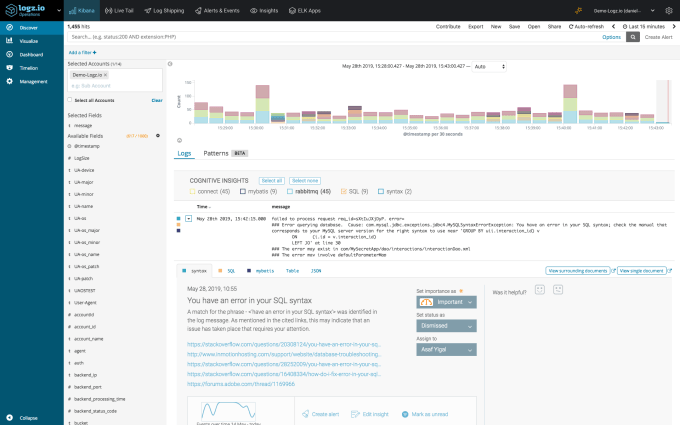
Screenshot: Logz.io
“We saw that the majority of the market is actually using open source. So we said, we want to solve this problem, a problem we have faced in the past and didn’t have a solution. What we’re going to do is we’re going to provide you with an easy-to-use cloud service that is offering an open-source compatible solution,” Levy explained. In other words, they wanted to build on that open-source idea, but offer it in a form that was easier to consume.
Larry Bohn, who is leading the investment for General Catalyst, says that his firm liked the idea of a company building on top of open source because it provides a built-in community of developers to drive the startup’s growth — and it appears to be working. “The numbers here were staggering in terms of how quickly people were adopting this and how quickly it was growing. It was very clear to us that the company was enjoying great success without much of a commercial orientation,” Bohn explained.
In fact, Logz.io already has 700 customers, including large names like Schneider Electric, The Economist and British Airways. The company has 175 employees today, but Levy says they expect to grow that by 250 by the end of this year, as they use this money to accelerate their overall growth.
Powered by WPeMatico
Equalum, an Israeli startup that helps companies gather data from a variety of enterprise sources, announced an $18 million Series B investment today.
The round was led by Planven Investments . Other participants included United Ventures and prior investors Innovation Endeavors and GE Ventures, along with a group of unnamed individuals. Today’s haul brings the total raised to $25 million, according to data provided by the company.
Equalum CEO and founder Nir Livneh says his company essentially acts as the data pipes to feed artificial intelligence, machine and more traditional business intelligence requirements. “Equalum is a real-time data ingestion platform. The idea of the platform is to be able to [gather] data coming from a bunch of enterprise system sources and be able to centralize that data and send it in real-time into analytic environments and feed those analytic environments,” Livneh explained.
He sees the money from this round as a way to continue to expand the original vision he had for the company. His approach in many ways is a classic Series B play. “I think the original thesis was validated. We have proven that we can go into Fortune 100 companies and get our solution adopted quickly,” he said. The next step is to expand beyond the original set of several dozen large customers and accelerate growth.
The company was founded in 2015 in Tel Aviv, Israel. It still maintains its R&D arm there today, with sales, marketing and management in Silicon Valley. Interestingly, its first customer was GE, which was also an early investor via GE Ventures.
Livneh says that he sees lots of room to grow in this market, which he says is still dominated by legacy vendors. He believes he can swoop in and replace aging offerings by providing a more modern and streamlined approach to data collection. Time will tell if he is right.
Powered by WPeMatico
When FireEye reported its earnings last month, the outlook was a little light, so the security vendor decided to be proactive and make a big purchase. Today, the company announced it has acquired Verodin for $250 million. The deal closed today.
The startup had raised over $33 million since it opened its doors five years ago, according to Crunchbase data, and would appear to have given investors a decent return. With Verodin, FireEye gets a security validation vendor; that is, a company that can run a review against the existing security setup and find gaps in coverage.
That would seem to be a handy kind of tool to have in your security arsenal, and could possibly explain the price tag. Perhaps it could also help set FireEye apart from the broader market, or fill in a gap in its own platform.
FireEye CEO Kevin Mandia certainly sees the potential of his latest purchase. “Verodin gives us the ability to automate security effectiveness testing using the sophisticated attacks we spend hundreds of thousands of hours responding to, and provides a systematic, quantifiable, and continuous approach to security program validation,” he said in a statement.
Chris Key, Verodin co-founder and chief executive officer, sees the purchase through the standard acquisition lens. “By joining FireEye, Verodin extends its ability to help customers take a proactive approach to understanding and mitigating the unique risks, inefficiencies and vulnerabilities in their environments,” he said in a statement. In other words, as part of a bigger company, we’ll do more faster.
While FireEye plans to incorporate Verodin into its on-prem and managed services, it will continue to sell the solution as a standalone product, as well.
Powered by WPeMatico
There is a tendency at any conference to get lost in the message. Spending several days immersed in any subject tends to do that. The purpose of such gatherings is, after all, to sell the company or technologies being featured.
Against the beautiful backdrop of the city of Barcelona last week, we got the full cloud native message at KubeCon and CloudNativeCon. The Cloud Native Computing Foundation (CNCF), which houses Kubernetes and related cloud native projects, had certainly honed the message along with the community who came to celebrate its five-year anniversary. The large crowds that wandered the long hallways of the Fira Gran Via conference center proved it was getting through, at least to a specific group.
Cloud native computing involves a combination of software containerization along with Kubernetes and a growing set of adjacent technologies to manage and understand those containers. It also involves the idea of breaking down applications into discrete parts known as microservices, which in turn leads to a continuous delivery model, where developers can create and deliver software more quickly and efficiently. At the center of all this is the notion of writing code once and being able to deliver it on any public cloud, or even on-prem. These approaches were front and center last week.
At five years old, many developers have embraced these concepts, but cloud native projects have reached a size and scale where they need to move beyond the early adopters and true believers and make their way deep into the enterprise. It turns out that it might be a bit harder for larger companies with hardened systems to make wholesale changes in the way they develop applications, just as it is difficult for large organizations to take on any type of substantive change.
Powered by WPeMatico
Last year IBM and Danish shipping conglomerate Maersk announced the limited availability of a blockchain-based shipping tool called TradeLens. Today, the two partners announced that a couple of other major shippers have come on board.
The partners announced that CMA CGM and MSC Mediterranean Shipping Company have joined TradeLens. When you include these companies together with Maersk, the TradeLens consortium now encompasses almost half of the world’s cargo container shipments, according to data supplied by IBM .
That’s important, because shipping has traditionally been a paper-intensive and largely manual process. It’s still challenging to track where a container might be in the world and which government agency might be holding it up. When it comes to auditing, it can take weeks of intensive effort to gather the paperwork generated throughout a journey from factory or field to market. Suffice to say, cargo touches a lot of hands along the way.
It’s been clear for years that shipping could benefit from digitization, but to this point, previous attempts like EDI have not been terribly successful. The hope is that by using blockchain to solve the problem, all the participants can easily follow the flow of shipments along the chain and trust that the immutable record has not been altered at any point.
As Marie Wieck, general manager for IBM Blockchain told TechCrunch at the time of last year’s announcement, the blockchain brings some key benefits to the shipping workflow:
The blockchain provides a couple of obvious advantages over previous methods. For starters, [Wieck said] it’s safer because data is distributed, making it much more secure with digital encryption built in. The greatest advantage though is the visibility it provides. Every participant can check any aspect of the flow in real time, or an auditor or other authority can easily track the entire process from start to finish by clicking on a block in the blockchain instead of requesting data from each entity manually.
The TradeLens partners certainly see the benefits of digitizing the process. “We believe that TradeLens, with its commitment to open standards and open governance, is a key platform to help usher in this digital transformation,” Rajesh Krishnamurthy, executive vice president for IT & Transformations at CMA CGM Group, said in a statement.
Today’s announcement is a big step toward gaining more adoption for this approach. While there are many companies working on supply chain products on the blockchain, the more shipping companies and adjacent entities like customs agencies who join TradeLens, the more effective it’s going to be.
Powered by WPeMatico
AMD CEO Lisa Su gave the Computex keynote in Taipei today, the first time the company has been invited to do so (the event officially starts tomorrow). During the presentation, AMD unveiled news about its chips and graphics processors that will increase pressure on competitors Intel and Nvidia, both in terms of pricing and performance.
Chips
All new third-generation Ryzen CPUs, the first with 7-nanometer desktop chips, will go on sale on July 7. The showstopper of Su’s keynote was the announcement of AMD’s 12-core, 24-thread Ryzen 9 3900x chip, the flagship of its third-generation Ryzen family. It will retail starting at $499, half the price of Intel’s competing Core i9 9920X chipset, which is priced at $1,189 and up.
The 3900x has 4.6 Ghz boost speed and 70 MB of total cache and uses 105 watts of thermal design power (versus the i9 9920x’s 165 watts), making it more efficient. AMD says that in a Blender demo against Intel i9-9920x, the 3900x finished about 18 percent more quickly.
Here’s an exclusive #COMPUTEX2019 look at the newest edition to the Ryzen family, the 12 core/24 thread 3rd Gen AMD Ryzen 9 3900X processor. https://t.co/OgLHoqWv9T pic.twitter.com/75FzfpdiKx
— AMD Ryzen (@AMDRyzen) May 27, 2019
Starting prices for other chips in the family are $199 for the 6-core, 12-thread 3600; $329 for the 8-core, 16-thread Ryzen 3700x (with 4.4 Ghz boost, 36 MB of total cache and a 65 watt TDP); and $399 for the 8-core, 16-thread Ryzen 3800X (4.5 Ghz, 32MB cache, 105w).
GPUs
AMD also revealed that its first Navi graphics processor units will be the Radeon RX 5000 series. Pricing is being closely watched because it may pressure Nvidia to bring down prices on competing products. AMD announced that the GPUs will be available in July, but more details, including pricing, performance and new features, won’t be announced until E3 next month in Los Angeles.
Introducing the world’s first “Navi” gaming GPU family based on the all new RDNA gaming architecture: the AMD Radeon RX 5700 series. Learn more from #COMPUTEX2019: https://t.co/xwexmdDMin pic.twitter.com/rY2dAsq52l
— AMD (@AMD) May 27, 2019
Data processors
AMD announced that its EPYC Rome data center processors, first demoed at CES in January, will launch next quarter, one quarter earlier than previously anticipated, to compete with Intel’s Cascade Lake. AMD says that during a benchmark test, EPYC Rome performed twice as fast as Cascade Lake.
AMD CEO @LisaSu just gave the first public competitive demonstration of a 2nd Gen AMD #EPYC server platform outperforming the competition in a NAMD Apo1 v2.12 benchmark test by more than 2x. #COMPUTEX2019 https://t.co/ZHmrqBigjB pic.twitter.com/HQI5EPLmFf
— AMD EPYC (@AMDServer) May 27, 2019
Powered by WPeMatico