Enterprise
Auto Added by WPeMatico
Auto Added by WPeMatico
Robotic process automation — which lets organizations shift repetitive back-office tasks to machines to complete — has been a hot area of growth in the world of enterprise IT, and now one of the companies that’s making waves in the area has acquired a smaller startup to continue extending its capabilities.
Blue Prism, which helped coin the term RPA when it was founded back in 2001, has announced that it is buying Thoughtonomy, which has built a cloud-based AI engine that delivers RPA-based solutions on a SaaS framework. Blue Prism is publicly traded on the London Stock Exchange — where its market cap is around £1.3 billion ($1.6 billion), and in a statement to the market alongside its half-year earnings, it said it would be paying up to £80 million ($100 million) for the firm.
The deal is coming in a combination of cash and stock: £12.5 million payable on completion of the deal, £23 million in shares payable on completion of the deal, up to £20 million payable a year after the deal closes, up to £4.5 million in cash after 18 months, and a final £20 million on the second anniversary of the deal closing, in shares. Thoughtonomy had never raised outside funding, although that was not for lack of interest.
“We’ve had approaches on a daily basis since the intelligent automation market has exploded,” said Terry Walby, CEO and founder of Thoughtonomy, in an interview, “but getting the best outcome for the company and our customers is not just about taking money and headlines [touting] our valuation.”
The acquisition comes about six months after Blue Prism announced it would be raising around $130 million (£100 million) to continue growing at a time when RPA is getting a lot of attention in the market. Linda Dotts, the company’s SVP of global partner strategy and programs, today confirmed that it did raise that money, and that part of the proceeds of that are being used to make the Thoughtonomy acquisition. She also confirmed that it would be looking at other opportunities, a sign that we are likely going to see at least a little more consolidation in this space.
On the same day that it had announced that fundraise, Blue Prism also unveiled a new AI initiative, working with partners to execute on that. And indeed that is what it is getting with Thoughtonomy. The companies were already working together before this — Thoughtonomy’s other key partners are companies like Microsoft’s Azure and Google Cloud, used to deliver its services — and according to Walby, the idea is that his startup will be helping Blue Prism get its services to the next level of where RPA is going.
“We provide architectural support and add intelligence,” he said in an interview. “Our platform addresses activities that require understanding or interpretation, and so it expands the use cases for RPA beyond structured processes.”
That’s notable, given the position of Blue Prism within the RPA landscape. The company is one of the more legacy providers — one of the consequences of being an early mover — and while that gives it a clear advantage of showing it has staying power, in the world of software that can be a more challenging sell when younger companies are building tech from scratch on newer frameworks. (UiPath, which has made major inroads into RPA both in terms of its customer and partner growth, as well as in terms of its funding, is one example.)
And in a market that is still seeing growth (read: companies often operate at a loss to invest in that growth), its ups and downs are there for everyone to see and scrutinise. In its half-year earnings that it posted today, its negative EBITDA margin widened once more — sales, marketing and other business development efforts come at a cost, for one — although group revenues also nearly doubled to £41.6 million from £22.9 million in the same period a year earlier. Total customer numbers are up 91% over the same period a year ago, and with sales returns typically taking about 12 months to come through on the balance sheet, the longer-term picture is worth watching, too.
Powered by WPeMatico

Few companies have changed the way developers work as profoundly as Atlassian. Its tools like Jira and Confluence are ubiquitous, and over the course of the last few years, the company has started to adapt many of them for wider enterprise usage outside of developer teams.
To talk about Atlassian’s story from being a small shop in Australia to a successful IPO — and its plans for the future — the company’s co-founder and co-CEO Scott Farquhar will join us at our inaugural TechCrunch Sessions: Enterprise event on September 5 in San Francisco.
 Farquhar co-founded Atlassian with Mike Cannon-Brookes, in 2001. It wasn’t until 2010, though, that the company raised its first major venture round ($60 million from Accel Partners). Even by that point, though, the company already had thousands of customers and a growing staff in Sydney and San Francisco.
Today, more than 150,000 companies use Atlassian’s tools. These range from the likes of Audi to Spotify, Twilio and Visa, with plenty of startups and small and medium businesses in between.
It’s no secret that Farquhar and Cannon-Brookes consider themselves accidental billionaires, so it’s maybe no surprise that in 2015, ahead of Atlassian’s successful IPO that valued it at well above $10 billion, he also signed on to the 1% Pledge movement.
Today, Farquhar also makes his own venture investments as part of Skip Capital, which he co-founded.
TC Sessions: Enterprise (September 5 at San Francisco’s Yerba Buena Center) will take on the big challenges and promise facing enterprise companies today. TechCrunch’s editors will bring to the stage founders and leaders from established and emerging companies to address rising questions, like the promised revolution from machine learning and AI, intelligent marketing automation and the inevitability of the cloud, as well as the outer reaches of technology, like quantum computing and blockchain.
Tickets are now available for purchase on our website at the early-bird rate of $395; student tickets are just $245.
We have a limited number of Startup Demo Packages available for $2,000, which includes four tickets to attend the event.
For each ticket purchased for TC Sessions: Enterprise, you will also be registered for a complimentary Expo Only pass to TechCrunch Disrupt SF on October 2-4.
Powered by WPeMatico
MongoDB is hosting its developer conference today and, unsurprisingly, the company has quite a few announcements to make. Some are straightforward, like the launch of MongoDB 4.2 with some important new security features, while others, like the launch of the company’s Atlas Data Lake, point the company beyond its core database product.
“Our new offerings radically expand the ways developers can use MongoDB to better work with data,” said Dev Ittycheria, the CEO and president of MongoDB. “We strive to help developers be more productive and remove infrastructure headaches — with additional features along with adjunct capabilities like full-text search and data lake. IDC predicts that by 2025 global data will reach 175 Zettabytes and 49% of it will reside in the public cloud. It’s our mission to give developers better ways to work with data wherever it resides, including in public and private clouds.”
 The highlight of today’s set of announcements is probably the launch of MongoDB Atlas Data Lake. Atlas Data Lake allows users to query data, using the MongoDB Query Language, on AWS S3, no matter their format, including JSON, BSON, CSV, TSV, Parquet and Avro. To get started, users only need to point the service at their existing S3 buckets. They don’t have to manage servers or other infrastructure. Support for Data Lake on Google Cloud Storage and Azure Storage is in the works and will launch in the future.
Also new is Full-Text Search, which gives users access to advanced text search features based on the open-source Apache Lucene 8.
In addition, MongoDB is also now starting to bring together Realm, the mobile database product it acquired earlier this year, and the rest of its product lineup. Using the Realm brand, Mongo is merging its serverless platform, MongoDB Stitch, and Realm’s mobile database and synchronization platform. Realm’s synchronization protocol will now connect to MongoDB Atlas’ cloud database, while Realm Sync will allow developers to bring this data to their applications.
“By combining Realm’s wildly popular mobile database and synchronization platform with the strengths of Stitch, we will eliminate a lot of work for developers by making it natural and easy to work with data at every layer of the stack, and to seamlessly move data between devices at the edge to the core backend,” explained Eliot Horowitz, CTO and co-founder of MongoDB.
As for the latest release of MongoDB, the highlight of the release is a set of new security features. With this release, Mongo is implementing client-side Field Level Encryption. Traditionally, database security has always relied on server-side trust. This typically leaves the data accessible to administrators, even if they don’t have client access. If an attacker breaches the server, that’s almost automatically a catastrophic event.
With this new security model, Mongo is shifting access to the client and to the local drivers. It provides multiple encryption options; for developers to make use of this, they will use a new “encrypt” JSON scheme attribute.
This ensures that all application code can generally run unmodified, and even the admins won’t get access to the database or its logs and backups unless they get client access rights themselves. Because the logic resides in the drivers, the encryption is also handled totally separate from the actual database.
Other new features in MongoDB 4.2 include support for distributed transactions and the ability to manage MongoDB deployments from a single Kubernetes control plane.
Powered by WPeMatico
Salesforce announced it is making progress toward releasing a Customer Data Platform (CDP) this week at Salesforce Connections in Chicago. While the company is talking in greater detail about the platform, they are calling Customer 360, it won’t be available for pilot customers until this Fall.
The idea behind the CDP isn’t all that different from good old-fashioned CRM, but instead of using a single source of data in a single database, Salesforce’s bread-and-butter product, it draws upon a variety of sources. Martin Khin, SVP for product strategy at Salesforce Marketing Cloud says that the company found that the average customer uses 15 significant sources of data to build a much more comprehensive picture of the customer.
In the 1990s, tracking customer data in a CRM was a fairly straightforward process. You had basic information like company name, address, phone number, main contacts and perhaps a listing of what each customer purchased, but as it has become increasingly crucial to gather enough data to fully understand the customer, it takes a richer set of data.
This whole area of creating a central database like a CDP is something that Salesforce, Adobe and others have begun to discuss in the last year. When you’re dealing with multiple sources of data, it becomes much more than a customer tracking problem. It becomes a serious data integration issue as the data is coming from a variety of disparate sources.
Khin says it comes down to pulling three main areas together. The first is identity management, in the sense that you have to be able to stitch together who this person is as he or she moves across the different data sources. It’s crucial to understand that this is the same individual in each channel and interaction, regardless of the system where the interaction occurs, and even if the customer started out without identifying themselves.
Once you have that identity foundation, which is the key to all of this, you can begin to build that 360 degree picture in the CDP, and with that, you can engage with the customer across multiple channels in a more intelligent way, based on actual detailed data about the person.
If the idea is to provide increasingly customized interactions, it requires as much data as you can gather to offer customized messages across each medium. The danger here is that you’re building a complete picture of each consumer in a central database, which in itself becomes a central point of failure. If a hacker were to breach that database, the prize would be a huge treasure trove of personal customer information.
Khin says Salesforce recognizes this of course, and cites Chairman Marc Benioff’s trust mantra. If that happened, it would be a huge breach of customer trust (and of their customers) and while it’s impossible to full protect any database, Salesforce considers security a huge priority.
The other issue is privacy around this information, especially in light of GDPR customer privacy rules in Europe, and other privacy initiatives coming down the pike in other countries. Khin says Salesforce customers have permission toggles they can turn on or off, depending on the region they are in.
For now, the Salesforce CDP is taking another step towards becoming an actual product. On the plus side, it could mean more meaningful, highly targeted marketing, but on the negative side, it’s a lot of personal information sitting in one place, and that’s something that every vendor building a CDP needs to take into consideration.
Powered by WPeMatico
VMware has been trying to reinvent itself from a company that helps you build and manage virtual machines in your data center to one that helps you manage your virtual machines wherever they live, whether that’s on prem or the public cloud. Today, the company announced it was buying Avi Networks, a six-year-old startup that helps companies balance application delivery in the cloud or on prem in an acquisition that sounds like a pretty good match. The companies did not reveal the purchase price.
Avi claims to be the modern alternative to load balancing appliances designed for another age when applications didn’t change much and lived on prem in the company data center. As companies move more workloads to public clouds like AWS, Azure and Google Cloud Platform, Avi is providing a more modern load-balancing tool, that not only balances software resource requirements based on location or need, but also tracks the data behind these requirements.
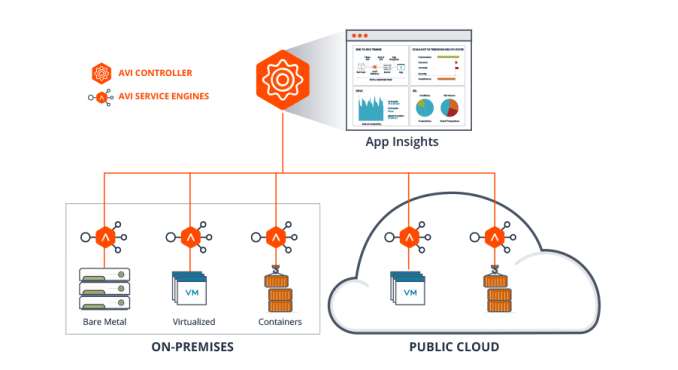
Diagram: Avi Networks
VMware has been trying to find ways to help companies manage their infrastructure, whether it is in the cloud or on prem, in a consistent way, and Avi is another step in helping them do that on the monitoring and load-balancing side of things, at least.
Tom Gillis, senior vice president and general manager for the networking and security business unit at VMware sees, this acquisition as fitting nicely into that vision. “This acquisition will further advance our Virtual Cloud Network vision, where a software-defined distributed network architecture spans all infrastructure and ties all pieces together with the automation and programmability found in the public cloud. Combining Avi Networks with VMware NSX will further enable organizations to respond to new opportunities and threats, create new business models, and deliver services to all applications and data, wherever they are located,” Gillis explained in a statement.
In a blog post, Avi’s co-founders expressed a similar sentiment, seeing a company where it would fit well moving forward. “The decision to join forces with VMware represents a perfect alignment of vision, products, technology, go-to-market, and culture. We will continue to deliver on our mission to help our customers modernize application services by accelerating multi-cloud deployments with automation and self-service,” they wrote. Whether that’s the case, time will tell.
Among Avi’s customers, which will now become part of VMware, are Deutsche Bank, Telegraph Media Group, Hulu and Cisco. The company was founded in 2012 and raised $115 million, according to Crunchbase data. Investors included Greylock, Lightspeed Venture Partners and Menlo Ventures, among others.
Powered by WPeMatico
IBM announced its latest blockchain initiative today. This one is in partnership with KPMG, Merk and Walmart to build a drug supply chain blockchain pilot.
These four companies are coming together to help come up with a solution to track certain drugs as they move through a supply chain. IBM is acting as the technology partner, KPMG brings a deep understanding of the compliance issues, Merk is of course a drug company and Walmart would be a drug distributor through its pharmacies and care clinics.
The idea is to give each drug package a unique identifier that you can track through the supply chain from manufacturer to pharmacy to consumer. Seems simple enough, but the fact is that companies are loathe to share any data with one another. The blockchain would provide an irrefutable record of each transaction as the drug moved along the supply chain, giving authorities and participants an easy audit trail.
The pilot is part of a set of programs being conducted by various stakeholders at the request of the FDA. The end goal is to find solutions to help comply with the U.S. Drug Supply Chain Security Act. According to the FDA Pilot Program website, “FDA’s DSCSA Pilot Project Program is intended to assist drug supply chain stakeholders, including FDA, in developing the electronic, interoperable system that will identify and trace certain prescription drugs as they are distributed within the United States.”
IBM hopes that this blockchain pilot will show it can build a blockchain platform or network on top of which other companies can build applications. “The network in this case, would have the ability to exchange information about these pharmaceutical shipments in a way that ensures privacy, but that is validated,” Mark Treshock, global blockchain solutions leader for healthcare and life sciences at IBM told TechCrunch.
He believes that this would help bring companies on board that might be concerned about the privacy of their information in a public system like this, something that drug companies in particular worry about. Trying to build an interoperable system is a challenge, but Treshock sees the blockchain as a tidy solution for this issue.
Some people have said that blockchain is a solution looking for a problem, but IBM has been looking at it more practically, with several real-world projects in production, including one to track leafy greens from field to store with Walmart and a shipping supply chain with Maersk to track shipping containers as they move throughout the world.
Treshock believes the Walmart food blockchain is particularly applicable here and could be used as a template of sorts to build the drug supply blockchain. “It’s very similar, tracking food to tracking drugs, and we are leveraging or adopting the assets that we built for food trust to this problem. We’re taking that platform and adapting it to track pharmaceuticals,” he explained.
Powered by WPeMatico

RealityEngines.AI, a research startup that wants to help enterprises make better use of AI, even when they only have incomplete data, today announced that it has raised a $5.25 million seed funding round. The round was led by former Google CEO and Chairman Eric Schmidt and Google founding board member Ram Shriram. Khosla Ventures, Paul Buchheit, Deepchand Nishar, Elad Gil, Keval Desai, Don Burnette and others also participated in this round.
The fact that the service was able to raise from this rather prominent group of investors clearly shows that its overall thesis resonates. The company, which doesn’t have a product yet, tells me that it specifically wants to help enterprises make better use of the smaller and noisier data sets they have and provide them with state-of-the-art machine learning and AI systems that they can quickly take into production. It also aims to provide its customers with systems that can explain their predictions and are free of various forms of bias, something that’s hard to do when the system is essentially a black box.

As RealityEngines CEO Bindu Reddy, who was previously the head of products for Google Apps, told me, the company plans to use the funding to build out its research and development team. The company, after all, is tackling some of the most fundamental and hardest problems in machine learning right now — and that costs money. Some, like working with smaller data sets, already have some available solutions like generative adversarial networks that can augment existing data sets and that RealityEngines expects to innovate on.
Reddy is also betting on reinforcement learning as one of the core machine learning techniques for the platform.
Once it has its product in place, the plan is to make it available as a pay-as-you-go managed service that will make machine learning more accessible to large enterprise, but also to small and medium businesses, which also increasingly need access to these tools to remain competitive.
Powered by WPeMatico

With 200X the range of Wi-Fi at 1/1000th of the cost of a cellular modem, Helium’s “LongFi” wireless network debuts today. Its transmitters can help track stolen scooters, find missing dogs via IoT collars and collect data from infrastructure sensors. The catch is that Helium’s tiny, extremely low-power, low-data transmission chips rely on connecting to P2P Helium Hotspots people can now buy for $495. Operating those hotspots earns owners a cryptocurrency token Helium promises will be valuable in the future…
The potential of a new wireless standard has allowed Helium to raise $51 million over the past few years from GV, Khosla Ventures and Marc Benioff, including a new $15 million Series C round co-led by Union Square Ventures and Multicoin Capital. That’s in part because one of Helium’s co-founders is Napster inventor Shawn Fanning. Investors are betting that he can change the tech world again, this time with a wireless protocol that like Wi-Fi and Bluetooth before it could unlock unique business opportunities.

Helium already has some big partners lined up, including Lime, which will test it for tracking its lost and stolen scooters and bikes when they’re brought indoors, obscuring other connectivity, or their battery is pulled, out deactivating GPS. “It’s an ultra low-cost version of a LoJack” Helium CEO Amir Haleem says.
InvisiLeash will partner with it to build more trackable pet collars. Agulus will pull data from irrigation valves and pumps for its agriculture tech business. Nestle will track when it’s time to refill water in its ReadyRefresh coolers at offices, and Stay Alfred will use it to track occupancy status and air quality in buildings. Haleem also imagines the tech being useful for tracking wildfires or radiation.
Haleem met Fanning playing video games in the 2000s. They teamed up with Fanning and Sproutling baby monitor (sold to Mattel) founder Chris Bruce in 2013 to start work on Helium. They foresaw a version of Tile’s trackers that could function anywhere while replacing expensive cell connections for devices that don’t need high bandwith. Helium’s 5 kilobit per second connections will compete with SigFox, another lower-power IoT protocol, though Haleem claims its more centralized infrastructure costs are prohibitive. It’s also facing off against Nodle, which piggybacks on devices’ Bluetooth hardware. Lucky for Helium, on-demand rental bikes and scooters that are perfect for its network have reached mainstream popularity just as Helium launches six years after its start.

Helium says it already pre-sold 80% of its Helium Hotspots for its first market in Austin, Texas. People connect them to their Wi-Fi and put it in their window so the devices can pull in data from Helium’s IoT sensors over its open-source LongFi protocol. The hotspots then encrypt and send the data to the company’s cloud that clients can plug into to track and collect info from their devices. The Helium Hotspots only require as much energy as a 12-watt LED light bulb to run, but that $495 price tag is steep. The lack of a concrete return on investment could deter later adopters from buying the expensive device.
Only 150-200 hotspots are necessary to blanket a city in connectivity, Haleem tells me. But because they need to be distributed across the landscape, so a client can’t just fill their warehouse with the hotspots, and the upfront price is expensive for individuals, Helium might need to sign up some retail chains as partners for deployment. As Haleem admits, “The hard part is the education.” Making hotspot buyers understand the potential (and risks) while demonstrating the opportunities for clients will require a ton of outreach and slick marketing.
Without enough Helium Hotspots, the Helium network won’t function. That means this startup will have to simultaneously win at telecom technology, enterprise sales and cryptocurrency for the network to pan out. As if one of those wasn’t hard enough.
Powered by WPeMatico
WhatsApp has so far relied on past dealings with bad players within its platform to ramp up its efforts to curtail spam and other automated behavior. The Facebook -owned giant has now announced an additional step it plans to take beginning later this year to improve the health of its messaging service: going after those whose mischievous activities can’t be traced within its platform.
The messaging platform, used by more than 1.5 billion users, confirmed on Tuesday that starting December 7 it will start considering signals off its platform to pursue legal actions against those who are abusing its system. The company will also go after individuals who — or firms that — falsely claim to have found ways to cause havoc on the service.
The move comes as WhatsApp grapples with challenges such as spam behavior to push agendas or spread false information on its messaging service in some markets. “This serves as notice that we will take legal action against companies for which we only have off-platform evidence of abuse if that abuse continues beyond December 7, 2019, or if those companies are linked to on-platform evidence of abuse before that date,” it said in an FAQ post on its site.
A WhatsApp spokesperson confirmed the change to TechCrunch, adding, “WhatsApp was designed for private messaging, so we’ve taken action globally to prevent bulk messaging and enforce limits on how WhatsApp accounts that misuse WhatsApp can be used. We’ve also stepped up our ability to identify abuse, which helps us ban 2 million accounts globally per month.”
Earlier this year, WhatsApp said (PDF) it had built a machine learning system to detect and weed out users who engage in inappropriate behavior, such as sending bulk messages or creating multiple accounts with intention to harm the service. The platform said it was able to assess the past dealings with problematic behaviors to ban 20% of bad accounts at the time of registration itself.
But the platform is still grappling to contain abusive behavior, a Reuters report claimed last month. The news agency reported about tools that were readily being sold in India for less than $15 that claimed to bypass some of the restrictions that WhatsApp introduced in recent months.
TechCrunch understands that with today’s changes, WhatsApp is going after those same set of bad players. It has already started to send cease and desist letters to marketing companies that claim to abuse WhatsApp in recent months, a person familiar with the matter said.
Powered by WPeMatico

Dropbox is evolving from a file-storage system to an enterprise software portal, where you can coordinate work with your team. Today the company launches a new version of Dropbox that allows you to launch apps with shortcuts for G Suite and more, plus use built-in Slack message-sending and Zoom video calls. It lets you search across all your files on your device and inside your other enterprise tools, and communicate and comment on your team’s work. Dropbox is also becoming a task manager, with the ability to add notes and tag co-workers in to-do lists attached to files.
The new Dropbox launches today for all of its 13 million business users across 400,000 teams plus its consumer tiers. Users can opt-in here for early access and businesses can turn on early access in their admin panel. “The way we work is broken,” CEO Drew Houston said to cue up the company’s mission statement: “to design a more enlightened way of working.”
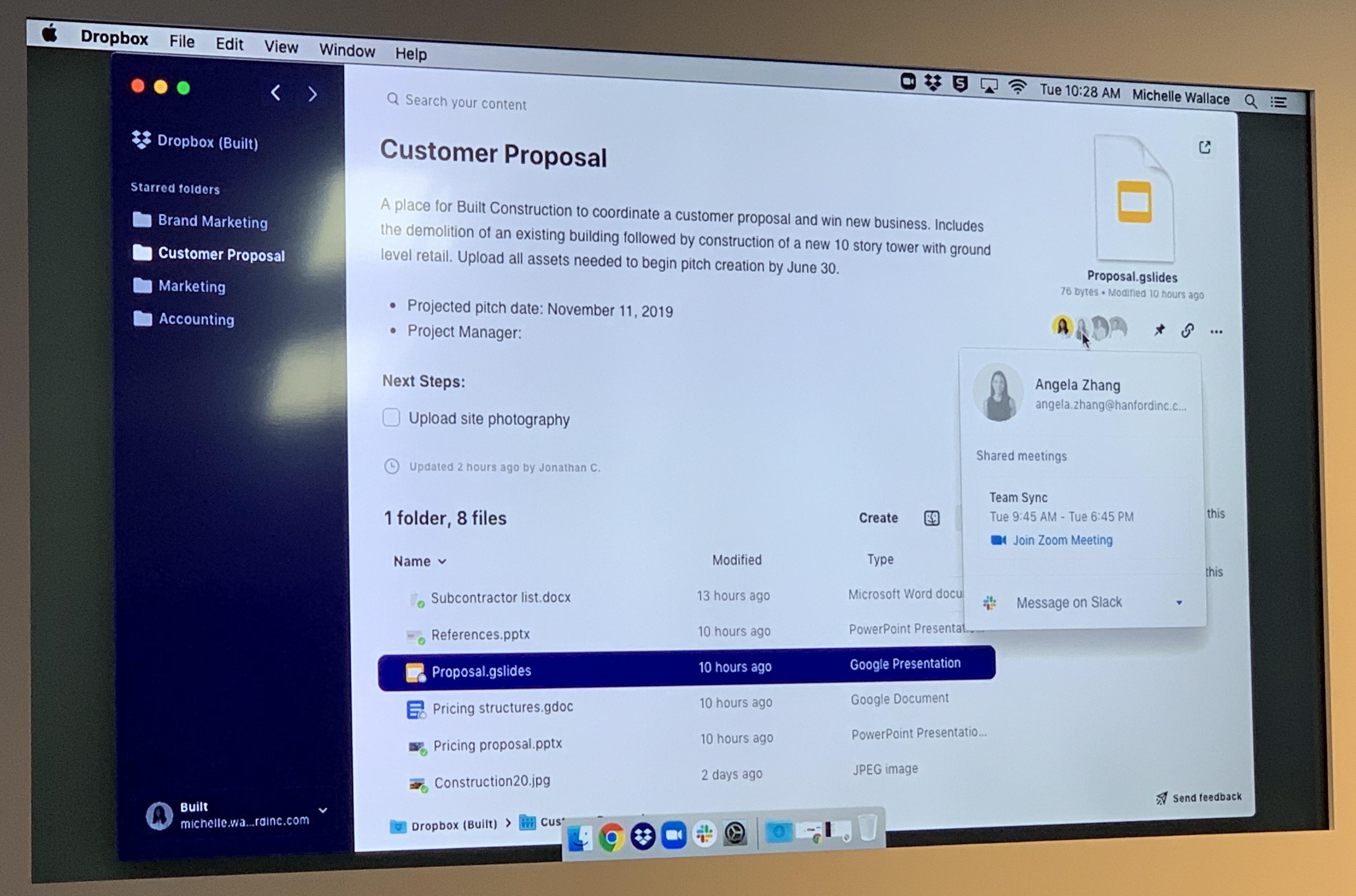
Dropbox seems to have realized that file storage by itself is a dying business. With storage prices dropping and any app being able to add their own storage system, it needed to move up the enterprise stack and become a portal that opens and organizes your other tools. Becoming the enterprise coordination layer is a smart strategy, and one that it seems Slack was happy to partner into rather than building itself.
As part of the update, Dropbox is launching a new desktop app for all users so it won’t have to live inside your Mac or Windows file system. When you click a file, you can see a preview and presence data about who has viewed it, who is currently and who has access.
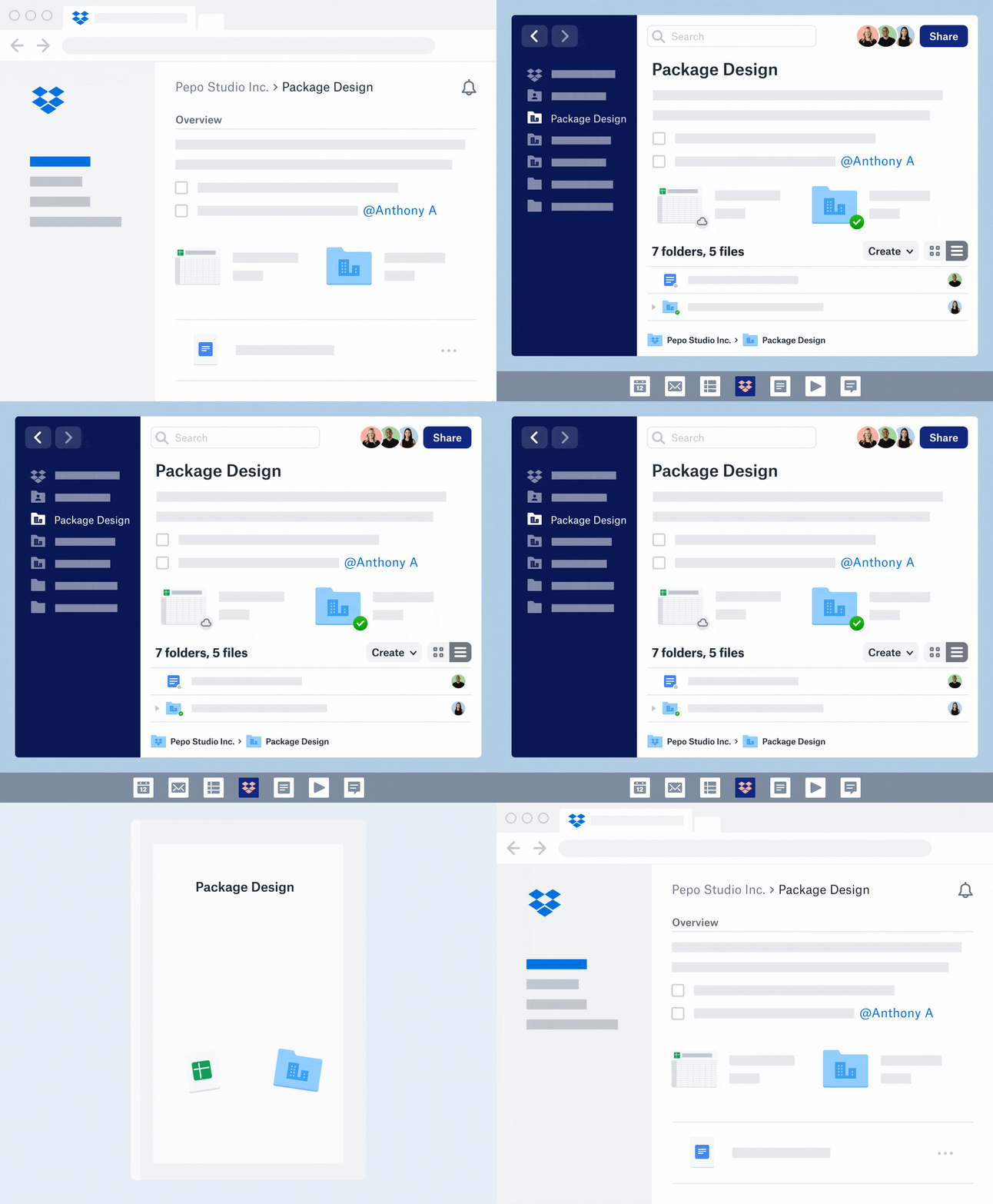
The launch includes deep integrations with Slack, so you can comment on files from within Dropbox, and Zoom, so you can video chat without leaving the workspace. Web and enterprise app shortcuts relieve you from keeping all your other tools constantly open in other tabs. Dropbox’s revamped search tool lets you crawl across your computer’s file system and all your cloud storage across other productivity apps.

But what’s most important about today’s changes is that Dropbox is becoming a task-management app. Each file lets you type out descriptions, to-do lists and tag co-workers to assign them tasks. An Activity Feed per file shows comments and actions from co-workers so you don’t have to collaborate in a separate Google Doc or Slack channel.
When asked about how Dropbox decided who to partner with (Slack, Zoom) versus who to copy (Asana), VP of biz dev Billy Blau essentially dodged the question while citing the “shared ethos” of Dropbox’s partners.
Houston kicked off the San Francisco launch event by pointing out that it’s easier to find info from the public than our own company’s knowledge that’s scattered across our computers and the cloud. The “Finder” on our computers hasn’t evolved to embrace a post-download era. He described how people spend 60% of our office time on work about work, like organization and communication, instead of actually working — a marketing angle frequently used by task-management startup Asana that Dropbox is now competing with more directly. “We’re going to help you get a handle on all this ‘work about work,’ ” Dropbox writes. Yet Asana has been using that phrase as a core of its messaging since 2013.
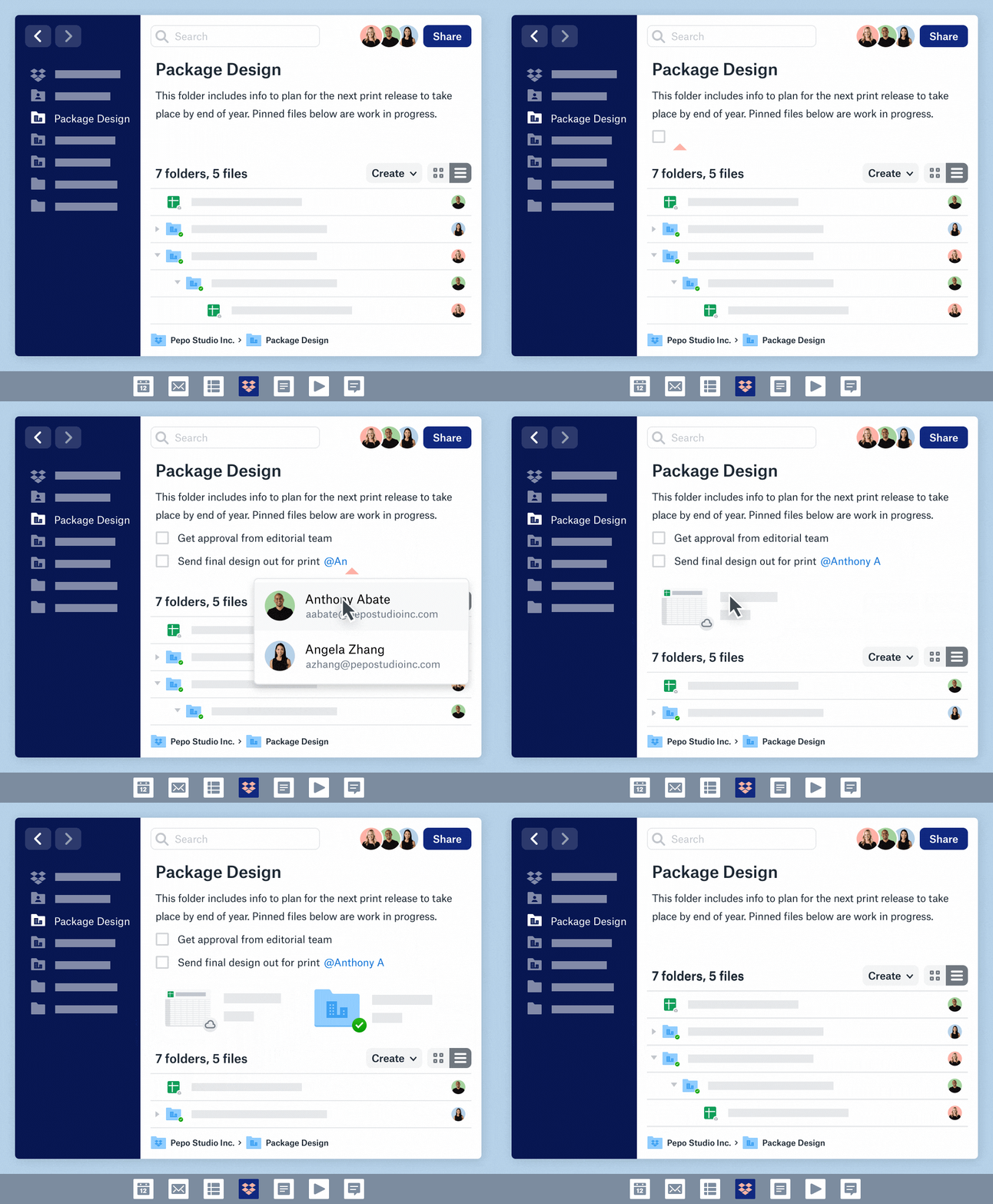
Now Dropbox wants to be your file tree, your finder and your desktop for the cloud. The question is whether files are always the central unit of work that comments and tasks should be pegged to, or whether it should be the task and project at the center of attention with files attached.
It will take some savvy onboarding and persistence to retrain teams to see Dropbox as their workspace instead of their computer’s desktop or their browser. But if it can become the identity and collaboration layer that connects the fragmented enterprise software, it could outlive file storage and stay relevant as new office tools emerge.
Powered by WPeMatico