Enterprise
Auto Added by WPeMatico
Auto Added by WPeMatico
Alibaba Group introduced its first AI inference chip today, a neural processing unit called Hanguang 800 that it says makes performing machine learning tasks dramatically faster and more energy efficient. The chip, announced today during Alibaba Cloud’s annual Apsara Computing Conference in Hangzhou, is already being used to power features on Alibaba’s e-commerce sites, including product search and personalized recommendations. It will be made available to Alibaba Cloud customers later.
As an example of what the chip can do, Alibaba said it usually takes Taobao an hour to categorize the one billion product images that are uploaded to the e-commerce platform each day by merchants and prepare them for search and personalized recommendations. Using Hanguang 800, Taobao was able to complete the task in only five minutes.
Alibaba is already using Hanguang 800 in many of its business operations that need machine processing. In addition to product search and recommendations, this includes automatic translation on its e-commerce sites, advertising and intelligence customer services.
Though Alibaba hasn’t revealed when the chip will be available to its cloud customers, the chip may help Chinese companies reduce their dependence on U.S. technology as the trade war makes business partnerships between Chinese and American tech companies more difficult. It also can help Alibaba Cloud grow in markets outside of China. Within China, it is the market leader, but in the Asia-Pacific region, Alibaba Cloud still ranks behind Amazon, Microsoft and Google, according to the Synergy Research Group.
Hanguang 800 was created by T-Head, the unit that leads the development of chips for cloud and edge computing within Alibaba DAMO Academy, the global research and development initiative in which Alibaba is investing more than $15 billion. T-Head developed the chip’s hardware and algorithms designed for business apps, including Alibaba’s retail and logistics apps.
In a statement, Alibaba Group CTO and president of Alibaba Cloud Intelligence Jeff Zhang (pictured above) said, “The launch of Hanguang 800 is an important step in our pursuit of next-generation technologies, boosting computing capabilities that will drive both our current and emerging businesses while improving energy-efficiency.”
He added, “In the near future, we plan to empower our clients by providing access through our cloud business to the advanced computing that is made possible by the chip, anytime and anywhere.”
T-Head’s other launches included the XuanTie 910 earlier this year, an IoT processor based on RISC-V, the open-source hardware instruction set that began as a project at UC Berkeley. XuanTie 910 was created for heavy-duty IoT applications, including edge servers, networking, gateway and autonomous vehicles.
Alibaba DAMO Academy collaborates with universities around the world, including UC Berkeley and Tel Aviv University. Researchers in the program focus on machine learning, network security, visual computing and natural language processing, with the goal of serving two billion customers and creating 100 million jobs by 2035.
Powered by WPeMatico
Amazon has gone live with Amazon Care, a new pilot healthcare service offering that is initially available to its employees in and around the Seattle area. The Amazon Care offering includes both virtual and in-person care, with telemedicine via app, chat and remote video, as well as follow-up visits and prescription drug delivery in person directly at an employee’s home or office.
First reported by CNBC, Amazon Care grew out of an initiative announced in 2018 with J.P. Morgan and Berkshire Hathaway to make a big change in how they all collectively handle their employee healthcare needs. The companies announced at the time that they were eager to put together a solution that was “free from profit-making incentives and constraints,” which are of course at the heart of private insurance companies that serve corporate clients currently.
Other large companies, like Apple, offer their own on-premise and remotely accessible healthcare services as part of their employee compensation and benefits packages, so Amazon is hardly unique in seeking to scratch this itch. The difference, however, is that Amazon Care is much more external-facing than those offered by its peers in Silicon Valley, with a brand identity and presentation that strongly suggests the company is thinking about more than its own workforce when it comes to a future potential addressable market for Care.
The Amazon Care logo.
Care’s website also provides a look at the app that Amazon developed for the telemedicine component, which shows the flow for choosing between text chat and video, as well as a summary of care provided through the service, with invoices, diagnosis and treatment plans all available for patient review.
Amazon lists Care as an option for a “first stop,” with the ability to handle things like colds, infections, minor injuries, preventative consultations, lab work, vaccinations, contraceptives and STI testing and general questions. Basically, it sounds like they cover a lot of what you’d handle at your general practitioner, before being recommended on for any more specialist or advanced medical treatment or expertise.
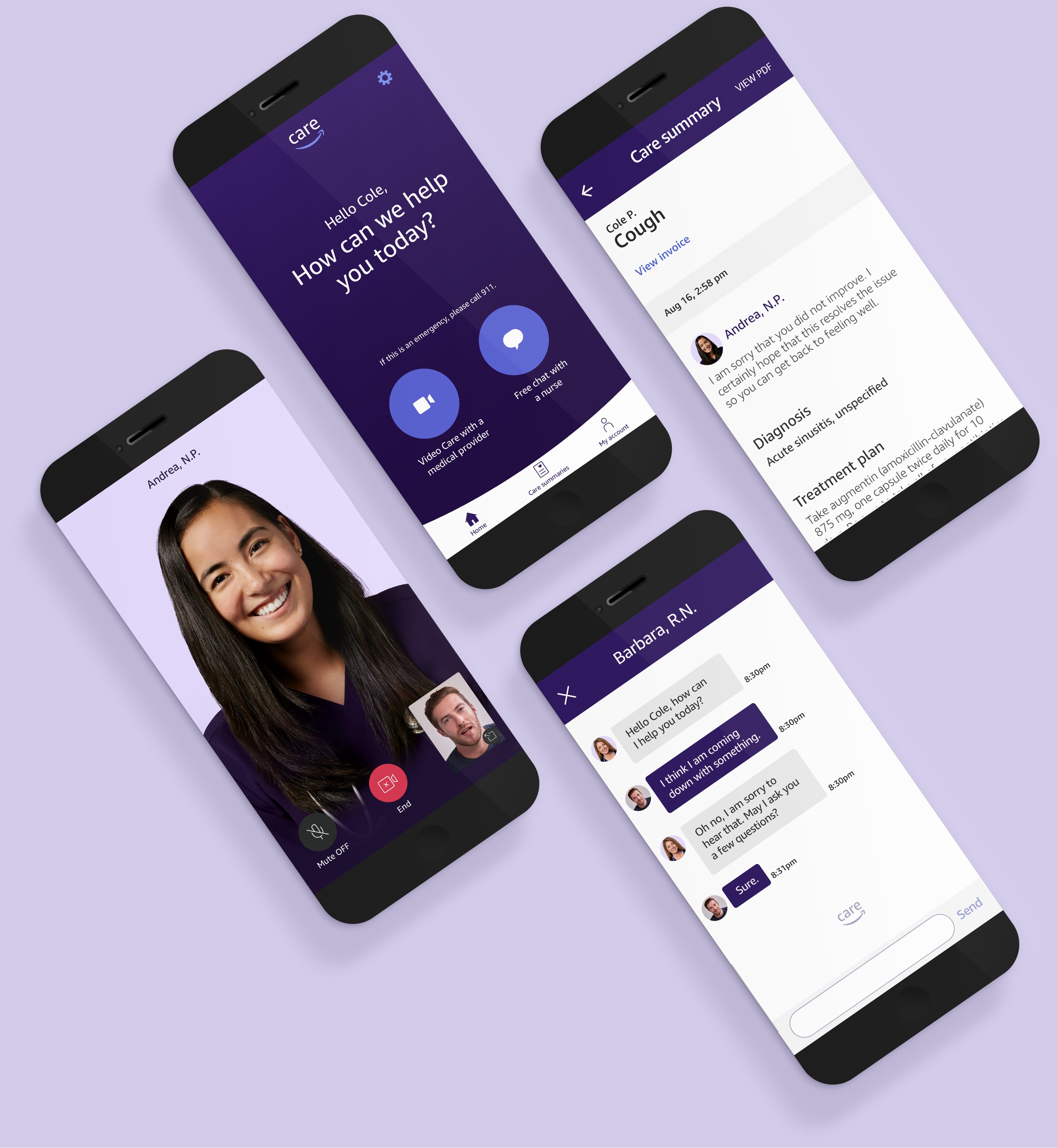
Rendered screenshots of the Amazon Care app for Amazon employees.
Current eligibility is limited to Amazon’s employees who are enrolled in the company’s health insurance plan and who are located in the pilot service geographical area. The service is currently available between 8 AM and 9 PM local time, Monday through Friday, and between 8 AM and 6 PM Saturday and Sunday.
Amazon acquired PillPack last year, an online pharmacy startup, for around $753 million, and that appears to be part of their core value proposition with Amazon Care, too, which features couriered prescribed medications and remotely communicated treatment plans.
Amazon may be limiting this pilot to employees at launch, but the highly publicized nature of their approach, and the amount of product development that clearly went into developing the initial app, user experience and brand all indicate that it has the broader U.S. market in mind as a potential expansion opportunity down the line. Recent reports also suggest that it’s going to make a play in consumer health with new wearable fitness tracking devices, which could very nicely complement insurance and healthcare services offered at the enterprise and individual level. Perhaps not coincidentally, Walgreens, CVS and McKesson stock were all trading down today.
Powered by WPeMatico
Kapwing is a laymen’s Adobe Creative Suite built for what people actually do on the internet: make memes and remix media. Need to resize a video? Add text or subtitles to a video? Trim or crop or loop or frame or rotate or soundtrack or… then you need Kapwing. The free web and mobile tool is built for everyone, not just designers. No software download or tutorials to slog through. Just efficient creativity.

In a year since coming out of stealth with 100,000 users, Kapwing has grown 10X, to more than 1 million. Now it going pro, building out its $20/month collaboration tools for social media managers and scrappy teams. But it won’t forget its roots with teens, so it has dropped its pay-$6-to-remove-watermarks tier while keeping its core features free.
Eager to capitalize on the meme and mobile content business, CRV has just led an $11 million Series A round for Kapwing. It’s joined by follow-on cash from Village Global, Sinai and Shasta Ventures, plus new investors Jane VC, Harry Stebbings, Vector and the Xoogler Syndicate. CRV partners “the venture twins” Justine and Olivia Moore actually met Kapwing co-founder and CEO Julia Enthoven while they all worked at The Stanford Daily newspaper in 2012.
Need to edit a meme or video? Kapwing has all the resizing, GIF, & subtitle tools you need https://t.co/FXDjShlUTq pic.twitter.com/1fEHxGoboz
— Josh Constine (@JoshConstine) September 24, 2019
“As a team, we love memes. We talk about internet fads almost every day at lunch and pay close attention to digital media trends,” says Enthoven, who started the company with fellow Googler Eric Lu. “One of our cultural tenets is to respect the importance of design, art and culture in the world, and another one is to not take ourselves too seriously.” But it is taking on serious clients.
As Kapwing’s toolset has grown, it has seen paying customers coming from Amazon, Sony, Netflix and Spotify. Now only 13% of what’s made with it are traditional text-plus-media memes. “Kapwing will always be designed for creators first: the students, artists, influencers, entrepreneurs, etc. who define and spread culture,” says Enthoven. “But we make money from the creative professionals, marketers, media teams and office workers who need to create content for work.”

That’s why in addition to plenty of templates for employing the latest trending memes, Kapwing now helps Pro subscribers with permanent hosting, saving throughout the creation process and re-editing after export. Eventually it plans to sell enterprise licenses to let whole companies use Kapwing.
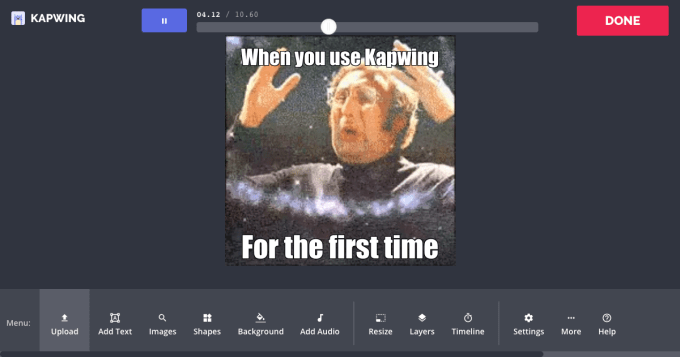
Copycats are trying to chip away at its business, but Kapwing will use its new funding to keep up a breakneck pace of development. Pronounced “Ka-Pwing,” like a bullet ricochet, it’s trying to stay ahead of Imgflip, ILoveIMG, Imgur’s on-site tool and more robust apps like Canva.
If you’ve ever been stuck with a landscape video that won’t fit in an Instagram Story, a bunch of clips you want to stitch together or the need to subtitle something for accessibility, you’ll know the frustration of lacking a purpose-built tool. And if you’re on mobile, there are even fewer options. Unlike some software suites you have to install on a desktop, Kapwing works right from a browser.
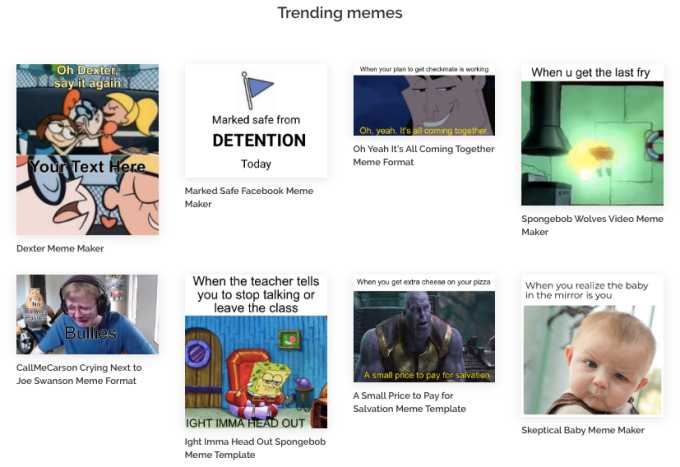
” ‘Memes’ is such a broad category of media nowadays. It could refer to a compilation like the political singalong videos, animations like Shooting Star memes or a change in music like the AOC Dancing memes,” Enthoven explains. “Although they used to be edgy, memes have become more mainstream . . . Memes popularized new types of multimedia formats and made raw, authentic footage more acceptable on social media.”
As communication continues to shift from text to visual media, design can’t only be the domain of designers. Kapwing empowers anyone to storytell and entertain, whether out of whimsy or professional necessity. If big-name creative software from Adobe or Apple don’t simplify and offer easy paths through common use cases, they’ll see themselves usurped by the tools of the people.
Powered by WPeMatico
After stating clearly on Friday that he would honor a $95,000 contract with ICE, CEO Barry Crist must have had a change of heart over the weekend. In a blog post this morning he wrote that the company would not be renewing the contract with ICE after all.
“After deep introspection and dialog within Chef, we will not renew our current contracts with ICE and CBP when they expire over the next year. Chef will fulfill our full obligations under the current contracts,” Crist wrote in the blog post.
He also backed off the seemingly firm position he took on Friday on the matter when he told TechCrunch, “It’s something that we spent a lot of time on, and I want to represent that there are portions of [our company] that do not agree with this, but I as a leader of the company, along with the executive team, made a decision that we would honor the contracts and those relationships that were formed and work with them over time,” he said.
Today, he acknowledged that intense feelings inside the company against the contract led to his decision. The contract began in 2015 under the Obama administration and was aimed at modernizing programming approaches at DHS, but over time as ICE family separation and deportation polices have come under fire, there were calls internally (and later externally) to end the contract. “Policies such as family separation and detention did not yet exist [when we started this contract]. While I and others privately opposed this and various other related policies, we did not take a position despite the recommendation of many of our employees. I apologize for this,” he wrote.
Crist also indicated that the company would be donating the revenue from the contracts to organizations that work with people who have been affected by these policies. It’s a similar approach that Salesforce took when 618 of its employees protested a contract the company has with the Customs and Border Patrol (CBP). In response to the protests, Salesforce pledged $1 million to organizations helping affected families.
After a tweet last week exposed the contract, the protests began on social media, and culminated in programmer Seth Vargo removing pieces of open-source code from the repository in protest of the contract in response. The company sounded firmly committed to fulfilling this contract in spite of the calls for action internally and externally, and the widespread backlash it was facing both inside and outside the company.
Vargo told TechCrunch in an interview that he saw this issue in moral terms, “Contrary to Chef’s CEO’s publicly posted response, I do think it is the responsibility of businesses to evaluate how and for what purposes their software is being used, and to follow their moral compass,” he said. Apparently Crist has come around to this point of view. Vargo chose not to comment on the latest development.
Powered by WPeMatico
On Friday afternoon Chef CEO Barry Crist and CTO Corey Scobie sat down with TechCrunch to defend their contract with ICE after a firestorm on social media called for them to cut ties with the controversial agency. On Sunday, programmer Seth Vargo, the man who removed his open-source components, which contributed to a partial shutdown of Chef’s commercial business for a time last week, responded.
While the Chef executives stated that the company was in fact the owner, Vargo made it clear he owned those pieces and he had every right to remove them from the repository. “Chef (the company) was including a third-party software package that I owned. It was on my personal repository on GitHub and personal namespace on RubyGems,” he said. He believes that gave him the right to remove them.
Chef CTO Corey Scobie did not agree. “Part of the challenge was that [Vargo] actually didn’t have authorization to remove those assets. And the assets were not his to begin with. They were actually created under a time when that particular individual [Vargo] was an employee of Chef. And so therefore, the assets were Chef’s assets, and not his assets to remove,” he said.
Vargo says that simply isn’t true and Chef misunderstands the licensing terms. “No OSI license or employment agreement requires me to continue to maintain code of my personal account(s). They are conflating code ownership (which they can argue they have) over code stewardship,” Vargo told TechCrunch.
As further proof, Vargo added that he has even included detailed instructions in his will on how to deal with the code he owns when he dies. “I want to make it absolutely clear that I didn’t “hack” into Chef or perform any kind of privilege escalation. The code lived in my personal accounts. Had I died on Thursday, the exact same thing would have happened. My will requests all my social media and code accounts be deleted. If I had deleted my GitHub account, the same thing would have happened,” he explained.
Vargo said that Chef actually was in violation of the open-source license when they restored those open-source pieces without putting his name on it. “Chef actually violated the Apache license by removing my name, which they later restored in response to public pressure,” he said.
Scobie admitted that the company did forget to include Vargo’s name on the code, but added it back as soon as they heard about the problem. “In our haste to restore one of the objects, we inadvertently removed a piece of metadata that identified him as the author. We didn’t do that knowingly. It was absolutely a mistake in the process of trying to restore customers and our global customer base service. And as soon as we were notified of it, we reverted that change on this specific object in question,” he said.
Vargo says, as for why he took down the open-source components, he was taking a moral stand against the contract, which dates back to the Obama administration. He also explained that he attempted to contact Chef via multiple channels before taking action. “First, I didn’t know about the history of the contract. I found out via a tweet from @shanley and subsequently verified via the USA spending website. I sent a letter and asked Chef publicly via Twitter to respond multiple times, and I was met with silence. I wanted to know how and why code in my personal repositories was being used with ICE. After no reply for 72 hours, I decided to take action,” he said.
Since then, Chef’s CEO Barry Crist has made it clear he was honoring the contract, which Vargo felt further justified his actions. “Contrary to Chef’s CEO’s publicly posted response, I do think it is the responsibility of businesses to evaluate how and for what purposes their software is being used, and to follow their moral compass,” he said.
Vargo has a long career helping build development tools and contributing to open source. He currently works for Google Cloud. Previous positions include HashiCorp and Chef.
Powered by WPeMatico
We might have just completed a full-day program devoted completely to enterprise at TechCrunch Sessions: Enterprise last week, but it doesn’t mean we plan to sell that subject short at TechCrunch Disrupt next month in San Francisco. In fact, we have something for everyone from startups to established public companies and everything in between along with investors and industry luminaries to discuss all-things enterprise.
SaaS companies have played a major role in enterprise software over the last decade, and we are offering a full line-up of SaaS company executives to provide you with the benefit of their wisdom. How about Salesforce chairman, co-CEO and co-founder Marc Benioff for starters? Benioff will be offering advice on how to build a socially responsible, successful startup.
If you’re interested in how to take your startup public, we’ll have Box CEO Aaron Levie, who led his company to IPO in 2015 and Jennifer Tejada, CEO at PagerDuty, who did the same just this year. The two executives will discuss the trials and tribulations of the IPO process and what happens after you finally go public.
Meanwhile, Slack co-founder and CTO Cal Henderson, another SaaS company that recently IPOed, will be discussing how to build great products with Megan Quinn from Spark Capital, a Slack investor.
Speaking of investors, Neeraj Agrawal, a general partner at Battery Ventures joins us on a panel with Whitney Bouck, COO at HelloSign and Jyoti Bansal, CEO and founder of Harness (as well as former CEO and co-founder at AppDynamics, which was acquired by Cisco in 2017 for $3.7 billion just before it was supposed to IPO). They will be chatting about what it takes to build a billion dollar SaaS business.
Not enough SaaS for you? How about Diya Jolly, Chief Product Officer at Okta discussing how to iterate your product?
If you’re interested in security, we have Dug Song from Duo, whose company was sold to Cisco in 2018 for $2.35 billion, explaining how to develop a secure startup. We will also welcome Nadav Zafrir from Israeli security incubator Team 8 to talk about the intriguing subject of when spies meet security on our main stage.
You probably want to hear from some enterprise company executives too. That’s why we are bringing Frederic Moll, chief development officer for the digital surgery group at Johnson & Johnson to talk about robots, Marillyn A. Hewson, chairman, president and CEO at Lockheed Martin discussing the space industry and Verizon CEO Hans Vestberg going over the opportunity around 5G.
We’ll also have seasoned enterprise investors, Mamoon Hamid from Kleiner Perkins and Michelle McCarthy from Verizon Ventures, acting as judges at the TechCrunch Disrupt Battlefield competition.
If that’s not enough for you, there will also be enterprise startups involved in the Battlefield and Startup Alley. If you love the enterprise, there’s something for everyone. We hope you can make it.
Still need tickets? You can pick those up right here.
Powered by WPeMatico
As Facebook prepares to launch its new cryptocurrency Libra in 2020, it’s putting the pieces in place to help it run. In one of the latest developments, it has acquired Servicefriend, a startup that built bots — chat clients for messaging apps based on artificial intelligence — to help customer service teams, TechCrunch has confirmed.
The news was first reported in Israel, where Servicefriend is based, after one of its investors, Roberto Singler, alerted local publication The Marker about the deal. We reached out to Ido Arad, one of the co-founders of the company, who referred our questions to a team at Facebook. Facebook then confirmed the acquisition with an Apple-like non-specific statement:
“We acquire smaller tech companies from time to time. We don’t always discuss our plans,” a Facebook spokesperson said.
Several people, including Arad, his co-founder Shahar Ben Ami, and at least one other indicate that they now work at Facebook within the Calibra digital wallet group on their LinkedIn profiles. Their jobs at the social network started this month, meaning this acquisition closed in recent weeks. (Several others indicate that they are still at Servicefriend, meaning they too may have likely made the move as well.)
Although Facebook isn’t specifying what they will be working on, the most obvious area will be in building a bot — or more likely, a network of bots — for the customer service layer for the Calibra digital wallet that Facebook is developing.
Facebook’s plan is to build a range of financial services for people to use Calibra to pay out and receive Libra — for example, to send money to contacts, pay bills, top up their phones, buy things and more.
It remains to be seen just how much people will trust Facebook as a provider of all these. So that is where having “human” and accessible customer service experience will be essential.
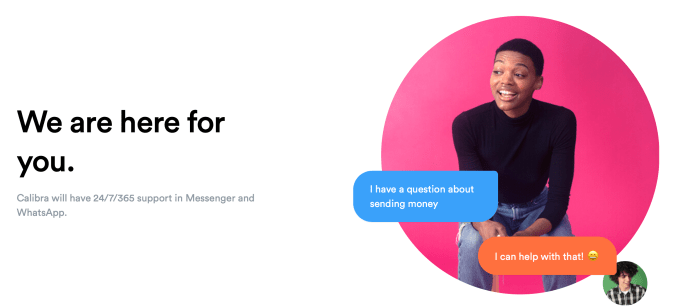
“We are here for you,” Calibra notes on its welcome page, where it promises 24-7 support in WhatsApp and Messenger for its users.
Servicefriend has worked on Facebook’s platform in the past: specifically it built “hybrid” bots for Messenger for companies to use to complement teams of humans, to better scale their services on messaging platforms. In one Messenger bot that Servicefriend built for Globe Telecom in the Philippines, it noted that the hybrid bot was able to bring the “agent hours” down to under 20 hours for each 1,000 customer interactions.
Bots have been a relatively problematic area for Facebook. The company launched a personal assistant called M in 2015, and then bots that let users talk to businesses in 2016 on Messenger, with quite some fanfare, although the reality was that nothing really worked as well as promised, and in some cases worked significantly worse than whatever services they aimed to replace.
While AI-based assistants such as Alexa have become synonymous with how a computer can carry on a conversation and provide information to humans, the consensus around bots these days is that the most workable way forward is to build services that complement, rather than completely replace, teams.
For Facebook, getting its customer service on Calibra right can help it build and expand its credibility (note: another area where Servicefriend has build services is in using customer service as a marketing channel). Getting it wrong could mean issues not just with customers, but with partners and possibly regulators.
Powered by WPeMatico
Yesterday, software development tool maker Chef found itself in the middle of a firestorm after a Tweet called them out for doing business with DHS/ICE. Eventually it led to an influential open-source developer removing a couple of key pieces of software from the project, bringing down some parts of Chef’s commercial business.
Chef intends to fulfill its contract with ICE, in spite of calls to cancel it. In a blog post published this morning, Chef CEO Barry Crist defended the decision. “I do not believe that it is appropriate, practical, or within our mission to examine specific government projects with the purpose of selecting which U.S. agencies we should or should not do business.”
He stood by the company’s decision this afternoon in an interview with TechCrunch, while acknowledging that it was a difficult and emotional decision for everyone involved. “For some portion of the community, and some portion of our company, this is a super, super-charged lightning rod, and this has been very difficult. It’s something that we spent a lot of time on, and I want to represent that there are portions of [our company] that do not agree with this, but I as a leader of the company, along with the executive team, made a decision that we would honor the contracts and those relationships that were formed and work with them over time,” he said.
He added, “I think our challenge as leadership right now is how do we collectively navigate through times like this, and through emotionally-charged issues like the ICE contract.”
The deal with ICE, which is a $95,000-a-year contract for software development tools, dates back to the Obama administration when the then DHS CIO wanted to move the department toward more modern agile/DevOps development workflows, according Christ.
He said for people who might think it’s a purely economic decision, the money represents a fraction of the company’s more than $50 million annual revenue (according to Crunchbase data), but he says it’s about a long-term business arrangement with the government that transcends individual administration policies. “It’s not about the $100,000, it’s about decisions we’ve made to engage the government. And I appreciate that not everyone in our world feels the same way or would make that same decision, but that’s the decision that we made as a leadership team,” Crist said.
Shortly after word of Chef’s ICE contract appeared on Twitter, according to a report in The Register, former Chef employee Seth Vargo removed a couple of key pieces of open-source software from the repository, telling The Register that “software engineers have to operate by some kind of moral compass.” This move brought down part of Chef’s commercial software and it took them 24 hours to get those services fully restored, according to Chef CTO Corey Scobie.
Crist says he wants to be clear that his decision does not mean he supports current ICE policies. “I certainly don’t want to be viewed as I’m taking a strong stand in support of ICE. What we’re taking a strong stand on is our consistency with working with our customers, and again, our work with DHS started in the previous administration on things that we feel very good about,” he said.
Powered by WPeMatico
You don’t see a startup get a $50 million seed round all that often, but such was the case with Vianai, an early-stage startup launched by Vishal Sikka, former Infosys managing director and SAP executive. The company launched recently with a big check and a vision to transform machine learning.
Just this week, the startup had a coming out party at Oracle Open World, where Sikka delivered one of the keynotes and demoed the product for attendees. Over the last couple of years, since he left Infosys, Sikka has been thinking about the impact of AI and machine learning on society and the way it is being delivered today. He didn’t much like what he saw.
It’s worth noting that Sikka got his PhD from Stanford with a specialty in AI in 1996, so this isn’t something that’s new to him. What’s changed, as he points out, is the growing compute power and increasing amounts of data, all fueling the current AI push inside business. What he saw when he began exploring how companies are implementing AI and machine learning today was a lot of complex tooling, which, in his view, was far more complex than it needed to be.
He saw dense Jupyter notebooks filled with code. He said that if you looked at a typical machine learning model, and stripped away all of the code, what you found was a series of mathematical expressions underlying the model. He had a vision of making that model-building more about the math, while building a highly visual data science platform from the ground up.
The company has been iterating on a solution over the last year with two core principles in mind: explorability and explainability, which involves interacting with the data and presenting it in a way that helps the user attain their goal faster than the current crop of model-building tools.
“It is about making the system reactive to what the user is doing, making it completely explorable, while making it possible for the developer to experiment with what’s happening in a way that is incredibly easy. To make it explainable means being able to go back and forth with the data and the model, using the model to understand the phenomenon that you’re trying to capture in the data,” Sikka told TechCrunch.
He says the tool isn’t just aimed at data scientists, it’s about business users and the data scientists sitting down together and iterating together to get the answers they are seeking, whether it’s finding a way to reduce user churn or discover fraud. These models do not live in a data science vacuum. They all have a business purpose, and he believes the only way to be successful with AI in the enterprise is to have both business users and data scientists sitting together at the same table working with the software to solve a specific problem, while taking advantage of one another’s expertise.
For Sikka, this means refining the actual problem you are trying to solve. “AI is about problem solving, but before you do the problem solving, there is also a [challenge around] finding and articulating a business problem that is relevant to businesses and that has a value to the organization,” he said.
He is very clear, that he isn’t looking to replace humans, but instead wants to use AI to augment human intelligence to solve actual human problems. He points out that this product is not automated machine learning (AutoML), which he considers a deeply flawed idea. “We are not here to automate the jobs of data science practitioners. We are here to augment them,” he said.
As for that massive seed round, Sikka knew it would take a big investment to build a vision like this, and with his reputation and connections, he felt it would be better to get one big investment up front, and he could concentrate on building the product and the company. He says that he was fortunate enough to have investors who believe in the vision, even though as he says, no early business plan survives the test of reality. He didn’t name specific investors, only referring to friends and wealthy and famous people and institutions. A company spokesperson reiterated they were not revealing a list of investors at this time.
For now, the company has a new product and plenty of money in the bank to get to profitability, which he states is his ultimate goal. Sikka could have taken a job running a large organization, but like many startup founders, he saw a problem, and he had an idea how to solve it. That was a challenge he couldn’t resist pursuing.
Powered by WPeMatico
Google announced today that it was investing €3 billion (approximately US$3.3 billion) to expand its data center presence in Europe. What’s more, the company pledged the data centers would be environmentally friendly.
This new investment is in addition to the $7 billion the company has invested since 2007 in the EU, but today’s announcement was focused on Google’s commitment to building data centers running on clean energy as much as the data centers themselves.
In a blog post announcing the new investment, CEO Sundar Pichai made it clear that the company was focusing on running these data centers on carbon-free fuels, pointing out that he was in Finland today to discuss with prime minister Antti Rinne building sustainable economic development in conjunction with a carbon-free future.
Of the €3 billion the company plans to spend, it will invest €600 million to expand its presence in Hamina, Finland, which he wrote “serves as a model of sustainability and energy efficiency for all of our data centers.” Further, the company already announced 18 new renewable energy deals earlier this week, which encompass a total of 1,600-megawatts in the U.S., South America and Europe.
In the blog post, Pichai outlined how the new data center projects in Europe would include some of these previously announced projects:
Today I’m announcing that nearly half of the megawatts produced will be here in Europe, through the launch of 10 renewable energy projects. These agreements will spur the construction of more than 1 billion euros in new energy infrastructure in the EU, ranging from a new offshore wind project in Belgium, to five solar energy projects in Denmark, and two wind energy projects in Sweden. In Finland, we are committing to two new wind energy projects that will more than double our renewable energy capacity in the country, and ensure we continue to match almost all of the electricity consumption at our Finnish data center with local carbon-free sources, even as we grow our operations.
The company is also helping by investing in new skills training, so people can have the tools to be able to handle the new types of jobs these data centers and other high-tech jobs will require. The company claims it has previously trained 5 million people in Europe for free in crucial digital skills, and recently opened a Google skills hub in Helsinki.
It’s obviously not a coincidence that the company is making an announcement related to clean energy on Global Climate Strike Day, a day when people from around the world are walking out of schools and off their jobs to encourage world leaders and businesses to take action on the climate crisis. Google is attempting to answer the call with these announcements.
Powered by WPeMatico