Enterprise
Auto Added by WPeMatico
Auto Added by WPeMatico
One of the big advantages of using the cloud is ease of deployment. For engineers, being able to dial up infrastructure resources means being able to develop without delays, but it can also lead to big bills at the end of the month if you don’t know what you’re spending.
Harness wants to help with that, and today the startup released a product called Continuous Efficiency. It is designed to help engineering teams use cloud resources in a more cost-efficient manner, and do this in real time as they allocate resources.
Jyoti Bansal, co-founder and CEO at Harness, says that today most companies don’t know the extent of their cloud costs until the finance people get the bill at the end of the month. What’s more, the bill is entirely disconnected from the developers who are responsible for that cost. Finally, he says that at least 35% of that cost is waste, money they didn’t have to spend.
What Harness is hoping to do with this new product is give developers visibility into their spending with the goal that if they see how much waste they are generating they will dial back on usage.
“We are rethinking managing your cloud costs. From the perspective of developers, how do we give context sensitivity to developers so they get a full view of [what they are spending in the cloud],” he said.
Oftentimes, resources go unused or are over allocated, and giving visibility into this should let developers stay on budget, and in some cases save big bucks. To show how this works, the company says that one customer had a Kubernetes cluster configured with an annual cost of $1.6 million. After running the Continuous Efficiency product, it found that just 15% of the cluster compute resources were actually being used. After reconfiguring based on this data, they were able to save $1.3 million over the course of a year.

Image Credit: Harness
While Bansal says the product was in development long before the pandemic started, a tool like this at this particular moment in time is even more important as companies are looking for ways to cut costs.
Harness was founded in 2016 and has raised $80 million, according to Crunchbase data. Bansal formerly co-founded AppDynamics, a company that Cisco acquired in January 2017 for $3.7 billion.
Powered by WPeMatico
One would think it’s a given that investment strategies would change in the strange times we find ourselves. With the economy staggering and so much general uncertainty, it seems caution would be the watchword of the day, especially in the enterprise. But enterprise investors aren’t necessarily looking at what’s going on right now.
As startups make their way into the enterprise, they often grow from a single product to a platform offering, which means such investments tend to be a long haul that can take a decade or longer to mature and exit or IPO. The bigger the approach, the longer the sales cycle, so even though sales motion could be stalling now, it doesn’t mean VCs are just giving up on these types of investments.
Savvy investors understand that this is going to be a long game, and the current situation driven by a worldwide pandemic won’t necessarily change their approach significantly.
We asked a number of enterprise investors if they have changed their approach in light of the pandemic and its knock-on economic impacts, how the current environment has changed their relationship with existing portfolio clients and how well those clients are coping with the new reality.
[Editor’s note: Our prior enterprise survey failed to include any responses from female VCs and did not meet TechCrunch’s standards for diversity and inclusion. We regret the error.]
With the pandemic having such a huge impact on the economy, how has this changed your investment approach and the types of companies you are more likely to invest in?
We remain committed to our five core thesis areas: security & infrastructure modernized, financial services rebuilt, work reimagined, data interconnected, and community activated. We break out each of our thesis areas into anywhere from 10-20 sub-sectors.
We have been continuously reprioritizing which sub-sectors will likely see business growth as well as opportunities to make a positive difference to a world grappling with COVID. There are still many unknowns and we closely watch company formation and funding to see where there might be particular concentration of entrepreneurial activity, which we take to be a positive sign that a market is robust and ready for significant investment.
Within enterprise software, we’ve unsurprisingly seen an acceleration in enterprise demand for communication and collaboration software. We’ve historically maintained a thesis that enterprise communication is an untapped, shadow set of data about workplace productivity and knowledge. With swaths of workers working remotely, capturing insights from these conversations provides a significant opportunity. This applies to industry verticals as much as it applies to functional software that sells across industries and focuses on a particular type of communication. We believe the key is that both employees and employers find these insights to be beneficial.
Lastly, we’ve also seen a growth in software and data that help enterprises navigate disruptions in supply, demand, or other aspects of their business.
Powered by WPeMatico
It’s been a big period of positive change for Yugabyte, makers of the open source, cloud native YugabyteDB database. Just last month they brought on former Pivotal president Bill Cook as CEO, and today the company announced it has closed a $30 million Series B.
8VC and strategic investor WiPro led the round with participation from existing investors Lightspeed Venture Partners and Dell Technologies Capital. Today’s investment brings the total raised to $55 million, according to the company.
The startup also announced that former Pivotal co-founder Scott Yara would be joining the company’s board. Along with Cook, that brings a distinct Pivotal influence to the company.
Kannan Muthukkaruppan, who was CEO, now holds the title of president. He says that the company has built “a fully open source, high performance distributed SQL database meant for transactional workloads in the cloud.”
Today, in addition to the open source product, it offers a private Database as a Service platform to enterprise customers. This can run on a variety of platforms including public, private, or hybrid cloud or Kubernetes infrastructure. The company also offers a fully managed cloud service, which is currently available on AWS and Google Cloud Platform with Azure support coming in the future.
The founders have quite a pedigree. Muthukkaruppan spent 13 years at Oracle helping build Oracle’s relational engine. Then he moved onto Facebook in the early days where he met co-founders Karthik Ranganathan and Mikhail Bautin. The founding team worked on database technology that helped scale Facebook from 40 million users to over a billion.
It was that background that really caught the attention of Cook. “First of all, there’s a huge market opportunity here that we think we fit into, and it is unique in the sense of the pedigree that this team has, and what they built and the expertise they have across that whole spectrum of being able to scale and have [a database that is] performant across [geographic] zones,” he said.
As the company gets this investment, it’s not only a period of change inside the organization, it is against the backdrop of the worldwide pandemic and economic fallout from that event, but Muthukkaruppan sees momentum here in spite of the macro conditions.
“With COVID-19, we actually saw an increased sense of urgency across many enterprises, wanting to move businesses to the cloud and improve their operational and go-to-market efficiency around the product that they were bringing to market,” he said. He believes that the company’s database can be a key part of that.
The company currently has 50 employees, but sees doubling that number in the next 12-18 months as interest in the products continues to grow. Cook says the company has a diverse workforce today, and he will continue to build on that in his hiring practices.
“The more inclusive you can be ties to all our principles and values [as a company] already so we’re not changing how we operate,” he says. He says diversity is not only the right thing to do from a human perspective, it also makes good business sense to have a diverse workforce.
Powered by WPeMatico

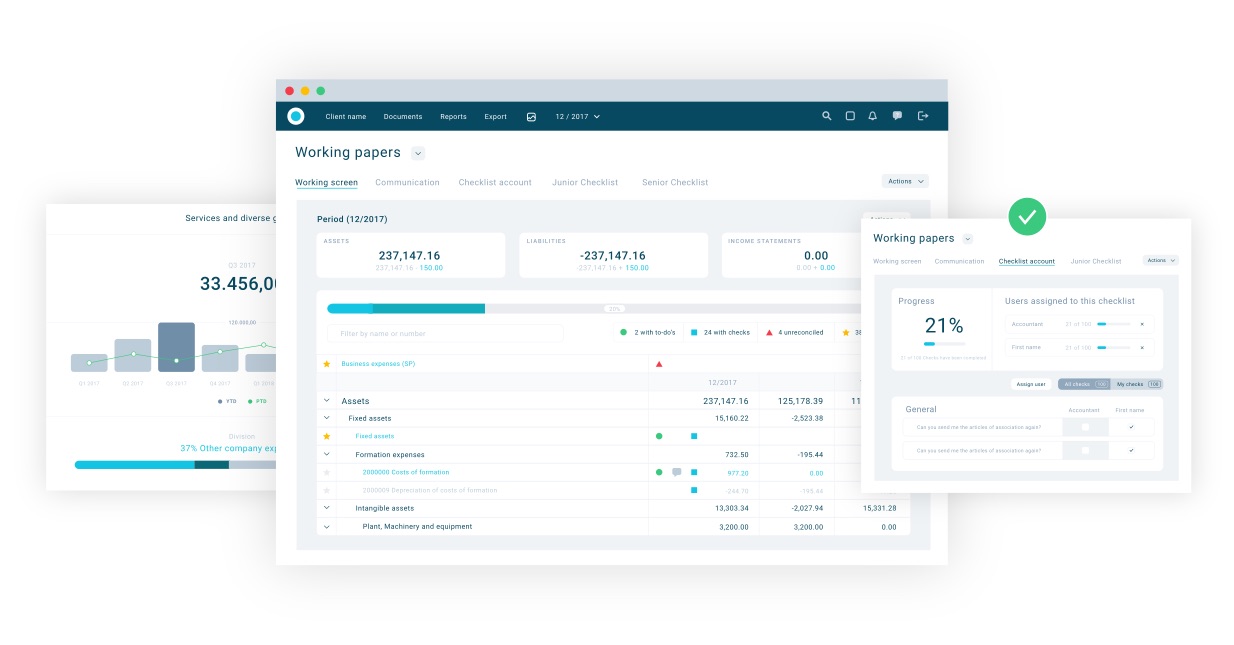
Meet Silverfin, a startup focused on accounting software. This isn’t about helping small startups handle accounting tasks themselves. Silverfin wants to build the cloud service for small and big accounting firms — Salesforce, but for accounting.
The startup just raised a Series B funding round led by Hg — Index Ventures led the previous Series A round. While terms of the deal are undisclosed, a source told me the round is worth approximately $30 million.
In order to improve productivity, Silverfin tries to automate the most time-consuming aspect of accounting — data collection. The company helps you connect with your clients’ accounting software directly to import their data, such as Xero, QuickBooks, Sage and SAP.
After that, Silverfin standardizes your data set and lets you add data manually so the platform can become the main data repository.
Once your data is in the system, you need to process it. Silverfin lets you configure automated workflows and templates so that anybody in the accounting firm can enrich data and check for compliance issues. Like Salesforce and other software-as-a-service products, multiple people can communicate on the service and look at all past edits and changes.
You can then visualize financial data, generate reports and statements. It opens up new possibilities for accounting firms. They can charge advisory services thanks to analytics tools and an alert system.
The startup was founded in Ghent, Belgium, but it has now expanded to London, Amsterdam and Copenhagen. Silverfin has attracted 650 customers, including big accounting firms in Europe and North America.
By targeting the most demanding customers first, Silverfin doesn’t need to replace Xero or QuickBooks altogether. It can integrate with those existing software solutions first. There’s an opportunity to go downmarket later and convince smaller companies that don’t necessarily have a big accounting team.
Powered by WPeMatico

Last year, Google launched the beta of Currents, which was essentially a rebrand of Google+ for G Suite users, since Google+ for consumers went to meet its maker in April 2019. While Google+ was meant to be an all-purpose social network, the idea behind Currents is more akin to what Microsoft is doing with Yammer or Facebook with Workplace. It’s meant to give employees a forum for internal discussions and announcements.

To complicate matters, Google kept Google+ around, even after the launch of Currents, but in an email to G Suite admins, it has now announced that Google+ for G Suite will close its doors on July 6, after which there will be no way to opt out of Currents or revert back to Google+.
And with that, Google has driven the final nail into Google+’s coffin. The Google+ mobile apps will be automatically updated to Currents. All existing links to Google+ will redirect to Currents.
Going forward, Google+ will only live on as a hazy memory, filled with circles of friends, all of which were forced to use their real name (at least at the beginning), +1 buttons everywhere, sparks and the promise of fun games, ripples and more.
Currents is all business — and while I’m not aware of a lot of companies that use it, it looks to be a solid option for companies that would otherwise use the Yammer/Teams combination in the Microsoft ecosystem. Now, I guess, we can start the countdown before Google launches another social network.
If you want to take a stroll down memory lane, check out our history of Google+ below:
Powered by WPeMatico
Slack and Amazon announced a big integration late yesterday afternoon. As part of the deal, Slack will use Amazon Chime for its call feature, while reiterating its commitment to use AWS as its preferred cloud provider to run its infrastructure. At the same time, Amazon has agreed to offer Slack as an option for all internal communications.
“Some parts of Amazon had licensed Slack before, but this is the first time it will be offered as an option to all employees,” an Amazon spokesperson told TechCrunch.
Make no mistake, this is a big deal as the SaaS communications tool increases its ties with AWS, but this agreement could also be about slighting Microsoft and its rival Teams product by making a deal with a cloud rival. In the past, Slack CEO Stewart Butterfield has had choice words for Microsoft saying the Redmond technology giant sees his company as an “existential threat.”
Whether that’s true — Teams is but one piece of a huge technology company — it’s impossible not to look at the deal in this context. Aligning more deeply with AWS sends a message to Microsoft, whose Azure infrastructure services compete with AWS.
Butterfield didn’t say that of course. He talked about how synergistic the deal was. “Strategically partnering with AWS allows both companies to scale to meet demand and deliver enterprise-grade offerings to our customers. By integrating AWS services with Slack’s channel-based messaging platform, we’re helping teams easily and seamlessly manage their cloud infrastructure projects and launch cloud-based services without ever leaving Slack,” he said in a statement.
The deal also includes several other elements including integrating AWS Key Management Service with Slack Enterprise Key Management (EKM) for encryption key management, deeper alignment with AWS’s chatbot service and direct integration with AWS AppFlow to enable secure transfer of data between Slack and Amazon S3 storage and the Amazon Redshift data warehouse.
AWS CEO Andy Jassy saw it as a pure integration play. “Together, AWS and Slack are giving developer teams the ability to collaborate and innovate faster on the front end with applications, while giving them the ability to efficiently manage their backend cloud infrastructure,” Jassy said in a statement.
Like any good deal, it’s good for both sides. Slack gets a big customer in AWS and AWS now has Slack directly integrating more of its services. One of the reasons enterprise users are so enamored with Slack is the ability to get work done in a single place without constantly having to change focus and move between interfaces.
This deal will provide more of that for common customers, while tweaking a common rival. That’s what you call win-win.
Powered by WPeMatico
As the pandemic surged and companies moved from offices to working at home, they needed tools to ensure the continuity of their business operations. SaaS companies have always been focused on allowing work from anywhere there’s access to a computer and internet connection, and while the economy is reeling from COVID-19 fallout, modern software companies are thriving.
That’s because the pandemic has forced companies that might have been thinking about moving to the cloud to find tools what will get them there much faster. SaaS companies like Zoom, Box, Slack, Okta and Salesforce were there to help; cloud security companies like CrowdStrike also benefited.
While it’s too soon to say how the pandemic will affect work long term when it’s safe for all employees to return to the office, it seems that companies have learned that you can work from anywhere and still get work done, something that could change how we think about working in the future.
One thing is clear: SaaS companies that have reported recent earnings have done well, with Zoom being the most successful example. Revenue was up an eye-popping 169% year-over-year as the world shifted in a big way to online meetings, swelling its balance sheet.
There is a clear connection between the domestic economy’s rapid transition to the cloud and the earnings reports we are seeing — from infrastructure to software and services. The pandemic is forcing a big change to happen faster than we ever imagined.
Zoom and CrowdStrike are two companies expected to grow rapidly thanks to the recent acceleration of the digital transformation of work. Their earnings reports this week made those expectations concrete, with both firms beating expectations while posting impressive revenue growth and profitability results.
Powered by WPeMatico
It was perhaps not until the COVID-19 pandemic hit the planet that most of us had ever heard or uttered the phrase “supply chain.” But in a global economy that had become drunk and lazy on “just in time ordering” and similar, the threat to supply chains of things like, oh, food, from that pesky virus has become real and visceral. That’s why automation of “the supply chain” has become such a huge issue. So it’s not a huge surprise that startups aimed at tackling this are suddenly thrust into the limelight.
Step forward, Cork, Ireland-based Keelvar, strategic sourcing software company, which today announces that it has raised $18 million in Series A funding led by Elephant Ventures and Mosaic Ventures, with participation from Paua Ventures, enabling the company to further expand into enterprise markets.
The investment will support Keelvar’s expansion plans for Europe and the U.S., amid the rapidly growing need for supply chain automation solutions, which has been further accelerated by the recent COVID-19 pandemic.
Keelvar provides large enterprises with “Advanced Sourcing Optimization” software and “Intelligent Sourcing Automation” that uses AI to fully automate tactical buying processes.
It competes with Coupa and Jaggaer in terms of all three offering sophisticated e-sourcing software. Keelvar says its key competitive advantage is that it provides intelligent bots to autopilot the sourcing projects, thus making the whole process easier, faster and cheaper.
It also currently manages more than $90 billion in spend annually for enterprises in all major industries. Customers include Siemens, Coca-Cola, Novartis, BMW and Samsung.
With COVID-19 disrupting supply chains globally, Keelvar expects the demand for automation to further increase.
In a statement, Alan Holland, CEO of Keelvar, said: “The Future of Work in procurement is changing quickly, with COVID19 acting as a catalyst. We have witnessed an escalation in demand from enterprises seeking intelligent systems to automate complex processes as teams became overburdened with disrupted supply chains. Keelvar has proven that Sourcing Bots can relieve that burden enormously. Now it’s time to hit the accelerator and scale-up.”
Speaking about the investment, Peter Fallon, partner at Elephant noted: “Keelvar’s sourcing optimization and automation software delivers meaningful ROI to enterprise sourcing and procurement organizations globally. We are excited to partner with Alan Holland and the team at Keelvar as the company continues to emerge as a leader in this market.”
Private sector companies alone spend trillions annually buying from third-party suppliers. External sourcing is usually the largest expense category and on average it is 43% of total costs (Bain & Company). The global procurement software market is currently growing at a CAGR of 9.1%, and expected to reach $7.3 billion by 2022 (IDC).
Speaking about the funding, Toby Coppel, co-founder, and partner at Mosaic Ventures said: “Keelvar is a brilliant example of machine learning in action, giving superpower to procurement teams in every large enterprise. With COVID-19 pushing businesses to embrace these new technologies, we’re excited to partner with Keelvar on the next phase of growth.”
Powered by WPeMatico
Searchable.ai is an early-stage startup in the alpha phase of testing its initial product, but it has an idea compelling enough to attract investment, even during a pandemic. Today the company announced an additional $4 million in seed capital to continue building its AI-driven search solution.
Susquehanna International Group and Omicron Media co-led the round, with participation by Defy Partners, NextView Ventures and a group of unnamed angel investors. Today’s investment comes on top of the $2 million in seed money the startup announced in October.
Company co-founder and CEO Brian Shin said that when he presented to his investors in early March at the last event he attended before everything shut down, they approached him about additional money, and given the economic uncertainty, he decided to take it.
“Honestly we probably would not have taken additional money if it was not for the uncertainty around the macro environment right now,” he told TechCrunch.
The company is trying to solve enterprise search and, being pre-revenue, Shin recognized that having additional capital would give them more room to build the product and get it to market.
“We are trying to solve this problem where people just can’t find information that they need in order to do their jobs. When you look within the workplace, this problem is just getting worse and worse with the proliferation of different formats and people storing their information in many different places, local networks, cloud repositories, email and Slack,” he explained.
They have a few thousand people in the alpha program right now testing a personal desktop version of the application that helps individual users find their content wherever it happens to be. The plan is to open that up to a wider group soon.
The road map calls for a teams version, where groups of employees can search among their different individual repositories; a developer version to build the search technology into other operations; and eventually an enterprise tool. They also want to add voice search starting with an Alexa skill, with the general belief that we need to move beyond keyword searches to more natural language approaches.
“We believe that there’ll be a whole new category of search, search companies and search products that are more conversational. […] Being able to interact with your information more naturally, more and more conversationally, that’s where we think the market is going,” he said.
The company now has more money in the bank to help achieve that vision.
Powered by WPeMatico
A lot of the attention in medical technology today has been focused on tools and innovations that might help the world better fight the COVID-19 global health pandemic. Today comes news of another startup that is taking on some funding for a disruptive innovation that has the potential to make both COVID-19 as well as other kinds of clinical assessments more accessible.
Nanox, a startup out of Israel that has developed a small, low-cost scanning system and “medical screening as a service” to replace the costly and large machines and corresponding software typically used for X-rays, CAT scans, PET scans and other body imaging services, is today announcing that it has raised $20 million from a strategic investor, South Korean carrier SK Telecom.
SK Telecom in turn plans to help distribute physical scanners equipped with Nanox technology as well as resell the pay-per-scan imaging service, branded Nanox.Cloud, and corresponding 5G wireless network capacity to operate them. Nanox currently licenses its tech to big names in the imaging space, like FujiFilm, and Foxconn is also manufacturing its donut-shaped Nanox.Arc scanners.
The funding is technically an extension of Nanox’s previous round, which was announced earlier this year at $26 million with backing from Foxconn, FujiFilm and more. Nanox says that the full round is now closed off at $51 million, with the company having raised $80 million since launching almost a decade ago, in 2011.
Nanox’s valuation is not being publicly disclosed, but a news report in the Israeli press from December said that one option the startup was considering was an IPO at a $500 million valuation. We understand from sources that the valuation is about $100 million higher now.
The Nanox system is based around proprietary technology related to digital X-rays. Digital radiography is a relatively new area in the world of imaging that relies on digital scans rather than X-ray plates to capture and process images.
Nanox says the ARC comes in at 70 kg versus 2,000 kg for the average CT scanner, and production costs are around $10,000 compared to $1-3 million for the CT scanner.
But in addition to being smaller (and thus cheaper) machines with much of the processing of images done in the cloud, the Nanox system, according to CEO and founder Ran Poliakine, can make its images in a tiny fraction of a second, making them significantly safer in terms of radiation exposure compared to existing methods.
Imaging has been in the news a lot of late because it has so far been one of the most accurate methods for detecting the progress of COVID-19 in patients or would-be patients in terms of how it is affecting patients’ lungs and other organs. While the dissemination of equipment like Nanox’s definitely could play a role in handling those cases better, the ultimate goal of the startup is much wider than that.
Ultimately, the company hopes to make its devices and cloud-based scanning service ubiquitous enough that it would be possible to run early detection, preventative scans for a much wider proportion of the population.
“What is the best way to fight cancer today? Early detection. But with two-thirds of the world without access to imaging, you may need to wait weeks and months for those scans today,” said Poliakine.
The startup’s mission is to distribute some 15,000 of its machines over the next several years to bridge that gap, and it’s getting there through partnerships. In addition to the SK Telecom deal it’s announcing today, last March, Nanox inked a $174 million deal to distribute 1,000 machines across Australia, New Zealand and Norway in partnership with a company called the Gateway Group.
The SK Telecom investment is an interesting development that underscores how carriers see 5G as an opportunity to revisit what kinds of services they resell and offer to businesses and individuals, and SK Telecom specifically has singled out healthcare as one obvious and big opportunity.
“Telecoms carriers are looking for opportunities around how to sell 5G,” said Ilung Kim, SK Telecom’s president, in an interview. “Now you can imagine a scanner of this size being used in an ambulance, using 5G data. It’s a game changer for the industry.”
Looking ahead, Nanox will continue to ink partnerships for distributing its hardware and reselling its cloud-based services for processing the scans, but Poliakine said it does not plan to develop its own technology beyond that to gain insights from the raw data. For that, it’s working with third parties — currently three AI companies — that plug into its APIs, and it plans to add more to the ecosystem over time.
Powered by WPeMatico