Enterprise
Auto Added by WPeMatico
Auto Added by WPeMatico
Every company today is struggling to deal with security and understanding what is happening on their systems. This is even more pronounced as companies have had to move their employees to work from home. Uptycs, a Boston-area security analytics startup, announced a $30 million Series B today to help companies detect and understand breaches when they happen.
Sapphire Ventures led the round with help from Comcast Ventures and ForgePoint Capital. The startup has now raised a total of $43 million, according to the company. Under the terms of today’s deal, Sapphire Ventures’ president and managing director Jai Das will be joining the company’s board.
Company co-founder and CEO Ganesh Pai says he and his co-founders previously worked at Akamai, where they observed Akamai’s debugging and diagnostic tools, which were designed to work at massive scale. The founders believed they could use a similar approach to building a security analytics platform, and in 2016 the group launched Uptycs .
“We help people to solve intrusion detection, compliance and audit and incident investigation. These are table stakes requirements [for security solutions] that most large scale organizations have, and of course with their scale the challenges vary. What we at Uptycs do is provide a solution for that,” Pai told TechCrunch.
The company uses a flight recorder approach to security, giving security operations teams the ability to sift through the data and review exactly how a detection happened and how the intruder got through the company’s defenses.
He recognizes his company is fortunate to get a round this large right now, but he says the solution has attracted a number of customers signing seven-digit contracts and this in turn got the attention of investors. “That customer engagement, their experience and this commitment from our customers led to this substantial round of funding,” he said.
The company currently has 65 employees spread across offices in Waltham, a Boston suburb, as well as two offices in India. Pai says the plan is to double that number in the next 12 months. “Between the cash flow from our existing customers and the pipeline for us and the funding, we are planning to grow in a meaningful way. If everything aligns with our expectation we will double our team size in the next 12 months,” he said.
As he grows his company in this way, Pai says they are talking to their investors about how to build a diverse workforce. “We’ve thought long and hard about it, both in terms of diversity and inclusion. It is a lot harder to execute because at the end of the day, there is a finite talent pool, but we are having conversations with our investors, who have seen patterns of success in terms of implementing such plans from growth stage ventures,” he said.
He added, “And of course we are a very early-stage company, but we are extremely cognizant, and given the current circumstances are acutely aware that we need to do our very best and make a difference.”
As the company has moved to work from home across its operations, he says it has benefited from working in the cloud from the start. “As an organization we are very fortunate that we built our organization so that everything runs in the cloud and everyone has been able to remain very productive,” he said.
Powered by WPeMatico
Ryan Easter couldn’t believe he was being asked to run a pandemic business continuity test.
It was late October, 2019 and Easter, IT Director and a principal at Johnson Investment Counsel, was being asked by regulators to ensure that their employees could work from home with the same capabilities they had in the office. In addition, the company needed to evaluate situations where up to 50% of personnel were impacted by a virus and unable to work, forcing others to pick up their internal functions and workload.
“I honestly thought that it was going to be a waste of time,” said Easter. “I never imagined that we would have had to put our pandemic plan into action. But because we had a tested strategy already in place, we didn’t miss a beat when COVID-19 struck.”
In the months leading up to the initial test, Johnson Investment Counsel developed a work anywhere blueprint with their technology partner Evolve IP. The plan covered a wide variety of integrated technologies including voice services, collaboration, virtual desktops, disaster recovery and remote office connectivity.
“Having a strategy where our work anywhere services were integrated together was one of the keys to our success,” said Easter. “We manage about $13 billion in assets for clients across the United States and provide comprehensive wealth and investment management to individual and institutional investors. We have our own line of mutual funds, a state-chartered trust company, a proprietary charitable gift fund, with research analysts and traders covering both equity and fixed income markets. Duct taping one-off solutions wasn’t going to cut it.”
Easter continued, “It was imperative that our advisors could communicate with clients, collaborate with each other and operate the business seamlessly. That included ensuring we could make real-time trades and provide all of our other client services.”
Five months later, the novel coronavirus hit the United States and Johnson Investment Counsel’s blueprint test got real.
Powered by WPeMatico
Loodse, a German Kubernetes automation platform, announced today that it was rebranding as Kubermatic. While it was at it, the company also announced that it was open-sourcing its Kubermatic Kubernetes Platform as open source under the Apache 2.0 License.
Co-founder Sebastian Scheele says that his company’s Kubernetes solution can provision clusters and applications on any cloud, as well as in a data center running, for example, OpenStack or VMware. What’s more, it can do it much faster by automating much of the operations side of running Kubernetes clusters.
“We wanted to really have a cloud native way to run and manage Kubernetes. And so it’s running the Kubernetes master itself, which is completely containerized on top of Kubernetes, rather than being run on VMs. This helps provide you with better scalability, but also because it’s running on Kubernetes, we get all of the resilience and auto scaling out of Kubernetes itself,” Scheele told TechCrunch.
He says that he and his co-founder Julian Hansert have always had a strong commitment to open source, and offering Kubermatic platform under the Apache 2.0 license is a way to show that to the community. “One of the big [things] we can bring to the table is making Kubermatic completely open source, while following the Open-core model, and having a strong commitment to open source to the world and also to the community,” he said.
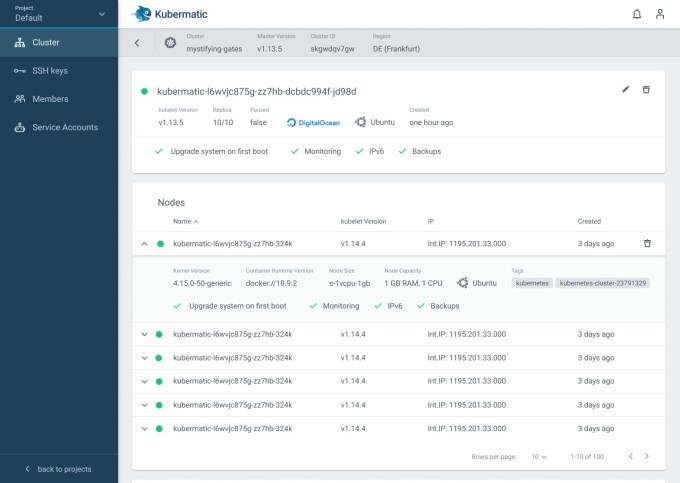
Image Credit: Kubermatic
As for why it’s rebranding, he says that the original company name is a German word that means navigation pilot for a ship. The name is a nod to its Hamburg base, which is a hub for container ships. It makes sense to Germans, but not others, so they wanted a name that more broadly reflected what the company does.
“Now that we are open-sourcing Kubermatic, we also thought that people should understand our vision and what’s our DNA. It’s Kubernetes automation, helping our customers to really save money on Kubernetes operations by automating as much as possible on the operation level, so our users can really focus on building new applications,” he explained.
The company launched four years ago and has taken no funding, completely bootstrapping along the way. It’s worth noting it was one of the top five committers to the open-source Kubernetes project in 2019, along with much bigger names including Google, VMware, Red Hat and Microsoft.
Today the company has 50 employees, most of whom are working remotely by choice, rather than due to the pandemic. In fact, the company has employees working in 10 different countries. He says that has allowed him to work with people with a broad set of skills, who don’t necessarily live in Hamburg where he and Hansert are based.
Powered by WPeMatico

Headless CMS company Contentful today announced that it has raised an $80 million Series E funding round led by Sapphire Ventures, with participation from General Catalyst, Salesforce Ventures and a number of other new and existing investors. With this, the company has now raised a total of $158.3 million and a Contentful spokesperson tells me that it is approaching a $1 billion valuation.
In addition, the company also today announced that it has hired Bridget Perry as its CMO. She previously led Adobe’s marketing efforts across Europe, the Middle East and Africa.
Currently, 28% of the Fortune 500 use Contentful to manage their content across platforms. The company says it has a total of 2,200 paying customers right now and these include the likes of Spotify, ITV, the British Museum, Telus and Urban Outfitters.
Steve Sloan, the company’s CEO who joined the company late last year, attributes its success to the fact that virtually every business today is in the process of figuring out how to become digital and serve its customers across platforms — and that’s a process that has only been accelerated by the coronavirus pandemic.
“Ten or 15 years ago, when these content platforms or content management systems were created, they were a) really built for a web-only world and b) where the website was a complement to some other business,” he said. “Today, the mobile app, the mobile web experience is the front door to every business on the planet. And that’s never been any more clear than in this recent COVID crisis, where we’ve seen many, many businesses — even those that are very traditional businesses — realize that the dominant and, in some cases, only way their customers can interact with them is through that digital experience.”
But as they are looking at their options, many decide that they don’t just want to take an off-the-shelf product, Sloan argues, because it doesn’t allow them to build a differentiated offering.

Image Credits: Contentful
Perry also noted that this is something she saw at Adobe, too, as it built its digital experience business. “Leading marketing at Adobe, we used it ourselves,” she said. “And so the challenge that we heard from customers in the market was how complex it was in some cases to implement, to organize around it, to build those experiences fast and see value and impact on the business. And part of that challenge, I think, stemmed from the kind of monolithic, all-in-one type of suite that Adobe offered. Even as a marketer at Adobe, we had challenges with that kind of time to market and agility. And so what’s really interesting to me — and one of the reasons why I joined Contentful — is that Contentful approaches this in a very different way.”
Sloan noted that putting the round together was a bit of an adventure. Contentful’s existing investors approached the company around the holidays because they wanted to make a bigger investment in the company to fuel its long-term growth. But at the time, the company wasn’t ready to raise new capital yet.
“And then in January and February, we had inbound interest from people who weren’t yet investors, who came to us and said, ‘hey, we really want to invest in this company, we’ve seen the trend and we really believe in it.’ So we went back to our insiders and said, ‘hey, we’re going to think about actually moving in our timeline for raising capital,” Sloan told me. “And then, right about that time is when COVID really broke out, particularly in Western Europe in North America.”
That didn’t faze Contentful’s investors, though.
“One of the things that really stood out about our investors — and particularly our lead investor for this round Sapphire — is that when everybody else was really, really frightened, they were really clear about the opportunity, about their belief in the team and about their understanding of the progress we had already made. And they were really unflinching in terms of their support,” Sloan said.
Unsurprisingly, the company plans to use the new funding to expand its go-to-market efforts (that’s why it hired Perry, after all), but Sloan also noted that Contentful plans to invest quite a bit into R&D, as well, as it looks to help its customers solve more adjacent problems.
Powered by WPeMatico
CRM software has become a critical piece of IT when it comes to getting business done, and today a startup focusing on one specific aspect of that stack — sales automation — is announcing a growth round of funding underscoring its own momentum. Outreach, which has built a popular suite of tools used by salespeople to help identify and reach out to prospects and improve their relationships en route to closing deals, has raised $50 million in a Series F round of funding that values the company at $1.33 billion.
The funding will be used to continue expanding geographically — headquartered in Seattle, Outreach also has an office in London and wants to do more in Europe and eventually Asia — as well as to invest in product development.
The platform today essentially integrates with a company’s existing CRM, be it Salesforce, or Microsoft’s, or Kustomer, or something else — and provides an SaaS-based set of tools for helping to source and track meetings, have to-hand information on sales targets, and a communications manager that helps with outreach calls and other communication in real time. It will be investing in more AI around the product, such as its newest product Kaia (an acronym for “knowledge AI assistant”), and it has also hired a new CFO, Melissa Fisher, from Qualys, possibly a sign of where it hopes to go next as a business.
Sands Capital — an investor out of Virginia that also backs the likes of UiPath and DoorDash — is leading the round, Outreach noted, with “strong participation” also from strategic backer Salesforce Ventures. Other investors include Operator Collective (a new backer that launched last year and focuses on B2B) and previous backers Lone Pine Capital, Spark Capital, Meritech Capital Partners, Trinity Ventures, Mayfield and Sapphire Ventures.
Outreach has raised $289 million to date, and for some more context, this is definitely an up round: the startup was last valued at $1.1 billion when it raised a Series E in April 2019.
The funding comes on the heels of strong growth for the company: More than 4,000 businesses now use its tools, including Adobe, Tableau, DoorDash, Splunk, DocuSign and SAP, making Outreach the biggest player in a field that also includes Salesloft (which also raised a significant round last year on the heels of Outreach’s), Clari, Chorus.ai, Gong, Conversica and Afiniti. Its sweet spot has been working with technology-led businesses and that sector continues to expand its sales operations, even as much of the economy has contracted in recent months.
“You are seeing a cambric explosion of B2B startups happening everywhere,” Manny Medina, CEO and co-founder of Outreach, said in a phone interview this week. “It means that sales roles are being created as we speak.” And that translates to a growing pool of potential customers for Outreach.
It wasn’t always this way.
When Outreach was first founded in 2011 in Seattle, it wasn’t a sales automation company. It was a recruitment startup called GroupTalent working on software to help source and hire talent, aimed at tech companies. That business was rolling along, until it wasn’t: In 2015, the startup found itself with only two months of runway left, with little hope of raising more.
“We were not hitting our stride, and growth was hard. We didn’t make the numbers in 2014 and then had two months of cash left and no prospects of raising more,” Medina recalled. “So I sat down with my co-founders,” — Gordon Hempton, Andrew Kinzer and Wes Hather, none of whom are at the company anymore — “and we decided to sell our way out of it. We thought that if we generated more meetings we could gain more opportunities to try to sell our recruitment software.
“So we built the engine to do that, and we saw that we were getting 40% reply rates to our own outreaching emails. It was so successful we had a 10x increase in productivity. But we ran out of sales capacity, so we started selling the meetings we had managed to secure with potential talent directly to the tech companies themselves,” in other words, the other side of its marketplace, those looking to fill vacancies.
That quickly tipped over into a business opportunity of its own. “Companies were saying to us, ‘I don’t want to buy the recruitment software. I need that sales engine!” The company never looked back, and changed its name to work for the pivot.
Fast-forward to 2020, and times are challenging in a completely different way, defined as we are by a global health pandemic that affects what we do every day, where we go, how we work, how we interact with people and much more.
Medina says the impact of the novel coronavirus has been a significant one for the company and its customers, in part because it fits well with two main types of usage cases that have emerged in the world of sales in the time of COVID-19.
“Older sellers now working from home are accomplished and don’t need to be babysat,” he said, but added they can’t rely on their traditional touchpoints “like meetings, dinners and bar mitzvahs” anymore to seal deals. “They don’t have the tools to get over the line. So our product is being called in to help them.”
Another group at the other end of the spectrum, he said, are “younger and less experienced salespeople who don’t have the physical environment [many live in smaller places with roommates] nor experience to sell well alone. For them it’s been challenging not to come into an office because especially in smaller companies, they rely on each other to train, to listen to others on calls to learn how to sell.”
That’s the other scenario where Outreach is finding some traction: They’re using Outreach’s tools as a proxy for physically sitting alongside and learning from more experienced colleagues, and using it as a supplement to learning the ropes in the old way.
“Outreach’s leadership position in the market, clear mission, and value-added approach make the company a natural investment choice for us,” said Michael Clarke, partner at Sands Capital’s Global Innovation Fund, in a statement. “Now more than ever, companies need an AI-powered sales engagement platform like Outreach. Enterprise sales teams are rapidly adopting sales engagement platforms and Outreach’s rapid growth reflects this.”
Like a lot of sales tools that are powered by AI, Outreach in part is taking on some of the more mundane jobs of salespeople.
But Medina doesn’t believe that this will play out in the “man versus machine” scenario we often ponder when we think about human obsolescence in the face of technological efficiency. In other words, he doesn’t think we’re close to replacing the humans in the mix, even at a time when we’re seeing so many layoffs.
“We are at the early innings,” he said. “There are 6.8 million sales people and we only have north of 100,000 users, not even 2% of the market. There may be a redefinition of the role, but not a reduction.”
Powered by WPeMatico
Google Cloud today announced the launch of Filestore High Scale, a new storage option — and tier of Google’s existing Filestore service — for workloads that can benefit from access to a distributed high-performance storage option.
With Filestore High Scale, which is based on technology Google acquired when it bought Elastifile in 2019, users can deploy shared file systems with hundreds of thousands of IOPS, 10s of GB/s of throughput and at a scale of 100s of TBs.
“Virtual screening allows us to computationally screen billions of small molecules against a target protein in order to discover potential treatments and therapies much faster than traditional experimental testing methods,” says Christoph Gorgulla, a postdoctoral research fellow at Harvard Medical School’s Wagner Lab., which already put the new service through its paces. “As researchers, we hardly have the time to invest in learning how to set up and manage a needlessly complicated file system cluster, or to constantly monitor the health of our storage system. We needed a file system that could handle the load generated concurrently by thousands of clients, which have hundreds of thousands of vCPUs.”
The standard Google Cloud Filestore service already supports some of these use cases, but the company notes that it specifically built Filestore High Scale for high-performance computing (HPC) workloads. In today’s announcement, the company specifically focuses on biotech use cases around COVID-19. Filestore High Scale is meant to support tens of thousands of concurrent clients, which isn’t necessarily a standard use case, but developers who need this kind of power can now get it in Google Cloud.
In addition to High Scale, Google also today announced that all Filestore tiers now offer beta support for NFS IP-based access controls, an important new feature for those companies that have advanced security requirements on top of their need for a high-performance, fully managed file storage service.
Powered by WPeMatico
Canva, the design platform for non-designers, has recently inked a partnership with FedEx Office to help businesses reopen amid the coronavirus pandemic with a design-to-print integration.
Canva declined to disclose the financial terms of the partnership.
With the new partnership, Canva and FedEx customers alike will be able to use Canva’s extensive libraries of templates, images and illustrations to design print materials for their businesses, like disposable restaurant menus, new hours of operation, information around new safety policies in the wake of the pandemic and more.
These customers can send their designs directly to FedEx for printing and pick up from over 2,000 FedEx Office locations across the U.S.
Canva’s target demographic is not hardcore, professional designers but rather non-designers, with a mission of democratizing design across professional organizations and more broadly to amateur designers.
As of October 2019, the Australia-based company was valued at $3.2 billion. At the time, Canva introduced enterprise collaboration software that allows sales teams, HR teams and other non-design teams to build out their own decks and materials with a simple drag-and-drop interface.
Since, Canva has complemented its design product with video editing software, as well.
The partnership with FedEx Office marks a big push into the U.S. market, with increased brand awareness and distribution via the established print and shipping giant.
Pricing around FedEx Office printing of Canva designs remains the same as FedEx’s usual pricing structure, but through August 31 FedEx is offering a 25% discount on orders of more than $50.
Powered by WPeMatico
As COVID-19 has forced companies to move employees from office to home, cloud services have seen a burst in business. Box has been speeding up its product roadmap to help companies that are in the midst of this transition. Today, the company announced the Box Relay template library, which includes a series of workflow templates to help customers build digital workflows faster.
Box CEO Aaron Levie says that the rapid shift to work from home has been a massive accelerant to digital transformation, in some cases driving years of digital transformation into a matter of weeks and months. He says that has made the need to digitize business processes more urgent than ever.
In fact, when he appeared on Extra Crunch Live last month, he indicated that businesses still have way too many manual processes:
We think we’re [in] an environment that anything that can be digitized probably will be. Certainly as this pandemic has reinforced, we have way too many manual processes in businesses. We have way too slow ways of working together and collaborating. And we know that we’re going to move more and more of that to digital platforms.
Box Relay is the company’s workflow tool, and while it has had the ability to create workflows, it required a certain level of knowledge and way of thinking to make that happen. Levie says that they wanted to make it as simple as possible for customers to build workflows to digitize manual processes.
“We are announcing an all new set of Box Relay templates, which are going straight to the heart of how do you automate and digitize business processes across the entire enterprise and make it really simple to do that,” he explained.
This could include things like a contract review, change order process or budget review to name a few examples. The template includes the pieces to get going, but the customer can customize the process to meet the needs of the individual organization’s requirements.
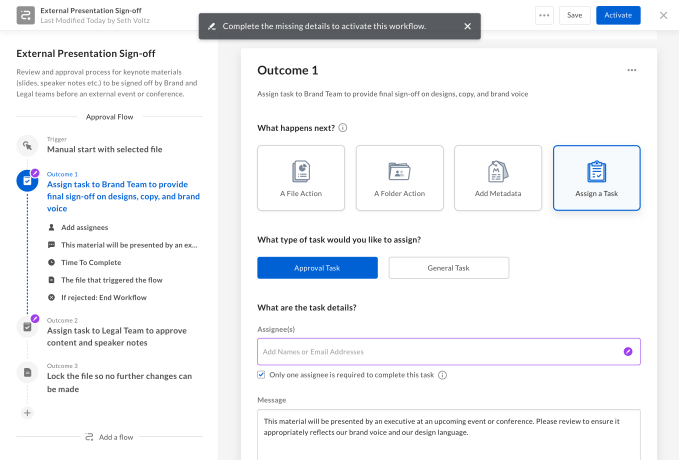
Image Credits: Box
While this is confined to Box-built templates for now, Levie says that down the road this could include the ability for customers to deploy templates of their own, or even for third parties like systems integrators to build industry or client-specific templates. But for today, it’s just about the ones you get out of the box from Box.
At the same time, the company is announcing the File Request feature, a name Levie admits doesn’t really do the feature justice. The idea is that in a workflow such as a paperless bank loan process, the individual has to submit multiple documents without having a Box account. After the company receives the documents, it can kick off a workflow automatically based on receiving the set of documents.
He says the combination of these two new capabilities will give customers the ability to digitize more and more of their processes and bring in a level of automation that wasn’t previously possible in Relay. “The combination of these two features is about driving automation across the entire enterprise and digitizing many more paper-based and manual processes in the enterprise,” Levie said.
Box will not be charging additional fees for these new features to customers using Box Relay. File Request should be available at the end of this month, while the template library should be available by the end of July, according to the company.
Powered by WPeMatico
An email app with a waitlist? No, this isn’t 2004 and I’m not talking about Gmail. Superhuman has managed to attract and maintain constant interest for its subscription email product, with a wait list at over 275,000 people long at last count – all while asking users to pay $30 per month to gain access to the service. Founder and CEO Rahul Vohra will join us on Tuesday, June 26 at 2pm ET/11am PT for an Extra Crunch Live Q&A.
We have plenty of questions of our own, but we bet you do, too! Extra Crunch members can ask their own questions directly to Vohra during the chat.
We’re thrilled to be able to sit down with Vohra for a discussion about email, why it was in need of change, and what’s bringing so much attention and interest to Superhuman on a sustained basis. We’ll talk about the current prevailing market climate and what that’s meant for the business, as well as how you manage to create not one, but two companies (Vohra previously founded and sold Rapportive) that have adapted email to more modern needs – and struck a chord with users as a result.
Meanwhile, SaaS seems to be one of the bright spots in an otherwise fairly gloomy global economic situation, and Superhuman’s $30 per month subscription model definitely qualifies. We’ll ask Vohra what it means to build a successful SaaS startup in 2020, and how there might be plenty of opportunity even in so-called ‘solved’ problems like email and other aspects of our digital lives that have become virtually invisible thanks to habit.
Audience members can also ask their own questions, so come prepared with yours if you’re already an Extra Crunch member. And if you aren’t yet – now’s a great time to sign up.
We hope to see you there!
Powered by WPeMatico
In a typical month, an IT department might deal with a small percentage of employees working remotely, but tracking a few thousand employees is one thing — moving an entire company offsite requires next-level planning.
To learn more about how large organizations are adapting to the rapid shift to working from home, we spoke to Liberty Mutual CIO James McGlennon, who helped orchestrate his company’s move about the challenges he faced as he shifted more than 44,000 employees in a variety of jobs, locations, cultures and living situations from office to home in short order.
Insurance company Liberty Mutual is headquartered in the heart of Boston, but the company has offices in 29 countries. While some staffers in parts of Asia and Europe were sent home earlier in the year, by mid-March the company had closed all of its offices in the U.S. and Canada, eventually sending every employee home.
McGlennon said he never imagined such a situation, but the company saw certain networking issues in recent years that gave them an inkling of what it might look like. That included an unexpected incident in which two points on a network ring around one of its main data centers went down in quick succession, first because a backhoe hit a line, and then at another point because someone stole the fiber-optic cable.
That got the CIO and his team thinking about how to respond to worst cases. “We certainly hadn’t contemplated needing to get 44,000 people working from home or working remotely so quickly, but there have been a few things that have happened over the last few years that made me think,” he said.
Powered by WPeMatico