Enterprise
Auto Added by WPeMatico
Auto Added by WPeMatico
Equinix, the data center company, has the distinction of recently recording its 69th straight positive quarter. One way that it has achieved that kind of revenue consistency is through strategic acquisitions. Today, the company announced that it’s purchasing 13 data centers from Bell Canada for $750 million, greatly expanding its footing in the country.
The deal is financially detailed by Equinix across two axes, including how much the data centers cost in terms of revenue, and adjusted profit. Regarding revenue, Equinix notes that it is paying $750 million for what it estimates to be $105 million in “annualized revenue,” calculated using the most recent quarter’s results multiplied by four. This gives the purchase a revenue multiple of a little over 7x.
Equinix also provided an adjusted profit multiple, saying that the 13 data center locations “[represent] a purchase multiple of approximately 15x EV / adjusted EBITDA.” Unpacking that, the company is saying that the asset’s enterprise value (similar to market capitalization, a popular valuation metric for public companies) is worth about 15 times its earnings before interest, taxes, deprecation and amortization (EBITDA). This seems a healthy price, but not one that is outrageous.
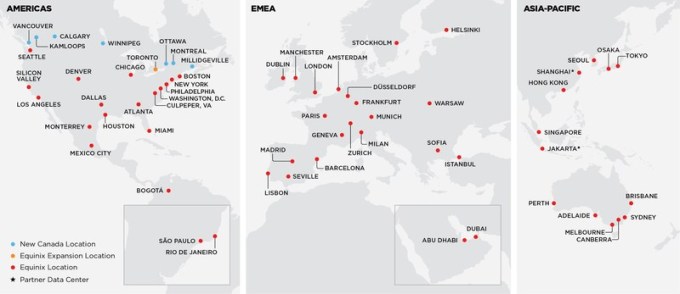
Global reach of Equinix including expanded Canadian operations shown in left panel (Image: Equinix)
The acquisition not only gives the company that additional revenue and a stronger foothold in the tenth largest economy in the world, it also gains 600 customers using the Bell data centers, of which 500 are net new.
As much of the world is attempting to digitally transform in the midst of the pandemic and current economic crisis, Equinix sees this as an opportunity to help more Canadian customers go digital more quickly.
“Equinix has been serving the Canadian market in Toronto for more than a decade. This expansion and scale gives the Canadian market a clear and rapid migration path to digital transformation. We’re looking forward to deepening our relationships with our existing Canada-based customers and helping new companies throughout the country position themselves for digital success,” Jon Lin, Equinix president, Americas told TechCrunch.
This is not the first time that Equinix has taken a bunch of data centers off the hands of a telco. In fact, three years ago, the company bought 29 centers from Verizon (which is the owner of TechCrunch) for $3.6 billion.
As telcos move away from the data center business, companies like Equinix are able to come in and expand into new markets and increase revenue. It’s one of the ways it continues to generate positive revenue year after year.
Today’s deal is just part of that strategy to keep expanding into new markets and finding new ways to generate additional revenue as more companies use their services. Equinix rents space in its data centers and provides all the services that companies need without having to run their own. That would include things like heating, cooling, racks and wiring.
Even though public cloud companies like Amazon, Microsoft and Google are generating headlines with growing revenues, plenty of companies still want to run their own equipment without going to the expense of actually owning the building where the equipment resides.
Today’s deal is expected to close in the second half of the year, assuming it clears all of the regulatory scrutiny required in a purchase like this.
Powered by WPeMatico
Bonusly, a platform that involves the entire organization in recognizing employees and rewarding them, closed on a $9 million Series A financing round led by Access Venture Partners. Next Frontier Capital, Operator Partners and existing investor FirstMark Capital also participated in the round.
Bonusly launched in 2013 when co-founder and CEO Raphael Crawford-Marks saw the opportunity to reinvent the way employers and colleagues recognize and reward their employees/coworkers.
“I knew that, in order to be successful, companies would be shifting their approach to employee experience and I thought software could enable that shift,” said Crawford-Marks. “Bonusly was this elegant idea of empowering employees to give each other timely, frequent and meaningful recognition that would not only benefit employees because they would feel recognized but also surface previously hidden information to the entire company about who was working with whom and on what and what strengths they were bringing to the workplace.”
Most employers use year-end bonuses and performance reviews to motivate workers, with some employers providing some physical rewards.
Bonusly thinks recognition should happen year-round. The platform works with the employers on their overall budget for recognition and rewards, and breaks that down into “points” that are allotted to all employees at the organization.
These employees can give out points to other co-workers, whether they’re direct reports or managers or peers, at any time throughout the year. Those points translate to a monetary value that can be redeemed by the employee at any time, whether it’s through PayPal as a cash reward or with one of Bonusly’s vendor partners, including Amazon, Tango Card and Cadooz. Bonusly also partners with nonprofit organizations to let employees redeem their points via charitable donation.
In fact, Crawford-Marks noted that Bonusly users just crossed the $500,000 mark for total donations, and have donated more than $100,000 to the WHO in six weeks.
Bonusly integrates with several collaboration platforms, including Gmail and Slack, to give users the flexibility to give points in whatever venue they choose. Bonusly also has a feed, not unlike social media sites like Twitter, that shows in real time employees who have received recognition.
The company has also built in some technical features to help with usability. For example, Bonusly understands the social organization of a company, surfacing the most relevant folks in the point feed based on who employees have given or received points to/from in the past. In a company with tens of thousands of employees, this keeps Bonusly relevant.
Bonusly has also incorporated tools for employers, including an auto-scale button for employers with workers in multiple jurisdictions or companies. The button allows employers to scale up or down the point allotments in different geographies based on cost of living.
There are also privacy controls on Bonusly that allow high-level employees and leadership to give each other recognition for projects that may not be widely known about at the company yet, like say for an acquisition that was completed.
Bonusly says that peer-to-peer recognition is more powerful than manager-only recognition, saying it’s nearly 36% more likely to have better financial outcomes.
The company also cites research that says that a happy workforce raises business productivity by more than 30%.
Bonusly competes with Kazoo and Motivocity, and Crawford-Marks says that the biggest differentiation factor is participation.
“We set a very high bar for how we measure participation and engagement in the platform,” he said. “You’ll see other companies claiming really high participation rates, but typically if you dig into that they’re talking about getting recognition every six months or every year or just logging in, rather than giving recognition every single month, month over month.”
He noted that 75% of employees on average give recognition in the first month of deployment with an organization, and that number gradually increases over time. By the two-year mark, 80% of employees are giving recognition every month.
Bonusly has raised a total of nearly $14 million in funding since inception.
Powered by WPeMatico
Box CEO Aaron Levie has been working to change the software world for 15 years, but the pandemic has accelerated the move to cloud services much faster than anyone imagined. As he pointed out yesterday in an Extra Crunch Live interview, who would have thought three months ago that businesses like yoga and cooking classes would have moved online — but here we are.
Levie says we are just beginning to see the range of what’s possible because circumstances are forcing us to move to the cloud much faster than most businesses probably would have without the pandemic acting as a change agent.
“Overall, what we’re going to see is that anything that can become digital probably will be in a much more accelerated way than we’ve ever seen before,” Levie said.
Fellow TechCrunch reporter Jon Shieber and I spent an hour chatting with Levie about how digital transformation is accelerating in general, how Box is coping with that internally and externally, his advice for founders in an economic crisis and what life might be like when we return to our offices.
Our interview was broadcast on YouTube and we have included the embed below.
Just a note that Extra Crunch Live is our new virtual speaker series for Extra Crunch members. Folks can ask their own questions live during the chat, with past and future guests like Alexis Ohanian, Garry Tan, GGV’s Hans Tung and Jeff Richards, Eventbrite’s Julia Hartz and many, many more. You can check out the schedule here. If you’d like to submit a question during a live chat, please join Extra Crunch.
The way that we think about digital transformation is that much of the world has a whole bunch of processes and ways of working — ways of communicating and ways of collaborating where if those business processes or that way we worked were able to be done in digital forms or in the cloud, you’d actually be more productive, more secure and you’d be able to serve your customers better. You’d be able to automate more business processes.
We think we’re [in] an environment that anything that can be digitized probably will be. Certainly as this pandemic has reinforced, we have way too many manual processes in businesses. We have way too slow ways of working together and collaborating. And we know that we’re going to move more and more of that to digital platforms.
In some cases, it’s simple, like moving to being able to do video conferences and being able to collaborate virtually. Some of it will become more advanced. How do I begin to automate things like client onboarding processes or doing research in a life sciences organization or delivering telemedicine digitally, but overall, what we’re going to see is that anything that can become digital probably will be in a much more accelerated way than we’ve ever seen before.
Powered by WPeMatico
In spite of a positive quarter with record revenue that beat analysts’ estimates, Salesforce stock was taking a hit today because of lighter guidance. Wall Street is a tough audience.
The stock was down $8.29/share, or 4.58%, as of 2:15 pm ET.
The guidance, which was a projection for next quarter’s earnings, was lighter than what the analysts on Wall Street expected. While Salesforce was projecting revenue for next quarter in the range of $4.89 to $4.90 billion, according to CNBC, analysts had expected $5.03 billion.
When analysts see a future that is a bit worse than what they expected, it usually results in a lower stock price, and that’s what we are seeing today. It’s worth noting that Salesforce is operating in the same economy as everyone else, and being a bit lighter on your projections in the middle of a pandemic seems entirely understandable.
In yesterday’s report, CEO Marc Benioff indicated that the company has been offering some customers some flexibility around payment as they navigate the economic fallout of COVID-19, and the company’s operating cash took a bit of a hit because of this.
“Operating cash flow was $1.86 billion, which was largely impacted by delayed payments from customers while sheltering in place and some temporary financial flexibility that we granted to certain customers that were most affected by the COVID pandemic,” president and CFO Mark Hawkins explained in the analyst call.
Still, the company reported revenue of $4.87 billion for the quarter, putting it on a run rate of $19.48 billion.
In a statement, David Hynes, Jr. of Canaccord Genuity remained high on Salesforce. “If you step back and think about what Salesforce is actually providing, tools that help businesses get closer to their customers are perhaps more important than ever in a slower-growth, socially distanced world. We have long reserved a spot for CRM among our top names in large cap, and we feel no differently about that view after what we heard last night. This is a high-quality firm with many levers to growth, and as such, we believe CRM is a good way to get a bit of defensive exposure to the favorable trends at play in software.”
The company is, after all, still firmly on the path to $20 billion in revenue. As Hynes points out, overall the kinds of tools that Salesforce offers should remain in demand as companies look for ways to digitally transform much more rapidly in our current situation, and look to companies like Salesforce for help.
Powered by WPeMatico
Due to COVID-19, business continuity has been put to the test for many companies in the manufacturing, agriculture, transport, hospitality, energy and retail sectors. Cost reduction is the primary focus of companies in these sectors due to massive losses in revenue caused by this pandemic. The other side of the crisis is, however, significantly different.
Companies in industries such as medical, government and financial services, as well as cloud-native tech startups that are providing essential services, have experienced a considerable increase in their operational demands — leading to rising operational costs. Irrespective of the industry your company belongs to, and whether your company is experiencing reduced or increased operations, cost optimization is a reality for all companies to ensure a sustained existence.
One of the most reliable measures for cost optimization at this stage is to leverage elastic services designed to grow or shrink according to demand, such as cloud and managed services. A modern product with a cloud-native architecture can auto-scale cloud consumption to mitigate lost operational demand. What may not have been obvious to startup leaders is a strategy often employed by incumbent, mature enterprises — achieving cost optimization by leveraging managed services providers (MSPs). MSPs enable organizations to repurpose full-time staff members from impacted operations to more strategic product lines or initiatives.
Powered by WPeMatico
When Cisco bought AppDynamics in 2017 for $3.7 billion just before the IPO, the company sent a clear signal it wanted to move beyond its pure network hardware roots into the software monitoring side of the equation. Yesterday afternoon the company announced it intends to buy another monitoring company, this time snagging internet monitoring solution ThousandEyes.
Cisco would not comment on the price when asked by TechCrunch, but published reports from CNBC and others pegged the deal at around $1 billion. If that’s accurate, it means the company has paid around $4.7 billion for a pair of monitoring solutions companies.
Cisco’s Todd Nightingale, writing in a blog post announcing the deal said that the kind of data that ThousandEyes provides around internet user experience is more important than ever as internet connections have come under tremendous pressure with huge numbers of employees working from home.
ThousandEyes keeps watch on those connections and should fit in well with other Cisco monitoring technologies. “With thousands of agents deployed throughout the internet, ThousandEyes’ platform has an unprecedented understanding of the internet and grows more intelligent with every deployment, Nightingale wrote.
He added, “Cisco will incorporate ThousandEyes’ capabilities in our AppDynamics application intelligence portfolio to enhance visibility across the enterprise, internet and the cloud.”
As for ThousandEyes, co-founder and CEO Mohit Lad told a typical acquisition story. It was about growing faster inside the big corporation than it could on its own. “We decided to become part of Cisco because we saw the potential to do much more, much faster, and truly create a legacy for ThousandEyes,” Lad wrote.
It’s interesting to note that yesterday’s move, and the company’s larger acquisition strategy over the last decade is part of a broader move to software and services as a complement to its core networking hardware business.
Just yesterday, Synergy Research released its network switch and router revenue report and it wasn’t great. As companies have hunkered down during the pandemic, they have been buying much less network hardware, dropping the Q1 numbers to seven year low. That translated into a $1 billion less in overall revenue in this category, according to Synergy.
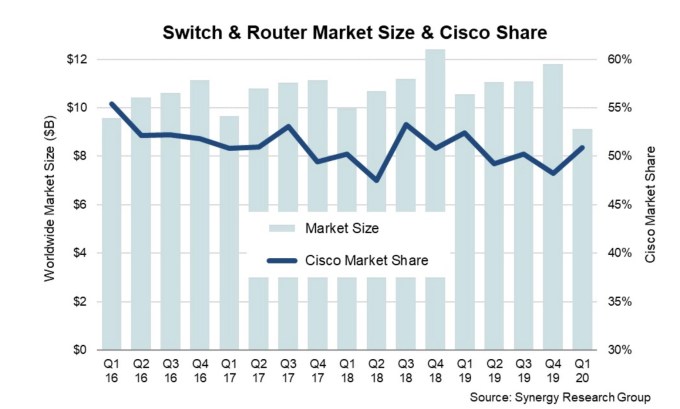
While Cisco owns the vast majority of the market, it obviously wants to keep moving into software services as a hedge against this shifting market. This deal simply builds on that approach.
ThousandEyes was founded in 2010 and raised over $110 million on a post valuation of $670 million as of February 2019, according to Pitchbook Data.
Powered by WPeMatico
In a surprise move, Mirantis acquired Docker’s Enterprise platform business at the end of last year, and while Docker itself is refocusing on developers, Mirantis kept the Docker Enterprise name and product. Today, Mirantis is rolling out its first major update to Docker Enterprise with the release of version 3.1.
For the most part, these updates are in line with what’s been happening in the container ecosystem in recent months. There’s support for Kubernetes 1.17 and improved support for Kubernetes on Windows (something the Kubernetes community has worked on quite a bit in the last year or so). Also new is Nvidia GPU integration in Docker Enterprise through a pre-installed device plugin, as well as support for Istio Ingress for Kubernetes and a new command-line tool for deploying clusters with the Docker Engine.
In addition to the product updates, Mirantis is also launching three new support options for its customers that now give them the option to get 24×7 support for all support cases, for example, as well as enhanced SLAs for remote managed operations, designated customer success managers and proactive monitoring and alerting. With this, Mirantis is clearly building on its experience as a managed service provider.
What’s maybe more interesting, though, is how this acquisition is playing out at Mirantis itself. Mirantis, after all, went through its fair share of ups and downs in recent years, from high-flying OpenStack platform to layoffs and everything in between.
 “Why we do this in the first place and why at some point I absolutely felt that I wanted to do this is because I felt that this would be a more compelling and interesting company to build, despite maybe some of the short-term challenges along the way, and that very much turned out to be true. It’s been fantastic,” Mirantis CEO and co-founder Adrian Ionel told me. “What we’ve seen since the acquisition, first of all, is that the customer base has been dramatically more loyal than people had thought, including ourselves.”
Ionel admitted that he thought some users would defect because this is obviously a major change, at least from the customer’s point of view. “Of course we have done everything possible to have something for them that’s really compelling and we put out the new roadmap right away in December after the acquisition — and people bought into it at very large scale,” he said. With that, Mirantis retained more than 90% of the customer base and the vast majority of all of Docker Enterprise’s largest users.
Ionel, who almost seemed a bit surprised by this, noted that this helped the company to turn in two “fantastic” quarters and was profitable in the last quarter, despite COVID-19.
“We wanted to go into this acquisition with a sober assessment of risks because we wanted to make it work, we wanted to make it successful because we were well aware that a lot of acquisitions fail,” he explained. “We didn’t want to go into it with a hyper-optimistic approach in any way — and we didn’t — and maybe that’s one of the reasons why we are positively surprised.”
He argues that the reason for the current success is that enterprises are doubling down on their container journeys and because they actually love the Docker Enterprise platform, like infrastructure independence, its developer focus, security features and ease of use. One thing many large customers asked for was better support for multi-cluster management at scale, which today’s update delivers.
“Where we stand today, we have one product development team. We have one product roadmap. We are shipping a very big new release of Docker Enterprise. […] The field has been completely unified and operates as one salesforce, with record results. So things have been extremely busy, but good and exciting.”
Powered by WPeMatico
We may be in the thick of a pandemic with all of the economic fallout that comes from that, but certain aspects of technology don’t change, no matter the external factors. Storage is one of them. In fact, we are generating more digital stuff than ever, and Wasabi, a Boston-based startup that has figured out a way to drive down the cost of cloud storage, is benefiting from that.
Today it announced a $30 million Series B led led by Forestay Capital, the technology innovation arm of Waypoint Capital, with help from previous investors. As with the previous round, Wasabi is going with home office investors, rather than traditional venture capital firms. Today’s round brings the total raised to $110 million, according to the company.
While founder and CEO David Friend wouldn’t discuss the specific valuation, he did say it was in the hundreds of millions of dollars.
Friend says the company needs the funds to keep up with the rapid growth. “We’ve got about 15,000 customers today, hundreds of petabytes of storage, 2,500 channel partners, 250 technology partners — so we’ve been busy,” he said.
He says that revenue continues to grow in spite of the impact of COVID-19 on other parts of the economy. “Revenue grew 5x last year. It’ll probably grow 3.5x this year. We haven’t seen any real slowdown from the coronavirus. Quarter over quarter growth will be in excess of 40% — this quarter over Q1 — so it’s just continuing on a torrid pace,” he said.
The challenge for a company like Wasabi, which is looking to capture a large chunk of the growing cloud storage market, is the infrastructure piece. It needs to keep building more to meet increasing demand, while keeping costs down, which remains its primary value proposition with customers.
The money will be used mostly to continue to expand its growing infrastructure requirements. The more they store, the more data centers they need, and that takes money. It will also help the company expand into new markets where countries have data sovereignty laws that require data to be stored in-country.
The company launched in 2015. It previously raised $68 million in 2018.
Note: This article originally stated this was a debt financing round. The company has clarified that it is an equity round.
Powered by WPeMatico
This week, Verizon Communications CEO Hans Vestberg joined us for an episode of Extra Crunch Live.
Vestberg is leading the company through the midst of one its biggest rollouts to date with the push into 5G connectivity. In our discussion, he spoke about how he’s managing the organization during this global crisis, his thoughts on work from home and acquisition strategy, and the ways in which 5G will change the way we work and live.
(Disclosure: Verizon Communications is TechCrunch’s parent company.)
Extra Crunch members can check out a partial transcript of the conversation (edited for length and clarity) or watch it in its entirety via YouTube video below.
Extra Crunch Live features some of the brightest minds in tech and VC, including Aileen Lee, Roelof Botha, Kirsten Green and Mark Cuban. Upcoming episodes will include Aaron Levie from Box, GGV’s Hans Tung and Jeff Richards, Eventbrite’s Julia Hartz and others. Extra Crunch members can submit questions to speakers in real time, so please sign up here if you haven’t already.
We’re a large company with 135,000 employees in 70 different countries around the globe. So, of course, we had an early warning when it started actually in Asia. We have employees in Asia, so we got the feeling that this could be really serious. It was early in the first week of February, we moved to the highest emergency or crisis level in the company. That means that we go to a certain crisis mode on how we organized and how we galvanized the company.
That’s usually put into place every time there is a big national disaster because you need to split between people taking care of the crisis and people taking care of running the business. So we were very early on with that. In the beginning of February, we started the emergency crisis operations center that was taking care of employee questions and prioritization of important things. At the same time, we continued to run the business. That was the first thing we did very early on.
Upcoming Extra Crunch Live episodes include discussions with Aaron Levie from Box, GGV’s Hans Tung and Jeff Richards, and Eventbrite’s Julia Hartz.
The other thing we did very early on is that we understood that this was something unprecedented. I mean, you have been in crisis before. I mean, I’ve been in the telecom crisis, and we’ve been in the banking crisis when everything just went boom. This is something totally different. You cannot use any of your historical experience when it comes to this pandemic, which actually impacts each and every one of us when it comes to health. So I was honest, and thought that they’re going to be a lot of questions. We decided very early on to run our noon live webcast to our employees. We are on our… I think it’s the 11th week, where at noon every day, we run the webcast for all our employees. That was two of the first things we did.
We didn’t think we were going to run for 11 weeks on the new live webcast, but we have done it because we see there’s a very good tool to communicate with all our employees.
Powered by WPeMatico
When Docker sold off its enterprise division to Mirantis last fall, that didn’t mark the end of the company. In fact, Docker still exists and has refocused as a cloud-native developer tools vendor. Today it announced an expanded partnership with Microsoft around simplifying running Docker containers in Azure.
As its new mission suggests, it involves tighter integration between Docker and a couple of Azure developer tools including Visual Studio Code and Azure Container Instances (ACI). According to Docker, it can take developers hours or even days to set up their containerized environment across the two sets of tools.
The idea of the integration is to make it easier, faster and more efficient to include Docker containers when developing applications with the Microsoft tool set. Docker CEO Scott Johnston says it’s a matter of giving developers a better experience.
“Extending our strategic relationship with Microsoft will further reduce the complexity of building, sharing and running cloud-native, microservices-based applications for developers. Docker and VS Code are two of the most beloved developer tools and we are proud to bring them together to deliver a better experience for developers building container-based apps for Azure Container Instances,” Johnston said in a statement.
Among the features they are announcing is the ability to log into Azure directly from the Docker command line interface, a big simplification that reduces going back and forth between the two sets of tools. What’s more, developers can set up a Microsoft ACI environment complete with a set of configuration defaults. Developers will also be able to switch easily between their local desktop instance and the cloud to run applications.
These and other integrations are designed to make it easier for Azure and Docker common users to work in in the Microsoft cloud service without having to jump through a lot of extra hoops to do it.
It’s worth noting that these integrations are starting in Beta, but the company promises they should be released some time in the second half of this year.
Powered by WPeMatico