Enterprise
Auto Added by WPeMatico
Auto Added by WPeMatico
Hasura is an open-source engine that can connect to PostgreSQL databases and microservices across hybrid- and multi-cloud environments and then automatically build a GraphQL API backend for them, making it easier for developers to then build their own data-driven applications on top of this unified API . For a while now, the San Francisco-based startup has offered a paid version (Hasura Pro) with enterprise-ready reliability and security tools, in addition to its free open-source version. Today, the company launched Hasura Cloud, which takes the existing Pro version, adds a number of cloud-specific features like dynamic caching, auto-scaling and consumption-based pricing, and brings those together in a fully managed service.
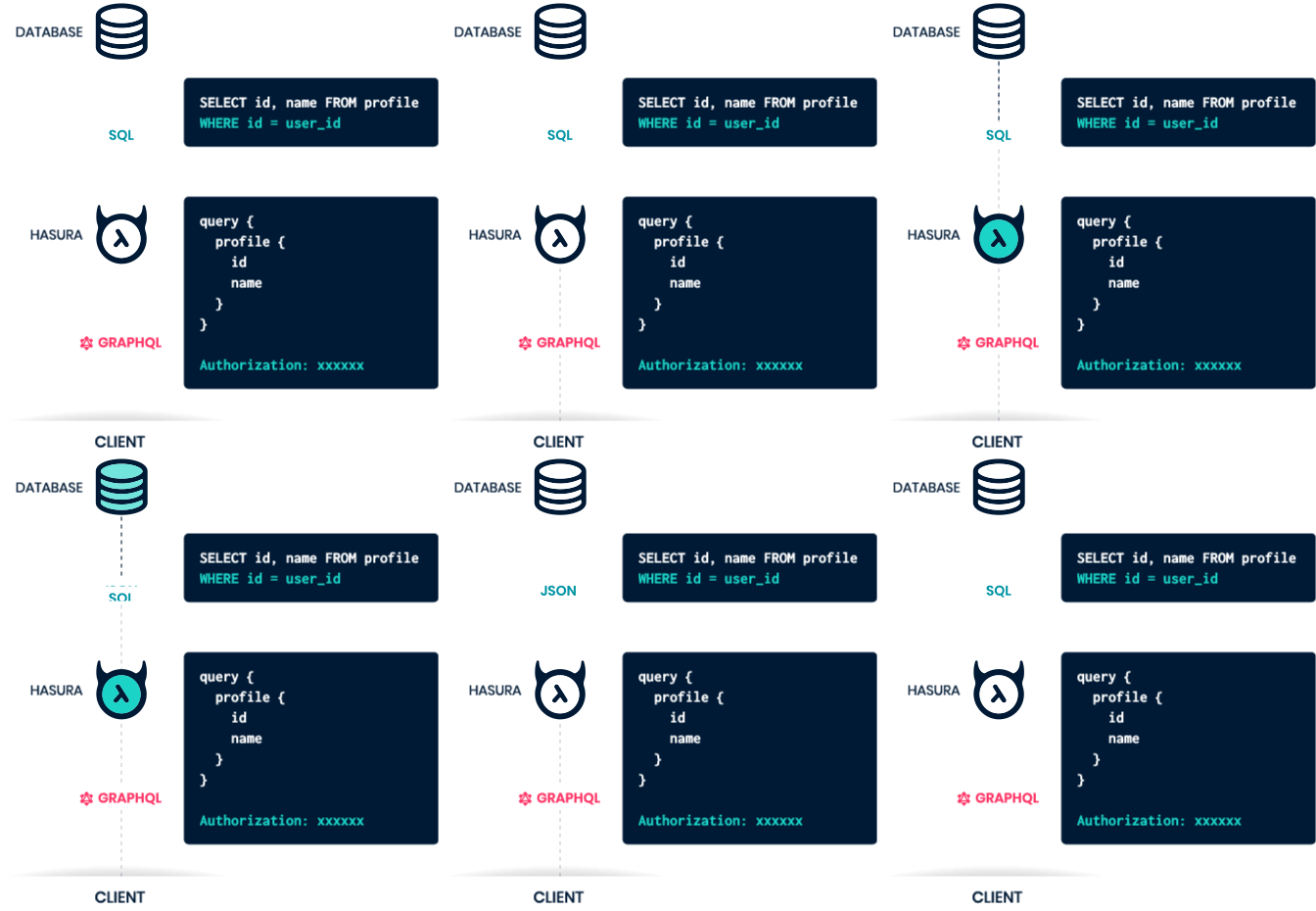
Image Credits: Hasura
At its core, Hasura’s service promises businesses the ability to bring together data from their various siloed databases and allow their developers to extract value from them through its GraphQL APIs. While GraphQL is still relatively new, the Facebook-incubated technology has quickly become extremely popular among many development teams.
Before founding the company and launching it in 2018, Hasura CEO and co-founder Tanmai Gopal worked for a consulting firm — and like with so many founders, that’s where he got the inspiration for the service.
“One of the key things that we noticed was that in the entire landscape, computing is becoming better, there are better frameworks, it is easier to deploy code, databases are becoming better and they kind of work everywhere,” he said. “But this kind of piece in the middle that is still a bottleneck and that there isn’t really a good solution for is this data access piece.” Almost by default, most companies host data in various SaaS services and databases — and now they were trying to figure out how to develop apps based on this for both internal and external consumers, noted Gopal. “This data distribution problem was this bottleneck where everybody would just spend massive amounts of time and money. And we invented a way of kind of automating that,” he explained.
The choice of GraphQL was also pretty straightforward, especially because GraphQL services are an easy way for developers to consume data (even though, as Gopal noted, it’s not always fun to build the GraphQL service itself). One thing that’s unusual and worth noting about the core Hasura engine itself is that it is written in Haskell, which is a rather unusual choice.

Image Credits: Hasura
The team tells me that Hasura is now nearing 50 million downloads for its free version and the company is seeing large and small users from across various industries relying on its products, which is probably no surprise, given that the company is trying to solve a pretty universal problem around data access and consumption.
Over the last few quarters, the team worked on launching its cloud service. “We’ve been thinking of the cloud in a very different way,” Gopal said. “It’s not your usual, take the open-source solution and host it, like a MongoDB Atlas or Confluent. What we’ve done is we’ve said, we’re going to re-engineer the open-source solution to be entirely multi-tenant and be completely pay-per pricing.”
Given this philosophy, it’s no surprise that Hasura’s pricing is purely based on how much data a user moves through the service. “It’s much closer to our value proposition,” Hasura co-founder and COO Rajoshi Ghosh said. “The value proposition is about data access. The big part of it is the fact that you’re getting this data from your databases. But the very interesting part is that this data can actually come from anywhere. This data could be in your third-party services, part of your data could be living in Stripe and it could be living in Salesforce, and it could be living in other services. […] We’re the data access infrastructure in that sense. And this pricing also — from a mental model perspective — makes it much clearer that that’s the value that we’re adding.”
Now, there are obviously plenty of other data-centric API services on the market, but Gopal argues that Hasura has an advantage because of its advanced caching for dynamic data, for example.
Powered by WPeMatico
Technology has dramatically changed over the last decade, and so has how we build and deliver enterprise software.
Ten years ago, “modern computing” was to rely on teams of network admins managing data centers, running one application per server, deploying monolithic services, through waterfall, manual releases managed by QA and release managers.
Today, we have multi and hybrid clouds, serverless services, in continuous integration, running infrastructure-as-code.
SaaS has grown from a nascent 2% of the $450B enterprise software market in 2009, to 23% in 2020 and crossed $100B in revenue. PaaS and IaaS revenue represent another $50B in revenue, expecting to double to $100B by 2022.
With 77% of the enterprise software market — over $350B in annual revenue — still on legacy and on-premise systems, modern SaaS, PaaS and IaaS eating at the legacy market alone can grow the market 3x-4x over the next decade.
As the shift to cloud accelerates across the platform and infrastructure layers, here are four trends starting to emerge that will change how we develop and deliver enterprise software for the next decade.
Companies are building more dynamic, multiplatform, complex infrastructures than ever. We see the “-aaS” of the application, data, runtime and virtualization layers. Modern architectures are forcing extensibility to work with any number of mixed and matched services.
Powered by WPeMatico
Sydney-based Canva, the design platform for non-designers, has today announced the close of a $60 million funding round, bringing its valuation to $6 billion, according to the company.
The startup has raised a total of more than $300 million, including this latest round of financing, from investors like Bond, General Catalyst, Sequoia Capital China, Felicis Ventures and Blackbird Ventures .
Canva COO and co-founder Cliff Obrecht explained that the round was 10x oversubscribed with interest from angels and new VCs, but that the company resisted taking extra capital.
“At our stage, investors are looking to deploy $50 million+ in capital,” said Obrecht. “Even our existing investors were looking to deploy between $50 million and $100 million, but we said ‘Oh, gee, we really don’t want to be diluted that much because we have a lot of conviction in the business and we don’t need that much money.’ ”
He also said the company wanted to remain with existing investors — Blackbird and Sequoia Capital China led this round — because those investors bet on the company when it was in its infancy, founded by three people in an isolated part of the world with no technical chops.
At the beginning of the pandemic, Canva made a commitment to continue paying all of its contracted workers, but froze hiring. The company also made quick moves to shut down the office and move to remote work. However, Canva is one of the few companies that is getting a boost from the world moving to work from home.
The company has seen a 50% uptick in shared designs, and around a 25% increase in designs created each month. Overall, Canva is growing 100% year over year in both revenue and users, with 30 million monthly active users across 190 countries.
Canva was founded in 2012 with the mission of democratizing design tools. While many non-designers can navigate their way around Google Slides or PowerPoint, or maybe even crop an image, going more in-depth on a design project can be daunting, as the suite of tools provided to designers can be incredibly complex.
The company’s tools are meant to simplify the design process for folks who don’t work in the design department, whether it’s the sales team putting together sales materials, marketers working on content or other departments working on internal materials to send to the broader organization. The drag-and-drop interface gives folks a way to create something beautiful and impressive without having to learn Photoshop.
The product started out as a freemium product for individual consumers but eventually started offering enterprise products, as well as a video editing tool that comes complete with video templates, easy-to-use animation tools and a library of stock video, music, etc.
The company has also launched an educational platform called Canva for Education, which integrates with G Suite and Google Classroom to get students started on design early. Canva also offers a developer platform for startups that want to integrate with the company, which currently includes Dropbox, Google Drive, PhotoMosh and Instagram, among others.
Most recently, Canva partnered with FedEx Office to offer easy design-to-print products that let users pick up print designs from one of more than 2,000 locations in the U.S. as the Sydney-based company looks to secure a foothold in this market.
Canva plans on using the funding to grow the company, make a push into collaboration and continue making acquisitions.
On the heels of the funding, Canva is looking to hire — the company currently has 1,000+ employees, of which more than 40% are female. (Canva did not disclose the percentage of its workforce that are non-white.)
Obrecht says that one of the greatest challenges for the company and for leadership personally is the burden of not feeling like they’re doing enough to make the world a better place. He explained that the company has a number of initiatives focused on this core tenet, including free access to the platform for more than 50,000 nonprofit organizations, education initiatives, anti-discrimination policies within its TOS and more.
“But it just never really feels like enough,” said Obrecht. “You see what’s happening and it’s a bit of a shit show and it’s not aspirational at all. It doesn’t look like it’s getting fixed quickly by the adults who are in government. They’re not doing the right thing, and if they’re not, who will? So we really believe we should have a heavy part in trying our best to make sure the shit show doesn’t continue.”
Powered by WPeMatico
With more companies moving workers home, making sure your systems are up and running has become more important than ever. ServiceNow, which includes in its product catalog an IT Help Desk component, recognizes that help desks have been bombarded during the pandemic. To help stop configuration problems before they start, the company today acquired Sweagle, a configuration management startup based in Belgium.
The companies did not share the purchase price.
ServiceNow gets a couple of boosts in the deal. First of all, it gets the startup’s configuration management products, which it can incorporate into its own catalog, but it also gains the machine learning and DevOps knowledge of the company’s employees. (The company would not share the exact number of employees, but PitchBook pegs it at 15.)
RJ Jainendra, ServiceNow’s vice president and general manager of DevOps and IT Business Management, sees a company that has pioneered the IT configuration management automation space, and brings with it capabilities that can boost ServiceNow’s offerings. “With capabilities for configuration data management from Sweagle, we will empower DevOps teams to deliver application and infrastructure changes more rapidly while reducing risk,” Jainendra said in a statement.
ServiceNow claims that there can be as many as 50,000 different configuration elements in a single enterprise application. Sweagle has designed a configuration data management platform with machine learning underpinnings to help customers simplify and automate that complexity. Configuration errors can cause shutdowns, security issues and other serious problems for companies.
Sweagle was founded in 2017 and raised $4.05 million on a post-valuation of $11.88 million, according to PitchBook data.
The company is part of a growing pattern of early-stage startups being sucked up by larger companies during the pandemic, including VMware acquiring Ocatarine and Atlassian buying Halp in May and NetApp snagging Spot earlier this month.
This is the third acquisition for ServiceNow this year, all involving AI underpinnings. In January it bought Loom Systems and Passsage AI. The deal is expected to close in Q3 this year, according to ServiceNow.
Powered by WPeMatico
HashiCorp is well known in the developer community for offering a slew of open-source tools to help build and manage modern applications. Today the company announced a new cloud platform and plans to eventually offer managed versions of those tools, starting with Consul, a tool for connecting and securing services across platforms.
HashiCorp CEO Dave McJannet says that the pandemic has accelerated demand for cloud infrastructure, and he sees a growing role for his company in helping to build cloud native applications. The company offers open-source and commercial versions of several popular tools, including Terraform, Consul, Vault and Packer, among others. These can run on premises or in the cloud, but McJannet says customers have been hankering for SaaS versions of these tools.
“Our customers have told us that it’s a huge challenge running a central shared service like Consul. It requires them to keep it up and running, and they have asked for something they can consume from us where we manage it for them,” McJannet told TechCrunch.
The company has been offering a managed version of Terraform for some time, but it has been quietly working on a cloud platform that could allow it to plug in each of the company’s products over time and offer managed services of all the products.
“What we are announcing today is what we call the HashiCorp Cloud Platform, and you can think of it as just a common chassis to allow us to run our products on any cloud. The first of those products that we’re making available is Consul on Amazon,” he said.
By offering the company’s products as a set of cloud services, it will lower the barrier to entry for customers who want to use their tooling, but don’t have the resources to run and manage on their own. That could potentially increase the company revenue over time. As McJannet pointed out, it’s a lot like what MongDB did with its managed Atlas database service, but for a wider set of products.
Last Fall, HashiCorp announced a $175 million investment on an impressive $5 billion valuation. It has 1,000 employees and is continuing to hire as demand for its product continues through the pandemic. McJannet was not discussing specific customer numbers, but said the customer count has doubled over the last year. As it builds out the new cloud services, and introduces more customers to its products, there’s a good chance that number will keep growing.
Powered by WPeMatico
Three years ago almost to the day, Intercom announced that it was bringing former Intuit exec Karen Peacock on board as COO. Today, she got promoted to CEO, effective July 1. Current CEO and company co-founder Eoghan McCabe will become Chairman.
As it turns out, these moves aren’t a coincidence. McCabe had been actively thinking about a succession plan when he hired Peacock. “When I first started talking to Eoghan three years ago, he shared with me that his vision was to hire someone as COO, who could then become the CEO at the right time and he could transition into the chairman role,” Peacock told TechCrunch .
She said while the idea was always there, they didn’t feel the need to rush the process. “We were just looking for whatever the right time was, and it wasn’t something we were expected to do in the first year or two. And now is really the right time to transition with all of the momentum that we’re seeing in the market,” she said.
She said as McCabe makes the transition away from running the company he helped found, he will still be around, and they will continue working together on things like product and marketing strategy, but Peacock brings a pedigree of her own to the new role.
Not only has she been in charge of commercial aspects of the Intercom business for the past three years, prior to that she was SVP at Intuit where she ran small business products that included QuickBooks, and grew it from a $500 million business to a hefty $2.5 billion during her tenure.
McCabe says that experience was one of the reasons he spent six months trying to convince Peacock to become COO at Intercom in 2017. “It’s really hard to find a leader that’s as well rounded, and as unique as Karen is. You know she doesn’t actually fit your typical very experienced operator,” he said. He points to her deep product background, calling her a “product nerd,” and her undergraduate degree in applied mathematics from Harvard as examples.
In spite of the pandemic, she’s taking over a company that’s still managing to grow. The company’s business messenger products, which enable companies to chat with customers online, have become increasingly important during the pandemic with many brick-and-mortar businesses shut down and the majority of business is being conducted digitally.
“Our overall revenue is $150 million in annual recurring revenue, and a supporting data point to what we were just talking about is that our new business to up market customers through our sales teams has doubled year over year. So we’re really seeing some quite nice acceleration there,” she said.
Peacock says she wants to continue building the company and using her role to build a diverse and inclusive culture. “I believe that [diversity and inclusion] is not one person’s job, it’s all of our jobs, but we have one person who’s the center post of that (a head of D&I). And then we work with outside consulting firms as well to just try and stay in a place where we understand all of what’s possible and what we can do in the world.”
She adds, “I will say that we need to make more progress on diversity and inclusion. I wouldn’t step back and pat ourselves on the back and say we’ve done this perfectly. There’s a lot more that we need to do, and it’s one of the things that I’m very excited to tackle as CEO.”
According to a February Wall Street Journal article, less than 6% of women hold CEO jobs in the U.S. Peacock certainly sees this and wants to continue to mentor women as she takes over at Intercom. “It is something that I’m very passionate about. I do speak to various different groups of up and coming women leaders, and I mentor a group of women outside of Intercom,” she said. She also sits on the board at Dropbox with other women leaders like Condoleezza Rice and Meg Whitman.
Peacock says that taking over during a pandemic makes it interesting, and instead of visiting the company’s offices, she’ll be doing a lot of video conferences. But neither is she coming in cold to the company having to ramp up on the business side of things, while getting to know everyone.
“I feel very fortunate to have been with Intercom for three years, and so I know all the people and they all know me. And so I think it’s a lot easier to do that virtually than if you’re meeting people for the very first time. Similarly, I also know the business very well, and so it’s not like I’m trying to both ramp up on the business and deal with a pandemic,” she said.
Powered by WPeMatico
As an increasing number of daily and essential services move to digital platforms — a trend that’s had a massive fillip in the last few months — having efficient but effective ways to verify that people are who they say they are online is becoming ever more important. Now, a startup called Payfone, which has built a B2B2C platform to identify and verify people using data (but no personal data) gleaned from your mobile phone, has raised $100 million to expand its business. Specifically, Rodger Desai, the co-founder and CEO, said in an interview that plan will be to build in more machine learning into its algorithms, expand to 35 more geographies and make strategic acquisitions to expand its technology stack.
The funding is being led by Apax Digital, with participation from an interesting list of new and existing backers. They include Sandbox Insurtech Ventures, a division of Sandbox Industries, which connects corporate investment funds with strategic startups in their space); Ralph de la Vega, the former vice chairman of AT&T; MassMutual Ventures; Synchrony; Blue Venture Fund (another Sandbox outfit); Wellington Management LLP; and the former CEO of LexisNexis, Andrew Prozes.
Several of these investors have a close link to the startup’s business: Payfone counts carriers, healthcare and insurance companies, and banks among its customers, which use Payfone technology in their backends to help verify users making transactions and logging in to their systems.
Payfone tells me it has now raised $175 million to date, and while it’s not disclosing its valuation with this round, according to PitchBook, in April 2019 when it raised previously, it was valued at $270 million. Desai added that Payfone is already profitable and business has been strong lately.
“In 2019 we processed 20 billion authentications, mostly for banks but also healthcare companies and others, and more generally, we’ve been growing 70% year-over-year,” he said. The aim is to boost that up to 100 billion authentications in the coming years, he said.
Payfone was founded in 2008 amongst a throng of mobile payment startups (hence its name) that emerged to help connect consumers, mobile content businesses and mobile carriers with simpler ways to pay using a phone, with a particular emphasis on using carrier billing infrastructure as a way of letting users pay without inputting or using cards (especially interesting in regions where credit and debit card penetration and usage are lower).
That has been an interesting if slowly growing business, so around 2015 Payfone starting to move toward using its tech and infrastructure to delve into the adjacent and related space of applying its algorithms, which use authentication data from mobile phones and networks to help carriers, banks and many other kinds of businesses verify users on their networks.
(Indeed, the connection between the technology used for mobile payments that bypasses credit/debit cards and the technology that might be used for ID verification is one that others are pursuing, too: Carrier billing startup Boku — which yesterday acquired one of its competitors, Fortumo, in a $41 million deal as part of a wider consolidation play — also acquired one of Payfone’s competitors, Danal, 18 months ago to add user authentication into its own range of services.)
The market for authentication and verification services was estimated to be worth some $6 billion in 2019 and is projected to grow to $12.8 billion by 2024, according to research published by MarketsandMarkets. But within that there seems to be an almost infinite amount of variations, approaches and companies offering services to carry out the work. That includes authentication apps, password managers, special hardware that generates codes, new innovations in biometrics using fingerprints and eye scans, and more.
While some of these require active participation from consumers (say by punching in passwords or authentication codes or using fingerprints), there’s also a push to develop more seamless and user-friendly, and essentially invisible, approaches, and that’s where Payfone sits.
As Desai describes it, Payfone’s behind-the-scenes solution is used either as a complement to other authentication techniques or on its own, depending on the implementation. In short, it’s based around creating “signal scores” and tokens, and is built on the concept of “data privacy and zero data knowledge architecture.” That is to say, the company’s techniques do not store any personal data and do not need personal data to provide verification information.
As he describes it, while many people might only be in their 20s when getting their first bank account (one of the common use cases for Payfone is in helping authenticate users who are signing up for accounts via mobile), they will have likely already owned a phone, likely with the same phone number, for a decade before that.
“A phone is with you and in your use for daily activities, so from that we can opine information,” he said, which the company in turn uses to create a “trust score” to identify that you are who you say you are. This involves using, for example, a bank’s data and what Desai calls “telecoms signals” against that to create anonymous tokens to determine that the person who is trying to access, say, a bank account is the same person identified with the phone being used. This, he said, has been built to be “spoof proof” so that even if someone hijacks a SIM it can’t be used to work around the technology.
While this is all proprietary to Payfone today, Desai said the company has been in conversation with other companies in the ecosystem with the aim of establishing a consortium that could compete with the likes of credit bureaus in providing data on users in a secure way.
“The trust score is based on our own proprietary signals but we envision making it more like a clearing house,” he said.
The fact that Payfone essentially works in the background has been just as much of a help as a hindrance for some observers. For example, there have been questions raised previously about how data is sourced and used by Payfone and others like it for identification purposes. Specifically, it seems that those looking closer at the data that these companies amass have taken issue not necessarily with Payfone and others like it, but with the businesses using the verification platforms, and whether they have been transparent enough about what is going on.
Payfone does provide an explanation of how it works with secure APIs to carry out its services (and that its customers are not consumers but the companies engaging Payfone’s services to work with consumer customers), and offers a route to opt out of of its services for those that seek to go that extra mile to do so, but my guess is that this might not be the end of that story if people continue to learn more about personal data, and how and where it gets used online.
In the meantime, or perhaps alongside however that plays out, there will continue to be interesting opportunities for approaches to verify users on digital platforms that respect their personal data and general right to control how any identifying detail — personal or not — gets used. Payfone’s traction so far in that area has helped it stand out to investors.
“Identity is the key enabling technology for the next generation of digital businesses,” said Daniel O’Keefe, managing partner of Apax Digital, in a statement. “Payfone’s Trust Score is core to the real-time decisioning that enterprises need in order to drive revenue while thwarting fraud and protecting privacy.” O’Keefe and his colleague, Zach Fuchs, a principal at Apax Digital, are both joining the board.
“Payfone’s technology enables frictionless customer experience, while curbing the mounting operating expense caused by manual review,” said Fuchs.
Powered by WPeMatico
Email is one of those things that no one likes but that we’re all forced to use. Superhuman, founded by Rahul Vohra, aims to help everyone get to inbox zero.
Launched in 2017, Superhuman charges $30 per month and is still in invite-only mode with more than 275,000 people on the waitlist. That’s by design, Vohra told us earlier this week on Extra Crunch Live.
“I think a lot of folks misunderstand the nature of our waitlist,” he said. “They assume it’s some kind of FOMO-generating technique or some kind of false scarcity. Nothing could be further from the truth. The real reason we have the waitlist is that I want everyone who uses Superhuman to be deliriously happy with their experience.”
Today, the app is only available for desktop and iOS. Superhuman started with iOS because most premium users have iPhones, Vohra said. Still, many users have Android, so Superhuman’s waitlist consists mostly of Android users.
“We don’t think that if we onboard them they’d have the best experience with Superhuman because email really is an ecosystem product,” he said. “You do it just as much on the go as you do from your laptop. There’s a lot of reasons like that. So if you’re a person who identifies that as a must-have, well, we’ll take in the survey, we’ll learn about you so we know when to reach out to you. Then when we have those things built or integrated, we’ll reach out.”
We also chatted about his obsession with email, determining pricing for a premium product, the impact of COVID-19, diversity in tech in light of the police killing of George Floyd and so much more.
Throughout the conversation, Vohra also offered up some good practical advice for founders. Here are some highlights from the conversation.
Yeah, I’m not at all worried. I used to get worried about this. You know, 10 years ago, even as recently as five years ago, I would get worried about competitors. But I think Paul Graham has really, really great advice on this. I think he says pretty much verbatim: Startups don’t kill other startups. Competition generally doesn’t kill the startup. Other things do, like running out of money being the biggest one, or lack of momentum or lack of motivation or co-founder feuds; these are all really dangerous things.
Competition from other startups generally isn’t the thing that gets you and you know, props to the Basecamp team and everything they’ve done with Hey. It’s really impressive. I think it’s for an entirely different demographic than Superhuman is for.
Superhuman is for the person for whom essentially email is work and work is email. Our users kind of almost personally identify with their email inbox, and they’re coming from Gmail or G Suite. Typically it’s overflowing so they often receive hundreds if not thousands of emails a day, and they send off 100 emails a day. Superhuman is for high-volume email for whom email really matters. Power users, essentially, though power users isn’t quite the right articulation. What I actually say is prosumers because there’s a lot of people who come to us at Superhuman and they’re not yet power users of email, but they know they need to be.
That’s what I would call a prosumer — someone who really wants to be brilliant at doing email. Now Hey doesn’t seem to be designed for that target market. It doesn’t seem to be designed for high-volume emailers or prosumers or power users.
Powered by WPeMatico
Finding somewhere in a Slack conversation, or stored in Box, Dropbox, Google Docs or Office 365, that one document you want to attach to an email is a huge challenge as we find ourselves spreading our content across a variety of cloud services. It’s one challenge that Cloudtenna has been trying to solve, and today the company announced a $2.5 million funding round along with the release of a new mobile search tool.
The funding comes from a variety of unnamed investors, along with Blazar Ventures, and brings the total raised to $6.5 million, according to the company.
Cloudtenna co-founder Aaron Ganek says that by using AI and document metadata, his company can find content wherever it lives. “What we’re really focused on is helping companies bring order to file chaos. Files are scattered everywhere across the cloud, and we have developed AI-powered applications that help users find files, no matter where they’re stored,” he said.
The company introduced a desktop search application in 2018 and today it’s announcing a mobile search tool called Workspace to go with it. Ganek says they built this app from the ground up to take advantage of the mobile context.
“Today, we’re bringing the search technology to smartphones and tablets. And just to be clear, this is not just a mobile version of our desktop product, but a complete case study in how people collaborate on the go,” he said.
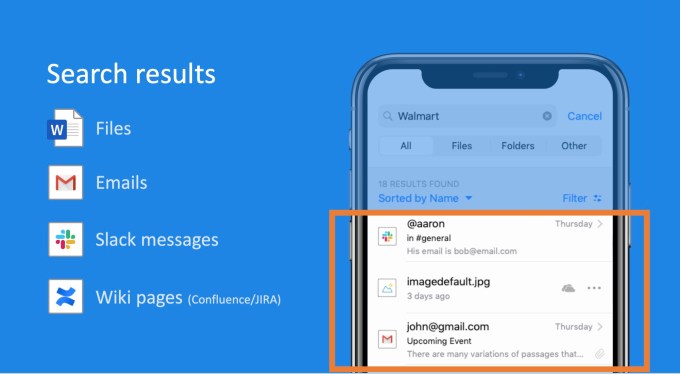
Image Credit: Cloudtenna
The AI component helps find files wherever they are based on your user history, who you tend to collaborate with and so forth. That helps the tool find the files that are most relevant to you, regardless of where they happen to be stored.
He says that raising money during a pandemic was certainly interesting, but the company has seen an uptick in usage due to the general increase in SaaS usage during this time, and investors saw that too, he said.
The company launched in 2016 and currently has nine employees, but Ganek said there aren’t any plans to expand on that number at this time, or at least any number he was ready to discuss.
Powered by WPeMatico
Onna, the “knowledge integration platform” (KIP) that counts Dropbox and Slack as backers, has raised $27 million in Series B funding.
Leading the round is Atomico, with participation from Glynn Capital. Previous investors Dawn Capital, Nauta Capital and Slack Fund also followed on.
Founded in 2015, Barcelona and New York-based Onna integrates with a plethora of workplace apps, including Slack, Dropbox, G Suite, Microsoft 365 and Salesforce, to help unlock the proprietary knowledge stored in a company’s various cloud and on-premise software. Typical applications for a KIP include compliance, governance, archiving and “eDiscovery.”
From communication apps to cloud storage to HR platforms, the idea is to unify all of this data and make it searchable but in a way that is secure and protects existing permissions and privacy. In fact, another way to think of Onna is like Apple’s Spotlight functionality but for the enterprise. However, pitched as a platform not just a feature, Onna also offers an API of its own so that various use cases can be built on top of this “single source of truth.”
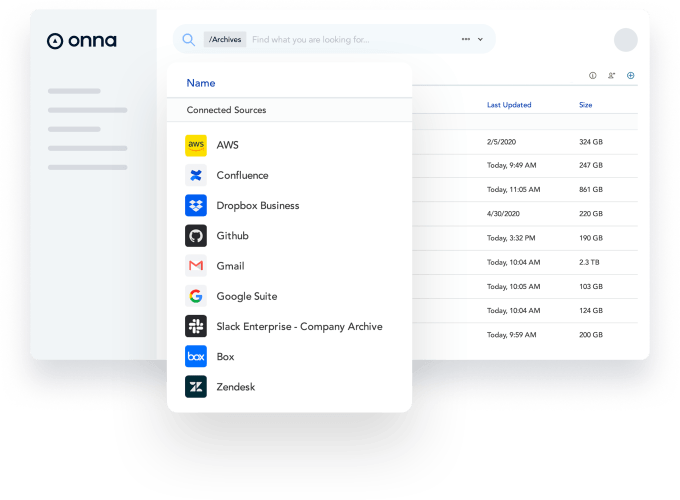 “Onna’s knowledge integration platform is a centralised, searchable and secure hub that connects company data wherever it resides and makes it easier and faster to make informed decisions,” Onna founder and CEO Salim Elkhou tells TechCrunch. “It is a productivity tool built for the way businesses work today… something that didn’t exist before, creating a new industry standard which benefits all companies within the ecosystem.”
Citing a report by single sign-in provider Okta, Elkhou notes that companies today use an average of 88 different apps across their workforce, a 21% increase from three years ago.
“The reason apps have become so popular is that they’re very effective for tackling specific challenges, or even a broad range of tasks. But the problem large organisations were coming up against is that their knowledge was spread across a wide range of apps that weren’t necessarily designed to work together.”
For example, a legal counsel could be looking to find contracts company-wide to assess a company’s exposure. The problem is that contracts may be saved in Salesforce, sent by email, shared over Slack or even saved on desktops. “Your company may have acquired another company, which has its own ways of saving information, so now the simple task of finding contracts can be a heavy lifting exercise, involving everyone’s time. With Onna, being the connective tissue across these applications, this search would take a split second,” claims Elkhou.
But the potential power of a KIP goes well beyond search alone. Elkhou says a more ambitious use case is unifying knowledge across apps and using Onna as infrastructure. “We believe that the next generation of workplace apps will be built on top of a knowledge integration platform like Onna,” he explains. “Due to our plug and play integrations with most enterprise apps and our open API, you can now build your own bespoke workflows on top of your company’s knowledge. More importantly, we handle all the heavy lifting on the back end when it comes to processing the right contextual information across multiple systems securely, which means you can get on with creatively building a more efficient workplace.”
“In Onna, we saw a product in a new and complementary category, providing a solution not at the data level but at the ‘knowledge level,’ ” adds Atomico’s Ben Blume, who has also joined the Onna board. “Onna’s core solution integrates with any tools in an organisation where knowledge resides, [and] ingests, indexes and classifies the knowledge inside, enabling it to power applications in many areas.”
Blume also points to the belief that some of the cloud tools vendors themselves have in Onna, with both Slack and Dropbox “investing, using and promoting” Onna’s solution. “As they look to grow their own penetration in organisations with a wider range of needs and demands, we saw partnering with Onna as a recognition of its best in class nature to their customers,” he says.
Meanwhile, I understand the new round of funding was done remotely due to lockdown, even though Atomico and Onna had already met and stayed in touch after the VC firm ended up not participating in the startup’s Series A.
Recalls Elkhou: “We had met with our investors in person over a year ago, and have had many video calls since and prior to the pandemic. However, soon after the lockdowns took effect, the need for remote collaboration tools skyrocketed which only accelerated the critical role Onna has in helping people within organisations access and share knowledge that was spread across an ever growing number of apps. If anything, it brought new urgency to the problem we were solving, because workplace serendipity no longer existed. You couldn’t answer questions over a coffee or by the water cooler, but these new remote workers still needed to access knowledge and share it securely.”
Powered by WPeMatico