Salesforce Ventures
Auto Added by WPeMatico
Auto Added by WPeMatico
Business, now more than ever before, is going digital, and today a startup that’s building a vertically integrated solution to meet business banking needs is announcing a big round of funding to tap into the opportunity. Airwallex — which provides business banking services directly to businesses themselves as well as via a set of APIs that power other companies’ fintech products — has raised $200 million, a Series E round of funding that values the Australian startup at $4 billion.
Lone Pine Capital is leading the round, with new backers G Squared and Vetamer Capital Management, and previous backers 1835i Ventures (formerly ANZi), DST Global, Salesforce Ventures and Sequoia Capital China also participating.
The funding brings the total raised by Airwallex — which has head offices in Hong Kong and Melbourne, Australia — to $700 million, including a $100 million injection that closed out its Series D just six months ago.
Airwallex will be using the funding both to continue investing in its product and technology as well as to continue its geographical expansion and to focus on some larger business targets. The company has started to make some headway into Europe and the U.K. and that will be one big focus, along with the U.S.
The quick succession of funding and rising valuation underscore Airwallex’s traction to date around what CEO and co-founder Jack Zhang describes as a vertically integrated strategy.
That involves two parts. First, Airwallex has built all the infrastructure for the business banking services that it provides directly to businesses with a focus on small and medium enterprise customers. Second, it has packaged up that infrastructure into a set of APIs that a variety of other companies use to provide financial services directly to their customers without needing to build those services themselves — the so-called “embedded finance” approach.
“We want to own the whole ecosystem,” Zhang said to me. “We want to be like the Apple of business finance.”
That seems to be working out so far for Airwallex. Revenues were up almost 150% for the first half of 2021 compared to a year before, with the company processing more than US$20 billion for a global client portfolio that has quadrupled in size. In addition to tens of thousands of SMEs, it also, via APIs, powers financial services for other companies like GOAT, Papaya Global and Stake.
Airwallex got its start like many of the strongest startups do: It was built to solve a problem that the founders encountered themselves. In the case of Airwallex, Zhang tells me he had actually been working on a previous startup idea. He wanted to build the “Blue Bottle Coffee” of Asia Pacific out of Australia, and it involved buying and importing a lot of different materials, packaging and, of course, coffee from all around the world.
“We found that making payments as a small business was slow and expensive,” he said, since it involved banks in different countries and different banking systems, manual efforts to transfer money between them and many days to clear the payments. “But that was also my background — payments and trading — and so I decided that it was a much more fascinating problem for me to work on and resolve.”
Eventually one of his co-founders in the coffee effort came along, with the four co-founders of Airwallex ultimately including Zhang, along with Xijing Dai, Lucy Liu and Max Li.
It was 2014, and Airwallex got attention from VCs early on in part for being in the right place at the right time. A wave of startups building financial services for SMBs were definitely gaining ground in North America and Europe, filling a long-neglected hole in the technology universe, but there was almost nothing of the sort in the Asia Pacific region, and in those earlier days solutions were highly regionalized.
From there it was a no-brainer that starting with cross-border payments, the first thing Airwallex tackled, would soon grow into a wider suite of banking services involving payments and other cross-border banking services.
“In the last six years, we’ve built more than 50 bank integrations and now offer payments across 95 countries, payments through a partner network,” he added, with 43 of those offering real-time transactions. From that, it moved on to bank accounts and “other primitive stuff” with card issuance and more, he said, eventually building an end-to-end payment stack.
Airwallex has tens of thousands of customers using its financial services directly, and they make up about 40% of its revenues today. The rest is the interesting turn the company decided to take to expand its business.
Airwallex had built all of its technology from the ground up itself, and it found that — given the wave of new companies looking for more ways to engage customers and become their one-stop shop — there was an opportunity to package that tech up in a set of APIs and sell that on to a different set of customers, those who also provided services for small businesses. That part of the business now accounts for 60% of Airwallex’s business, Zhang said, and is growing faster in terms of revenues. (The SMB business is growing faster in terms of customers, he said.)
A lot of embedded finance startups that base their business around building tech to power other businesses tend to stay at arm’s length from offering financial services directly to consumers. The explanation I have heard is that they do not wish to compete against their customers. Zhang said that Airwallex takes a different approach, by being selective about the customers they partner with, so that the financial services they offer would not be in direct competition with those of its customers. The GOAT marketplace for sneakers, or Papaya Global’s HR platform are classic examples of this.
However, as Airwallex continues to grow, you can’t help but wonder whether one of those partners might like to gobble up all of Airwallex and take on some of that service provision role itself. In that context, it’s very interesting to see Salesforce Ventures returning to invest even more in the company in this round, given how widely the company has expanded from its early roots in software for salespeople into a massive platform providing a huge range of cloud services to help people run their businesses.
For now, it’s been the combination of its unique roots in Asia Pacific, plus its vertical approach of building its tech from the ground up, plus its retail acumen that has impressed investors and may well see Airwallex stay independent and grow for some time to come.
“Airwallex has a clear competitive advantage in the digital payments market,” said David Craver, MD at Lone Pine Capital, in a statement. “Its unique Asia-Pacific roots, coupled with its innovative infrastructure, products and services, speak volumes about the business’ global growth opportunities and its impressive expansion in the competitive payment providers space. We are excited to invest in Airwallex at this dynamic time, and look forward to helping drive the company’s expansion and success worldwide.”
Updated to note that the coffee business was in Australia, not Hong Kong.
Powered by WPeMatico
Copenhagen-based process automation platform Leapwork has snagged Denmark’s largest-ever Series B funding round, announcing a $62 million raise co-led by KKR and Salesforce Ventures, with existing investors DN Capital and Headline also participating.
Also today it’s disclosing that its post-money valuation now stands at $312 million.
The “no-code” 2015-founded startup last raised back in 2019, when it snagged a $10 million Series A. The business was bootstrapped through earlier years — with the founders putting in their own money, garnered from prior successful exits. Their follow-on bet on no-code already looks to have paid off in spades: Since launching the platform in 2017, Leapwork has seen its customer base more than double year on year and it now has a roster of 300+ customers around the world paying it to speed up their routine business processes.
Software testing is a particular focus for the tools, which Leapwork pitches at enterprises’ quality assurance and test teams.
It claims that by using its no-code tech — a label for the trend which refers to software that’s designed to be accessible to non-technical staff, greatly increasing its utility and applicability — businesses can achieve a 10x faster time to market, 97% productivity gains and a 90% reduction in application errors. So the wider pitch is that it can support enterprises to achieve faster digital transformations with only their existing mix of in-house skills.
Customers include the likes of PayPal, Mercedes-Benz and BNP Paribas.
Leapwork’s own business, meanwhile, has grown to a team of 170 people — working across nine offices throughout Europe, North America and Asia.
The Series B funding will be used to accelerate its global expansion, with the startup telling us it plans to expand the size of its local teams in key markets and open a series of tech hubs to support further product development.
Expanding in North America is a big priority now, with Leapwork noting it recently opened a New York office — where it plans to “significantly” increase headcount.
“In terms of our global presence, we want to ensure we are as close to our customers as possible, by continuing to build up local teams and expertise across each of our key markets, especially Europe and North America,” CEO and co-founder Christian Brink Frederiksen tells TechCrunch. “For example, we will build up more expertise and plan to really scale up the size of the team based out of our New York office over the next 12 months.
“Equally we have opened new offices across Europe, so we want to ensure our teams have the scope to work closely with customers. We also plan to invest heavily in the product and the technology that underpins it. For example, we’ll be doubling the size of our tech hubs in Copenhagen and India over the next 12 months.”
Product development set to be accelerated with the chunky Series B will focus on enhancements and functionality aimed at “breaking down the language barrier between humans and computers,” as Brink Frederiksen puts it
“Europe and the U.S. are our two main markets. Half of our customers are U.S. companies,” he also tells us, adding: “We are extremely popular among enterprise customers, especially those with complex compliance setups — 40% of our customers come from enterprises banking, insurance and financial services.
“Having said that, because our solution is no-code, it is heavily used across industries, including healthcare and life sciences, logistics and transportation, retail, manufacturing and more.”
Asked about competitors — given that the no-code space has become a seething hotbed of activity over a number of years — Leapwork’s initial response is coy, trying the line that its business is a “truly special snowflake.” (“We truly believe we are the only solution that allows non-technical everyday business users to automate repetitive computer processes, without needing to understand how to code. Our no-code, visual language is what really sets us apart,” is how Brink Frederiksen actually phrases that.)
But on being pressed Leapwork names a raft of what it calls “legacy players” — such as Tricentis, Smartbear, Ranorex, MicroFocus, Eggplant Software, Mabl and Selenium — as (also) having “great products,” while continuing to claim they “speak to a different audience than we do.”
Certainly Leapwork’s Series B raise speaks loudly of how much value investors are seeing here.
Commenting in a statement, Patrick Devine, director at KKR, said:
Test automation has historically been very challenging at scale, and it has become a growing pain point as the pace of software development continues to accelerate. Leapwork’s primary mission since its founding has been to solve this problem, and it has impressively done so with its powerful no-code automation platform.
“The team at Leapwork has done a fantastic job building a best-in-class corporate culture which has allowed them to continuously innovate, execute and push the boundaries of their automation platform,” added Stephen Shanley, managing director at KKR, in another statement.
In a third supporting statement, Nowi Kallen, principal at Salesforce Ventures, added:
Leapwork has tapped into a significant market opportunity with its no-code test automation software. With Christian and Claus [Rosenkrantz Topholt] at the helm and increased acceleration to digital adoption, we look forward to seeing Leapwork grow in the coming years and a successful partnership.
The proof of the no-code “pudding” is in adoption and usage — getting non-developers to take to and stick with a new way of interfacing with and manipulating information. And so far, for Leapwork, the signs are looking good.
Powered by WPeMatico
Mobile field service startup Youreka Labs Inc. raised an $8.5 million Series A round of funding co-led by Boulder Ventures and Grotech Ventures, with participation from Salesforce Ventures.
The Maryland-based company also officially announced its CEO — Bill Karpovich joined to lead the company after previously general manager at IBM Cloud & Watson Platform.
Youreka Labs spun out into its own company from parent company Synaptic Advisors, a cloud consulting business focused on the customer relationship management transformations using Salesforce and other artificial intelligence and automation technologies.
The company is developing robotic smart mobile assistants that enable frontline workers to perform their jobs more safely and efficiently. This includes things like guided procedures, smart forms and photo or video capture. Youreka is also embedded in existing Salesforce mobile applications like Field Service Mobile so that end-users only have to operate from one mobile app.
Youreka has identified four use cases so far: healthcare, manufacturing, energy and utilities and the public sector. Working with companies like Shell, P&G, Humana and the Transportation Security Administration, the company’s technology makes it possible for someone to share their knowledge and processes with their colleagues in the field, Karpovich told TechCrunch.
“In the case of healthcare, we are taking complex medical assessments from a doctor and pushing them out to nurses out in the field by gathering data into a simple mobile app and making it useful,” he added. “It allows nurses to do a great job without being doctors themselves.”
Karpovich said the company went after Series A dollars because it was “time for it to be on its own.” He was receiving inbound interest from investors, and the capital would enable the company to proceed more rapidly. Today, the company is focused on the Salesforce ecosystem, but that can evolve over time, he added.
The funding will be used to expand the company’s reach and products. He expects to double the team in the next six to 12 months across engineering to be able to expand the platform. Youreka boasts 100 customers today, and Karpovich would also like to invest in marketing to grow that base.
In addition to the use cases already identified, he sees additional potential in financial services and insurance, particularly for those assessing damage. The company is also concentrated in the United States, and Karpovich has plans to expand in the U.K. and Europe.
In 2020, the company grew 300%, which Karpovich attributes to the need of this kind of tool in field service. Youreka has a licensing model with charges per end user per month, along with an administrative license, for the people creating the apps, that also charges per user and per month pricing.
“There are 2.5 million jobs open today because companies can’t find people with the right skills,” he added. “We are making these jobs accessible. Some say that AI is doing away with jobs, but we are using AI to enhance jobs. If we can take 90% of the knowledge and give a digital assistant to less experienced people, you could open up so many opportunities.”
Powered by WPeMatico

Aforza, developing cloud and mobile apps for consumer goods companies, announced a $22 million Series A round led by DN Capital.
The London-based company’s technology is built on the Salesforce and Google Cloud platforms so that consumer goods companies can digitally transform product distribution and customer engagement to combat issues like unprofitable promotions and declining market share, Aforza co-founder and CEO Dominic Dinardo told TechCrunch. Using artificial intelligence, the company recommends products and can predict the order a retailer can make with promotions and pricing based on factors like locations.
The global market for consumer packaged goods apps is forecasted to reach $15 billion by 2024. However, the industry is still using outdated platforms that, in some cases, lead to a loss of 5% of sales when goods are out of stock, Dinardo said.
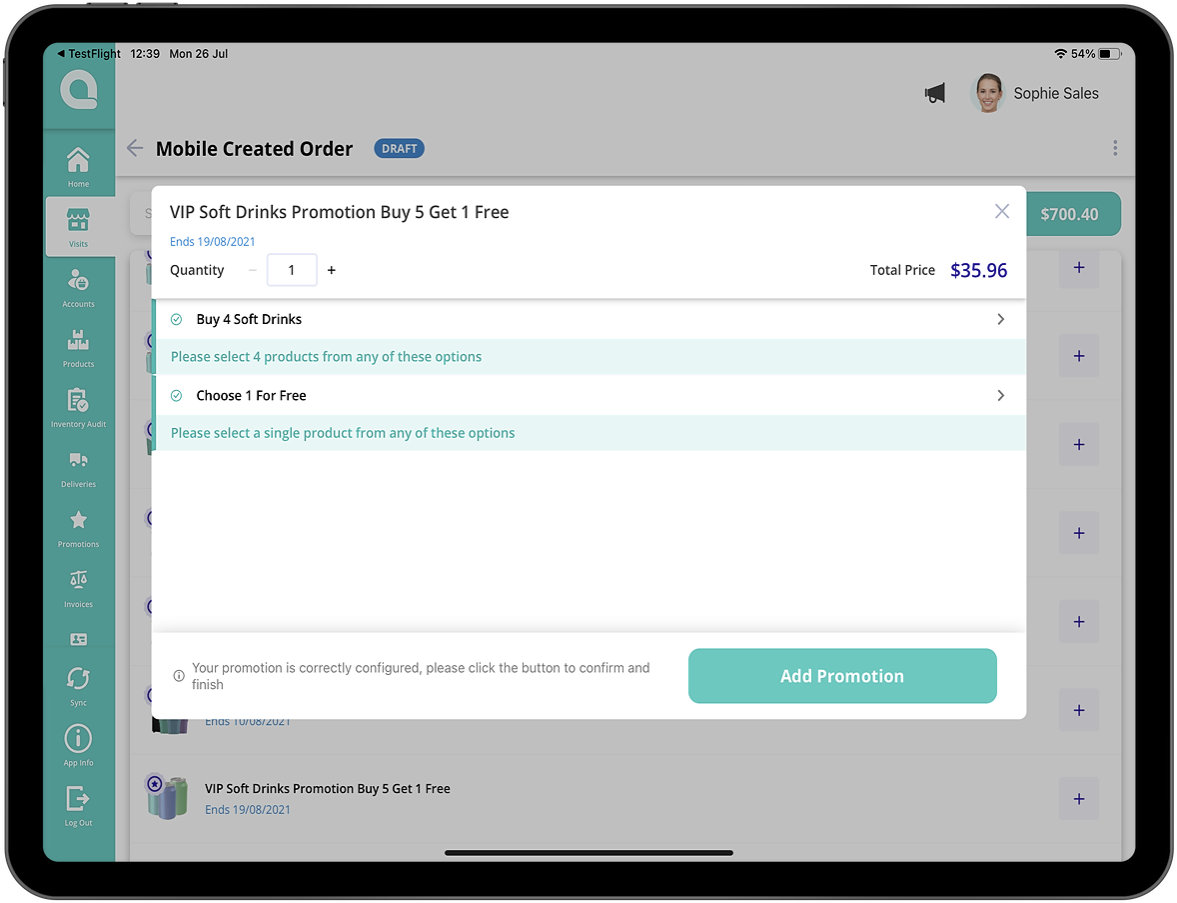
Aforza’s trade promotion designer mobile image. Image Credits: Aforza
Dinardo and his co-founders, Ed Butterworth and Nick Eales, started the company in 2019. All veterans of Salesforce, they saw how underserved the consumer goods industry was in terms of moving to digital.
Aforza is Dinardo’s first time leading a company. However, from his time at Salesforce he feels he got an education like going to “Marc Benioff’s School of SaaS.” The company raised an undisclosed seed round in 2019 from Bonfire Ventures, Daher Capital, DN Capital, Next47 and Salesforce Ventures.
Then the pandemic happened, which had many of the investors leaning in, which was validation of what Aforza was doing, Dinardo said.
“Even before the pandemic, the consumer goods industry was challenged with new market entrants and horrible legacy systems, but then the pandemic turned off pathways to customers,” he added. “Our mission is to improve the lives of consumers by bringing forth more sustainable products and packaging, but also helping companies be more agile and handle changes as the biggest change is happening.”
Joining DN Capital in the round were Bonfire Ventures, Daher Capital and Next47.
Brett Queener, partner at Bonfire Ventures, said he helped incubate Aforza with Dinardo and Eales, something his firm doesn’t typically do, but saw a unique opportunity to get in on the ground floor.
Also working at Salesforce, he saw the consumer goods industry as a major industry with a compelling reason to make a technology shift as customers began expecting instant availability and there were tons of emerging startups coming into the direct-to-consumer space.
Those startups don’t have a year or two to pull together the kind of technology it took to scale. With Aforza, they can build a product that works both online and off on any device, Queener said. And rather than planning promotions on a quarterly basis, companies can make changes to their promotional spend in real time.
“It is time for Aforza to tell the world about its technology, time to build out its footprint in the U.S. and in Europe, invest more in R&D and execute the Salesforce playbook,” he said. “That is what this round is about.”
Dinardo intends on using the new funding to continue R&D and to double its employee headcount over the next six months as it establishes its new U.S. headquarters in the Northeast. It is already working with customers in 20 countries.
As to growth, Dinardo said he is using his past experiences at startups like Veeva and Vlocity, which was acquired by Salesforce in 2020, as benchmarks for Aforza’s success.
“We have the money and the expertise — now we need to take a moment to breathe, hire people with the passion to do this and invest in new product tiers, digital assets and even payments,” he said.
Powered by WPeMatico

Simpplr, a modern platform for building intranet sites (or “employee communications and enablement platforms,” as the company calls it), today announced that it has raised a $32 million Series C round led by Tola Capital. Norwest Ventures, which led the company’s Series B round last year, as well as Salesforce Ventures and George Still Ventures also participated. This brings Simpplr’s total funding to just over $61 million.
As Simpplr CEO and founder Dhiraj Sharma told me, the Series B round was meant to help the team accelerate product innovation and development. Unsurprisingly, the COVID-19 pandemic only increased demand for digital workplace solutions like Simpplr. As Sharma noted, the company’s thesis was always that the world was moving toward remote/hybrid work. The pandemic only accelerated this process and with that, the sense of urgency in its customer base to modernize their own platforms for communicating with their employees. To keep up with this growth, the company doubled its team since last August (though Sharma, just like many other startup founders I’ve recently talked to, also bemoaned that it’s becoming increasingly hard to find talent).

The company says that it added 100 enterprise customers over the course of the last year. Today, its customer base includes a number of early adopters like Splunk or Nutanix, which were always building toward a global workforce and always had a need for a product like Simpplr. But due to the pandemic, more traditional businesses like Fox, AAA insurance or Renewal by Andersen also needed to quickly find ways to support their newly remote workforces.
“When this pandemic happened, there were lots of traditional companies who didn’t think that they would be doing remote work as much in the near future as they had to,” Sharma said. “For them, things changed and then what they realized is that they did not have effective means of formal employee communication and also lacked the digital employee experience — and they realized that very quickly.”
Simpplr is obviously not the only intranet solution on the market, but Sharma argues that the service isn’t just recognized by analyst firms like Gartner and Forrester, but also highly reviewed by its customers, in large part thanks to its focus on user experience. “UX is our number one strength and differentiator. We have been pushing the boundaries of intranet for the last five years,” he said and cited features like the company’s auto-governance engine, which he likened to a “Roomba for your intranet.”

Image Credits: Simpplr
Analytics, too, is another area where Simpplr is trying to differentiate itself. “Our company’s mission is to help companies build a better workplace — and unless we can show the areas of improvement and provide insights like how to do something better, we just become a dumb tool,” he said. “For us, what is very important is not only that you are communicating but helping our customers to understand what’s working and what’s not working. What’s the impact of the communication and how are your employees feeling about it?”
Looking ahead, the company is working on building more AI into its tools — including its analytics — to help companies better communicate with their employees and understand the impact of those messages.
As for the new funding round, Sharma noted that he bootstrapped his previous two companies, which has made him take a somewhat conservative approach to fundraising. “When I used to hear that your investors or VCs expect growth at all costs, I just could never understand that,” he said. “So while building this company, even though this is a venture-funded company, I still wanted to make sure that I use the finances responsibly and I build a business in a sustainable manner. I wanted to make sure that if we raised a large investment, we have a proper use for that investment and that this investment will bring the right results.”
Tola Capital principal Eddie Kang will now join Simpplr’s board. “The future of work is hybrid and Simpplr is essential to a company’s ability to engage with employees,” he said. “As enterprise software investors, what excites us about Simpplr’s platform is that it allows leadership teams to streamline communications across channels and provides a turnkey platform that drives value to customers very quickly. Our partnership with Simpplr will accelerate its roadmap to meet the needs of global business leaders and communications teams.”
Powered by WPeMatico
AttackIQ, a cybersecurity startup that provides organizations with breach and attack simulation solutions, has raised $44 million in Series C funding as it looks to ramp up its international expansion.
The funding round was led by Atlantic Bridge, Saudi Aramco Energy Ventures (SAEV) and Gaingels, with existing vendors — including Index Ventures, Khosla Ventures, Salesforce Ventures and Telstra Ventures — also participating. The round brings the company’s total funding raised to date to $79 million.
AttackIQ was founded in 2013 and is based out of San Diego, California. It provides an automated validation platform that runs scenarios to detect any gaps in a company’s defenses, enabling organizations to test and measure the effectiveness of their security posture and receive guidance on how to fix what’s broken. Broadly, AttackIQ’s platform helps an organization’s security teams anticipate, prepare and hunt for threats that may impact their business, before hackers get there first.
Its Security Optimization Platform platform, which supports Windows, Linux and macOS across public, private and on-premises cloud environments, is based on the MITRE ATT&CK framework, a curated knowledge base of known adversary threats, tactics and techniques. This is used by a number of cybersecurity companies also building continuous validation services, including FireEye, Palo Alto Networks and Cymulate.
AttackIQ says this latest round of funding, which comes more than two years after its last, arrives at a “dynamic time” for the company. Not only has cybersecurity become more of a priority for organizations as a result of a major uptick in both ransomware and supply-chain attacks, the company also recently accelerated its international expansion efforts through a partnership with technology distributor Westcon.
The startup says it’s planning to use these new funds to further expand internationally through its newfound partnership with Atlantic Bridge, which will also see Kevin Dillon, the company’s co-founder and managing director, join the AttackIQ board of directors.
“AttackIQ has established itself as a category leader with a formidable enterprise customer base that includes four of the Fortune 20,” said Dillon. “We believe deeply in the company’s vision and potential to become the next billion-dollar cybersecurity software company and look forward to helping the company turn early traction in Europe and the Middle East into robust, long-term expansion.”
Brett Galloway, CEO of AttackIQ, said the round “reaffirms the strength” of its platform.
As well as enabling organizations to review the robustness of their security defenses, the startup also runs the AttackIQ Academy, which provides free entry-level and advanced cybersecurity training. It has accumulated 17,200 registered students to date across 176 countries.
Powered by WPeMatico
Vercel, the company behind the popular open-source Next.js React framework, today announced that it has raised a $102 million Series C funding round led by Bedrock Capital. Existing investors Accel, CRV, Geodesic Capital, Greenoaks Capital and GV also participated in this round, together with new investors 8VC, Flex Capital, GGV, Latacora, Salesforce Ventures and Tiger Global. In total, the company has now raised $163 million and its current valuation is $1.1 billion.
As Vercel notes, the company saw strong growth in recent months, with traffic to all sites and apps on its network doubling since October 2020. The number of sites among the world’s largest 10,000 websites that use Next.js grew 50% in the same time frame, too.
Image Credits: Vercel
Given the open-source nature of the Next.js framework, not all of these users are obviously Vercel customers, but its current paying customers include the likes of Carhartt, Github, IBM, McDonald’s and Uber.
“For us, it all starts with a front-end developer,” Vercel CEO Guillermo Rauch told me. “Our goal is to create and empower those developers — and their teams — to create delightful, immersive web experiences for their customers.”
With Vercel, Rauch and his team took the Next.js framework and then built a serverless platform that specifically caters to this framework and allows developers to focus on building their front ends without having to worry about scaling and performance.
Older solutions, Rauch argues, were built in isolation from the cloud platforms and serverless technologies, leaving it up to the developers to deploy and scale their solutions. And while some potential users may also be content with using a headless content management system, Rauch argues that increasingly, developers need to be able to build solutions that can go deeper than the off-the-shelf solutions that many businesses use today.
Rauch also noted that developers really like Vercel’s ability to generate a preview URL for a site’s front end every time a developer edits the code. “So instead of just spending all your time in code review, we’re shifting the equation to spending your time reviewing or experiencing your front end. That makes the experience a lot more collaborative,” he said. “So now, designers, marketers, IT, CEOs […] can now come together in this collaboration of building a front end and say, ‘that shade of blue is not the right shade of blue.’”
“Vercel is leading a market transition through which we are seeing the majority of value-add in web and cloud application development being delivered at the front end, closest to the user, where true experiences are made and enjoyed,” said Geoff Lewis, founder and managing partner at Bedrock. “We are extremely enthusiastic to work closely with Guillermo and the peerless team he has assembled to drive this revolution forward and are very pleased to have been able to co-lead this round.”
Powered by WPeMatico
Salesforce dominates the world of CRM today, but while it’s a popular and well-used tool for organizing contacts and information, it doesn’t have all the answers when it comes to helping salespeople and marketers sell better, especially when meetings are not in person. Today, one of the startups that has emerged to help fill the gap is announcing a round of growth funding on the back of a huge year for its business.
Qualified — which builds better interactions for B2B sales and marketing teams that already use Salesforce by tapping into extra data sources to develop a better profile of those visiting your website, in aid of improving and personalizing the outreach (hence the name: you’re building “qualified” leads) — has picked up $51 million in funding. The startup will be using the Series B to continue building out its business with more functionality in the platform, and hiring across the board to expand business development and more.
Led by Salesforce Ventures, the funding round also included Norwest Venture Partners and Redpoint Ventures, both previous backers, among others. As with so many rounds at the moment — the venture world is flush with funding at the moment — this one is coming less than a year after Qualified’s last raise. It closed a $12 million Series A in August of last year.
Qualified was co-founded by two Salesforce veterans — ex-Salesforce CMO Kraig Swensrud and ex-SVP of Salesforce.com Sean Whiteley — serial entrepreneurs who you could say have long been hammering away at the challenges of building digital tools for sales and marketing people to do their jobs better online. The pair have founded and sold two other startups filling holes to that end: GetFeedback, acquired by SurveyMonkey, and Kieden, acquired by Salesforce.
The gap that they’re aiming to fill with this latest venture is the fact that when sales and marketing teams want to connect with prospects directly through, say, a phone call, they might have all of that contact’s information at their disposal. But if those teams want to make a more engaged contact when someone is visiting their site — a sign that a person is actually interested and thinking already about engaging with a company — usually the sales and marketing teams are in the dark about who those visitors are.
“We founded Qualified on the premise that a website should be more than a marketing brochure, but not just a sales site,” Swensrud, who is the CEO, said in an interview.
Qualified has built a tool that essentially takes several signals from Salesforce as well as other places to build up some information about the site visitor. It then uses it to give the sales and marketing teams more of a steer so that when they reach out via a screen chat to say “how can I help?” they actually have more information and can target their questions in a better way. A sales or marketing rep might know which pages a person is also visiting, and can then use the conversation that starts with an online chat to progress to a voice or video call, or a meeting.
If a person is already in your Salesforce Rolodex, you get more information; but even without that there is some detail provided to be slightly less impersonal. (Example: When I logged into Qualified to look around the site, a chat popped up with a person greeting me “across the pond”… I’m in London.)
Qualified also integrates with a number of other tools that are used to help source data and build its customer profiles, including Slack, Microsoft Teams, 6sense, Demandbase, Marketo, HubSpot, Oracle Eloqua, Clearbit, ZoomInfo and Outreach.
Additional data is part and parcel of the kinds of information that sales and marketing people always need when reaching out to prospective customers, whether it’s via a “virtual” digital channel or in person. However, in the last year — where in-person meetings, team meetings and working side-by-side with those who can give advice have all disappeared — having extra tools like these arguably have proven indispensable.
“Sales reps would heavily rely on their ‘road warrior’ image,” Swensrud said. “But all that stuff is gone, so as a result every seller is sitting at an office, at home, expecting digital interactions to happen that never existed before.”
And it seems some believe that even outside of COVID-19 enforcing a different way of doing things, the trend for “virtual selling”, as it’s often called, is here to stay: Gartner forecasts that by 2025, some 80% of B2B sales interactions will take place in digital channels. (So long to the expense account lunch, I guess.)
It’s because of the events of 2020, plus those bigger trends, that Qualified has seen revenues in the last year grow some 800% and its net customer revenue retention rate hover at 175%, with funding rounds come in relatively close succession in the wake of that.
There is something interesting to Qualified that reminds me a bit of more targeted ad retargeting, as it were, and in that, you can imagine a lot of other opportunities for how Qualified might expand in scenarios where it would be more useful to know why someone is visiting your site, without outright asking them and bothering them with the question. That could include customer service, or even a version that might sell better to consumers coming to, say, a clothes site after reading something about orange being the new black.
For now, though, it’s focused on the B2B opportunity.
There are a number of tools on the market that are competing with Salesforce as the go-to platform for people to organise and run CRM operations, but Swensrud is bullish for now on the idea of building specifically for the Salesforce ecosystem.
“Our product is being driven by and runs on Salesforce,” he noted, pointing out that it’s through Salesforce that you’re able to go from chatting to a phone call by routing the information to the data you have on file there. “Our roots go very deep.”
The funding round today is a sign that Salesforce is also happy with that close arrangement, which gives it a customization that its competitors lack.
“Qualified represents an entirely new way for B2B companies to engage buyers,” said Bill Patterson, EVP of CRM Applications at Salesforce, in a statement. “When marketing and inbound sales teams use this solution with Sales Cloud… they see a notable impact on pipeline. We are thrilled about our growing partnership with Qualified and their success within the Salesforce ecosystem.”
Powered by WPeMatico
Class, an edtech startup that integrates exclusively with Zoom to make remote teaching more elegant, has raised $12.25 million in new financing. The round brings Salesforce Ventures, Sound Ventures and Super Bowl champion Tom Brady onto its capital table.
CEO and founder Michael Chasen said that Marc Benioff, the CEO of Salesforce, approached the company about investing in Class. Salesforce Ventures launched a $100 million Impact Fund in October 2020, a month after Class launched, to back edtech companies and cloud enterprises businesses with an impact lens.
As for Tom Brady entering the edtech world, Chasen said that the famous football player has made tech investments in the past and, “as the father of three is passionate about helping people through education.”
“Tom Brady and I are both fathers to three kids and like all parents, we get the need to add teaching and learning tools to Zoom,” Chasen added.
Class has now raised $58 million in less than a year, with a $30 million Series A in February 2021 and a $16 million seed round in September 2020. Today’s raise is less than its Series A round, which signals it was likely more done strategically to bring on investors than out of necessity.
The money will be used to help roll out Class to K-12 and higher-ed institutions across the world. The startup’s software publicly launched on the Mac a few months ago, and will exit beta for Windows, iPhone, Android and Chromebook in the next few weeks, Chasen said. The larger public launch will help scale the some 7,500 schools that have shown interest in adopting Class.
The big hurdle for Class, and any startup selling e-learning solutions to institutions, is post-pandemic utility. While institutions have traditionally been slow to adopt software due to red tape, Chasen says that both of Class’ customers, higher ed and K-12, are actively allocating budget for these tools. The price for Class ranges between $10,000 to $65,000 annually, depending on the number of students in the classes.
“We have not run into a budgeting problem in a single school,” Chasen said in February. “Higher ed has already been taking this step towards online learning, and they’re now taking the next step, whereas K-12, this is the first step they’re taking.” So far, Class has more than 125 paying clients with even-split between K-12 and higher ed, and 10% of customers using it for corporate teams.
It’s not the only startup that is trying to reinvent Zoom University. A number of companies are trying to serve the same market of students and teachers who are fatigued by current video conferencing solutions which — at best — often look like a gallery view with a chat bar. Three companies that are gaining traction include Engageli, Top Hat and InSpace.
While each startup has its own unique strategy and product, the founders behind them all need to answer the same question: Can they make digital learning a preferred mode of pedagogy and comprehension — and not merely a backup — after the pandemic is over?
As that question continues to get explored, today’s news shows that Class isn’t having any trouble recruiting people to believe the answer is yes. In just nine months, the company has gone from two to more than 150 employees and contractors.
Powered by WPeMatico
BigID has been on the investment fast track, raising $94 million over three rounds that started in January 2018. Today, that investment train kept rolling as the company announced a $70 million Series D on a valuation of $1 billion.
Salesforce Ventures and Tiger Global co-led the round with participation Glynn Capital and existing investors Bessemer Venture Partners, Scale Venture Partners and Boldstart Ventures. The company has raised almost $165 million in just over two years.
BigID is attracting this kind of investment by building a security and privacy platform. When I first spoke to CEO and co-founder Dimitri Sirota in 2018, he was developing a data discovery product aimed at helping companies coping with GDPR find the most sensitive data, but since then the startup has greatly expanded the vision and the mission.
“We started shifting I think when we spoke back in September from being this kind of best of breed data discovery privacy to being a platform anchored in data intelligence through our kind of unique approach to discovery and insight,” he said.
That includes the ability for BigID and third parties to build applications on top of the platform they have built, something that might have attracted investor Salesforce Ventures. Salesforce was the first cloud company to offer the ability for third parties to build applications on its platform and sell them in a marketplace. Sirota says that so far their marketplace includes just apps built by BigID, but the plan is to expand it to third-party developers in 2021.
While he wasn’t ready to talk about specific revenue growth, he said he expects a material uplift in revenue for this year, and he believes that his investors are looking at the vast market potential here.
He has 235 employees today with plans to boost it to 300 next year. While he stopped hiring for a time in Q2 this year as the pandemic took hold, he says that he never had to resort to layoffs. As he continues hiring in 2021, he is looking at diversity at all levels from the makeup of his board to the executive level to the general staff.
He says that the ability to use the early investments to expand internationally has given them the opportunity to build a more diverse workforce. “We have staff around the world and we did very early […] so we do have diversity within our broader company. But clearly not enough when it came to the board of directors and the executives. So we realized that, and we are trying to change that,” he said.
As for this round, Sirota says like his previous rounds in this cycle he wasn’t necessarily looking for additional money, but with the pandemic economy still precarious, he took it to keep building out the BigID platform. “We actually have not purposely gone out to raise money since our seed. Every round we’ve done has been preemptive. So it’s been fairly easy,” he told me. In fact, he reports that he now has five years of runway and a much more fully developed platform. He is aiming to accelerate sales and marketing in 2021.
The company’s previous rounds included a $14 million Series A in January 2018, a $30 million B in June that year and a $50 million C in September 2019.
Powered by WPeMatico