Salesforce Ventures
Auto Added by WPeMatico
Auto Added by WPeMatico
When Salesforce Ventures launched the first $50 million Impact Fund in 2017, it wanted to invest not only in promising cloud businesses, but startups with a socially positive mission. Today, the company launched the second Impact Fund, this time doubling its initial investment with a new $100 million fund.
The latest fund is also designed to help bring more investment into areas that the company feels need to be emphasized as a corporate citizen beyond pure business goals, including education and reskilling, climate action, diversity, equity and inclusion, and providing tech for nonprofits and foundations.
Suzanne DiBianca, chief impact officer and EVP of Corporate Relations at Salesforce, says the money is being put to work on some of the world’s most pressing social issues. “Now more than ever, we believe business can be a powerful platform for change. We must leverage technology and invest in innovative ideas to drive the long-term health and wellness of all citizens, enable equal access to education and fuel impactful climate action,” DiBianca said in a statement.
Brent Leary, founder and principal analyst at CRM Essentials, says that this investment is consistent with their commitment to social issues. “This fits right in with Salesforce’s efforts on making business a force for change. They talk it, they walk it and they invest in it,” Leary told TechCrunch.
Claudine Emeott, director of Impact Investing, said in a Q&A on the company website that as with the first fund, the company is looking for cloud companies with some ties to Salesforce that address these core social components and can have a positive impact on the world. While there is a social aspect to each company, it still follows a particular investment thesis related to cloud computing. Her goal is to have a portfolio of cloud startups by next year that are addressing the set of social needs the firm has laid out.
“I hope that [by next year] we have made numerous investments in companies that are addressing today’s concurrent crises, and I hope that we can point to their measurable impact on those crises. I hope that we can point to exciting new integrations between our portfolio companies and Salesforce to tackle these challenges together,” Emeott said.
Paul Greenberg, president of the 56 Group and author of “CRM at the Speed of Light,” says that while he doesn’t always agree with Salesforce on every matter, he admires their social bent. “As an analyst, I might battle with them on some of their products, the things they do in the market and their messaging, but as a human being, I applaud them for their deep commitment to the common good,” he said.
Salesforce has always had a social component to its corporate goals, including its 1-1-1 philanthropy model. While Salesforce isn’t always completely consistent, as with its contract with ICE, it does put money and personnel toward helping in the communities where it operates, encouraging volunteerism and charitable giving from the top down and modeled across the organization.
This investment fund, while looking at the investments through a distinctly Salesforce lens, is designed to fund startups to help solve intractable social problems, while using its extensive financial resources for the betterment of the world.
Powered by WPeMatico
OwnBackup has made a name for itself primarily as a backup and disaster recovery system for the Salesforce ecosystem, and today the company announced a $50 million investment.
Insight Partners led the round, with participation from Salesforce Ventures and Vertex Ventures. This chunk of money comes on top of a $23 million round from a year ago, and brings the total raised to more than $100 million, according to the company.
It shouldn’t come as a surprise that Salesforce Ventures chipped in when the majority of the company’s backup and recovery business involves the Salesforce ecosystem, although the company will be looking to expand beyond that with the new money.
“We’ve seen such growth over the last two and a half years around the Salesforce ecosystem, and the other ISV partners like Veeva and nCino that we’ve remained focused within the Salesforce space. But with this funding, we will expand over the next 12 months into a few new ecosystems,” company CEO Sam Gutmann told TechCrunch.
In spite of the pandemic, the company continues to grow, adding 250 new customers last quarter, bringing it to over 2,000 customers and 250 employees, according to Gutmann.
He says that raising the round, which closed at the beginning of May, had some hairy moments as the pandemic began to take hold across the world and worsen in the U.S. For a time, he began talking to new investors in case his existing ones got cold feet. As it turned out, when the quarterly numbers came in strong, the existing ones came back and the round was oversubscribed, Gutmann said.
“Q2 frankly was a record quarter for us, adding over 250 new accounts, and we’re seeing companies start to really understand how critical this is,” he said.
The company plans to continue hiring through the pandemic, although he says it might not be quite as aggressively as they once thought. Like many companies, even though they plan to hire, they are continually assessing the market. At this point, he foresees growing the workforce by about another 50 people this year, but that’s about as far as he can look ahead right now.
Gutmann says he is working with his management team to make sure he has a diverse workforce right up to the executive level, but he says it’s challenging. “I think our lower ranks are actually quite diverse, but as you get up into the leadership team, you can see on the website unfortunately we’re not there yet,” he said.
They are instructing their recruiting teams to look for diverse candidates whether by gender or ethnicity, and employees have formed a diversity and inclusion task force with internal training, particularly for managers around interviewing techniques.
He says going remote has been difficult, and he misses seeing his employees in the office. He hopes to have at least some come back before the end of the summer and slowly add more as we get into the fall, but that will depend on how things go.
Powered by WPeMatico

Headless CMS company Contentful today announced that it has raised an $80 million Series E funding round led by Sapphire Ventures, with participation from General Catalyst, Salesforce Ventures and a number of other new and existing investors. With this, the company has now raised a total of $158.3 million and a Contentful spokesperson tells me that it is approaching a $1 billion valuation.
In addition, the company also today announced that it has hired Bridget Perry as its CMO. She previously led Adobe’s marketing efforts across Europe, the Middle East and Africa.
Currently, 28% of the Fortune 500 use Contentful to manage their content across platforms. The company says it has a total of 2,200 paying customers right now and these include the likes of Spotify, ITV, the British Museum, Telus and Urban Outfitters.
Steve Sloan, the company’s CEO who joined the company late last year, attributes its success to the fact that virtually every business today is in the process of figuring out how to become digital and serve its customers across platforms — and that’s a process that has only been accelerated by the coronavirus pandemic.
“Ten or 15 years ago, when these content platforms or content management systems were created, they were a) really built for a web-only world and b) where the website was a complement to some other business,” he said. “Today, the mobile app, the mobile web experience is the front door to every business on the planet. And that’s never been any more clear than in this recent COVID crisis, where we’ve seen many, many businesses — even those that are very traditional businesses — realize that the dominant and, in some cases, only way their customers can interact with them is through that digital experience.”
But as they are looking at their options, many decide that they don’t just want to take an off-the-shelf product, Sloan argues, because it doesn’t allow them to build a differentiated offering.

Image Credits: Contentful
Perry also noted that this is something she saw at Adobe, too, as it built its digital experience business. “Leading marketing at Adobe, we used it ourselves,” she said. “And so the challenge that we heard from customers in the market was how complex it was in some cases to implement, to organize around it, to build those experiences fast and see value and impact on the business. And part of that challenge, I think, stemmed from the kind of monolithic, all-in-one type of suite that Adobe offered. Even as a marketer at Adobe, we had challenges with that kind of time to market and agility. And so what’s really interesting to me — and one of the reasons why I joined Contentful — is that Contentful approaches this in a very different way.”
Sloan noted that putting the round together was a bit of an adventure. Contentful’s existing investors approached the company around the holidays because they wanted to make a bigger investment in the company to fuel its long-term growth. But at the time, the company wasn’t ready to raise new capital yet.
“And then in January and February, we had inbound interest from people who weren’t yet investors, who came to us and said, ‘hey, we really want to invest in this company, we’ve seen the trend and we really believe in it.’ So we went back to our insiders and said, ‘hey, we’re going to think about actually moving in our timeline for raising capital,” Sloan told me. “And then, right about that time is when COVID really broke out, particularly in Western Europe in North America.”
That didn’t faze Contentful’s investors, though.
“One of the things that really stood out about our investors — and particularly our lead investor for this round Sapphire — is that when everybody else was really, really frightened, they were really clear about the opportunity, about their belief in the team and about their understanding of the progress we had already made. And they were really unflinching in terms of their support,” Sloan said.
Unsurprisingly, the company plans to use the new funding to expand its go-to-market efforts (that’s why it hired Perry, after all), but Sloan also noted that Contentful plans to invest quite a bit into R&D, as well, as it looks to help its customers solve more adjacent problems.
Powered by WPeMatico

Enterprise barcode scanner company Scandit has closed an $80 million Series C round, led by Silicon Valley VC firm G2VP. Atomico, GV, Kreos, NGP Capital, Salesforce Ventures and Swisscom Ventures also participated in the round — which brings its total raised to date to $123M.
The Zurich-based firm offers a platform that combines computer vision and machine learning tech with barcode scanning, text recognition (OCR), object recognition and augmented reality which is designed for any camera-equipped smart device — from smartphones to drones, wearables (e.g. AR glasses for warehouse workers) and even robots.
Use-cases include mobile apps or websites for mobile shopping; self checkout; inventory management; proof of delivery; asset tracking and maintenance — including in healthcare where its tech can be used to power the scanning of patient IDs, samples, medication and supplies.
It bills its software as “unmatched” in terms of speed and accuracy, as well as the ability to scan in bad light; at any angle; and with damaged labels. Target industries include retail, healthcare, industrial/manufacturing, travel, transport & logistics and more.
The latest funding injection follows a $30M Series B round back in 2018. Since then Scandit says it’s tripled recurring revenues, more than doubling the number of blue-chip enterprise customers, and doubling the size of its global team.
Global customers for its tech include the likes of 7-Eleven, Alaska Airlines, Carrefour, DPD, FedEx, Instacart, Johns Hopkins Hospital, La Poste, Levi Strauss & Co, Mount Sinai Hospital and Toyota — with the company touting “tens of billions of scans” per year on 100+ million active devices at this stage of its business.
It says the new funding will go on further pressing on the gas to grow in new markets, including APAC and Latin America, as well as building out its footprint and ops in North America and Europe. Also on the slate: Funding more R&D to devise new ways for enterprises to transform their core business processes using computer vision and AR.
The need for social distancing during the coronavirus pandemic has also accelerated demand for mobile computer vision on personal smart devices, according to Scandit, which says customers are looking for ways to enable more contactless interactions.
Another demand spike it’s seeing is coming from the pandemic-related boom in ‘Click & Collect’ retail and “millions” of extra home deliveries — something its tech is well positioned to cater to because its scanning apps support BYOD (bring your own device), rather than requiring proprietary hardware.
“COVID-19 has shone a spotlight on the need for rapid digital transformation in these uncertain times, and the need to blend the physical and digital plays a crucial role,” said CEO Samuel Mueller in a statement. “Our new funding makes it possible for us to help even more enterprises to quickly adapt to the new demand for ‘contactless business’, and be better positioned to succeed, whatever the new normal is.”
Also commenting on the funding in a supporting statement, Ben Kortlang, general partner at G2VP, added: “Scandit’s platform puts an enterprise-grade scanning solution in the pocket of every employee and customer without requiring legacy hardware. This bridge between the physical and digital worlds will be increasingly critical as the world accelerates its shift to online purchasing and delivery, distributed supply chains and cashierless retail.”

Powered by WPeMatico
With a large proportion of knowledge workers doing now doing their jobs from home, the need for tools to help them feel connected to their profession can be as important as tools to, more practically, keep them connected. Today, a company that helps do precisely that is announcing a growth round of funding after seeing engagement on its platform triple in the last month.
GO1.com, an online learning platform focused specifically on professional training courses (both those to enhance a worker’s skills as well as those needed for company compliance training), is today announcing that it has raised $40 million in funding, a Series C that it plans to use to continue expanding its business. The startup was founded in Brisbane, Australia and now has operations also based out of San Francisco — it was part of a Y Combinator cohort back in 2015 — and more specifically, it wants to continue growth in North America, and to continue expanding its partner network.
GO1 not disclosing its valuation but we are asking. It’s worth pointing out that not only has it seen engagement triple in the last month as companies turn to online learning to keep users connected to their professional lives even as they work among children and house pets, noisy neighbours, dirty laundry, sourdough starters, and the rest (and that’s before you count the harrowing health news we are hit with on a regular basis). But even beyond that, longer term GO1 has shown some strong signs that speak of its traction.
It counts the likes of the University of Oxford, Suzuki, Asahi and Thrifty among its 3,000+ customers, with more than 1.5 million users overall able to access over 170,000 courses and other resources provided by some 100 vetted content partners. Overall usage has grown five-fold over the last 12 months. (GO1 works both with in-house learning management systems or provides its own.)
“GO1’s growth over the last couple of months has been unprecedented and the use of online tools for training is now undergoing a structural shift,” said Andrew Barnes, CEO of GO1, in a statement. “It is gratifying to fill an important void right now as workers embrace online solutions. We are inspired about the future that we are building as we expand our platform with new mediums that reach millions of people every day with the content they need.”
The funding is coming from a very strong list of backers: it’s being co-led by Madrona Venture Group and SEEK — the online recruitment and course directory company that has backed a number of edtech startups, including FutureLearn and Coursera — with participation also from Microsoft’s venture arm M12; new backer Salesforce Ventures, the investing arm of the CRM giant; and another previous backer, Our Innovation Fund.
Microsoft is a strategic backer: GO1 integrated with Teams, so now users can access GO1 content directly via Microsoft’s enterprise-facing video and messaging platform.
“GO1 has been critical for business continuity as organizations navigate the remote realities of COVID-19,” said Nagraj Kashyap, Microsoft Corporate Vice President and Global Head of M12, in a statement. “The GO1 integration with Microsoft Teams offers a seamless learning experience at a time when 75 million people are using the application daily. We’re proud to invest in a solution helping keep employees learning and businesses growing through this time.”
Similarly, Salesforce is also coming in as a strategic, integrating this into its own online personal development products and initiatives.
“We are excited about partnering with GO1 as it looks to scale its online content hub globally. While the majority of corporate learning is done in person today, we believe the new digital imperative will see an acceleration in the shift to online learning tools. We believe GO1 fits well into the Trailhead ecosystem and our vision of creating the life-long learner journey,” said Rob Keith, Head of Australia, Salesforce Ventures, in a statement.
Working remotely has raised a whole new set of challenges for organizations, especially those whose employees typically have never before worked for days, weeks and months outside of the office.
Some of these have been challenges of a more basic IT nature: getting secure access to systems on the right kinds of machines and making sure people can communicate in the ways that they need to to get work done.
But others are more nuanced and long-term but actually just as important, such as making sure people remain in a healthy state of mind about work. Education is one way of getting them on the right track: professional development is not only useful for the person to do her or his job better, but it’s a way to motivate people, to focus their minds, and take a rest from their routines, but in a way that still remains relevant to work.
GO1 is absolutely not the only company pursuing this opportunity. Others include Udemy and Coursera, which have both come to enterprise after initially focusing more on traditional education plays. And LinkedIn Learning (which used to be known as Lynda, before LinkedIn acquired it and shifted the branding) was a trailblazer in this space.
For these, enterprise training sits in a different strategic place to GO1, which started out with compliance training and onboarding of employees before gravitating into a much wider set of topics that range from photography and design, through to Java, accounting, and even yoga and mindfulness training and everything in between.
It’s perhaps the directional approach, alongside its success, that have set GO1 apart from the competition and that has attracted the investment, which seems to have come ahead even of the current boost in usage.
“We met GO1 many months before COVID-19 was on the tip of everyone’s tongue and were impressed then with the growth of the platform and the ability of the team to expand their corporate training offering significantly in North America and Europe,” commented S. Somasegar, managing director, Madrona Venture Group, in a statement. “The global pandemic has only increased the need to both provide training and retraining – and also to do it remotely. GO1 is an important link in the chain of recovery.” As part of the funding Somasegar will join the GO1 board of directors.
Notably, GO1 is currently making all COVID-19 related learning resources available for free “to help teams continue to perform and feel supported during this time of disruption and change,” the company said.
Powered by WPeMatico

Autify, a platform that makes testing web application as easy as clicking a few buttons, has raised a $2.5 million seed round from Global Brain, Salesforce Ventures, Archetype Ventures and several angels. The company, which recently graduated from the Alchemist accelerator program for enterprise startups, splits its base between the U.S., where it keeps an office, and Japan, where co-founders Ryo Chikazawa (CEO) and Sam Yamashita got their start as software engineers.
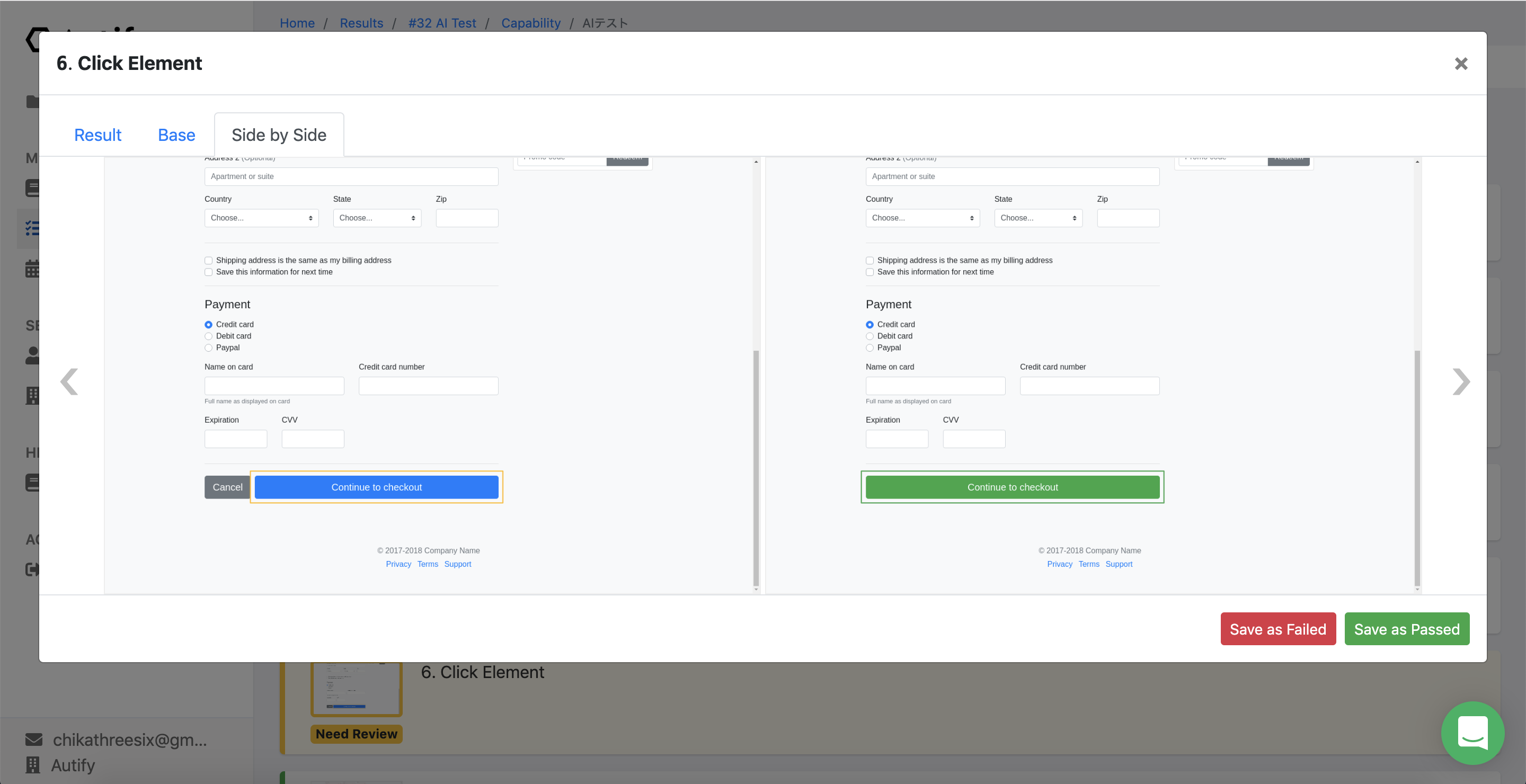
The main idea here is that Autify, which was founded in 2016, allows teams to write tests by simply recording their interactions with the app with the help of a Chrome extension, then having Autify run these tests automatically on a variety of other browsers and mobile devices. Typically, these kinds of tests are very brittle and quickly start to fail whenever a developer makes changes to the design of the application.
Autify gets around this by using some machine learning smarts that give it the ability to know that a given button or form is still the same, no matter where it is on the page. Users can currently test their applications using IE, Edge, Chrome and Firefox on macOS and Windows, as well as a range of iOS and Android devices.
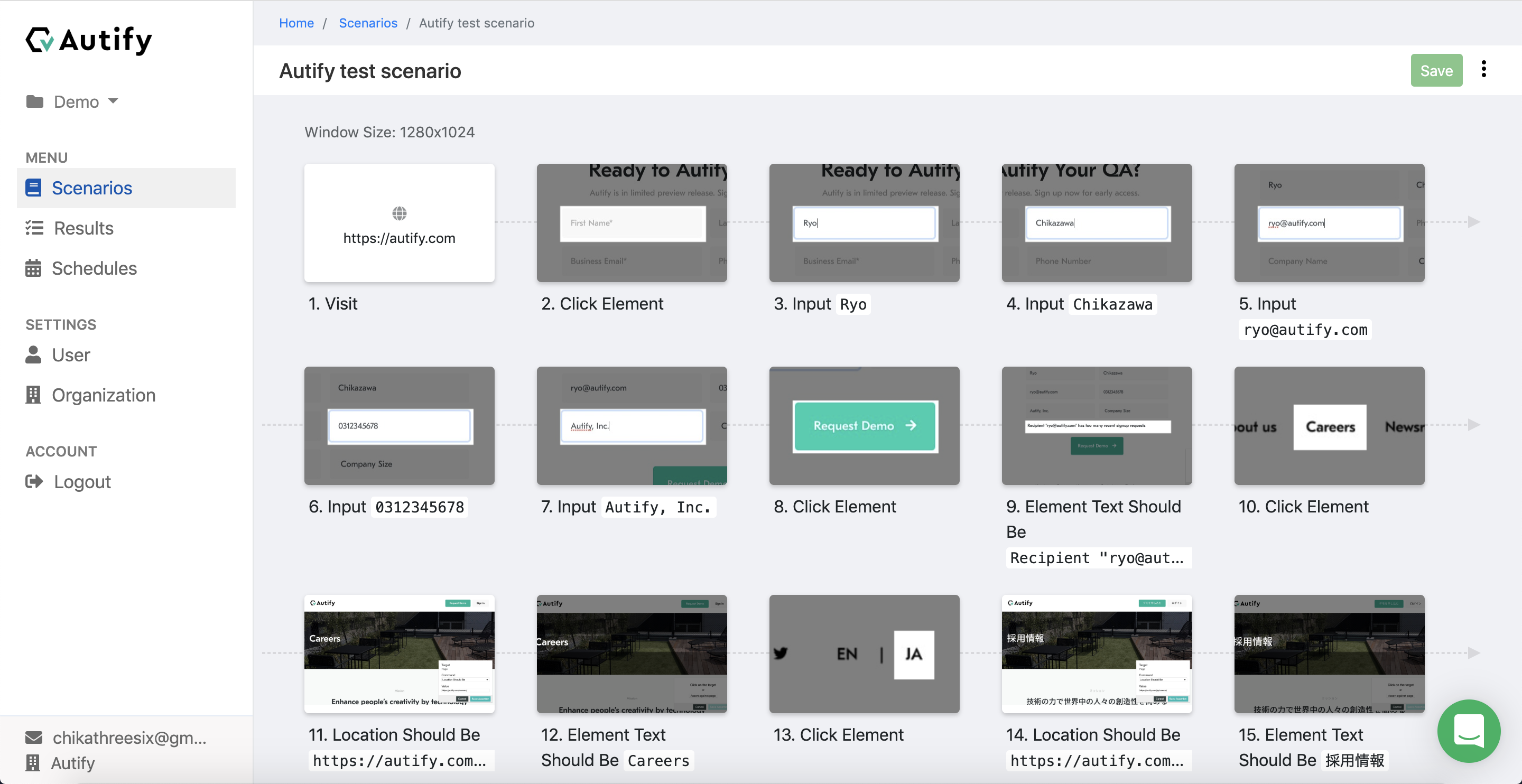
Chikazawa tells me that the main idea of Autify is based on his own experience as a developer. He also noted that many enterprises are struggling to hire automation engineers who can write tests for them, using Selenium and similar frameworks. With Autify, any developer (and even non-developer) can create a test without having to know the specifics of the underlying testing framework. “You don’t really need technical knowledge,” explained Chikazawa. “You can just out of the box use Autify.”
There are obviously some other startups that are also tackling this space, including SpotQA, for example. Chikazawa, however, argues that Autify is different, given its focus on enterprises. “The audience is really different. We have competitors that are targeting engineers, but because we are saying that no coding [is required], we are selling to the companies that have been struggling with hiring automating engineers,” he told me. He also stressed that Autify is able to do cross-browser testing, something that’s also not a given among its competitors.
The company introduced its closed beta version in March and is currently testing the service with about a hundred companies. It integrates with development platforms like TestRail, Jenkins and CircleCI, as well as Slack.
Powered by WPeMatico
Automattic, the company behind WordPress.com, WooCommerce, Longreads, Simplenote and soon Tumblr, is now worth $3 billion. But its founder and CEO Matt Mullenweg has a bigger goal. He wants to make the web better, more open and diverse.
With the rise of social networks and closed platforms, Automattic’s mission statement has never sounded so important. Automattic doesn’t want to be the hot new startup. It wants to build a strong foundation to empower content creators for decades to come.
In an interview this week, Matt Mullenweg discussed why he raised $300 million from Salesforce Ventures, what he thinks of the current state of the web and how Automattic has a shot at building the open-source operating system of the web. The interview was edited for clarity and brevity.
(Photo Credit: Christopher Michel / Flickr under a CC BY 2.0 license)
Romain Dillet: Tell me more about how much money you’ve raised, who you’ve raised from.
Powered by WPeMatico
As we wrote last week in How Salesforce paved the way for the SaaS platform approach, the ability to build extensions, applications and even whole companies on top of the Salesforce platform set the stage and the bar for every SaaS company since. Vlocity certainly recognized that. Targeting five verticals, it built industry-specific CRM solutions on the Salesforce platform, and today announced a $60 million Series C round on a fat unicorn $1 billion valuation.
The round was led by Sutter Hill Ventures and Salesforce Ventures. New investors Bessemer Venture Partners and existing strategic investors Accenture and New York Life also participated. The company has now raised $163 million.
Company co-founder and CEO David Schmaier, whose extensive career includes stints with Siebel Systems and Oracle, says he and his co-founders (three of whom helped launch Veeva) wanted to take the idea of Veeva, which is a life sciences-focused company built on top of Salesforce, and extend that idea across five verticals instead of just one. Those five verticals include communications and media, insurance and financial services, health, energy and utilities and government and nonprofits.
The idea he said was to build a company with a market that was 10x the size of life sciences. “What we’re doing now is building five Veevas at once. If you could buy a product already tailored to the needs of your industry, why wouldn’t you do that?,” Schmaier said.
The theory seems to be working. He says that the company, which was founded in 2014, has already reached $100 million in revenue and expects to double that by the end of this year. Then of course, there is the unicorn valuation. While perhaps not as rare as it once was, reaching the $1 billion level is still a significant milestone for a startup.
In the Salesforce platform story, co-founder and CTO Parker Harris addressed the need for solutions like the ones from Veeva and Vlocity. “…Harris said they couldn’t build one Salesforce for healthcare and another for insurance and a third one for finance. We knew that wouldn’t scale, and so the platform [eventually] just evolved out of this really close relationship with our customers and the needs they had.” In other words, Salesforce made the platform flexible enough for companies like these to fill in the blanks.
“Vlocity is a perfect example of the incredible innovation occurring in the Salesforce ecosystem and how we are working together to provide customers in all industries the technologies they need to attract and serve customers in smarter ways,” Jujhar Singh, EVP and GM for Salesforce Industries said in a statement.
It’s also telling that of the three strategic investors in this round — New York Life, Accenture and Salesforce Ventures — Salesforce is the biggest investor, according to Schmaier.
The company has 150 customers, including investor New York Life, Verizon (which owns this publication), Cigna and the City of New York. It already has 700 employees in 20 countries. With this additional investment, you can expect those numbers to increase.
“What this Series C round allows us to do is to really put the gas on investing in product development, because verticals are all about going deep,” Schmaier said.
Powered by WPeMatico
Appen just announced that it’s acquiring Figure Eight in an all-cash deal that sees Appen paying $175 million upfront, with an additional payment of up to $125 million based on Figure Eight’s performance this year.
Both companies focus on using crowdsourced labor pools to annotate data, which in turn is used to train artificial intelligence and machine learning — for example, Figure Eight (formerly known as CrowdFlower and Dolores Labs) says its technology has been for everything from mapping to stock photography to scanning receipts for expense reports.
Appen, meanwhile, is a publicly-traded company headquartered in Sydney. CEO Mark Brayan described its technology — and its “crowd” of more than 1 million remote workers — as “highly complementary” to Figure Eight, which he praised for its data annotation and self-serve capabilities.
“We know that to compete and to be able to deliver even higher volumes, we need a richer set of technologies,” Brayan said. “That’s where Figure Eight comes in. They are, in our view, the leader in the market of the platform providers.”
As for what this means for the Figure Eight team, he said, “Everybody stays in place,” and that Appen plans to continue investing in the product.
Brayan also noted that Appen previously acquired another data annotation company called Leapforce in 2017, a move that he said provided the company with greater scale.
“The Figure Eight acquisition is the next step of our evolution,” he said. “Step one was to get bigger, step two is to become much more tech forward, which is what we get with Figure Eight.”
San Francisco-based Figure Eight has raised a total of $58 million in funding, according to Crunchbase, from investors including Trinity Ventures, Industry Ventures, Canvas Ventures and Salesforce Ventures. As CrowdFlower, it launched on-stage at the TechCrunch50 conference nearly a decade ago.
“I’m extremely proud of the team,” said Figure Eight co-founder Lukas Biewald in a statement. “This is a genuine validation of everything we’ve achieved and a great platform for our teams to combine and continue to do amazing things in AI.”
Biewald (a college friend of mine), along with his co-founder Chris Van Pelt, has moved on to a new startup called Weights and Biases, but he remains involved in Figure Eight as chairman. You can watch their TC50 presentation here.
Powered by WPeMatico
Alation, a startup that helps crawl a company’s databases in order to build a data search catalog, announced a $50 million Series C investment today.
The round was led by Sapphire Ventures and Salesforce Ventures. Existing investors Costanoa Ventures, DCVC (Data Collective), Harmony Partners and Icon Ventures also participated. Today’s investment brings the total raised to $82 million, according to Crunchbase data.
The participation of Sapphire Ventures, originally launched by SAP, and Salesforce Ventures, the venture arm of Salesforce, is particularly telling. One of the issues these enterprise software companies face when they go inside large enterprises is helping customer’s access and understand data wherever it lives. It’s one of the reasons that Salesforce bought MuleSoft for $6.5 billion last year.
This is a problem that employees face, as well. It’s simply inefficient to query multiple databases manually, or to even know what databases exist inside a large organization. Alation uses out-of-the-box connectors to connect to common data sources like Oracle, Redshift, Teradata, Spark and Tableau to create a centralized data catalog.
With that catalog in place, employees can search just as they would with any enterprise search engine, with the notable difference that this tool is focused strictly on structured data inside of supported data sources.
The company goes beyond pure matching to find the data an employee is searching for. Company CEO and co-founder Satyen Sangani says they also use a method to analyze usage to display the most likely result. “What differentiates us in particular is that we look at the logs of how people are using that information,” he explained. This is analogous to how Google uses the PageRank algorithm to measure the popularity of a page based on the number of times people link to a page.

Alation catalog page. Screenshot: Alation
It is certainly not alone in the space, with competitors like Alteryx and Informatica, but Alation’s approach seems to be resonating. Sangani reports triple-digit growth four years running. The company has soared from 89 employees at the end of last year to around 200 today. It boasts 100 large enterprise customers in production, including names like BMW, Hilton, American Express and Salesforce (whose investment arm, Salesforce Ventures also helped lead today’s round).
As the company grows rapidly, Sangani says he wants the capital in place to help fuel the increasing interest. The size and scope of his customers means that he will need to hire not just engineers to keep developing the product and building new connectors, but customer support and sales and marketing. In all, he expects to add between 100 and 200 employees in the next year.
He also wants to continue building out partnerships. As an example, Teradata is an authorized reseller, and has helped sell the product in global markets where a startup like Alation might lack the resources to enter.
Based in Redwood City, Calif., the company launched in 2012 and released the first version of the product in 2014. Its most recent round prior to today was a $23 million Series B in 2017.
Powered by WPeMatico