Recent Funding
Auto Added by WPeMatico
Auto Added by WPeMatico
The traditional world of publishing has been challenged hard by the digital revolution. Reading as a pastime has been in significant decline, in part because of the proliferation of screens and options for what to watch and do on them. On the other hand, Amazon has led the charge in changing the economics of publishing: the returns on book sales, and profits to publishers and writers, have all seen margins squeezed in the e-reader universe.
A Berlin-based startup called Inkitt has built a crowdsourced publishing platform to buck those trends. It believes that there is still a place for reading in our modern world, if it’s presented in the right way (more on that below), and today it is announcing a $16 million round of funding that underscores its success to date — the Inkitt community today has 1.6 million readers and 110,000 writers with some 350,000 uploaded stories, with a run-rate of $6 million from a new “bite-sized”, immersive reading app it launched earlier this year called Galatea — and its ambitions going forward.
How big are those ambitions? Ali Albazaz, Inkitt’s founder and CEO, said the mission is to build the “Disney of the 21st century.” Digital novels are just the beginning, in his view: plans include a move into audio, TV, games and film, “and maybe even theme parks.”
But before we ride a rollercoaster based on The Millennium Wolves — one of the best sellers on the platform, with $1 million in sales in the first six months of its release; 24-year-old author Sapir Englard is using her royalties to finance her jazz studies at Berklee in Boston, Massachusetts — Inkitt is starting small.
In addition to continuing to search for authors that might make good Galatea fodder, it’s going to add 10 new languages in addition to English, along with more data science to improve readership and connecting audiences with the stories that are most engaging to them. The company has sourced some of its most successful works from places like India and Israel, so the thinking is that it’s time to make sure non-English readers in those countries are also getting a look in.
“It’s a long plan, and we’re working on it step by step,” Albazaz said in an interview this week. “We are looking for the best talents and the best stories, wherever they are being told. We want to find them, unearth them and turn them into globally successful franchises.”
The Series A is being led by Kleiner Perkins, with participation also from HV Holtzbrinck Ventures, angel investor Itai Tsiddon, Xploration Capital, Redalpine Capital, Speedinvest, and Earlybird. Inkitt is not disclosing its valuation, but it had raised $5 million before this (including this seed round led by Redalpine).
Inkitt got its start several years ago with a very basic idea: an app for people (usually unsigned authors) to upload excerpts of fictional works in progress, or entire fiction manuscripts — novels specifically — to connect them with readers to provide feedback. It would gather data that it collected from these readers to provide more insights into what people wanted to read, to feed its algorithm, and to give feedback to the writers.
It was a simple concept that competed with a plethora of other places where unpublished writers can get their work out there (including Kindle).
But then, six months ago, that concept of data-based, crowdsourced writing and reading took an interesting turn with the launch of Galatea.
With this, Inkitt selects the stories that perform the best on its first app — most readers, most often completed reading, best feedback, most recommended, and so on — and its in-house team of editors and developers reformat them for Galatea as short-form, bite-sized “mini episodes” that come with specific effects attuned to each page you read to make the experience more immersive.
This includes features like sound, haptic effects like the phone vibrating with crashes and heartbeats, fire spreading across the screen in a burning moment, and a requirement for users to swipe to proceed to the next section. (It’s a fitting name for the app: Galatea was the ivory statue that Pygmalion carved that came to life.)

As Albazaz describes it, Galatea was created as a response to the generation of consumers whose attention is constantly being diverted through notifications, and who have become used to getting information in short bursts.
“Nowadays you have Snapchat, Instagram and the rest, and they all send you notifications, but when you read you need a lot of attention,” he said.
So the solution was to cut down the page size to a paragraph at a time.
“Instead of flipping pages as you would on an e-reading app, you flip paragraphs.” These take up no more than about 20% of the screen, he said.
A reader gets one “episode” (about 15 minutes of reading, with several pages of text) free every day, so in theory you could read books on Galatea without paying anything, but typically people buy credits to continue reading a bit more than that each day, and it works out on average to about $12 per book in revenue. Inkitt is now adding multiple thousands of users (installs) each day across its two apps.
In addition to making this about tailoring a reading app to what consumers are most likely to do on a screen today, it’s about rethinking the model for how to source literature to disseminate in the first place.
“We all love stories and the way we create and consume them is evolving continuously,” said KP partner Ilya Fushman. “Inkitt’s rich and dynamic story format is rapidly capturing the imagination of a new generation of readers. Their content marketplace is connecting consumers with authors around the globe to entertain and democratize publishing.”
To date, the focus has very much been on original content that Inkitt has sourced itself. The basic model leaves a lot on the table, though. For one, what about all of the literature that has already been published in the world that either hasn’t really hit the right chord yet with readers, or classics, or popular works that might just be a little more interesting with the Galatea treatment?
On the other hand, the Galatea model seems to be inherently biased towards the most obvious “hits” — page turners that are engaging from the get-go, or are written on themes that have already proven to be popular. What about the wider body of literature that might not be accessible page-turners but are definitely worthwhile reading, stories that might one day become a part of the literary canon. For every Harry Potter series, some still want and need a Finnegan’s Wake or Milkman.
Albazaz has an answer for both of those: he says that his startup has already been approached by a number of publishers to work on ways of using its platform for their own works, and so that is something you might imagine will get turned on down the line. And he acknowledged the blockbuster element of the work on the platform now, but said that as it grows and scales its audience, it will be looking for works that appeal to a wider range of tastes.
The company’s business is a veritable David to Amazon’s Goliath, but one thing Inkitt has going for it is that it offers those who will take a chance on its platform a promise of making a good return.
Albazaz claims that the average writer on Galatea earns 30 to 50 times more than what would be earned via Amazon, which he calls “a horrible partner to work with as a publisher.” He wouldn’t comment exactly on the royalties split is on Inkitt, or whether that higher figure is due to more readers or a better cut (or both), except that he said that there are simply “more readers” of your work, “making you more money.”
It’s also a more flexible platform in another regard: if you want to publish elsewhere at the same time, you can. “No one is locked in,” he said. “Our mission statement, which we have across the wall in our office, is to be the fairest and most objective publisher. That’s the only way you will discover hidden talents.”
Powered by WPeMatico
Software APIs help different tools communicate with one another, let developers access essential services without having to code it themselves and are critical components for driving a platform-driven strategy. Yet they require solid documentation to help make the best use of them. ReadMe, a startup that helps companies customize their API documentation, announced a $9 million Series A today led by Accel with help from Y Combinator. The company was part of the Y Combinator Winter 2015 cohort.
Prior to today’s funding announcement, the company had taken just a $1.2 million seed round in 2014. Today, it reports 3,000 paying customers and that it has been profitable for the last several years, an unusual position for a startup. In spite of this success, co-founder and CEO Gregory Koberger said as the company has taken on larger customers, they have more sophisticated requirements, and that prompted them to take this round of funding.
In addition, it has expanded the platform to use a company’s API logs to help create more dynamic documentation and improve customer support kinds of scenarios. But by taking on data from other companies, it needs to make sure the data is secure, and today’s funding will help in that regard.
“We’re going to still build the company traditionally by hiring more engineers, more support people, more designers, the obvious stuff, but the main impetus for doing this was that we started working with bigger companies with more secure data. So a lot of the money is going to help make sure that we handle that right,” Koberger explained.
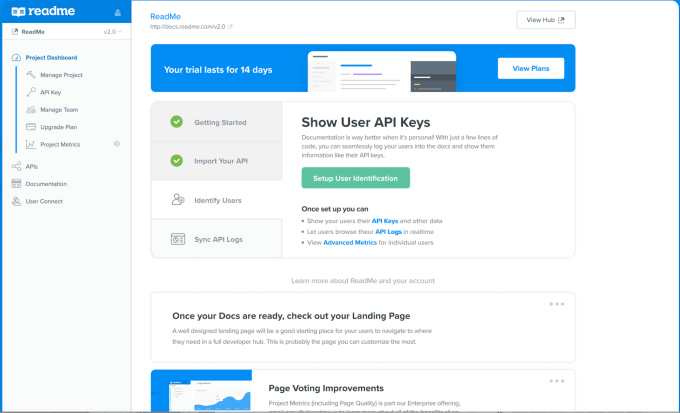
Image: ReadMe
He says this ability to make use of the API logs has opened up all kinds of possibilities for the company, as the data provides a valuable window into how people use the APIs. “It’s amazing how much you get by just actually seeing what the server sees. When people are having problems with an API, they can debug it themselves because they can actually see the problems, the support team can see it as well,” Koberger said.
Accel’s Dan Levine, whose firm is leading the investment, believes that having good documentation is the difference between making and breaking an API. “APIs don’t just create technical integration, they create ecosystems around core services and underpin corporate partnerships that generate billions of dollars. ReadMe is as much a strategy as it is a service for businesses. Providing clean, interactive, data-driven API documentation to make developers love working with you can be the difference between 100 partnerships or 1,000 partnerships,” Levine said.
ReadMe was founded in 2014. It has 22 employees in their San Francisco office, a number that should increase with today’s funding.
Powered by WPeMatico
ThoughtSpot was started by a bunch of ex-Googlers looking to bring the power of search to data. Seven years later the company is growing fast, sporting a fat valuation of almost $2 billion and looking ahead to a possible IPO. Today it announced a hefty $248 million Series E round as it continues on its journey.
Investors include Silver Lake Waterman, Silver Lake’s late-stage growth capital fund, along with existing investors Lightspeed Venture Partners, Sapphire Ventures and Geodesic Capital. Today’s funding brings the total raised to $554 million, according to the company.
The company wants to help customers bring speed to data analysis by answering natural language questions about the data without having to understand how to formulate a SQL query. As a person enters questions, ThoughtSpot translates that question into SQL, then displays a chart with data related to the question, all almost instantly (at least in the demo).
It doesn’t stop there though. It also uses artificial intelligence to understand intent to help come up the exact correct answer. ThoughtSpot CEO Sudheesh Nair says that this artificial intelligence underpinning is key to the product. As he explained, if you are looking for the answer to a specific question, like “What is the profit margin of red shoes in Portland?,” there won’t be multiple answers. There is only one answer, and that’s where artificial intelligence really comes into play.
“The bar on delivering that kind of answer is very high and because of that, understanding intent is critical. We use AI for that. You could ask, ‘How did we do with red shoes in Portland?’ I could ask, ‘What is the profit margin of red shoes in Portland?’ The system needs to know that we both are asking the same question. So there’s a lot of AI that goes behind it to understand the intent,” Nair explained.

Image: ThoughtSpot
ThoughtSpot gets answers to queries by connecting to a variety of internal systems, like HR, CRM and ERP, and uses all of this data to answer the question, as best it can. So far, it appears to be working. The company has almost 250 large-company customers, and is on a run rate of close to $100 million.
Nair said the company didn’t necessarily need the money, with $100 million still in the bank, but he saw an opportunity, and he seized it. He says the money gives him a great deal of flexibility moving forward, including the possibility of acquiring companies to fill in missing pieces or to expand the platform’s capabilities. It also will allow him to accelerate growth. Plus, he sees the capital markets possibly tightening next year and he wanted to strike while the opportunity was in front of him.
Nair definitely sees the company going public at some point. “With these kind of resources behind us, it actually opens up an opportunity for us to do any sort of IPO that we want. I do think that a company like this will benefit from going public because Global 2000 kind of customers, where we have our most of our business, appreciate the transparency and the stability represented by public companies,” he said.
He added, “And with $350 million in the bank, it’s totally [possible to] IPO, which means that a year and a half from now if we are ready to take the company public, we can actually have all options open, including a direct listing, potentially. I’m not saying we will do that, but I’m saying that with this kind of funding behind us, we have all those options open.”
Powered by WPeMatico
Cybersecurity asset management startup Axonius has raised $20 million in its second round of funding this year.
Venture capital firm OpenView led the Series B, joining existing investors in bringing $37 million to date following the startup’s $13 million Series A in February.
The security startup, founded in 2017, helps companies keep track of their enterprise assets, such as how many clouds, computers and devices are on their network. The logic goes that if you know what you have — including devices plugged into your network by employees or guests — you can keep track and discover holes in your enterprise security. That insight allows enterprises to enforce security policies to keep the rest of the network safe — like installing endpoint security software, or blocking devices from connecting to the network altogether.
Axonius’ co-founder and chief executive Dean Sysman said the company takes a different approach to asset management.
“You can’t secure what you don’t know about,” he told TechCrunch. “Almost everything you’re doing in security relies on a foundation of knowing your assets and how they stack up against your security policies. Once you get that foundation taken care of, everything else you do will benefit,” he said.
Instead, Axonius integrates with more than a hundred existing security and management solutions to build up a detailed picture of an entire organization.
Clearly it’s a strategy that’s paying off.
The company already has big-name clients like The New York Times and Schneider Electric, as well as a handful of customers in the Fortune 500.
Sysman said the bulk of the funding will go toward the expansion of its sales and marketing teams, but also the continued improvement and development of its product. “We’re hitting the gas and continuing to bring our solution to as many organizations in the market as we can,” he said.
Axonius said OpenView partner Mackey Craven, who focuses on cloud computing and enterprise infrastructure companies, will join the board of directors following the fundraise.
Powered by WPeMatico
Hedvig, a Swedish startup, is following in the footsteps of Lemonade, building a new generation of insurance platforms that use AI to help evaluate customers and operate on a policy of using surplus for social good. Today the company announced the next stage of its growth. The startup has closed a SEK100 million ($10.4 million) round of funding to expand from its current offering of property insurance into a wider range of categories, and begin the costly process of expanding its business into more countries beyond its home market.
The funding values the company at SEK342 million ($35.5 million) — a modest figure considering Lemonade’s recent $300 million round, reportedly (per PitchBook) at a $2.1 billion post-money valuation — but helps position the company to set its sights on being a strong regional player (if not an acquisition target for Lemonade if it wants to quickly add new regions: the latter kicked off its first services in Europe earlier this year, so its global aspirations are clear).
It currently has 15,000 customers in its home market of Sweden, who use it for property insurance on rented or owned apartments, and Lucas Carlsen, the co-founder and CEO, said in an emailed interview with TechCrunch that it “definitely” plans to expand that to houses as well as other categories. Home insurance also covers contents, such as gadgets, and travel, and Carlsen said that the former (gadgets) accounts for the majority of claims at the moment.
The round was led by Obvious Ventures, the venture fund co-founded by Twitter/Medium/Blogger co-founder Ev Williams, with D-Ax, the early-stage investment arm of Swedish retail giant Axel Johnson Group, also participating, along with past investor Cherry Ventures.
“We are building a global company. We just started in Sweden since we happened to live here, and it serves as a good test market as we have some of the worlds’ most progressive and demanding consumers. Today, we do not have any news to share about future markets, but stay tuned!,” said Carlsen.
“The new funding will mainly be used to fuel growth in Sweden, but we’ll also be looking at extending into new markets and insurance categories. Insurance is capital intensive and our new partners are committed to supporting our long-term vision,” he continued.
Indeed, getting an investor like Obvious (which published its own short announcement about the investment) involved could open the door to introductions with a number of other investors down the road.
“Hedvig is harnessing its purpose, the power of AI, and its human-centered product to create a modern, full-stack insurance company. Their incredible team is delivering against the mission – to give people the world’s most incredible insurance experience – and we at Obvious are honored to help scale it further,” said Vishal Vasishth, one of Obvious Ventures’ other co-founders, in a statement.
Hedvig — named, Carlsen said, after a legend of “someone who stood up for others and fought for their causes: that’s what we do,” — will sound familiar to you if you know Lemonade.
It follows in a wave of more socially forward businesses that are being created, which are using technology to help disrupt the status quo but also to bridge the gap between building services that consumers need and the principles they would like to adhere to more if possible. (Other examples include the likes of Beyond Meat, which is also backed by Obvious; as well as the plethora of electric and hybrid vehicle makers; and more.)
In the case of Hedvig and the challenge of insurance, the proposition goes like this:
Hedvig uses technology and innovative algorithms to help assess a potential customer, who is then provided with lowest-cost, and often competitively priced, premiums. Then, as a “full-stack” digital company, it also uses its algorithms to help process claims. After Hedvig uses its bigger pot of money to pay out claims, the annual surplus is donated to charities selected by its customers.
“By not pocketing this money ourselves we can focus on providing the best service possible to you and not on making more money from denying claims,” Carlsen said.
Hedvig itself makes money by taking a cut off users’ monthly premiums (it doesn’t specify how much). To date, Hedvig has not disclosed how much it has been able to “give back” according to its business model. But the philosophy is that by digitising some of the more mundane processes that are relegated to human adjustors and customer agents at traditional agencies — and by not being inherently greedy — the startup is able to provide a more pleasant, more efficient and more conscionable service.
Powered by WPeMatico

Many Silicon Valley companies and fintech startups in India today share a common mission: They all want to bring their financial services to the next billion users. Dozens of fintech startups that we have spoken to in recent months have told us that they all want to address much of India, one of the last great growth markets globally, in the next few years.
So you can imagine our excitement when we learned there is at least one startup that is going after just a few million users in the immediate future. We’re talking about CRED, a nine-month-old, Bangalore-based startup that is building solutions to incentivize credit card users in India to become more responsible with money and thereby improve their credit score.
CRED has raised $120 million in a Series B financing round, Kunal Shah, founder and CEO of the startup, told TechCrunch on Monday. He declined to share more information. The startup, which has raised about $145 million to date, is now valued between $430 million to $450 million, a person familiar with the matter told TechCrunch.
According to a regulatory filing, existing investors Sequoia Capital, Ribbit Capital and DST Global’s Gemini Investments led the round, with participation from Tiger Global, Hillhouse Capital, General Catalyst, Greenoaks Capital and Dragoneer.
Hundreds of millions of Indians today don’t have a credit score because they have never taken a loan from a recognized entity nor owned a credit card. According to the government’s official figures, fewer than 50 million credit cards are in circulation in India currently, with industry reports suggesting that the actual number of unique credit card holders is about half of that.
“Nobody taught us about how to use money,” Shah told TechCrunch in a recent interview. “This has created a huge trust gap in India. If you look at developed markets, systematic trust is very high between all the entities. Members don’t have to rely on third-parties. In India, even if you wanted to rent a flat, you look for brokers, for instance.”

You can build that trust when you know how someone handles their money, and how they have handled it in recent history. “Our aim is to create a big membership community with high credit worthiness, therefore open up more opportunities for them,” Shah explained.
Shah is not going after the masses. He wants to focus on just the credit card users for now, and if he could win the trust of just half of those plastic card holders in India, he would consider it a success.
“Instead of chasing the mythological mass customers who are currently useful only on paper if you wanted to boast about your daily active user or monthly active user metric, our goal is to serve the existing users,” he said.
On CRED, users are offered a range of features, including the ability to better track their spending, get reminders and check their credit score, but more importantly, access to a range of lofty offers such as membership to a gym at a discounted price, access to good restaurants at low prices and subscription to various services at little to no charge. Users can access these features by earning points, which they can secure every time they pay their credit card bills on time.
Varun Krishnan, editor of technology news site FoneArena, told TechCrunch that he has found CRED useful in getting reminders to pay his bills and likes that he can pay them through a range of payment options, including UPI apps and debit cards. “I have several cards and it is hard to track amounts and due dates of payment for each one. They send all these alerts on WhatsApp, which is a blessing,” he said.
These are the reasons that attracted many people like Krishnan to join CRED. That, and some incentive to pay his bills — though he hopes that CRED expands the range of offers it currently provides to customers.
That wish may soon come true. In the coming months, CRED will enable these highly sought-after customers to access some financial services from banks in a single-click. Additionally, it is also exploring expansion to some international markets, the aforementioned source said.
CRED does not charge users any money for joining its platform, nor for availing any of the features it offers. But it is generating revenue from some of the partners that are supplying offers on the app.
It’s not a surprise that Shah, an industry veteran known for speaking the uncomfortable truths at conferences, has won the trust of so many investors already. He built one of the biggest payment apps in India, Freecharge, and sold it to e-commerce giant Snapdeal for a whopping $400 million in one of the increasingly rare exits that India’s fintech market has seen to date.
Powered by WPeMatico
Boll & Branch, which sells sustainably sourced sheets, pillows, mattresses and towels, is announcing that it has raised $100 million in a strategic investment from L Catterton’s Flagship Buyout Fund.
This looks like a big change from the company’s previous approach to funding. It was self-funded for its first two years (resulting in what CEO Scott Tannen described as “a lot of maxed out credit cards and five mortgages on my house”), and even when it started looking at venture capital, it only raised a total of $12 million from a single institutional backer, Silas Capital.
In fact, when Recode wrote about Boll & Branch’s Series B last year, it described the startup as one “that wants to raise as little venture capital as possible.”
Tannen said that when he founded the company with his wife Missy, they wanted to “build a sustainable business from the ground up,” and that wasn’t just about the products — they didn’t want to build a company that was “ultimately designed from day one to be sold.”
As a result, he said, Boll & Branch has been profitable for the past four years and is now bringing in “nine-figure revenue.” He compared it to other L Catterton investments like The Honest Company and Peloton, companies that “have become the winner in the startup competition” and are ready to “really become household names.”
In a statement, L Catterton’s Nik Thukral described Boll & Branch as “one of the most beloved bedding brands” and said it “capitalizes on several compelling trends including the emergence of authentic, pure, and chemical free products that can be traced back to their origin, as well as consumers’ heightened focus on healthy living.”
The company’s next steps include expanding internationally — Tannen said that while the company doesn’t currently sell outside the United States, “It’s hard to imagine a country or market in the world that doesn’t make sense for Boll & Branch.”
It will also continue expanding the product lineup. Tannen hinted at “really interesting product introductions” coming in the next few months. They might not be the most obvious additions to the lineup, but he said these decisions come from asking, “What does the home goods brand of the future look like?”
He added, “That’s what we’re trying to be, versus trying to look in the shopping mall and just creating a new version of something [that already exists].”
Powered by WPeMatico
Stylitics, a startup powering outfit-based shopping recommendations for online retailers, is announcing that it has raised $15 million in Series B funding.
The company was initially known for ClosetSpace, a mobile app that provided consumers with outfit recommendations and inspiration.
While the app is still live, Stylitics’ focus has shifted to its retailer tools — for example, when you look at this blouse on the LOFT website or this shirt on the Banana Republic site, Stylitics is powering the “Ways to Wear It” and “Wear It With” widgets recommending other products that you could purchase to complete the outfit.
The company said it’s drawing on brand merchandising guidelines, engagement and purchase data from the retailer, broader trend data and stylists’ expertise to create these recommendations, which are updated as products sell out.
In an email, founder and CEO Rohan Deuskar (pictured above) added that Stylitics is able to provide useful recommendations from the start, without requiring time to train with a retailer’s data.

“We have billions of data points from powering outfitting on dozens of sites for more than four years, so we have a very good idea on Day One what an excellent and high performing outfit should look like for each product for a new customer,” Deuskar said.
Stylitics says it has driven $300 million for its retail partners — a group grown in the past year to include Ann Taylor, Calvin Klein, Chico’s, Gap, Kohl’s, Macy’s, Under Armour and White House Black Market.
The startup has now raised a total of $21 million. The new round was led by PeakSpan Capital, with participation from Trestle LP. PeakSpan co-founder Phil Dur is joining the Stylitics board.
“With the rapid growth of digital commerce, retailers are scrambling to keep pace with the consumer demand for more visually exciting and compelling shopping experiences,” Dur said in a statement.
The startup said it will use the money to grow its sales and marketing team while developing new types of shoppable content and in-store experiences.
Powered by WPeMatico
FreshToHome, a Bangalore-based e-commerce startup that sells fresh vegetable, fish, chicken and other kinds of meat, has raised $20 million in a new financing round as it looks to expand its footprint in the nation.
The Series B round for the startup was led by Iron Pillar, with Joe Hirao, the founder of Japan’s ZIGExn, also participating. The startup, which closed its $11 million Series A financing round three months ago, has raised $33 million to date.
FreshToHome sells “100 percent” pure and fresh vegetables and meat in Bangalore, Mumbai and Pune — the latter two of which it recently entered. It says it does not add any preservatives or other chemicals to prolong the life of the produce. (Typical meat sold by a retail store is riddled with chemicals and could be months old.)
Unlike most other marketplaces, FreshToHome has built its own supply chain network, which gives it better control over quality and delivery of the food items. It uses trains and planes to move inventory, and has become one of the biggest clients of several local airlines.
The startup sources vegetables and fish directly from 1,500 fishermen and farmers across the nation. It uses an app to negotiate with farmers and fishermen.
It continues to expand its control over all aspects of its business. “Today a large part of our poultry comes from institutional farmers. Now we are going a step ahead and processing the chicken at the slaughtering level ourselves,” Shan Kadavil, CEO of FreshToHome, told TechCrunch in an interview.
FreshToHome is able to deliver the perishables on the same day and as soon as up to two hours, Kadavil said.
The startup also began operations in UAE recently and has opened physical stores in Bangalore and Chennai.
FreshToHome has amassed 650,000 customers — up from 400,000 in late May — in 10 cities in India, and recently started to sell milk in Bangalore, another market segment that remains largely unstructured in the nation. Every day it receives 14,000 orders, and processes 20 tons of fresh food.
It recently crossed $30 million in annualized direct to consumer sales, which makes it the largest e-commerce platform serving this category. It is seeing 30% month-to-month growth, said Kadavil, who has previously managed tech support for Support, and India operations for gaming firm Zynga.
And that growth has helped the startup attract some attention. Several major players in the nation, including Amazon India that recently expanded to include perishable category and Flipkart, have held talks with FreshToHome to acquire some stake in the startup, a person familiar with the matter told TechCrunch.
And there is a big opportunity in the space. The cold-chain market of India is estimated to grow to $37 billion in next five years.
In addition to directly procuring its supplies from farmers and fishermen, FreshToHome also serves as a micro-VC, giving them access to some money upfront and resources to produce more from their farms. It also gives them an assurance that it will buy back their produce.
Kadavil founded FreshToHome with Mathew Joseph, a veteran in the industry who has dealt with fish export for more than 30 years. Joseph started India’s first e-commerce venture in fish and meat, called SeaToHome, in 2012.
FreshToHome will use the fresh capital to expand its network of contract farmers, and add 200 to 300 tons of additional produce each month.
In a prepared statement, Anand Prasanna, managing partner of Iron Pillar, for which it is the first investment in food-tech space, said, “FreshToHome’s brand proposition has been to provide 100% fresh food with 0% chemicals — not an easy thing to achieve in India at a large scale. By smartly using big data and machine learning, they have created a sustainable supply chain, which offers a fair price to consumers, fishermen and farmers, for their premium produce… We love companies that solve such hard issues in large market segments in India through unique tech enabled moats!”
Powered by WPeMatico

BharatPe, a New Delhi-based firm that is enabling hundreds of thousands of merchants to start accepting digital payments for the first time, and is also giving them access to working capital, has raised $50 million as it looks to scale its business in the nation.
The Series B round for the one-year-old startup was led by San Francisco-headquartered VC firm Ribbit Capital and London-based Steadview Capital, both of which have previously invested in a number of financial services in India.
Existing investors Sequoia Capital, Beenext Capital and Insight Partners also participated in the round, pushing BharatPe’s all-time raise to $65 million. The new round valued the startup at $225 million, Ashneer Grover, co-founder and CEO of BharatPe, told TechCrunch in an interview.
Google and Amazon, both of which offer payment services in India, were also in advanced stages of talks to fund BharatPe’s Series B financing round, but the startup’s founding team was not keen on diluting their stakes, especially in the wake of BharatPe’s recent growth, a person familiar with the matter told TechCrunch.
BharatPe operates an eponymous service to help offline merchants accept digital payments. Even as India has already emerged as the second largest internet market, with more than 500 million users, much of the country remains offline. Among those outside of the reach of the internet are merchants running small businesses, such as roadside tea stalls.
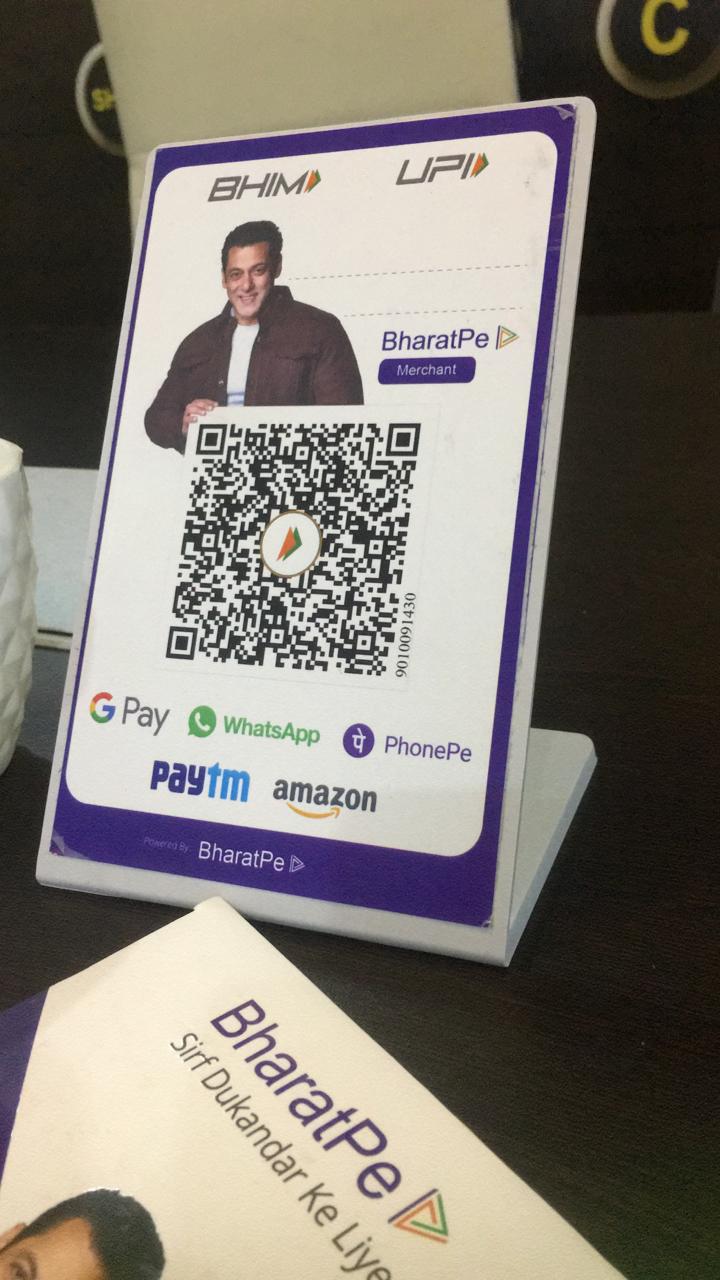
To make these merchants comfortable in accepting digital payments, BharatPe relies on QR codes built as part of government-backed UPI payments infrastructure. “We get them to put up a QR code in their shops, and any customer that uses a UPI-powered payments app — which is now supported by nearly every payments app in India — can pay these shop owners digitally,” said Grover.
Through BharatPe, these merchants also get access to a simplified dashboard on their phones to track the customers who owe them money and get periodic reminders.
BharatPe has amassed more than 1.5 million merchants on its platform. It processes more than 21 million transactions a month, worth more than $83 million, Grover said.
BharatPe also allows merchants to secure short-term loans. New merchants can secure about $500 for a period of three months from BharatPe. As merchants spend more time on BharatPe, the firm increases the amount to about $2,000.
The lending business is crucial to BharatPe. Payment apps make little to no money through making transactions on their platforms. Those processing UPI payments can not even charge a small commission to merchants. “There is no money to be made in doing payments in India,” Grover said. So you charge small interest on loans.
Access to working capital is a major challenge in developed markets such as India. According to a World Bank report, more than 2 billion people globally do not have access to working capital.
Grover said BharatPe aims to use the fund to add about 3.5 million merchants in the next 12 months. The firm has more than 2,000 sales people who are adding 400,000 new merchants to BharatPe each month, he said.
The rest of the money will go into financing the loans on the platform and building new solutions. Later today, BharatPe will launch a new service to connect suppliers and merchants through BharatPe so that their accounts are in sync.
Powered by WPeMatico