india
Auto Added by WPeMatico
Auto Added by WPeMatico
Even as more than 150 million people are using digital payment apps each month in India, only about 20 million of them invest in mutual funds and stocks. A startup that is attempting to change that by courting millennials has just received a big backing.
Bangalore-headquartered Groww said on Thursday it had raised $30 million in its Series C financing round. YC Continuity, the growth-stage investment fund of Y Combinator, led the round, while existing investors Sequoia India, Ribbit Capital and Propel Ventures participated in it. The new round brings three-year-old startup Groww’s total raise-to-date to $59 million.
Groww allows users to invest in mutual funds, including systematic investment planning (SIP) and equity-linked savings. The app maintains a very simplified user interface to make it easier for its largely millennial customer base to comprehend the investment world. It offers every fund that is currently available in India.
In recent months, the startup has expanded its offerings to allow users to buy stocks of Indian firms and digital gold, said Lalit Keshre, co-founder and chief executive of Groww, in an interview with TechCrunch. Keshre and other three co-founders of Groww worked at Flipkart before launching their own startup.
Groww has amassed over 8 million registered users for its mutual fund offering, and over 200,000 users have bought stocks from the platform, said Keshre. The new fund will allow Groww to further expand its reach in the country and also introduce new products, he said.
One of those products is the ability to allow users to buy stocks of U.S.-listed firms and derivatives, he said. The startup is already testing this with select users, he said.
“We believe Groww is building the largest retail brokerage in India. At YC, we have known the founders since the company was just an idea and they are some of the best product people you will meet anywhere in the world. We are grateful to be partners with Groww as they build one of the largest retail financial platforms in the world,” said Anu Hariharan, partner at YC Continuity, in a statement.
More than 60% of Groww users come from smaller cities and towns of India and 60% of these have never made such investments before, said Keshre. The startup is conducting workshops in several small cities to educate people about the investment world. And that’s where the growth opportunities lie.
“India is seeing increased participation of retail investors in financial markets — with 2 million new stock market investors added in the last quarter alone,” said Ashish Agrawal, principal at Sequoia Capital India, in a statement.
Scores of startups such as Zerodha, INDWealth and Cube Wealth have emerged and expanded in India in recent years to offer wealth management platforms to the country’s growing internet population. Many established financial firms such as Paytm have also expanded their offerings to include investments in mutual funds. Amazon, which has aggressively expanded its financial services catalog in India in recent months, also sells digital gold in the country.
Powered by WPeMatico
India continues to crack down on Chinese apps, Microsoft launches a deepfake detector and Google offers a personalized news podcast. This is your Daily Crunch for September 2, 2020.
The big story: India bans PUBG and other Chinese apps
The Indian government continues its purge of apps created by or linked to Chinese companies. It already banned 59 Chinese apps back in June, including TikTok.
India’s IT Ministry justified the decision as “a targeted move to ensure safety, security, and sovereignty of Indian cyberspace.” The apps banned today include search engine Baidu, business collaboration suite WeChat Work, cloud storage service Tencent Weiyun and the game Rise of Kingdoms. But PUBG is the most popular, with more than 40 million monthly active users.
The tech giants
Microsoft launches a deepfake detector tool ahead of US election — The Video Authenticator tool will provide a confidence score that a given piece of media has been artificially manipulated.
Google’s personalized audio news feature, Your News Update, comes to Google Podcasts — That means you’ll be able to get a personalized podcast of the latest headlines.
Twitch launches Watch Parties to all creators worldwide — Twitch is doubling down on becoming more than just a place for live-streamed gaming videos.
Startups, funding and venture capital
Indonesian insurtech startup PasarPolis gets $54 million Series B from investors including LeapFrog and SBI — The startup’s goal is to reach people who have never purchased insurance before with products like inexpensive “micro-policies” that cover broken device screens.
XRobotics is keeping the dream of pizza robots alive — XRobotics’ offering resembles an industrial 3D printer, in terms of size and form factor.
India’s online learning platform Unacademy raises $150 million at $1.45 billion valuation — India has a new startup unicorn.
Advice and analysis from Extra Crunch
The IPO parade continues as Wish files, Bumble targets an eventual debut — Alex Wilhelm looks at the latest IPO news, including Bumble planning to go public at a $6 to $8 billion valuation.
3 ways COVID-19 has affected the property investment market — COVID-19 has stirred up the long-settled dust on real estate investing.
Deep Science: Dog detectors, Mars mappers and AI-scrambling sweaters — Devin Coldewey kicks off a new feature in which he gets you all caught up on the most recent research papers and scientific discoveries.
(Reminder: Extra Crunch is our subscription membership program, which aims to democratize information about startups. You can sign up here.)
Everything else
‘The Mandalorian’ launches its second season on Oct. 30 — The show finished shooting its second season right before the pandemic shut down production everywhere.
GM, Ford wrap up ventilator production and shift back to auto business — Both automakers said they’d completed their contracts with the Department of Health and Human Services.
The Daily Crunch is TechCrunch’s roundup of our biggest and most important stories. If you’d like to get this delivered to your inbox every day at around 3pm Pacific, you can subscribe here.

Powered by WPeMatico
For years, India has served as the largest open battleground for Silicon Valley and Chinese firms searching for their next billion users.
With more than 400 million WhatsApp users, India is already the largest market for the Facebook-owned service. The social juggernaut’s big blue app also reaches more than 300 million users in the country.
Google is estimated to reach just as many users in India, with YouTube closely rivaling WhatsApp for the most popular smartphone app in the country.
Several major giants from China, like Alibaba and Tencent (which a decade ago shut doors for most foreign firms), also count India as their largest overseas market. At its peak, Alibaba’s UC Web gave Google’s Chrome a run for its money. And then there is TikTok, which also identified India as its biggest market outside of China.
Though the aggressive arrival of foreign firms in India helped accelerate the growth of the local ecosystem, their capital and expertise also created a level of competition that made it too challenging for most Indian firms to claim a slice of their home market.
New Delhi’s ban on 59 Chinese apps on June 30 on the basis of cybersecurity concerns has changed a lot of this.
Indian apps that rarely made an appearance in the top 20 have now flooded the charts. But are these skyrocketing download figures translating to sustaining users?
An industry executive leaked the download, monthly active users, weekly active users and daily active users figures from one of the top mobile insight firms. In this Extra Crunch report, we take a look at the changes New Delhi’s ban has enacted on the world’s second largest smartphone market.
Scores of startups in India, including news aggregator DailyHunt, on-demand video streamer MX Player and advertising giant InMobi Group, have launched their short-video format apps in recent months.
Powered by WPeMatico
Pattern, a Lehi, Utah-based reseller that offers large and small brands a way to optimize their sales on marketplaces like Amazon, eBay, Walmart and Google Shopping, has raised $52 million in growth funding, the company said.
The money, from Ainge Advisory and KSV Global, will be used to expand the company’s business worldwide.
Founded in 2013, the e-commerce reseller uses analytics to lock down market-specific keywords in advertising and has managed to reach a run-rate that should see it hit $500 million in annual revenue by the end of 2020, according to Pattern co-founder and chief investment officer, Melanie Alder.
Brands like Nestlé, Pandora, Panasonic, Zebra and Skechers sell their goods to Pattern in an effort to juice sales on digital marketplaces.
“Pattern represents our brands in the US, across Europe, and in select markets in Asia, selling for us on global marketplaces such as Amazon, Walmart, Tmall, and JD as well as building and managing three of our direct-to-consumer sites,” said Kyle Bliffert, CEO and president of Atrium Innovations, a Nestlé Health Science company, in a statement. “The global e-commerce growth we have experienced by leveraging Pattern’s expertise is extraordinary.”
Pattern places bets on where a product is likely to receive the most attention using specific keywords, according to the company’s chief executive, Dave Wright. The company buys products from its brand partners and then sells them widely across marketplaces in the U.S., Europe and Asia. These markets represent $2.7 trillion in total sales and Wright expects it to reach $7 trillion by 2024.
As Wright noted, a majority of searches for sales begin on Amazon . The company just opened its eighteenth location in Germany. Pattern has grown sales for brands from $3 million to $26 million and the company makes money off of the margin on the sales of products. With the new funding, the company intends to expand into other geographies like Japan and India.
Wright says his company addresses one of the fundamental problems with advertising technology — the proliferation of tools hasn’t meant better optimization for most brands, because they’re teams aren’t equipped to specialize.
While there may be hundreds of different advertising and marketing folks working at a company, each company may have hundreds of brands that it sells and the dedicated teams to specific brands may only have one or two people on staff.
“Data makes all the difference,” said co-founder and CEO Dave Wright. “I’ve spent the bulk of my career in data science and data management, and our ability to detect and act on ‘patterns’ on e-commerce platforms has allowed the brands we represent to be incredibly successful.”
Powered by WPeMatico
Mobile device maker HMD Global has announced a $230M Series A2 — its first tranche of external funding since a $100M round back in 2018 when it tipped over into a unicorn valuation. Since late 2016 the startup has exclusively licensed Nokia’s brand for mobile devices, going on to ship some 240M devices to date.
Its latest cash injection is notable both for its size (HMD claims it as the third largest funding round in Europe this year); and the profile of the strategic investors ploughing in capital — namely: Google, Nokia and Qualcomm.
Though whether a tech giant (Google) whose OS dominates the world’s smartphone market (Android) becoming a strategic investor in Europe’s last significant mobile OEM (HMD) catches the attention of regional competition enforcers remains to be seen. Er, vertical integration anyone? (To wit: It’s a little over two years since Google was slapped with a $5BN penalty by EU regulators for antitrust violations related to how it operates Android — and the Commission has said it continues to monitor the market ‘remedies’.)
In a further quirk, when we spoke to HMD Global CEO, Florian Seiche, ahead of today’s announcement, he didn’t expect the names of the investors to be disclosed — but a press spokesperson had already shared them with us so he duly confirmed the trio are investors in the round. (But wouldn’t be drawn on how much equity Google is grabbing.)
HMD’s smartphones run on Google’s Android platform, which gives the tech giant a firm business reason for supporting the mobile maker in growing the availability of Google-packed hardware in key growth markets around the world.
And while HMD likens its consistent (and consistently updated) flavor of Android to the premium ‘pure’ Android experience you get from Google’s own-brand Pixel smartphones, the difference is the Finnish company offers devices across the range of price points, and targets hardware at mobile users in developing markets.
The upshot is relatively little overlap with Google’s Pixel hardware, and still plenty of business upside for Google should HMD grow the pipeline of Google services users (as it makes money by targeting ads).
Connoisseurs of mobile history may see more than a little irony in Google investing into Nokia branded smartphones (via HMD), given Android’s role in fatally disrupting Nokia’s lucrative smartphone business — knocking the Finnish giant off its perch as the world’s number one mobile maker and ushering in an era of Android-fuelled Asian mobile giants. But wait long enough in tech and what goes around oftentimes comes back around.
“We’re extremely excited,” said Seiche, when we mention Google’s pivotal role in Nokia’s historical downfall in smartphones. “How we are going to write that next chapter on smartphones is a critical strategic pillar for the company and our opportunity to team up so closely with Google around this has been a very, very great partnership from the beginning. And then this investment definitely confirms that — also for the future.”
“It’s a critical time for the industry therefore having a clear strategy — having a clear differentiation and a different point of view to offer, we believe, is a fantastic asset that we have developed for ourselves. And now is a great moment for us to double down on this,” he added.
We also asked Seiche whether HMD has any interest in taking advantage of the European Commission’s Android antitrust enforcement decision — i.e. to fork Android and remove the usual Google services, perhaps swapping them out for some European alternatives, which is at least a possibility for OEMs selling in the region — but Seiche told us: “We have looked at it but we strongly believe that consumers or enterprise customers actually love [Google] services and therefore they choose those services for themselves.” (Millions of dollars of direct investment from Google also, presumably, helps make the Google services business case stack up.)
Nokia, meanwhile, has always had a close relationship with HMD — which was established by former Nokia execs for the sole purpose of licensing its iconic mobile brand. (The backstory there is a clause in the sale terms of Nokia’s mobile device division to Microsoft expired in 2016, paving the way for Nokia’s brand to be returned to the smartphone market without the prior Windows Mobile baggage.)
Its investment into HMD now looks like a vote of confidence in how the company has been executing in the fiercely competitive mobile space to date (HMD doesn’t break out a lot of detail about device sales but Seiche told us it sold in excess of 70M mobiles last year; that’s a combined figure for smartphones and feature phones) — as well as an upbeat assessment of the scope of the growth opportunity ahead of it.
On the latter front US-led geopolitical tensions between the West and China do look poised to generate a tail-wind for HMD’s business.
Mobile chipmaker Qualcomm, for example, is facing a loss of business, as US government restrictions threaten its ability to continue selling chips to Huawei; a major Chinese device maker that’s become a key target for US president Trump. Its interest in supporting HMD’s growth, therefore, looks like a way for Qualcomm to hedge against US government disruption aimed at Chinese firms in its mobile device maker portfolio.
While with Trump’s recent threats against the TikTok app it seems safe to assume that no tech company with a Chinese owner is safe.
As a European company, HMD is able to position itself as a safe haven — and Seiche’s sales pitch talks up a focus on security detail and overall quality of experience as key differentiating factors vs the Android hoards.
“We have been very clear and very consistent right from the beginning to pick these core principles that are close to our heart and very closely linked with the Nokia brand itself — and definitely security, quality and trust are key elements,” he told TechCrunch. “This is resonating with our carrier and retail customers around the world and it is definitely also a core fundamental differentiator that those partners that are taking a longer term view clearly see that same opportunity that we see for us going forward.”
HMD does use manufacturing facilities in China, as well as in a number of other locations around the world — including Brazil, India, Indonesia and Vietnam.
But asked whether it sees any supply chain risks related to continued use of Chinese manufacturers to build ‘secure’ mobile hardware, Seiche responded by claiming: “The most important [factor] is we do control the software experience fully.” He pointed specifically to HMD’s acquisition of Valona Labs earlier this year. The Finnish security startup carries out all its software audits. “They basically control our software to make sure we can live up to that trusted standard,” Seiche added.
Landing a major tranche of new funding now — and with geopolitical tension between the West and the Far East shining a spotlight on its value as alternative, European mobile maker — HMD is eyeing expansion in growth markets such as Africa, Brail and India. (Currently, HMD said it’s active in 91 markets across eight regions, with its devices ranged in 250,000 retail outlets around the world.)
It’s also looking to bring 5G to devices at a greater range of price-points, beyond the current flagship Nokia 8.3. Seiche also said it wants to do more on the mobile services side. HMD’s first 5G device, the flagship Nokia 8.3, is due to land in the US and Europe in a matter of weeks. And Seiche suggested a timeframe of the middle of next year for launching a 5G device at a mid tier price point.
“The 5G journey again has started, in terms of market adoption, in China. But now Europe, US are the key next opportunity — not just in the premium tier but also in the mid segment. And to get to that as fast as possible is one of our goals,” he said, noting joint-working with Qualcomm on that.
“We also see great opportunity with Nokia in that 5G transition — because they are also working on a lot of private LTE deployments which is also an interesting area since… we are also very strongly present in that large enterprise segment,” he added.
On mobile services, Seiche highlighted the launch of HMD Connect: A data SIM aimed at travellers — suggesting it could expand into additional connectivity offers in future, forging more partnerships with carriers.
“We have already launched several services that are close to the hardware business — like insurance for your smartphones — but we are also now looking at connectivity as a great area for us,” he said. “The first pilot of that has been our global roaming but we believe there is a play in the future for consumers or enterprise customers to get their connectivity directly with their device. And we’re partnering also with operators to make that happen.”
“You can see us more as a complement [to carriers],” he added, arguing that business “dynamics” for carriers have also changed substantially — and customer acquisition hasn’t been a linear game for some time.
“In a similar way when we talk about Google Pixel vs us — we have a different footprint. And again if you look at carriers where they get their subscribers from today is already today a mix between their own direct channels and their partner channels. And actually why wouldn’t a smartphone player be a natural good partner of choice also for them? So I think you’ll see that as a trend, potentially, evolving in the next couple of years.”
Powered by WPeMatico
Hello and welcome back to Equity, TechCrunch’s venture capital-focused podcast (now on Twitter!), where we unpack the numbers behind the headlines.
As ever, I was joined by TechCrunch managing editor Danny Crichton and our early-stage venture capital reporter Natasha Mascarenhas. We had Chris on the dials and a pile of news to get through, so we were pretty hyped heading into the show.
But before we could truly get started we had to discuss Cincinnati, and TikTok. Pleasantries and extortion out of the way, we got busy:
It was another fun week! As always we appreciate you sticking with and supporting the show!
Equity drops every Monday at 7:00 a.m. PT and Friday at 6:00 a.m. PT, so subscribe to us on Apple Podcasts, Overcast, Spotify and all the casts.
Powered by WPeMatico
Amazon has found a new partner to expand the reach of its cloud services business — AWS — in India, the world’s second largest internet market.
On Wednesday, the e-commerce giant announced it has partnered with Bharti Airtel, the third-largest telecom operator in India with more than 300 million subscribers, to sell a wide-range of AWS offerings under Airtel Cloud brand to small, medium, and large-sized businesses in the country.
The deal could help AWS, which leads the cloud market in India, further expand its dominance in the country. The move follows a similar deal Reliance Jio — India’s largest telecom operator and which has raised more than $20 billion in recent months from Google, Facebook and a roster of other high-profile investors — struck with Microsoft last year to sell cloud services to small businesses. The two announced a 10-year partnership to “serve millions of customers.”
Airtel, which serves over 2,500 large enterprises and more than a million emerging businesses, itself signed a similar cloud deal with Google in January this year. That partnership is still in place, Airtel said.
“AWS brings over 175 services to the table. We pretty much support any workload on the cloud. We have the largest and the most vibrant community of customers,” said Puneet Chandok, President of AWS in India and South Asia, on a call with reporters Wednesday noon.
The two companies, which signed a similar agreement in 2015, will also collaborate on building new services and help existing customers migrate to Airtel Cloud, they said.
Today’s deal illustrates Airtel’s push to build businesses beyond its telecom venture, said Harmeen Mehta, Global CIO and Head of Cloud and Security Business at Airtel, on the call. Last month, Airtel partnered with Verizon — TechCrunch’s parent company — to sell BlueJeans video conferencing service to business customers in India.
Deals with carriers were very common a decade ago in India as tech giants rushed to amass users in the country. Replicating a similar strategy now illustrates the phase of the cloud adoption in the nation.
Nearly half a billion people in India came online last decade. And slowly, small businesses and merchants are also beginning to use digital tools, storage services, and accept online payments.
India has emerged as one of the emerging leading grounds for cloud services. The public cloud services market of the country is estimated to reach $7.1 billion by 2024, according to research firm IDC.
Powered by WPeMatico
Electric vehicles (EVs) are spreading throughout the world. While Tesla has drawn the most attention in the United States with its luxurious and cutting-edge cars, EVs are becoming a mainstay in markets far away from the environs of California.
Take India for instance. In the local mobility market, two- and three-wheel vehicles are starting to emerge as a popular option for a rapidly expanding middle class looking for more affordable options. EV versions are popular thanks to their reduced maintenance costs and higher reliability compared to gasoline alternatives.

Two-wheeled electric scooters are a fast-growing segment of India’s mobility market.
There’s just one problem, and it’s the same one faced by every country which has attempted to convert from gasoline to electric: how do you build out the charging station network to make these vehicles usable outside a small range from their garage?
It’s the classic chicken-and-egg problem. You need EVs in order to make money on charging stations, but you can’t afford to build charging stations until EVs are popular. Some startups have attempted to build out these networks themselves first. Perhaps the most famous example was Better Place, an Israeli startup that raised $800 million in venture capital before dying from negative cash flow back in 2013. Tesla has attempted to solve the problem by being both the chicken and egg by creating a network of Superchargers.
That’s what makes Statiq so interesting. The company, based in the New Delhi suburb of Gurugram, is bootstrapping an EV charging network using a multi-revenue model that it hopes will allow it to avoid the financial challenges that other charging networks have faced. It’s in the current Y Combinator batch and will be presenting at Demo Day later this month.
Akshit Bansal and Raghav Arora, the company’s co-founders, worked together previously as consultants and built a company for buying photos online, eventually reaching 50,000 monthly actives. They decided to make a pivot — a hard pivot really — into EVs and specifically charging equipment.

Statiq founders Raghav Arora and Akshit Bansal. Photos via Statiq
“We felt the need to do something about the climate because we were living in Delhi and Delhi is one of the most polluted cities in the world, and India is home to a lot of the polluted cities in the world. So we wanted to do something about it,” Bansal said. As they researched the causes of pollution, they learned that automobile exhaust represented a large part of the problem locally. They looked at alternatives, but EV charging stations remain basically non-existent across the country.
Thus, they founded Statiq in October 2019 and officially launched this past May. They have installed more than 150 charging stations in Delhi, Bangalore, and Mumbai and the surrounding environs.
Let’s get to the economics though, since that to me is the most fascinating part of their story. Statiq as I noted has a multi-revenue model. First, end users buy a subscription from Statiq to use the network, and then users pay a fee per charging session. That session fee is split between Statiq and the property owner, giving landlords who install the stations an incremental revenue boost.

A Statiq charging station. Photo via Statiq
When it comes to installation, Statiq has a couple of tricks up its sleeves. First, the company’s charging equipment — according to Bansal — costs roughly a third of the equivalent cost of U.S. equipment. That makes the base technology cheaper to acquire. From there, the company negotiates installations with landlords where the landlords will pay the fixed costs of installation in exchange for that continuing session charge fee.
On top of all that, the charging stations have advertising on them, offering another income stream particularly in high-visibility locations like shopping malls which are critical for a successful EV charging network.
In short, Statiq hasn’t had to outlay capital in order to put in place their charging equipment — and they were able to bootstrap before applying to YC earlier this year. Bansal said the company had dozens of charging stations and thousands of paid sessions on its platform before joining their YC batch, and “we are now growing 20% week-over-week.”
What’s next? It’s all about deliberate scaling. The EV market is turning on in India, and Statiq wants to be where those cars are. Bansal and his co-founder are hoping to ride the wave, continuing to build out critical infrastructure along the way. India’s government will likely continue to help: its approved billions of dollars in incentives for EVs and for charging stations, tipping the economics even further in the direction of a clean car future.
Powered by WPeMatico


Hevo founders Manish Jethani and Sourabh Agarwal
According to data pipeline startup Hevo, many small- to medium-sized companies juggle more than 40 different applications to manage sales, marketing, finance, customer support and other operations. All of these applications are important sources of data that can be analyzed to improve a company’s performance. That data often remains separate, however, making it difficult for different teams to collaborate.
Hevo enables its clients’ employees to integrate data from more than 150 different sources, including enterprise software from Salesforce and Oracle, even if they don’t have any technical experience. The company announced today that it has raised an $8 million Series A round led by Singapore-based venture capital firm Qualgro and Lachy Groom, a former executive at payments company Stripe.
The round, which brings Hevo’s total raised so far to $12 million, also included participation from returning investors Chiratae Ventures and Sequoia Capital India’s early-stage startup program Surge. The company was first covered by TechCrunch when it raised seed funding in 2017.
Hevo’s Series A will be used to increase the number of integrations available on its platform, and hire sales and marketing teams in more countries, including the United States and Singapore. The company currently has clients in 16 markets, including the U.S., India, France, Australia and Hong Kong, and counts payments company Marqeta among its customers.
In a statement, Puneet Bysani, tech lead manager at Marqeta, said, “Hevo saved us many engineering hours, and our data teams could focus on creating meaningful KPIs that add value to Marqeta’s business. With Hevo’s pre-built connectors, we were able to get data from many sources into Redshift and Snowflake very quickly.”
Based in Bangalore and San Francisco, Hevo was founded in 2017 by chief executive officer Manish Jethani and chief technology officer Sourabh Agarwal. The two previously launched SpoonJoy, a food delivery startup that was acquired by Grofers, one of India’s largest online grocery delivery services, in 2015. Jethani and Agarwal spent a year working at Grofers before leaving to start Hevo.
Hevo originated in the challenges Jethani and Agarwal faced while developing tech for SpoonJoy’s order and delivery system.
“All of our team members would come to us and say, ‘hey, we want to look at these metrics,’ or we would ask our teams questions if something wasn’t working. Oftentimes, they would not have the data available to answer those questions,” Jethani told TechCrunch.
Then at Grofers, Jethani and Agarwal realized that even large companies face the same challenges. They decided to work on a solution to allow companies to quickly integrate data sources.
For example, a marketing team at a e-commerce company might have data about its advertising on social media platforms, and how much traffic campaigns bring to their website or app. But they might not have access to data about how many of those visitors actually make purchases, or if they become repeat customers. By building a data pipeline with Hevo, they can bring all that information together.
Hevo is designed to serve all sectors, including e-commerce, healthcare and finance. In order to use it, companies sign up for Hevo’s services on its website and employees enter their credentials for software supported by the platform. Then Hevo automatically extracts and organizes the data from those sources and prepares it for cloud-based data warehouses, such as Amazon Redshift and Snowflake. A user dashboard allows companies to customize integrations or hide sensitive data.
Hevo is among a roster of “no code, low code” startups that have recently raised venture capital funding for building tools that enable non-developers to add features to their existing software. The founders say its most direct competitor is Fivetran, an Oakland, California-based company that also builds pipelines to move data to warehouses and prepare it for analysis.
Jethani said Hevo differentiates by “optimizing our product for non-technical users.”
“The number of companies who need to use data is very high and there is not enough talent available in the market. Even if it is available, it is very competitive and expensive to hire that engineering talent because big companies like Google and Amazon are also competing for the same talent,” he added. “So we felt that there has to be some democratization of who can use this technology.”
Hevo also focuses on integrating data in real-time, which is especially important for companies that provide on-demand deliveries or services. During the COVID-19 pandemic, Jethani says e-commerce clients have used Hevo to manage an influx in orders as people under stay-at-home orders purchase more items online. Companies are also relying on Hevo to help organize and manage data as their employees continue to work remotely.
In a statement about the funding, Qualgro managing partner Heang Chhor said, “Hevo provides a truly innovative solution for extracting and transforming data across multiple data sources–in real time with full automation. This helps enterprises to fully capture the benefit of data flowing though the many databases and software they currently use. Hevo’s founders are the type of globally-minded entrepreneurs that we like to support.”
Powered by WPeMatico

Scores of online learning startups have emerged in India in recent years to serve school-age students. More than 250 million students are enrolled across schools in urban and rural parts of the country.
Whether one is in kindergarten, or preparing to join a college to pursue an undergraduate course, there are several startups offering a plethora of courses at affordable price points to help these students get there.
Byju’s, Unacademy and Vedantu among other local startups today help tens of millions of students each year gain access to high-profile and established teachers and a repository of study material that many might not have been able to find in an offline setting.
These startups — and legacy educational institutions — are helping students chase some of the most aspirational jobs: careers in engineering and medicine.
Most of these students, however, will either end up not getting their dream job — or based on their skills and India’s growing unemployment figures, a job altogether.
There are about 400 million people in India, or roughly a third of the country’s population, who are confronting a fundamental challenge: Not able to speak English, and lacking other skills that could prove crucial when applying for a job.
Entri, a startup based in the Southern city of Kochi, is attempting to address this market. The three-year-old startup offers upskilling courses to help people excel at exams that would land them a job with state and federal governments. And it teaches them these courses in the language with which they are most comfortable.
Students who dropped out before high school to those who have already attained graduate-level degrees account for the vast majority of users of Entri .
The startup began its courses in Malayalam, a language spoken by about 50 million people in India and especially popular in South India, explained Mohammed Hisamuddin, co-founder and chief executive of Entri. It has since added its courses in several other languages, including Hindi, Telugu, Kannada and Tamil.
Over the years, Entri has also expanded its course catalog to help people pursuing other kinds of jobs, including those in the blue-collar category, replicating a model similar to that of San Francisco-headquartered Udemy .
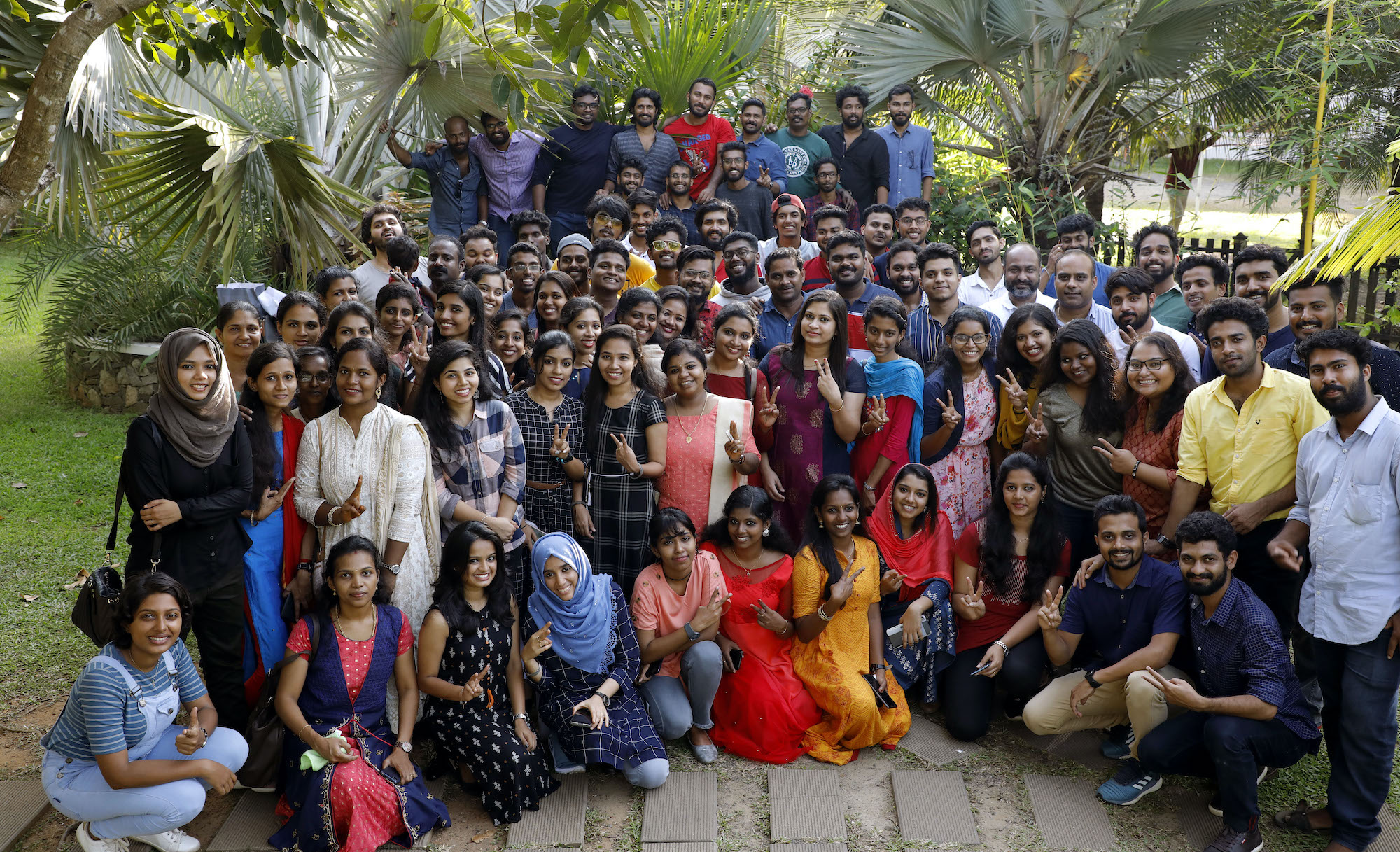
The team at Kochi-based startup Entri. (Photo provided by Entri)
“We soon realized that only about 1.5 to 2% of the people who appear in these exams are able to make the shortlist,” he said. “These exams are very competitive, so many start to explore jobs in the private sector, sometimes even when they already have some low-profile job.”
The startup now offers more than 150 courses, including several languages, accounting and those that teach popular computer applications such as Microsoft Office. These pre-recorded video courses and quizzes run for 30 to 60 days.
“Starting with the 100 million people who apply for government jobs each year, Entri is expanding the universe of employable candidates by skilling people in their own language — as it should be,” said Arjun Malhotra, a partner at venture firm Good Capital . “It’s ridiculous that economic opportunities are bottlenecked because of the medium of learning. Skills bringing employability shouldn’t require people to be proficient in English.”
Hisamuddin said Entri has amassed more than 3 million users on its platform, up from 1.5 million early this year. About 90,000 of these users are paying subscribers. “We are adding close to 10,000 paying subscribers each month now,” he said in an interview with TechCrunch early this week.
Entri offers a portion of its courses in certain languages at no charge, but complete access requires a subscription. Paid subscriptions start as low as 300 Indian rupees a year ($4) and go as high as 10,000 Indian rupees ($133), said Hisamuddin. The most popular subscription tier costs 1,500 Indian rupees ($20).
The startup said this week that it had closed a $3.1 million Pre-Series A financing round, led by Good Capital. Hari TN, head of human resources at online grocery startup BigBasket, and HyperTrack founder Kashyap Deorah also participated in the round.
It plans to deploy the fresh capital into introducing 50 additional courses to its platform and reach more users. Hisamuddin said Entri’s revenues have surged 150% in the last three months and its annual recurring revenue (ARR) has reached $2 million. He aims to scale Entri’s ARR to $5 million by this year.
Powered by WPeMatico