Enterprise
Auto Added by WPeMatico
Auto Added by WPeMatico
As sales teams partner with other companies, they go through a process called account mapping to find common customers and prospects. This is usually a highly manual activity tracked in spreadsheets. Crossbeam, a Philadelphia startup, has come up with a way to automate partnership data integration. Today the company announced a $25 million Series B investment.
Redpoint Ventures led the round with help from existing investors FirstMark Capital, Salesforce Ventures, Slack Fund and Uncork Capital, along with new investors Okta Ventures and Partnership Leaders, a partnership industry association. All in all, an interesting mix of traditional VCs and strategic investors that Crossbeam could potentially partner with as they grow the business.
The funding comes on the heels of a $3.5 million seed round in 2018 and a $12.5 million Series A a year ago. The startup has now raised a total of $41 million.
Crossbeam has been growing steadily, and that attracted the attention of investors, whom CEO and co-founder Bob Moore says approached him. He was actually not thinking about fundraising until next year, but when the opportunity presented itself, he decided to seize it.
The platform has a natural networking effect built into it with over 900 companies using it so far. As new companies come on, they invite partners, who can join and invite more partners, and that creates a constant sales motion for them without much effort at all.
“We didn’t go out fundraising. We caught the eye of Redpoint because they could see the virality of the product and the extent to which it was being used by many of their portfolio companies and companies out in the market […],” Moore told TechCrunch.
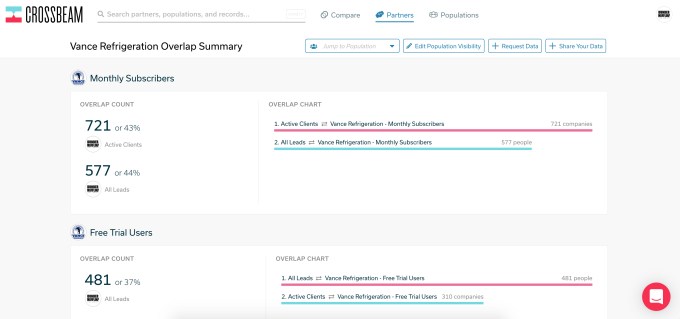
Image Credits: Crossbeam
To accelerate interest in the product, the company also announced a new free tier, which replaces the limited free trial and a starter level that previously cost $500 per month. Prior to this move, if you didn’t move to the starter tier, you would lose your data when the trial was over.
“The idea here is what we’ve seen in the data is that we can create a whole lot of value for people and demonstrate really strong ROI once they get in the door and actually have access to that data, and they don’t have to worry about a free trial where the data is going away,” Moore explained.
Moore says they currently have 28 employees and have ambitious plans to add new people to the mix in the coming months, expecting to reach 50 employees by early 2021. As the company revs up on the personnel side, Moore says diversity is front and center of their plans.
“As far as Crossbeam specifically goes, we’ve made sure that diversity, equity and inclusion is part of our entire recruiting process and also the cultural experience that we create for people that are at the company,” he said. Although he didn’t discuss specific numbers, he said the company was making progress, particularly in the latest round of hires.
While the company has an office in Philly, even before COVID hit, it was a remote first organization with about half of the employees working from home. “I think a lot of our culture was kind of built to make sure that remote team members are first-class citizens in every respect in the company. So we already had all the controls, technology and practices in place, and when we shut the office, it was about as smooth as could be,” he said.
Powered by WPeMatico

WordPress.com, a division of Automattic, is launching a new product called P2. And this time, it’s all about improving internal communications for private groups. As a remote company, Automattic has been using P2 internally for years to communicate asynchronously. It’s a place to share long-form posts, a repository to keep onboarding documents and other important evergreen documents.
P2 is built on top of WordPress . You can view it as a sort of WordPress for teams that is heavily customized around the concept of sharing ideas with other team members. Companies now rely on multiple internal communication tools. P2 can replace some of them but doesn’t want to reinvent the wheel altogether.
For instance, P2 isn’t a Slack competitor. You can’t use it for real-time chat. But P2 can be used to share important announcements — the kind of announcements that you can find on an intranet portal.

Image Credits: WordPress.com
You can also use it for long-term projects and create your own P2 for your team in particular. In that case, P2 competes more directly with Workplace by Facebook or Yammer. In order to make it more useful for asynchronous communications, P2 has some features that make it more useful than a simple WordPress blog.
For instance, you can @-mention your co-workers to send them a notification and follow posts to receive updates. You can also create checklists, embed PDF documents, stick important posts at the top of the homepage and stay on top of what happened while you were gone. There are dedicated menus to view new posts, new comments and mentions you’ve received.
While you can theoretically access the classic WordPress back-end, you can write new posts, edit existing posts and write comments without ever leaving P2. The company uses the new block editor that lets you add headings, lists, video embeds and media in a visual way. It works a bit like Squarespace’s editor or Notion, and it makes a ton of sense to leverage the new editor right next to content you’re viewing, commenting on, etc.
For content that always remains relevant, you can create documents, which are pages without a specific publishing date and without comments. These documents are sorted in their own category and can be easily shared across a company. You can use documents for internal policies, guides or important contact information. Many companies rely on Google Docs and shared folders in Google Drive for this kind of document. P2 could potentially replace those shared folders and become the main information repository.
By default, P2 sites are private, but you can make them public in case you want to share updates on your product with clients or use P2 for public events.
If you’re familiar with the WordPress ecosystem, you might already know a WordPress theme called P2. The new P2 announced today is a new product that takes that idea to the next level. Automattic has been iterating on the concept and using it widely with its 1,300 employees across 912 internal P2 sites.
WordPress.com is going to offer hosted P2 instances. Anybody can create a P2 for free and invite other people. Eventually, WordPress.com plans to offer paid subscriptions for advanced features. In other words, P2 is going to be a software-as-a-service product. But there will be a self-hostable, open-source version in the future as well.
I played around with a few P2 instances, and the overall impression is that the complexity of WordPress remains hidden by default, which is a good thing. It’s a clean and focused product that would work particularly well in that spot between company-wide emails and announcements getting lost in Slack.

Image Credits: WordPress.com
Powered by WPeMatico

Microsoft today announced the launch of a new open-source service mesh based on the Envoy proxy. The Open Service Mesh is meant to be a reference implementation of the Service Mesh Interface (SMI) spec, a standard interface for service meshes on Kubernetes that has the backing of most of the players in this ecosystem.
The company plans to donate Open Service Mesh to the Cloud Native Computing Foundation (CNCF) to ensure that it is community-led and has open governance.
“SMI is really resonating with folks and so we really thought that there was room in the ecosystem for a reference implementation of SMI where the mesh technology was first and foremost implementing those SMI APIs and making it the best possible SMI experience for customers,” Microsoft director of partner management for Azure Compute (and CNCF board member) Gabe Monroy told me.
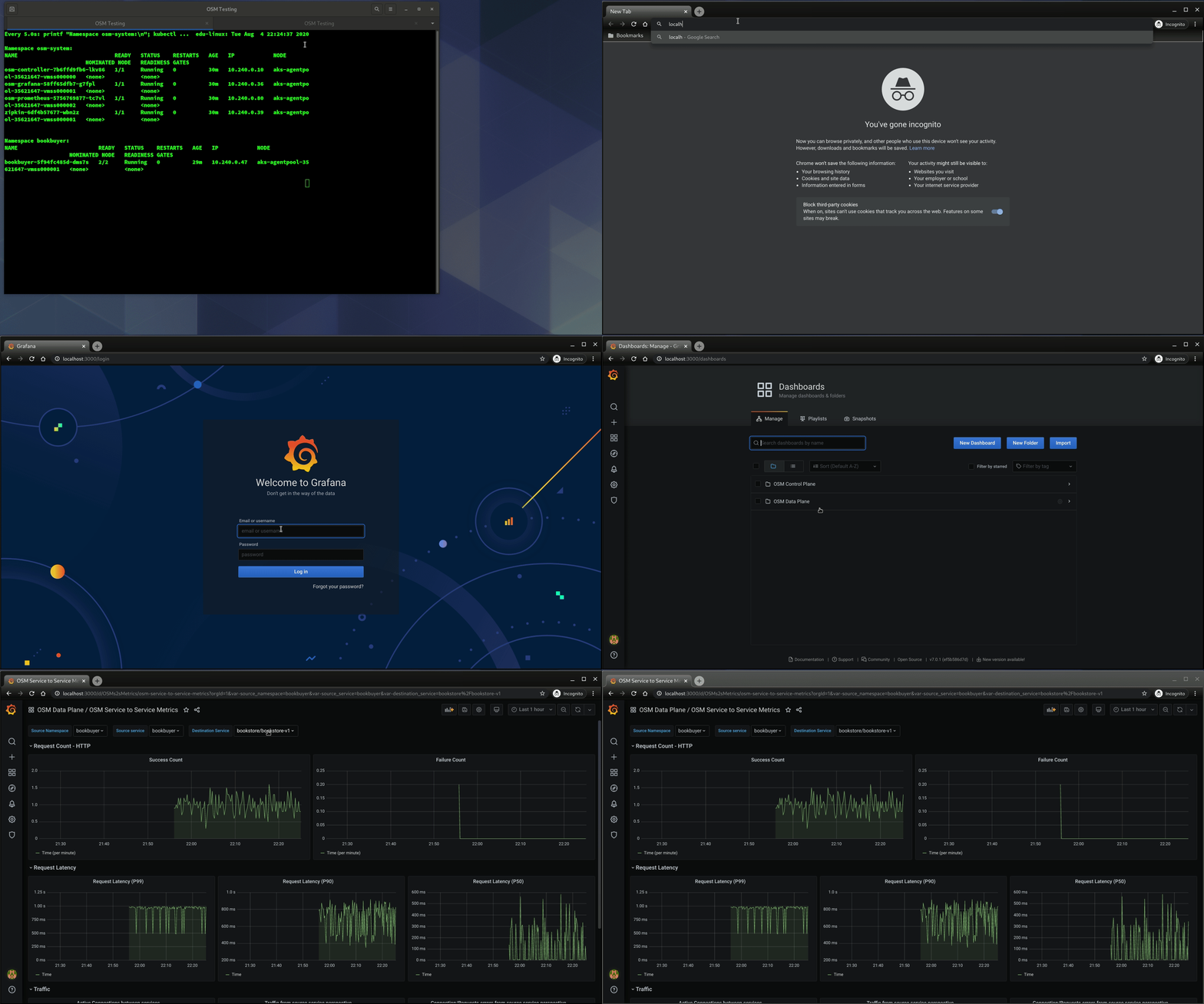
Image Credits: Microsoft
He also added that, because SMI provides the lowest common denominator API design, Open Service Mesh gives users the ability to “bail out” to raw Envoy if they need some more advanced features. This “no cliffs” design, Monroy noted, is core to the philosophy behind Open Service Mesh.
As for its feature set, SMI handles all of the standard service mesh features you’d expect, including securing communications between services using mTLS, managing access control policies, service monitoring and more.
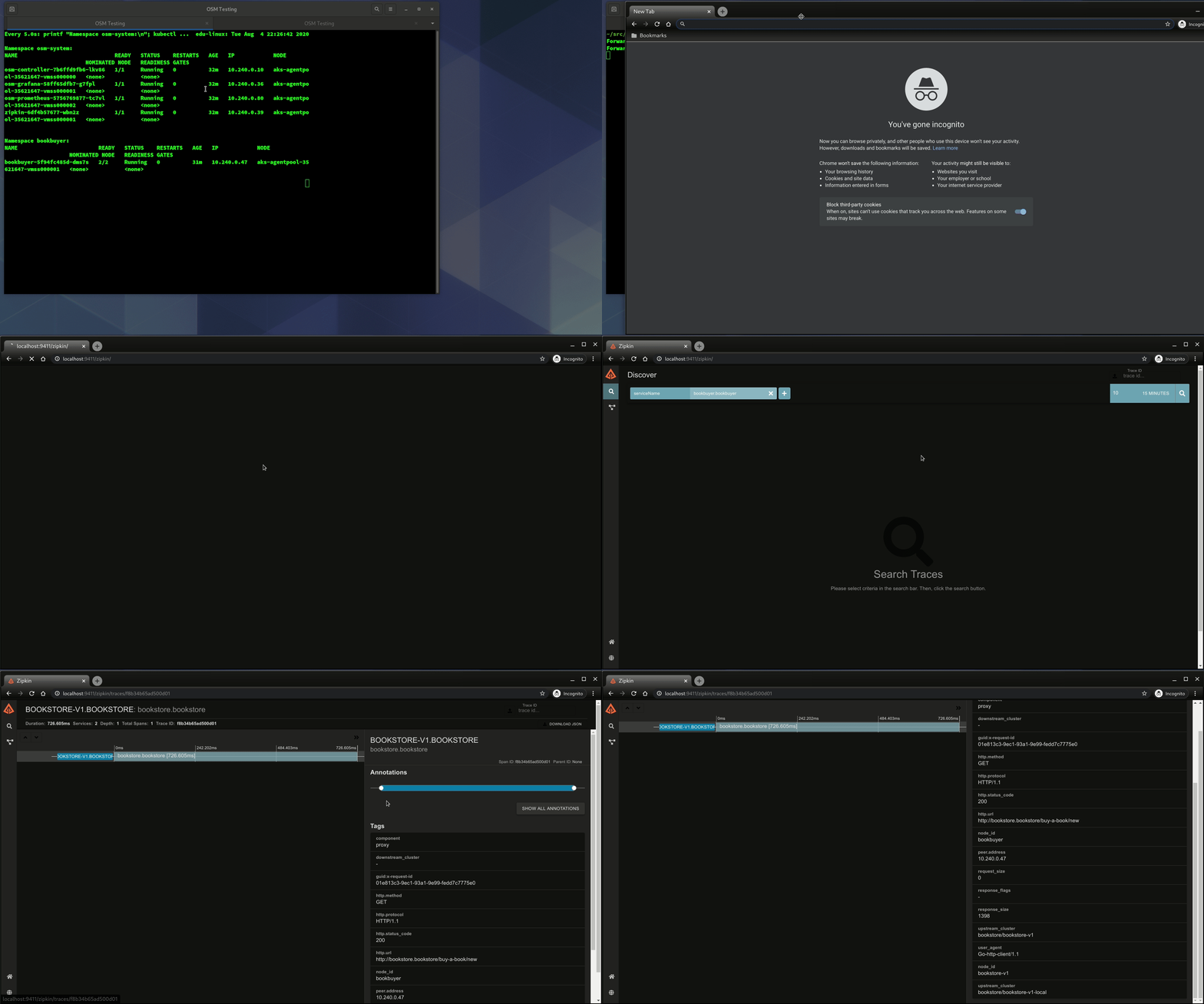
Image Credits: Microsoft
There are plenty of other service mesh technologies in the market today, though. So why would Microsoft launch this?
“What our customers have been telling us is that solutions that are out there today, Istio being a good example, are extremely complex,” he said. “It’s not just me saying this. We see the data in the AKS support queue of customers who are trying to use this stuff — and they’re struggling right here. This is just hard technology to use, hard technology to build at scale. And so the solutions that were out there all had something that wasn’t quite right and we really felt like something lighter weight and something with more of an SMI focus was what was going to hit the sweet spot for the customers that are dabbling in this technology today.”
Monroy also noted that Open Service Mesh can sit alongside other solutions like Linkerd, for example.
A lot of pundits expected Google to also donate its Istio service mesh to the CNCF. That move didn’t materialize. “It’s funny. A lot of people are very focused on the governance aspect of this,” he said. “I think when people over-focus on that, you lose sight of how are customers doing with this technology. And the truth is that customers are not having a great time with Istio in the wild today. I think even folks who are deep in that community will acknowledge that and that’s really the reason why we’re not interested in contributing to that ecosystem at the moment.”
Powered by WPeMatico
It seemed so simple. A small schema issue in a database was wrecking a feature in the app, increasing latency and degrading the user experience. The resident data engineer pops in a fix to amend the schema, and everything seems fine — for now. Unbeknownst to them, that small fix completely clobbered all the dashboards used by the company’s leadership. Finance is down, ops is pissed, and the CEO — well, they don’t even know whether the company is online.
For data engineers, it’s not just a recurring nightmare — it’s a day-to-day reality. A decade plus into that whole “data is the new oil” claptrap, and we’re still managing data piecemeal and without proper systems and controls. Data lakes have become data oceans and data warehouses have become … well, whatever the massive version of a warehouse is called (a waremansion I guess). Data engineers bridge the gap between the messy world of real life and the precise nature of code, and they need much better tools to do their jobs.
As TechCrunch’s unofficial data engineer, I’ve personally struggled with many of these same problems. And so that’s what drew me into Datafold.
Datafold is a brand-new platform for managing the quality assurance of data. Much in the way that a software platform has QA and continuous integration tools to ensure that code functions as expected, Datafold integrates across data sources to ensure that changes in the schema of one table doesn’t knock out functionality somewhere else.
Founder Gleb Mezhanskiy knows these problems firsthand. He’s informed from his time at Lyft, where he was a data scientist and data engineer, and later transformed into a product manager “focused on the productivity of data professionals.” The idea was that as Lyft expanded, it needed much better pipelines and tooling around its data to remain competitive with Uber and others in its space.
His lessons from Lyft inform Datafold’s current focus. Mezhanskiy explained that the platform sits in the connections between all data sources and their outlets. There are two challenges to solve here. First, “data is changing, every day you get new data, and the shape of it can be very different either for business reasons or because your data sources can be broken.” And second, “the old code that is used by companies to transform this data is also changing very rapidly because companies are building new products, they are refactoring their features … a lot of errors can happen.”
In equation form: messy reality + chaos in data engineering = unhappy data end users.
With Datafold, changes made by data engineers in their extractions and transformations can be compared for unintentional changes. For instance, maybe a function that formerly returned an integer now returns a text string, an accidental mistake introduced by the engineer. Rather than wait until BI tools flop and a bunch of alerts come in from managers, Datafold will indicate that there is likely some sort of problem, and identify what happened.
The key efficiency here is that Datafold aggregates changes in datasets — even datasets with billions of entries — into summaries so that data engineers can understand even subtle flaws. The goal is that even if an error transpires in 0.1% of cases, Datafold will be able to identify that issue and also bring a summary of it to the data engineer for response.
Datafold is entering a market that is, quite frankly, as chaotic as the data being processed. It sits in the key middle layer of the data stack — it’s not the data lake or data warehouse for storing data, and it isn’t the end user BI tools like a Looker, Tableau or many others. Instead, it’s part of a number of tools available for data engineers to manage and monitor their data flows to ensure consistency and quality.
The startup is targeting companies with at least 20 people on their data team — that’s the sweet spot where a data team has enough scale and resources that they are going to be concerned with data quality.
Today Datafold is three people, and will be debuting officially at YC’s Demo Day later this month. Its ultimate dream is a world where data engineers never again have to get an overnight page to fix a data quality issue. If you’ve been there, you know precisely why such a product is valuable.
Powered by WPeMatico
PandaDoc, the startup that provides a fully digital sales document workflow from proposal to electronic signature to collecting payment, announced a $30 million Series B extension today, making it the second such extension the company has taken since taking its original $15 million Series B in 2017. The total for the three B investments is $50 million.
Company co-founder and CEO Mikita Mikado says that he took this approach — taking the original money in 2017, then $5 million last year along with the money announced today — because it made more sense financially for the company than taking a huge chunk of money all at once.
“Basically when we do little chunks of cash frequently, [we found that] you dilute yourself less,” Mikado told TechCrunch. He said that they’ve grown comfortable with this approach because the business became more predictable once it passed 10,000 customers. In fact today it has 20,000.
“With a high-velocity in-bound sales model, you can predict what’s going to happen next month or [say] six months out. So you kind of have this luxury of raising as much money as you need when you need it, minimizing dilution just like public companies do,” he said.
While he wouldn’t discuss specifics in terms of valuations, he did say that the B1 had 2x the valuation of the original B round and the B2 had double the valuation of the B1.
For this round, One Peak led the investment, with participation from Microsoft’s Venture Fund (M12), Savano Capital Partners, Rembrandt Venture Partners and EBRD Venture Capital Investment Programme.
Part of the company’s growth strategy is using their eSignature tool to move people to the platform. They made that tool free in March just as the pandemic was hitting hard in the U.S., and it has proven to be what Mikado called “a lead magnet” to get more people familiar with the company.
Once they do that he says, they start to look at the broader set of tools and they can become paying customers. “This launch helped us validate that businesses need a broader workflow solution. Businesses used to think of the eSignature as the Holy Grail in getting a deal done. Now they are realizing that eSignature is just a moment in time. The full value is what happens before, during and after the eSignature in order to get deals done,” Mikado said.
The company currently has 334 employees with plans to hit 380 by year’s end and is aiming for 470 by next year. With the office in San Francisco, Belarus and Manila, it has geographic diversity built in, but Mikado says it’s something they are still working at and includes anti-bias programs and training and leadership programs to give more people a chance to be hired or promoted into management.
When it came to shutting down offices and working from home, Mikado admits it was a challenge, especially as some of the geographies they operate in might not have access to a good internet connection at home or face other challenges, but overall he says it has worked out in terms of maintaining productivity across the company. And he points out being geographically diverse, they have had to deal with online communications for some time.
Powered by WPeMatico
As Kubernetes and cloud-native technologies proliferate, developers and IT have found a growing set of technical challenges they need to address, and new concepts and projects have popped up to deal with them. For instance, operators provide a way to package, deploy and manage your cloud-native application in an automated way. Kubermatic wants to take that concept a step further, and today the German startup announced KubeCarrier, a new open-source, cloud-native service management hub.
Kubermatic co-founder Sebastian Scheele says three or four years ago, the cloud-native community needed to solve a bunch of technical problems around deploying Kubernetes clusters, such as overlay networking, service meshes and authentication. He sees a similar set of problems arising today where developers need more tools to manage the growing complexity of running Kubernetes clusters at scale.
Kubermatic has developed KubeCarrier to help solve one aspect of this. “What we’re currently focusing on is how to provision and manage workloads across multiple clusters, and how IT organizations can have a service hub where they can provide those services to their organizations in a centralized way,” Scheele explained.
Scheele says that KubeCarrier provides a way to manage and implement all of this, giving organizations much greater flexibility beyond purely managing Kubernetes. While he sees organizations with lots of Kubernetes operators, he says that as he sees it, it doesn’t stop there. “We have lots of Kubernetes operators now, but how do we manage them, especially when there are multiple operators, [along with] the services they are provisioning,” he asked.
This could involve provisioning something like Database as a Service inside the organization or for external customers, while combining or provisioning multiple services, which are working on multiple levels and a need a way to communicate with each other.
“That is where KubeCarrier comes in. Now, we can help our customers to build this kind of automation around provisioning, and service capability so that different teams can provide different services inside the organization or to external customers,” he said.
As the company explains it, “KubeCarrier addresses these complexities by harnessing the Kubernetes API and Operators into a central framework allowing enterprises and service providers to deliver cloud native service management from one multi-cloud, multi-cluster hub.”
KubeCarrier is available on GitHub, and Scheele says the company is hoping to get feedback from the community about how to improve it. In parallel, the company is looking for ways to incorporate this technology into its commercial offerings, and that should be available in the next 3-6 months, he said.
Powered by WPeMatico
Harness has made a name for itself creating tools like continuous delivery (CD) for software engineers to give them the kind of power that has been traditionally reserved for companies with large engineering teams like Google, Facebook and Netflix. Today, the company announced it has acquired Drone.io, an open-source continuous integration (CI) company, marking the company’s first steps into open source, as well as its first acquisition.
The companies did not share the purchase price.
“Drone is a continuous integration software. It helps developers to continuously build, test and deploy their code. The project was started in 2012, and it was the first cloud-native, container-native continuous integration solution on the market, and we open sourced it,” company co-founder Brad Rydzewski told TechCrunch.
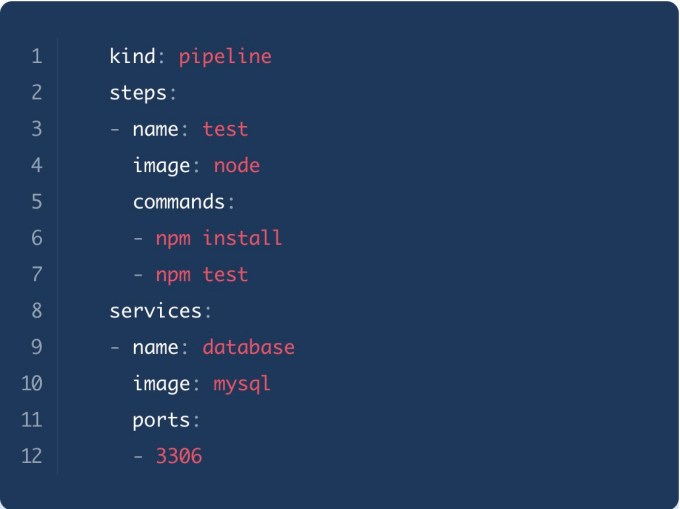
Drone delivers pipeline configuration information as code in a Docker container. Image: Drone.io
While Harness had previously lacked a CI tool to go with its continuous delivery tooling, founder and CEO Jyoti Bansal said this was less about filling in a hole than expanding the current platform.
“I would call it an expansion of our vision and where we were going. As you and I have talked in the past, the mission of Harness is to be a next-generation software delivery platform for everyone,” he said. He added that buying Drone had a lot of upside.”It’s all of those things — the size of the open-source community, the simplicity of the product — and it [made sense], for Harness and Drone to come together and bring this integrated CI/CD to the market.”
While this is Harness’ first foray into open source, Bansal says it’s just the starting point and they want to embrace open source as a company moving forward. “We are committed to getting more and more involved in open source and actually making even more parts of Harness, our original products, open source over time as well,” he said.
For Drone community members who might be concerned about the acquisition, Bansal said he was “100% committed” to continuing to support the open-source Drone product. In fact, Rydzewski said he wanted to team with Harness because he felt he could do so much more with them than he could have done continuing as a standalone company.
“Drone was a growing community, a growing project and a growing business. It really came down to I think the timing being right and wanting to partner with a company like Harness to build the future. Drone laid a lot of the groundwork, but it’s a matter of taking it to the next level,” he said.
Bansal says that Harness intends to also offer on the Harness platform a commercial version of Drone with some enterprise features, even while continuing to support the open source side of it.
Drone was founded in 2012. The only money it raised was $28,000 when it participated in the Alchemist Accelerator in 2013, according to Crunchbase data. The deal has closed and Rydzewski has joined the Harness team.
Powered by WPeMatico
Amazon has found a new partner to expand the reach of its cloud services business — AWS — in India, the world’s second largest internet market.
On Wednesday, the e-commerce giant announced it has partnered with Bharti Airtel, the third-largest telecom operator in India with more than 300 million subscribers, to sell a wide-range of AWS offerings under Airtel Cloud brand to small, medium, and large-sized businesses in the country.
The deal could help AWS, which leads the cloud market in India, further expand its dominance in the country. The move follows a similar deal Reliance Jio — India’s largest telecom operator and which has raised more than $20 billion in recent months from Google, Facebook and a roster of other high-profile investors — struck with Microsoft last year to sell cloud services to small businesses. The two announced a 10-year partnership to “serve millions of customers.”
Airtel, which serves over 2,500 large enterprises and more than a million emerging businesses, itself signed a similar cloud deal with Google in January this year. That partnership is still in place, Airtel said.
“AWS brings over 175 services to the table. We pretty much support any workload on the cloud. We have the largest and the most vibrant community of customers,” said Puneet Chandok, President of AWS in India and South Asia, on a call with reporters Wednesday noon.
The two companies, which signed a similar agreement in 2015, will also collaborate on building new services and help existing customers migrate to Airtel Cloud, they said.
Today’s deal illustrates Airtel’s push to build businesses beyond its telecom venture, said Harmeen Mehta, Global CIO and Head of Cloud and Security Business at Airtel, on the call. Last month, Airtel partnered with Verizon — TechCrunch’s parent company — to sell BlueJeans video conferencing service to business customers in India.
Deals with carriers were very common a decade ago in India as tech giants rushed to amass users in the country. Replicating a similar strategy now illustrates the phase of the cloud adoption in the nation.
Nearly half a billion people in India came online last decade. And slowly, small businesses and merchants are also beginning to use digital tools, storage services, and accept online payments.
India has emerged as one of the emerging leading grounds for cloud services. The public cloud services market of the country is estimated to reach $7.1 billion by 2024, according to research firm IDC.
Powered by WPeMatico
Qualified, a startup co-founded by former Salesforce executives Kraig Swensrud and Sean Whiteley, has raised $12 million in Series A funding.
Swensrud (Qualified’s CEO) said the startup is meant to solve a problem that he faced when he was CMO at Salesforce. Apparently he’d complain about being “blind,” because he knew so little about who was visiting the Salesforce website.
“There could be 10 or 100 or 100,000 people on my website right now, and I don’t know who they are, I don’t know what they’re interested in, my sales team has no idea that they’re even there,” he said.
Apparently, this is a big problem in business-to-business sales, where waiting five minutes after a lead leaves your website can result in a 10x decrease in the odds of making contact. But the solution currently adopted by many websites is just a chatbot that treats every visitor similarly.
Qualified, meanwhile, connects real-time website visitor information with a company’s Salesforce customer database. That means it can identify visitors from high-value accounts and route them to the correct salesperson while they’re still on the website, turning into a full-on sales meeting that can also include a phone call and screensharing.

Image Credits: Qualified
Of course, the amount of data Qualified has access to will differ from visitor to visitor. Some visitors may be purely incognito, while in other cases, the platform might simply know your city or where you work. In still others (say if you click on a link from marketing email), it can identify you individually.
That’s something I experienced myself, when I decided to take a look at the Qualified website this morning and was quickly greeted with a message that read, “ Welcome TechCrunch! We’re excited about our funding announcement…” It was a little creepy, but also much more effective than my visits to other marketing technology websites, where someone usually sends me a generic sales message.
Swensrud acknowledged that using Qualified represents “a change to people’s selling processes,” as it requires sales to respond in real time to website visitors (as a last resort, Qualified can also use chatbots and schedule future calls), but he argued that it’s a necessary change.
“If you email them later, some percentage of those people, they ghost you, they get bored, they moved on to the competition,” he said. “This real-time approach, it forces organizations to think differently in terms of their process.”
And it’s an approach that seems to be working. Among Qualified’s customers, the company says ThoughtSpot increased conversations with its target accounts by 10x, Bitly grew its enterprise sales pipeline by 6x and Gamma drove over $2.5 million in new business pipeline.
The Series A brings Qualified’s total funding to $17 million. It was led by Norwest Venture Partners, with participation from existing investors including Redpoint Ventures and Salesforce Ventures. Norwest’s Scott Beechuk is joining Qualified’s board of directors.
“The conversational model is simply a better way to connect with new customers,” Beechuk said in a statement. “Buyers love the real-time engagement, sellers love the instant connections, and marketers have the confidence that every dollar spent on demand generation is maximized. The multi-billion-dollar market for Salesforce automation software is going to adopt this new model, and Qualified is perfectly positioned to capture that demand.”
Powered by WPeMatico
Big news today the world of IT startups targeting businesses. Rippling, the startup founded by Parker Conrad to take on the ambitious challenge of building a platform to manage all aspects of employee data, from payroll and benefits through to device management, has closed $145 million in funding — a monster Series B that catapults the company to a valuation of $1.35 billion.
Parker Conrad, the CEO who co-founded the company with Prasanna Sankar (the CTO), said in an interview that the plan will be to use the money to continue its own in-house product development (that is, bringing more tools into the Rippling mix organically, not by way of acquisition) but also to have it just in case, given everything else going on at the moment.
“We will double down on R&D but to be honest we’re trying not to change the formula too much,” Conrad said. “We want to have that discipline. This fundraising was opportunistic amid the larger macroeconomic risk at the moment. I was working at startups in 2008-2009 and the funding markets are strong right now, all things considered, and so we wanted to make sure we had the stockpile we needed in case things went bad.”
This latest round included Greenoaks Capital, Coatue Management and Bedrock Capital, as well as existing investors including Kleiner Perkins, Initialized Capital and Y Combinator. Founders Fund partner Napoleon Ta will join Rippling’s board of directors. Founders Fund had also backed Zenefits when Parker was at the helm, and from what we understand, this round was oversubscribed — also a big feat in the current market, working against a lot of factors, including a wobbling economy.
It is a big leap for the company: it was just a little over a year ago that it raised a Series A of $45 million at a valuation of $270 million.
This latest round is notable for a few reasons.
First is the business itself. HR and employee management software are two major areas of IT that have faced a lot of fragmentation over the years, with many businesses opting for a cocktail of services covering disparate areas like employee onboarding, payroll, benefits, device management, app provisioning and permissions and more. That’s been even more the case among smaller organizations in the 2-1,000 employee range that Rippling targets.
Rippling is approaching that bigger challenge as one that can be tackled by a single platform — the theory being that managing HR employee data is essentially part and parcel of good management of IT data permissions and device provision. This funding is a signal of how both investors and customers are buying into Rippling and its approach, even if right now the majority of customers don’t onboard with the full suite of services. (Some 75% are usually signing up with HR products, Conrad noted.)
“We like to think of ourselves as a Salesforce for employee data,” Conrad said, “and by that, we think that employee data is more than just HR. We want to manage access to all of your third-party business apps, your computer and other devices. It’s when you combine all that that you can manage employees well.”
The company is gradually adding more tools. Most recently, it’s been launching new tools to help with job costing, helping companies track where employees are spending time when working on different projects, a tool critical for IT, accounting and other companies where employees work across a number of clients. Other new tools include SMS communications for “desk-less” workers and more accounting integrations.
Second is the founder. You might recall that Conrad was ousted from his previous company, Zenefits (taking on a related, but smaller, challenge in payroll and benefits), over a controversy linked to compliance issues and also misleading investors. But if Zenefits was finished with Conrad, Conrad was not finished with Zenefits — or at least the problem it was tackling. This funding is a testament to how investors are putting a big bet on Conrad himself, who says that a lot of what he has been building at Rippling was what he would have done at Zenefits if he’d stayed there.
“Once you’re lucky, twice you’re good,” said Mamoon Hamid, a partner at Kleiner Perkins, in a separate statement. “Parker is a true product visionary, and he and his team are solving an enormous pain point for businesses everywhere. We’re thrilled to continue partnering with Rippling as demand for their platform dramatically increases in this era of remote work.”
“Rippling is not just a superior payroll company, but something much broader: they’ve built the system of record for all employee data, creating an entirely new software category. Rippling’s massive market opportunity is to streamline the employee life cycle, from software to payroll to benefits, and fundamentally improve the way businesses hire and manage their employees,” said Ta in a statement.
Third is the context in which this round is coming. We’re in the midst of an economic downturn caused in part by a global health pandemic, and that’s leading to a lot of companies curtailing budgets, reducing headcount and potentially shutting down altogether. Ironically, that force is also propelling companies like Rippling full steam ahead.
Its SaaS model — priced at a flat $8 per person per month — not only fits with how many businesses are being run at the moment (primarily remotely), but Rippling’s purpose is specifically geared to helping businesses both onboard and offboard employees more efficiently, the kind of software that companies need to have in place to fit how they are working right now.
Updated with commentary from an interview with Conrad.
Powered by WPeMatico