Enterprise
Auto Added by WPeMatico
Auto Added by WPeMatico
Meet Teemyco, a Stockholm-based startup that wants to reproduce office interactions in a virtual environment. The company wants to foster spontaneous interactions and casual collaboration with a room-based interface. Each employee moves from one room to another just like in a physical office.
If you’re no longer working from an office, chances are you rely heavily on email, Slack, Microsoft Teams, Zoom, Google Meet or a combination of all those tools. While those tools work perfectly fine for what they’re designed to achieve, many companies feel like important information is getting lost. It’s harder to bump into a colleague next to the coffee machine and ask a quick question.
With Teemyco, each person is working in a virtual room. By default, you work in the lobby. You can consider it as an open space with multiple desks. When you want to get together for a planned or unplanned meeting, you can pull someone from the lobby and create another room.
In that room, you can start an audio call or a video call. You can see your colleagues in the corner of your screen and stay focused on a document at the same time, or you can put a video call in full screen. When someone is done, they can leave the room.
Those interactions are less formal than what you get with video-conferencing services. You don’t have to send a link to a Zoom room, you don’t have to send a calendar invite. People hop in and hop out.
If you’re working on something important, you can move to a focus room so that you don’t get interrupted every 15 minutes. Other people won’t be able to pull you from your virtual desk. If you have to run some errands, you can also put yourself in a room that says you’re not there — those rooms can act as a status.
Teemyco also helps you work next to your favorite colleague. You can create a room and use a walkie-talkie feature for quick interactions throughout the day. And, of course, you can create a break room for non-work-related discussions.
Teemyco is still a young company. The product is only available in beta. The company raised a $1 million seed round led by Luminar Ventures with Antler, Gazella and various business angels also participating.
It’s also not going to work for all companies. I’m not sure it scales well for a company with hundreds of employees, for instance. Introverts might not be fans of real-time communication either.
If you’re a remote-first company, you know that it’s important to have a culture of transparency. And written information is always more transparent than video conferences.
And yet, depending on your corporate culture, something like Teemyco can be useful. It can augment information stored in shared documents and internal communication tools.
It’s an interesting product that proves that the inevitable debate between physical offices and remote teams is not a binary problem. There is some granularity, and companies can adjust the knob depending on specific needs.
Powered by WPeMatico
Oracle was never fond of the JEDI cloud contract process, that massive $10 billion, decade-long Department of Defense cloud contract that went to a single vendor. It was forever arguing to anyone who would listen that that process was faulty and favored Amazon.
Yesterday it lost another round in court when the U.S. Court of Appeals rejected the database giant’s argument that the procurement process was flawed because it went to a single vendor. It also didn’t buy that there was a conflict of interest because a former Amazon employee was involved in writing the DoD’s request for proposal criteria.
On the latter point, the court wrote, “The court addressed the question whether the contracting officer had properly assessed the impact of the conflicts on the procurement and found that she had.”
Further, the court found that Oracle’s case didn’t have merit in some cases because it failed to meet certain basic contractual criteria. In other cases, it didn’t find that the DoD violated any specific procurement rules with this bidding process.
This represents the third time the company has tried to appeal the process in some way, four if you include direct executive intervention with the president. In fact, even before the RFP had been released in April 2018, CEO Safra Catz brought complaints to the president that the bid favored Amazon.
In November 2018, the Government Accountability Office (GAO) denied Oracle’s protest that it favored Amazon or any of the other points in their complaint. The following month, the company filed a $10 billion lawsuit in federal court, which was denied last August. Yesterday’s ruling is on the appeal of that decision.
It’s worth noting that for all its complaints that the deal favored Amazon, Microsoft actually won the bid. Even with that determination, the deal remains tied up in litigation as Amazon has filed multiple complaints, alleging that the president interfered with the deal and that they should have won on merit.
As with all things related to this contract, the drama has never stopped.
Powered by WPeMatico
Episerver is announcing that it has reached an agreement to acquire Optimizely for an undisclosed sum.
Optimizely was founded in 2009 by Dan Siroker and Pete Koomen. It became synonymous with A/B testing, subsequently building a broader suite of tools for marketers to experiment with and personalize their websites and apps, with more than 1,000 customers, including Gap, StubHub, IBM and The Wall Street Journal.
The company had raised more than $200 million in funding from Goldman Sachs, Index Ventures, Andreessen Horowitz, GV and others. Earlier this year, it laid off 15% of its staff, citing the impact of COVID-19.
Episerver, meanwhile, was founded in Stockholm back in 1994 and offers tools for marketers to manage their digital content. Accel-KKR sold the company to Insight Partners for $1.1 billion in 2018. (Today’s announcement describes Insight as a “strategic advisor and sponsor” in the acquisition.)
In a statement, Episerver CEO Alex Atzberger said this is “the most significant transformation in our company’s history – one that will set a new industry standard for digital experience platforms.” It sounds like the idea is to extend Episerver’s capabilities around content and commerce with Optimizely’s experimentation tools.
“The breakthrough combination of Episerver and Optimizely will transform digital experience creation and optimization, enabling digital teams to replace guesswork with evidence-based outcomes,” Atzberger said. “This, along with our shared mission to empower growing companies to compete digitally, makes me thrilled to welcome the Optimizely team to Episerver, as we prove there are no extraordinary experiences without experimentation.”
A company spokesperson said the deal is for a mix of cash and stock. The acquisition is expected to close in the fourth quarter of this year, with the companies remaining fully staffed and independent until then.
“Winning in today’s digital world requires delivering the best and most personalized digital experiences,” said Jay Larson, who replaced Siroker as Optimizely CEO in 2017, in a statement. “Episerver and Optimizely have a shared vision to optimize every customer touchpoint through the use of experimentation. Together, we will enable our customers to do more testing, in more places, with greater ease than ever before.”
Powered by WPeMatico

Avo, a startup that helps businesses better manage their data quality across teams, today announced that it has raised a $3 million seed round led by GGV Capital, with participation from Heavybit, Y Combinator and others.
The company’s founder, Stefania Olafsdóttir, who is currently based in Iceland, was previously the head of data science at QuizUp, which at some point had 100 million users around the world. “I had the opportunity to build up the Data Science Division, and that meant the cultural aspect of helping people ask and answer the right questions — and get them curious about data — but it also meant the technical part of setting up the infrastructure and tools and pipelines, so people can get the right answers when they need it,” she told me. “We were early adopters of self-serve product analytics and culture — and we struggled immensely with data reliability and data trust.”

Image Credits: Avo
As companies collect more data across products and teams, the process tends to become unwieldy and different teams end up using different methods (or just simply different tags), which creates inefficiencies and issues across the data pipeline.
“At first, that unreliable data just slowed down decision making, because people were just like, didn’t understand the data and needed to ask questions,” Olafsdóttir said about her time at QuizUp. “But then it caused us to actually launch bad product updates based on incorrect data.” Over time, that problem only became more apparent.
“Once organizations realize how big this issue is — that they’re effectively flying blind because of unreliable data, while their competition might be like taking the lead on the market — the default is to patch together a bunch of clunky processes and tools that partially increase the level of liability,” she said. And that clunky process typically involves a product manager and a spreadsheet today.
At its core, the Avo team set out to build a better process around this, and after a few detours and other product ideas, Olafsdóttir and her co-founders regrouped to focus on exactly this problem during their time in the Y Combinator program.
Avo gives developers, data scientists and product managers a shared workspace to develop and optimize their data pipelines. “Good product analytics is the product of collaboration between these cross-functional groups of stakeholders,” Olafsdóttir argues, and the goal of Avo is to give these groups a platform for their analytics planning and governance — and to set company-wide standards for how they create their analytics events.
Once that is done, Avo provides developers with typesafe analytics code and debuggers that allows them to take those snippets and add them to their code within minutes. For some companies, this new process can help them go from spending 10 hours on fixing a specific analytics issue to an hour or less.
Most companies, the team argues, know — deep down — that they can’t fully trust their data. But they also often don’t know how to fix this problem. To help them with this, Avo also today released its Inspector product. This tool processes event streams for a company, visualizes them and then highlights potential errors. These could be type mismatches, missing properties or other discrepancies. In many ways, that’s obviously a great sales tool for a service that aims to avoid exactly these problems.
One of Avo’s early customers is Rappi, the Latin American delivery service. “This year we scaled to meet the demand of 100,000 new customers digitizing their deliveries and curbside pickups. The problem with every new software release was that we’d break analytics. It represented 25% of our Jira tickets,” said Rappi’s head of Engineering, Damian Sima. “With Avo we create analytics schemas upfront, identify analytics issues fast, add consistency over time and ensure data reliability as we help customers serve the 12+ million monthly users their businesses attract.”
As most startups at this stage, Avo plans to use the new funding to build out its team and continue to develop its product.
“The next trillion-dollar software market will be driven from the ground up, with developers deciding the tools they use to create digital transformation across every industry. Avo offers engineers ease of implementation while still retaining schemas and analytics governance for product leaders,” said GGV Capital Managing Partner Glenn Solomon. “Our investment in Avo is an investment in software developers as the new kingmakers and product leaders as the new oracles.”
Powered by WPeMatico
Process automation startup Hypatos has raised a €10 million (~$11.8 million) seed round of funding from investors including Blackfin Tech, Grazia Equity, UVC Partners and Plug & Play Ventures.
The Germany and Poland-based company was spun out of AI for accounting startup Smacc at the back end of 2018 to apply deep learning tech to power a wider range of back-office automation, with a focus on industries with heavy financial document processing needs, such as the financial and insurance sectors.
Hypatos is applying language processing AI and computer vision tech to speed up financial document processing for business use cases such as invoices, travel and expense management, loan application validation and insurance claims handling via — touting a training data set of more than 10 million annotated data entities.
It says the new seed funding will go on R&D to expand its portfolio of AI models so it can automate business processing for more types of documents, as well as for fueling growth in Europe, North American and Asia. Its customer base at this point includes Fortune 500 companies, major accounting firms and more than 300 software companies.
While there are plenty of business process automation plays, Hypatos says its use of deep learning tech supports an “in-depth understanding” of document content — which in turn allows it to offer customers a “soup to nuts” automation menu that covers document classification, information capturing, content validation and data enrichment.
It dubs its approach “cognitive process automation” (CPA) versus more basic applications of business process automation with software robots (RPA), which it argues aren’t so contextually savvy — thereby claiming an edge.
As well as document processing solutions, it has developed machine learning modules for enhancing customers’ existing systems (e.g. ECM, ERP, CRM, RPA); and offers APIs for software providers to draw on its machine learning tech for their own applications.
“All offerings include machine learning pipeline software for continuous model training in the cloud or in on-premise deployments,” it notes in a press release.
“We have deep knowledge of how financial documents are processed and millions of data entities in our training data,” says chief commercial officer Cem Dilmegani, discussing where Hypatos fits in the business process automation landscape. “We get compared to RPA companies like UiPath, enterprise content management (ECM) companies like Kofax Readsoft as well as generalist ML document automation companies like Hyperscience. However, we are quite different.
“We focus on end-to-end automation, we don’t only help companies capture data, we help them process it using our deep domain understanding, enabling higher rates of automation. For example, to automate incoming invoice processing (A/P automation) we apply our document understanding AI to capture all data, classify the document, identify the specific goods and services, validate for internal/external compliance and assign financial accounts, cost centers, cost categories etc. to automate all processing tasks.
“Finally, we offer this technology as components easily accessible via APIs. This allows RPA or ECM users to leverage our technology and increase their level of automation.”
Hypatos claims it’s seeing uplift as a result of the coronavirus pandemic — noting it’s providing a service to more than a dozen Fortune 500 companies to help with in-shoring efforts, which it says are accelerating as a result of COVID-19 putting pressure on the traditional business process outsourcing model as offshore workforce productivity in lower wage regions is affected by coronavirus lockdowns.
“We believe that we are in a pivotal moment of machine learning adoption in large organizations,” adds Andreas Unseld, partner at UVC Partners, in a supporting statement. “Hypatos’ technology provides ample opportunity to transform many core business processes. We’re impressed by the Hypatos machine learning technology and see the team in a perfect position to take a leading role in the machine learning revolution to come.”
Powered by WPeMatico
Transposit is a company built by engineers to help engineers, and one big way to help them is to get systems up and running faster when things go wrong — as they always will at some point. Transposit has come up with a way to build runbooks for faster disaster recovery, while using data to update them in an automated fashion.
Today, the company announced a $35 million Series B investment led by Altimeter Capital, with participation from existing investors Sutter Hill Ventures, SignalFire and Unusual Ventures. Today’s investment brings the total raised to $50.4 million, according to the company.
Company CEO Divanny Lamas and CTO and founder Tina Huang see technology issues as less an engineering problem and more as a human problem, because it’s humans who have to clean up the messes when things go wrong. Huang says forgetting the human side of things is where she thinks technology has gone astray.
“We know that the real superpower of the product is that we focus on the human and the user side of things. And as a result, we’re building an engineering culture that I think is somewhat differentiated,” Huang told TechCrunch.
Transposit is a platform that at its core helps manage APIs, connections to other programs, so it starts with a basic understanding of how various underlying technologies work together inside a company. This is essential for a tool that is trying to help engineers in a moment of panic figure out how to get back to a working state.
When it comes to disaster recovery, there are essentially two pieces: getting the systems working again, then figuring out what happened. For the first piece, the company is building data-driven runbooks. By being data-driven, they aren’t static documents. Instead, the underlying machine learning algorithms can look at how the engineers recovered and adjust accordingly.
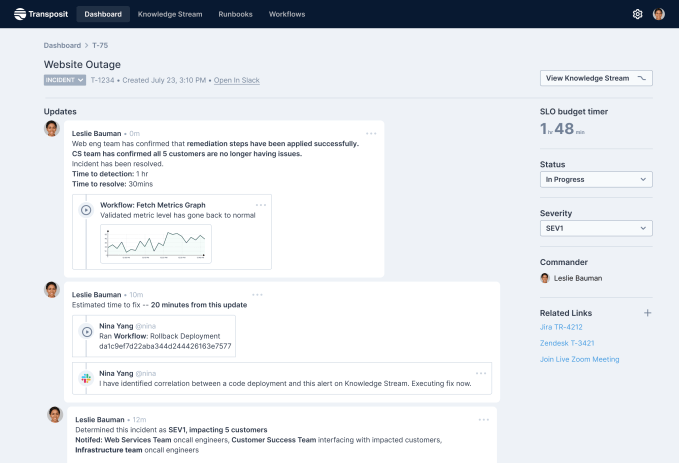
Image Credits: Transposit
“We realized that no one was focusing on what we realize is the root problem here, which is how do I have access to the right set of data to make it easier to reconstruct that timeline, and understand what happened? We took those two pieces together, this notion that runbooks are a critical piece of how you spread knowledge and spread process, and this other piece, which is the data, is critical,” Huang said.
Today the company has 26 employees, including Huang and Lamas, who Huang brought on board from Splunk last year to be CEO. The company is somewhat unique having two women running the organization, and they are trying to build a diverse workforce as they build their company to 50 people in the next 12 months.
The current make-up is 47% female engineers, and the goal is to remain diverse as they build the company, something that Lamas admits is challenging to do. “I wish I had a magic answer, or that Tina had a magic answer. The reality is that we’re just very demanding on recruiters. And we are very insistent that we have a diverse pipeline of candidates, and are constantly looking at our numbers and looking at how we’re doing,” Lamas said.
She says being diverse actually makes it easier to recruit good candidates. “People want to work at diverse companies. And so it gives us a real edge from a kind of culture perspective, and we find that we get really amazing candidates that are just tired of the status quo. They’re tired of the old way of doing things and they want to work in a company that reflects the world that they want to live in,” she said.
The company, which launched in 2016, took a few years to build the first piece, the underlying API platform. This year it added the disaster recovery piece on top of that platform, and has been running its beta since the beginning of the summer. They hope to add additional beta customers before making it generally available later this year.
Powered by WPeMatico
A newly discovered bug in a cloud system used to manage SonicWall firewalls could have allowed hackers to break into thousands of corporate networks.
Enterprise firewalls and virtual private network appliances are vital gatekeepers tasked with protecting corporate networks from hackers and cyberattacks while still letting in employees working from home during the pandemic. Even though most offices are empty, hackers frequently look for bugs in critical network gear in order to break into company networks to steal data or plant malware.
Vangelis Stykas, a researcher at security firm Pen Test Partners, found the new bug in SonicWall’s Global Management System (GMS), a web app that lets IT departments remotely configure their SonicWall devices across the network.
But the bug, if exploited, meant any existing user with access to SonicWall’s GMS could create a user account with access to any other company’s network without permission.
From there, the newly created account could remotely manage the SonicWall gear of that company.
In a blog post shared with TechCrunch, Stykas said there were two barriers to entry. Firstly, a would-be attacker would need an existing SonicWall GMS user account. The easiest way — and what Stykas did to independently test the bug — was to buy a SonicWall device.
The second issue was that the would-be attacker would also need to guess a unique seven-digit number associated with another company’s network. But Stykas said that this number appeared to be sequential and could be easily enumerated, one after the other.
Once inside a company’s network, the attacker could deliver ransomware directly to the internal systems of their victims, an increasingly popular tactic for financially driven hackers.
SonicWall confirmed the bug is now fixed. But Stykas criticized the company for taking more than two weeks to patch the vulnerability, which he described as “trivial” to exploit.
“Even car alarm vendors have fixed similar issues inside three days of us reporting,” he wrote.
A SonicWall spokesperson defended the decision to subject the fix to a “full” quality check before it was rolled out, and said it is “not aware” of any exploitation of the vulnerability.
Powered by WPeMatico
Google launched a few updates to its Contact Center AI product today, but the most interesting one is probably the beta of its new Custom Voice service, which will let brands create their own text-to-speech voices to best represent their own brands.
Maybe your company has a well-known spokesperson for example, but it would be pretty arduous to have them record every sentence in an automated response system or bring them back to the studio whenever you launch a new product or procedure. With Custom Voice, businesses can bring in their voice talent to the studio and have them record a script provided by Google. The company will then take those recordings and train its speech models based on them.
As of now, this seems to be a somewhat manual task on Google’s side. Training and evaluating the model will take “several weeks,” the company says and Google itself will conduct its own tests of the trained model before sending it back to the business that commissioned the model. After that, the business must follow Google’s own testing process to evaluate the results and sign off on it.
For now, these custom voices are still in beta and only American English is supported so far.
It’s also worth noting that Google’s review process is meant to ensure that the result is aligned with its internal AI Principles, which it released back in 2018.
Like with similar projects, I would expect that this lengthy process of creating custom voices for these contact center solutions will become mainstream quickly. While it will just be a gimmick for some brands (remember those custom voices for stand-alone GPS systems back in the day?), it will allow the more forward-thinking brands to distinguish their own contact center experiences from those of the competition. Nobody likes calling customer support, but a more thoughtful experience that doesn’t make you think you’re talking to a random phone tree may just help alleviate some of the stress at least.
Powered by WPeMatico
We’re seeing a gradual expansion of national regulations that require data from SaaS applications to be stored locally in the country where it’s sourced and used. Today a startup that’s built a service around that need — specifically, data residency-as-a-service — is announcing some funding to continue building out its company amid strong demand.
InCountry, which provides a set of solutions — comprising software as well as some consultancy — that helps companies comply with local regulations when adopting SaaS products, has raised $18 million in funding.
This is technically an extension to its Series A, but in keeping with the growth of its business, it comes with a big bump to its valuation: the startup is now valued at “north” of $150 million. Founder and CEO Peter Yared said this is more than double the valuation of its previous round a little over a year ago.
The money is coming from a mix of strategic and financial investors. It’s being led by Caffeinated Capital and Abu Dhabi’s Mubadala, with participation from new investor Accenture Ventures and previous investors Arbor Ventures, Felicis, Ridge Ventures, Bloomberg Beta and Team Builder Ventures. Accenture is one of InCountry’s key channel partners, reselling the software as part of bigger data management and integration contracts, Yared tells me.
The company has seen a decent bump in its business in the last year, expanding to 90 countries from 65, where it provides guidance and services to store and use data in compliance with legal requirements. Alongside that it has an increasingly long list of software packages that it covers with its products. The list currently includes Salesforce, ServiceNow, Twilio, Mambu and Segment, with customers including a large list of enterprises including stock exchanges, banks and pharmaceutical companies.
“This company was based off a crazy thesis,” Yared said with an almost incredulous laugh (he has a very jocular way of talking, even when he’s being serious). “Now it’s 20 months old, and our customers are banks, pharma giants, stock exchanges. We are proud that large institutions can trust us.”
A big bump in its business in recent times has been in Asia Pacific and the Middle East, which are two main regions when it comes to data residency regulations and therefore ripe ground for winning new customers — one reason why Mubadala is part of this round, Yared said.
“At Mubadala we are committed to backing visionary founders whose innovations fuel economies,” said Ibrahim Ajami, head of Ventures at Mubadala Capital. “Since day one, InCountry’s cloud solution has addressed a massive challenge in this era of regulation by giving businesses the tools to grow internationally while remaining compliant with data residency regulations. We’re doubling down on our investment and are supporting InCountry’s expansion into the MENA region because we believe they are the best team to help drive global business forward.”
Partly due to the growing ubiquity, flexibility and relatively cheap cost of cloud computing, software as a service has been on a fast growth trajectory for years now. But even within that trend, it has had a huge boost in 2020 as a result of the global health pandemic.
COVID-19 has given the need for remote computing, and being able to access data wherever you happen to be — which in many cases today is no longer in your usual office space. On top of that, we have a lot more “wiggle room” in business, with organizations quickly scaling up and down with demand.
The knock-on effect has been a big boost for SaaS. But that growth has come with some caveats, and one of the biggest alongside security has been around data protection, and specifically national requirements in how data is stored and used. Arguably, SaaS companies have been more concerned with scaling their software and business funnels than they have been with how data is handled and how that has changed in keeping with local regulations, and that’s the opportunity that InCountry has stepped in to fill.
It provides not just a set of software to store and handle data in a secure way, but also an extensive list of legal advisors with expertise at the local level to help companies get their data policies in order. It’s an interesting model: While InCountry’s been an early mover in identifying this market opportunity and building technology to address it, it’s buffered its competitive position not with a sole focus on technology, but an extensive amount of human capital to get each implementation right.
That can prove to be a costly thing to get wrong. In the EU in July, the Court of Justice of the European Union (CJEU) put down the EU-US Privacy Shield — a framework that let businesses transfer personal data between the European Union and the United States while ensuring compliance with data protection regulations. This has impacted some 5,000 companies, which now have to rethink how they handle their data. The fine for not complying with storing data locally means that they can be fined up to 4% of their revenues.
Yared tells me that for now, the main competitor to something like InCountry has been companies building their own policies in house. Some of those solutions would have been done completely in house and some in partnership with integrators, but all of them were hard to scale and were painful to maintain, one reason why companies and their business partners are turning to working with his startup.
“Accenture Ventures is pleased to support InCountry as it continues to expand globally,” said Tom Lounibos, managing director, Accenture Ventures, in a statement. “InCountry’s software solutions are helping companies address the critical issue of becoming and remaining compliant with a multitude of data residency laws. This expansion will help support enterprises as they unlock their business across borders.”
Powered by WPeMatico
Gong announced a $200 million Series D investment just last month, and loaded with fresh cash, the company wasted no time taking advantage. Today, it announced it was buying early-stage Isreali sales technology startup Vayo. The companies did not share terms of the deal, but Gong CEO Amit Bendov said the deal closed a couple of weeks ago.
The two companies match up quite well from a tech standpoint. While Gong searches unstructured data like emails and phone call transcripts and finds nuggets of data, Vayo looks at structured data, which is essentially the output of the Gong search process. What’s more, it handles large amounts of data at scale.
“Vayo helps find customer interactions at a large scale to identify trends like customers likely to churn or usage is going up, or your deals are starting to slow down — and they do this for structured data at scale,” Bendov told TechCrunch.
He said this ability to identify trends was really what attracted him to the company, even though it was still at an early stage of development. “It’s a perfect fit for Gong. We take unstructured data — emails, audio calls video calls — and extract insights. Customers, especially with a large organization, don’t want to see individual interactions but high order insights […] and they’ve developed [a solution] to identify trends on large data volumes for customer interactions,” he said.
Vayo was founded in 2018 and raised $1.7 million in seed capital, according to Crunchbase. Joining forces with Gong gives them an opportunity to develop the technology inside a company that’s growing quickly and is extremely well capitalized, having raised more than $300 million in the last 18 months.
Avshi Avital, CEO at Vayo, who has joined Gong with his four fellow employees, gave a familiar argument for selling the company. “With Gong we found the perfect partner to realize this mission faster and maximize the impact of the technology we built given the scale of their customer base and growth potential,” he said.
The plan is to fold the Vayo tech into the Gong platform, a process that will take three to six months, according to Bendov.
Powered by WPeMatico