Enterprise
Auto Added by WPeMatico
Auto Added by WPeMatico
Metadata.io announced today that it has raised $6.5 million in Series A funding.
It’s been more than four years since I wrote about the startup’s $2 million seed funding. At the time, co-founder and CEO Gil Allouche described the product as helping business-to-business marketers target their ads as people who resemble their existing sales leads.
Since then, the company has launched its product in general availability, and Allouche told me yesterday that it’s become “really the middleware for the sales and marketing stack.”
“It doesn’t just … give you insights, it skips the human as the bottleneck of execution for marketing [operations],” Allouche said, adding that this makes marketing teams more efficient while also eliminating much of the drudgery. “If you’re a Don Draper who’s really good at creative or content, you should spend your time on that and not in an Excel spreadsheet.”
At the same time, ad targeting remains a key part of the company’s capabilities. For example, its new product MetaMatch allows advertisers to build and target custom audiences on Facebook, LinkedIn and programmatic display.
Allouche also said that demand has increased “quite significantly” since the beginning of the pandemic. That’s counter to larger digital ad trends, but he noted that B2B companies still need to reach customers, and many of the old tools — like in-person events — are now off the table.
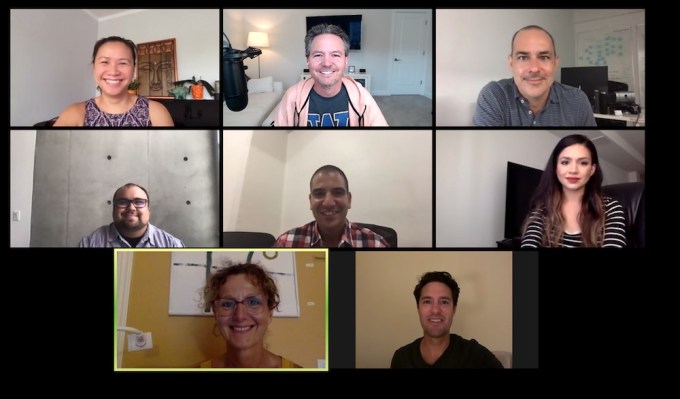
Gil Allouche and the Metadata leadership team
In addition, he said that Metadata’s proprietary database of 1.4 billion customer profiles have given it an additional advantage in the face of privacy regulation and ad-tracking restrictions.
The platform has been used by companies including Zoom, Drift, Pendo, Udacity, and Vonage.
The new funding was led by Resolute Ventures, with participation from Greycroft, York IE, Stormbreakers, Eloqua founder Mark Organ, Segment founder Ilya Volodarsky and others.
“Metadata isn’t another marketing technology,” Organ said in a statement. “From the origin of the company transforming marketing operations by eliminating tedious manual work, to today, creating a category that transcends demand gen, it is enabling the autonomous marketer to be a reality. It is the marketer that’s needed for the future.”
Powered by WPeMatico
When companies need to find manufacturers to build custom parts, it’s not always an easy process, especially during a pandemic. Xometry, a seven-year-old startup based in Maryland, has built an online marketplace where companies can find manufacturers across the world with excess capacity to build whatever they need. Today, the company announced a $75 million Series E investment to keep expanding the platform.
T. Rowe Price Associates led the investment, with participation from new firms Durable Capital Partners LP and ArrowMark Partners. Previous investors also joined the round, including BMW i Ventures, Greenspring Associates, Dell Technologies Capital, Robert Bosch Venture Capital, Foundry Group, Highland Capital Partners and Almaz Capital . Today’s investment brings the total raised to $193 million, according to the company.
Company CEO and co-founder Randy Altschuler says Xometry fills a need by providing a digital way of putting buyers and manufacturers together with a dash of artificial intelligence to put the right combination together. “We’ve created a marketplace using artificial intelligence to power it, and provide an e-commerce experience for buyers of custom manufacturing and for suppliers to deliver that manufacturing,” Altschuler told TechCrunch.
The kind of custom pieces that are facilitated by this platform include mechanical parts for aerospace, defense, automotive, robotics and medical devices — what Altschuler calls mission-critical parts. Being able to put companies together in this fashion is particularly useful during COVID-19 when certain regions might have been shut down.
“COVID has reinforced the need for distributed manufacturing and our platform enables that by empowering these local manufacturers, and because we’re using technology to do it, as COVID has unfolded […] and as continents have shut down, and even specific states in the United States have shut down, our platform has allowed customers to autocorrect and shift work to other locations,” he explained
What’s more, companies could take advantage of the platform to manufacture critical personal protective equipment. “One of the beauties of our platform was when COVID hit customers could come to our platform and suddenly access this tremendous amount of manufacturing capacity to produce this much-needed PPE,” he said.
Xometry makes money by facilitating the sale between the buyer and producer. They help set the price and then make money on the difference between the cost to produce and how much the buyer was willing to pay to have it done.
They have relationships with 5,000 manufacturers located throughout the world and 30,000 customers using the platform to build the parts they need. The company currently has around 350 employees, with plans to use the money to add more to keep enhancing the platform.
Altschuler says from a human perspective, he wants his company to have a diverse workforce because he never wants to see people being discriminated against for whatever reason, but he also says as a company with an international market, having a diverse workforce is also critical to his business. “The more diversity that we have within Xometry, the more we’re able to effectively market to those folks, sell to those folks and understand how they utilize technology. We’re just going to better understand our customer set as we [build a more diverse workforce],” he said.
As a Series E-stage company, Altschuler does not shy away from the IPO question. In fact, he recently brought in new CFO Jim Rallo, who has experience taking a company public. “The market that we operate in is so large, and there’s so many opportunities for us to serve both our customers and our suppliers, and we have to be great for both of them. We need capital to do that, and the public markets can be an efficient way to access that capital and to grow our business, and in the end that’s what we want to do,” he said.
Powered by WPeMatico
Astute, a customer engagement platform headquartered in Columbus, Ohio, is announcing that it has acquired social media marketing company Socialbakers.
The financial terms of the acquisition were not disclosed. Socialbakers CEO Yuval Ben-Itzhak will become president of Socialbakers for the combined company, and he told me via email that the entire Socialbakers team will be joining as well, resulting in a combined organization with more than 600 employees and $100 million in annual recurring revenue.
Socialbakers was one of the last independent players from the first wave of social analytics. Founded in 2008 and based in Prague, the company raised a total of $34 million in funding, according to Crunchbase, from investors including Earlybird Venture Capital and Index Ventures. And it’s used by more than 2,500 brands globally.
Astute, meanwhile, has been around for 25 years, and focuses on unifying customer data. Ben-Itzhak said that by acquiring Socialbakers, Astute will be able to add social media-focused features like audience insights, content planning, influencer marketing and ad analytics.
“Socialbakers and Astute are already sharing dozens of mutual brand customers in the enterprise segment,” he said. “This is, in fact, how the acquisition talks came about. The platform integration process has already started and is expected to continue through Q4.”
In a statement, Astute CEO Mark Zablan also emphasized the comprehensiveness of the resulting platform.
“The lines between customer care, customer experience, and marketing have become increasingly blurred, presenting real challenges for companies,” Zablan said. “Combining the market-leading social media marketing capabilities of Socialbakers with Astute’s engagement suite not only helps our customers tackle this challenge more effectively, but also marks a major milestone along Astute’s journey towards becoming the end-to-end customer engagement platform that the Chief Customer Officer needs to succeed.”
Powered by WPeMatico
When we last reported on Snyk in January, eons ago in COVID time, the company announced $150 million investment on a valuation of over $1 billion. Today, barely nine months later, it announced another $200 million and its valuation has expanded to $2.6 billion.
The company is obviously drawing some serious investor attention, and even a pandemic is not diminishing that interest. Addition led today’s round, bringing the total raised to $450 million with $350 million coming this year alone.
Snyk has a unique approach to security, building it into the development process instead of offloading it to a separate security team. If you want to build a secure product, you need to think about it as you’re developing the product, and that’s what Snyk’s product set is designed to do — check for security as you’re committing your build to your git repository.
With an open-source product at the top of funnel to drive interest in the platform, CEO Peter McKay says the pandemic has only accelerated the appeal of the company. In fact, the startup’s annual recurring revenue (ARR) is growing at a remarkable 275% year over year.
McKay says even with the pandemic his company has been accelerating, adding 100 employees in the last 12 months to take advantage of the increasing revenue. “When others were kind of scaling back we invested and it worked out well because our business never slowed down. In fact, in a lot of the industries it really picked up,” he said.
That’s because as many other founders have pointed out, COVID is speeding up the rate at which many companies are moving to the cloud, and that’s working to Snyk’s favor. “We’ve just capitalized on this accelerated shift to the cloud and modern cloud-native applications,” he said.
The company currently has 375 employees, with plans to add 100 more in the next year. As it grows, McKay says that he is looking to build a diverse and inclusive culture, something he learned about as he moved through his career at VMware and Veeam.
He says one of the keys at Snyk is putting every employee through unconscious bias training to help limit bias in the hiring process, and the executive team has taken a pledge to make the company’s hiring practices more diverse. Still, he recognizes it takes work to achieve these goals, and it’s always easy for an experienced team to go back to the network instead of digging deeper for a more diverse candidate pool.
“I think we’ve put all the pieces in place to get there, but I think like a lot of companies, there’s still a long way to go,” he said. But he recognizes the sooner you embed diversity into the company culture, the better because it’s hard to go back after the fact and do it.
Addition founder Lee Fixel says he sees a company that’s accelerating rapidly and that’s why he was willing to pour in so big an investment. “Snyk’s impressive growth is a signal that the market is ready to embrace a change from traditional security and empower developers to tackle the new security risk that comes with a software-driven digital world,” he said in a statement.
Snyk was founded in 2015. The founders brought McKay on board for some experienced leadership in 2018 to help lead the company through its rapid growth. Prior to the $350 million in new money this year, the company raised $70 million in 2019.
Powered by WPeMatico
Sprinklr has been busy the last few years acquiring a dozen companies, then rewriting their code base and incorporating them into the company’s customer experience platform. Today, the late-stage startup went back to the fundraising well for the first time in four years, and it was a doozy, raising $200 million on a $2.7 billion valuation.
The money came from private equity firm Hellman & Friedman, which also invested $300 million in buying back secondary shares. Meanwhile the company also announced $150 million in convertible securities from Sixth Street Growth. That’s a lot of action for a company that’s been quiet on the fundraising front for years.
Company founder and CEO Ragy Thomas says he sought the investment now because after building a customer experience platform, he was ready to accelerate and he needed the money to do it. He expects the company to hit $400 million in annual recurring revenue by year’s end and he says that he sees a much bigger opportunity on the horizon.
“We think it’s a $100 billion opportunity and our large public competitors have validated that and continue to do so in the customer experience management space,” he said. Those large competitors include Salesforce and Adobe.
He sees customer experience management as having the kind of growth that CRM has had in the past, and this money gives him more options to grow faster, while working with a big private equity firm.
“So what was appealing in this market for us was not just putting some more money in the bank and being a little more aggressive in growth, innovation, go to market and potential M&A, but what was also appealing is the opportunity to bring someone like a Hellman & Friedman to the table,” Thomas said.
The company has 1,000 clients, some spending millions of dollars a year. They currently have 1,900 employees in 25 offices around the world, and Thomas wants to add another 500 over the next 12 months — and he believes that $1 billion in ARR is a realistic goal for the company.
As he builds the company, Thomas, who is a person of color, has codified diversity and inclusion into the company’s charter, what he calls the “Sprinklr Way.” “For us, diversity and inclusion is not impossible. It is not something that you do to check a box and market yourself. It’s deep in our DNA,” he said.
Tarim Wasim a partner at investor Hellman & Friedman, sees a company with tremendous potential to lead a growing market. “Sprinklr has a unique opportunity to lead a Customer Experience Management market that’s already massive — and growing — as enterprises continue to realize the urgent need to put CXM at the heart of their digital transformation strategy,” Wasim said in a statement.
Sprinklr was founded in 2009. Before today, it last raised $105 million in 2016 led by Temasek Holdings. Past investors include Battery Ventures, ICONIQ Capital and Intel Capital.
Powered by WPeMatico
The other day I took a moment to count the number of stories we’ve done on TechCrunch on the DoD’s $10 billion, decade-long, winner-take-all, JEDI cloud contract. This marks the 30th time we’ve written about this deal over the last two years, and it comes after a busy week last week in JEDI cloud contract news.
That we’re still writing about this is fairly odd if you consider the winner was announced last October when the DoD chose Microsoft, but there is no end in sight to the on-going drama that is this procurement process.
Government contracts don’t typically catch our attention at TechCrunch, but this one felt different early on. There was the size and scope of the deal of course. There was the cute play on the “Star Wars” theme. There was Oracle acting like a batter complaining to the umpire before the first pitch was thrown. There was the fact that everyone thought Amazon would win until it didn’t.
There was a lot going on. In fact, there’s still a lot going on with this story.
Let’s start with Oracle, which dispatched CEO Safra Catz to the White House in April 2018 even before the RFP had been written. She was setting the stage to complain that the deal was going to be set up to favor Amazon, something that Oracle alleged until the day Microsoft was picked the winner.
Catz had been on the Trump transition team and so had the ear of the president. While the president certainly interjected himself in this process, it’s not known how much influence that particular meeting might have had. Suffice to say that it was only the first volley in Oracle’s long war against the JEDI contract procurement process.
It would include official complaints with the Government Accountability Office and a federal lawsuit worth not coincidentally $10 billion. It would claim the contract favored Amazon. It would argue that the one-vendor approach wasn’t proper. It would suggest that because the DoD had some former Amazon employees helping write the RFP, that it somehow favored Amazon. The GAO and two court cases found otherwise, ruling against Oracle every single time.
It’s worth noting that the Court of Appeals ruling last week indicated that Oracle didn’t even meet some of the basic contractual requirements, all the while complaining about the process itself from the start.
Nobody was more surprised that Amazon lost the deal than Amazon itself. It still believes to this day that it is technically superior to Microsoft and that it can offer the DoD the best approach. The DoD doesn’t agree. On Friday, it reaffirmed its choice of Microsoft. But that is not the end of this, not by a long shot.
Amazon has maintained since the decision was made last October that the decision-making process had been tainted by presidential interference in the process. They believe that because of the president’s personal dislike of Amazon CEO Jeff Bezos, who also owns the Washington Post, he inserted himself in the process to prevent Bezos’ company from winning that deal.
In January, Amazon filed a motion to stop work on the project until this could all be sorted out. In February, a judge halted work on the project until Amazon’s complaints could be heard by the court. It is September and that order is still in place.
In a blog post on Friday, Amazon reiterated its case, which is based on presidential interference and what it believes is technical superiority. “In February, the Court of Federal Claims stopped performance on JEDI. The Court determined AWS’s protest had merit, and that Microsoft’s proposal likely failed to meet a key solicitation requirement and was likely deficient and ineligible for award. Our protest detailed how pervasive these errors were (impacting all six technical evaluation factors), and the Judge stopped the DoD from moving forward because the very first issue she reviewed demonstrated serious flaws,” Amazon wrote in the post.
Microsoft on the other hand went quietly about its business throughout this process. It announced Azure Stack, a kind of portable cloud that would work well as a field operations computer system. It beefed up its government security credentials.
Even though Microsoft didn’t agree with the one-vendor approach, indicating that the government would benefit more from the multivendor approach many of its customers were taking, it made clear if those were the rules, it was in it to win it — and win it did, much to the surprise of everyone, especially Amazon.
Yet here we are, almost a year later and in spite of the fact that the DoD found once again, after further review, that Microsoft is still the winner, the contract remains in limbo. Until that pending court case is resolved, we will continue to watch and wait and wonder if this will ever be truly over, and the JEDI cloud contract will actually be implemented.
Powered by WPeMatico

Hasura, a service that provides developers with an open-source engine that provides them a GraphQL API to access their databases, today announced that it has raised a $25 million Series B round led by Lightspeed Venture Partners. Previous investors Vertex Ventures US, Nexus Venture Partners, Strive VC and SAP.iO Fund also participated in this round.
The new round, which the team raised after the COVID-19 pandemic had already started, comes only six months after the company announced its $9.9 million Series A round. In total, Hasura has now raised $36.5 million.
In addition to the new funding, Hasura also today announced that it has added support for MySQL databases. Until now, the company’s service only worked with PostgreSQL databases.

Rajoshi Ghosh, co-founder and COO (left) and Tanmai Gopal, co-founder and CEO (right). Image Credits: Hasura
As the company’s CEO and co-founder Tanmai Gopal told me, MySQL support has long been at the top of the most requested features by the service’s users. Many of these users — who are often in the healthcare and financial services industry — are also working with legacy systems they are trying to connect to modern applications and MySQL plays an important role there, given how long it has been around.
In addition to adding MySQL support, Hasura is also adding support for SQL Server to its lineup, but for now, that’s in early access.
“For MySQL and SQL Server, we’ve seen a lot of demand from our healthcare and financial services / fin-tech users,” Gopal said. “They have a lot of existing online data, especially in these two databases, that they want to activate to build new capabilities and use while modernizing their applications.
Today’s announcement also comes only a few months after the company launched a fully managed cloud service for its service, which complements its existing paid Pro service for enterprises.
“We’re very impressed by how developers have taken to Hasura and embraced the GraphQL approach to building applications,” said Gaurav Gupta, partner at Lightspeed Venture Partners and Hasura board member. “Particularly for front-end developers using technologies like React, Hasura makes it easy to connect applications to existing databases where all the data is without compromising on security and performance. Hasura provides a lovely bridge for re-platforming applications to cloud-native approaches, so we see this approach being embraced by enterprise developers as well as front-end developers more and more.”
The company plans to use the new funding to add support for more databases and to tackle some of the harder technical challenges around cross-database joins and the company’s application-level data caching system. “We’re also investing deeply in company building so that we can grow our GTM and engineering in tandem and making some senior hires across these functions,” said Gopal.
Powered by WPeMatico
Progress, a Boston-area developer tool company, boosted its offerings in a big way today when it announced it was acquiring software automation platform Chef for $220 million.
Chef, which went 100% open source last year, had annual recurring revenue (ARR) of $70 million from the commercial side of the house. Needless to say, Progress CEO Yogesh Gupta was happy to bring the company into the fold and gain not only that revenue, but a set of highly skilled employees, a strong developer community and an impressive customer list.
Gupta said that Chef fits with his company’s acquisition philosophy. “This acquisition perfectly aligns with our growth strategy and meets the requirements that we’ve previously laid out: a strong recurring revenue model, technology that complements our business, a loyal customer base and the ability to leverage our operating model and infrastructure to run the business more efficiently,” he said in a statement.
Chef CEO Barry Crist offered a typical argument for an acquired company; that Progress offered a better path to future growth, while sending a message to the open-source community and customers that Progress would be a good steward of the startup’s vision.
“For Chef, this acquisition is our next chapter, and Progress will help enhance our growth potential, support our Open Source vision, and provide broader opportunities for our customers, partners, employees and community,” Crist said in a statement.
Chef’s customer list is certainly impressive, and includes tech industry stalwarts like Facebook, IBM and SAP, as well as non-tech companies like Nordstrom, Alaska Airlines and Capital One.
The company was founded in 2008 and had raised $105 million, according to Crunchbase data. It hadn’t raised any funds since 2015, when it raised a $40 million Series E led by DFJ Growth. Other investors along the way included Battery Ventures, Ignition Partners and Scale Venture Partners.
The transaction is expected to close next month, pending normal regulatory approvals.
Powered by WPeMatico
Unlike some of its competitors, Google Cloud has recently started emphasizing how its large lineup of different services can be combined to solve common business problems. Instead of trying to sell individual services, Google is focusing on solutions and the latest effort here is what it calls its Business Application Platform, which combines the API management capabilities of Apigee with the no-code application development platform of AppSheet, which Google acquired earlier this year.
As part of this process, Google is also launching a number of new features for both services today. The company is launching the beta of a new API Gateway, built on top of the open-source Envoy project, for example. This is a fully managed service that is meant to make it easier for developers to secure and manage their API across Google’s cloud computing services and serverless offerings like Cloud Functions and Cloud Run. The new gateway, which has been in alpha for a while now, offers all the standard features you’d expect, including authentication, key validation and rate limiting.
As for its low-code service AppSheet, the Google Cloud team is now making it easier to bring in data from third-party applications thanks to the general availability to Apigee as a data source for the service. AppSheet already supported standard sources like MySQL, Salesforce and G Suite, but this new feature adds a lot of flexibility to the service.
With more data comes more complexity, so AppSheet is also launching new tools for automating processes inside the service today, thanks to the early access launch of AppSheet Automation. Like the rest of AppSheet, the promise here is that developers won’t have to write any code. Instead, AppSheet Automation provides a visual interface, that, according to Google, “provides contextual suggestions based on natural language inputs.”
“We are confident the new category of business application platforms will help empower both technical and line of business developers with the core ability to create and extend applications, build and automate workflows, and connect and modernize applications,” Google notes in today’s announcement. And indeed, this looks like a smart way to combine the no-code environment of AppSheet with the power of Apigee .
Powered by WPeMatico
We have seen a lot of action this week as the DoD tries to finally determine the final winner of the $10 billion, decade-long DoD JEDI cloud contract. Today, the DoD released a statement that after reviewing the proposals from finalists Microsoft and Amazon again, it reiterated that Microsoft was the winner of the contract.
“The Department has completed its comprehensive re-evaluation of the JEDI Cloud proposals and determined that Microsoft’s proposal continues to represent the best value to the Government. The JEDI Cloud contract is a firm-fixed-price, indefinite-delivery/indefinite-quantity contract that will make a full range of cloud computing services available to the DoD,” the DoD said in a statement.
This comes on the heels of yesterday’s Court of Appeals decision denying Oracle’s argument that the procurement process was flawed and that there was a conflict of interest because a former Amazon employee helped write the requirements for the RFP.
While the DoD has determined that it believes that Microsoft should still get the contract, after selecting them last October, that doesn’t mean this is the end of the line for this long-running saga. In fact, a federal judge halted work on the project in February pending a hearing on an ongoing protest from Amazon, which believes it should have won based on merit, and the fact it believes the president interfered with the procurement process to prevent Jeff Bezos, who owns The Washington Post, from getting the lucrative contract.
The DoD confirmed that the project could not begin until the legal wrangling was settled. “While contract performance will not begin immediately due to the Preliminary Injunction Order issued by the Court of Federal Claims on February 13, 2020, DoD is eager to begin delivering this capability to our men and women in uniform,” the DoD reported in a statement.
A Microsoft spokesperson said the company was ready to get to work on the project as soon as it got the OK to proceed. “We appreciate that after careful review, the DoD confirmed that we offered the right technology and the best value. We’re ready to get to work and make sure that those who serve our country have access to this much needed technology,” a Microsoft spokesperson told TechCrunch .
Meanwhile, in a blog post published late this afternoon, Amazon made it clear that it was unhappy with today’s outcome and will continue to pursue legal remedy for what they believe to be presidential interference that has threatened the integrity of the procurement process. Here’s how they concluded the blog post:
We strongly disagree with the DoD’s flawed evaluation and believe it’s critical for our country that the government and its elected leaders administer procurements objectively and in a manner that is free from political influence. The question we continue to ask ourselves is whether the President of the United States should be allowed to use the budget of the Department of Defense to pursue his own personal and political ends? Throughout our protest, we’ve been clear that we won’t allow blatant political interference, or inferior technology, to become an acceptable standard. Although these are not easy decisions to make, and we do not take them lightly, we will not back down in the face of targeted political cronyism or illusory corrective actions, and we will continue pursuing a fair, objective, and impartial review.
While today’s statement from DoD appears to take us one step closer to the end of the road for this long-running drama, it won’t be over until the court rules on Amazon’s arguments. It’s clear from today’s blog post that Amazon has no intention of stepping down.
Note: We have updated this story with content from an Amazon blog post responding to this news.
Powered by WPeMatico