Enterprise
Auto Added by WPeMatico
Auto Added by WPeMatico
The ongoing push for social distancing to slow the spread of COVID-19 has meant that more people than ever are using internet-based services to get things done. And that is having a direct impact on digital customer service, which is seeing unprecedented traffic and demands when things are not running smoothly. Today, one of the startups that’s built an interesting, very “hands-on” approach to addressing that problem is announcing a round of funding to expand its business.
Glia, which has built a platform that not only integrates and helps manage different customer support channels, but also provides tools to help agents proactively get into a customer’s app or web page to help them find things or fix issues, is today announcing that it has picked up $78 million in a Series C round of funding. Dan Michaeli, the co-founder and CEO who is based out of New York (the company has a substantial operation in Estonia too), said it will be used to continue developing its technology and expanding to address inbound interest for its services after seeing its revenues grow by 150% in 2020.
The company’s original focus was around financial services and it counts a large base of customers in that area, but it is also seeing a lot of activity in adjacent industries like insurance, as well as education, retail and other categories Michaeli said.
“We’ve had overwhelming demand and it’s incredible to see how businesses want to adopt us right now,” he said in an interview. “The plan is to significantly scale up and continue to define and meet that demand for digital customer service.” The company is likely also to use some of the funding for acquisitions in what appears to be a rapidly consolidating market.
The round is being led by Insight Partners, with Don Brown (an entrepreneur in the world of customer service, with his company Interactive Intelligence acquired by Genesys for $1.4 billion) also participating.
Glia isn’t disclosing other investors, but past backers include Tola Capital, Temerity Capital, Grassy Creek and Wildcat Capital, as well as Insight. Prior to this, the company, which has been around since 2012 and was previously known as SaleMove, had raised just $28 million and its valuation was a modest $69 million according to PitchBook data (and it’s not disclosing valuation today).
There are a lot of customer service startups in the market today, and a number of them are seeing huge boosts in their business, and even some consolidation as others snap up tech to make sure they have their own customer service strategies going in the right direction. (Witness Facebook of all companies acquiring omnichannel customer support and CRM leader Kustomer for $1 billion in November.)
Glia is not unlike many of the new guard of these companies, in that its focus is very squarely on providing a platform to be able to manage and interact across whatever digital channel a customer happens to be using. Glia, I should point out, means “glue” in Greek.
What makes Glia quite interesting and different from these are some of the twists it uses to engage with users. One of these involves being able to give agents the ability to actually get on the screen of the user in question, in order to both guide the user around the screen, and to see what the user is doing on that screen.
To be clear, the connection and ability to track what the user is doing is just on the screen in question, and it’s done with the user’s awareness of what is going on. In the demo of the service that I went through, it’s a very smooth service, which reminded me just a little of things like Clippy on Microsoft Word.
Alongside this, Glia provides tools to agents to coach them on questions to ask, phrasing to use and links for answers, and Glia also develops virtual customer service assistants, to help with more basic questions. These also have the ability to interact with people’s screens when they make contact with a company. This in effect sees the company combining a number of technologies in one place, from natural language to suggest (and in some cases run) customer service responses, through to computer vision to help detect what is going on on the remote screen, through to more fundamental CRM technology to run those services across multiple platforms.
While screen sharing has been a well-used tool in other areas — for example in workforce collaboration environments, or for presenting online — Glia is seen as one of the pioneers in leveraging that for customer service. For investors, the interest in Glia has been to tap into that.
“We are proud to expand our investment in Glia as the company continues to lead the evolution of Digital Customer Service for businesses across the globe,” said Lonne Jaffe, managing director at Insight Partners, in a statement. “Glia’s platform provides the modern technology necessary for businesses to meet customers in their digital journeys and communicate through the customer’s channel of choice. With this capital, the company will continue to scale and keep up with skyrocketing demand.”
We are in a key moment of digital transformation in customer services. Surprisingly, there are still many who opt for calling in to ask questions, but as Michaeli noted, these days, even when they are still using phones, customers will do so with “their screens in front of them.”
Brown believes that this is the other opportunity to seize. “Many companies are still focused on moving antiquated, on-premises telephony systems to cloud contact centers that essentially offer the same functionality,” he said in a statement. “Instead, businesses can leapfrog this process and move directly to a digital-first cloud approach by partnering with Glia. If I were to build Interactive Intelligence for today’s contact center, I would take Glia’s approach.”
Powered by WPeMatico
As the pandemic took hold in 2020, companies accelerated their move to cloud services. Lacework, the cloud security startup, was in the right place at the right time as customers looked for ways to secure their cloud native workloads. The company reported that revenue grew 300% year over year for the second straight year.
It was rewarded for that kind of performance with a $525 million Series D today. It did not share an exact valuation, only saying that it exceeded $1 billion, which you would expect on such a hefty investment. Sutter Hill and Altimeter Capital led the round with help from D1 Capital Management, Coatue, Dragoneer Investment Group, Liberty Global Ventures, Snowflake Ventures and Tiger Global Management. The company has now raised close to $600 million.
Lacework CEO Dan Hubbard says one of the reasons for such widespread interest from investors is the breadth of the company’s security solution. “We enable companies to build securely in the cloud, and we span across multiple different categories of markets, which enable the customers to do that,” he said.
He says that encompasses a range of services, including configuration and compliance, security for infrastructure as code, build time and runtime vulnerability scanning and runtime security for cloud native environments like Kubernetes and containers.
As the company has grown revenue, it has been adding employees quickly. It started the year with 92 employees and closed with more than 200, with plans to double that by the end of this year. As he looks at hiring, Hubbard is aware of the need to build a diverse organization, but acknowledges that tech in general hasn’t done a great job so far.
He says they are working with the various teams inside the company to try and change that, while also working to support outside organizations that are helping educate underrepresented groups to get the skills they need and then building from that. “If you can help solve the problem at an earlier stage, then I think you’ve got a bigger opportunity [to have a base of people to hire] there,” he said.
The company was originally nurtured inside Sutter Hill and is built on top of the Snowflake platform. It reports that $20 million of today’s total comes from Snowflake’s new venture arm, which is putting some money into an early partner.
“We were an alpha Snowflake customer, and they were an alpha customer of ours. Our platform is built on top of the Snowflake data cloud and their new venture arm has also joined the round with an investment to further strengthen the partnership there,” Hubbard said.
As for Sutter Hill, investor Mike Speiser sees Lacework as one of his firm’s critical investments. “[Much] like Snowflake at a similar point in its evolution, Lacework is growing revenue at over 300% per year making Lacework one of Sutter Hill Ventures’ most important and promising portfolio companies,” he said in a statement.
Powered by WPeMatico
The COVID-19 pandemic and specifically need for social distancing to slow the spread of the virus have continued to keep many of us away from the office. Now, increasingly, many organizations and people believe that it could usher in a more permanent shift to remote, distributed and virtual work. Today, a startup that has built a set of tools specifically to help salespeople with that change — by way of digital sales — has raised a substantial growth round to meet that demand.
SalesLoft, a sales platform based out of Atlanta, Georgia that provides AI-based tools to help salespeople run their sales process virtually — from finding and following up on leads, through to helping them sell with virtual coaching tools, and then assisting in the post-sales process — has closed $100 million in funding.
The company’s co-founder and CEO Kyle Porter confirmed to TechCrunch that the company is now valued at $1.1 billion post-money, a substantial hike on its previous valuation. In April 2019, well before any global health pandemics, the company had raised a Series D of $70 million at around a $600 million valuation (a figure we confirmed at the time with sources close to the company).
This latest round is being led by Owl Rock Capital, with previous investors Insight Partners, HarbourVest, and Emergence Capital — a VC focused specifically on enterprise startups, which notably was an early backer of Zoom and many others — also participating.
SalesLoft has now raised some $245 million, an impressive sum for any startup, but also worth pointing out for the fact that it’s not based out of the Valley but Atlanta, Georgia (a state in the news for other reasons at the moment, as the focus of a hotly contested U.S. Senate runoff election).
The company has been on a growth tear for several years now, as one of the big players in the area of so-called sales engagement: tools to help salespeople sell better to clients (or would-be clients), which can include real-time monitoring of interactions to provide coaching to improve the process, suggestions for supplementary content to enhance the pitch and more basic software simply to manage records and communications.
Even before the pandemic hit, this was a key growth area in enterprise software, with both in-person and online/digital salespeople relying on these kinds of products to help them get more of an edge with their work, but a lot of the focus had really been on inside sales (B2B sales focusing on bigger purchases). Porter described the effect of COVID-19 as a “tailwind” propelling that already strong trend.
“The effects of COVID have been a tailwind due to the effects of digital selling,” he said. “All sellers immediately became remote. But now the genie is out of the bottle and not going back in. It’s meant that inside sales are now all sales. Whether the opportunities are mid-funnel or upgrades or renewals, we are establishing ourselves as the engagement platform of record because it’s all becoming digital and all sellers are finding more success.”
He added that SalesLoft’s own sales cycle has improved by 40% since the pandemic, a reflection, he said, of the “urgency and need” for tools like those that the startup develops.
Another shift has been in terms of the kinds of customers SalesLoft works with. The company originally was focused on the mid-market, but that has changed with more larger enterprises also coming on board. Google, LinkedIn (which backs SalesLoft and is in a strategic partnership with it), Cisco, Dell and IBM are all customers, and Porter said that more “mainstream” businesses like Cargil, 3M and Standard & Poor are also increasingly becoming clients.
That is leading the startup to building out bigger solutions, beyond the basic pitch of “sales engagement” that has been SalesLoft’s mainstay up to now. The company competes against a plethora of others, including Clari, Chorus.ai, Gong, Conversica, Afiniti and Outreach, as well as biggies like Salesforce. Outreach, notably, had a big mid-COVID round of its own, raising at a $1.3 billion valuation in June last year, a mark of that wider market demand. Porter notes that SalesLoft’s big selling point is that it offers an increasingly end-to-end sales solution to customers, meaning less shopping around.
Powered by WPeMatico
Segment, the startup Twilio bought last fall for $3.2 billion, was just beginning to take off in 2015 when it ran into a scaling problem: It was growing so quickly, the tools it had built to process marketing data on its platform were starting to outgrow the original system design.
Inaction would cause the company to hit a technology wall, managers feared. Every early-stage startup craves growth and Segment was no exception, but it also needed to begin thinking about how to make its data platform more resilient or reach a point where it could no longer handle the data it was moving through the system. It was — in a real sense — an existential crisis for the young business.
The project that came out of their efforts was called Centrifuge, and its purpose was to move data through Segment’s data pipes to wherever customers needed it quickly and efficiently at the lowest operating cost.
Segment’s engineering team began thinking hard about what a more robust and scalable system would look like. As it turned out, their vision would evolve in a number of ways between the end of 2015 and today, and with each iteration, they would take a leap in terms of how efficiently they allocated resources and processed data moving through its systems.
The project that came out of their efforts was called Centrifuge, and its purpose was to move data through Segment’s data pipes to wherever customers needed it quickly and efficiently at the lowest operating cost. This is the story of how that system came together.
The systemic issues became apparent the way they often do — when customers began complaining. When Tido Carriero, Segment’s chief product development officer, came on board at the end of 2015, he was charged with finding a solution. The issue involved the original system design, which like many early iterations from startups was designed to get the product to market with little thought given to future growth and the technical debt payment was coming due.
“We had [designed] our initial integrations architecture in a way that just wasn’t scalable in a number of different ways. We had been experiencing massive growth, and our CEO [Peter Reinhardt] came to me maybe three times within a month and reported various scaling challenges that either customers or partners of ours had alerted him to,” said Carriero.
The good news was that it was attracting customers and partners to the platform at a rapid clip, but it could all have come crashing down if the company didn’t improve the underlying system architecture to support the robust growth. As Carriero reports, that made it a stressful time, but having come from Dropbox, he was actually in a position to understand that it’s possible to completely rearchitect the business’s technology platform and live to tell about it.
“One of the things I learned from my past life [at Dropbox] is when you have a problem that’s just so core to your business, at a certain point you start to realize that you are the only company in the world kind of experiencing this problem at this kind of scale,” he said. For Dropbox that was related to storage, and for Segment it was processing large amounts of data concurrently.
In the build-versus-buy equation, Carriero knew that he had to build his way out of the problem. There was nothing out there that could solve Segment’s unique scaling issues. “Obviously that led us to believe that we really need to think about this a little bit differently, and that was when our Centrifuge V2 architecture was born,” he said.
The company began measuring system performance, at the time processing 8,442 events per second. When it began building V2 of its architecture, that number had grown to an average of 18,907 events per second.
Powered by WPeMatico
Chronosphere, the scalable cloud native monitoring tool launched in 2019 by two former Uber engineers, announced a $43.4 million Series B today. The company also announced that their service was generally available starting today.
Greylock, Lux Capital and venture capitalist Lee Fixel, all of whom participated in the startup’s $11 million Series A in 2019, led the round with participation from new investor General Atlantic. The company has raised $54.4 million.
The two founders, CEO Martin Mao and CTO Rob Skillington, created the open-source M3 monitoring project while they were working at Uber, and left in 2019 to launch Chronosphere, a startup based on that project. As Mao told me at the time of the A round, the company wanted to simplify the management of running the open source project:
M3 itself is a fairly complex piece of technology to run. It is solving a fairly complex problem at large scale, and running it actually requires a decent amount of investment to run at large scale, so the first thing we’re doing is taking care of that management,
He said that the company spent most of last year iterating the product and working with beta customers, adding that they certainly benefited from building the commercial service on top of the open-source project.
“I think we’re lucky that we have the foundation already from the open-source project, but we really wanted to focus a lot on building a product on top of that technology and really have this product be differentiated, so that was most of the focus of 2020 for us,” he said.
Mao points out that he and Skillington weren’t looking for this new round of funding as they still had money left from the A round, but the company’s previous investors approached them and they decided to strike to add additional money to the balance sheet, which would help grow the company, attract employees and help reassure customers they had plenty of capital to continue building the product and the company.
As the company has developed over the last year, it has been adding employees at a rapid clip, growing from 13 at the time of the A round in 2019 to 50 today with plans to double that by the end of next year. Mao says the founders have been thinking about how to build a diverse company from its early days.
“So [ … ] beginning last year we were making sure we were hiring the right leaders, and the right recruiting team who also care about diversity, then following that we made company-wide goals and targets for both gender and ethnic diversity, and then [we have been] holding ourselves accountable on these particular goals and tracking against them,” Mao said.
The company has been spread out from the beginning, even before COVID, with offices in Seattle, New York and Lithuania, and that has helped in terms of having a broader base to recruit from. Mao wants to remain mostly remote whenever it’s possible to return to the office, but maintain hubs on each coast where employees can meet and see each other in person.
With the product generally available today, the company will look to expand its customer base, and with the open-source project to drive interest, they have a proven way to attract new customers to the commercial product.
Powered by WPeMatico

From COVID-19’s curve to election polls, public temperature checks to stimulus checks, 2020 was dominated by numbers — the guiding compass of any self-respecting venture capital investor.
As a VC exclusively focused on investments in Israeli cybersecurity, the numbers that guide us have become some of the most interesting to watch over the course of the past year.
The start of a new year presents the perfect opportunity to reflect on the annual performance of Israel’s cybersecurity ecosystem and prepare for what the next twelve months of innovation will bring. With the global cybersecurity market outperforming this year’s panic-stricken expectations, we carefully combed through the figures to see how Israel’s market, its strongest performer, compared — and predict what it has in store.
The cybersecurity market continues to draw the confidence of investors, who appear to recognize its heightened importance during times of crisis.
The “cyber nation” not only remained strong throughout the pandemic, but even saw a rise in fundraising, especially around application and cloud security, following the emergence of remote workflow security gaps brought on by social distancing. Encouraged by this, investors have demonstrated committed enthusiasm to its growth and M&A landscape.
Emboldened by the sector’s overall strength and new opportunities, today’s Israeli visionaries are developing stronger convictions to build larger companies; many of them, already successful entrepreneurs, are making their own bets in the industry as serial entrepreneurs and angel investors.
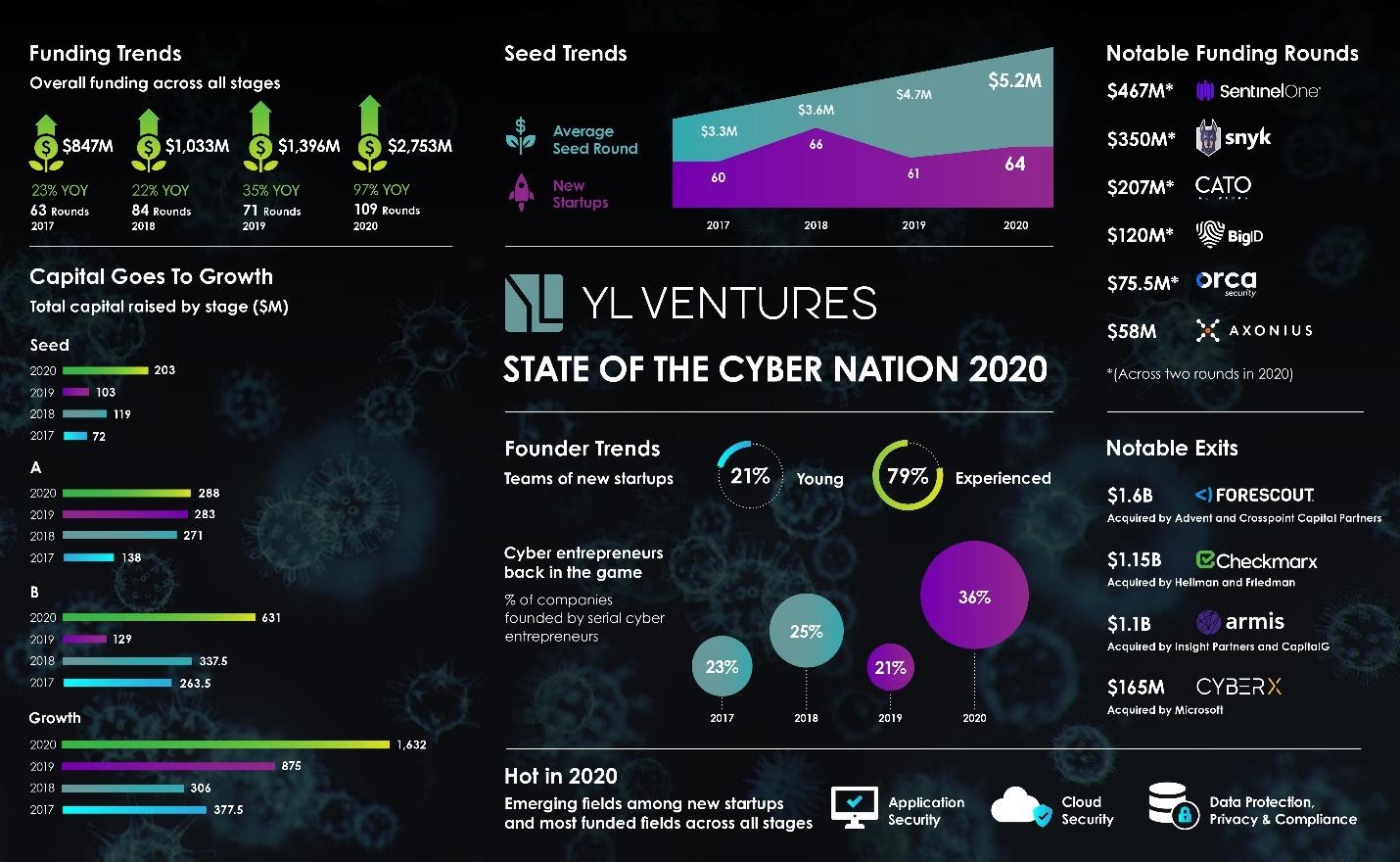
Image Credits: YL Ventures (opens in a new window)
The numbers also reveal how investors are increasingly concentrating their funds on larger seed rounds for serial entrepreneurs and the foremost industry trends. More than $2.75 billion was poured into the industry this year to back companies across all stages, a 97% increase from last year’s $1.39 billion. If its long-term slope is any indication, we can only expect it to continue to grow.
However, though they clearly indicate progress, the numbers still make the need for a demographic reset clear. Like the rest of the industry, Israel’s cybersecurity ecosystem must adapt to the pace of change set out by this year’s social movements, and the time has long passed for true diversity and gender representation in cybersecurity leadership.
As the market’s biggest leaders garner experience and expertise, the bar for entry to Israel’s cybersecurity startup ecosystem has gradually risen over the years. However, this did not appear to impact this year’s entrepreneurial breakthroughs. 58% of Israel’s newly founded cybersecurity companies received seed rounds this year, totaling 64 seeded companies in 2020 compared with last year’s 61. The total number of newly founded companies increased by 5%, reversing last year’s downward trend.
The amount invested at seed hit an all-time high as average deal size in 2020 increased by 11%, amounting to an average of $5.2 million per deal. This continues an upward trend in average seed rounds, which have surged over the last four years due to sizable year-on-year increases. It also provides further support for a shift toward higher caliber seed rounds with a strategically focused and “all-in” approach. In other words, founders that meet the new bar for entry are raising bigger rounds for more ambitious visions.
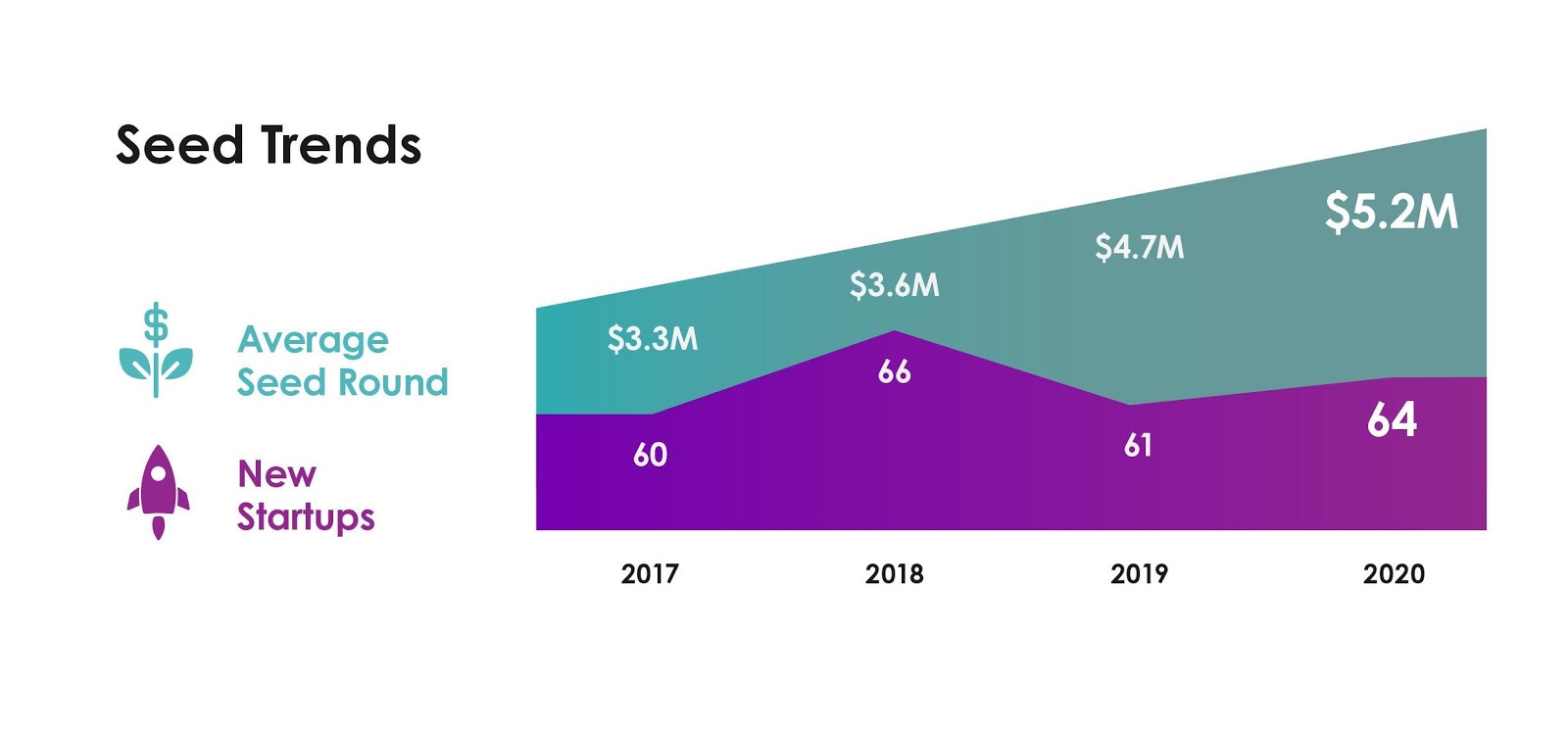
Image Credits: YL Ventures
2020 proved an exceptional year for application security and cloud security startups. Perhaps the runaway successes of Snyk and Checkmarx left strong impressions. This year saw an explosive 140% increase in application security company seed investments (such as Enso Security, build.security and CloudEssence), as well as a whopping 200% increase in cloud security seed investments (like Solvo and DoControl), from last year.
Powered by WPeMatico
Scale AI CEO Alexandr Wang doesn’t need a crystal ball to see where artificial intelligence will be used in the future. He just looks at his customer list.
The four-year-old startup, which recently hit a valuation of more than $3.5 billion, got its start supplying autonomous vehicle companies with the labeled data needed to train machine learning models to develop and eventually commercialize robotaxis, self-driving trucks and automated bots used in warehouses and on-demand delivery.
The wider adoption of AI across industries has been a bit of a slow burn over the past several years as company founders and executives begin to understand what the technology could do for their businesses.
In 2020, that changed as e-commerce, enterprise automation, government, insurance, real estate and robotics companies turned to Scale’s visual data labeling platform to develop and apply artificial intelligence to their respective businesses. Now, the company is preparing for the customer list to grow and become more varied.
Scale AI’s customer list has included an array of autonomous vehicle companies including Alphabet, Voyage, nuTonomy, Embark, Nuro and Zoox. While it began to diversify with additions like Airbnb, DoorDash and Pinterest, there were still sectors that had yet to jump on board. That changed in 2020, Wang said.
Scale began to see incredible use cases of AI within the government as well as enterprise automation, according to Wang. Scale AI began working more closely with government agencies this year and added enterprise automation customers like States Title, a residential real estate company.
Wang also saw an increase in uses around conversational AI, in both consumer and enterprise applications as well as growth in e-commerce as companies sought out ways to use AI to provide personalized recommendations for its customers that were on par with Amazon.
Robotics continued to expand as well in 2020, although it spread to use cases beyond robotaxis, autonomous delivery and self-driving trucks, Wang said.
“A lot of the innovations that have happened within the self-driving industry, we’re starting to see trickle out throughout a lot of other robotics problems,” Wang said. “And so it’s been super exciting to see the breadth of AI continue to broaden and serve our ability to support all these use cases.”
The wider adoption of AI across industries has been a bit of a slow burn over the past several years as company founders and executives begin to understand what the technology could do for their businesses, Wang said, adding that advancements in natural language processing of text, improved offerings from cloud companies like AWS, Azure and Google Cloud and greater access to datasets helped sustain this trend.
“We’re finally getting to the point where we can help with computational AI, which has been this thing that’s been pitched for forever,” he said.
That slow burn heated up with the COVID-19 pandemic, said Wang, noting that interest has been particularly strong within government and enterprise automation as these entities looked for ways to operate more efficiently.
“There was this big reckoning,” Wang said of 2020 and the effect that COVID-19 had on traditional business enterprises.
If the future is mostly remote with consumers buying online instead of in-person, companies started to ask, “How do we start building for that?,” according to Wang.
The push for operational efficiency coupled with the capabilities of the technology is only going to accelerate the use of AI for automating processes like mortgage applications or customer loans at banks, Wang said, who noted that outside of the tech world there are industries that still rely on a lot of paper and manual processes.
Powered by WPeMatico
When Salesforce acquired Quip in 2016 for $750 million, it gained CEO and co-founder Bret Taylor as part of the deal. Taylor has since risen quickly through the ranks of the software giant to become president and COO, second in command behind CEO Marc Benioff. Taylor’s experience shows that startup founders can sometimes play a key role in the companies that acquire them.
Benioff, 56, has been running Salesforce since its founding more than 20 years ago. While he hasn’t given any public hints that he intends to leave anytime soon, if he wanted to step back from the day-to-day running of the company or even job share the role, he has a deep bench of executive talent including many experienced CEOs, who like Taylor came to the company via acquisition.
One way to step back from the enormous responsibility of running Salesforce would be by sharing the role.
He and his wife Lynne have been active in charitable giving and in 2016 signed The Giving Pledge, an initiative from the The Bill and Melinda Gates Foundation, to give a majority of their wealth to philanthropy. One could see him wanting to put more time into pursuing these charitable endeavors just as Gates did 20 years ago. As a means of comparison, Gates founded Microsoft in 1975 and stayed for 25 years until he left in 2000 to run his charitable foundation full time.
Even if this remains purely speculative for the moment, there is a group of people behind him with deep industry experience, who could be well-suited to take over should the time ever come.
One way to step back from the enormous responsibility of running Salesforce would be by sharing the role. In fact, for more than a year starting in 2018, Benioff actually shared the top job with Keith Block until his departure last year. When they worked together, the arrangement seemed to work out just fine with Block dealing with many larger customers and helping the software giant reach its $20 billion revenue goal.
Before Block became co-CEO, he had a myriad other high-level titles including co-chairman, president and COO — two of which, by the way, Taylor has today. That was a lot of responsibility for one person inside a company the size of Salesforce, but promoting him to co-CEO from COO gave the company a way to reward his hard work and help keep him from jumping ship (he eventually did anyway).
As Holger Mueller, an analyst at Constellation Research points out, the co-CEO concept has worked out well at major enterprise companies that have tried it in the past, and it helped with continuity. “Salesforce, SAP and Oracle all didn’t miss a beat really with the co-CEO departures,” he said.
If Benioff wanted to go back to the shared responsibility model and take some work off his plate, making Taylor (or someone else) co-CEO would be one way to achieve that. Certainly, Brent Leary, lead analyst at CRM Essentials sees Taylor gaining increasing responsibility as time goes along, giving credence to the idea.
“Ever since Quip was acquired Taylor seemed to be on the fast track, becoming president and chief product officer less than a year-and-a-half after the acquisition, and then two years later being promoted to chief operating officer,” Leary said.
While Taylor isn’t the only person who could step into Benioff’s shoes, he looks like he has the best shot at the moment, especially in light of the $27.7 billion Slack deal he helped deliver earlier this month.
“Taylor being publicly praised by Benioff for playing a significant role in the Slack acquisition, Salesforce’s largest acquisition to date, shows how much he has solidified his place at the highest levels of influence and decision-making in the organization,” Leary pointed out.
But Mueller posits that his rapid promotions could also show something might be lacking with internal options, especially around product. “Taylor is a great, smart guy, but his rise shows more the product organization bench depth challenges that Salesforce has,” he said.
Powered by WPeMatico
CommonGround, a startup developing technology for what its founders describe as “4D collaboration,” is announcing that it has raised $19 million in funding.
This isn’t the first time Amir Bassan-Eskenazi and Ran Oz have launched a startup together — they also founded video networking company BigBand Networks, which won two technology-related Emmy Awards, went public in 2007 and was acquired by Arris Group in 2011. Before that, they worked together at digital compression company Optibase, which Oz co-founded and where Bassan-Eskenazi served as COO.
Although CommonGround is still in stealth mode and doesn’t plan to fully unveil its first product until next year, Bassan-Eskenazi and Oz outlined their vision for me. They acknowledged that video conferencing has improved significantly, but said it still can’t match face-to-face communication.
“Some things you just cannot achieve through a flat video-conferencing-type solution,” Bassan-Eskenazi said. “Those got better over the years, but they never managed to achieve that thing where you walk into a bar … and there’s a group of people talking and you know immediately who is a little taken aback, who is excited, who is kind of ‘eh.’”

CommonGround founders Amir Bassan-Eskenazi and Ran Oz. Image Credits: CommonGround
That, essentially, is what Bassan-Eskenazi, Oz and their team are trying to build — online collaboration software that more fully captures the nuances of in-person communication, and actually improves on face-to-face conversations in some ways (hence the 4D moniker). Asked whether this involves combining video conferencing with other collaboration tools, Oz replied, “Think of it as beyond video,” using technology like computer vision and graphics.
Bassan-Eskenazi added that they’ve been working on CommonGround for more than year, so this isn’t just a response to our current stay-at-home environment. And the opportunity should still be massive as offices reopen next year.
“When we started this, it was a problem we thought some of the workforce would understand,” he said. “Now my mother understands it, because it’s how she reads to the grandkids.”
As for the funding, the round was led by Matrix Partners, with participation from Grove Ventures and StageOne Ventures.
“Amir and Ran have a bold vision to reinvent communications,” said Matrix General Partner Patrick Malatack in a statement. “Their technical expertise, combined with a history of successful exits, made for an easy investment decision.”
Powered by WPeMatico
Earlier this month, when Nutanix announced it was hiring former VMware COO Rajiv Ramaswami as CEO, it looked like a good match. What’s more, it pulled a key player from a market rival. Well, it seems VMware took exception to losing the executive, and filed a lawsuit against him yesterday for breach of contract.
The company is claiming that Ramaswami had inside knowledge of the key plans of his former company and that he should have told them that he was interviewing for a job at a rival organization.
“Rajiv Ramaswami failed to honor his fiduciary and contractual obligations to VMware. For at least two months before resigning from the company, at the same time he was working with senior leadership to shape VMware’s key strategic vision and direction, Mr. Ramaswami also was secretly meeting with at least the CEO, CFO, and apparently the entire Board of Directors of Nutanix, Inc. to become Nutanix’s Chief Executive Officer. He joined Nutanix as its CEO only two days after leaving VMware,” the company wrote in a statement.
As you can imagine, Nutanix didn’t agree, countering in a statement of its own that, “VMware’s lawsuit seeks to make interviewing for a new job wrongful. We view VMware’s misguided action as a response to losing a deeply valued and respected member of its leadership team. Mr. Ramaswami and Nutanix have gone above and beyond to be proactive and cooperative with VMware throughout the transition.”
At the time of the hiring, analyst Holger Mueller from Constellation Research noted that the two companies were primary competitors and hiring Ramawami was was a big win for Nutanix. “So hiring Ramaswami brings both an expert for multicloud to the Nutanix helm, as well as weakening a key competitor from a talent perspective,” he told me earlier this month.
Mueller doesn’t see much chance of the suit succeeding. “It’s been a long time since the last lawsuit happened in Silicon Valley [involving] a tech exec jumping ship. Being an ’employment at will’ state, these suits are typically unsuccessful,” he told me this morning.
He added, “The interesting part of the VMware v. Nutanix lawsuit is, does a high-ranking executive interviewing with a competitor equal a break of confidentiality by itself, or does material information have to be breached to reach the point. Traditionally the right to (confidentially) interview has been protected by the courts,” he said.
It’s unclear what the end game would be in this type of legal action, but it does complicate matters for Nutanix as it transitions to a new chief executive. Ramaswami took over from co-founder Dheeraj Pandey, who announced plans to leave the post last summer.
The lawsuit was filed Monday in Superior Court of the State of California, County of Santa Clara.
Powered by WPeMatico