Enterprise
Auto Added by WPeMatico
Auto Added by WPeMatico
Explosion, a company that has combined an open source machine learning library with a set of commercial developer tools, announced a $6 million Series A today on a $120 million valuation. The round was led by SignalFire, and the company reported that today’s investment represents 5% of its value.
Oana Olteanu from SignalFire will be joining the board under the terms of the deal, which includes warrants of $12 million in additional investment at the same price.
“Fundamentally, Explosion is a software company and we build developer tools for AI and machine learning and natural language processing. So our goal is to make developers more productive and more focused on their natural language processing, so basically understanding large volumes of text, and training machine learning models to help with that and automate some processes,” company co-founder and CEO Ines Montani told me.
The company started in 2016 when Montani met her co-founder, Matthew Honnibal in Berlin where he was working on the spaCy open source machine learning library. Since then, that open source project has been downloaded over 40 million times.
In 2017, they added Prodigy, a commercial product for generating data for the machine learning model. “Machine learning is code plus data, so to really get the most out of the technologies you almost always want to train your models and build custom systems because what’s really most valuable are problems that are super specific to you and your business and what you’re trying to find out, and so we saw that the area of creating training data, training these machine learning models, was something that people didn’t pay very much attention to at all,” she said.
The next step is a product called Prodigy Teams, which is a big reason the company is taking on this investment. “Prodigy Teams is [a hosted service that] adds user management and collaboration features to Prodigy, and you can run it in the cloud without compromising on what people love most about Prodigy, which is the data privacy, so no data ever needs to get seen by our servers,” she said. They do this by letting the data sit on the customer’s private cluster in a private cloud, and then use Prodigy Team’s management features in the public cloud service.
Today, they have 500 companies using Prodigy including Microsoft and Bayer in addition to the huge community of millions of open source users. They’ve built all this with just six early employees, a number that has grown to 17 recently (they hope to reach 20 by year’s end).
She believes if you’re thinking too much about diversity in your hiring process, you probably have a problem already. “If you go into hiring and you’re thinking like, oh, how can I make sure that the way I’m hiring is diverse, I think that already shows that there’s maybe a problem,” she said.
“If you have a company, and it’s 50 dudes in their 20s, it’s not surprising that you might have problems attracting people who are not white dudes in their 20s. But in our case, our strategy is to hire good people and good people are often very diverse people, and again if you play by the [startup] playbook, you could be limited in a lot of other ways.”
She said that they have never seen themselves as a traditional startup following some conventional playbook. “We didn’t raise any investment money [until now]. We grew the team organically, and we focused on being profitable and independent [before we got outside investment],” she said.
But more than the money, Montani says that they needed to find an investor that would understand and support the open source side of the business, even while they got capital to expand all parts of the company. “Open source is a community of users, customers and employees. They are real people, and [they are not] pawns in [some] startup game, and it’s not a game. It’s real, and these are real people,” she said.
“They deserve more than just my eyeballs and grand promises. […] And so it’s very important that even if we’re selling a small stake in our company for some capital [to build our next] product [that open source remains at] the core of our company and that’s something we don’t want to compromise on,” Montani said.
Powered by WPeMatico
Pixalate raised $18.1 million in growth capital for its fraud protection, privacy and compliance analytics platform that monitors connected television and mobile advertising.
Western Technology Investment and Javelin Venture Partners led the latest funding round, which brings Pixalate’s total funding to $22.7 million to date. This includes a $4.6 million Series A round raised back in 2014, Jalal Nasir, founder and CEO of Pixalate, told TechCrunch.
The company, with offices in Palo Alto and London, analyzes over 5 million apps across five app stores and more 2 billion IP addresses across 300 million connected television devices to detect and report fraudulent advertising activity for its customers. In fact, there are over 40 types of invalid traffic, Nasir said.
Nasir grew up going to livestock shows with his grandfather and learned how to spot defects in animals, and he has carried that kind of insight to Pixalate, which can detect the difference between real and fake users of content and if fraudulent ads are being stacked or hidden behind real advertising that zaps smartphone batteries or siphons internet usage and even ad revenue.
Digital advertising is big business. Nasir cited Association of National Advertisers research that estimated $200 billion will be spent globally in digital advertising this year. This is up from $10 billion a year prior to 2010. Meanwhile, estimated ad fraud will cost the industry $35 billion, he added.
“Advertisers are paying a premium to be in front of the right audience, based on consumption data,” Nasir said. “Unfortunately, that data may not be authorized by the user or it is being transmitted without their consent.”
While many of Pixalate’s competitors focus on first-party risks, the company is taking a third-party approach, mainly due to people spending so much time on their devices. Some of the insights the company has found include that 16% of Apple’s apps don’t have privacy policies in place, while that number is 22% in Google’s app store. More crime and more government regulations around privacy mean that advertisers are demanding more answers, he said.
The new funding will go toward adding more privacy and data features to its product, doubling the sales and customer teams and expanding its office in London, while also opening a new office in Singapore.
The company grew 1,200% in revenue since 2014 and is gathering over 2 terabytes of data per month. In addition to the five app stores Pixalate is already monitoring, Nasir intends to add some of the China-based stores like Tencent and Baidu.
Noah Doyle, managing director at Javelin Venture Partners, is also monitoring the digital advertising ecosystem and said with networks growing, every linkage point exposes a place in an app where bad actors can come in, which was inaccessible in the past, and advertisers need a way to protect that.
“Jalal and Amin (Bandeali) have insight from where the fraud could take place and created a unique way to solve this large problem,” Doyle added. “We were impressed by their insight and vision to create an analytical approach to capturing every data point in a series of transactions — more data than other players in the industry — for comprehensive visibility to help advertisers and marketers maintain quality in their advertising.”
Powered by WPeMatico
Even without staffing shortages, local merchants have difficulty answering calls while all hands are busy, and Goodcall wants to alleviate some of that burden from America’s 30 million small businesses.
Goodcall’s free cloud-based conversational platform leverages artificial intelligence to manage incoming phone calls and boost customer service for businesses of all sizes. Former Google executive Bob Summers left Google back in January, where he was working on Area 120 — an internal incubator program for experimental projects — to start Goodcall after recognizing the call problem, noting that in fact 60% of the calls that come into merchants go unanswered.
“It’s frustrating for you and for the person calling,” Summers told TechCrunch. “Every missed call is a lost opportunity.”
Goodcall announced its launch Wednesday with $4 million in seed funding led by strategic investors Neo, Foothill Ventures, Merus Capital, Xoogler Ventures, Verissimo Ventures and VSC Ventures, as well as angel investors including Harry Hurst, founder and co-CEO of Pipe.com, and Zillow co-founder Spencer Rascoff.

Goodcall mobile agent. Image Credits: Goodcall
Restaurants, shops and merchants can set up on Goodcall in a matter of minutes and even establish a local phone number to free up an owner’s mobile number from becoming the business’ main line. The service is initially deployed in English and the company has plans to operate in Spanish, French and Hindi by 2022.
Merchants can choose from six different assistant voices and monitor the call logs and what the calls were about. Goodcall can also capture consumer sentiment, Summers said.
The company offers three options, including its freemium service for solopreneurs and business owners, which includes up to 500 minutes per month of Goodcall services for a single phone line. Up to five additional locations and five staff members costs $19 per month for the Pro level, or the Premium level provides unlimited locations and staff for $49 per month.
During the company’s beta period, Goodcall was processing several thousands of calls per month. The new funding will be used to continue to offer the free service, hire engineers and continue product development.
In addition to the funding round, Goodcall is unveiling a partnership with Yelp to tap into its database of local businesses so that those owners and managers can easily deploy Goodcall. Yelp data shows that more than 500,000 businesses opened during the pandemic. The company pulls in from Yelp a merchant’s open hours, location, if they offer Wi-Fi and even their COVID policy.
“We are partnering with Yelp, which has the best data on small businesses, and other large distribution channels to get our product to market,” Summers said. “We are bringing technology into an industry that hasn’t innovated since the 1980s and democratizing conversational AI for small businesses that are the main driver of job creation, and we want to help them grow.”
Powered by WPeMatico
Duda announced Wednesday that it acquired Canada-based Snipcart, a startup that enables businesses to add a shopping cart to their websites.
The acquisition is Palo Alto-based Duda’s first deal, and follows the website development platform’s $50 million Series D round in June that brings its total funding to $100 million to date. Duda co-founder and CEO Itai Sadan declined to comment on the acquisition amount.
Duda, which works with digital agencies and SaaS companies, has approximately 1 million published paying sites, and the acquisition was driven by the company seeing a boost in e-commerce websites as a result of the global pandemic, he told TechCrunch.
This was not just about a technology acquisition for Duda, but also a talented team, Sadan said. The entire Snipcart team of 12 is staying on, including CEO Francois Lanthier Nadeau; the companies will be fully integrated by 2022 and the first collaborative versions will come out.
When he met the Snipcart team, Sadan thought they were “super experienced and held the same values.”
“We share many of the same types of customers, many of which are API-first,” he added. “If our customers need more headless commerce, they can build their own front end using Snipcart. Their customers will benefit from us growing the team — we plan to double it in the next year and roll out more features at a faster pace.”
The global retail e-commerce market is estimated to grow by 50% to $6.3 trillion by 2024, according to Statista. Duda itself has experienced a year over year increase of 265% in e-commerce sites being built on its platform, which Sadan said was what made Snipcart an attractive acquisition to further accelerate and manage its growth that includes over 17,000 customers.
Together, the companies will offer new capabilities, like payment and membership tools inside of the Duda platform. Many of Duda’s customers come with inventory and don’t want to manage it on another e-commerce platform, so Snipcart will be that component for taking their inventory and making it shoppable on the web.
“Everyone is thinking about how to introduce transactions into their websites and web experiences, and that is what we were looking for in an e-commerce platform,” Sadan said.
Powered by WPeMatico
Itamar Jobani was a software developer working for a medical company and “hated that time of the month” when he had to use the company’s chosen reimbursement tool.
“It was full of friction and as part of the company’s wellness team, I felt an urge to take care of the employee experience and find a better tool,” Jobani told TechCrunch. “I looked for something, but didn’t find it, so I tried to build it myself.”
What resulted was PayEm, an Israeli company he founded with Omer Rimoch in 2019 to be a spend and procurement platform for high-growth and multinational organizations. Today, it announced $27 million in funding that includes $7 million in seed funding, led by Pitango First and NFX, with participation by LocalGlobe and Fresh Fund, as well as $20 million in Series A funding led by Glilot+.
The company’s technology automates the reimbursement, procurement, accounts payable and credit card workflows to manage all of the requests and invoices, while also creating bills and sending payments to over 200 territories in 130 currencies.
It gives company finance teams a real-time look at what items employees are asking for funds to buy, and what is actually being spent. For example, teams can submit a request and go through an approval flow that can be customized with purchasing codes tied to a description of the transaction. At the same time, all transactions are continuously reconciled versus having to spend hours at the end of the month going through paperwork.
“Organizations are running in a more democratized way with teams buying things on behalf of the organization,” Jobani said. “We built a platform to cater to those needs, so it’s like a disbursement platform instead of a finance team always being in charge.”
The global B2B payments market is valued at $120 trillion annually and is expected to reach $200 trillion by 2028, according to payment industry newsletter Nilson Report. PayEm is among many B2B payments startups attracting venture capital — for example, last month, Nium announced a $200 million in Series D funding at a $1 billion valuation. Paystand raised $50 million in Series C funding to make B2B payments cashless, while Dwolla raised $21 million for its API that allows companies to build and facilitate fast payments.
Meanwhile, PayEm itself saw accelerated growth in the second quarter of 2021, including increasing its transaction volume by four times over the previous quarter and generating millions of dollars in revenue. It now boasts a list of hundreds of customers like Fiverr, JFrog and Next Insurance. It also launched new features like the ability to create corporate cards.
The company, which also has an office in New York, has 40 employees currently, and the new funds will enable the company to triple its headcount, focusing on hiring in the United States, and to bring additional features and payment capabilities to market.
“Each person can have a budget and a time frame for making the purchase, while accounting still feels in control,” Jobani added. “Everyone now has the full context and the right budget line item.”
Powered by WPeMatico

The digital transformation currently sweeping society has likely reached your favorite local restaurant.
Since 2013, Boston-based Toast has offered bars and eateries a software platform that lets them manage orders, payments and deliveries.
Over the last year, its customers have processed more than $38 billion in gross payment volume, so Alex Wilhelm analyzed the company’s S-1 for The Exchange with great interest.
“Toast was last valued at just under $5 billion when it last raised, per Crunchbase data,” he writes. “And folks are saying that it could be worth $20 billion in its debut. Does that square with the numbers?”
Full Extra Crunch articles are only available to members.
Use discount code ECFriday to save 20% off a one- or two-year subscription.
Airbnb, DoorDash and Coinbase each debuted at past Y Combinator Demo Days; as of this writing, they employ a combined 10,000 people.
Today and tomorrow, TechCrunch reporters will cover the proceedings at YC’s Summer 20201 Demo Day. In addition to writing up founder pitches, they’ll also rank their favorites.
Even remotely, I can feel a palpable sense of excitement radiating from our team — anything can happen at YC Demo Day, so sign up for Extra Crunch to follow the action.
Thanks very much for reading; I hope you have an excellent week.
Walter Thompson
Senior Editor, TechCrunch
@yourprotagonist
Image Credits: Ron Miller/TechCrunch
In August 2006, AWS activated its EC2 cloud-based virtual computer, a milestone in the cloud infrastructure giant’s development.
“You really can’t overstate what Amazon was able to accomplish,” writes enterprise reporter Ron Miller.
In the 15 years since, EC2 has enabled clients of any size to test and run their own applications on AWS’ virtual machines.
To learn more about a fundamental technological shift that “would help fuel a whole generation of startups,” Ron interviewed EC2 VP Dave Brown, who built and led the Amazon EC2 Frontend team.

Image Credits: Jasmin Merdan (opens in a new window)/ Getty Images
Most managers agree that OKRs foster transparency and accountability, but running a team effectively has different challenges when workers are attending all-hands meetings from their kitchen tables.
Instead of just discussing key metrics before board meetings or performance reviews, make them part of the day-to-day culture, recommends Jeremy Epstein, Gtmhub’s CMO.
“Strengthen your team by creating authentic workplace transparency using numbers as a universal language and providing meaning behind your team’s work.”

Image Credits: Getty Images under an Andrii Yalanskyi (opens in a new window) license
Many founders must overcome a few emotional hurdles before they’re comfortable pitching a potential investor face-to-face.
To alleviate that pressure, Unicorn Capital founder Evan Fisher recommends that entrepreneurs use pre-pitch meetings to build and strengthen relationships before asking for a check:
“This is the ‘we actually aren’t looking for money; we just want to be friends for now’ pitch that gets you on an investor’s radar so that when it’s time to raise your next round, they’ll be far more likely to answer the phone because they actually know who you are.”
Pre-pitches are good for more than curing the jitters: These conversations help founders get a better sense of how VCs think and sometimes lead to serendipitous outcomes.
“Investors are opportunists by necessity,” says Fisher, “so if they like the cut of your business’s jib, you never know — the FOMO might start kicking hard.”

Image Credits: MirageC (opens in a new window) / Getty Images
FischerJordan’s Deeba Goyal and Archita Bhandari break down the pandemic’s impact on alternative lenders, specifically what they had to do to survive the crisis, taking a look at smaller lenders including Credibly, Kabbage, Kapitus and BlueVine.
“Only those who were able to find a way through the complexities of their existing capital sources were able to maintain their performance, and the rest were left to perish or find new funding avenues,” they write.

Image Credits: Nigel Sussman (opens in a new window)
Customer engagement software company Freshworks’ S-1 filing depicts a company that’s experiencing accelerating revenue growth, “a great sign for the health of its business,” reports Alex Wilhelm in this morning’s The Exchange.
“Most companies see their growth rates decline as they scale, as larger denominators make growth in percentage terms more difficult.”
Studying the company’s SEC filing, he found that “Freshworks isn’t a company where we need to cut it lots of slack, as we might with an adjusted EBITDA number. It is going public ready for Big Kid metrics.”
Powered by WPeMatico
Databricks this morning confirmed earlier reports that it was raising new capital at a higher valuation. The data- and AI-focused company has secured a $1.6 billion round at a $38 billion valuation, it said. Bloomberg first reported last week that Databricks was pursuing new capital at that price.
The Series H was led by Counterpoint Global, a Morgan Stanley fund. Other new investors included Baillie Gifford, UC Investments and ClearBridge. A grip of prior investors also kicked in cash to the round.
The new funding brings Databricks’ total private funding raised to $3.5 billion. Notably, its latest raise comes just seven months after the late-stage startup raised $1 billion on a $28 billion valuation. Its new valuation represents paper value creation in excess of $1 billion per month.
The company, which makes open source and commercial products for processing structured and unstructured data in one location, views its market as a new technology category. Databricks calls the technology a data “lakehouse,” a mashup of data lake and data warehouse.
Databricks CEO and co-founder Ali Ghodsi believes that its new capital will help his company secure market leadership.
For context, since the 1980s, large companies have stored massive amounts of structured data in data warehouses. More recently, companies like Snowflake and Databricks have provided a similar solution for unstructured data called a data lake.
In Ghodsi’s view, combining structured and unstructured data in a single place with the ability for customers to execute data science and business-intelligence work without moving the underlying data is a critical change in the larger data market.
“[Data lakehouses are] a new category, and we think there’s going to be lots of vendors in this data category. So it’s a land grab. We want to quickly race to build it and complete the picture,” he said in an interview with TechCrunch.
Ghodsi also pointed out that he is going up against well-capitalized competitors and that he wants the funds to compete hard with them.
“And you know, it’s not like we’re up against some tiny startups that are getting seed funding to build this. It’s all kinds of [large, established] vendors,” he said. That includes Snowflake, Amazon, Google and others who want to secure a piece of the new market category that Databricks sees emerging.
The company’s performance indicates that it’s onto something.
Databricks has reached the $600 million annual recurring revenue (ARR) milestone, it disclosed as part of its funding announcement. It closed 2020 at $425 million ARR, to better illustrate how quickly it is growing at scale.
Per the company, its new ARR figure represents 75% growth, measured on a year-over-year basis.
That’s quick for a company of its size; per the Bessemer Cloud Index, top-quartile public software companies are growing at around 44% year over year. Those companies are worth around 22x their forward revenues.
At its new valuation, Databricks is worth 63x its current ARR. So Databricks isn’t cheap, but at its current pace should be able to grow to a size that makes its most recent private valuation easily tenable when it does go public, provided that it doesn’t set a new, higher bar for its future performance by raising again before going public.
Ghodsi declined to share timing around a possible IPO, and it isn’t clear whether the company will pursue a traditional IPO or if it will continue to raise private funds so that it can direct list when it chooses to float. Regardless, Databricks is now sufficiently valuable that it can only exit to one of a handful of mega-cap technology giants or go public.
Why hasn’t the company gone public? Ghodsi is enjoying a rare position in the startup market: He has access to unlimited capital. Databricks had to open another $100 million in its latest round, which was originally set to close at just $1.5 billion. It doesn’t lack for investor interest, allowing its CEO to bring aboard the sort of shareholder he wants for his company’s post-IPO life — while enjoying limited dilution.
This also enables him to hire aggressively, possibly buy some smaller companies to fill in holes in Databricks’ product roadmap, and grow outside of the glare of Wall Street expectations from a position of capital advantage. It’s the startup equivalent of having one’s cake and eating it too.
But staying private longer isn’t without risks. If the larger market for software companies was rapidly devalued, Databricks could find itself too expensive to go public at its final private valuation. However, given the long bull market that we’ve seen in recent years for software shares, and the confidence Ghodsi has in his potential market, that doesn’t seem likely.
There’s still much about Databricks’ financial position that we don’t yet know — its gross margin profile, for example. TechCrunch is also incredibly curious what all its fundraising and ensuing spending have done to near-term Databricks operating cash flow results, as well as how long its gross-margin adjusted CAC payback has evolved since the onset of COVID-19. If we ever get an S-1, we might find out.
For now, winsome private markets are giving Ghodsi and crew space to operate an effectively public company without the annoyances that come with actually being public. Want the same thing for your company? Easy: Just reach $600 million ARR while growing 75% year over year.
Powered by WPeMatico
Software billing startup Octane announced Tuesday that it raised $2 million on a post-money valuation of $10 million to advance its pay-as-you-go billing software.
Akash Khanolkar and his co-founders met a decade ago at Carnegie Mellon University and since then went off in different directions. In Khanolkar’s case, he ran a cloud consulting business and saw how fast companies like Datadog and Snowflake were coming to market and dealing with Amazon Web Services.
He found that the commonality in all of those fast-growing companies was billing software using a pay-as-you-go business model versus the traditional flat-rate plans, Khanolkar told TechCrunch.
However, he explained that monitoring consumption means that billing becomes complicated: companies now have to track how customers are using the software per second in order to bill correctly each month.
Seeing the shift toward consumption-based billing, the co-founders came back together in June 2020 to create Octane, a metered billing system that helps vendors create a plan, monitor usage and charge in a similar way to Snowflake and AWS, Khanolkar said.
“We are API-driven, and you as a vendor will send us usage data, and on our end, we store it and then do real-time aggregations so at the end of the month, you can accordingly bill customers,” Khanolkar said. “We have seen contention between engineering and product. Engineers are there to create core plans, so we built a no-code experience for product teams to be able to create new price plans and then perform changes, like adding coupons.”
Within the global cloud billing market, which is expected to reach $6.5 billion by 2025, there are a set of Octane competitors, like Chargebee and Zuora, that Khanolkar said are tackling the subscription management side and succeeding in the past several years. Now there is a usage and consumption-based world coming and a whole new set of software businesses, like Octane, coming in to succeed there.
The new round of funding was led by Basis Set Ventures and included Dropbox co-founder Arash Ferdowsi, Github CTO Jason Warner, Fortress CTO Assunta Gaglione, Scale AI CRO Chetan Chaudhary, former Twilio executive Evan Cummack, Esteban Reyes, Abstraction Capital and Script Capital.
“With the rise of product-led growth and usage-based pricing models, usage-based billing is a critical and foundational piece of infrastructure that has been simply missing,” said Chang Xu, partner at Basis Set Ventures, via email. “At the same time, it’s something that every department cares about as it’s your revenue. Many later-stage companies we talk to that have built this in-house talk about the ongoing maintenance costs and wishes that there is a vendor they can outsource it to.”
We are super impressed with the Octane team with their dedication to building a best-in-class and robust usage-based billing solution. They’ve validated this opportunity by talking to lots of engineering teams so they can solve for all the edge cases, which is important in something as mission critical as billing. We are convinced that Octane will become an inevitable part of the tech infrastructure.”
The new funding will go primarily toward hiring engineers, as well as product, marketing and sales staff. Octane currently has seven employees, and Khanolkar expects to be around 10 by the end of the year.
The company is working with a large range of companies, primarily focused on infrastructure and the depth gauge industries. Octane is also seeing some unique use cases emerge, like a construction company using the usage meter to track the hours an employee works and companies in electric charging using the meter for those purposes.
“We didn’t envision construction guys using it, but in theory, it could be used by any company that tracks time — even legal,” Khanolkar added.
He declined to speak about the company’s revenue, but did say it now had two to three years of runway.
Up next, the company plans to roll out new features like price experimentation based on usage to help customers better make decisions on how to price their software, another problem Khanolkar sees happening. It will build ways that customers can try different plans against usage data to validate which one works the best.
“We are still in the early innings of consumption-based models, but we see more end users opting to go with an enterprise that wants to let them try out the software and then pay as they go,” he added.
Powered by WPeMatico
Walnut raised $15 million in Series A funding, led by Eight Roads Ventures, to continue developing its sales experience platform.
Founders Yoav Vilner and Danni Friedland started the company in July 2020. Vilner told TechCrunch that while at a previous company, he was building a category called technology marketing in Israel. He realized that company sales people often ran into problems when it was time to demonstrate their product — the product would break, or they would have to ask another department to open something or add a feature, none of which happened instantaneously, Vilner added.
He and Friedland’s answer to that problem is a no-code platform for teams to create customized product demonstrations quickly, be able to integrate them into their sales and marketing processes and then generate insights from the demos.
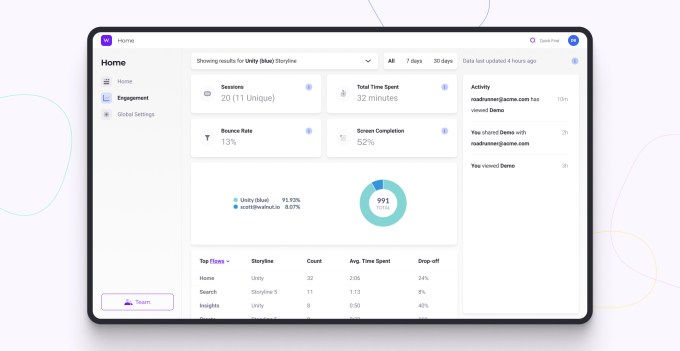
Walnut engagement example. Image Credits: Walnut
“We let the sales and marketing teams replicate the SaaS product in our cloud environment, which is disconnected from the back end,” Vilner explained. “They can create a storyline to fit their customer and the demonstration, and then following the demo, sales leaders can get insight on what was good or bad. It encourages the sharing of knowledge and what story worked best for which kind of company.”
The company’s latest round gives it $21 million raised to date, and follows a $6 million seed round that included NFX, A Capital, Liquid2 Ventures and Graph Ventures, Vilner said.
Walnut serves over 60 business-to-business clients, including Adobe, NetApp, Varonis and People AI. In addition to Tel Aviv, the company has offices in New York and London.
Vilner intends to use the new funding to grow the team across the U.S, Europe and Israel and continue developing its technology and platform, including tools to embed demos into a website for product-led growth. He also expects to double the team of 25 over the next year.
Eyal Rabinovich, an investor at Eight Roads Ventures, said his brother is a Walnut customer, and the company fits with one of the firm’s theses around broad vertically integrated brands in SaaS and deep technology.
Rabinovich was tracking the sales enablement space for a while and said many companies claim to provide something unique, but it is usually workflow and processes. In Walnut’s case, it is solving something at the core of sales.
“They make everything measurable, and the ‘holy grail’ is conversion, and even just 1% conversion could mean millions of dollars,” he added. “Every company we spoke to wanted to use this product. Customers were telling us they closed the sales cycle within two weeks.”
Powered by WPeMatico
As artificial intelligence continues to weave its way into more enterprise applications, a startup that has built a platform to help businesses, especially non-tech organizations, build more customized AI decision-making tools for themselves has picked up some significant growth funding. Peak AI, a startup out of Manchester, England, that has built a “decision intelligence” platform, has raised $75 million, money that it will be using to continue building out its platform, expand into new markets and hire some 200 new people in the coming quarters.
The Series C is bringing a very big name investor on board. It is being led by SoftBank Vision Fund 2, with previous backers Oxx, MMC Ventures, Praetura Ventures and Arete also participating. That group participated in Peak’s Series B of $21 million, which only closed in February of this year. The company has now raised $119 million; it is not disclosing its valuation.
(This latest funding round was rumored last week, although it was not confirmed at the time and the total amount was not accurate.)
Richard Potter, Peak’s CEO, said the rapid follow-on in funding was based on inbound interest, in part because of how the company has been doing.
Peak’s so-called Decision Intelligence platform is used by retailers, brands, manufacturers and others to help monitor stock levels and build personalized customer experiences, as well as other processes that can stand to have some degree of automation to work more efficiently, but also require sophistication to be able to measure different factors against each other to provide more intelligent insights. Its current customer list includes the likes of Nike, Pepsico, KFC, Molson Coors, Marshalls, Asos and Speedy, and in the last 12 months revenues have more than doubled.
The opportunity that Peak is addressing goes a little like this: AI has become a cornerstone of many of the most advanced IT applications and business processes of our time, but if you are an organization — and specifically one not built around technology — your access to AI and how you might use it will come by way of applications built by others, not necessarily tailored to you, and the costs of building more tailored solutions can often be prohibitively high. Peak claims that those using its tools have seen revenues on average rise 5%, return on ad spend double, supply chain costs reduce by 5% and inventory holdings (a big cost for companies) reduce by 12%.
Peak’s platform, I should point out, is not exactly a “no-code” approach to solving that problem — not yet at least: It’s aimed at data scientists and engineers at those organizations so that they can easily identify different processes in their operations where they might benefit from AI tools, and to build those out with relatively little heavy lifting.
There have also been different market factors that have played a role. COVID-19, for example, and the boost that we have seen both in increasing “digital transformation” in businesses and making e-commerce processes more efficient to cater to rising consumer demand and more strained supply chains have all led to businesses being more open and keen to invest in more tools to improve their automation intelligently.
This, combined with Peak AI’s growing revenues, is part of what interested SoftBank. The investor has been long on AI for a while; but it also has been building out a section of its investment portfolio to provide strategic services to the kinds of businesses in which it invests.
Those include e-commerce and other consumer-facing businesses, which make up one of the main segments of Peak’s customer base.
Notably, one of its recent investments specifically in that space was made earlier this year, also in Manchester, when it took a $730 million stake (with potentially $1.6 billion more down the line) in The Hut Group, which builds software for and runs D2C businesses.
“In Peak we have a partner with a shared vision that the future enterprise will run on a centralized AI software platform capable of optimizing entire value chains,” Max Ohrstrand, senior investor for SoftBank Investment Advisers, said in a statement. “To realize this a new breed of platform is needed and we’re hugely impressed with what Richard and the excellent team have built at Peak. We’re delighted to be supporting them on their way to becoming the category-defining, global leader in Decision Intelligence.”
It’s not clear that SoftBank’s two Manchester interests will be working together, but it’s an interesting synergy if they do, and most of all highlights one of the firm’s areas of interest.
Longer term, it will be interesting to see how and if Peak evolves to extend its platform to a wider set of users at the organizations that are already its customers.
Potter said he believes that “those with technical predispositions” will be the most likely users of its products in the near and medium term. You might assume that would cut out, for example, marketing managers, although the general trend in a lot of software tools has precisely been to build versions of the same tools used by data scientists for these less technical people to engage in the process of building what it is that they want to use.
“I do think it’s important to democratize the ability to stream data pipelines, and to be able to optimize those to work in applications,” Potter added.
Powered by WPeMatico