Enterprise
Auto Added by WPeMatico
Auto Added by WPeMatico
As more companies become ever more reliant on digital infrastructure for everyday work, the more they become major targets for malicious hackers — both trends accelerated by the pandemic — and that is leading to an ever-greater need for IT and security departments to find ways of protecting data should it become compromised. Today, one of the companies that has emerged as a strong player in data backup and recovery is announcing its first major round of funding.
HYCU, which provides multi-cloud backup and recovery services for mid-market and enterprise customers, has raised $87.5 million, a Series A that it the Boston-based startup will be using to invest in building out its platform further, to bring its services into more markets, and to hire 100 more people.
HYCU’s premise and ambition, CEO and founder Simon Taylor said in an interview, is to provide backup and storage services that are as simple to use “as backing up in iCloud for consumers.”
“If you look at primary storage, it’s become very SaaS-ifed, with no professional services required,” he continued. “But backup has stayed very legacy. It’s still mostly focused on one specific environment and can’t perform well when multi-cloud is being used.”
And HYCU’s name fits with that ethos. It is pronounced “haiku”, which Taylor told me refers not just to that Japanese poetic form that looks simple but hides a lot of meaning, but also “hybrid cloud uptime.”
The company is probably known best for its integration with Nutanix, but has over time expanded to serve enterprises building and operating IT and apps over VMware, Google Cloud, Azure and AWS. The company also has built a tool to help migrate data for enterprises, HYCU Protégé, which will also be expanded.
The funding is being led by Bain Capital Ventures, with participation also from Acrew Capital (which was also in the news last week as an investor in the $118 million round for Pie Insurance). The valuation is not being disclosed.
This is the first major outside funding that the company has announced since being founded in 2018, but in that time it has grown into a sizeable competitor against others like Rubrik, Veeam, Veritas and CommVault. The Rubrik comparison is interesting, given that it is also backed by Bain (which led a $261 million round in Rubrik in 2019). HYCU now has more than 2,000 customers in 75 countries. Taylor says that not taking funding while growing into what it has become meant that it was “listening and closer to the needs of our customers,” rather than spending more time paying attention to what investors says.
Now that it’s reached a certain scale, though, things appear to be shifting and there will probably be more money down the line. “This is just round one for us,” Taylor said.
He added that this funding came in the wake of a lot of inbound interest that included not just the usual range of VCs and private equity firms that are getting more involved in VC, but also, it turns out, SPACs, which as they grow in number, seem to be exploring what kinds and stages of companies they tap with their quick finance-and-go-public model.
And although HYCU hadn’t been proactively pitching investors for funding, it would have been on their radars. In fact, Bain is a major backer of Nutanix, putting some $750 million into the company last August. There is some strategic sense in supporting businesses that figure strongly in the infrastructure of your other portfolio companies.
There is another important reason for HYCU raising capital to expand beyond what its balance sheet could provide to fuel growth: HYCU’s would-be competition is itself going through a moment of investment and expansion. For example, Veeam, which was acquired by Insight last January for $5 billion, then proceeded to acquire Kasten to move into serving enterprises that used Kubernetes-native workloads across on-premises and cloud environments. And Rubrik last year acquired Igneous to bring management of unstructured data into its purview. And it’s not a given that just because this is a sector seeing a lot of demand, that it’s all smooth sailing. Igneous was on the rocks at the time of its deal, and Rubrik itself had a data leak in 2019, highlighting that even those who are expert in protecting data can run up against problems.
Taylor notes that ransomware indeed remains a very persistent problem for its customers — reflecting what others in the security world have observed — and its approach for now is to remain focused on how it delivers services in an agent-less environment. “We integrate into the platform,” he said. “That is incredibly important. It means that you can be up and running immediately, with no need for professional services to do the integrating, and we also make it a lot harder for criminals because of this.”
Longer term, it will keep its focus on backup and recovery with no immediate plans to move into adjacent areas though such as more security services or other tools. “We’re not trying to be a Veritas and own the entire business end-to-end,” Taylor said. “The goal is to make sure the IT department has visibility and the cloud journey is protected.”
Enrique Salem, a partner at Bain Capital Ventures and the former CEO of Symantec, is joining HYCU’s board with this round and sees the opportunity in the market for a product like HYCU’s.
“We are in the early days of a multi-decade shift to the public cloud, but existing on-premises backup vendors are poorly equipped to enable this transition, creating tremendous opportunity for a new category of cloud-native backup providers,” he said in a statement. “As one of the early players in multi-cloud backup as a service bringing true SaaS to both on-premises and cloud-native environments, HYCU is a clear leader in a space that will continue to create large multi-billion dollar companies.”
Stefan Cohen, a principal at Bain Capital Ventures, will also be joining the board.
Powered by WPeMatico
MessageBird, the omnichannel cloud communications platform recently valued at $3 billion, is continuing to ramp up its M&A activity. Following last year’s acquisition of Pusher, a company that provides real-time web technologies, it is announcing that it has acquired “video-first” customer engagement platform 24sessions, and customer data platform Hull.
Terms of the two new deals aren’t being disclosed, although MessageBird founder and CEO Robert Vis tells me the three acquisitions add up to about $100 million in total, and we alreadly know that Pusher’s acquisition price was $35 million. I also understand that the 24sessions and Hull acquisitions saw both companies’ investors exit entirely.
Originally seen as a European or “rest of the world” competitor to U.S.-based Twilio — offering a cloud communications platform that supports voice, video and text capabilities all wrapped up in an API — MessageBird has since repositioned itself as an “Omnichannel Platform-as-a-Service” (OPaaS). The idea is to easily enable enterprises and medium and smaller-sized companies to communicate with customers on any channel of their choosing.
Out of the box, this includes support for WhatsApp, Messenger, WeChat, Twitter, Line, Telegram, SMS, email and voice. Customers can start online and then move their support request or query over to a more convenient channel, such as their favourite mobile messaging app, which, of course, can go with them. It’s all part of MessageBird Vis’ big bet that the future of customer interactions is omni-channel.
To that end, the acquisition of 24sessions adds another channel: video. This, Vis tells me, is a particularly important channel where in-person interactions are being replicated digitally. However, he says it’s not just enough to have a video option — you need one that is compliant and secure. This is especially true for regulated industries such as financial services and healthcare. In addition, 24sessions is web-based, meaning that end-users aren’t required to install an app.
“Bringing a safe, secure and customizable video platform into the MessageBird family is the next step in our strategic journey,” said Vis in a statement. “Our portfolio of owned services already includes SMS, voice, email, OTT, social, live chat and push. The addition of 24sessions’ video platform gives us one of the world’s most comprehensive and powerful omnichannel offerings, and is consistent with our having end-to-end control of the stack in order to create magical experiences for our customers”.
“By joining forces with MessageBird, we’re making a leap forward in our mission to improve personal customer contact and turn it into a smooth digital experience, without losing the human touch,” adds Rutger Teunissen, CEO of 24sessions. “Video has become a more embedded, instant, intelligent, and integrated part of the omnichannel customer experience”.
However, communicating with customers more efficiently doesn’t just mean interacting with them on the channels of their choosing and building backend workflows to support this, it also requires a better understanding of the customer and the context of their query. That’s where the acquisition of Hull, based in France and the U.S., comes into play.
Described as a customer data platform (CDP), Hull’s team and technology will be deployed to create an “in-depth analytics layer” between MessageBird’s omnichannel offering and the workflow solutions it provides to customers.
“We want to empower clients to have easy, frictionless conversations with customers, so it’s crucial that we understand where those customers are and how they like to communicate,” said Vis. “To do that, it’s crucial that our platform is able to collect, unify and enrich product, marketing, and sales data and synchronize it across the workflow.”
In total, 45 staff will join from 24sessions, and 14 will join from Hull. The combined M&A brings MessageBird’s total headcount to almost 500 people across its nine hubs globally.
Powered by WPeMatico
If you develop software for a large enterprise company, chances are you’ve heard of Tricentis. If you don’t develop software for a large enterprise company, chances are you haven’t. The software testing company with a focus on modern cloud and enterprise applications was founded in Austria in 2007 and grew from a small consulting firm to a major player in this field, with customers like Allianz, BMW, Starbucks, Deutsche Bank, Toyota and UBS. In 2017, the company raised a $165 million Series B round led by Insight Venture Partners.
Today, Tricentis announced that it has acquired Neotys, a popular performance testing service with a focus on modern enterprise applications and a tests-as-code philosophy. The two companies did not disclose the price of the acquisition. France-based Neotys launched in 2005 and raised about €3 million before the acquisition. Today, it has about 600 customers for its NeoLoad platform. These include BNP Paribas, Dell, Lufthansa, McKesson and TechCrunch’s own corporate parent, Verizon.
As Tricentis CEO Sandeep Johri noted, testing tools were traditionally script-based, which also meant they were very fragile whenever an application changed. Early on, Tricentis introduced a low-code tool that made the automation process both easier and resilient. Now, as even traditional enterprises move to DevOps and release code at a faster speed than ever before, testing is becoming both more important and harder for these companies to implement.
“You have to have automation and you cannot have it be fragile, where it breaks, because then you spend as much time fixing the automation as you do testing the software,” Johri said. “Our core differentiator was the fact that we were a low-code, model-based automation engine. That’s what allowed us to go from $6 million in recurring revenue eight years ago to $200 million this year.”
Tricentis, he added, wants to be the testing platform of choice for large enterprises. “We want to make sure we do everything that a customer would need, from a testing perspective, end to end. Automation, test management, test data, test case design,” he said.
The acquisition of Neotys allows the company to expand this portfolio by adding load and performance testing as well. It’s one thing to do the standard kind of functional testing that Tricentis already did before launching an update, but once an application goes into production, load and performance testing becomes critical as well.
“Before you put it into production — or before you deploy it — you need to make sure that your application not only works as you expect it, you need to make sure that it can handle the workload and that it has acceptable performance,” Johri noted. “That’s where load and performance testing comes in and that’s why we acquired Neotys. We have some capability there, but that was primarily focused on the developers. But we needed something that would allow us to do end-to-end performance testing and load testing.”
The two companies already had an existing partnership and had integrated their tools before the acquisition — and many of its customers were already using both tools, too.
“We are looking forward to joining Tricentis, the industry leader in continuous testing,” said Thibaud Bussière, president and co-founder at Neotys. “Today’s Agile and DevOps teams are looking for ways to be more strategic and eliminate manual tasks and implement automated solutions to work more efficiently and effectively. As part of Tricentis, we’ll be able to eliminate laborious testing tasks to allow teams to focus on high-value analysis and performance engineering.”
NeoLoad will continue to exist as a stand-alone product, but users will likely see deeper integrations with Tricentis’ existing tools over time, include Tricentis Analytics, for example.
Johri tells me that he considers Tricentis one of the “best kept secrets in Silicon Valley” because the company not only started out in Europe (even though its headquarters is now in Silicon Valley) but also because it hasn’t raised a lot of venture rounds over the years. But that’s very much in line with Johri’s philosophy of building a company.
“A lot of Silicon Valley tends to pay attention only when you raise money,” he told me. “I actually think every time you raise money, you’re diluting yourself and everybody else. So if you can succeed without raising too much money, that’s the best thing. We feel pretty good that we have been very capital efficient and now we’re recognized as a leader in the category — which is a huge category with $30 billion spend in the category. So we’re feeling pretty good about it.”
Powered by WPeMatico
EQT Ventures, an investment firm based in Europe that has raised more than €1.2 billion ($1.4 billion USD), announced that it has promoted Laura Yao to partner. At the same time, the firm announced it recently hired Anne Raimondi, former SVP of Operations at Zendesk, as operating partner.
The company is based in Stockholm, with offices in London, Berlin, Paris, Amsterdam and Luxembourg. Yao is based in the U.S. office in San Francisco, where she has been working for three years prior to her recent promotion to partner. She says that the company tends to hire people with operator experience because they relate well to the founders of startups in which they invest.
“Our goal is to partner with the most ambitious and boldest founders in Europe and the U.S. and kind of be the investors that we all wish we’d had when we were on the other side of the table,” Yao told me.
Yao’s background includes co-founding a startup called The PhenomList in 2011.
While she is responsible for looking for new investments, Raimondi works with the existing portfolio of companies, particularly B2B SaaS companies, helping them with practical aspects of building a startup like go-to-market strategy, organizational design, hiring executives and other components of company building.
“I joined earlier this year as an operating partner, so I’m not on the investing side but actually focused on working with existing portfolio company founders as they grow and scale,” Raimondi said.
Unfortunately, female partners like Yao and Raimondi remain a rarity in most venture firms with a Crunchbase report from last April finding that just 3% of investors are women, and that over two-thirds of firms don’t have a single woman as a partner.
EQT has a 50/50 male to female employee ratio, although the partners were all male until Yao was promoted and Raimondi hired. That makes two of six as the company attempts to make the investment team reflect the rest of the company and the population at large.
Part of Raimondi’s job is talking to startups about building diverse and equitable organizations and she and Yao know the company needs to model that. She says that thriving startups understand on the product side that to build a successful product, they start with a hypothesis, then develop targets and metrics to test, learn and then iterate.
She says that they need to do the same thing to build a diverse and inclusive company. That starts with defining what diversity and inclusion looks like and setting up metrics to measure their progress.
“You evaluate [your diversity goals] and hold [the company] accountable to what you’ve signed up for. If you don’t meet them, [you look at] what can you do to improve them. Then you look at how you keep iterating, and then constantly measuring the employee experience across many dimensions, including not only diversity, but the important part of belonging,” Raimondi said.
Both women say their company does a good job at this, and their hiring/promotion proves that. Yao says that the organization as a whole has created a comfortable and inclusive culture. “It’s very collaborative and egalitarian. Anyone can say whatever’s on their mind. It’s very non-hierarchical and a comfortable place for a woman to work. I felt immediately welcomed and that my ideas were welcome immediately,” she said.
The company portfolio includes startups in the U.S. and Europe and the firm sees itself as a bridge between the two locations. Among the companies EQT has invested in include bug bounty startup HackerOne, website building technology Netlify and quantum computing startup Seeqc.
Early Stage is the premier “how-to” event for startup entrepreneurs and investors. You’ll hear firsthand how some of the most successful founders and VCs build their businesses, raise money and manage their portfolios. We’ll cover every aspect of company building: Fundraising, recruiting, sales, product-market fit, PR, marketing and brand building. Each session also has audience participation built-in — there’s ample time included for audience questions and discussion. Use code “TCARTICLE” at checkout to get 20% off tickets right here.
Powered by WPeMatico
Last October as Slack was preparing for its virtual Frontiers conference, the company began thinking about different ways people could communicate on the platform. While it had built its name on being able to integrate a lot of services in a single place to alleviate the dreaded task-switching phenomenon, it has been largely text-based up until now.
More recently, Slack has started developing a few new features that could bring different ways of interacting to the platform. CEO Stewart Butterfield discussed them on Thursday with former TechCrunch reporter Josh Constine, now a SignalFire investor, in a Clubhouse interview.
The talk was about the future of work, and Slack believes these new ways of communicating could help employees better connect online as we shift to a hybrid work world — one which has been hastened by the pandemic over the last year. There is a general consensus that many companies will continue to work in a hybrid fashion, even when the pandemic is over.
For starters, Slack aims to add a way to communicate by video. But instead of trying to compete with Zoom or Microsoft Teams, Slack is envisioning an experience that’s more like Instagram Stories.
Think about the CEO sharing an important announcement with the company, or the kind of information that might have gone out in a companywide email. Instead, you can skip the inbox and deliver the message directly by video. It’s taking a page from the consumer approach to social and trying to move it into the enterprise.
Writing in a company blog post earlier this week, Slack chief product officer Tamar Yehoshua was clear this was going to be an asynchronous approach, rather than a meeting kind of experience.
“To help with this, we are piloting ways to shift meetings toward an asynchronous video experience that feels native in Slack. It allows us to express nuance and enthusiasm without a meeting,” she wrote.
While it was at it, Slack decided to create a way of just chatting by voice. As Butterfield told Constine in his Clubhouse interview, this is essentially Clubhouse (or Twitter Spaces) being built for Slack.
Yeah, I’ve always believed the ‘good artists copy, great artists steal’ thing, so we’re just building Clubhouse into Slack, essentially. Like that idea that you can drop in, the conversation’s happening whether you’re there or not, you can enter and leave when you want, as opposed to a call that starts and stops, is an amazing model for encouraging that spontaneity and that serendipity and conversations that only need to be three minutes, but the only option for you to schedule them is 30 minutes. So look out for Clubhouse built into Slack.
Again, it’s taking a consumer social idea and applying it to a business setting with the idea of finding other ways to keep you in Slack when you could be using other tools to achieve the same thing, whether it be Zoom meetings, email or your phone.
Butterfield also hinted that another feature — asynchronous audio, allowing you to leave the equivalent of a voicemail — could be coming some time in the future. A Slack spokesperson confirmed that it was in the works, but wasn’t ready to share details yet.
It’s impossible to look at these features without thinking about them in the context of the $27 billion Salesforce acquisition of Slack at the end of last year. When you put them all together, you have this set of tools that let you communicate in whatever way makes the most sense to you.
When you combine that Slack Connect DM, a new feature to communicate outside the organization that was released this week to some controversy, as people wanted assurances that they could control spam and harassment, it takes the concept one step further — outside the organization itself.
As part of a larger entity like Salesforce, these tools could be useful across sales, service and even marketing as a way to communicate in a variety of ways inside and outside the organization. And they greatly expand the value prop of Slack as it becomes part of Salesforce sometime later this year.
While it began talking about the new audio and video features last fall, the company has been piloting them since the beginning of this year. So far Slack is not saying when the new features will be generally available.
Powered by WPeMatico
When TechCrunch covered UIPath’s Series A in 2017, it was a small startup out of Romania working in a little known area of enterprise software called robotic process automation (RPA).
Then the company took off with increasingly large multibillion dollar valuations. It progressed through its investment rounds, culminating with a $750 million round on an eye-popping $35 billion valuation last month.
This morning, the company took the next step on its rapid-fire evolutionary path when it filed its S-1 to go public. To illustrate just how fast the company’s rise has been, take a look at its funding history:
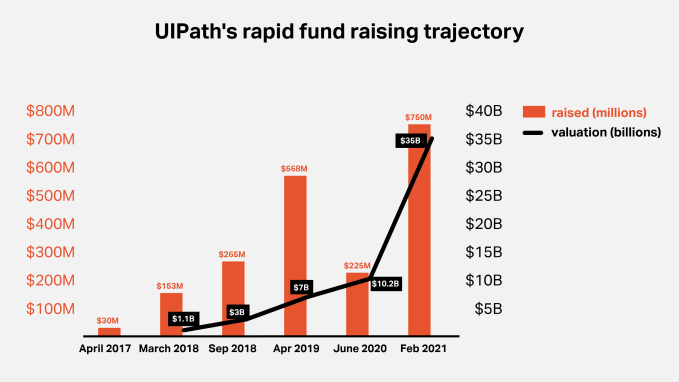
Image Credits: Bryce Durbin/TechCrunch
RPA is much better understood these days with larger enterprise software companies like SAP, Microsoft, IBM and ServiceNow getting involved. With RPA, companies can automate a mundane process like processing an insurance claim, moving work automatically, while bringing in humans only when absolutely necessary. For example, instead of having a person enter a number in a spreadsheet from an email, that can happen automatically.
In June 2019, Gartner reported that RPA was the fastest-growing area in enterprise software, growing at over 60% per year, and attracting investors and larger enterprise software vendors to the space. While RPA’s growth has slowed as it matures, a September 2020 Gartner report found it expanding at a more modest 19.5% with total revenue expected to reach $2 billion in 2021. Gartner found that stand-alone RPA vendors UIPath, Blue Prism and Automation Anywhere are the market leaders.
Although the market feels rather small given the size of the company’s valuation, it’s still a nascent space. In its S-1 filing this morning, the company painted a rosy picture, projecting a $60 billion addressable market. While TAM estimates tend to trend large, UIPath points out that the number encompasses far more than pure RPA into what they call “Intelligent Process Automation.” That could include not only RPA, but also process discovery, workflow, no-code development and other forms of automation.
Indeed, as we wrote earlier today on the soaring process automation market, the company is probably going to need to expand into these other areas to really grow, especially now that it’s competing with much bigger companies for enterprise automation dollars.
While UIPath is in the midst of its quiet period, it came up for air this week to announce that it had bought Cloud Elements, a company that gives it access to API integration, an important component of automation in the enterprise. Daniel Dines, the company co-founder and CEO said the acquisition was about building a larger platform of automation tools.
“The acquisition of Cloud Elements is just one example of how we are building a flexible and scalable enterprise-ready platform that helps customers become fully automated enterprises,” he said in a statement.
While there is a lot of CEO speak in that statement, there is also an element of truth in that the company is looking at the larger automation story. It can use some of the cash from its prodigious fundraising to begin expanding on its original vision with smaller acquisitions that can fill in missing pieces in the product road map.
The company will need to do that and more to compete in a rapidly moving market, where many vendors are fighting for different parts of the business. As it continues its journey to becoming a public company, it will need to continue finding new ways to increase revenue by tapping into different parts of the wider automation stack.
Powered by WPeMatico
We’ve seen a lot of trend lines moving throughout 2020 and into 2021 around automation, workflow, robotic process automation (RPA) and the movement to low-code and no-code application building. While all of these technologies can work on their own, they are deeply connected and we are starting to see some movement toward bringing them together.
While the definition of process automation is open to interpretation, and could include things like industrial automation, Statista estimates that the process automation market could be worth $74 billion in 2021. Those are numbers that are going to get the attention of both investors and enterprise software executives.
Just this week, Berlin-based Camunda announced a $98 million Series B to help act as a layer to orchestrate the flow of data between RPA bots, microservices and human employees. Meanwhile, UIPath, the pure-play RPA startup that’s going to IPO any minute now, acquired Cloud Elements, giving it a way to move beyond RPA into API automation.
Not enough proof for you? How about ServiceNow announcing this week that it is buying Indian startup Intellibot to give it — you guessed it — RPA capabilities. That acquisition is part of a broader strategy by the company to move into full-scale workflow and automation, which it discussed just a couple of weeks ago.
Meanwhile, at the end of last year, SAP bought a different Berlin process automation startup, Signavio, for $1.2 billion after announcing new automated workflow tools and an RPA tool at the beginning of December. Microsoft is in on it too, having acquired process automation startup Softmotive last May, which it then combined with its own automation tool PowerAutomate.
What we have here is a frothy mix of startups and large companies racing to provide a comprehensive spectrum of workflow automation tools to empower companies to spin up workflows quickly and move work involving both human and machine labor through an organization.
The result is hot startups getting prodigious funding, while other startups are exiting via acquisition to these larger companies looking to buy instead of build to gain a quick foothold in this market.
Cathy Tornbohm, Distinguished Research vice president at Gartner, says part of the reason for the rapidly growing interest is that these companies have stayed on the sidelines up until now, but they see an opportunity and are using their checkbooks to play catch-up.
“IBM, SAP, Pega, Appian, Microsoft, ServiceNow all bought into the RPA market because for years they didn’t focus on how data got into their systems when operating between organizations or without a human. [Instead] they focused more on what happens inside the client’s organization. The drive to be digitally more efficient necessitates optimizing data ingestion and data flows,” Tornbohm told me.
For all the bluster from the big vendors, they do not control the pure-play RPA market. In fact, Gartner found that the top three players in this space are UIPath, Automation Anywhere and Blue Prism.
But Tornbohm says that, even as the traditional enterprise vendors try to push their way into the space, these pure-play companies are not sitting still. They are expanding beyond their RPA roots into the broader automation space, which could explain why UIPath came up from its pre-IPO quiet period to make the Cloud Elements announcement this week.
Dharmesh Thakker, managing partner at Battery Ventures, agrees with Tornbohm, saying that the shift to the cloud, accelerated by COVID-19, has led to an expansion of what RPA vendors are doing.
“RPA has traditionally focused on automation-UI flow and user steps, but we believe a full automation suite requires that ability to automate processes across the stack. For larger companies, we see their interest in the category as a way to take action on data within their systems. And for standalone RPA vendors, we see this as validation of the category and an invitation to expand their offerings to other pillars of automation,” Thakker said.
The activity we have seen across the automation and workflow space over the last year could be just the beginning of what Thakker and Tornbohm are describing, as companies of all sizes fight to become the automation stack of choice in the coming years.
Early Stage is the premier “how-to” event for startup entrepreneurs and investors. You’ll hear firsthand how some of the most successful founders and VCs build their businesses, raise money and manage their portfolios. We’ll cover every aspect of company building: Fundraising, recruiting, sales, product-market fit, PR, marketing and brand building. Each session also has audience participation built-in — there’s ample time included for audience questions and discussion. Use code “TCARTICLE” at checkout to get 20% off tickets right here.
Powered by WPeMatico
When AWS CEO Andy Jassy announced in an email to employees yesterday that Tableau CEO Adam Selipsky was returning to run AWS, it was probably not the choice most considered. But to the industry watchers we spoke to over the last couple of days, it was a move that made absolute sense once you thought about it.
Gartner analyst Ed Anderson says that the cultural fit was probably too good for Jassy to pass up. Selipsky spent 11 years helping build the division. It was someone he knew well and had worked side by side with for over a decade. He could slide into the new role and be trusted to continue building the lucrative division.
Anderson says that even though the size and scope of AWS has changed dramatically since Selipsky left in 2016 when the company closed the year on a $16 billion run rate, he says that the organization’s cultural dynamics haven’t changed all that much.
“Success in this role requires a deep understanding of the Amazon/AWS culture in addition to a vision for AWS’s future growth. Adam already knows the AWS culture from his previous time at AWS. Yes, AWS was a smaller business when he left, but the fundamental structure and strategy was in place and the culture hasn’t notably evolved since then,” Anderson told me.
Matt McIlwain, managing director at Madrona Venture Group, says the experience Selipsky had after he left AWS will prove invaluable when he returns.
“Adam transformed Tableau from a desktop, licensed software company to a cloud, subscription software company that thrived. As the leader of AWS, Adam is returning to a culture he helped grow as the sales and marketing leader that brought AWS to prominence and broke through from startup customers to become the leading enterprise solution for public cloud,” he said.
Holger Mueller, an analyst with Constellation Research, says that Selipsky’s business experience gave him the edge over other candidates. “His business acumen won out over [internal candidates] Matt Garmin and Peter DeSantis. Insight on how Salesforce works may be helpful and valued as well,” Mueller pointed out.
As for leaving Tableau and with it Salesforce, the company that purchased it for $15.7 billion in 2019, Brent Leary, founder and principal analyst at CRM Essentials, believes that it was only a matter of time before some of these acquired company CEOs left to do other things. In fact, he’s surprised it didn’t happen sooner.
“Given Salesforce’s growing stable of top notch CEOs accumulated by way of a slew of high-profile acquisitions, you really can’t expect them all to stay forever, and given Adam Selipsky’s tenure at AWS before becoming Tableau’s CEO, this move makes a whole lot of sense. Amazon brings back one of their own, and he is also a wildly successful CEO in his own right,” Leary said.
While the consensus is that Selipsky is a good choice, he is going to have awfully big shoes to fill. The fact is that division is continuing to grow like a large company currently on a run rate of over $50 billion. With a track record like that to follow, and Jassy still close at hand, Selipsky has to simply continue letting the unit do its thing while putting his own unique stamp on it.
Any kind of change is disconcerting though, and it will be up to him to put customers and employees at ease and plow ahead into the future. Same mission. New boss.
Powered by WPeMatico
The pandemic has clearly had an impact on the way we work, and this is especially true for salespeople. Salesforce introduced a number of updates to Sales Cloud this morning, including Salesforce Meetings, a smart overlay for Zoom meetings that gives information and advice to the sales team as they interact with potential customers in online meetings.
Bill Patterson, EVP and general manager of CRM applications at Salesforce says that the company wanted to help sales teams manage these types of interactions better and take advantage of the fact they are digital.
“There’s a broad recognition, not just from Salesforce, but really from every sales organization that selling is forever changed, and I think that there’s been a broad understanding, and maybe a surprise in learning how effective we can be in the from anywhere kind of times, whether that’s in office or not in office or whatever,” Patterson explained.
Salesforce Meetings gives that overlay of information, whether it’s advice to slow down the pace of your speech or information about the person speaking. It also can compile action items and present a To Do list to participants at the end of each meeting to make sure that tasks don’t fall through the cracks.
This is made possible in part through the Einstein intelligence layer that is built across the entire Salesforce platform. In this case, it takes advantage of a new tool called Einstein Conversation Insights, which the company is also exposing as a feature for developers to build their own solutions using this tool.
For sales people who might find the tool a bit too invasive, you can dial the confidence level of the information up or down on an individual basis, so that you can get a lot of information or a little depending on your needs.
For now, it works with Zoom and the company has been working closely with the Zoom development team to provide the API and SDK tooling it needs to pull off something like this, according to Patterson. He notes that plans are in the works to make it compatible with WebEx and Microsoft Teams in the future.
While the idea was in the works prior to the pandemic, COVID created a sense of urgency for this kind of feature, as well as other features announced today like Pipeline Inspection, which uses AI to analyze the sales pipeline. It searches for changes to deals over time with the goal of finding the ones that could benefit most from coaching or managerial support to get them over the finish line.
Brent Leary, founder and principal analyst at CRM Essentials says that this ability to capture information in online meetings is changing the way we think about CRM.
“The thing the caught my attention is how tightly integrated video meetings/collaboration is now into sales process. This is really compelling because meeting interactions that may not find their way into the CRM system are now automatically captured,” Leary told me.
Salesforce Meetings is available today, while Pipeline Inspection is expected to be available this summer.
Powered by WPeMatico
Ketch, a startup aiming to help businesses navigate the increasingly complex world of online privacy regulation and data compliance, is announcing that it has raised $23 million in Series A funding.
The company is also officially coming out of stealth. I actually wrote about Ketch’s free PrivacyGrader tool last year, but now it’s revealing the broader vision, as well as the products that businesses will actually be paying for.
The startup was founded by CEO Tom Chavez and CTO Vivek Vaidya. The pair previously founded Krux, a data management platform acquired by Salesforce in 2016, and Vaidya told me that Ketch is the answer to a question that they’d begun to ask themselves: “What kind of infrastructure can we build that will make our former selves better?”
Chavez said that Ketch is designed to help businesses automate the process of remaining compliant with data regulations, wherever their visitors and customers are. He suggested that with geographically specific regulations like Europe’s GDPR in place, there’s a temptation to comply globally with the most stringent rules, but that’s not necessary or desirable.
“It’s possible to use data to grow and to comply with the regulations,” Chavez said. “One of our customers turned off digital marketing completely in order to comply. This has got to stop […] They are a very responsible customer, but they didn’t know there are tools to navigate this complexity.”
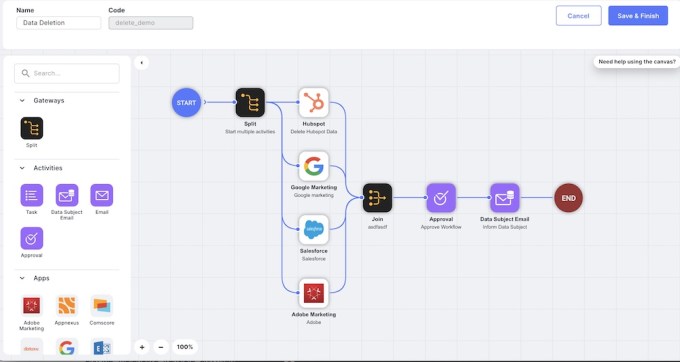
Image Credits: Ketch
The pair also suggested that things are even more complex than you might think, because true compliance means going beyond the “Hollywood façade” of a privacy banner — it requires actually implementing a customer’s requests across multiple platforms. For example, Vaidya said that when someone unsubscribes to your email list, there’s “a complex workflow that needs to be executed to ensure that the email is not going to continue … and make sure the customer’s choices are respected in a timely manner.”
After all, Chavez noted, if a customer tells you, “I want to delete my data,” and yet they keep getting marketing emails or targeted ads, they’re not going to be satisfied if you say, “Well, I’ve handled that in the four walls of my own business, that’s an issue with my marketing and email partners.”
Chavez also said that Ketch isn’t designed to replace any of a business’ existing marketing and customer data tools, but rather to “allow our customers to configure how they want to comply vis-à-vis what jurisdiction they’re operating in.” For example, the funding announcement includes a statement from Patreon’s legal counsel Priya Sanger describing Ketch as “an easily configurable consent management and orchestration system that was able to be deployed internationally” that “required minimal engineering time to integrate into our systems.”
As for the Series A, it comes from CRV, super{set} (the startup studio founded by Chavez and Vaidya), Ridge Ventures, Acrew Capital and Silicon Valley Bank. CRV’s Izhar Armony and Acrew’s Theresia Gouw are joining Ketch’s board of directors.
And if you’d like to learn more about the product, Ketch is hosting a webinar at 11am Pacific today.
Powered by WPeMatico