Enterprise
Auto Added by WPeMatico
Auto Added by WPeMatico
At first glance, Quiq and Snaps might sound like similar startups — they both help businesses talk to their customers via text messaging and other messaging apps. But Snaps CEO Christian Brucculeri said “there’s almost no overlap in what we do” and that the companies are “almost complete complements.”
That’s why Quiq (based in Bozeman, Montana) is acquiring Snaps (based in New York). The entire Snaps team is joining Quiq, with Brucculeri becoming senior vice president of sales and customer success for the combined organization.
Quiq CEO Mike Myer echoed Bruccleri’s point, comparing the situation to dumping two pieces of a jigsaw puzzle on the floor and discovering “the two pieces fit perfectly.”
More specifically, he told me that Quiq has generally focused on customer service messaging, with a “do it yourself, toolset approach.” After all, the company was founded by two technical co-founders, and Myer joked, “We can’t understand why [a customer] can’t just call an API.” Snaps, meanwhile, has focused more on marketing conversations, and on a managed service approach where it handles all of the technical work for its customers.
In addition, Myer said that while Quiq has “really focused on the platform aspect from the beginning” — building integrations with more than a dozen messaging channels including Apple Business Chat, Google’s Business Messages, Instagram, Facebook Messenger and WhatsApp — it doesn’t have “a deep natural language or conversational AI capability” the way Snaps does.
Myer said that demand for Quiq’s offering has been growing dramatically, with revenue up 300% year-over-year in the last six months of 2020. At the same time, he suggested that the divisions between marketing and customer service are beginning to dissolve, with service teams increasingly given sales goals, and “at younger, more commerce-focused organizations, they don’t have this differentiation between marketing and customer service” at all.
Apparently the two companies were already working together to create a combined offering for direct messaging on Instagram, which prompted broader discussions about how to bring the two products together. Moving forward, they will offer a combined platform for a variety of customers under the Quiq brand. (Quiq’s customers include Overstock.com, West Elm, Men’s Wearhouse and Brinks Home Security, while Snaps’ include Bryant, Live Nation, General Assembly, Clairol and Nioxin.) Brucculeri said this will give businesses one product to manage their conversations across “the full customer journey.”
“The key term you’re hearing is conversation,” Myer added. “It’s not about a ticket or a case or a question […] it’s an ongoing conversation.”
Snaps had raised $13 million in total funding from investors including Signal Peak Ventures. The financial terms of the acquisition were not disclosed.
Powered by WPeMatico
Okta today announced it was expanding its platform into a couple of new areas. Up to this point, the company has been known for its identity access management product, giving companies the ability to sign onto multiple cloud products with a single sign on. Today, the company is moving into two new areas: privileged access and identity governance
Privileged access gives companies the ability to provide access on an as-needed basis to a limited number of people to key administrative services inside a company. This could be your database or your servers or any part of your technology stack that is highly sensitive and where you want to tightly control who can access these systems.
Okta CEO Todd McKinnon says that Okta has always been good at locking down the general user population access to cloud services like Salesforce, Office 365 and Gmail. What these cloud services have in common is you access them via a web interface.
Administrators access the speciality accounts using different protocols. “It’s something like secure shell, or you’re using a terminal on your computer to connect to a server in the cloud, or it’s a database connection where you’re actually logging in with a SQL connection, or you’re connecting to a container, which is the Kubernetes protocol to actually manage the container,” McKinnon explained.
Privileged access offers a couple of key features including the ability to limit access to a given time window and to record a video of the session so there is an audit trail of exactly what happened while someone was accessing the system. McKinnon says that these features provide additional layers of protection for these sensitive accounts.
He says that it will be fairly trivial to carve out these accounts because Okta already has divided users into groups and can give these special privileges to only those people in the administrative access group. The challenge was figuring out how to get access to these other kinds of protocols.
The governance piece provides a way for security operations teams to run detailed reports and look for issues related to identity. “Governance provides exception reporting so you can give that to your auditors, and more importantly you can give that to your security team to make sure that you figure out what’s going on and why there is this deviation from your stated policy,” he said.
All of this when combined with the $6.5 billion acquisition of Auth0 last month is part of a larger plan by the company to be what McKinnon calls the identity cloud. He sees a market with several strategic clouds and he believes identity is going to be one of them.
“Because identity is so strategic for everything, it’s unlocking your customer, access, it’s unlocking your employee access, it’s keeping everything secure. And so this expansion, whether it’s customer identity with zero trust or whether it’s doing more on the workforce identity with not just access, but privileged access and identity governance. It’s about identity evolving in this primary cloud,” he said.
While both of these new products were announced today at the company’s virtual Oktane customer conference, they won’t be generally available until the first quarter of next year.
Powered by WPeMatico
Thanks to major players like Amazon and Walmart, we’ve become accustomed to next- or same-day delivery. But the pandemic has also renewed our interest in buying from smaller businesses and retailers.
Swyft, a company that has just raised $17.5 million in a Series A, helps retailers of any size provide affordable same-day delivery. The round was co-led by Inovia Capital and Forerunner Ventures, with participation from Shopify and existing investors Golden Ventures and Trucks VC.
Swyft is a marketplace, connecting a network of shipping carriers with vendors. But the company also provides software to those carriers to make them more efficient, and turns them into a vast network that allows them to pick up more inventory without adding to their infrastructure.
In other words, several regional carriers may play a part in delivering a parcel shipped via Swyft without making any big changes to their original routes or adding new drivers, trucks, etc.
To date, major players in both shipping and retail have dominated this space, thanks in large part to their ability to deliver quickly. Swyft is looking to amass an army, for lack of a better term, comprised of all of the smaller players, including mom and pop retailers and vendors as well as smaller, regional carriers. Banded together through software, these carriers and retailers can match the scale and influence of the behemoths without spending a fortune.
Swyft was co-founded by Aadil Kazmi (CEO), Zeeshan Hamid (head of Engineering) and Maraz Rahman (head of Sales). Kazmi and Hamid both spent their careers at Amazon, working on data and last-mile operations for the behemoth. Rahman was an early employee at a YC-backed proptech startup.
The trio started asking themselves early last year why retailers weren’t able to offer same-day delivery and chose to tackle the gap they discovered.
The key ingredient to Swyft is not its aggregation of couriers, but the software it provides to them. Because Swyft is increasing demand for these carriers, it also needs to make them more efficient. The back-end software allows carriers to digitize or automate a good deal of what they’re traditionally doing by hand.
Kazmi says that Swyft is able to come in anywhere between 25-30% cheaper than the incumbent option.
“I don’t know what percent of your purchases are from Amazon, but for me it’s like 150%,” said Eurie Kim. “I’d prefer to buy elsewhere with the pandemic, and support local and independent brands, but Amazon’s trained us all to have fast and free shipping. It feels like an opportunity where the consumer experience is really lacking and the burden on merchants and retailers is extremely heavy.”
Swyft currently has 16 full-time employees; 12% percent are female and 75% are people of color, according to the company.
Since April 2020, Swyft has facilitated the delivery of more than 180,000 packages, and expanded gross margin from 78% to 82%, thanks in large part to revenue from the software side of the business and a zero-asset model.
Powered by WPeMatico
The longer we continue to work with either all or part of our teams in remote, out-of-physical-office environments, the more imperative it becomes for those teams to have some tools in place to keep the channels of communication and management open, and for the individuals in those teams to have a sense of how well they are performing. Today, one of the startups that provides a team productivity app with that in mind is announcing a round of funding to fuel its growth.
Pathlight, which has built a performance management platform for customer-facing teams — sales, field service and support — to help managers and employees themselves track and analyze how they are doing, to coach them when and where it’s needed and to communicate updates and more, has picked up $25 million — money that it will be using to continue growing its customer base and the functionality across its app.
The funding is being led by Insight Partners, with previous backers Kleiner Perkins and Quiet Capital also participating, alongside Uncorrelated Ventures; Jeremy Stoppelman, CEO of Yelp; David Glazer, CFO of Palantir; and Michael Ovitz, co-founder of CAA and owner of Broad Beach Ventures. Pathlight has now raised $35 million.
Pathlight today provides users with a range of tools to visualize team and individual performance across various parameters set by managers, using data that teams integrate from other platforms like Salesforce, Zendesk and Outreach, among others.
Using that data and specific metrics for the job in question, managers can then initiate conversations with individuals to focus on specific areas where things need attention, and provide some coaching to help fix it. It can also be used to provide team-wide updates and encouragement, which sits alongside whatever other tools a person might use in their daily customer-facing work.
Since launching in March 2020, the startup has picked up good traction, with customers including Twilio, Earnin, Greenhouse and CLEAR. But perhaps even more importantly, the pandemic and resulting switch to remote work has underscored how necessary tools like Pathlight’s have become: The startup says that engagement on its platform has shot up 300% in the last 12 months.
Alexander Kvamme, the CEO of Pathlight, said that he first became aware of the challenges of communicating across customer-facing teams, and having transparency on how they are doing as individuals and as a group, when he was at Yelp. Yelp had acquired his startup, reservations service SeatMe, and used the acquisition to build and run Yelp Reservations.
He was quick to realize that there weren’t really effective tools for him to see how individuals in the sales team were doing, how they were doing compared to goals the company wanted to achieve and based on the sales data they already had in other systems, how to work more effectively with people to communicate when something needed changing, and how to tailor all that in line with new variations in the formula — in their case, how to sell new products like a reservations service alongside advertising and other Yelp services for businesses.
“Whether it’s five or 3,000 people, the problem doesn’t go away,” he said. “Everyone uses their own systems, and it hurts front-line employees when they don’t know how they are doing, or don’t get recognition when they are doing well, or don’t get coaching when they are not. Our thesis was that if software is eating the world, and you as a company are buying more software and analytics, over time managers will be more like data analysts. So we are providing a way for managers to be more data-driven.”
Five years down the line, Kvamme got the bug again to start a company and decided to return to that problem, teaming up with co-founder Trey Doig, the engineer who designed SeatMe and then turned it into Yelp Reservations and is now Pathlight’s CTO.
As they see it, the challenge has still not really been addressed. That’s not to say that there are not a number of companies — competitors to Pathlight — looking to fill that gap as well. Another people management platform called Lattice last year picked up $45 million (I’m guessing it will be raising money again around about now); HubSpot, Zoho, SalesLoft and a number of others also are taking different approaches to the same challenge: front-line customer-facing people spend the majority of their time and attention on interacting with people, and so there need to be better tools in place to help them figure out how to make that communication more effective, figure out what is working and what is not.
And all of this, of course, is not at all new: It’s not like we all woke up one day and suddenly wanted to know how we are doing at work, or managers suddenly felt they needed to communicate with staff.
What has changed, however, is how we work: Many of us have not seen the inside of our offices for more than a year at this point, and for a large proportion of us, we may never return again, or if we do it will be under different circumstances.
All of this means that some of the more traditional metrics and indicators of our performance, praising, management relationships and learning from teammates simply is not there anymore.
In customer-facing areas like sales, support and field service, that lack of contact may be even more acute, since many of the teams working in these environments have long relied on huddles and communication throughout the day, week and month to continuously tweak work and improve it. So while tools like Pathlight’s will be useful as data analytics provision for teams regardless of how we work, it can be argued that they are even more important right now.
“I think people have started to realize that if you can empower front line to be more independent, your numbers will go up and do better,” Kvamme said.
This is part of what went into the investment decision made here.
“With the acceleration of digital transformation across the enterprise, it’s not enough to rethink the way we work — we must also rethink the way we manage,” said Jeff Lieberman, MD at Insight Partners. “Pathlight is ushering in a new age of data-driven management, an ethos that we believe every enterprise will need to embrace — quickly. We are excited to partner with the Pathlight team as they bring their powerful platform to companies across the world.”
Powered by WPeMatico
Artificial intelligence has become a fundamental cornerstone of how a lot of business software works, providing a useful boost in reading, understanding and using the often-fragmented trove of data that organizations generate these days. In the latest development, an Israeli startup called Blue dot, which uses AI to help companies handle their tax accounting, is announcing $32 million in funding to continue its growth, specifically addressing the demand from companies for more user-friendly tools to help read and correctly itemize expenses for tax purposes.
“The tax sector is very complicated, and we are playing in a very large space, but it’s a huge revolution,” Blue dot’s CEO and co-founder Isaac Saft said in an interview. “Business and enterprise accounting is just not going to look the same in the future as it does today.”
The funding is being led by Ibex Investors in partnership with Lutetia Technology Partners, with past investors La Maison Partners, Viola and Target Global also contributing. Blue dot rebranded only last week from its original name, VATBox (part of the funding will be used to help Blue dot move deeper into the U.S. market, where the concept of VAT is not quite so ubiquitous: there is no national sales tax and states determine the rates themselves).
PitchBook notes that under its previous name, the startup last raised money in 2017, a $20 million Series B led by Viola at a $120 million post-money valuation.
While Blue dot is not disclosing valuation today, it’s likely to be significantly higher than this based on some of its engagements. In addition to customers like Amazon, tobacco giant BAT and Dell, it also has a partnership with one of the bigger names in expense accounting, SAP Concur, which uses Blue dot to power its expense data entry tool to automatically read charges and figure out how to itemize them so that employees or accountants don’t need to go through the pain of that themselves.
As Saft describes it, part of what is propelling his company’s business is the bigger trend of consumerization and the role that it has played in enterprise services: the working world has picked up a lot of technology tools, led by the smartphone, to help them organize their personal lives, and a lot of what they are being “served” through technology is increasingly personalized with lower barriers of entry, whether its on e-commerce sites, entertainment or social media. In the working world, people can often be frustrated as a result with how much work something like expenses can involve — a process that gets ever more complicated the more strict tax regimes become.
Blue dot’s approach is to essentially view the tax accounting process as something that can be improved with AI to make it easier for people to use — whether those people are workers itemizing their expenses, or accountants auditing them and running those through even bigger accounting processes. With a machine learning system that both takes into account a company’s own internal compliance and company policies, and the wider tax and regulatory framework, Blue dot helps “read” an expense and figure out how to notate it, how much tax should be accounted and where, and so on.
This is especially important as the process of entering and managing expenses gets pushed out to the people spending the money, rather than dedicated accountants handling that work on their behalf. An awareness of how modern offices are functioning today and evolving is one reason why investors were interested here.
“We believe Blue dot can change the way organizations worldwide manage accounting and its tax implications for their expenses,” Gal Gitter, a partner at Ibex, said in a statement. “There’s been a major market shift away from centralization of enterprise functions, including procurement. As that accelerates, more companies will be looking for ways to replace costly and complex manual processes with digital, automated solutions that use data and AI to essentially enable transactions to report themselves, which Blue dot delivers.”
Powered by WPeMatico
No-code startups continue to see a lot of traction among enterprises, where employees — strictly speaking, non-technical, but still using software every day — are getting hands-on and building apps to take on some of the more repetitive aspects of their jobs, the so-called “citizen coders” of the working world.
And in one of the latest developments, Bryter — an AI-based no-code startup that has built a platforms used by some 100 global enterprises to date across some 2,000 business applications and workflows — is announcing a new round of funding to double down on that opportunity. The Berlin-based company has closed a Series B of $66 million, money that it will be investing into its platform and expanding in the U.S. out of a New York office it opened last year. The funding comes on the heels of seeing a lot of demand for its tools, CEO and co-founder Michael Grupp said in an interview.
“It was a great year for low-code and no-code platforms,” said Grupp, who co-founded the company with Micha-Manuel Bues and Michael Hübl. “What everyone has realized is that most people don’t actually care about the tech. They only care about the use cases. They want to get things done.” Customers using the service include the likes of McDonald’s, Telefónica, PwC, KPMG and Deloitte in Europe, as well as banks, healthcare and industrial enterprises.
Tiger Global is leading this round, with previous backers Accel, Dawn Capital, Notion Capital and Cavalry Ventures also participating, along with a number of individual backers (they include Amit Agarwal, CPO of Datadog; Lars Björk, former CEO of Qlik; Ulf Zetterberg, founder and CEO of Seal Software; and former ServiceNow global SVP James Fitzgerald). The valuation is not being disclosed; Bryter has raised around $90 million to date.
Accel and Dawn co-led Bryter’s Series A of $16 million less than a year ago, in June 2020, a rapid funding pace that underscores both interest in the no-code/low-code space — Bryter’s enterprise customer base has doubled from 50 since then — and the fact that startups in it are striking while the iron is hot.
Bryter’s not the only one: Airtable, Genesis, Rows, Creatio and Ushur are among the many startups building “hands-on tech creation for non-techie people” that have raised money in the last several months.
Automation has been the bigger trend that has propelled a lot of this activity. Knowledge workers spend most of their time these days in apps — a state of affairs that pre-dates the COVID-19 pandemic, but has definitely been furthered throughout it. While some of that work still requires manual involvement and evaluation from those workers, software has automated large swathes of those jobs.
RPA — robotic process automation, where companies like UiPath, Automation Anywhere and Blue Prism have taken a big lead — has accounted for a significant chunk of that activity, especially when it comes to reading forms and lots of data entry. But there remains a lot of other transactions and activities within specific apps where RPA is typically not used (not yet at least!). And this is where non-tech workers are finding that no-code tools like Bryter, which use artificial intelligence to deliver more personalised, yet scalable, automation, can play a very useful role.
“We sit on top of RPA in many cases,” said Grupp.
The company says that business functions where its platform has been implemented include compliance, legal, tax, privacy and security, procurement, administration and HR, and the kinds of features that are being built include virtual assistants, chatbots, interactive self-service tools and more.
These don’t replace people as such, but cut down the time they need to spend in specific tasks to process and handle information within them, and could in theory also be used to build tools for customers to interact with services more easily, cutting down on the amount of time that agents are getting details and handling engagements.
That scalability and the rapid customer up-take from a pool of users that extends beyond tech early adopters are part of what attracted the funding.
“Bryter has all the characteristics of a top-tier software company: high quality product that solves a real customer pain point, a large market opportunity and a world-class founding team,” said John Curtius, a partner at Tiger Global, in a statement. “The feedback from Bryter’s customers was resoundingly positive in our research, and we are excited to see the company reach new heights over the coming years.”
“Bryter has seen explosive growth over the last year, signing landmark customers across a large number of sectors and use cases. This does not come as a surprise. In the pandemic-affected world, digitalisation is no longer a nice to have, it is an imperative,” added Evgenia Plotnikova, a partner at Dawn Capital.
Powered by WPeMatico

Esri, the geographic information system (GIS), mapping and spatial analytics company, is hosting its (virtual) developer summit today. Unsurprisingly, it is making a couple of major announcements at the event that range from a new design system and improved JavaScript APIs to support for running ArcGIS Enterprise in containers on Kubernetes.
The Kubernetes project was a major undertaking for the company, Esri Product Managers Trevor Seaton and Philip Heede told me. Traditionally, like so many similar products, ArcGIS was architected to be installed on physical boxes, virtual machines or cloud-hosted VMs. And while it doesn’t really matter to end-users where the software runs, containerizing the application means that it is far easier for businesses to scale their systems up or down as needed.
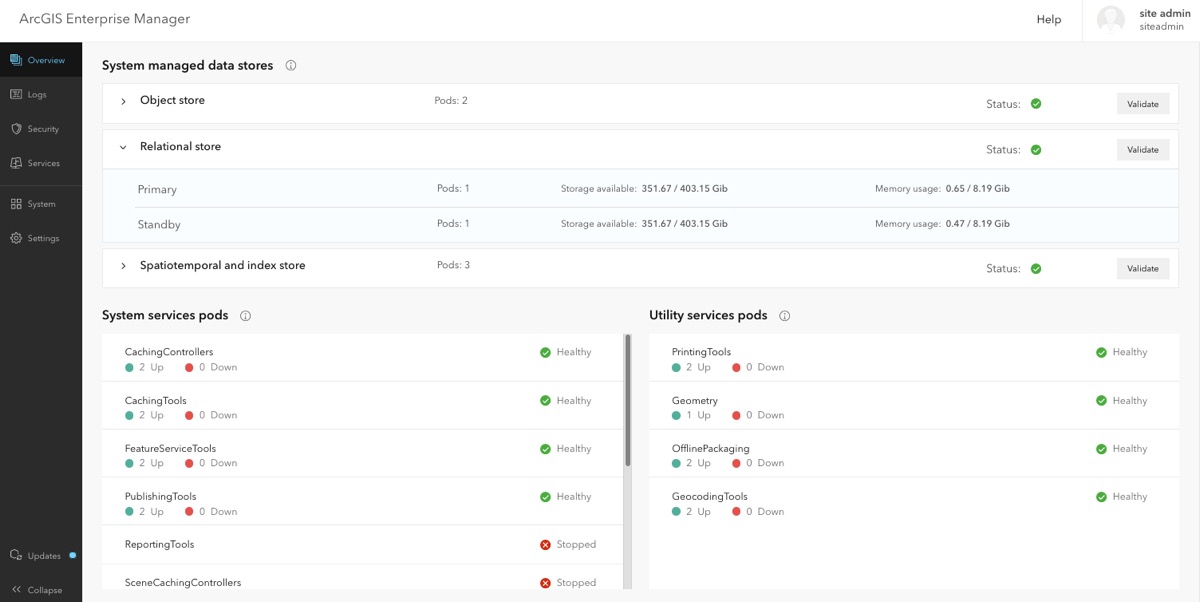
Esri ArcGIS Enterprise on Kubernetes deployment. Image Credits: Esri
“We have a lot of customers — especially some of the larger customers — that run very complex questions,” Seaton explained. “And sometimes it’s unpredictable. They might be responding to seasonal events or business events or economic events, and they need to understand not only what’s going on in the world, but also respond to their many users from outside the organization coming in and asking questions of the systems that they put in place using ArcGIS. And that unpredictable demand is one of the key benefits of Kubernetes.”
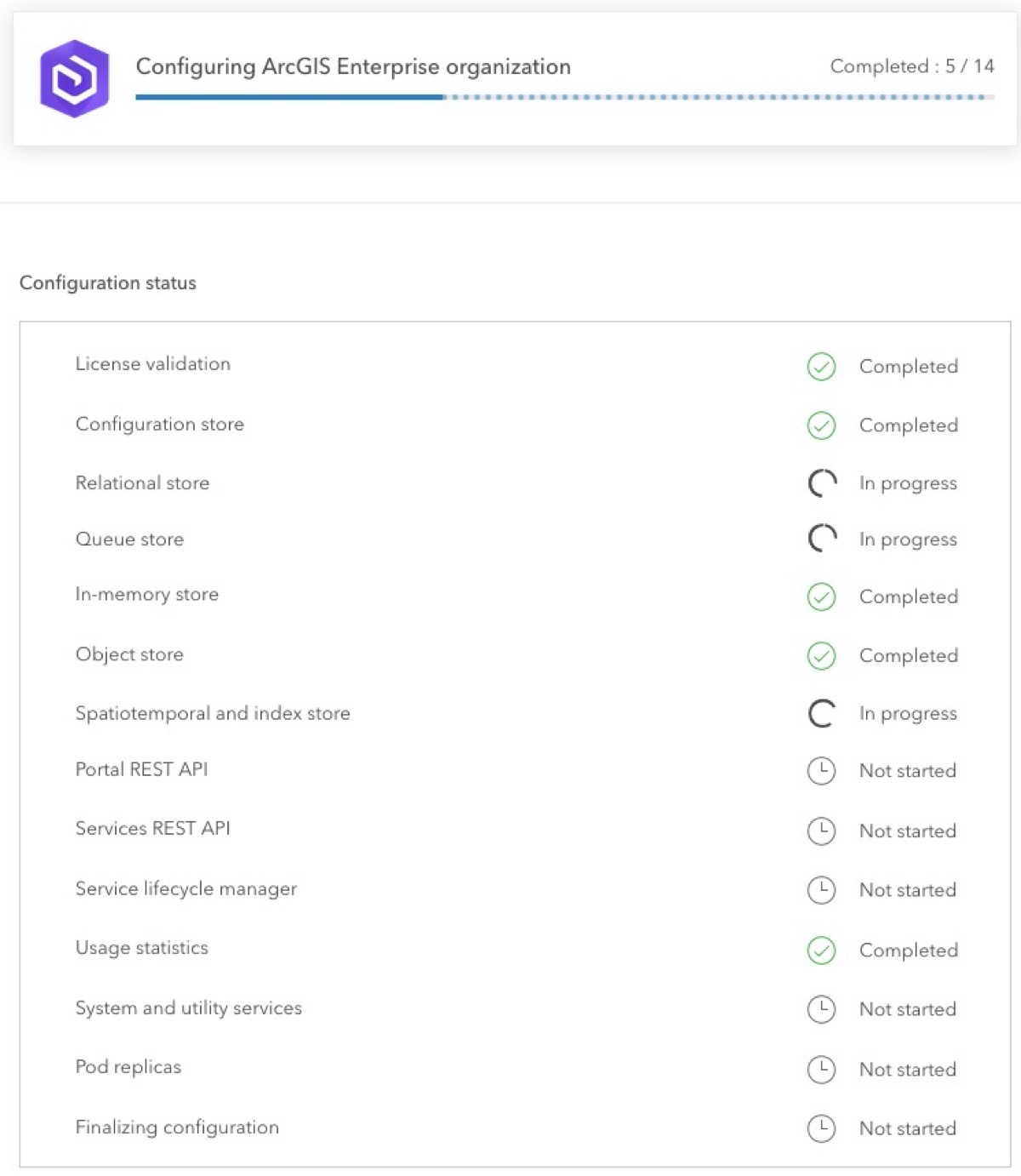
Deploying Esri ArcGIS Enterprise on Kubernetes. Image Credits: Esri
The team could have chosen to go the easy route and put a wrapper around its existing tools to containerize them and call it a day, but as Seaton noted, Esri used this opportunity to re-architect its tools and break it down into microservices.
“It’s taken us a while because we took three or four big applications that together make up [ArcGIS] Enterprise,” he said. “And we broke those apart into a much larger set of microservices. That allows us to containerize specific services and add a lot of high availability and resilience to the system without adding a lot of complexity for the administrators — in fact, we’re reducing the complexity as we do that and all of that gets installed in one single deployment script.”
While Kubernetes simplifies a lot of the management experience, a lot of companies that use ArcGIS aren’t yet familiar with it. And as Seaton and Heede noted, the company isn’t forcing anyone onto this platform. It will continue to support Windows and Linux just like before. Heede also stressed that it’s still unusual — especially in this industry — to see a complex, fully integrated system like ArcGIS being delivered in the form of microservices and multiple containers that its customers then run on their own infrastructure.
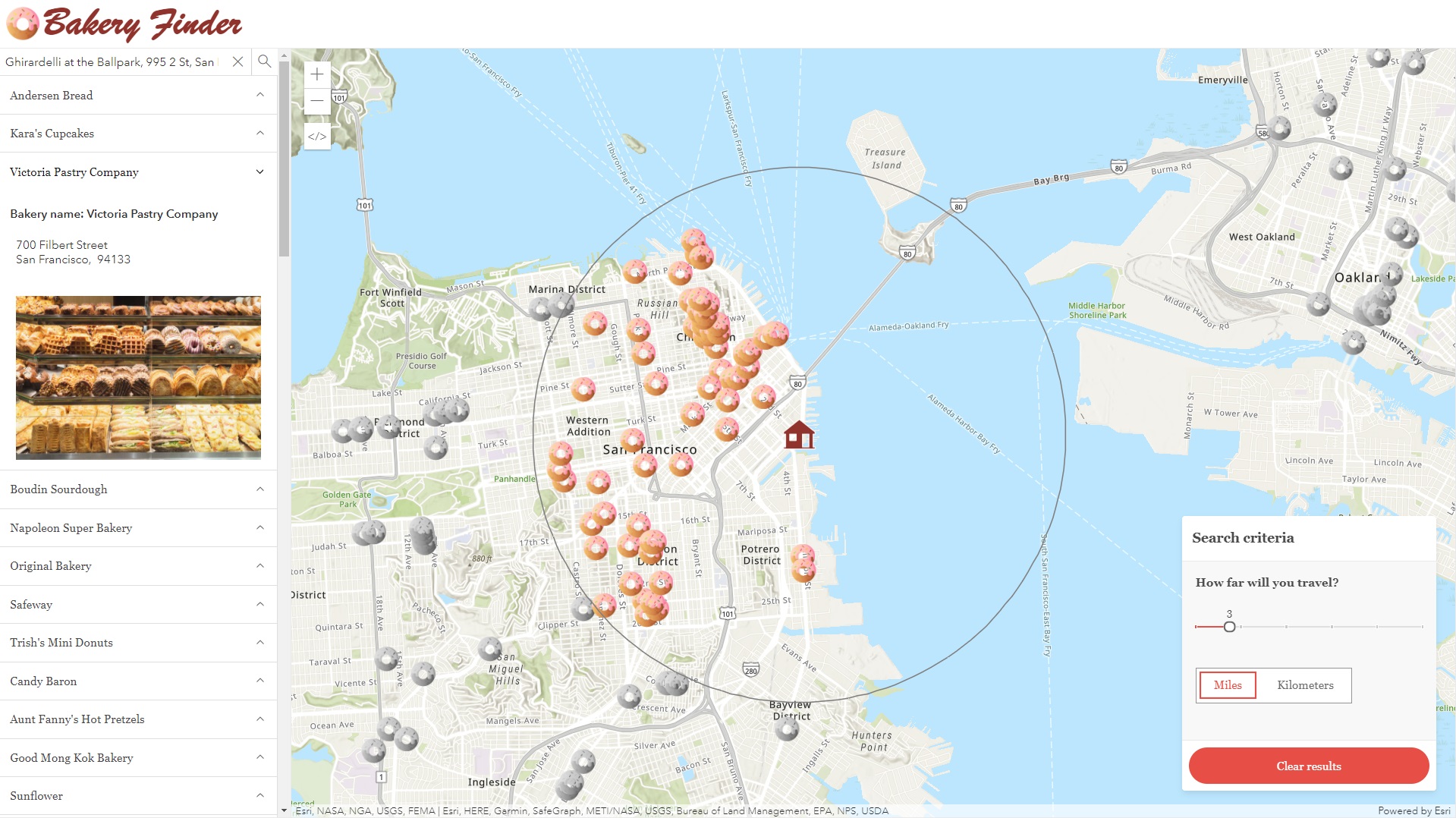
Image Credits: Esri
In addition to the Kubernetes announcement, Esri also today announced new JavaScript APIs that make it easier for developers to create applications that bring together Esri’s server-side technology and the scalability of doing much of the analysis on the client-side. Back in the day, Esri would support tools like Microsoft’s Silverlight and Adobe/Apache Flex for building rich web-based applications. “Now, we’re really focusing on a single web development technology and the toolset around that,” Esri product manager Julie Powell told me.
A bit later this month, Esri also plans to launch its new design system to make it easier and faster for developers to create clean and consistent user interfaces. This design system will launch April 22, but the company already provided a bit of a teaser today. As Powell noted, the challenge for Esri is that its design system has to help the company’s partners put their own style and branding on top of the maps and data they get from the ArcGIS ecosystem.
Powered by WPeMatico

Machine learning (ML) models are only as good as the data you feed them. That’s true during training, but also once a model is put in production. In the real world, the data itself can change as new events occur and even small changes to how databases and APIs report and store data could have implications on how the models react. Since ML models will simply give you wrong predictions and not throw an error, it’s imperative that businesses monitor their data pipelines for these systems.
That’s where tools like Aporia come in. The Tel Aviv-based company today announced that it has raised a $5 million seed round for its monitoring platform for ML models. The investors are Vertex Ventures and TLV Partners.
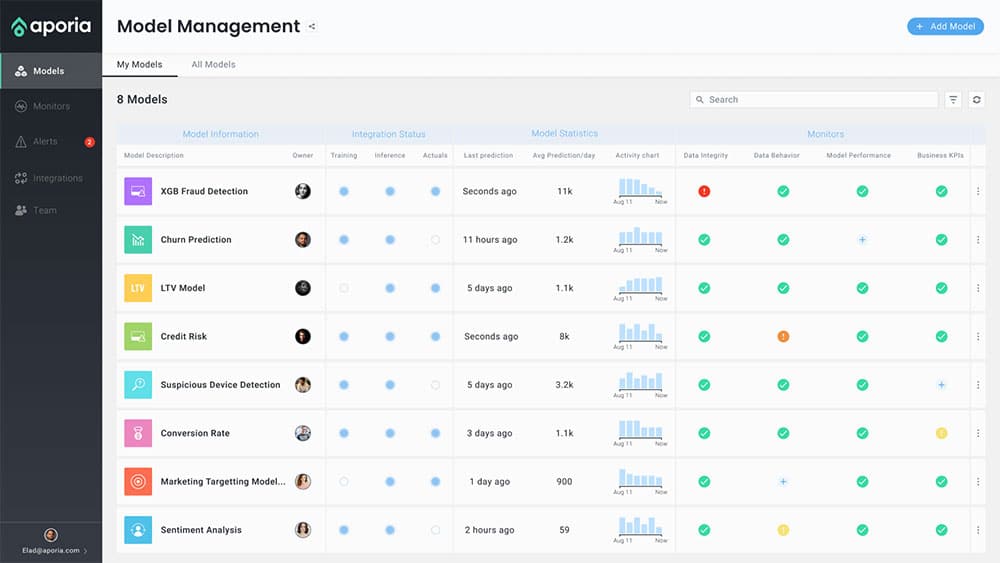
Image Credits: Aporia
Aporia co-founder and CEO Liran Hason, after five years with the Israel Defense Forces, previously worked on the data science team at Adallom, a security company that was acquired by Microsoft in 2015. After the sale, he joined venture firm Vertex Ventures before starting Aporia in late 2019. But it was during his time at Adallom where he first encountered the problems that Aporio is now trying to solve.
“I was responsible for the production architecture of the machine learning models,” he said of his time at the company. “So that’s actually where, for the first time, I got to experience the challenges of getting models to production and all the surprises that you get there.”
The idea behind Aporia, Hason explained, is to make it easier for enterprises to implement machine learning models and leverage the power of AI in a responsible manner.
“AI is a super powerful technology,” he said. “But unlike traditional software, it highly relies on the data. Another unique characteristic of AI, which is very interesting, is that when it fails, it fails silently. You get no exceptions, no errors. That becomes really, really tricky, especially when getting to production, because in training, the data scientists have full control of the data.”
But as Hason noted, a production system may depend on data from a third-party vendor and that vendor may one day change the data schema without telling anybody about it. At that point, a model — say for predicting whether a bank’s customer may default on a loan — can’t be trusted anymore, but it may take weeks or months before anybody notices.
Aporia constantly tracks the statistical behavior of the incoming data and when that drifts too far away from the training set, it will alert its users.
One thing that makes Aporia unique is that it gives its users an almost IFTTT or Zapier-like graphical tool for setting up the logic of these monitors. It comes pre-configured with more than 50 combinations of monitors and provides full visibility in how they work behind the scenes. That, in turn, allows businesses to fine-tune the behavior of these monitors for their own specific business case and model.
Initially, the team thought it could build generic monitoring solutions. But the team realized that this wouldn’t only be a very complex undertaking, but that the data scientists who build the models also know exactly how those models should work and what they need from a monitoring solution.
“Monitoring production workloads is a well-established software engineering practice, and it’s past time for machine learning to be monitored at the same level,” said Rona Segev, founding partner at TLV Partners. “Aporia‘s team has strong production-engineering experience, which makes their solution stand out as simple, secure and robust.”
Powered by WPeMatico

At its Oktane21 conference, Okta, the popular authentication and identity platform, today announced a new — and free — developer edition that features fewer limitations and support for significantly more monthly active users than its current free plan.
The new ‘Okta Starter Developer Edition,’ as it’s called, allows developers to scale up to 15,000 monthly active users — up from only 1,000 on its existing free plan. In addition, the company is also launching enhanced documentation, a set of sample apps and new SDKs, which now cover languages and frameworks like Go, Java, JavaScript, Python, Vue.js, React Native and Spring Boot.
“Our overall philosophy isn’t, ‘we want to just provide […] a set of authentication and authorization services.’ The way we’re looking at this is, ‘hey, app developer, how do we provide you the foundation you need to get up and running quickly with authorization and authentication as one part of it,’ ” Diya Jolly, Okta’s chief product officer, told me. And she believes that Okta is in a unique position to do so, because it doesn’t only offer tools to manage authorization and access, but also systems for securing microservices and providing applications with access to privileged resources.
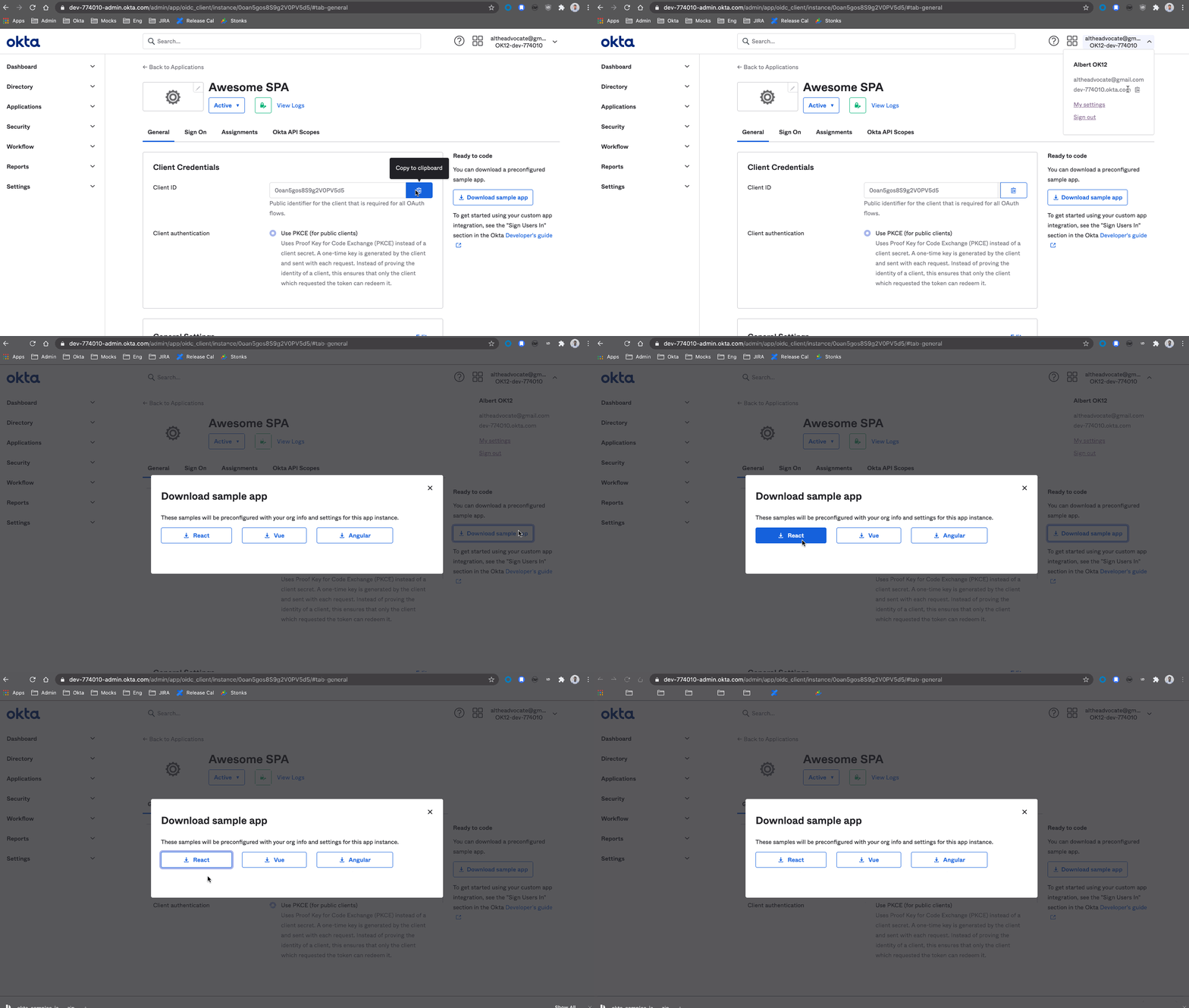
Image Credits: Okta
It’s also worth noting that, while the deal hasn’t closed yet, Okta’s intent to acquire Auth0 significantly extends its developer strategy, given Auth0’s developer-first approach.
As for the expanded free account, Jolly noted that the company found that developers wanted to be able to access more of the service’s features during their prototyping phases. That means the new free Developer Edition comes with support for multi-factor authentication, machine-to-machine tokens and B2B integrations, for example, in addition to expanded support for integrations into toolchains. As is so often the case with enterprise tools, the free edition doesn’t come with the usual enterprise support options and has lower rate limits than the paid plans.
Still, and Jolly acknowledged this, a small to medium-sized business may be able to build applications and take them into production based on this new free plan.
“15K [monthly active users] is is a lot, but if you look at our customer base, it’s about the right amount for the smaller business applications, the real SMBs, and that was the goal. In a developer motion, you want people to try out things and then upgrade. I think that’s the key. No developer is going to come and build with you if you don’t have a free offering that they can tinker around and play with.”
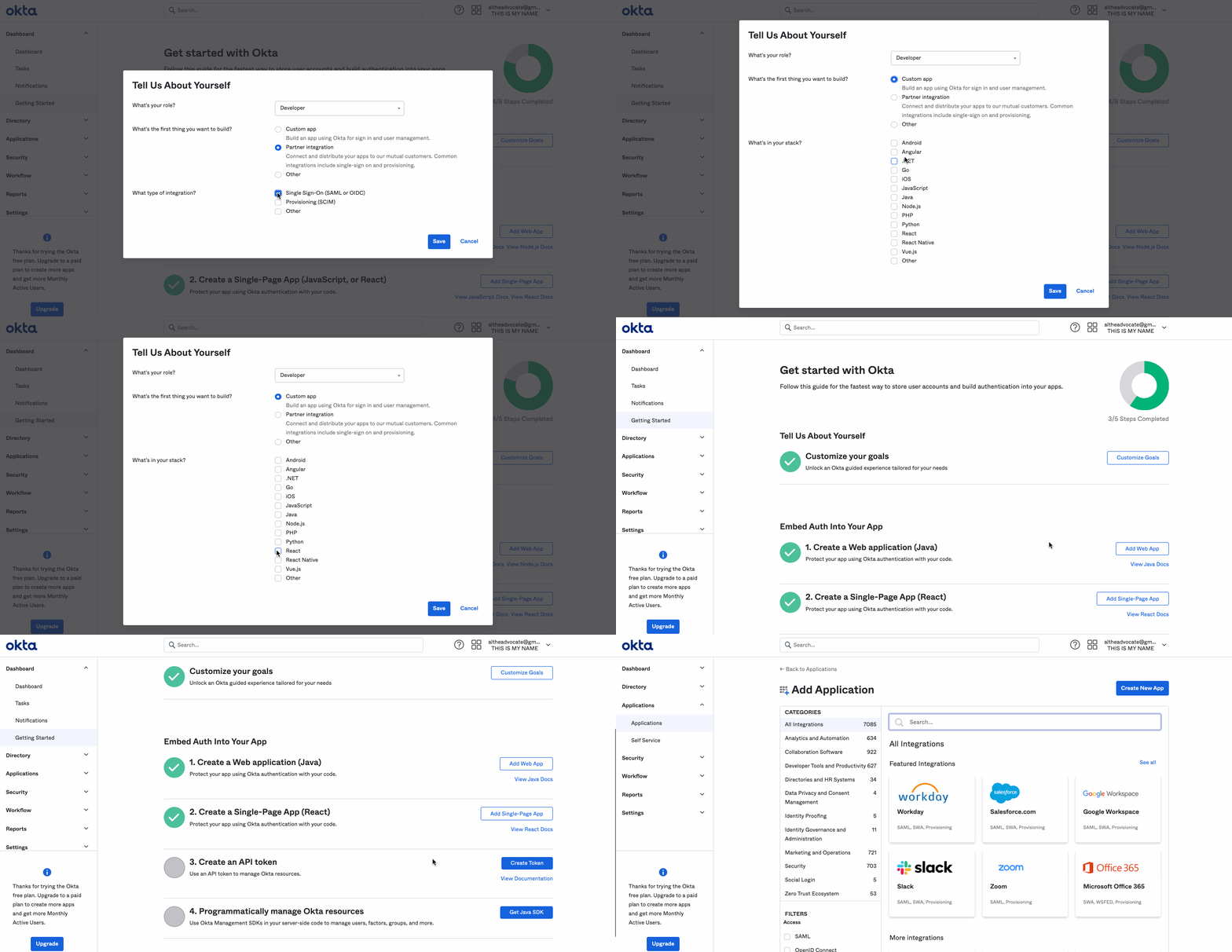
Image Credits: Okta
She noted that the company has spent a lot of time thinking about how to support developers through the application development lifecycle overall. That includes better CLI tools for developers who would rather bypass Okta’s web-based console, for example, and additional integrations with tools like Terraform, Kong and Heroku. “Today, [developers] have to stitch together identity and Okta into those experiences — or they use some other identity — we’ve pre-stitched all of this for them,” Jolly said.
The new Okta Starter Developer Edition, as well as the new documentation, sample applications and integrations, are now available at developer.okta.com.
Powered by WPeMatico
Digital transformation is the name of the game these days, and companies that are enabling businesses to take a leap into the future, by helping them tackle their most complex operations, are reaping the rewards. In the latest development, OneStream, a startup that provides a toolkit of services to enterprises to help them run financial operations (for example, reporting, planning, tax and more), has raised $200 million in primary equity. The funding values OneStream at $6 billion.
D1 Capital Partners led the financing, with participation from Tiger Global and Investment Group of Santa Barbara (IGSB), the company said. Tiger Global and D1 appear to share at least one common backer, Tiger Management, which may be one reason why you see them together in many big deals.
The company plans to use the funding to continue building out the tools that it provides to customers, and to keep up with demand for its services as more customers replace legacy applications and very basic, spreadsheet-based operations.
“We remain sharply focused on delivering innovative planning, reporting and analysis solutions designed to help our customers succeed for today’s fast-paced and increasingly complex business environment,” said Tom Shea, CEO of OneStream Software, in a statement. “The valuation we received is great recognition of the value our employees and stakeholders have helped to create, as well as the exciting opportunities ahead for OneStream.”
To put these large numbers into some context, OneStream was valued at $1 billion only two years ago, when KKR took a majority stake in the company worth more than $500 million. The company’s CFO, Bill Koefoed, has confirmed to us that KKR will continue to be “substantially OneStream’s largest shareholder and remains a very supportive investor”. The company meanwhile appears to be holding off any plans for going public for the time being — despite some possible hints that it was considering that move.
“OneStream is currently focused on delivering 100% customer access, continuing to grow the business and creating value for stakeholders,” Koefoed said. “IPO is a potential exit and OneStream is preparing to be a public company. However, there is no specific timeline.”
The growth in valuation, meanwhile, reflects the surge of business that OneStream has seen in the last two years, and in particular in the last 12 months, as companies have been compelled to update their systems to work more efficiently and flexibly amid the COVID-19 pandemic and the impact it has had around in-person interactions. OneStream said annual recurring revenue grew 85% in 2020, with customers growing by 40% to 650 enterprises.
The company’s focus is specifically in the area commonly called corporate performance management (CPM), which includes a number of the financial corporate operations that a company runs behind the scenes to keep its business ticking.
Some of these would have fallen to a range of software providers, and much of the work would have been carried out by way of on-premise solutions, with companies like SAP, Oracle Hyperion and IBM dominating the space with all-in solutions, and others like Anaplan and Blackline providing point solutions addressing specific aspects of those functions.
But as with other areas of enterprise services, the advances of technology and software have created opportunities to take a lot of that functionality into the cloud and to run the processes across a single system to improve analytics and efficiency, and that has provided an opportunity to the likes of OneStream.
The impact of the pandemic should not be underestimated in this trend, and it was one that OneStream was able to nail because its software can be used across disparate teams and can draw a direct line to helping companies manage their finances better. And unlike a lot of tech companies that raise venture funding, one interesting detail with OneStream is that it has extended its customer base well outside the realm of technology companies and other early adopters. Those using its software include the likes of Fruit of the Loom, McCain (the frozen fries king) and AAA, but also Takeaway.com, the Carlyle Group and many others.
“The pandemic accelerated OneStream’s business given that it was a wake-up call for many companies that had not digitally transformed their key finance processes,” said Koefoed. “As a result, we have seen increased demand from companies who were using spreadsheets or legacy CPM applications to manage their financial close, consolidation, reporting, planning and forecasting processes… They are better able to keep their finance teams connected and collaborating while physically dispersed. In addition, we have seen many organizations increasing the frequency of their forecasting and scenario modeling from quarterly or monthly to weekly and daily in some cases, especially during the early days of the pandemic when modeling revenue and cash flow was critical.”
For investors, the interest more specifically was how OneStream managed to add more customers away from competitors in the last year.
“OneStream’s platform delivers exceptional customer value,” said Andrew Wynne, a principal at D1 Capital Partners, in a statement. “Management’s intense focus on customer success has enabled OneStream to capture significant market share from incumbents, while posting strong growth in both revenue and customer acquisition. We believe OneStream has both the vision and product required to be a dominant force in its industry.”
Going forward, it sounds like the company will continue to build on what it has already established. That will include more business into Asia Pacific alongside its current operations in North America and Europe, Koefoed said. It will also use its foothold in finance and providing services to the finance department to make inroads into other areas that link closely to money management: money spending and revenue generation, with tools to plan and operate in areas like HR, IT, sales, marketing, supply chain management “and other areas to ensure alignment and optimal resource allocations,” he added.
Powered by WPeMatico