Enterprise
Auto Added by WPeMatico
Auto Added by WPeMatico
Kenyan consumer experience platform for businesses in Africa, Ajua today announced that it has acquired WayaWaya, a Kenya-based AI and ML messaging and payments company.
WayaWaya’s customers and partners include the likes of I&M Bank, Interswitch and MTN. The company offers a range of services, from digital banking and payment services to financial services APIs and payment bots.
According to Ajua, the acquisition is primarily focused on WayaWaya’s payments bots system known as Janja. The platform, which has customers like Airtel, Ezee Money, Housing Finance Company of Kenya (HF Group), enables borderless banking and payments across apps and social media platforms. Teddy Ogallo, the entrepreneur who founded WayaWaya, joins Ajua as VP of Product APIs and Integrations.
Per Crunchbase, WayaWaya has just raised $75,000. Although the two companies did not disclose the financial details of the acquisition, Ajua is expected to have paid 10 times more than WayaWaya’s total raise.
Ajua, formerly mSurvey, was founded in 2012 by Kenfield Griffith. The company is solving a consumer data problem for African businesses to understand their business better and drive growth.
“There’s a lot of commerce happening on the continent and Ajua wants companies to move from transaction numbers to the customers behind such transaction,” Griffith told TechCrunch. “Imagine if we knew what drove consumer habits for businesses. I mean, that’s a huge exponential curve for African businesses.”

Teddy Ogallo (Founder, WayaWaya) & Kenfield Griffith (CEO, Ajua)
Nigeria’s SME market alone is valued at $220 billion annually. And while businesses, mostly big enterprises, can afford customer communication tools, a large segment of small businesses are being left out. Ajua’s play is to use data and analytics to connect companies with their customers in real time. “We’ve taken what makes enterprise customers successful, and we’re capturing it in a simple format so SMEs can have the same tools,” Griffith added.
Since most consumer behavior for these SMEs happens offline, Ajua gives businesses unique USSD codes to receive payments, get feedback and offer discounts to their customers. It is one of the products Ajua has launched over the years for customer feedback at the point of service to businesses that cumulatively have over 45 million customers.
The company’s partners and clients also include Coca-Cola, FBNQuest, GoodLife Pharmacy, Java House, Safaricom, Standard Chartered and Total.
As an intelligent messaging bot, Janja is used by individuals and businesses across WhatsApp, Facebook Messenger and Telegram to automate customer support and make cross-border payments. So, Janja’s integration into Ajua’s product stack will close much of the acquirer’s customer experience loop by automating responses and giving customers what they want, when they want it.
This acquisition comes a month after Ajua announced that it partnered with telecom operator MTN Nigeria to launch a customer management product for Nigerian businesses. The product called MTN EnGauge carries the same features present in Ajua but, in this case, is tailored solely for businesses using the MTN network. The roll-out is expected to generate more data for Ajua’s thousands of users. It will also be upgraded to incorporate Janja and other services.
In hindsight, it appears Ajua could have created a product like Janja in-house due to its vast experience in the consumer experience space. However, the company chose an acquisition and Griffith gave two reasons why — building a similar product would have taken a long time and Ogallo seemed to know Janja’s business and operations so well, it just made sense to get him on board.
“Teddy was going the same direction we’re going. We just thought to acquire WayaWaya instead and make a really good company out of both products attempting to solve the same problem. To me, it’s all about solving the problem together rather than going alone,” said the CEO.
On why he accepted the acquisition, Ogallo, who now has a new role, noted that Ajua’s ability to scale customer service and experience and also help businesses was one reason and earned admiration from him. “Seeing how WayaWaya’s technology can complement Ajua’s innovative products and services, and help scale and monetize businesses, is an exciting opportunity for us, and we are happy that our teams will be collaborating to build something unique for the continent,” he added.
This is a solid infrastructure play from Ajua coming from a founder who is a massive advocate of acquisition and consolidation. Griffith believes that the two are strategies for a speedier route to new markets and channels in Africa.
“I think there are lots of ways we can build the ecosystem. There are lots of young talent building stuff, and they don’t have access to capital to get to the next stage. The question is if they want to race to the finish line or take off time and get acquired. I think there’s a huge opportunity in Africa if you want to solve complex problems by acquisition.”
There has been an uptick in local acquisitions in Africa from startups within a single country and between two countries in the past three years. For the former, Nigerian recruitment platform Jobberman’s acquisition of NGCareers last year comes to mind. And there are pan-African instances like Lagos-based hub CcHub’s acquisition of iHub, its Nairobi counterpart; Ethiopian software provider Apposit sell-off to Nigerian fintech Paga; and Johannesburg-based fintech MFS Africa acquiring Uganda’s Beyonic.
The common theme among the acquisitions (and most African acquisitions) is their undisclosed sums. For Ajua, Griffith cited regulatory issues as one reason why the company is keeping the figure under wraps.
Since launching nine years ago, Ajua has raised a total of $3.5 million, according to Crunchbase. Given the nature of this acquisition and partnership with MTN, the company might set sights on another fundraise to scale aggressively into Nigeria (a market it entered in 2019) and other African countries.
Powered by WPeMatico
Red Hat CEO Paul Cormier runs the centerpiece of IBM’s transformation hopes. When Big Blue paid $34 billion for his company in 2018, it was because it believed it could be the linchpin of the organization’s shift to a focus on hybrid computing.
In its most recent earnings report, IBM posted positive revenue growth for only the second time in eight quarters, and it was Red Hat’s 15% growth that led the way. Cormier recognizes the role his company plays for IBM, and he doesn’t shy away from it.
As he told me in an interview this week ahead of the company’s Red Hat Summit, a lot of cloud technology is based on Linux, and as the company that originally made its name selling Red Hat Enterprise Linux (RHEL), he says that is a technology his organization is very comfortable working with. He sees the two companies working well together, with Red Hat benefitting from having IBM sell his company’s software, while remaining neutral technologically, something that benefits customers and pushes the overall IBM vision.
Even though Cormier has been with Red Hat for 20 years, he took over as its CEO after Arvind Krishna replaced Ginni Rometty as IBM’s chief executive and long-time Red Hat CEO Jim Whitehurst moved over to a role at IBM last April. Cormier stepped in as leader just as the pandemic hit the U.S. with its full force.
“Going into my first year of a pandemic, no one knew what the business was going to look like, and not that we’re completely out of the woods yet, but we have weathered that pretty well,” he said.
Part of the reason for that is because like many software companies, he has seen his customers shifting to the cloud much faster than anyone thought previously. While the pandemic acted as a forcing event for digital transformation, it has left many companies to manage a hybrid on-prem and cloud environment, a place where Red Hat can help.
“Having a hybrid architecture brings a lot of value […], but it’s complex. It just doesn’t happen by magic, and I think we helped a lot of customers, and it accelerated a lot of things by years of what was going to happen anyways,” Cormier told me.
In terms of the workforce moving to work from home, Red Hat had 25% of its workforce doing that even before the pandemic, so the transition wasn’t as hard as you might think for a company of its size. “Most every meeting at Red Hat had someone on remotely [before the pandemic]. And so we just sort of flipped into that mode overnight. I think we had an easier time than others for that reason,” he said.
Red Hat’s 15% growth was a big reason for IBM showing modest revenue growth last quarter, something that has been hard to come by for the last seven years. At IBM’s earnings call with analysts, CEO Krishna and CFO Jim Kavanaugh both saw Red Hat maintaining that double digit growth as key to driving the company toward more stable positive revenue in the coming years.
Cormier says that he anticipates the same things that IBM expects — and that Red Hat is up to the task ahead of it. “We see that growth continuing to happen as it’s a huge market, and this is the way it’s really playing out. We share the optimism,” he explained.
While he understands that Red Hat must remain neutral and work with multiple cloud partners, IBM is free to push Red Hat, and having that kind of sales clout behind it is also helping drive Red Hat revenue. “What IBM does for us is they open the door for us in many more places. They are in many more countries than we were [prior to the acquisition], and they have a lot of high-level relationships where they can open the door for us,” he said.
In fact, Cormier points out that IBM salespeople have quotas to push Red Hat in their biggest accounts. “IBM sales is very incentivized to bring Red Hat in to help solve customer problems with Red Hat products,” he said.
When you’re being billed as a savior of sorts for a company as storied as IBM, it wouldn’t be surprising for Cormier to feel the weight of those expectations. But if he is he doesn’t seem to show it. While he acknowledges that there is pressure, he argues that it’s no different from being a public company, only the stakeholders have changed.
“Sure it’s pressure, but prior to [being acquired] we were a public company. I look at Arvind as the chairman of the board and IBM as our shareholders. Our shareholders put a lot of pressure on us too [when we were public]. So I don’t feel any more pressure with IBM and with Arvind than we had with our shareholders,” he said.
Although they represent only 5% of IBM’s revenue at present, Cormier knows it isn’t really about that number, per se. It’s about what his team does and how that fits in with IBM’s transformation strategy overall.
Being under pressure to deliver quarter after quarter is the job of any CEO, especially one that’s in the position of running a company like Red Hat under a corporation like IBM, but Cormier as always appears to be comfortable in his own skin and confident in his company’s ability to continue chugging along as it has been with that double-digit growth. The market potential is definitely there. It’s up to Red and Hat and IBM to take advantage.
Powered by WPeMatico
In the never-ending stream of venture capital funding rounds, from time to time, a group of startups working on the same problem will raise money nearly in unison. So it was with OKR-focused startups toward the start of 2020.
How were so many OKR-focused tech upstarts able to raise capital at the same time? And was there really space in the market for so many different startups building software to help other companies manage their goal-setting? OKRs, or “objectives and key results,” a corporate planning method, are no longer a niche concept. But surely, over time, there would be M&A in the group, right?
During our first look into the cohort, we concluded that it felt likely that there was “some consolidation” ahead for the group “when growth becomes more difficult.” At the time, however, it was clear that many founders and investors expected the OKR software market to have material depth.
They were right, and we were wrong. A year later, in early 2021, we asked the same group how their previous year had gone. Nearly every single company had a killer year, with many players growing by well over 100%.
The Exchange explores startups, markets and money. Read it every morning on Extra Crunch or get The Exchange newsletter every Saturday.
OKR company Ally.io grew 3.3x in 2020, for example, while its competitor Gtmhub grew by 3x over the same time period. More capital followed. Ally.io raised $50 million in a Series C in the first quarter, while Gtmhub put together a $30 million Series B during the same period.
They won’t be the final startups in the OKR cohort to raise this year. We know this because we reached out to the group again this week, this time probing their Q1 performance, and, critically, asking the startups to discuss their level of optimism regarding the rest of 2021.
 As before, the group’s recent results are strong, at least when compared to their own planning. But notably, the collection of competing companies is more optimistic than before about the rest of the year than they were before Q1 2021. Things are heating up for the OKR startup world.
A takeaway from our work today is that our prior notes about how impressively deep the software market is proving to be may have been too modest. And frankly, that’s super-good news for startups and investors alike. So much for SaaS-fatigue.
In a sense, we should not be surprised that OKR startups are doing well or that the startup software market is so large. You’d imagine that the historic pace of venture capital investment that we’ve seen so far in 2021 in Europe and the United States was based on results, or evidence that there was lots more room for software-focused startups to grow.
Interestingly, while these companies look similar to outsiders, they are each betting on strategies and differentiators that could help them win in their selected portion of the OKR space. Which also means that the sector may not be as crowded as it seems.
Don’t take our word for it. Let’s hear from Gtmhub COO Seth Elliott, Workboard CEO and co-founder Deidre Paknad, Koan CEO and co-founder Matt Tucker, Ally.io CEO and co-founder Vetri Vellore, and Perdoo CEO and founder Henrik-Jan van der Pol about just what the software market looks like to them.
We’ll start with how the startups performed in Q1 2021, dig into how they feel about the rest of the year, and then talk about how differentiation among the cohort could be helping them not step on each other’s toes.
WorkBoard is having a strong start to 2021. Paknad’s company, which raised in both March of 2019 and January of 2020, told The Exchange that it hired 82 people in the first three months of 2021, and that it plans on doing it again in the current quarter. WorkBoard is “investing heavily,” Paknad said via DM, and “made [its] Q1 targets.”
Powered by WPeMatico
Vena, a Canadian company focused on the Corporate Performance Management (CPM) software space, has raised $242 million in Series C funding from Vista Equity Partners.
As part of the financing, Vista Equity is taking a minority stake in the company. The round follows $25 million in financing from CIBC Innovation Banking last September, and brings Vena’s total raised since its 2011 inception to over $363 million.
Vena declined to provide any financial metrics or the valuation at which the new capital was raised, saying only that its “consistent growth and…strong customer retention and satisfaction metrics created real demand” as it considered raising its C round.
The company was originally founded as a B2B provider of planning, budgeting and forecasting software. Over time, it’s evolved into what it describes as a “fully cloud-native, corporate performance management platform” that aims to empower finance, operations and business leaders to “Plan to Grow” their businesses. Its customers hail from a variety of industries, including banking, SaaS, manufacturing, healthcare, insurance and higher education. Among its over 900 customers are the Kansas City Chiefs, Coca-Cola Consolidated, World Vision International and ELF Cosmetics.
Vena CEO Hunter Madeley told TechCrunch the latest raise is “mostly an acceleration story for Vena, rather than charting new paths.”
The company plans to use its new funds to build out and enable its go-to-market efforts as well as invest in its product development roadmap. It’s not really looking to enter new markets, considering it’s seeing what it describes as “tremendous demand” in the markets it currently serves directly and through its partner network.
“While we support customers across the globe, we’ll stay focused on growing our North American, U.K. and European business in the near term,” Madeley said.
Vena says it leverages the “flexibility and familiarity” of an Excel interface within its “secure” Complete Planning platform. That platform, it adds, brings people, processes and systems into a single source solution to help organizations automate and streamline finance-led processes, accelerate complex business processes and “connect the dots between departments and plan with the power of unified data.”
Early backers JMI Equity and Centana Growth Partners will remain active, partnering with Vista “to help support Vena’s continued momentum,” the company said. As part of the raise, Vista Equity Managing Director Kim Eaton and Marc Teillon, senior managing director and co-head of Vista’s Foundation Fund, will join the company’s board.
“The pandemic has emphasized the need for agile financial planning processes as companies respond to quickly-changing market conditions, and Vena is uniquely positioned to help businesses address the challenges required to scale their processes through this pandemic and beyond,” said Eaton in a written statement.
Vena currently has more than 450 employees across the U.S., Canada and the U.K., up from 393 last year at this time.
Powered by WPeMatico
Five months ago, Adobe purchased (for $1.5 billion) Workfront, a company that helps build marketing department workflows. Today the company is officially announcing how it intends to use it. As marketing executives try to balance mapping strategy to the creative process while building customized experiences, a marketing workflow tool would fit neatly into Adobe Experience Manager (AEM), and that’s where it has landed.
Alex Shootman, who was CEO at Workfront and is now VP and GM of Adobe Workfront, told me they see the tool as the system of record for the marketing department inside of AEM. While there is more than a hint of marketing in that explanation, the data from Workfront’s workflows acts as a record of the creative process.
As part of Adobe, the company has built hooks into Experience Manager and Creative Cloud to enable marketing’s creative work to move through an organized and auditable process, leaving a data trail that lets management know exactly what happened — a marketing system of record.
Shootman says having this system of record in place allows marketing teams to do several things. For starters, it lets them connect strategy to execution. “If you think about a CMO, he or she and their team is developing the key priorities for decisions for the year or for the quarter [and this helps them] take those key priorities and make sure that they are driving the activities within the marketing organization,” he said.
He says that involves connecting the people, processes and data within marketing into a single system where teams can iteratively plan on the work as changes arise. That’s where Workfront comes into play.
Brent Leary, lead analyst at CRM Essentials, says the approach makes a great deal of sense. “Creating enough personalized content at scale to stay connected with customers as their needs evolve over time is a team sport. That calls for tighter collaboration throughout the creation process, and Workfront within the AEM brings a sophisticated project management capability to the creative process,” Leary said.
During the pandemic, that became imperative as the majority of sales moved online. That increased the need for speed and agility. Having this workflow tool in place inside the Adobe Experience Manager means it’s not only allowing marketing to build customized experiences for its customers, it also enables them to automate the workflows behind those customizations.
The way this could work in practice is a marketing team creates a campaign and maps it out in Workfront. From there, creatives get assigned tasks and these tasks show up in Creative Cloud. When they complete the assignment, it automatically goes back into Workfront where it will be reviewed, eventually get approved and get published to the Digital Asset Management (DAM) tool where it will be available for use by the entire marketing team.
When it comes to acquisitions, it’s hard to know how well they’ll turn out, but Workfront seems particularly well suited to the Adobe ecosystem, a tool that can help bring a missing workflow automation component to the entire creative process, while allowing marketing execs to see exactly how their strategy played out.
Powered by WPeMatico

Adobe today announced the launch of a new asset management tool, Adobe Experience Manager Assets Essentials. That’s a mouthful, but while the company didn’t necessarily simplify the name, the idea here is to give teams that work with lots of digital assets an easier-to-use management experience in the Adobe Experience Cloud than Adobe’s current enterprise-centric asset management tool can offer.
In addition, Adobe is also launching the first tool to integrate this new experience: the Adobe Journey Optimizer. This new tool is meant to help users leverage their customer data to build out customer journeys and figure out the best ways to deliver messages and content along that journey.
“The push towards digital content and building these richer, engaging experiences — customers expect it,” Elliot Sedegah, director of Strategy and Product Marketing, Adobe, told me. “Almost every interaction that you go along, you expect a rich experience. And not only at that point of just having richer material, like images or video, etc., but you expect it at every point of interaction with that customer. So that customer, if you think of it, isn’t just interacting with a brand, but our customers, they think of it as a customer journey. So using the same content, from awareness to conversion to post-sale and loyalty — they expect that same story to maintain. And it’s getting increasingly hard to get to all the different touchpoints.”
Image Credits: Adobe
Like with similar products, the idea here is to create a centralized, collaborative space for content creators and the teams that use their work. In that respect, this new tool isn’t necessarily all that different from other shared online file management services. But Adobe is also leveraging some of its unique capabilities. It’s using its AI smarts and Adobe Sensei platform to help users organize and tag their assets, for example, to make them more easily searchable. And the new tool is integrated with Adobe Asset Link, so creative professionals can search, browse and edit these assets directly from Photoshop, Illustrator, InDesign and XD without having to switch context.
As Sedegah noted, not too long ago, it was mostly the creative teams and marketing that were involved in the content creation and management process. But today, this group also includes sales teams and customer support, for example, and the pandemic only accelerated this process.

Image Credits: Adobe
“[Our customers] have been forced to rethink their business models, rethink the way that they engage with customers — and it essentially accelerated this digital-everywhere process of the experiences customers get, the agility that customers expect from businesses, and then the number of people — and how they work — leveraging that content.”
So while Adobe’s enterprise asset management tools worked just fine before, the company’s users were telling it that it needed to do a better job at creating tools that made its asset management technology easier to use by more teams.
The first tool to integrate this new asset management experience directly is the Journey Optimizer. “That was a great opportunity for us to rethink that user experience that our customers wanted to deliver — and then make it easier for that person to do,” Sedegah said. “So as you’re building out a content journey — or maybe you’re designing a piece of content that’s going to get sent to maybe a customer as they engage with a brand — the digital assets appear right there for that author to use.”
Next up for integration is Workfront, the work management platform Adobe acquired last year. There’s an obvious synergy here between Workfront’s abilities to manage the planning, review and approval stages of a project and an asset management system like this.
The long-term strategy, though, is to integrate this experience across all Experience Cloud applications.
Powered by WPeMatico

Arm today announced the launch of two new platforms, Arm Neoverse V1 and Neoverse N2, as well as a new mesh interconnect for them. As you can tell from the name, V1 is a completely new product and maybe the best example yet of Arm’s ambitions in the data center, high-performance computing and machine learning space. N2 is Arm’s next-generation general compute platform that is meant to span use cases from hyperscale clouds to SmartNICs and running edge workloads. It’s also the first design based on the company’s new Armv9 architecture.
Not too long ago, high-performance computing was dominated by a small number of players, but the Arm ecosystem has scored its fair share of wins here recently, with supercomputers in South Korea, India and France betting on it. The promise of V1 is that it will vastly outperform the older N1 platform, with a 2x gain in floating-point performance, for example, and a 4x gain in machine learning performance.
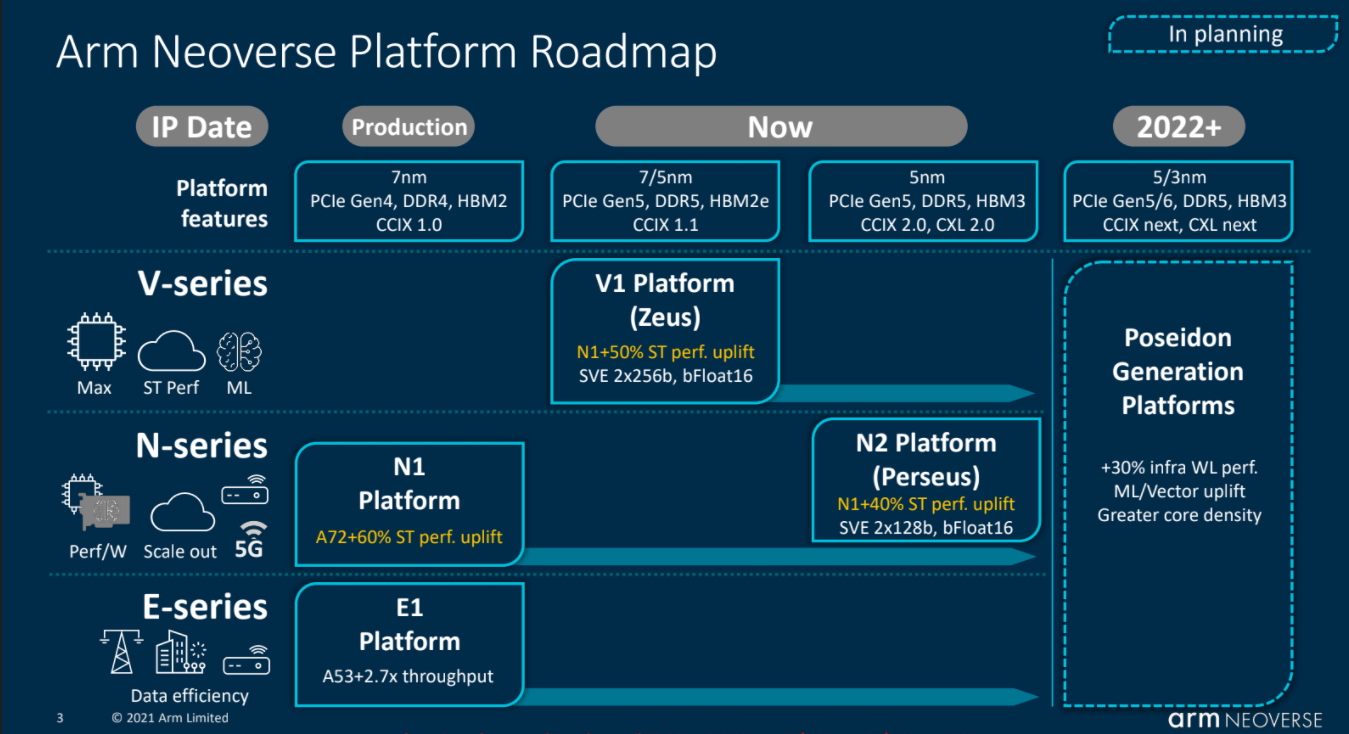
Image Credits: Arm
“The V1 is about how much performance can we bring — and that was the goal,” Chris Bergey, SVP and GM of Arm’s Infrastructure Line of Business, told me. He also noted that the V1 is Arm’s widest architecture yet. He noted that while V1 wasn’t specifically built for the HPC market, it was definitely a target market. And while the current Neoverse V1 platform isn’t based on the new Armv9 architecture yet, the next generation will be.
N2, on the other hand, is all about getting the most performance per watt, Bergey stressed. “This is really about staying in that same performance-per-watt-type envelope that we have within N1 but bringing more performance,” he said. In Arm’s testing, NGINX saw a 1.3x performance increase versus the previous generation, for example.

Image Credits: Arm
In many ways, today’s release is also a chance for Arm to highlight its recent customer wins. AWS Graviton2 is obviously doing quite well, but Oracle is also betting on Ampere’s Arm-based Altra CPUs for its cloud infrastructure.
“We believe Arm is going to be everywhere — from edge to the cloud. We are seeing N1-based processors deliver consistent performance, scalability and security that customers want from Cloud infrastructure,” said Bev Crair, senior VP, Oracle Cloud Infrastructure Compute. “Partnering with Ampere Computing and leading ISVs, Oracle is making Arm server-side development a first-class, easy and cost-effective solution.”
Meanwhile, Alibaba Cloud and Tencent are both investing in Arm-based hardware for their cloud services as well, while Marvell will use the Neoverse V2 architecture for its OCTEON networking solutions.
Powered by WPeMatico
Getting actionable business information into the hands of users who need it has always been a challenge. If you have to wait for experts to help you find the answers, chances are you’re going to be too late. Enter Tellius, an early-stage startup building a solution to help business users find the information they need when they need it.
Today the company announced an $8 million Series A led by Sands Capital Ventures, with participation from Grotech. Today’s investment brings the total raised to $17 million, according to the company.
CEO and founder Ajay Khanna says the company is attempting to marry two technologies that have traditionally lived in silos: business intelligence and artificial intelligence. He believes that bringing them together can lead to greater wisdom and help close the insight gap.
“Tellius is an AI-driven decision intelligence platform, and what we do is we combine machine learning — AI-driven automation — with a Google-like natural language interface, so combining the left brain and the right brain to enable business teams to get insights on the data,” Khanna told me.
The idea is to let the machine learning teams and the business analysts continue to do their thing, but provide an application where business users can put all of that to work. “We believe that to go from data to decisions, you need to know not only what happened, but why things change and how you can improve your company,” he said.
The product takes aim at three employee groups. The first is the business user, who can simply query the data with a natural language question to get results. The second is a data analyst, who can get more granular by choosing a specific model to base the query on, and finally a data scientist who can enhance the query with Python or Spark code.
It connects to various data sources, including Salesforce and Google Analytics, data lakes like Snowflake, csv files to take advantage of Excel data or cloud storage tools like Amazon S3. It comes in two versions: one that the customer can connect to the cloud infrastructure provider of choice, and one which they run as a service and manage for the customers.
Khanna says that as companies struggled to change the way they do business during the pandemic, they needed the kind of insights his company provides, and business grew 300% last year as a result.
The startup launched in 2016 after Khanna sold a previous company, which allowed him to bootstrap while in stealth. They spent a couple of years building the product and brought the first version of Tellius to market in Q3 2018. That’s when they took a $7.5 million seed round.
Powered by WPeMatico
As businesses continue to look for better ways to work more efficiently, a pioneer in the space of low-code tools to help automate how apps work together is announcing a round of funding on the back of impressive early traction.
Berlin-based n8n — which provides a framework for both technical and non-technical people to synchronize and integrate data and workflows — has raised $12 million in a Series A round of funding.
The startup plans to use the money to continue expanding its team, which now numbers 60 people, and to expand its platform and the services it provides to users.
Currently, n8n can help link up and integrate data and functions between more than 200 established applications, as well as any custom apps or services that you might be using in your specific organization. And since launching in October 2019, the startup has picked up an impressive 16,000 users — including both developers and “citizen developers” (those whose jobs might be described as non-technical but they are not afraid to be more hands-on in trying to build in ways to work better).
Now it wants to make the service easier for more of the latter group to get stuck in with using it.
“We are still seen as a technical product and less of one for citizen developers,” founder and CEO Jan Oberhauser said in an interview. “Our plan is to make n8n simpler to use, so that it’s much easier to adopt. We want to give everyone technical superpowers, whether it’s the marketing team or the IT department.” That means for example building not just chatbots but more intelligent ones, or creating new ways of visualizing data in Slack or something else altogether. And n8n’s platform can also be used to build automation within products, for example to monitor performance and flag when something might need maintenance.
The round is being led by Felicis Ventures, with Sequoia Capital, firstminute Capital and Harpoon Ventures also participating. Sequoia and firstminute co-led n8n’s seed round about a year ago, which also included participation from Eventbrite’s Kevin Hartz, Supercell’s Ilkka Paananen and unnamed early employees of Google and Zendesk, among others. The startup has now raised around $14 million and is not disclosing valuation.
There are a number of low-code and no-code startups on the market today and many of them have been seeing a surge of in interest in the last year. It’s a trend I suspect was brought about in no small part by the arrival of COVID-19.
The pandemic not only led to more people working remotely and relying on apps and other cloud-based services to get what they needed to do done, but in many cases it led organizations to refocus on how they were working, and what could be improved. In some cases, it also has meant a severe tightening of belts, and so companies are needing to do more with less human power, another factor leading to more proactive efforts to use software to get more out of… software.
That’s meant more strain on IT teams, and that too has led to more people within departments themselves getting proactive in improving their own workflows.
Other startups in the space include Bryter (which raised a $66 million Series B earlier this month) and Genesis (which raised $45 million in March), along with Zapier, Airtable, Rows, Gyana, Ushur, Creatio, EasySend and CapivateIQ, some of which are coming to the market with a variety of solutions targeting a set of generic tools, while others are building solutions for more narrow use cases.
In the case of n8n, the company might be considered a “pioneer” in the space not just because of its focus on the growing area of low-code tools, but because of how it views the world of software.
The basic approach n8n is taking is around the idea of “fair code.” This is somewhat similar to open-source, and is analogous to a freemium-style model for the concept. The code is available in a public repository and the idea is that this will never disappear (one issue many enterprises face on the bleeding edge of tech: companies and their services sometimes shut down). However, n8n itself limits how much it can be used for free, before users start to pay to use it so that n8n can monetize its work, which it does in the form of consulting and integration services. (In the case of n8n, that limit looks to be up to a limit of $30,000 in support services revenues.)
Oberhauser was an early proponent of the concept of n8n and he runs a site dedicated to spreading the word. (You can also read about the different approaches to fair code, and some of what led to the creation of the concept, here.)
While basic and limited access to the code will remain free, and even as a company like n8n aims to make it easier and easier for non-developers to build integrations, there will be areas that need attention to make those services accessible to the people within an organization. For starters, there is the issue of setting up the basic integration connectors, especially in cases where the software a company is using is proprietary or customized.
There is also another issue that is likely to become more prominent as low-code and no-code tools continue to grow in popularity, and that is security. While IT departments may not have oversight of every single integration, neither will the security teams, which means that new data vulnerabilities might well become more commonplace, too. For all of these reasons, n8n is betting that there will still be some integration and consulting involved in implementation.
“Almost every company needs help connecting outside and internal systems, to make it easier for people to get started,” Oberhauser said.
Aydin Senkut, founder and managing partner of Felicis Ventures, who led the round, said that what attracted him to n8n was the extensibility of the platform — that it could be applied not just for app integration and workflow automation in those apps but a much wider set of use cases — and the very early traction of 16,000 users that it’s picked up with very little fanfare, a sign that the service has some stickiness and usefulness to it.
And the fact that it lets developers — “citizen” or otherwise — play with so many options is also a key part of it.
“We feel that data is the new oil, and one of the special things here is not just low or no-code per se, but how n8n is making it seamless and easy to connect tens or even hundreds of apps.” Senkut said that it reminded him a little of Felicis’ early investment in Plaid. “Essentially, the more data and APIs you have the more valuable the company can be. I think to measure the potential of a company, look at the APIs. If you can connect disparate things together, that is key.”
Powered by WPeMatico