Enterprise
Auto Added by WPeMatico
Auto Added by WPeMatico

Why can we see all our bank, credit card and brokerage data on our phones instantaneously in one app, yet walk into a doctor’s office blind to our healthcare records, diagnoses and prescriptions? Our health status should be as accessible as our checking account balance.
The liberation of financial data enabled by startups like Plaid is beginning to happen with healthcare data, which will have an even more profound impact on society; it will save and extend lives. This accessibility is quickly approaching.
As early investors in Quovo and PatientPing, two pioneering companies in financial and healthcare data, respectively, it’s evident to us the winners of the healthcare data transformation will look different than they did with financial data, even as we head toward a similar end state.
For over a decade, government agencies and consumers have pushed for this liberation.
This push for greater data liquidity coincides with demand from consumers for better information about cost and quality.
In 2009, the Health Information Technology for Economic and Clinical Health Act (HITECH) gave the first big industry push, catalyzing a wave of digitization through electronic health records (EHR). Today, over 98% of medical records are digitized. This market is dominated by multibillion‐dollar vendors like Epic, Cerner and Allscripts, which control 70% of patient records. However, these giant vendors have yet to make these records easily accessible.
A second wave of regulation has begun to address the problem of trapped data to make EHRs more interoperable and valuable. Agencies within the Department of Health and Human Services have mandated data sharing among payers and providers using a common standard, the Fast Healthcare Interoperability Resources (FHIR) protocol.
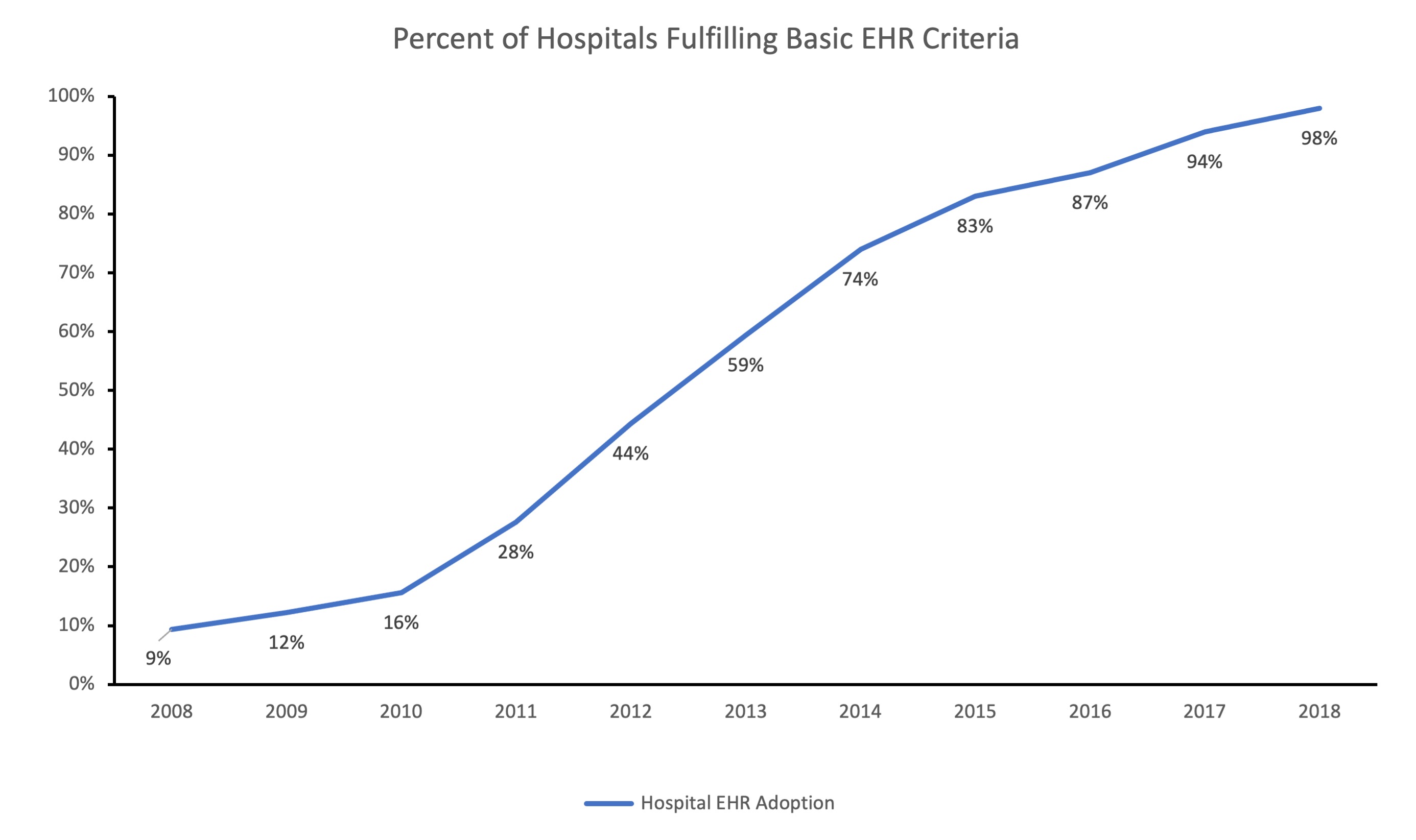
Image Credits: F-Prime Capital
This push for greater data liquidity coincides with demand from consumers for better information about cost and quality. Employers have been steadily shifting a greater share of healthcare expenses to consumers through high-deductible health plans — from 30% in 2012 to 51% in 2018. As consumers pay for more of the costs, they care more about the value of different health options, yet are unable to make those decisions without real-time access to cost and clinical data.

Image Credits: F-Prime Capital
Tech startups have an opportunity to ease the transmission of healthcare data and address the push of regulation and consumer demands. The lessons from fintech make it tempting to assume that a Plaid for healthcare data would be enough to address all of the challenges within healthcare, but it is not the right model. Plaid’s aggregator model benefited from a relatively high concentration of banks, a limited number of data types and low barriers to data access.
By contrast, healthcare data is scattered across tens of thousands of healthcare providers, stored in multiple data formats and systems per provider, and is rarely accessed by patients directly. Many people log into their bank apps frequently, but few log into their healthcare provider portals, if they even know one exists.
HIPPA regulations and strict patient consent requirements also meaningfully increase friction to data access and sharing. Financial data serves mostly one-to-one use cases, while healthcare data is a many-to-many problem. A single patient’s data is spread across many doctors and facilities and is needed by just as many for care coordination.
Because of this landscape, winning healthcare technology companies will need to build around four propositions:
Powered by WPeMatico
IBM today made another acquisition to deepen its reach into providing enterprises with AI-based services to manage their networks and workloads. It announced that it is acquiring Turbonomic, a company that provides tools to manage application performance (specifically resource management), along with Kubernetes and network performance — part of its bigger strategy to bring more AI into IT ops, or as it calls it, AIOps.
Financial terms of the deal were not disclosed, but according to data in PitchBook, Turbonomic was valued at nearly $1 billion — $963 million, to be exact — in its last funding round in September 2019. A report in Reuters rumoring the deal a little earlier today valued it at between $1.5 billion and $2 billion. A source tells us the figure is accurate.
The Boston-based company’s investors included General Atlantic, Cisco, Bain, Highland Capital Partners and Red Hat. The last of these, of course, is now a part of IBM (so it was theoretically also an investor), and together Red Hat and IBM have been developing a range of cloud-based tools addressing telco, edge and enterprise use cases.
This latest deal will help extend that further, and it has more generally been an area that IBM has been aggressive in recently. Last November IBM acquired another company called Instana to bring application performance management into its stable, and it pointed out today that the Turbonomic deal will complement that and the two technologies’ tools will be integrated together, IBM said.
Turbonomic’s tools are particularly useful in hybrid cloud architectures, which involve not just on-premise and cloud workloads, but workloads that typically are extended across multiple cloud environments. While this may be the architecture people apply for more resilience, reasons of cost, location or other practicalities, the fact of the matter is that it can be a challenge to manage. Turbonomic’s tools automate management, analyse performance and suggest changes for network operations engineers to make to meet usage demands.
“Businesses are looking for AI-driven software to help them manage the scale and complexity challenges of running applications cross-cloud,” said Ben Nye, CEO, Turbonomic, in a statement. “Turbonomic not only prescribes actions, but allows customers to take them. The combination of IBM and Turbonomic will continuously assure target application response times even during peak demand.”
The bigger picture for IBM is that it’s another sign of how the company is continuing to move away from its legacy business based around servers, movinh deeper into services, and specifically services on the infrastructure of the future, cloud-based networks.
“IBM continues to reshape its future as a hybrid cloud and AI company,” said Rob Thomas, SVP, IBM Cloud and Data Platform, in a statement. “The Turbonomic acquisition is yet another example of our commitment to making the most impactful investments to advance this strategy and ensure customers find the most innovative ways to fuel their digital transformations.”
A large part of the AI promise in the world of network operations and IT ops is how it will afford companies to rely more on automation, another area where IBM has been very active. (In a very different application of this technology — in business services — this month, it acquired MyInvenio in Italy to bring process mining technology in house.)
The promise of automation, meanwhile, is lower operation costs, a critical issue for managing network performance and availability in hybrid cloud deployments.
“We believe that AI-powered automation has become inevitable, helping to make all information-centric jobs more productive,” said Dinesh Nirmal, general manager, IBM Automation, in a statement. “That’s why IBM continues to invest in providing our customers with a one-stop shop of AI-powered automation capabilities that spans business processes and IT. The addition of Turbonomic now takes our portfolio another major step forward by ensuring customers will have full visibility into what is going on throughout their hybrid cloud infrastructure, and across their entire enterprise.”
Powered by WPeMatico
Taking on Amazon S3 in the cloud storage game would seem to be a fool-hearty proposition, but Wasabi has found a way to build storage cheaply and pass the savings onto customers. Today the Boston-based startup announced a $112 million Series C investment on a $700 million valuation.
Fidelity Management & Research Company led the round with participation from previous investors. It reports that it has now raised $219 million in equity so far, along with additional debt financing, but it takes a lot of money to build a storage business.
CEO David Friend says that business is booming and he needed the money to keep it going. “The business has just been exploding. We achieved a roughly $700 million valuation on this round, so you can imagine that business is doing well. We’ve tripled in each of the last three years and we’re ahead of plan for this year,” Friend told me.
He says that demand continues to grow and he’s been getting requests internationally. That was one of the primary reasons he went looking for more capital. What’s more, data sovereignty laws require that certain types of sensitive data like financial and healthcare be stored in-country, so the company needs to build more capacity where it’s needed.
He says they have nailed down the process of building storage, typically inside co-location facilities, and during the pandemic they actually became more efficient as they hired a firm to put together the hardware for them onsite. They also put channel partners like managed service providers (MSPs) and value added resellers (VARs) to work by incentivizing them to sell Wasabi to their customers.
Wasabi storage starts at $5.99 per terabyte per month. That’s a heck of a lot cheaper than Amazon S3, which starts at 0.23 per gigabyte for the first 50 terabytes or $23.00 a terabyte, considerably more than Wasabi’s offering.
But Friend admits that Wasabi still faces headwinds as a startup. No matter how cheap it is, companies want to be sure it’s going to be there for the long haul and a round this size from an investor with the pedigree of Fidelity will give the company more credibility with large enterprise buyers without the same demands of venture capital firms.
“Fidelity to me was the ideal investor. […] They don’t want a board seat. They don’t want to come in and tell us how to run the company. They are obviously looking toward an IPO or something like that, and they are just interested in being an investor in this business because cloud storage is a virtually unlimited market opportunity,” he said.
He sees his company as the typical kind of market irritant. He says that his company has run away from competitors in his part of the market and the hyperscalers are out there not paying attention because his business remains a fraction of theirs for the time being. While an IPO is far off, he took on an institutional investor this early because he believes it’s possible eventually.
“I think this is a big enough market we’re in, and we were lucky to get in at just the right time with the right kind of technology. There’s no doubt in my mind that Wasabi could grow to be a fairly substantial public company doing cloud infrastructure. I think we have a nice niche cut out for ourselves, and I don’t see any reason why we can’t continue to grow,” he said.
Powered by WPeMatico
Cybersecurity nightmares like the SolarWinds hack highlight how malicious hackers continue to exploit vulnerabilities in software and apps to do their dirty work. Today a startup that’s built a platform to help organizations protect themselves from this by running threat detection and response at the network level is announcing a big round of funding to continue its growth.
Vectra AI, which provides a cloud-based service that uses artificial intelligence technology to monitor both on-premise and cloud-based networks for intrusions, has closed a round of $130 million at a post-money valuation of $1.2 billion.
The challenge that Vectra is looking to address is that applications — and the people who use them — will continue to be weak links in a company’s security set-up, not least because malicious hackers are continually finding new ways to piece together small movements within them to build, lay and finally use their traps. While there will continue to be an interesting, and mostly effective, game of cat-and-mouse around those applications, a service that works at the network layer is essential as an alternative line of defense, one that can find those traps before they are used.
“Think about where the cloud is. We are in the wild west,” Hitesh Sheth, Vectra’s CEO, said in an interview. “The attack surface is so broad and attacks happen at such a rapid rate that the security concerns have never been higher at the enterprise. That is driving a lot of what we are doing.”
Sheth said that the funding will be used in two areas. First, to continue expanding its technology to meet the demands of an ever-growing threat landscape — it also has a team of researchers who work across the business to detect new activity and build algorithms to respond to it. And second, for acquisitions to bring in new technology and potentially more customers.
(Indeed, there has been a proliferation of AI-based cybersecurity startups in recent years, in areas like digital forensics, application security and specific sectors like SMBs, all of which complement the platform that Vectra has built, so you could imagine a number of interesting targets.)
The funding is being led by funds managed by Blackstone Growth, with unnamed existing investors participating (past backers include Accel, Khosla and TCV, among other financial and strategic investors). Vectra today largely focuses on enterprises, highly demanding ones with lots at stake to lose. Blackstone was initially a customer of Vectra’s, using the company’s flagship Cognito platform, Viral Patel — the senior MD who led the investment for the firm — pointed out to me.
The company has built some specific products that have been very prescient in anticipating vulnerabilities in specific applications and services. While it said that sales of its Cognito platform grew 100% last year, Cognito Detect for Microsoft Office 365 (a separate product) sales grew over 700%. Coincidentally, Microsoft’s cloud apps have faced a wave of malicious threats. Sheth said that implementing Cognito (or indeed other network security protection) “could have prevented the SolarWinds hack” for those using it.
“Through our experience as a client of Vectra, we’ve been highly impressed by their world-class technology and exceptional team,” John Stecher, CTO at Blackstone, said in a statement. “They have exactly the types of tools that technology leaders need to separate the signal from the noise in defending their organizations from increasingly sophisticated cyber threats. We’re excited to back Vectra and Hitesh as a strategic partner in the years ahead supporting their continued growth.”
Looking ahead, Sheth said that endpoint security will not be a focus for the moment because “in cloud there is so much open territory”. Instead it partners with the likes of CrowdStrike, SentinelOne, Carbon Black and others.
In terms of what is emerging as a stronger entry point, social media is increasingly coming to the fore, he said. “Social media tends to be an effective vector to get in and will remain to be for some time,” he said, with people impersonating others and suggesting conversations over encrypted services like WhatsApp. “The moment you move to encryption and exchange any documents, it’s game over.”
Powered by WPeMatico
The last year of pandemic living has been real-world, and sometimes harrowing, proof of how important it can be to have efficient and well-equipped emergency response services in place. They can help people remotely if need be, and when they cannot, they make sure that in-person help can be dispatched quickly in medical and other situations. Today, a company that’s building cloud-based tools to help with this process is announcing a round of funding as it continues to grow.
RapidDeploy, which provides computer-aided dispatch technology as a cloud-based service for 911 centers, has closed a round of $29 million, a Series B round of funding that will be used both to grow its business and continue expanding the SaaS tools that it provides to its customers. In the startup’s point of view, the cloud is essential to running emergency response in the most efficient manner.
“911 response would have been called out on a walkie talkie in the early days,” said Steve Raucher, the co-founder and CEO of RapidDeploy, in an interview. “Now the cloud has become the nexus of signals.”
Austin-based RapidDeploy provides data and analytics to 911 centers — the critical link between people calling for help and connecting those calls with the nearest medical, police or fire assistance — and today it has about 700 customers using its RadiusPlus, Eclipse Analytics and Nimbus CAD products.
That works out to about 10% of all 911 centers in the U.S. (7,000 in total), and covering 35% of the population (there are more centers in cities and other dense areas). Its footprint includes state coverage in Arizona, California and Kansas. It also has operations in South Africa, where it was originally founded.
The funding is coming from an interesting mix of financial and strategic investors. Led by Morpheus Ventures, the round also had participation from GreatPoint Ventures, Ericsson Ventures, Samsung Next Ventures, Tao Capital Partners and Tau Ventures, among others. It looks like the company had raised about $30 million before this latest round, according to PitchBook data. Valuation is not being disclosed.
Ericsson and Samsung, as major players in the communication industry, have a big stake in seeing through what will be the next generation of communications technology and how it is used for critical services. (And indeed, one of the big leaders in legacy and current 911 communications is Motorola, a would-be competitor of both.) AT&T is also a strategic go-to-market (distribution and sales) partner of RapidDeploy’s, and it also has integrations with Apple, Google, Microsoft and OnStar to feed data into its system.
The business of emergency response technology is a fragmented market. Raucher describes them as “mom-and-pop” businesses, with some 80% of them occupying four seats or less (a testament to the fact that a lot of the U.S. is actually significantly less urban than its outsized cities might have you think it is), and in many cases a lot of these are operating on legacy equipment.
However, in the U.S. in the last several years — buffered by innovations like the Jedi project and FirstNet, a next-generation public safety network — things have been shifting. RapidDeploy’s technology sits alongside (and in some areas competes with) companies like Carbyne and RapidSOS, which have been tapping into the innovations of cell phone technology both to help pinpoint people and improve how to help them.
RapidDeploy’s tech is based around its RadiusPlus mapping platform, which uses data from smart phones, vehicles, home security systems and other connected devices and channels it to its data stream, which can help a center determine not just location but potentially other aspects of the condition of the caller. Its Eclipse Analytics services, meanwhile, are meant to act as a kind of assistant to those centers to help triage situations and provide insights into how to respond. The Nimbus CAD then helps figure out who to call out and routing for response.
Longer term, the plan will be to leverage cloud architecture to bring in new data sources and ways of communicating between callers, centers and emergency care providers.
“It’s about being more of a triage service rather than a message switch,” Raucher said. “As we see it, the platform will evolve with customers’ needs. Tactical mapping ultimately is not big enough to cover this. We’re thinking about unified communications.” Indeed, that is the direction that many of these services seem to be going, which can only be a good thing for us consumers.
“The future of emergency services is in data, which creates a faster, more responsive 9-1-1 center,” said Mark Dyne, founding partner at Morpheus Ventures, in a statement. “We believe that the platform RapidDeploy has built provides the necessary breadth of capabilities that make the dream of Next-Gen 9-1-1 service a reality for rural and metropolitan communities across the nation and are excited to be investing in this future with Steve and his team.” Dyne has joined the RapidDeploy board with this round.
Powered by WPeMatico
DigitalOcean has emailed customers warning of a data breach involving customers’ billing data, TechCrunch has learned.
The cloud infrastructure giant told customers in an email on Wednesday, obtained by TechCrunch, that it has “confirmed an unauthorized exposure of details associated with the billing profile on your DigitalOcean account.” The company said the person “gained access to some of your billing account details through a flaw that has been fixed” over a two-week window between April 9 and April 22.
The email said customer billing names and addresses were accessed, as well as the last four digits of the payment card, its expiry date and the name of the card-issuing bank. The company said that customers’ DigitalOcean accounts were “not accessed,” and passwords and account tokens were “not involved” in this breach.
“To be extra careful, we have implemented additional security monitoring on your account. We are expanding our security measures to reduce the likelihood of this kind of flaw occuring [sic] in the future,” the email said.
DigitalOcean said it fixed the flaw and notified data protection authorities, but it’s not clear what the apparent flaw was that put customer billing information at risk.
In a statement, DigitalOcean’s security chief Tyler Healy said 1% of billing profiles were affected by the breach, but declined to address our specific questions, including how the vulnerability was discovered and which authorities have been informed.
Companies with customers in Europe are subject to GDPR and can face fines of up to 4% of their global annual revenue.
Last year, the cloud company raised $100 million in new debt, followed by another $50 million round, months after laying off dozens of staff amid concerns about the company’s financial health. In March, the company went public, raising about $775 million in its initial public offering.
Powered by WPeMatico
Every company wants to maintain that initial spark it had when it was an early-stage startup, but keeping that going as you scale into a public company isn’t always easy. Atlassian is taking a unique approach by opening up product ideas to an internal competition, and actually funding and building the best ones with the goal of bringing them to market.
Steve Goldsmith, who is heading up the project for Atlassian, says that it’s an in-house startup incubator called Point A. The company wants to encourage employees to be constantly thinking about new ways to improve the products. And every employee is encouraged to participate, not just engineers or product managers, as many might think.
“Point A is our internal framework for turning ideas into products. It’s our way of finding the innovation that’s happening all over the company, and giving a process and framework for those ideas to reach the maturity of actually becoming products that we offer to our customers,” Goldsmith told me.
He says that like many companies they hold internal hackathons and other events where many times employees come up with creative concepts for products, but they tend to get put on a shelf after the event is over and never get looked at again. With Point A, they can actually compete to put their experiments to work and see if they are actually viable.
“So we think of Point A as a way of finding all those different ideas and prototypes and concepts that people have in their brains or on the side of their desk kind of thing, and giving a process and a structure for those ideas to get out the door, and really invest in the ones that have some traction,” Goldsmith said.
He says by providing an official internal process to vet and maybe fund some of them, people inside the organization know that their proposals are being heard and they have a mechanism for submitting them, and the company has a way of seeing them.
The company launched Point A in 2019 looking at 35 possible projects, and testing them as possible products. Last January, they chose nine that made the final cut and four turned into actual products and made it out the door this week, including the Jira Work Management tool, which is being released today.
The next program is ready to roll with employees ready to present their ideas in a pitch day competition to get things going. “Our first class is graduating out of this program, and […] we start the process again. We actually just went through our big list of all the ideas to do it a second time, and we are doing a pitch day. It’s going to be a fun Shark Tank, The Voice kind of inspired [competition],” he said.
Company co-founders and co-CEOs Mike Cannon-Brookes and Scott Farquhar both participate in judging the competition, so it has executive buy-in, giving more clout to the program and sending a message to employees that their ideas are being taken seriously.
The company provides funding, time away from your regular job and executive coaches, and combines that with customer collaboration and early founder involvement with the goal of finding a scalable, repeatable process with defined phases that helps teams take the most innovative ideas from concept to customer.
Some make it. Some don’t, as you might expect, but so far the plan seems to be working and is successfully encouraging innovation from within, something every company should be trying to do.
Powered by WPeMatico

Atlassian today announced a new edition of its Jira project management tool, Jira Work Management. The company has long been on a journey of bringing Jira to teams beyond the software development groups it started out with. With Jira Service Management, it is successfully doing that with IT teams. With Jira Core, it also moved further in this direction, but Jira Work Management takes this a step further (and will replace Jira Core). The idea here is to offer a version of Jira that enables teams across marketing, HR, finance, design and other groups to manage their work and — if needed — connect it to that of a company’s development teams.
“Jira Software’s this de-facto standard,” Atlassian’s VP of Product Noah Wasmer told me. “We’re making just huge inroads with Jira Service Management right now, bringing IT teams into that loop. We have over 100,000 customers now on those two products. So it’s really doing incredibly well. But one of the things that CIOs say is that it’s really tough to put Jira Software in front of an HR team and the legal team. They often ask, what is code? What is a pull request?”

Image Credits: Atlassian
Wasmer also noted that even though Jira Software is specifically meant for developers, about half of its users are already in other teams that work with these development teams. “We think that [Jira Work Management] gives them the more contextually relevant tool — a tool that actually helps them accelerate and move faster,” Wasmer said.
With Jira Work Management, the company is looking at making it easier for any team to track and manage their work in what Wasmer described as a “universal system and family of product.” As company’s look at how to do remote and hybrid work, Atlassian believes that they’ll need this kind of core product to keep track of the work that is being done. But it’s also about the simple fact that every business is now a software business and while every team’s work touches upon this, marketing and design teams often still work in their own silos.
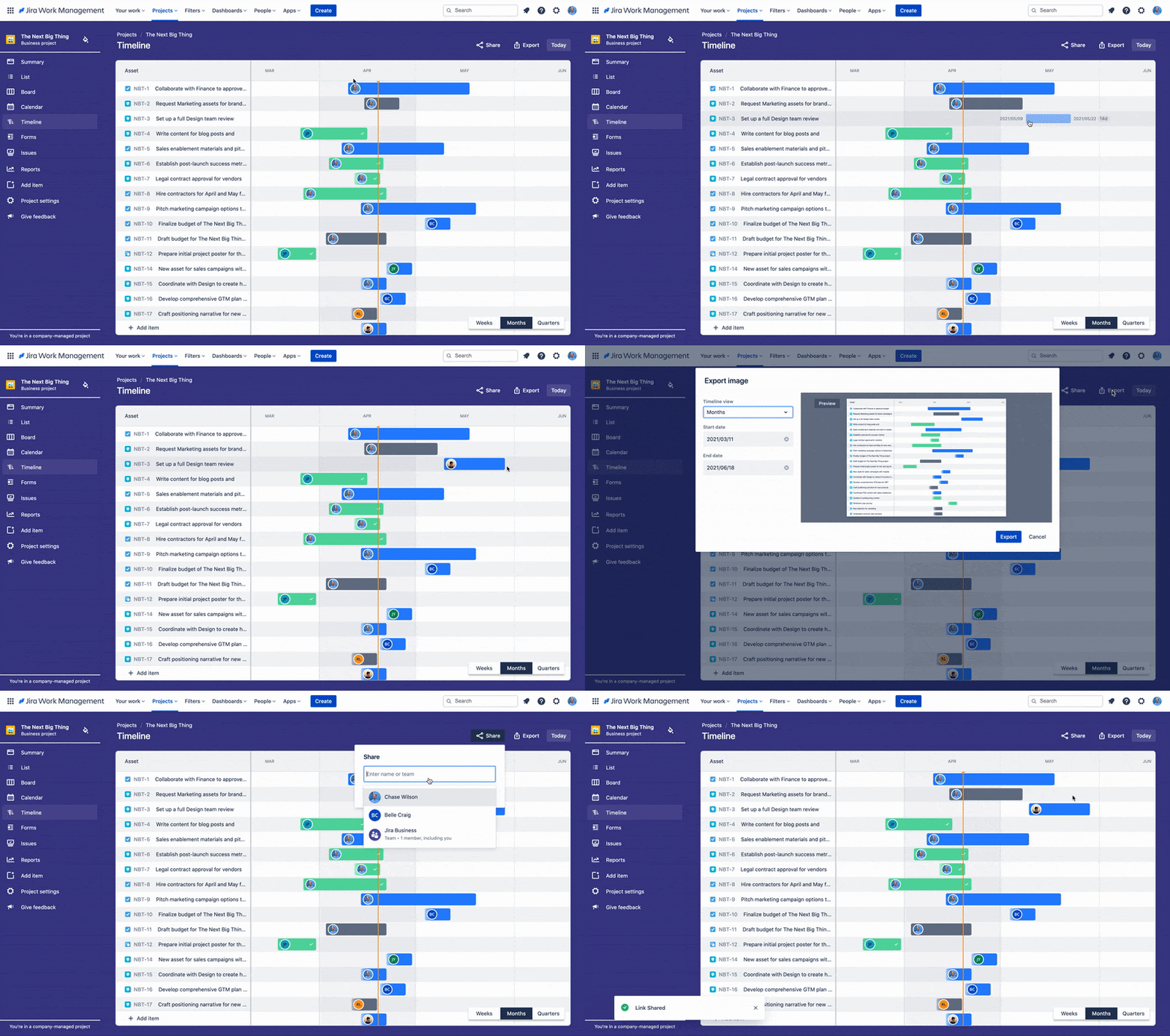
Image Credits: Atlassian
These different teams, though, also have quite different expectations of the user interface they need to manage their work most effectively. So while Jira Work Management features all of the automation features and privacy controls of its brethren, it is based around a slightly different and simplified user interface than Jira Software, for example.
What’s even more important, though, is that Jira Work Management offers a variety of views for teams to enter and manipulate their data. To get new users onboarded quickly, Atlassian built a set of templates for some of the most common use cases it expects, though users are obviously free to customize all these different views to their hearts’ — and business needs’ — content.
Atlassian also changed some of the language around Jira tickets. There are no “stories” and “bugs” in Jira Work Management (unless you add them yourself) and instead, these templates use words like “tasks,” “assets” (for design use cases) or “candidates” (for HR).

Image Credits: Atlassian
Given the fact that spreadsheets are the universal language of business, it’s maybe no surprise that the List view is core here, with an Excel/Airtable-like experience that should immediately feel familiar to any business user. It’s inline editable and completely abstracts away the usual Jira ticket, even though underneath, it’s the same taxonomy and infrastructure.
“We really wanted people to walk into this product and just understand that there is work that needs to be done,” Chase Wilson, the head of product marketing for Jira Work Management, said. He noted that the team worked on making the experience feel snappy.
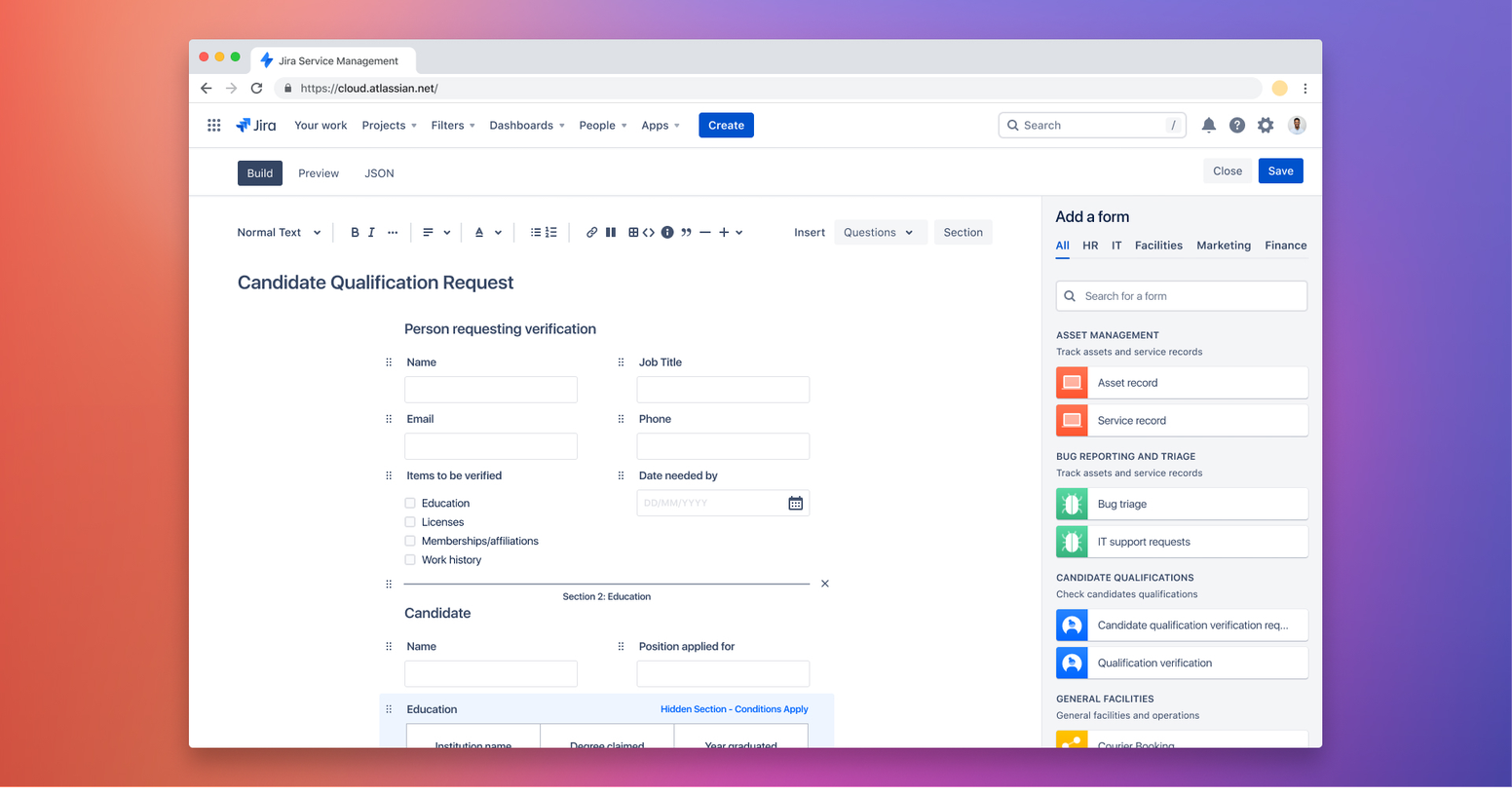
Image Credits: Atlassian
The other views available are pretty straightforward: a calendar and Gantt chart-like timeline view, as well as the traditional Kanban board that has long been at the core of Jira (and Agile in general).
Jira Work Management also lets users build forms, using a drag-and-drop editor that makes it easy for anybody inside an organization to build forms and collect requests that way. Only a few weeks ago, Atlassian announced the acquisition of ThinkTilt, the company behind the popular no-code form-builder ProForma and it looks like it is already putting this acquisition to work here.
As Wasmer stressed, Jira Work Management is meant to help different teams get work done in a way that works best for them. But because Jira is now a family of products, it also enables a lot more cross-team collaboration. That means a development team that is working on implementing a GDPR requirement can now build a workflow that ties in with the project board for a legal team that then allows legal to hold up a software release until it approves this new feature.
“We hear about this all the time today,” he said. “They just stick the legal team into Jira Software — and it over-inundates them with information that’s not relevant to what they’re trying to get done. Now we can expose them. And we also then get that legal team, that marketing team, exposed to different templates for different work. What they’re finding is that once they get used to it for that must-do use case, they start saying: Well, hey, why don’t I use this for contract approvals at the end of the quarter?”
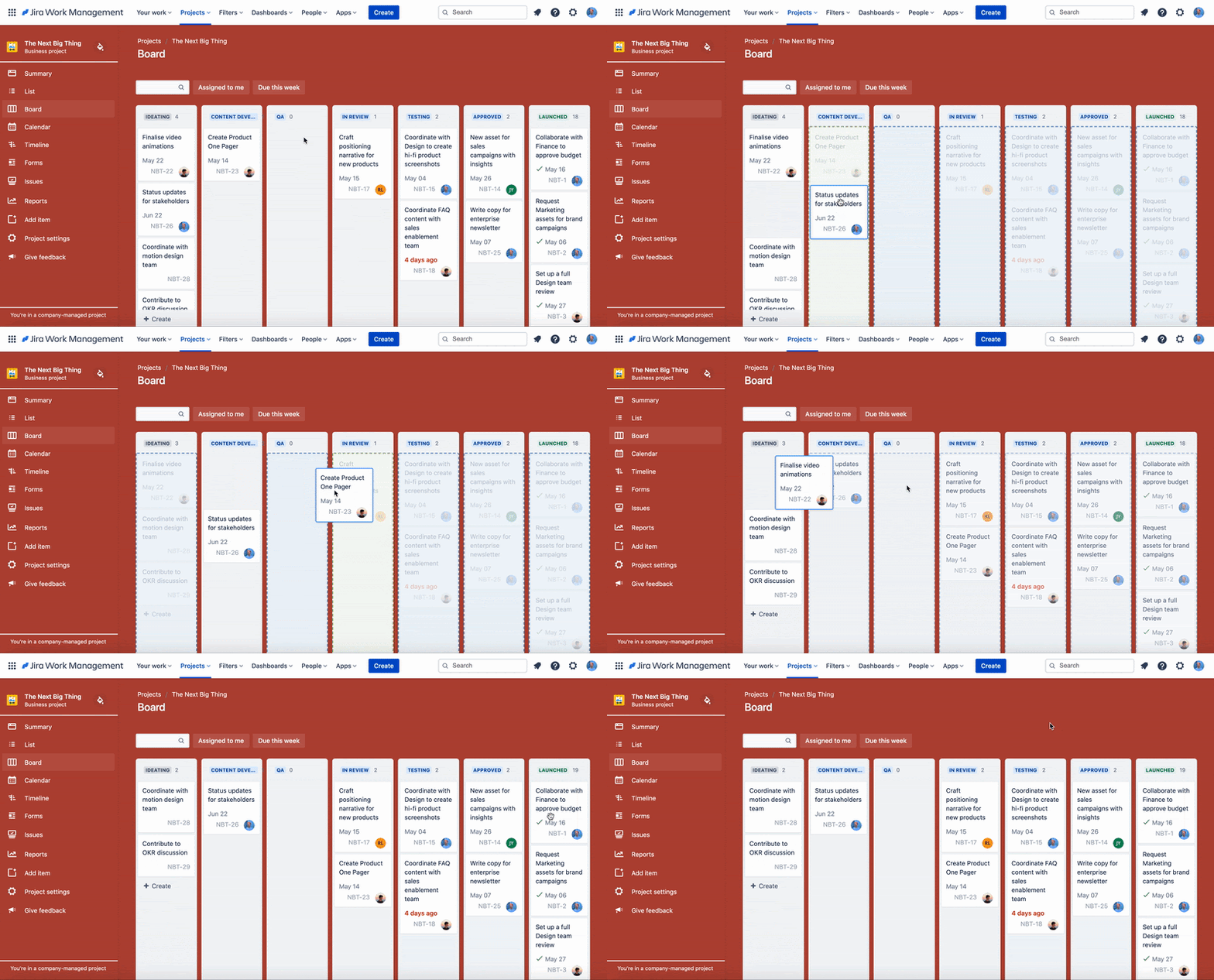
Image Credits: Atlassian
As for pricing, Atlassian follows its same standard template here, offering a free tier for teams with up to 10 users and then the paid tiers start at $5/user/month, with discounts for larger teams.
Looking ahead, Atlassian plans to add more reporting capabilities, native approvals for faster signoffs and more advanced functionality across the new work views.
It’s worth noting that Jira Work Management is the first product to come out of Point A, Atlassian’s new innovation program “dedicated to connecting early-adopter customers with product teams to build the next generation of teamwork tools.”
Powered by WPeMatico
Data intelligence company Near is announcing the acquisition of another company in the data business — UM.
In some ways, this echoes Near’s acquisition of Teemo last fall. Just as that deal helped Singapore-headquartered Near expand into Europe (with Teemo founder and CEO Benoit Grouchko becoming Near’s chief privacy officer), CEO Anil Mathews said that this new acquisition will help Near build a presence in the United States, turning the company into “a truly global organization,” while also tailoring its product to offer “local flavors” in each country.
The addition of UM’s 60-person team brings Near’s total headcount to around 200, with UM CEO Gladys Kong becoming CEO of Near North America.
At the same time, Mathews suggested that this deal isn’t simply about geography, because the data offered by Near and UM are “very complementary,” allowing both teams to upsell current customers on new offerings. He described Near’s mission as “merging two diverse worlds, the online world and the offline world,” essentially creating a unified profile of consumers for marketers and other businesses. Apparently, UM is particularly strong on the offline side, thanks to its focus on location data.

Near CEO Anil Mathews and UM CEO Gladys Kong. Image Credits: Near
“UM has a very strong understanding of places, they’ve mastered their understanding of footfalls and dwell times,” Mathews added. “As a result, most of the use cases where UM is seeing growth — in tourism, retail, real estate — are in industries struggling due to the pandemic, where they’re using data to figure out, ‘How do we come out of the pandemic?’ ”
TechCrunch readers may be more familiar with UM under its old name, UberMedia, which created social apps like Echofon and UberSocial before pivoting its business to ad attribution and location data. Kong said that contrary to her fears, the company had “an amazing 2020” as businesses realized they needed UM’s data (its customers include RAND Corporation, Hawaii Tourism Authority, Columbia University and Yale University).
And the year was capped by connecting with Near and realizing that the two companies have “a lot of synergies.” In fact, Kong recalled that UM’s rebranding last month was partly at Mathews’ suggestion: “He said, ‘Why do you have media in your name when you don’t do media?’ And we realized that’s probably how the world saw us, so we decided to change [our name] to make it clear what we do.”
Founded in 2010, UM raised a total of $34.6 million in funding, according to Crunchbase. The financial terms of the acquisition were not disclosed.
Powered by WPeMatico

Opsera, a startup that’s building an orchestration platform for DevOps teams, today announced that it has raised a $15 million Series A funding round led by Felicis Ventures. New investor HMG Ventures, as well as existing investors Clear Ventures, Trinity Partners and Firebolt Ventures also participated in this round, which brings the company’s total funding to $19.3 million.
Founded in January 2020, Opsera lets developers provision their CI/CD tools through a single framework. Using this framework, they can then build and manage their pipelines for a variety of use cases, including their software delivery lifecycle, infrastructure as code and their SaaS application releases. With this, Opsera essentially aims to help teams set up and operate their various DevOps tools.
The company’s two co-founders, Chandra Ranganathan and Kumar Chivukula, originally met while working at Symantec a few years ago. Ranganathan then spent the last three years at Uber, where he ran that company’s global infrastructure. Meanwhile, Chivukula ran Symantec’s hybrid cloud services.
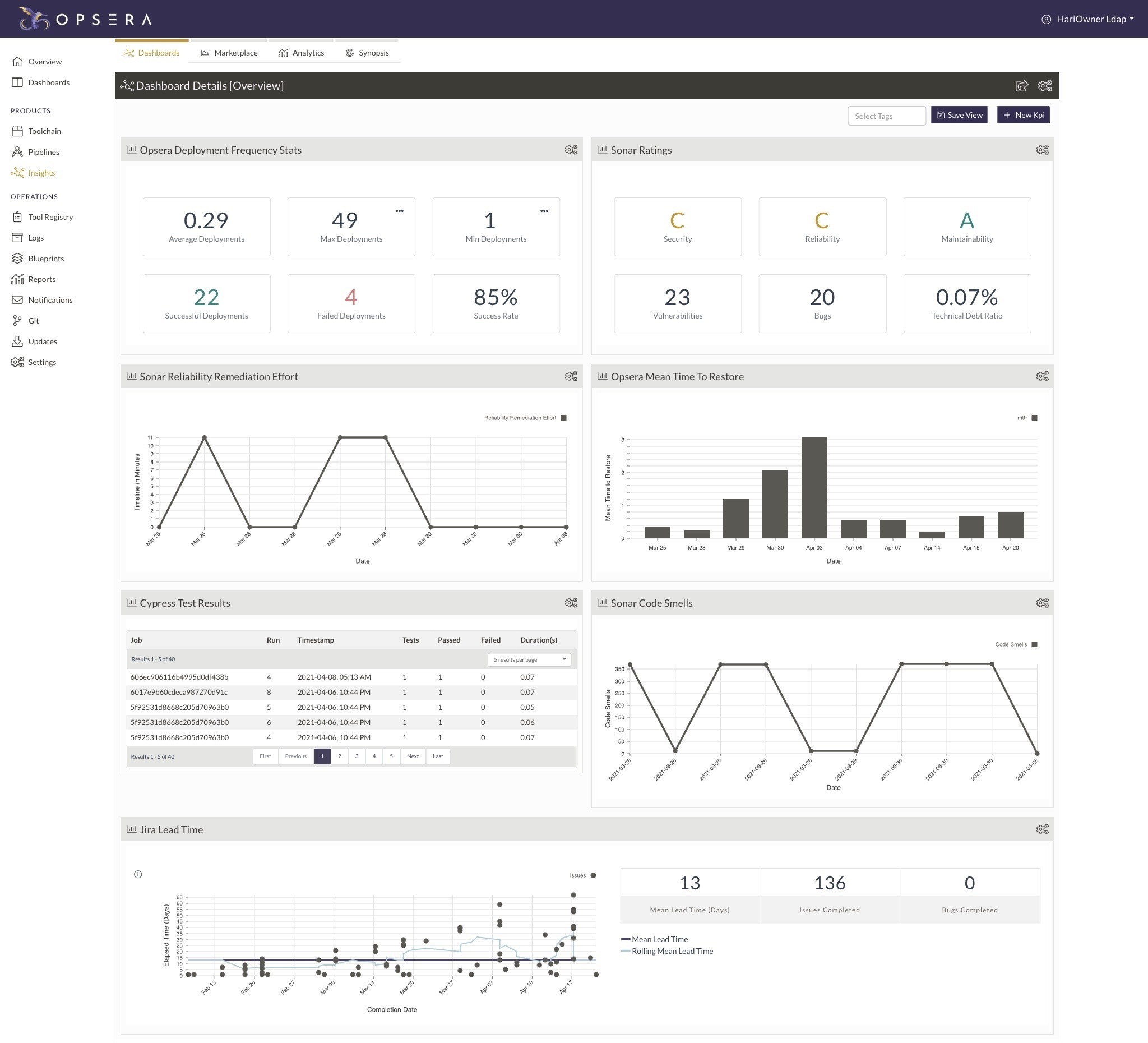
Image Credits: Opsera
“As part of the transformation [at Symantec], we delivered over 50+ acquisitions over time. That had led to the use of many cloud platforms, many data centers,” Ranganathan explained. “Ultimately we had to consolidate them into a single enterprise cloud. That journey is what led us to the pain points of what led to Opsera. There were many engineering teams. They all had diverse tools and stacks that were all needed for their own use cases.”
The challenge then was to still give developers the flexibility to choose the right tools for their use cases, while also providing a mechanism for automation, visibility and governance — and that’s ultimately the problem Opsera now aims to solve.
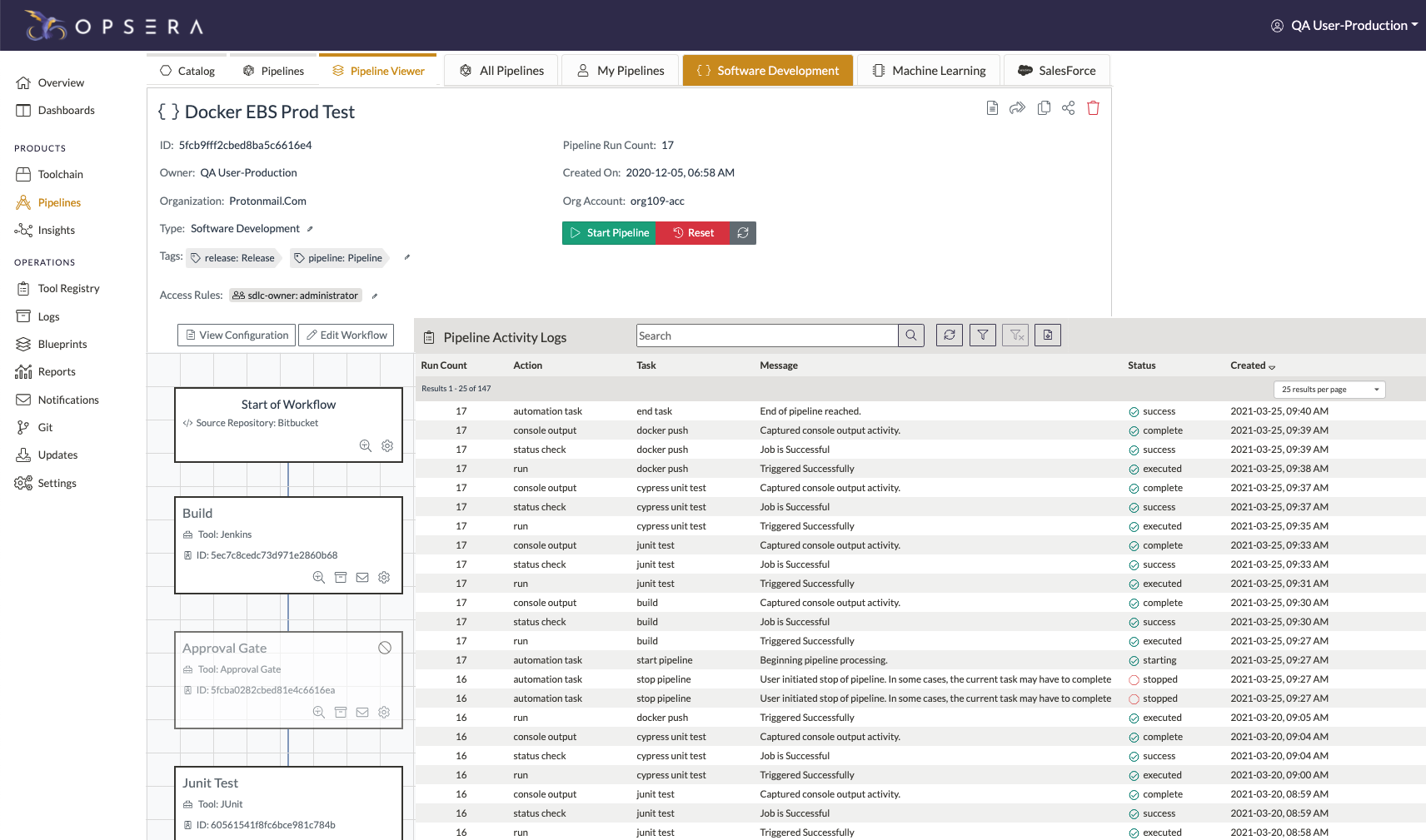
Image Credits: Opsera
“In the DevOps landscape, […] there is a plethora of tools, and a lot of people are writing the glue code,” Opsera co-founder Chivukula noted. “But then they’re not they don’t have visibility. At Opsera, our mission and goal is to bring order to the chaos. And the way we want to do this is by giving choice and flexibility to the users and provide no-code automation using a unified framework.”
Wesley Chan, a managing director for Felicis Ventures who will join the Opsera board, also noted that he believes that one of the next big areas for growth in DevOps is how orchestration and release management is handled.
“We spoke to a lot of startups who are all using black-box tools because they’ve built their engineering organization and their DevOps from scratch,” Chan said. “That’s fine, if you’re starting from scratch and you just hired a bunch of people outside of Google and they’re all very sophisticated. But then when you talk to some of the larger companies. […] You just have all these different teams and tools — and it gets unwieldy and complex.”
Unlike some other tools, Chan argues, Opsera allows its users the flexibility to interface with this wide variety of existing internal systems and tools for managing the software lifecycle and releases.
“This is why we got so interested in investing, because we just heard from all the folks that this is the right tool. There’s no way we’re throwing out a bunch of our internal stuff. This would just wreak havoc on our engineering team,” Chan explained. He believes that building with this wide existing ecosystem in mind — and integrating with it without forcing users onto a completely new platform — and its ability to reduce friction for these teams, is what will ultimately make Opsera successful.
Opsera plans to use the new funding to grow its engineering team and accelerate its go-to-market efforts.
Powered by WPeMatico