Enterprise
Auto Added by WPeMatico
Auto Added by WPeMatico
As cloud-native apps continue to become increasingly central to how organizations operate, a startup founded by the creators of a popular open-source tool to manage authorization for cloud-native application environments is announcing some funding to expand its efforts at commercializing the opportunity.
Styra, the startup behind Open Policy Agent, has picked up $40 million in a Series B round of funding led by Battery Ventures. Also participating are previous backers A. Capital, Unusual Ventures and Accel; and new backers CapitalOne Ventures, Citi Ventures and Cisco Investments. Styra has disclosed CapitalOne is also one of its customers, along with e-commerce site Zalando and the European Patent Office.
Styra is sitting on the classic opportunity of open source technology: scale and demand.
OPA — which can be used across Kubernetes, containerized and other environments — now has racked up some 75 million downloads and is adding some 1 million downloads weekly, with Netflix, Capital One, Atlassian and Pinterest among those that are using OPA for internal authorization purposes. The fact that OPA is open source is also important:
“Developers are at the top of the food chain right now,” CEO Bill Mann said in an interview, “They choose which technology on which to build the framework, and they want what satisfies their requirements, and that is open source. It’s a foundational change: if it isn’t open source it won’t pass the test.”
But while some of those adopting OPA have hefty engineering teams of their own to customize how OPA is used, the sheer number of downloads (and potential active users stemming from that) speak to the opportunity for a company to build tools to help manage that and customize it for specific use cases in cases where those wanting to use OPA may lack the resources (or appetite) to build and scale custom implementations themselves.
As with many of the enterprise startups getting funded at the moment, Styra has proven itself in particular over the last year, with the switch to remote work, workloads being managed across a number of environments, and the ever-persistent need for better security around what people can and should not be using. Authorization is a particularly acute issue when considering the many access points that need to be monitored: as networks continue to grow across multiple hubs and applications, having a single authorization tool for the whole stack becomes even more important.
Styra said that some of the funding will be used to continue evolving its product, specifically by creating better and more efficient ways to apply authorization policies by way of code; and by bringing in more partners to expand the scope of what can be covered by its technology.
“We are extremely impressed with the Styra team and the progress they’ve made in this dynamic market to date,” said Dharmesh Thakker, a general partner at Battery Ventures. “Everyone who is moving to cloud, and adopting containerized applications, needs Styra for authorization—and in the light of today’s new, remote-first work environment, every enterprise is now moving to the cloud.” Thakker is joining the board with this round.
Powered by WPeMatico
Automation is extending into every aspect of how organizations get work done, and today comes news of a startup that is building tools for one industry in particular: life sciences. Artificial, which has built a software platform for laboratories to assist with, or in some cases fully automate, research and development work, has raised $21.5 million.
It plans to use the funding to continue building out its software and its capabilities, to hire more people, and for business development, according to Artificial’s CEO and co-founder David Fuller. The company already has a number of customers including Thermo Fisher and Beam Therapeutics using its software directly and in partnership for their own customers. Sold as aLab Suite, Artificial’s technology can both orchestrate and manage robotic machines that labs might be using to handle some work; and help assist scientists when they are carrying out the work themselves.
“The basic premise of what we’re trying to do is accelerate the rate of discovery in labs,” Fuller said in an interview. He believes the process of bringing in more AI into labs to improve how they work is long overdue. “We need to have a digital revolution to change the way that labs have been operating for the last 20 years.”
The Series A is being led by Microsoft’s venture fund M12 — a financial and strategic investor — with Playground Global and AME Cloud Ventures also participating. Playground Global, the VC firm co-founded by ex-Google exec and Android co-creator Andy Rubin (who is no longer with the firm), has been focusing on robotics and life sciences and it led Artificial’s first and only other round. Artificial is not disclosing its valuation with this round.
Fuller hails from a background in robotics, specifically industrial robots and automation. Before founding Artificial in 2019, he was at Kuka, the German robotics maker, for a number of years, culminating in the role of CTO; prior to that, Fuller spent 20 years at National Instruments, the instrumentation, test equipment and industrial software giant. Meanwhile, Artificial’s co-founder, Nikhita Singh, has insight into how to bring the advances of robotics into environments that are quite analogue in culture. She previously worked on human-robot interaction research at the MIT Media Lab, and before that spent years at Palantir and working on robotics at Berkeley.
As Fuller describes it, he saw an interesting gap (and opportunity) in the market to apply automation, which he had seen help advance work in industrial settings, to the world of life sciences, both to help scientists track what they are doing better, and help them carry out some of the more repetitive work that they have to do day in, day out.
This gap is perhaps more in the spotlight today than ever before, given the fact that we are in the middle of a global health pandemic. This has hindered a lot of labs from being able to operate full in-person teams, and increased the reliance on systems that can crunch numbers and carry out work without as many people present. And, of course, the need for that work (whether it’s related directly to Covid-19 or not) has perhaps never appeared as urgent as it does right now.
There have been a lot of advances in robotics — specifically around hardware like robotic arms — to manage some of the precision needed to carry out some work, but up to now no real efforts made at building platforms to bring all of the work done by that hardware together (or in the words of automation specialists, “orchestrate” that work and data); nor link up the data from those robot-led efforts, with the work that human scientists still carry out. Artificial estimates that some $10 billion is spent annually on lab informatics and automation software, yet data models to unify that work, and platforms to reach across it all, remain absent. That has, in effect, served as a barrier to labs modernising as much as they could.
A lab, as he describes it, is essentially composed of high-end instrumentation for analytics, alongside then robotic systems for liquid handling. “You can really think of a lab, frankly, as a kitchen,” he said, “and the primary operation in that lab is mixing liquids.”
But it is also not unlike a factory, too. As those liquids are mixed, a robotic system typically moves around pipettes, liquids, in and out of plates and mixes. “There’s a key aspect of material flow through the lab, and the material flow part of it is much more like classic robotics,” he said. In other words, there is, as he says, “a combination of bespoke scientific equipment that includes automation, and then classic material flow, which is much more standard robotics,” and is what makes the lab ripe as an applied environment for automation software.
To note: the idea is not to remove humans altogether, but to provide assistance so that they can do their jobs better. He points out that even the automotive industry, which has been automated for 50 years, still has about 6% of all work done by humans. If that is a watermark, it sounds like there is a lot of movement left in labs: Fuller estimates that some 60% of all work in the lab is done by humans. And part of the reason for that is simply because it’s just too complex to replace scientists — who he described as “artists” — altogether (for now at least).
“Our solution augments the human activity and automates the standard activity,” he said. “We view that as a central thesis that differentiates us from classic automation.”
There have been a number of other startups emerging that are applying some of the learnings of artificial intelligence and big data analytics for enterprises to the world of science. They include the likes of Turing, which is applying this to helping automate lab work for CPG companies; and Paige, which is focusing on AI to help better understand cancer and other pathology.
The Microsoft connection is one that could well play out in how Artificial’s platform develops going forward, not just in how data is perhaps handled in the cloud, but also on the ground, specifically with augmented reality.
“We see massive technical synergy,” Fuller said. “When you are in a lab you already have to wear glasses… and we think this has the earmarks of a long-term use case.”
Fuller mentioned that one area it’s looking at would involve equipping scientists and other technicians with Microsoft’s HoloLens to help direct them around the labs, and to make sure people are carrying out work consistently by comparing what is happening in the physical world to a “digital twin” of a lab containing data about supplies, where they are located, and what needs to happen next.
It’s this and all of the other areas that have yet to be brought into our very AI-led enterprise future that interested Microsoft.
“Biology labs today are light- to semi-automated—the same state they were in when I started my academic research and biopharmaceutical career over 20 years ago. Most labs operate more like test kitchens rather than factories,” said Dr. Kouki Harasaki, an investor at M12, in a statement. “Artificial’s aLab Suite is especially exciting to us because it is uniquely positioned to automate the masses: it’s accessible, low code, easy to use, highly configurable, and interoperable with common lab hardware and software. Most importantly, it enables Biopharma and SynBio labs to achieve the crowning glory of workflow automation: flexibility at scale.”
Harasaki is joining Peter Barratt, a founder and general partner at Playground Global, on Artificial’s board with this round.
“It’s become even more clear as we continue to battle the pandemic that we need to take a scalable, reproducible approach to running our labs, rather than the artisanal, error-prone methods we employ today,” Barrett said in a statement. “The aLab Suite that Artificial has pioneered will allow us to accelerate the breakthrough treatments of tomorrow and ensure our best and brightest scientists are working on challenging problems, not manual labor.”
Powered by WPeMatico

Merge, a startup that helps its users build customer-facing integrations with third-party tools, today announced that it has raised a $4.5 million seed round led by NEA. Additional angel investors include former MuleSoft CEO Greg Schott, Cloudflare CEO Matthew Prince, Expanse co-founders Tim Junio and Matt Kraning, and Jumpstart CEO Ben Herman.
Launched in 2020, the core focus of Merge is to give B2B companies a unified API to access data from what is currently about 40 HR, payroll, recruiting and accounting platforms, with plans for expanding to additional areas soon. But Merge co-founders Shensi Ding and Gil Feig, who have been lifelong friends and previously worked at companies like Expanse and Jumpstart, stress that the service isn’t aiming to replace workflow tools Workato or Zapier.
Image Credits: Merge
“What we built is more similar to Plaid than MuleSoft or other things,” Feig said. “We built a unified API, so we’re fully embedded in a customer’s product and they build one integration with us and can automatically offer all these integrations to their customers. On top of that, we offer what we call integrations management, which is a suite of tools to automatically detect issues where the customer would have to get involved — automatically detect that stuff and handle it without ever having to involve engineering again.”
When Merge’s systems detect issues with an integration, maybe because a data schema in an API response has changed without notice (which happens with some regularity), Merge’s engineers can fix that within minutes, in part because the teams also built an internal no-code tool for building and managing these integrations.

Image Credits: Merge
As Ding also noted, B2B buyers today also simply expect their tools to feature integrations with the service they use. “Companies, when they purchase a vendor, they expect that vendor to have integrations with all the other vendors that they own,” she said. “They don’t want to have to purchase a vendor and then purchase a workflow product and then connect those products.”
And while Merge’s focus right now is squarely on a few verticals, the plan is to expand this to far more areas shortly, likely starting with CRM. “Salesforce has a pretty large market share, so we thought that it wasn’t going to be as interesting of a market,” Ding said. “But it turns out that their API is so complex that customers would still prefer to integrate with us instead if we simplify it for them.”
Ding and Feig tell me the company, which came out of stealth about two months ago, already has about 100 organizations on its platform, varying from seed-stage companies to publicly listed enterprises. The team credits its focus on security and reliability (and its SOC II compliance) with being able to bring on some of these larger companies despite being a seed-stage company itself.
To monetize the service, Merge offers a free tier (up to 10,000 API requests per month) and charges $0.01 per API request for additional usage. Unsurprisingly, the company also offers customized enterprise plans for its larger customers.
“The time and expense associated with building and maintaining myriad API integrations is a pain point we hear about consistently from our portfolio companies across all industries,” said NEA managing general partner Scott Sandell, who will join the company’s board. “Merge is tackling this ubiquitous problem head-on via their easy-to-use, unified API platform. Their platform has broad applicability and is a massive upgrade for any software company that needs to build, manage, and maintain multiple API integrations.”
Powered by WPeMatico
At long last, the Monday.com crew dropped an F-1 filing to go public in the United States. TechCrunch has long known that the company, which sells corporate productivity and communications software, has scaled north of $100 million in annual recurring revenue (ARR).
The countdown to its IPO filing — an F-1, because the company is based in Israel, rather than the S-1s filed by domestic companies — has been ticking for several quarters, so seeing Monday.com drop the document on this Monday morning was just good fun.
The Exchange explores startups, markets and money.
Read it every morning on Extra Crunch or get The Exchange newsletter every Saturday.
The Exchange has been riffling through the document since it came out, and we’ve picked up on a few things to explore. We’ll start by looking at the company’s revenue growth on a historical basis to see if it has accelerated in recent quarters thanks to the pandemic. Then, we’ll turn to profitability, cash burn, share-based compensation expenses and product vision.
 We’ll wrap at the end with a summary of what we’ve learned and also make sure to check out the company’s marketing spend, because I’m sure you’ve seen its digital ads.
It’s a lot to chew through, so no more dilly-dallying. Into the numbers!
As always, we’re starting with revenue growth because it’s still the single most important thing about any venture-backed company.
This is great news for the startup, its employees and its investors. From 2019 to 2020, Monday.com grew its revenues from $78.1 million to $161.1 million, or 106%.
From Q1 2020 to Q1 2021, the company’s revenues grew from $31.9 million to $59 million. That’s about 85% growth. So, by what measure do we mean that the company’s revenue growth is accelerating? Its sequential-quarter revenue growth is picking up. Observe the following:
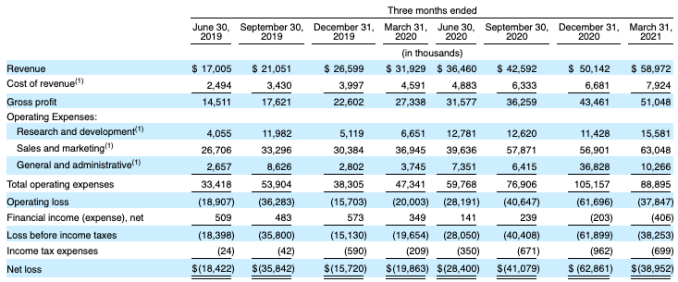
Image Credits: Monday.com F-1 filing
From Q2 2019 to Q3 2019, the company added around $4 million in revenue. From Q2 2020 to Q3 2020, that number was $6.1 million. More recently, the company’s revenue added $7.6 million from Q3 2020 to Q4 2020, which accelerated to $8.8 million from the final quarter of 2020 to the first quarter of 2021. Of course, from an ever-larger base, the company’s growth rate may decline. But the super clean and obvious expanding sequential revenue gains at the company are solid.
The fact that it added so much top line in recent quarters also helps explain why Monday.com is going public now. Sure, the markets are still near record highs and the pandemic is fading, but just look at that consistent growth! It’s investor catnip.
Powered by WPeMatico
For Bill Staples, the freshly appointed CEO at New Relic, who takes over on July 1, yesterday was a good day. After more than 20 years in the industry, he was given his own company to run. It’s quite an accomplishment, but now the hard work begins.
On the positive side of the equation, New Relic is one of the market leaders in the application performance monitoring space.
Lew Cirne, New Relic’s founder and CEO, who is stepping into the executive chairman role, spent the last several years rebuilding the company’s platform and changing its revenue model, aiming for what he hopes is long-term success.
“All the work we did in re-platforming our data tier and our user interface and the migration to consumption business model, that’s not so we can be a $1 billion New Relic — it’s so we can be a multibillion-dollar New Relic. And we are willing to forgo some short-term opportunity and take some short-term pain in order to set us up for long-term success,” Cirne told TechCrunch after yesterday’s announcement.
On the positive side of the equation, New Relic is one of the market leaders in the application performance monitoring space. Gartner has the company in third place behind Dynatrace and Cisco AppDynamics, and ahead of DataDog. While the Magic Quadrant might not be gospel, it does give you a sense of the relative market positions of each company in a given space.
New Relic competes in the application performance monitoring business, or APM for short. APM enables companies to keep tabs on the health of their applications. That allows them to cut off problems before they happen, or at least figure out why something is broken more quickly. In a world where users can grow frustrated quickly, APM is an important part of the customer experience infrastructure. If your application isn’t working well, customers won’t be happy with the experience and quickly find a rival service to use.
In addition to yesterday’s CEO announcement, New Relic reported earnings. TechCrunch decided to dig into the company’s financials to see just what challenges Staples may face as he moves into the corner office. The resulting picture is one that shows a company doing hard work for a more future-aligned product map and business model, albeit one that may not generate the sort of near-term growth that gives Staples ample breathing room with public investors.
Making long-term bets on a company’s product and business model future can be difficult for Wall Street to swallow in the near term. But such work can garner an incredibly lucrative result; Adobe is a good example of a company that went from license sales to subscription incomes. There are others in the midst of similar transitions, and they often take growth penalties as older revenues are recycled in favor of a new top line.
So when we observe New Relic’s recent result and guidance for the rest of the year, we’re more looking for future signs of life than quick gains.
Starting with the basics, New Relic had a better-than-anticipated quarter. An analysis showed the company’s profit and adjusted profit per share both beat expectations. And the company announced $173 million in total revenue, around $6 million more than the market expected.
So, did its shares rise? Yes, but just 5%, leaving them far under their 52-week high. Why such a modest bump after so strong a report? The company’s guidance, we reckon. Per New Relic, it expects its current quarter to bring 6% to 7% growth compared to the year-ago period. And it anticipates roughly 6% growth for its current fiscal year (its fiscal 2022, which will conclude at the end of calendar Q1 2022).
Powered by WPeMatico
Cisco has been busy on the acquisition front this week, and today the company announced it was buying threat assessment platform Kenna Security, the third company it has purchased this week. The two companies did not disclose the purchase price.
With Kenna, Cisco gets a startup that uses machine learning to sort through the massive pile of threat data that comes into a security system on a daily basis and prioritizes the threats most likely to do the most damage. That could be a very useful tool these days when threats abound and it’s not always easy to know where to put your limited security resources. Cisco plans to take that technology and integrate into its SecureX platform.
Gee Rittenhouse, senior vice president and general manager of Cisco’s Security Business Group, wrote in a blog post announcing the deal with Kenna that his company is getting a product that brings together Cisco’s existing threat management capabilities with Kenna’s risk-based vulnerability management skills.
“That is why we are pleased to announce our intent to acquire Kenna Security, Inc., a recognized leader in risk-based vulnerability prioritization with over 14 million assets protected and over 12.7 billion managed vulnerabilities. Using data science and real-world threat intelligence, it has a proven ability to bring data in from a multi-vendor environment and provide a comprehensive view of IT vulnerability risk,” Rittenhouse wrote in the blog post.
The security sphere has been complex for a long time, but with employees moving to work from home because of COVID, it became even more pronounced in the last year. In a world where the threat landscape changes quickly, having a tool that prioritizes what to look at first in its arsenal could be very useful.
Kenna Security CEO Karim Toubba gave a typical executive argument for being acquired: it gives him a much bigger market under Cisco than his company could have built alone.
“Now is our opportunity to change the industry: once the acquisition is complete, we will be one step closer to delivering Kenna’s pioneering Risk-Based Vulnerability Management (RBVM) platform to the more than 7,000 customers using Cisco SecureX today. This single action exponentially increases the impact Kenna’s technology will have on the way the world secures networks, endpoints and infrastructures,” he wrote in the company blog.
The company, which launched in 2010, claims to be the pioneer in the RBVM space. It raised over $98 million on a $320 million post-money valuation, according to PitchBook data. Customers include HSBC, Royal Bank of Canada, Mattel and Quest Diagnostics.
For those customers, the product will cease to be standalone at some point as the companies work together to integrate Kenna technology into the SecureX platform. When that is complete, the standalone customers will have to purchase the Cisco solution to continue using the Kenna tech.
Cisco has had a busy week on the acquisition front. It announced its intent to acquire Sedona Systems on Tuesday, Socio Labs on Wednesday and this announcement today. That’s a lot of activity for any company in a single week. The deal is expected to close in Cisco Q4 FY 2021. Kenna’s 170 employees will be joining the Security Business Group led by Rittenhouse.
Powered by WPeMatico
At the market close this afternoon ahead of its earnings report, New Relic, an applications performance monitoring company, announced that founder Lew Cirne would be stepping down as CEO and moving into the executive chairman role.
At the same time, the company announced that Bill Staples, a software industry vet, would be taking over as CEO. Staples joined the company last year as chief product officer before being quickly promoted to president and chief product officer in January. Today’s promotion marks a rapid rise through the ranks to lead the company.
Cirne said when he began thinking about stepping into that executive chairman role, he was looking for a trusted partner to take his place as CEO, and he found that in Staples. “Every founder’s dream is for the company to have a long-lasting impact, and then when the time is right for them to step into a different role. To do that, you need a trusted partner that will lead with the right core values and bring to the table what the company needs as an active partner. And so I’m really excited to move to the executive chairman role [and to have Bill be that person],” Cirne told me.
For Staples, who has worked at large organizations throughout his career, this opportunity to lead the company as CEO is the pinnacle of his long career arc. He called the promotion humbling, but one he believes he is ready to take on.
“This is a new chapter for me, a new experience to be a CEO of a public company with a billion-dollar-plus value valuation, but I think the experience I have in the seat of our customers, as well as the experience I’ve had at Microsoft and Adobe, very large companies with very large stakes running large organizations has really prepared me well for this next phase,” Staples said.
Cirne says he plans to take some time off this summer to give Staples the space to grow as the leader of the company without being in the shadow of the founder and long-time CEO, but he plans to come back and work with him as the executive chairman moving forward come the fall.
As he steps into this new role, Staples will be taking over. “Certainly I have a lot to learn about what it takes to be a great CEO, but I also come in with a lot of confidence that I’ve managed organizations at scale. You know I’ve been part of P&Ls that were many times larger than New Relic, and I have confidence that I can help New Relic grow as a company.”
Hope Cochran, managing director at Madrona Ventures, who is also the chairman of the New Relic Board, said that the board fully backs of the decision to pass the CEO torch from Cirne to Staples. “With the foundation that Lew built and Bill’s leadership, New Relic has a very bright future ahead and a clear path to accelerate growth as the leader in observability,” she said in a statement.
The official transition is scheduled to take place on July 1st.
Powered by WPeMatico
They say for every door that opens another closes, and the executive shuffle at VMware is certainly proving that old chestnut true. Four months after Pat Gelsinger stepped down as CEO to return to run Intel, the virtual machine pioneer announced yesterday that long-time exec Raghu Raghuram was taking over that role.
That set in motion another change when COO Sanjay Poonen, whom some had speculated might get the CEO job, announced yesterday afternoon on Twitter that he was leaving the company after seven years.
Coincidence? We think not.
Holger Mueller, an analyst at Constellation Research, says that he was surprised that Poonen didn’t get the job, but perhaps the VMware board valued Raghuram’s product focus more highly. “At 50, he [would have been] a long-term solution, and he did a great job on the End User Computing (EUC) side of the product before becoming COO. I guess that it is still not VMware’s core business,” he said.
Regardless, Mueller still liked the choice of Raghuram as CEO, saying that he brought stability and reliability to the position, but he sees him likely as a solid interim solution for several years as the company spins out from Dell and becomes a fully independent organization again.
“Obviously the board wanted to have someone who knows product, and has been there a long time, and is associated with the VMware core success — so that creates relatability [and stability].” He added, “At 57 he is the transitional candidate, and a good choice, a veteran who is happy to run this two-three or maybe five years and won’t go anywhere [in the interim]. And the board has time to find a long-term solution,” Mueller told me.
Mark Lockwood, lead analyst on VMware at Gartner, sees Raghuram as the right man for the job, with no reservations, one who will continue to implement the current strategy while putting his own stamp on the position.
“That the VMware board chose someone in Raghu Raghuram who has been the technical strategy executive inside the company for years speaks volumes about the board’s comfort level with the existing strategy trajectory of the company. Mr. Raghuram will most certainly steer the company slightly differently than Mr. Gelsinger did, but at least from the outside, the CEO appointment appears to be a stamp of approval on the company’s broad portfolio,” Lockwood said.
As for Poonen, he says that the writing was on the wall when he didn’t get the promotion. “Although Sanjay Poonen has indeed been a valuable executive for VMware, it was always unlikely that he would remain if not chosen for the CEO role,” Lockwood said.
Stephen Elliot, an analyst at IDC, was also bullish on the Raghuram appointment, saying he brings a broad understanding of the company, and that’s important to VMware right now. “He understands VMware customers, the technologies, M&A, and the importance of execution and its impact on profitable growth. He has been central to almost every successful strategy the company has created, and been a leader for product strategy and execution. He has a very good balance of making tactical and strategic moves to anticipate the value VMware can deliver for customers in a one-three year horizon,” Elliot said.
Elliot thinks Poonen will be just fine and will find a landing spot pretty quickly. “He is another very talented executive; he will become a CEO elsewhere, and another company will be very lucky,” he said. He says that it will take time to see if there is any impact from that, but he believes that VMware shouldn’t have trouble attracting other executive talent to fill in any gaps.
For every executive move, there are choices for replacements, and subsequent fallout from those choices. We saw a full-fledged example of that yesterday on display at VMware. If these industry experts are right, the company chose stability and reliability and a deep understanding of product. That would seem to be solid enough reasoning on the part of the board, even though Poonen leaving seems to be collateral damage from the decision, and a big loss for the company.
Powered by WPeMatico
BluBracket, an early-stage startup that focuses on keeping source code repositories secure, even in distributed environments, announced a $12 million Series A today.
Evolution Equity Partners led the round, with help from existing investors Unusual Ventures, Point72 Ventures, SignalFire and Firebolt Ventures. When combined with the $6.5 million seed round we reported on last year, the company has raised $19.5 million so far.
As you might imagine, being able to secure code in distributed environments came in quite handy when much of the technology world moved to work from home last year. BluBracket co-founder and COO Ajay Arora says that the pandemic forced many organizations to look carefully at how they secured their code base.
“So the anxiety organizations had about making sure their source code was secure and that it wasn’t leaking, from that standpoint that was a big tailwind for us. [With companies moving to a] completely remote development workforce, and with code being so important to their business as intellectual property, they needed to get that visibility into what vulnerabilities were there,” Arora explained.
Even prior to the pandemic, the company was finding they were gaining traction with developers and security pros by using a bottom up approach offering a free community version of the software. Having that free version as a top of the funnel for their sales motion was also helpful once COVID hit full force.
Today, Arora says the company has multiple thousands of developers, DevOps and SecOps users across dozens of organizations using the company’s suite of products. The big reference company right now is Priceline, but he says there are other big names that would prefer not to be public about it.
The company currently has 30 employees, with plans to double that by the end of the year, and he says that building diversity and inclusion into the hiring process is part of the company’s core values, and part of how the executive team gets measured.
“We’re big believers in putting our money where our mouth is and one of the OKRs for me and my co-founder [CEO Prakash Linga], or one of the things that we’re actually compensated for, is how well we are doing in building diversity and inclusion on the team,” he said. He adds that the recruiters that they are using are also being held to the same standard when it comes to providing a diverse set of candidates for open positions.
The company launched in 2018 and the founding team came from Vera, a startup that helped secure documents in motion. That company was sold to HelpSystems in December 2020 after Arora and Linga had left to start BluBracket.
Powered by WPeMatico
More money for the now very buzzy business of reshaping how people work: Worksome is announcing it recently closed a $13 million Series A funding round for its “freelance talent platform” — after racking up 10x growth in revenue since January 2020, just before the COVID-19 pandemic sparked a remote working boom.
The 2017 founded startup, which has a couple of ex-Googlers in its leadership team, has built a platform to connect freelancers looking for professional roles with employers needing tools to find and manage freelancer talent.
It says it’s seeing traction with large enterprise customers that have traditionally used Managed Service Providers (MSPs) to manage and pay external workforces — and views employment agency giants like Randstad, Adecco and Manpower as ripe targets for disruption.
“Most multinational enterprises manage flexible workers using legacy MSPs,” says CEO and co-founder Morten Petersen (one of the Xooglers). “These largely analogue businesses manage complex compliance and processes around hiring and managing freelance workforces with handheld processes and outdated technology that is not built for managing fluid workforces. Worksome tackles this industry head on with a better, faster and simpler solution to manage large freelancer and contractor workforces.”
Worksome focuses on helping medium/large companies — who are working with at least 20+ freelancers at a time — fill vacancies within teams rather than helping companies outsource projects, per Petersen, who suggests the latter is the focus for the majority of freelancer platforms.
“Worksome helps [companies] onboard people who will provide necessary skills and will be integral to longer-term business operations. It makes matches between companies and skilled freelancers, which the businesses go on to trust, form relationships with and come back to time and time again,” he goes on.
“When companies hire dozens or hundreds of freelancers at one time, processes can get very complicated,” he adds, arguing that on compliance and payments Worksome “takes on a much greater responsibility than other freelancing platforms to make big hires easier”.
The startup also says it’s concerned with looking out for (and looking after) its freelancer talent pool — saying it wants to create “a world of meaningful work” on its platform, and ensure freelancers are paid fairly and competitively. (And also that they are paid faster than they otherwise might be, given it takes care of their payroll so they don’t have to chase payments from employers.)
The business started life in Copenhagen — and its Series A has a distinctly Nordic flavor, with investment coming from the Danish business angel and investor on the local version of the Dragons’ Den TV program Løvens Hule; the former Minister for Higher Education and Science, Tommy Ahlers; and family home manufacturer Lind & Risør.
It had raised just under $6M prior to thus round, per Crunchbase, and also counts some (unnamed) Google executives among its earlier investors.
Freelancer platforms (and marketplaces) aren’t new, of course. There are also an increasing number of players in this space — buoyed by a new flush of VC dollars chasing the ‘future of work’, whatever hybrid home-office flexible shape that might take. So Worksome is by no means alone in offering tech tools to streamline the interface between freelancers and businesses.
A few others that spring to mind include Lystable (now Kalo), Malt, Fiverr — or, for techie job matching specifically, the likes of HackerRank — plus, on the blue collar work side, Jobandtalent. There’s also a growing number of startups focusing on helping freelancer teams specifically (e.g. Collective), so there’s a trend towards increasing specialism.
Worksome says it differentiates vs other players (legacy and startups) by combining services like tax compliance, background and ID checks and handling payroll and other admin with an AI powered platform that matches talent to projects.
Although it’s not the only startup offering to do the back-office admin/payroll piece, either, nor the only one using AI to match skilled professionals to projects. But it claims it’s going further than rival ‘freelancer-as-a-service’ platforms — saying it wants to “address the entire value chain” (aka: “everything from the hiring of freelance talent to onboarding and payment”).
Worksome has 550 active clients (i.e. employers in the market for freelancer talent) at this stage; and has accepted 30,000 freelancers into its marketplace so far.
Its current talent pool can take on work across 12 categories, and collectively offers more than 39,000 unique skills, per Petersen.
The biggest categories of freelancer talent on the platform are in Software and IT; Design and Creative Work; Finance and Management Consulting; plus “a long tail of niche skills” within engineering and pharmaceuticals.
While its largest customers are found in the creative industries, tech and IT, pharma and consumer goods. And its biggest markets are the U.K. and U.S.
“We are currently trailing at +20,000 yearly placements,” says Petersen, adding: “The average yearly spend per client is $300,000.”
Worksome says the Series A funding will go on stoking growth by investing in marketing. It also plans to spend on product dev and on building out its team globally (it also has offices in London and New York).
Over the past 12 months the startup doubled the size of its team to 50 — and wants to do so again within 12 months so it can ramp up its enterprise client base in the U.S., U.K. and euro-zone.
“Yes, there are a lot of freelancer platforms out there but a lot of these don’t appreciate that hiring is only the tip of the iceberg when it comes to reducing the friction in working with freelancers,” argues Petersen. “Of the time that goes into hiring, managing and paying freelancers, 75% is currently spent on admin such as timesheet approvals, invoicing and compliance checks, leaving only a tiny fraction of time to actually finding talent.”
Worksome woos employers with a “one-click-hire” offer — touting its ability to find and hire freelancers “within seconds”.
If hiring a stranger in seconds sounds ill-advised, Worksome greases this external employment transaction by taking care of vetting the freelancers itself (including carrying out background checks; and using proprietary technology to asses freelancers’ skills and suitability for its marketplace).
“We have a two-step vetting process to ensure that we only allow the best freelance talent onto the Worksome platform,” Petersen tells TechCrunch. “For step one, an inhouse-built robot assesses our freelancer applicants. It analyses their skillset, social media profiles, profile completeness and hourly or daily rate, as well as their CV and work history, to decide whether each person is a good fit for Worksome.
“For step two, our team of talent specialists manually review and decline or approve the freelancers that pass through step one with a score of 85% or more. We have just approved our 30,000th freelancer and will be able to both scale and improve our vetting procedure as we grow.”
A majority of freelancer applicants fail Worksome’s proprietary vetting processes. This is clear because it says it has received 80,000 applicants so far — but only approved 30,000.
That raises interesting questions about how it’s making decisions on who is (and isn’t) an ‘appropriate fit’ for its talent marketplace.
It says its candidate assessing “robot” looks at “whether freelancers can demonstrate the skillset, matching work history, industry experience and profile depth” deemed necessary to meet its quality criteria — giving the example that it would not accept a freelancer who says they can lead complex IT infrastructure projects if they do not have evidence of relevant work, education and skills.
On the AI freelancer-to-project matching side, Worksome says its technology aims to match freelancers “who have the highest likelihood of completing a job with high satisfaction, based on their work-history, and performance and skills used on previous jobs”.
“This creates a feedback loop that… ensure that both clients and freelancers are matched with great people and great work,” is its circular suggestion when we ask about this.
But it also emphasizes that its AI is not making hiring decisions on its own — and is only ever supporting humans in making a choice. (An interesting caveat since existing EU data protection rules, under Article 22 of the GDPR, provide for a right for individuals to object to automated decision making if significant decisions are being taken without meaningful human interaction.)
Using automation technologies (like AI) to make assessments that determine whether a person gains access to employment opportunities or doesn’t can certainly risk scaled discrimination. So the devil really is in the detail of how these algorithmic assessments are done.
That’s why such uses of technology are set to face close regulatory scrutiny in the European Union — under incoming rules on ‘high risk’ users of artificial intelligence — including the use of AI to match candidates to jobs.
The EU’s current legislative proposals in this area specifically categorize “employment, workers management and access to self-employment” as a high risk use of AI, meaning applications like Worksome are likely to face some of the highest levels of regulatory supervision in the future.
Nonetheless, Worksome is bullish when we ask about the risks associated with using AI as an intermediary for employment opportunities.
“We utilise fairly advanced matching algorithms to very effectively shortlist candidates for a role based solely on objective criteria, rinsed from human bias,” claims Petersen. “Our algorithms don’t take into account gender, ethnicity, name of educational institutions or other aspects that are usually connected to human bias.”
“AI has immense potential in solving major industry challenges such as recruitment bias, low worker mobility and low access to digital skills among small to medium sized businesses. We are firm believers that technology should be utilized to remove human bias’ from any hiring process,” he goes on, adding: “Our tech was built to this very purpose from the beginning, and the new proposed legislation has the potential to serve as a validator for the hard work we’ve put into this.
“The obvious potential downside would be if new legislation would limit innovation by making it harder for startups to experiment with new technologies. As always, legislation like this will impact the Davids more than the Goliaths, even though the intentions may have been the opposite.”
Zooming back out to consider the pandemic-fuelled remote working boom, Worksome confirms that most of the projects for which it supplied freelancers last year were conducted remotely.
“We are currently seeing a slow shift back towards a combination of remote and onsite work and expect this combination to stick amongst most of our clients,” Petersen goes on. “Whenever we are in uncertain economic times, we see a rise in the number of freelancers that companies are using. However, this trend is dwarfed by a much larger overall trend towards flexible work, which drives the real shift in the market. This shift has been accelerated by COVID-19 but has been underway for many years.
“While remote work has unlocked an enormous potential for accessing talent everywhere, 70% of the executives expect to use more temporary workers and contractors onsite than they did before COVID-19, according to a recent McKinsey study. This shows that businesses really value the flexibility in using an on-demand workforce of highly skilled specialists that can interact directly with their own teams.”
Asked whether it’s expecting growth in freelancing to sustain even after we (hopefully) move beyond the pandemic — including if there’s a return to physical offices — Petersen suggests the underlying trend is for businesses to need increased flexibility, regardless of the exact blend of full-time and freelancer staff. So platforms like Worksome are confidently poised to keep growing.
“When you ask business leaders, 90% believe that shifting their talent model to a blend of full-time and freelancers can give a future competitive advantage (Source: BCG),” he says. “We see two major trends driving this sentiment; access to talent, and building an agile and flexible organization. This has become all the more true during the pandemic — a high degree of flexibility is allowing organisations to better navigate both the initial phase of the pandemic as well the current pick up of business activity.
“With the amount of change that we’re currently seeing in the world, and with businesses are constantly re-inventing themselves, the access to highly skilled and flexible talent is absolutely essential — now, in the next 5 years, and beyond.”
Powered by WPeMatico