Enterprise
Auto Added by WPeMatico
Auto Added by WPeMatico
The podcasting world remains one of the most vibrant formats in media (and I am not just saying that since the Equity crew won a Webby yesterday for our not-that-humble podcast). Its openness, diversity, freedom and ease-of-authoring has broadened the medium to all sorts of hosts on every subject imaginable.
We experience that dynamism and verve in our own audio listening, but then we start to tune into our company’s internal communications, and, well, you certainly don’t need sleeping pills to zone out. Top-down, formal, banal — corporate comms remains mired in a 1950s way of speaking that is completely out-of-sync with the millennials and Gen Z majority of workers who expect something actually worth watching and listening to.
Spokn wants to make company-wide podcasting a must-listen event, not just for leaders to talk to their employees, but for every worker to have a voice and share their expertise and stories across their workplaces. Through its app, companies can deliver personalized podcast feeds on everything from a daily standup or weekly AMA to training and development content, all of which is secure and kept for internal use.
It’s an idea that has quickly attracted investor attention. The startup, which was part of Y Combinator’s most recent Winter 2021 batch, closed on a $4 million seed round two weeks before Demo Day led by Ann Bordetsky, a partner at NEA who joined earlier this year and previously served as COO of Rival. This is her first investment with the firm.
The company was founded by Fawzy Abu Seif, Mariel Davis and Mohammad Galal Eldeen. Abu Seif and Davis met each other in an Egyptian jazz club in November 2017, about a week after he had quit his job. They eventually came together not just as a couple — they got married in the fall of 2019 — but as business partners, linking up with Galal Eldeen and incorporating Spokn in April 2018.

Spokn’s Mohammad Galal Eldeen, Mariel Davis and Fawzy Abu Seif. Image Credits: Spokn
Spokn’s product evolved across three iterations. First, the team tried to create audio narrations of evergreen content at major publishers like The New York Times. The idea was to help publishers reuse their best content as a new revenue source while connecting more listeners into these brands. Getting publishers to commit was tough though. “The consumer app wasn’t doing that great, and we started hunting around the data to see if something was working,” Davis said.
What they found was that professional development podcasts were much more popular compared to other topics, and so they had an opportunity to re-jigger the product to focus on training and specifically target enterprises. The idea was “let’s empower companies with the same tools we had as a consumer company,” Abu Seif said.
Prior to Spokn, Davis had worked with an entrepreneur in the Middle East building out a social enterprise network focused on skills training, a role in which she handled internal communications. She saw just how little impact media like email made for employees, particularly in the distributed workforce she was attempting to engage. The new direction for Spokn was far more enticing.
The newly married couple moved to New York City from Egypt and signed an apartment lease in early March 2020 — just as the COVID-19 pandemic spread widely in the region. We “multiplied the living expenses by 8-10x while doing the same Zoom calls we could make from there,” Abu Seif joked.
Eventually, the company realized that it could do much more than just training, and expanded into broader internal comms. “Async audio is a lot more personal than email,” Abu Seif said. This latest product iteration launched in November 2020, and included push notifications, an app for streaming, personalization features and analytics to allow companies to track what was working and what was not for employees.
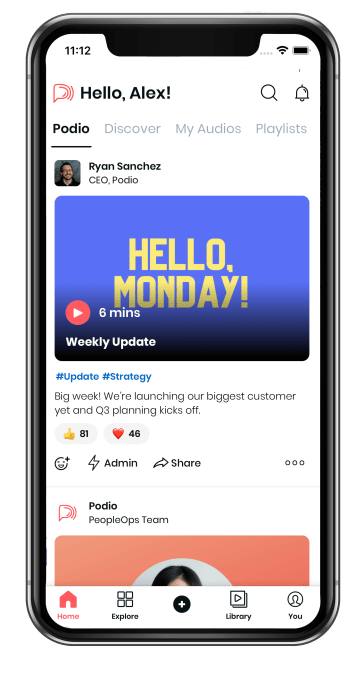
Spokn’s app offers a personalized feed of company podcasts. Image Credits: Spokn
Perhaps most importantly, companies can tailor the access lists for individual podcasts to particular groups of people, such as senior execs, people managers, sales employees or any other logical grouping. We “get a lot of inbound from companies that are trying to duct-tape solutions together,” Davis said. For Abu Seif, “all the tools that marketers have to engage consumers, we are empowering companies to engage with their employees.”
Despite the startup and product’s youth, it has attracted a quick following among companies, with customers including Podium, ShipBob, Cedar, Mixpanel, ServiceNow and Superhuman. Podium’s CEO, for example, records weekly podcasts that are shipping on Spokn, and apparently even installed a podcast studio near his office just to make it easier to produce his shows.
Podcasting inside companies fixes a lot of problems with traditional internal comms. First and foremost, it can create a deeper connection where email cannot. Audio can feel more personal than even video, and also can be played in the background. It’s also asynchronous, unlike live video, allowing employees in different time zones to connect with key stories at an appropriate time.
Plus, employees can avoid all the fatigue that comes from being onscreen. “No one wants Zoom zombies,” Bordetsky of NEA said. “We need intuitive and asynchronous communication tools like Spokn to build connection and community in the workplace.” Her thesis for the investment is that “flexible, distributed work is here to stay and employee communication is at the heart of building a modern, virtual-first employee experience.”
Buyers of Spokn range from heads of people to sales teams, and the company is also focused on recruiting and retention as well. “Companies are pretty freaked out about retaining their great talent,” Davis said. Some companies are now sharing “stories with prospects even before their first day at the company.”
While the product is mostly used by leaders today, Spokn wants to expand that remit to employees talking with their peer colleagues, helping to build community in hybrid offices where it is harder than ever to make a connection with others.
Of course, companies can screw up podcasting just as much as they have screwed up every other medium to communicate like humans, and Davis says it’s become her full-time job to help them think through storytelling and how to connect better with their own employees. We “work to find the right storytellers in the company,” she said.
Outside NEA, other investors in the seed round included Reach Capital, Funders Club, Liquid2, Share Capital, SOMA Capital, Scribble VC and Hack VC.
Powered by WPeMatico
Britive, an early-stage startup that is trying to bring privileged access control to a multi-cloud world, announced a $10 million Series A this morning. Crosslink Capital led the investment, with participation from previous investors Upfront Ventures and One Way Ventures.
The company helps automate permissioning across multiple cloud vendors and software services, whether that involves a human or a machine seeking permission. In a world of increasing automation, it’s often a machine seeking access, and that makes permissioning all the more critical, says Britive co-founder and CEO Art Poghosyan.
“What we offer is an automated approach to access, [moving from] what we call statically granted access, which constantly gets added all the time […] to completely ‘just in time access’,” he said. That means that after you define a policy, it sets the ground rules for access, and grants it based on that policy for the time required, and nothing more, whether you’re a human or a machine.
In today’s complex development, world that could take many forms, including API keys and secrets. “Yes, sometimes those things are granted to a human actor like a DevOps engineer, but a lot of times it also needs to be granted — quote, unquote — to a Terraform script or to GitHub to go and build out application infrastructure or deploy an application,” he said.
The company currently has 40 employees, a number that Poghosyan expects to double in the next 12 months as he puts this capital to work. As a first-generation Armenian immigrant, Poghosyan says that he takes diversity and inclusion extremely seriously as he hires more employees.
“We’ve always been committed — in this business and our previous startup — to providing equal opportunities to talented people, no matter what background they come from. I’m really proud that even as a small company — we’re 40 at the moment — we have more than 50% of our workforce which comes from ethnic minority groups,” he said.
Britive, which is based in Los Angeles, launched in 2018 and brought its first product to market in 2019. The company raised a $5.4 million seed round last July, which it announced in September, making the total raised so far approximately $15.4 million.
Powered by WPeMatico
Unbounce, a Vancouver startup best known for helping marketers create automated landing pages, added a new wrinkle this morning when it announced it has acquired Snazzy.ai, an early-stage automated copywriting startup. The two companies did not share the terms.
Unbounce Chief Strategy Officer Tamara Grominsky says that her company focuses on helping customers convert their customers into sales, and with Snazzy, it gets some pretty nifty technology based on GPT-3 artificial intelligence technology.
“We’re focused right now on building conversion intelligence software that will allow marketers to work with machines to really unlock their true conversion potential […] and we saw a huge opportunity with Snazzy to focus particularly on the content creation and copy creation space to help us accelerate that strategy,” Grominsky explained.
She points out that the product is really aimed at the marketing generalist charged with overseeing landing pages, and who is responsible for a range of tasks including writing copy. “The average Unbounce customer isn’t a specialized copywriter, so they don’t spend [their work] day writing copy. They’re what we would consider a marketing generalist or really someone who’s responsible for a wide range of marketing responsibilities,” she said.
Snazzy co-founder Chris Frantz says the tech is really about getting people started, and then they can tweak the results as needed. “The hardest part has always been to get that first line, that first page, the first couple of words in — and we eliminate that entirely. That might not always result in amazing copy, but on the plus side you can always click the button again and give it another try,” he said.
Frantz says that with so much competition in the space, he and his co-founder felt they could build a market much faster as part of a larger and broader marketing platform solution like Unbounce.
“I love Tamara’s vision for the future of Unbounce. I think she has a very ambitious vision. She sold me on that very early on in the process. At the same time, there was a lot of competition in the space, and to have a key differentiator with a company like Unbounce, which has a decade of marketing experience and a lot of trust within this community, I think it’s a very powerful wedge that we can use to further grow our audience,” Frantz said.
The tool lets you write a range of copy, from landing pages to Google ad copy. The company launched in alpha last October and already had 30,000 customers, which Grominsky says Unbounce hopes to convert into customers. The good news for those customers is that the company plans to leave Snazzy as a standalone product, while incorporating the tech into the platform in ways that make sense in the coming year.
Powered by WPeMatico
Project management has long been a people-led aspect of the workplace, but that has slowly been changing. Trends in automation, big data and AI have not only ushered in a new wave of project management applications, but they have led to a stronger culture of people willing to use them. Today, one of the startups building a platform for the next generation of project management is announcing some funding — a sign of the traction it’s getting in the market.
Forecast, a platform and startup of the same name that uses AI to help with project management and resource planning — put simply, it uses artificial intelligence to both “read” and integrate data from different enterprise applications in order to build a bigger picture of the project and potential outcomes — has raised $19 million to continue building out its business.
The company plans to use some of the funding to expand to the U.S., and some to continue building out its platform and business, headquartered in London with a development office also in Copenhagen.
This funding, a Series A, comes less than a year after the startup’s commercial launch, and it was led by Balderton Capital, with previous investors Crane Ventures Partners, SEED Capital and Heartcore also participating.
Forecast closed a seed round in November 2019 and then launched just as the pandemic was kicking off. It was a time when some projects were indeed put on ice, but others that went ahead did so with more caution on all sorts of fronts — financial, organizational and technical. It turned out to be a “right place, right time” moment for Forecast, a tool that plays directly into providing a technical platform to manage all of that in a better way, and it tripled revenues during the year. Its customers include the likes of the NHS, the Red Cross, Etain and more. It says over 150,000 projects have been created and run through its platform to date.
Project management — the process of planning what you need to do, assigning resources to the task and tracking how well all of that actually goes to plan — has long been stuck between a rock and a hard place in the world of work.
It can be essential to getting things done, especially when there are multiple departments or stakeholders involved; yet it’s forever an inexact science that often does not reflect all the complexities of an actual project, and therefore may not be as useful as it could or should be.
This was a predicament that founder and CEO Dennis Kayser knew all too well, having been an engineer and technical lead on a number of big projects himself. His pedigree is an interesting one: One of his early jobs was as a developer at Varien, where he built the first version of Magento. (The company was eventually rebranded as Magento and then acquired by eBay, then spun out, then acquired again, this time by Adobe for nearly $1.7 billion, and is now a huge player in the world of e-commerce tools.) He also spent years as a consultant at IBM, where among other things he helped build and formulate the first versions of ikea.com.
In those and other projects, he saw the pitfalls of project management not done right — not just in terms of having the right people on a project at the right time, but the resource planning needed, better calculations of financial outcomes in the event of a decision going one way or the other, and so on.
He didn’t say this outright, but I’m sure one of the points of contention was the fact that the first ikea.com site didn’t actually have any e-commerce in it, just a virtual window display of sorts. That was because Ikea wanted to keep people shopping in its stores, away from the efficiency of just buying the one thing you actually need and not the 10 you do not. Yes, there are plenty of ways now of recirculating people to buy more when you select one item for a shopping cart — something the likes of Amazon has totally mastered — but this was years ago when there was still even more opportunities for innovation than there are now. All of this is to say that you might very reasonably argue that had there been better project managing and resource planning tools to give forecasts of potential outcomes of one or another route taken, people advocating for a different approach could have made their case better. And maybe Ikea would have jumped on board with digital commerce far sooner than it did.
“Typically you get a lot of spreadsheets, people scattered across different tools that include accounting, CRM, Gitlab and more,” Kayser said.
That became the impetus for trying to build something that can take all of that into account and make a project management tool that — rather than just being a way of accounting to a higher-up, or reflecting only what someone can be bothered to update in the system — something that can help a team.
“Connecting everything into our engine, we leverage data to understand what they are working on and what is the right thing to be working on, what the finances are looking like,” he continued. “So if you work in product, you can plan out who is where, and what resourcing you need, what kind of people and skills you require.” This is a more dynamic progression of some of the other newer tools that are being used for project management today, targeting, in his words, “people who graduate from Monday and Asana who need something more robust, either because they have too many people working on a project or because it’s too complicated, there is just too much stuff to handle.”
More legacy tools he said that are used include Oracle “to some degree” and Mavenlink, which he describes as possibly Forecast’s closest competitor, “but its platform is aging.”
Currently the Forecast platform has some 26 integrations of popular tools used for projects to produce its insights and intelligence, including Salesforce, Gitlab, Google Calendar, and, as it happens, Asana. But given how fragmented the market is, and the signals one might gain from any number of other resources and apps, I suspect that this list will grow as and when its customers need more supported, or Forecast works out what can be gleaned from different places to paint an even more accurate picture.
The result may not ever replace an actual human project manager, but certainly starts to then look like a “digital twin” (a phrase I have been hearing more and more these days) that will definitely help that person, and the rest of the team, work in a smarter way.
“We are really excited to be an early investor in Forecast,” said James Wise, a partner at Balderton Capital, in a statement. “We share their belief that the next generation of SaaS products will be more than just collaboration tools, but use machine learning to actively solve problems for their users. The feedback we got from Forecast’s customers was quite incredible, both in their praise for the platform and in how much of a difference it had already made to their operations. We look forward to supporting the company to scale this impact going forward.”
Powered by WPeMatico
Hot off the heels of our look into Marqeta’s IPO filing and dives into SPACs for Bright Machines and Bird, we’re parsing the WalkMe IPO filing. Later this week, Squarespace will direct list and we’ll see IPOs from Oatly and Procore. It’s a super busy time for public debuts of all sorts.
Given how hectic the IPO market is, we’re going to skip our usual throat clearing and dig into WalkMe’s IPO document. As always, we’ll start with a brief overview of its product and then move into discussing its financial performance.

Image Credits: Alex Wilhelm
WalkMe is the second Israel-based technology company to file to go public this week: No-code startup Monday.com is also pursuing an American IPO.
Alright! Into the breach.
WalkMe’s software provides visual overlays on websites that help users navigate the product in question. I base that explanation on my time at Crunchbase, which was a customer during at least part of my time there. WalkMe is popular with marketing teams who want to introduce users to a new or refreshed experience.
Per the company’s F-1 filing, other elements of its service that matter include its onboarding system and what WalkMe calls Workstation, or its “single interface to the applications within an enterprise and simplifies task completion through a natural language conversational interface and automation.” We’re including that last feature because it says “automation,” which, in the wake of the UiPath IPO, is a word worth watching. Investors are.
At a high level, WalkMe is a SaaS business, which means that when we digest its results we are digging into a modern software company. Let’s do just that.
From 2019 to 2020, WalkMe grew its revenues from $105.1 million to $148.3 million, a gain of 41%. In its most recent quarter, the company’s growth rate slowed: From Q1 2020 to Q1 2021, WalkMe’s top line grew 25% from $34.2 million to $42.7 million.
In SaaS terms, WalkMe calculates that its annual recurring revenue, or ARR, grew from $131.2 million at the end of 2019 to $164.3 million in 2020. In more granular terms, the company’s ARR grew from $137.8 million to $177.5 million in the first quarters of 2020, and 2021, respectively.
Powered by WPeMatico

At Google I/O today Google Cloud announced Vertex AI, a new managed machine learning platform that is meant to make it easier for developers to deploy and maintain their AI models. It’s a bit of an odd announcement at I/O, which tends to focus on mobile and web developers and doesn’t traditionally feature a lot of Google Cloud news, but the fact that Google decided to announce Vertex today goes to show how important it thinks this new service is for a wide range of developers.
The launch of Vertex is the result of quite a bit of introspection by the Google Cloud team. “Machine learning in the enterprise is in crisis, in my view,” Craig Wiley, the director of product management for Google Cloud’s AI Platform, told me. “As someone who has worked in that space for a number of years, if you look at the Harvard Business Review or analyst reviews, or what have you — every single one of them comes out saying that the vast majority of companies are either investing or are interested in investing in machine learning and are not getting value from it. That has to change. It has to change.”
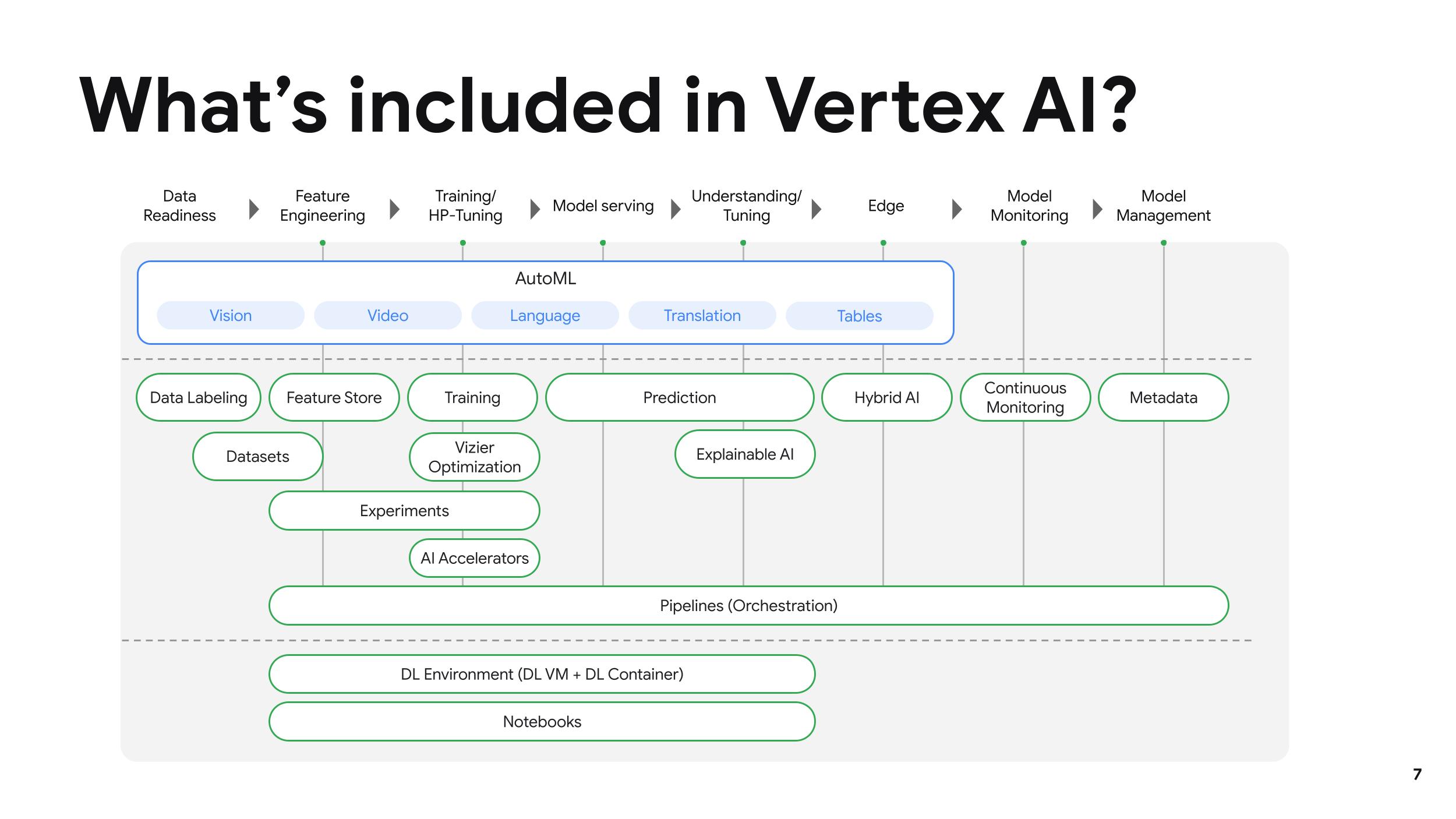
Image Credits: Google
Wiley, who was also the general manager of AWS’s SageMaker AI service from 2016 to 2018 before coming to Google in 2019, noted that Google and others who were able to make machine learning work for themselves saw how it can have a transformational impact, but he also noted that the way the big clouds started offering these services was by launching dozens of services, “many of which were dead ends,” according to him (including some of Google’s own). “Ultimately, our goal with Vertex is to reduce the time to ROI for these enterprises, to make sure that they can not just build a model but get real value from the models they’re building.”
Vertex then is meant to be a very flexible platform that allows developers and data scientist across skill levels to quickly train models. Google says it takes about 80% fewer lines of code to train a model versus some of its competitors, for example, and then help them manage the entire lifecycle of these models.

Image Credits: Google
The service is also integrated with Vizier, Google’s AI optimizer that can automatically tune hyperparameters in machine learning models. This greatly reduces the time it takes to tune a model and allows engineers to run more experiments and do so faster.
Vertex also offers a “Feature Store” that helps its users serve, share and reuse the machine learning features and Vertex Experiments to help them accelerate the deployment of their models into producing with faster model selection.
Deployment is backed by a continuous monitoring service and Vertex Pipelines, a rebrand of Google Cloud’s AI Platform Pipelines that helps teams manage the workflows involved in preparing and analyzing data for the models, train them, evaluate them and deploy them to production.
To give a wide variety of developers the right entry points, the service provides three interfaces: a drag-and-drop tool, notebooks for advanced users and — and this may be a bit of a surprise — BigQuery ML, Google’s tool for using standard SQL queries to create and execute machine learning models in its BigQuery data warehouse.
“We had two guiding lights while building Vertex AI: get data scientists and engineers out of the orchestration weeds, and create an industry-wide shift that would make everyone get serious about moving AI out of pilot purgatory and into full-scale production,” said Andrew Moore, vice president and general manager of Cloud AI and Industry Solutions at Google Cloud. “We are very proud of what we came up with in this platform, as it enables serious deployments for a new generation of AI that will empower data scientists and engineers to do fulfilling and creative work.”

Powered by WPeMatico
Like “innovation,” machine learning and artificial intelligence are commonplace terms that provide very little context for what they actually signify. AI/ML spans dozens of different fields of research, covering all kinds of different problems and alternative and often incompatible ways to solve them.
One robust area of research here that has antecedents going back to the mid-20th century is what is known as stochastic optimization — decision-making under uncertainty where an entity wants to optimize for a particular objective. A classic problem is how to optimize an airline’s schedule to maximize profit. Airlines need to commit to schedules months in advance without knowing what the weather will be like or what the specific demand for a route will be (or, whether a pandemic will wipe out travel demand entirely). It’s a vibrant field, and these days, basically runs most of modern life.
Warren B. Powell has been exploring this problem for decades as a researcher at Princeton, where he has operated the Castle Lab. He has researched how to bring disparate areas of stochastic optimization together under one framework that he has dubbed “sequential decision analytics” to optimize problems where each decision in a series places constraints on future decisions. Such problems are common in areas like logistics, scheduling and other key areas of business.
The Castle Lab has long had industry partners, and it has raised tens of millions of dollars in grants from industry over its history. But after decades of research, Powell teamed up with his son, Daniel Powell, to spin out his collective body of research and productize it into a startup called Optimal Dynamics. Father Powell has now retired full-time from Princeton to become chief analytics officer, while son Powell became CEO.
The company raised $18.4 million in new funding last week from Bessemer led by Mike Droesch, who recently was promoted to partner earlier this year with the firm’s newest $3.3 billion fundraise. The company now has 25 employees and is centered in New York City.
So what does Optimal Dynamics actually do? CEO Powell said that it’s been a long road since the company’s founding in mid-2017 when it first raised a $450,000 pre-seed round. We were “drunkenly walking in finding product-market fit,” Powell said. This is “not an easy technology to get right.”
What the company ultimately zoomed in on was the trucking industry, which has precisely the kind of sequential decision-making that father Powell had been working on his entire career. “Within truckload, you have a whole series of uncertain variables,” CEO Powell described. “We are the first company that can learn and plan for an uncertain future.”
There’s been a lot of investment in logistics and trucking from VCs in recent years as more and more investors see the potential to completely disrupt the massive and fragmented market. Yet, rather than building a whole new trucking marketplace or approaching it as a vertically integrated solution, Optimal Dynamics decided to go with the much simpler enterprise SaaS route to offer better optimization to existing companies.
One early customer, which owned 120 power units, saved $4 million using the company’s software, according to Powell. That was a result of better utilization of equipment and more efficient operations. They “sold off about 20 vehicles that they didn’t need anymore due to the underlying efficiency,” he said. In addition, the company was able to reduce a team of 10 who used to manage trucking logistics down to one, and “they are just managing exceptions” to the normal course of business. As an example of an exception, Powell said that “a guy drove half way and then decided he wanted to quit,” leaving a load stranded. “Trying to train a computer on weird edge events [like that] is hard,” he said.
Better efficiency for equipment usage and then saving money on employee costs by automating their work are the two main ways Optimal Dynamics saves money for customers. Powell says most of the savings come in the former rather than the latter, since utilization is often where the most impact can be felt.
On the technical front, the key improvement the company has devised is how to rapidly solve the ultra-complex optimization problems that logistics companies face. The company does that through value function approximation, which is a field of study where instead of actually computing the full range of stochastic optimization solutions, the program approximates the outcomes of decisions to reduce compute time. We “take in this extraordinary amount of detail while handling it in a computationally efficient way,” Powell said. That’s where we have really “wedged ourselves as a company.”
Early signs of success with customers led to a $4 million seed round led by Homan Yuen of Fusion Fund, which invests in technically sophisticated startups (i.e. the kind of startups that take decades of optimization research at Princeton to get going). Powell said that raising the round was tough, transpiring during the first weeks of the pandemic last year. One corporate fund pulled out at the last minute, and it was “chaos ensuing with everyone,” he said. This Series A process meanwhile was the opposite. “This round was totally different — closed it in 17 days from round kickoff to closure,” he said.
With new capital in the bank, the company is looking to expand from 25 employees to 75 this year, who will be trickling back to the company’s office in the Flatiron neighborhood of Manhattan in the coming months. Optimal Dynamics targets customers with 75 trucks or more, either fleets for rent or private fleets owned by companies like Walmart who handle their own logistics.
Powered by WPeMatico
The influence of a founder on their company’s culture cannot be overstated. Everything from their views on the product and business to how they think about people affects how their company’s employees will behave, and since behavior in turn informs culture, the consequences of a founder’s early decisions can be far-reaching.
So it’s not very surprising that Expensify has its own take on almost everything it does when you consider what its founder and CEO David Barrett learned early in his life: “Basically everyone is wrong about basically everything.” As we saw in part 1 of this EC-1, this led him to the revelation that it’s easier to figure things out for yourself than finding advice that applies to you. Eventually, these insights — and the adventurous P2P hacker attitude he nurtured alongside his colleagues and Travis Kalanick at Red Swoosh — would inform how he would go about shaping Expensify.
Expensify’s culture can’t be separated from its hiring and growth processes — by joining the company, employees self-select into a group that isn’t likely to get hung up about trade-offs.
It’s striking how Expensify has managed to maintain this character 13 years later, even on the threshold of an IPO. How did this happen? During a series of interviews in February and early March, we found the answer is tied to the level of thought and effort this expense management business puts into its culture.
You see, the people at Expensify are prepared to invent their own playbook, develop it and, if needed, rewrite it completely. Its HR policies and strategy are tailored to find people who would have fun building an expense management product. It has a unique growth and recognition scheme to offset the drawbacks of a flat organizational structure. It’s even got a “Senate” that vets all major decisions. No kidding.
All this, and more, has ultimately helped Expensify reach more than 10 million users and achieve $100 million in annual revenue with just 130 employees. Let’s take a closer look at how Expensify makes it happen.
It’s clear Expensify’s unusually high employee-to-revenue ratio is intentional: “We want the fewest people necessary to get the job done,” Barrett says. But how do you actually achieve it? How do you hire and keep people who can deliver such results? Barrett had to learn how the hard way.
Expensify’s first team was based in San Francisco and comprised Barrett’s old Red Swoosh and Akamai colleagues, who joined a few months after Akamai fired him. A small team was enough to get started, but it was much more difficult to hire additional people. Barrett is eager to clarify the Valley is not really the best place to recruit talent: “Sure, Silicon Valley has a ton of really awesome people, but all of them have jobs!,” he says.
Powered by WPeMatico
Without good data, it’s impossible to build an accurate predictive machine learning model. Explorium, a company that has been building a solution over the last several years to help data pros find the best data for a given model, announced a $75 million Series C today — just 10 months after announcing a $31 million Series B.
Insight Partners led today’s investment with participation from existing investors Zeev Ventures, Emerge, F2 Venture Capital, 01 Advisors and Dynamic Loop Capital. The company reports it has now raised a total of $127 million. George Mathew, managing partner at Insight, and former president and COO at Alteryx, will be joining the board, giving the company someone with solid operator experience to help guide them into the next phase.
Company co-founder and CEO Maor Shlomo, says that in spite of how horrible COVID has been from a human perspective, it has been a business accelerator for his company and he saw revenue quadruple last year (although he didn’t share specific numbers beyond that). “It’s related to the nature of our business. We’re helping enterprises and data practitioners find new data sources that can help them solve business challenges,” Sholmo explained.
He says that during the pandemic, a lot of companies had to find new data sources because the old data wasn’t especially helpful for predictive models. That meant that customers required new sources to give them visibility into the shifts and movements in the market to help them adjust and make decisions during pandemic. “And given that’s basically what our platform does in its essence, we’ve seen a lot of growth [over the past year],” he says.
With the revenue growth the company has been experiencing, it has been adding employees at rapid clip. When we spoke to Explorium last July, the company had 87 people. Today that number has grown to 130 with plans to get to 200 perhaps by the end of 2021 or early 2022, depending on how the business continues to grow.
The company has offices in Tel Aviv and San Mateo, California with plans to open a new office in New York City whenever it’s possible to do so. While Shlomo wants a flexible workplace, he’s not going fully remote with plans to allow people to work two days from home and three in the office as local rules allow.
Powered by WPeMatico
Email marketing is decades old, but it’s a category that has surprising life in it. Multiple generations of email marketing companies have come through and sustained success, from Constant Contact to Mailchimp. These brands often become household names — after all, you probably have hundreds of emails with their logos attached to the email footer.
Klaviyo is not as much of a household name right now, but it is absolutely on its way to the paramount of the next-generation of email marketing startups.
The company announced today that it has raised $320 million in new capital in a Series D round, led by Sands Capital, a private and public equity investor that has, among many areas of focus, a thesis in ecommerce. That brings the company’s total fundraising to $675 million, following a $200 million Series C round from just six months ago.
Klaviyo was the subject of one of our most recent EC-1 analyses, where we looked at the company’s history of growth, how it is rebuilding what’s been dubbed “owned marketing” (i.e. marketing channels that a business owns like email rather than channels owned by platforms like Facebook and Instagram), how marketers are using Klaviyo post-COVID, and some startup growth lessons from the business as well.
There is nearly 10,000 words of analysis packed into that whole story, so read that or save it for the weekend if you really want to get into the nitty-gritty of Klaviyo’s story and how it is fitting in to the wider email marketing space. But suffice it to say that the company’s secret sauce is perhaps obvious: it’s a marketing company that’s pretty damn good at marketing. That’s allowed it to pull in gargantuan numbers of new customers as many retailers and brick-and-mortar businesses fled online in the wake of the COVID-19 pandemic.
In its press statement, the company wrote that “Klaviyo’s customer base doubled over the past 12 months and the company now serves over 70,000 paying customers, a more than 110% increase from 2019 — ranging from small businesses to Fortune 500 companies, in more than 120 countries.” It also said that it plans to increase its head count from 800 to 1,300 people this year.
The company is headquartered in Boston, and Klaviyo’s all-but decacorn valuation is a major win for the Boston enterprise ecosystem, which continues to percolate on high.
In addition to Sands, Counterpoint Global, Whale Rock Capital Management, ClearBridge Investments, Lone Pine Capital, Owl Rock Capital, and Glynn Capital also joined the round as new investors. Previous investors Accel and Summit Partners also participated.
Powered by WPeMatico