Enterprise
Auto Added by WPeMatico
Auto Added by WPeMatico
While companies’ operations become increasingly fragmented into a wide variety of different spots — especially if they exist somewhere in a group of different cloud tools — making sure those operations are still healthy has become more and more critical.
And for companies whose lifeblood is directly keeping that software online longer, it’s even more important. Uptime maps directly to revenue, and that’s why Caleb Hailey — who previously worked on this as a consultancy — decided to start Sensu to try to piece together the monitoring operations into a single spot where a company can keep an eye on the health of their operations. The company said it has raised $10 million in a new financing round led by Battery Ventures, with existing investor Foundry Group participating. Battery’s General Partner Dharmesh Thakker is joining the company’s board of directors.
“Big enterprises are hesitant to work on startups, they’re risk averse, and it reduces the risk exposure to double down on an open source stack,” Hailey said. ” But this open source technology, it’s used in the largest institutions in the world, and we have found that by delivering cost savings in a competitive market we have already established a rapidly growing developer stream.”
While all those different tools may have their own way of monitoring the health of a system, Sensu tries to get all this into one place to make things a little easier than checking things one-by-one. The aim is to be more proactive and try to flag problems before they are even noticed by the people using Sensu, plugging directly into services like Slack or sending emails to flag potential issues before they end up becoming larger problems. Like others like Cloudera, Sensu builds its business around helping companies deploy this otherwise open source technology efficiently.
Sensu’s backstory starts as a consultancy for Hailey, which was focused on infrastructure and automation — especially as more and more companies moved to a hybrid cloud model that existed partially in some box somewhere on Azure or AWS. Starting off as an open source project is one way that he hopes to convince larger enterprises that might already be using similar tools to adopt a known entity rather than just giving some random startup the keys to maintaining their operations.
The monitoring space is still a competitive — and crowded — one. There are tools like AppDynamics or New Relic, but Hailey argues that Sensu can be competitive with those as they are very bundled while his startup helps companies piece together a more complete solution. For example, a company might need higher granularity in their reports, and Sensu aims to try to provide a robust toolkit for companies that have many disparate operations they need to keep online and running smoothly.
Powered by WPeMatico
Subscription biller Zuora was well-received by stock market investors on Thursday, following its public debut. After pricing its IPO at $14 and raising $154 million, the company closed at $20, valuing the company around $2 billion.
It was also much higher than expected. The company said in its filings that it planned to price its shares between $9 and $11, before it raised that range to $11 to $13.
Founder and CEO Tien Tzuo told TechCrunch that he believes “a bet on us is really a bet on an entire shift to a new business model, to a subscription economy.” He is optimistic that subscriptions are the “business model of the future.”
Zuora sees itself as an early pioneer in a growing category. The company believes that more businesses will shift their business models to subscriptions, across sectors like media and entertainment, transportation, publishing, industrial goods and retail.
It helps its 950 customers manage subscriptions, including billing and revenue recognition. Zuora touts that it has 15 of the Fortune 100 businesses as clients.
Zuora’s revenue for its fiscal 2018 year was $167.9 million. This was up from $113 million in 2017 and $92.2 million the year before. Losses remained constant in this time frame, from $48.2 million in 2016 to $47.2 million in 2018.
“We have a history of net losses, anticipate increasing our operating expenses in the future, and may not achieve or sustain profitability,” warned the requisite risk factors section of the filing.
It also acknowledged a competitive landscape. Oracle and SAP are amongst the companies offering software in the ERP (enterprise resource planning) category. It also competes with other startups like Chargebee and Chargify.
The largest shareholders are Benchmark, which owned 11.1 percent prior to the IPO. Founder and CEO Tien Tzuo owned 10.2 percent. Others with a significant stake included Wellington Management, Shasta Ventures, Tenaya Capital and Redpoint.
The San Mateo, Calif.-based company previously raised more than $240 million, dating back to 2007.
Zuora listed on the New York Stock Exchange, under the ticker “ZUO.” Goldman Sachs and Morgan Stanley worked as lead underwriters on the deal. Fenwick & West and Wilson Sonsini served as counsel.
After a slow start to the year for tech IPOs, there has been a flurry of activity in recent weeks. Dropbox and Spotify were amongst the recent public debuts. We also have DocuSign, Pivotal and Smartsheet on the horizon.
Powered by WPeMatico

Meet Bubblz, a French startup that wants to optimize all the boring processes that slow you down. If you’re trying to hire someone, if you need to collect information from many people, if you regularly put together marketing campaigns, you can use Bubblz to automate all the steps and collaborate with your coworkers.
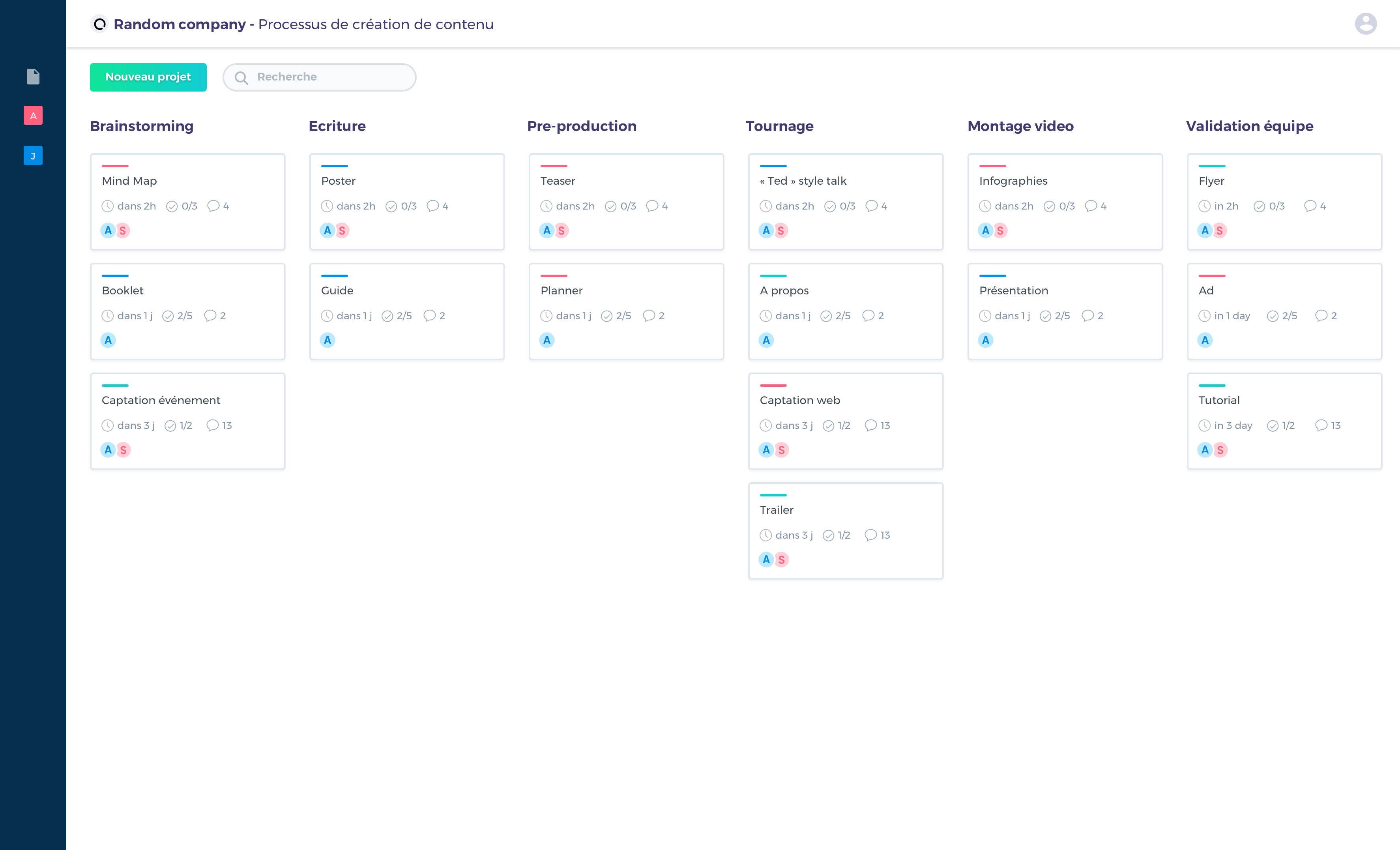
Many people use Trello or another kanban-based tool to manage potential new hires and all sorts of processes that require multiple steps. Bubblz uses the same metaphor but with a few extra tricks.
Setting up a process is going to take some thinking and a bit of time. But the idea is that you’ll save a lot of time once you have created a process in Bubblz.
Each step is represented as a column. You can then configure some actions based on each step. For instance, if you’re trying to hire someone, your first step could be an online form to collect information and upload files.
After that, you can review each application and configure multiple buttons. If you click yes, it can move the application to the next column. If you click no, it can send a rejection email and archive the application.
If you decide to hire someone, you can track that the person has signed their contract or automatically send an email to the IT department to make them aware of the new hire. You can define a short todo list for each step.
This is just an example but you can use Bubblz for other painful processes. You can create a new process from scratch or import one from the process library. I don’t think it makes sense to use Bubblz for everything, but it’s the kind of services that can make sense for some very specific issues and departments.
Bubblz uses a software-as-a-service approach. You can create a basic account for free, and the company also offers paid monthly plans for advanced features.
Powered by WPeMatico
Criminal records, driving records, employment verifications. Companies that use on-demand employees need to know that all the boxes have been checked before they send workers into the world on their behalf, and they often need those boxes checked quickly.
A growing number of them use Checkr, a San Francisco-based company that says it currently runs one million background checks per month for more than 10,000 customers, including, most newly, the car-share company Lyft, the services marketplace Thumbtack, and eyewear seller Warby Parker.
Investors are betting many more customers will come aboard, too. This morning, Checkr is announcing $100 million in Series C funding led by T. Rowe Price, which was joined by earlier backers Accel and Y Combinator.
The round brings the company’s total funding to roughly $150 million altogether, which is a lot of capital in not a lot of time. Yet Checkr is very well-positioned considering the changing nature of work. The company was born when software engineers Daniel Yanisse and Jonathan Perichon worked together at same-day delivery service startup Deliv and together eyed the chance to build a faster, more efficient background check. The number of flexible workers has only exploded in the four years since.
So-called alternative employment arrangements, in the parlance of the Bureau of Labor Statistics, including gig economy jobs, have grown from representing 10.1 percent of U.S. employees in 2005 to 15.8 percent of employees in 2015. And that percentage looks to rise further still as more digital platforms provide direct connections between people needing a service and workers willing to provide it.
Meanwhile, Checkr, which has been capitalizing on this race for talent, has its sights on much more than the on-demand workforce, says Yanisse, who is Checkr’s CEO. While the 180-person company counts Uber, Instacart, and GrubHub among its base of customers, Checkr is also actively expanding outside of the tech and gig economy, he says. It recently began working with the staffing giant Adecco, for example, as well as the major insurer Allstate.
At present, all of these customers pay Checkr per background check. That may change over time, however, particularly if the company plans to go public eventually, which Yanisse suggests is the case. (Public shareholders, like private shareholders, love recurring revenue.)
“Right now, our pricing model for customers is pay-per-applicant,” says Yanisse. “But we have a whole suite of SaaS products and tools” — including an interesting new tool designed to help hiring managers eradicate their unwitting hiring biases — “so we’re becoming more like a SaaS” business.
While things are ticking along nicely, every startup has its challenges. In Checkr’s case, one of these would seem to be those high-profile cases where background checks are painted as far from foolproof. One situation that springs to mind is the individual who began driving for Uber last year, six months before intentionally plowing into a busy bike path in New York. Indeed, though Checkr claims that it can tear through a lot of information within 24 hours — including education verification, reference checks, drug screening — we wonder if it isn’t so fast that it misses red flags.
Yanisse doesn’t think so. “Overall background checks aren’t a silver bullet,” he says. “Our job is to make the process faster, more efficient, more accurate, and more fair. But past information doesn’t guarantee future performance,” he adds. “This isn’t ‘Minority Report.’”
We also ask Yanisse about Checkr’s revenue. Often, a financing round of the size that Checkr is announcing today suggests a revenue run rate of $100 million or so. Yanisse declines to say, telling us Checkr doesn’t share revenue or its valuation publicly. “It’s still a bit early,” he says. “There’s this obsession with metrics in Silicon Valley, and we just want to make sure we’re focused on the right things.”
But, he adds, “you’re in the ballpark.”
Correction: An earlier version of this story incorrectly listed Visa as a customer.
Powered by WPeMatico

At its re:Invent developer conference, AWS made so many announcements that even some of the company’s biggest launches only got a small amount of attention. While the company’s long-awaited Elastic Container Service for Kubernetes got quite a bit of press, the launch of the far more novel Fargate container service stayed under the radar.
When I talked to him earlier this week, AWS VP and Amazon CTO (and EDM enthusiast) Werner Vogels admitted as much. “I think some of the Fargate stuff got a bit lost in all the other announcements that there were,” he told me. “I think it is a major step forward in making containers more cloud native and we see quite a few of our customers jumping on board with Fargate.”
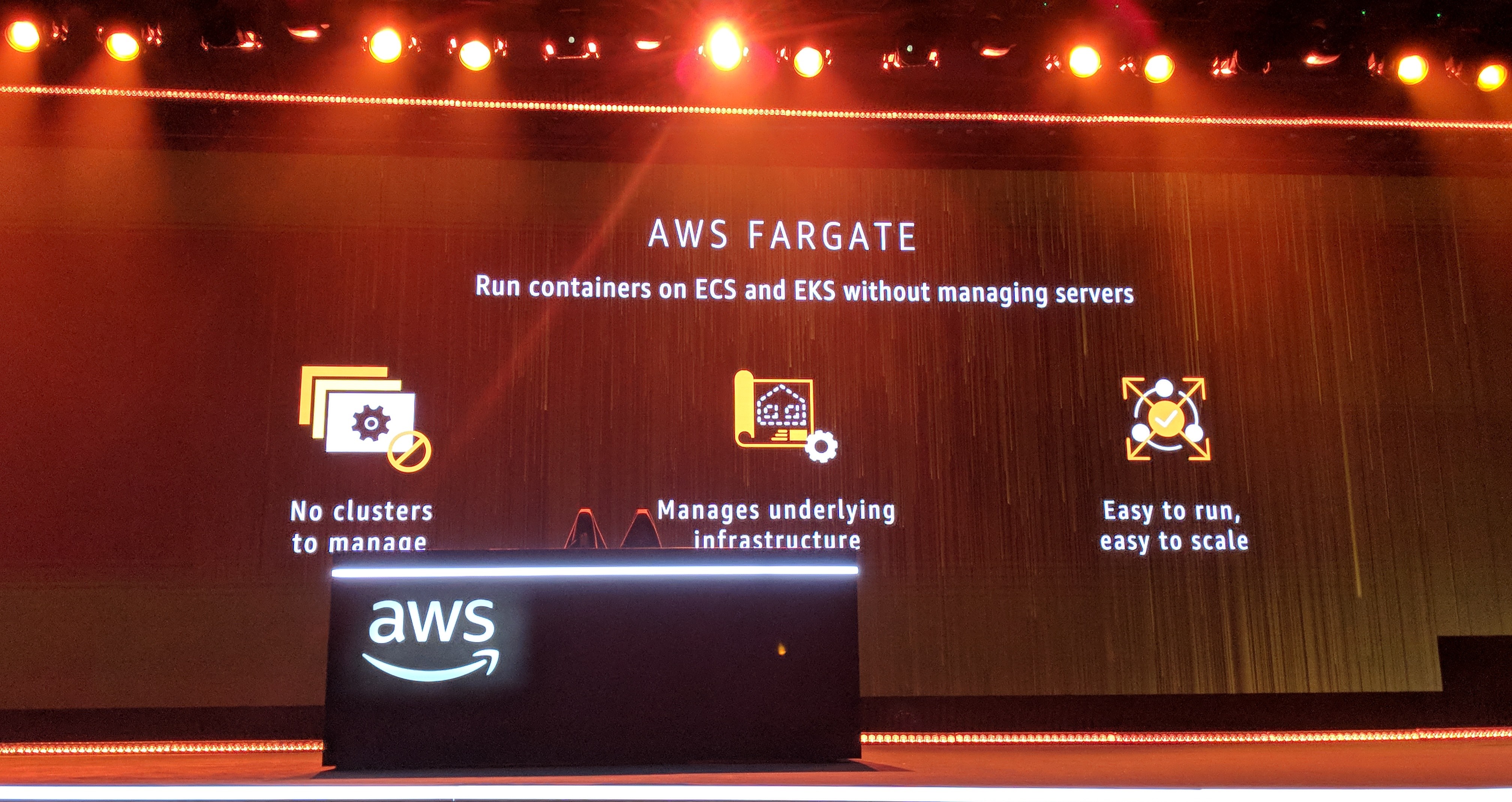
Fargate, if you haven’t followed along, is a technology for AWS’ Elastic Container Service (ECS) and Kubernetes Service (EKS) that abstracts all of the underlying infrastructure for running containers away. You pick your container orchestration engine and the service does the rest. There’s no need for managing individual servers or clusters. Instead, you simply tells ECS or EKS that you want to launch a container with Fargate, define the CPU and memory requirements of your application and let the service handle the rest.

To Vogels, who also published a longer blog post on Fargate today, the service is part of the company’s mission to help developers focus on their applications — and not the infrastructure. “I always compare it a bit to the early days of cloud,” said Vogels. “Before we had AWS, there were only virtual machines. And many companies build successful businesses around it. But when you run virtual machines, you still have to manage the hardware. […] One of the things that happened when we introduced EC2 [the core AWS cloud computing service] in the early days, was sort of that it decoupled things from the hardware. […] I think that tremendously improved developer productivity.”
But even with the early containers tools, if you wanted to run them directly on AWS or even in ECS, you still had to do a lot of work that had little to do with actually running the containers. “Basically, it’s the same story,” Vogels said. “VMs became the hardware for the containers. And a significant amount of work for developers went into that orchestration piece.”
What Amazon’s customers wanted, however, was being able to focus on running their containers — not what Vogels called the “hands-on hardware-type of management.” “That was so pre-cloud,” he added and in his blog post today, he also notes that “container orchestration has always seemed to me to be very not cloud native.”
In Vogels’ view, it seems, if you are still worried about infrastructure, you’re not really cloud native. He also noted that the original promise of AWS was that AWS would worry about running the infrastructure while developers got to focus on what mattered for their businesses. It’s services like Fargate and maybe also Lambda that take this overall philosophy the furthest.
Even with a container service like ECS or EKS, though, the clusters still don’t run completely automatically and you still end up provisioning capacity that you don’t need all the time. The promise of Fargate is that it will auto-scale for you and that you only pay for the capacity you actually need.
“Our customers, they just want to build software, they just want to build their applications. They don’t want to be bothered with how to exactly map this container down to that particular virtual machine — which is what they had to do,” Vogels said. “With Fargate, you select the type of CPUs you want to use for a particular task and it will autoscale this for you. Meaning that you actually only have to pay for the capacity you use.”

When it comes to abstracting away infrastructure, though, Fargate does this for containers, but it’s worth noting that a serverless product like AWS Lambda takes it even further. For Vogels, this is a continuum and driven by customer demand. While AWS is clearly placing big bets on containers, he is also quite realistic about the fact that many companies will continue to use containers for the foreseeable future. “VMs won’t go away,” he said.
With a serverless product like Lambda, you don’t even think about the infrastructure at all anymore, not even containers — you get to fully focus on the code and only pay for the execution of that code. And while Vogels sees the landscape of VMs, containers and serverless as a continuum, where customers move from one to the next, he also noted that AWS is seeing enterprises that are skipping over the container step and going all in on serverless right away.
Powered by WPeMatico

TravelPerk, a Barcelona-based SaaS startup that’s built an end-to-end business travel platform, has closed a $21 million Series B round, led by Berlin-based Target Global and London’s Felix Capital. Earlier investors Spark Capital and Sunstone also participated in the round, alongside new investor Amplo.
When we last spoke to the startup back in June 2016 — as it was announcing a $7M Series A — it had just 20 customers. It’s now boasting more than 1,000, name-checking “high growth” companies such as Typeform, TransferWise, Outfittery, GetYourGuide, GoCardless, Hotjar, and CityJet among its clients, and touting revenue growth of 1,200% year-on-year.
Co-founder and CEO Avi Meir tells us the startup is “on pace” to generate $100M in GMV this year.
Meir’s founding idea, back in 2015, was to create a rewards program based around dynamic budgeting for business trips. But after conversations with potential customers about their pain-points, the team quickly pivoted to target a broader bundle of business travel booking problems.
The mission now can be summarized as trying to make the entire business travel journey suck less — from booking flights and hotels; to admin tools for managing policies; analytics; customer support; all conducted within what’s billed as a “consumer-like experience” to keep end-users happy. Essentially it’s offering end-to-end travel management for its target business users.
“Travel and finance managers were frustrated by how they currently manage travel and looked for an all in one tool that JUST WORKS without having to compare rates with Skyscanner, be redirected to different websites, write 20 emails back and forth with a travel agent to coordinate a simple trip for someone, and suffer bad user experience,” says Meir.
“We understood that in order to fix business travel there is no way around but diving into it head on and create the world’s best OTA (online travel agency), combined with the best in class admin tools needed in order to manage the travel program and a consumer grade, smart user experience that travelers will love. So we became a full blown platform competing head on with the big TMCs (travel management companies) and the legacy corporate tools (Amex GBT, Concur, Egencia…) .”
He claims TravelPerk’s one-stop business trip shop now has the world’s largest bookable inventory (“all the travel agent inventory but also booking.com, Expedia, Skyscanner, Airbnb… practically any flight/hotel on the internet — only we have that”).
Target users at this stage are SMEs (up to 1,500 employees), with tech and consulting currently its strongest verticals, though Meir says it “really runs the gamut”. While the current focus is Europe, with its leading markets being the UK, Germany and Spain.
TravelPerk’s business model is freemium — and its pitch is it can save customers more than a fifth in annual business travel costs vs legacy corporate tools/travel agents thanks to the lack of commissions, free customer support etc.
But it also offers a premium tier with additional flexibility and perks — such as corporate hotel rates and a travel agent service for group bookings — for those customers who do want to pay to upgrade the experience.
On the competition front the main rivals are “old corporate travel agencies and TMC”, according to Meir, along with larger players such as Egencia (by Expedia) and Concur (SAP company).
“There are a few startups doing what we are doing in the U.S. like TripActions, NexTravel, as well as some smaller ones that are popping up but are in an earlier stage,” he notes.
“Since our first round… TravelPerk has been experiencing some incredible growth compared to any tech benchmark I know,” he adds. “We’ve found a stronger product market fit than we imagined and grew much faster than planned. It seems like everyone is unhappy with the way they are currently booking and managing business travel. Which makes this a $1.25 trillion market, ready for disruption.”
The Series B will be put towards scaling “fast”, with Meir arguing that TravelPerk has landed upon a “rare opportunity” to drive the market.
“Organic growth has been extremely fast and we have an immediate opportunity to scale the business fast, doing what we are doing right now at a bigger scale,” he says.
Commenting in a statement, Antoine Nussenbaum, partner at Felix Capital, also spies a major opportunity. “The corporate travel industry is one of the largest global markets yet to be disrupted online. At Felix Capital we have a high conviction about a new era of consumerization of enterprise software,” he says.
While Target Global general partner Shmuel Chafets describes TravelPerk as “very well positioned to be a market leader in the business travel space with a product that makes business travel as seamless and easy as personal travel”.
“We’re excited to support such an experienced and dedicated team that has a strong track record in the travel space,” he adds in a supporting statement. “TravelPerk is our first investment in Barcelona. We believe in a pan-European startup ecosystem and we look forward to seeing more opportunities in this emerging startup hub.”
Flush with fresh funding, the team’s next task is even more recruitment. “We’ll grow our teams all around with emphasis on engineering, operations and customer support. We’re also planning to expand, opening local offices in 4-5 new countries within the upcoming year and a half,” says Meir.
He notes the company has grown from 20 to 100 employees over the past 12 months already but adds that it will continue “hiring aggressively”.

Powered by WPeMatico
There’s a new venture fund in town from some familiar faces.
Carey Lai, who previously worked at Intel Capital and IVP, is joining forces with Paul Yeh, formerly of Kleiner Perkins.
They’re calling it Conductive Ventures and it’s launching with $100 million under management. They’ll be investing in “expansion stage” companies across enterprise software and hardware categories, meaning Series A, Series B and beyond.
Check sizes will be between $2 million and $7 million dollars. They expect to invest in 10-15 companies for this first fund.
Conductive will be looking for “early product market fit with customer success,” Lai told TechCrunch. Then the plan is to “help them grow their businesses abroad.”
It’s not a corporate venture arm, but Conductive has Panasonic as its sole LP. Because of this, there will be a special focus on helping North American startups expand into Asia, particularly Japan.
Lai and Yeh touted “connections to Foxconn” and also ties to Taiwan to help them succeed overseas.
They also said they want to be hands-on when it comes to growth. Conductive will place an emphasis on improving margins, aiming to accelerate revenue and reduce costs.
The two were roommates when they were younger and think that they will get along especially well as an investment team.
So far, they’ve made four investments. There’s Ambiq Micro, a semiconductor manufacturer; CSC Generation, for consumer leasing; Desktop Metal, in 3D printing; and Sprinklr, for customer experience management. Lai has served on the board of Sprinklr. They hope to continue to take board seats.
Not to get ahead of things, but they are already thinking about fund two. Yeh said that it will be in “a couple years” and “slightly higher, slightly bigger” in size.
Powered by WPeMatico
Splunk has always been known as a company that can sift through oodles of log or security data and help customers surface the important bits. Today, it announced it was going to try to apply that same skill set to Industrial Internet of Things data.
IIoT is data found in manufacturing settings, typically come from sensors on the factory floor giving engineers and plant managers data about the health and well-being of the machines running in the facility. Up until now, that data hasn’t had a modern place to live. Traditionally, companies pull the data into Excel and try to slice and dice it to find the issues
Splunk wants to change that with Splunk Industrial Asset Intelligence (IAI). The latest product pulls data from a variety of sources where it can be presented to management and engineers with the information they need to see along with critical alerts.
The new product takes advantage of some existing Splunk tools being built on top of Splunk Enterprise, but instead of processing data coming from IT systems, it’s looking at Industrial Control Systems (ICS), sensors, SCADA (supervisory control and data acquisition) systems and applications and pulling all that data together and presenting it to the key constituencies in a dashboard.
It is not a simple matter, however, to set up these dashboards, pull the data from the various data sources, some of which may be modern and some quite old, and figure out what’s important for a particular customer. Splunk says it has turned to systems integrators to help with that part of the implementation.
Splunk understands data, but it also recognizes working in the manufacturing sector is new territory for them, so they are looking to SIs with expertise in manufacturing to help them work with the unique requirements of this group. But it’s still data says Ammar Maraqa. Splunk SVP of Business Operations And Strategy and General Manager of IoT Markets
“If you step back at the end of the day, Splunk is able to ingest and correlate heterogeneous sets of data to provide a view into what’s happening in their environments,” Maraqa said.
With today’s announcement, Splunk Industrial Asset Intelligence exits Beta for a limited release. It should be generally available sometime in the Fall.
Powered by WPeMatico
UK startup Juro, which is applying a “design centric approach” and machine learning tech to help businesses speed up the authoring and management of sales contracts, has closed $2m in seed funding led by Point Nine Capital.
Prior investor Seedcamp also contributed to the round. Juro is announcing Taavet Hinrikus (TransferWise’s co-founder) as an investor now too, as well as Michael Pennington (Gumtree co-founder) and the family office of Paul Forster (co-founder of Indeed.com).
Back in January 2017 the London-based startup closed a $750,000 (£615k) seed round, though CEO and co-founder Richard Mabey tells us that was really better classed as an angel round — with Point Nine Capital only joining “late” in the day.
“We actually could have strung it out to Series A,” he says of the funding that’s being announced now. “But we had multiple offers come in and there is so much of an explosion in demand for the [machine learning] that it made sense to do a round now rather than wait for the A. The whole legal industry is undergoing radical change and we want to be leading it.”
Juro’s SaaS product is an integrated contracts workflow that combines contract creation, e-signing and commenting capabilities with AI-powered contract analytics.
Its general focus is on customers that have to manage a high volume of contacts — such as marketplaces.
The 2016-founded startup is not breaking out any customer numbers yet but says its client list includes the likes of Estee Lauder, Deliveroo and Nested. And Mabey adds that “most” of its demand is coming from enterprise at this point, noting it has “several tech unicorns and Fortune 500 companies in trial”.
While design is clearly a major focus — with the startup deploying clean-looking templates and visual cues to offer a user-friendly ‘upgrade’ on traditional legal processes — the machine learning component is its scalable, value-added differentiator to serve the target b2b users by helping them identify recurring sticking points in contract negotiations and keep on top of contract renewals.
Mabey tells TechCrunch the new funding will be used to double down on development of the machine learning component of the product.
“We’re not the first to market in contract management by about 25 years,” he says with a smilie. “So we have always needed to prove out our vision of why the incumbents are failing. One part of this is clunky UX and we’ve succeeded so far in replacing legacy providers through better design (e.g. we replace DocuSign at 80% of our customers).
“But the thing we and our investors are really excited about is not just helping businesses with contract workflow but helping them understand their contract data, auto-tag contracts, see pattens in negotiations and red flag unusual contract terms.”
While this machine learning element is where he sees Juro cutting out a competitive edge in an existing and established market, Mabey concedes it takes “quite a lot of capital to do well”. Hence taking more funding now.
“We need a level of predictive accuracy in our models that risk averse lawyers can get comfortable with and that’s a big ask!” he says.
Specifically, Juro will be using the funding to hire data scientists and machine learning engineers — building out the team at both its London and Riga offices. “We’re doing it like crazy,” adds Mabey. “For example, we just hired from the UK government Digital Service the data scientist who delivered the first ML model used by the UK government (on the gov.uk website).
“There is a huge opportunity here but great execution is key and we’re building a world class team to do it. It’s a big bet to grow revenue as quickly as we are and do this kind of R&D but that’s just what the market is demanding.”
Juro’s HQ remains in London for now, though Mabey notes its entire engineering team is based in the EU — between Riga, Amsterdam and Barcelona — “in part to avoid ‘Brexit risk’”.
“Only 27% of the team is British and we have customers operating in 12 countries — something I’m quite proud of — but it does leave us rather exposed. We’re very open minded about where we will be based in the future and are waiting to hear from the government on the final terms of Brexit,” he says when asked whether the startup has any plans to Brexit to Berlin.
“We always look beyond the UK for talent: if the government cannot provide certainty to our Romanian product designer (ex Kalo, Entrepreneur First) that she can stay in the UK post Brexit without risking a visa application, tbh it makes me less bullish on London!”
Powered by WPeMatico
In an interview last month with Julie Bort from Business Insider, Parker Harris and Marc Benioff told the story of how when they first launched the company, they were trying to raise money and nobody would give them a dime. Benioff said he went to every venture capital in Silicon Valley — and was turned down every single time.
This could be a lesson for every startup out there with a vision, who is not able to find conventional financing for your idea. Salesforce found the money, but it took one on one fundraising, rather than the traditional VC route.
The company famously launched in an apartment that Benioff rented, and he put up some of his own money to buy the company’s first computers. Then it was time to go downtown and ask the VCs for money and it did not go well.
“I had to go hat in hand, like I was a high tech beggar, down to Silicon Valley to raise some money…And as I go from venture capitalist to venture capitalist to venture capitalist — and a lot of them are my friends, people I’ve gone to lunch with — and each and every one of them said no,” Benioff said. “Salesforce was never able to raise a single dollar from a venture capitalist,” he added.
He suggested there were a lot of reasons for that including competitors who would call after his meetings and deliberately sabotage him or people who simply didn’t believe in the cloud as a vision of the future of software.
Whatever the reasons, Salesforce was eventually able to raise over $60 million from private individual investors, before going public in 2004. In the context of today’s venture capital environment, it is pretty tough to imagine a guy like Benioff not finding one taker, especially when you consider that he was not exactly an unknown quantity. And still no one would write him a check.
But this wasn’t now. It was in the late 1990s when nobody was thinking about cloud computing and the notion of software on the internet was a distant idea. Benioff was imagining something completely different and not one firm had the vision to see what was coming. Today, Salesforce is a $10 billion company and those folks that turned him down have to be wondering what they were thinking.
“When you start something like Salesforce, you want to surround yourself with people who do believe in you, who do believe you’re going to be successful because you’re going to have a whole bunch of people who are going to tell you that you’re not, Benioff said.
That’s something every entrepreneur should remember.
Powered by WPeMatico