Enterprise
Auto Added by WPeMatico
Auto Added by WPeMatico
If you believe blockchains will proliferate in the coming years, it stands to reason that you will need some sort of mechanism to move information between them — a network of blockchains with bridges and processes for sharing information between entities. That is exactly what The Aion Network is providing with a new blockchain network released today.
The company wants to be the underlying infrastructure for a network of blockchains in a similar way that TCP/IP drove the proliferation of the internet. To that end, the company, which originally began as a for-profit startup called Nuco, has decided to become a not-for-profit organization with the goal of setting up protocols for a set of interconnected blockchains. They now see their role as something akin to the Linux Foundation, helping third-party companies build products and creating an ecosystem around their base technology.
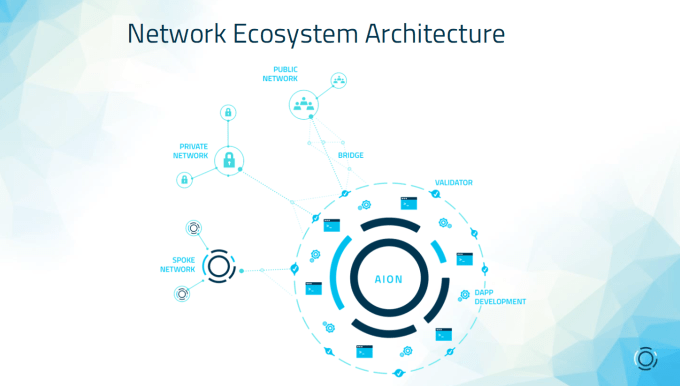
Graphic: Aion Networks
“The core design of network we have been building is to connect various networks, and route data and transactions through a public network. We are launching that network today. It allows you to build bridges to other blockchain networks. That public network acts as relayer between blockchains,” Matthew Spoke, CEO and co-founder at Aion Networks told TechCrunch.
While there clearly could be security concerns with a public by-way for blockchain data moving between systems, Spoke says that can be minimized. Instead of transmitting a medical record between a hospital and insurance company, you send a proof that the person had an operation, which the insurance company can check against the coverage rules it has created for that individual and vice versa.
The idea behind this venture is to provide the underlying plumbing to encourage more highly scalable blockchain use cases. Spoke and his team once ran the blockchain practice at Deloitte before starting this venture, and they saw roadblocks to scaling first-hand. “When we were doing enterprise projects, our biggest realization was that the plumbing wasn’t sophisticated enough. The scaling wasn’t meeting specs that enterprise companies would need long-term. Because of that, we were not seeing anyone moving beyond proof of concept projects. What we are doing is trying to mature the possible use cases,” he said.
In order to drive adoption, the company is introducing a token or cryptocurrency to be used to move data across the network and build in a level of trust. Spoke believes if the users have skin in the game in the form of tokens, that could create a higher level of trust on the system.
“Instead of paying for infrastructure, you are going to pay to be part of a common trusted protocol. It comes down to the mechanism of consensus and being incentivized to do business in an honest way,” Spoke said
This is probably not something that will get adopted widely overnight. Just because they have built it, they still require a level of utilization for it to really take off, and that will require more blockchain projects. “We still need a few years of pure focus on infrastructure to make sure we are getting these layers right. Every time you move data of any kind there are security vulnerabilities, and we need to make sure there are good specs and comfort in using it,” he said.
Powered by WPeMatico
Etleap is a play on words for a common set of data practices: extract, transform and load. The startup is trying to place these activities in a modern context, automating what they can and in general speeding up what has been a tedious and highly technical practice. Today, they announced a $1.5 million seed round.
Investors include First Round Capital, SV Angel, Liquid2, BoxGroup and other unnamed investors. The startup launched five years ago as a Y Combinator company. It spent a good 2.5 years building out the product, says CEO and founder Christian Romming. They haven’t required additional funding until now because they have been working with actual customers. Those include Okta, PagerDuty and Mode, among others.
Romming started out at adtech startup VigLink and while there he encountered a problem that was hard to solve. “Our analysts and scientists were frustrated. Integration of the data sources wasn’t always a priority and when something broke, they couldn’t get it fixed until a developer looked at it.” That lack of control slowed things down and made it hard to keep the data warehouse up-to-date.
He saw an opportunity in solving that problem and started Etleap . While there were (and continue to be) legacy solutions like Informatica, Talend and Microsoft SQL Server Integration Services, he said when he studied these at a deeply technical level, he found they required a great deal of help to implement. He wanted to simplify ETL as much as possible, putting data integration into the hands of much less technical end users, rather than relying on IT and consultants.
One of the problems with traditional ETL is that the data analysts who make use of the data tend to get involved very late after the tools have already been chosen, and Romming says his company wants to change that. “They get to consume whatever IT has created for them. You end up with a bread line where analysts are at the mercy of IT to get their jobs done. That’s one of the things we are trying to solve. We don’t think there should be any engineering at all to set up an ETL pipeline,” he said.
Etleap is delivered as managed SaaS or you can run it within your company’s AWS accounts. Regardless of the method, it handles all of the managing, monitoring and operations for the customer.
Romming emphasizes that the product is really built for cloud data warehouses. For now, they are concentrating on the AWS ecosystem, but have plans to expand beyond that down the road. “We want to help more enterprise companies make better use of their data, while modernizing data warehousing infrastructure and making use of cloud data warehouses,” he explained.
The company currently has 15 employees, but Romming plans to at least double that in the next 12-18 months, mostly increasing the engineering team to help further build out the product and create more connectors.
Powered by WPeMatico
Over the past few years, the old language of “customer support” has been supplanted by the new language of “customer success.” In the old model, companies would essentially disappear following the conclusion of a sale, merely handling customer problems when they arose. Now, companies are actively reaching out to customers, engaging them with education and training and monitoring them with analytics to ensure they have the best time with the product as possible.
What’s changing is the nature of product and services today: subscription. Customers no longer just make a single buying decision about a product, but instead must actively commit to using the product, or else they churn.
New York-based Catalyst, founded by brothers Edward and Kevin Chiu, wants to rebuild customer success from the ground up with an integrated software platform. They have received some capital success of their own, securing $2.4 million in venture capital from Phil Black of True Ventures with participation from Ludlow Ventures and Compound.
New York has had something of an increase in founder mafias, as TechCrunch reported this weekend. Catalyst is no exception to this trend, with the Chiu brothers both working at DigitalOcean, one of New York’s many high-flying enterprise startups. Edward Chiu was director of customer success at the company for a number of years, but had a unique background in sales and also in coding before starting.
Kevin Chiu was head of inside sales at DigitalOcean . “I brought my brother on to do sales at DigitalOcean,” Edward Chiu explains. “We always knew that we wanted to start a company together, but wanted to see if we would kill each other.” The two worked together, and lo and behold, they didn’t kill each other.
Edward Chiu wanted to match the product experience of using DigitalOcean with the experience of using its internal customer success tools. Nothing on the market fit. “Given that DigitalOcean was a very technical product,” Chiu explained, “we decided to build our own tool.” Chiu thought of customer success at DigitalOcean as its own product, and his team built up the platform to improve its functionality and scalability. “We just used the tool and we loved it,” he said, so we “started to show this tool to a bunch of other customer success leaders I am connected with.”
Other customer success leaders said they wanted the platform, and “after the 20th person told me that,” he and his brother spun out of DigitalOcean to go on their own. Unlike enterprise startups in New York a couple of years ago that often struggled to find any investors, Catalyst found cash quickly. “Two weeks in we had more offers than we knew what to do with,” Chiu explained. The two said they had originally targeted a fundraise of $750,000, but ended up at $2.4 million.
Catalyst is a platform that integrates between a number of other major SaaS services such as Salesforce, Zendesk, Mixpanel and others to create a unified dashboard for data around customer success. From there, customer success managers have a set of automated tools to handle engagement, such as customer segmentation and email campaigns.
A major challenge in the customer success world is that these managers often don’t have the skills required to do advanced data analytics, so they often rely on their friends in engineering to run scripts or perform database lookups. The hope is that Catalyst’s feature set is powerful enough that these sorts of ad hoc tasks become a thing of the past. “Because we aggregate all this data, you can run queries,” Chiu explains.
Chiu says that Catalyst doesn’t just want to be a software platform, but rather a movement that pushes every company to think about how they can make their customers successful. “There are so many companies that are starting to understand that it is not something that you do once you raise a Series A, but something you do from day one,” Chiu said. “If you take care of your very first customer, they will constantly promote you and constantly promote your business.”
The company is based in Flatiron, and has eight employees.
Powered by WPeMatico

Data analytics platform Tableau today announced the launch of both a new data preparation product and a new subscription pricing plan.
Currently, Tableau offers desktop plans for users who want to analyze their data locally, a server plan for businesses that want to deploy the service on-premises or on a cloud platform, and a fully hosted online plan. Prices for these range from $35 to $70 per user and month. The new pricing plans don’t focus so much on where the data is analyzed but on the analyst’s role. The new Creator, Explorer and Viewer plans are tailored toward the different user experiences. They all include access to the new Tableau Prep data preparation tool, Tableau Desktop and new web authoring capabilities — and they are available both on premises or in the cloud.
Existing users can switch their server or desktop subscriptions to the new release today and then assign each user either a creator, explorer or viewer role. As the name indicates, the new viewer role is meant for users who mostly consume dashboards and visualizations, but don’t create their own. The explorer role is for those who need access to a pre-defined data set and the creator role is for analysts and power user who need access to all of Tableau’s capabilities.
“Organizations are facing the urgent need to empower their entire workforce to help drive more revenue, reduce costs, provide better service, increase productivity, discover the next scientific breakthrough and even save lives,” said Adam Selipsky, CEO at Tableau, in today’s announcement. “Our new offerings will help entire organizations make analytics ubiquitous, enabling them to tailor the capabilities required for every employee.”
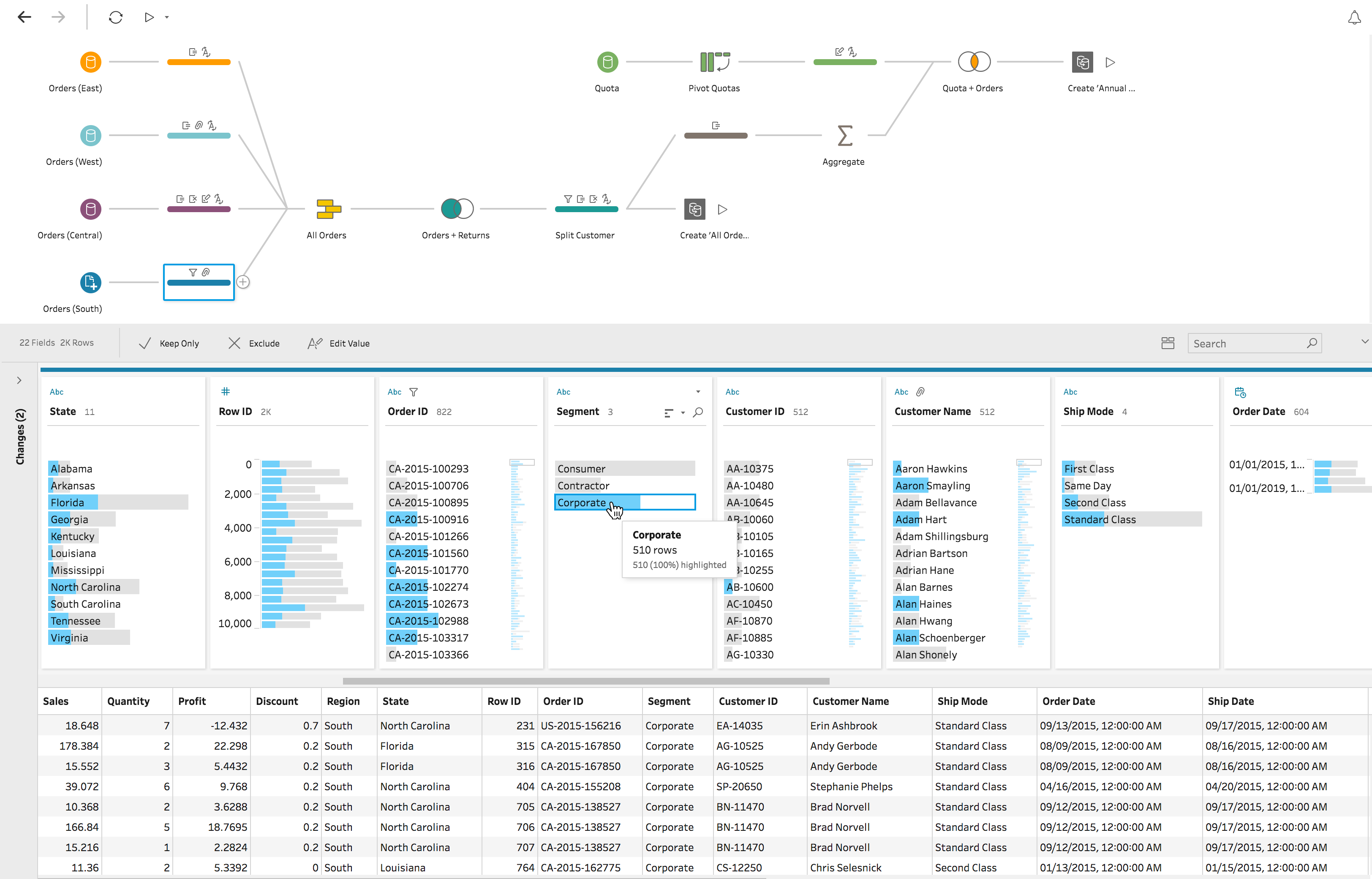
As for the new data preparation tool, the general idea here is to give users a visual way to shape and clean their data, something that’s especially important as businesses now often pull in data from a variety of sources. Tableau Prep can automate some of this, but the most important aspect of the service is that it gives users a visual interface for creating these kind of workflows. Prep includes support for all the standard Tableau data connectors and lets users perform calculations, too.
“Our customers often tell us that they love working with Tableau, but struggle when data is in the wrong shape for analysis,” said Francois Ajenstat, Chief Product Officer at Tableau. “We believe data prep and data analysis are two sides of the same coin that should be deeply integrated and look forward to bringing fun, easy data prep to everyone regardless of technical skill set.”
Powered by WPeMatico
Heptio is one of the more interesting companies in the container ecosystem. In part, that’s due to the simple fact that it was founded by Craig McLuckie and Joe Beda, two of the three engineers behind the original Kubernetes project, but also because of the technology it’s developing and the large amount of funding it has raised to date.

As the company announced today, it saw its revenue grow 140 percent from the last quarter of 2017 to the first quarter of 2018. In addition, Heptio says its headcount quadrupled since the beginning of 2017. Without any actual numbers, that kind of data doesn’t mean all that much. It’s easy to achieve high-growth numbers if you’re starting out from zero, after all. But it looks like things are going well at the company and that the team is finding its place in the fast-growing Kubernetes ecosystem.
In addition to announcing these numbers, the team also today launched a new open-source project that will join the company’s existing stable of tools, like the cluster-recovery tool Ark and the Kubernetes cluster-monitoring tool Sonobuoy.
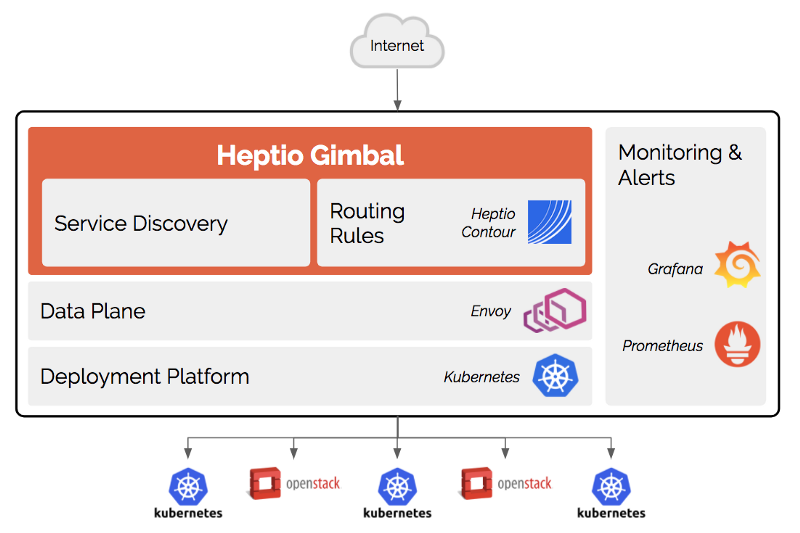
This new tool, Heptio Gimbal, has a very specific use case that is probably only of interest to a relatively small number of users — but for them, it’ll be a lifeline. Gimbal, which Heptio developed together with Yahoo Japan subsidiary Actapio, helps enterprises route traffic into both Kubernetes clusters and OpenStack deployments. Many enterprises now run these technologies in parallel, and while some are now moving beyond OpenStack and toward a more Kubernetes -centric architecture, they aren’t likely to do away with their OpenStack investments anytime soon.
“We approached Heptio to help us modernize our infrastructure with Kubernetes without ripping out legacy investments in OpenStack and other back-end systems,” said Norifumi Matsuya, CEO and president at Actapio. “Application delivery at scale is key to our business. We needed faster service discovery and canary deployment capability that provides instant rollback and performance measurement. Gimbal enables our developers to address these challenges, which at the macro-level helps them increase their productivity and optimize system performance.”
Gimbal uses many of Heptio’s existing open-source tools, as well as the Envoy proxy, which is part of the Cloud Native Computing Foundation’s stable of cloud-native projects. For now, Gimbal only supports one specific OpenStack release (the “Mitaka” release from 2016), but the team is looking at adding support for VMware and EC2 in the future.
Powered by WPeMatico
When the Department of Defense announced in March a 10-year winner-take-all cloud contract that could be worth up to $10 billion, it raised a few eyebrows. Last week, they clarified some of the conditions, and it turns out that much like a modern baseball free agent contract, there are a couple of points where the DoD can opt out of the deal.
In a press conference last week, chief Pentagon spokesperson Dana W. White indicated that the original contract award is for just two years. After that there are two additional options for five years and three years. The department can opt out after the first two years if it’s not working out, or seven years if it accepts the second option. Obviously if it takes the final option, that would add up to a full 10-year commitment.
Leigh Madden, who heads up Microsoft’s defense effort, says he believes Microsoft can win such a contract, but it isn’t necessarily the best approach for the DoD. “If the DoD goes with a single award path, we are in it to win, but having said that, it’s counter to what we are seeing across the globe where 80 percent of customers are adopting a multi-cloud solution,” Madden told TechCrunch.
White indicated that 46 companies have responded to the request for proposal, but it seems clear there are only a handful of companies that could handle a project of this scope. For starters, we have Amazon and Microsoft, along with Google, IBM and Oracle.
That said, White indicated that companies can band together and form a partnership, which means you could see some extremely strange bedfellows trying to form the equivalent of a rock supergroup with multiple players coming together to win the deal.
This development certainly opens up some interesting options for the vendors involved and creates a level of competition and alliances the likes of which the tech industry might have never seen. Whoever gets the contract, they get two years to prove they can do this, then they will be evaluated before getting a shot at the second five-year window.
Powered by WPeMatico
Slack exposed the demand for a dead-simple internal communications tool, which has inspired a wave of startups trying to pick apart the rest of a company’s daily activities — including Slite, which hopes to take on internal notes with a fresh round of new capital.
Slite is more or less an attempt at a replacement for a Google Doc or something in Dropbox Paper that is sprawling and getting a little out of control. An employee might create a Slite note like an onboarding manual or an internal contact list, and the hope is to replace the outdated internal wiki and offer employees a hub where they can either go and start stringing together important information, or find it right away. The company today said it has raised $4.4 million in a new seed funding round led by Index Ventures after coming out of Y Combinator’s 2018 winter class. Ari Helgason is joining Slite’s board of directors as part of the deal.
“We now have to develop this product enough to show we can actually replace large amounts of things,” co-founder Christophe Pasquier said. “Today we have more than 300 active teams, and we have to show that we can make it scale. In the short term is just we’re replacing Google Docs because these tools ahven’t evolved and we’re bringing something super fresh. The longer-term vision of really bringing all the information that has value from a team and becoming this single source of truth for teams.”
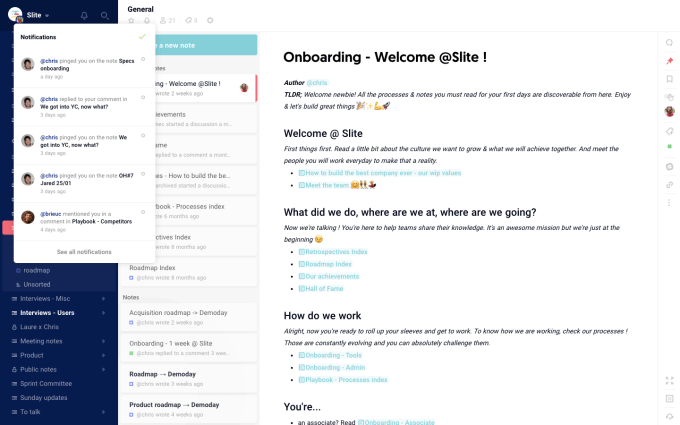
Slite tracks permissions and changes to the notes in order to allow companies to do a better job of maintaining them, rather than sharing around links and having different people jump in and make changes. The part about sharing links is one in particular that stung for Pasquier, as even larger companies can have issues with employees asking in Slack what policies are — or even for links to parts of the internal wiki where that important information is buried.
Getting there certainly won’t be easy. Companies like Dropbox continuing to invest in these kinds of collaborative note-taking tools — that could easily evolve into internal hubs of information. And as Pasquier tries to liken the development arc to Slack, which showed employees wanted some more seamless tool for communication, that company is also working on making its search tools smarter, like helping employees find the right person to ask a question. It doesn’t look like an asynchronous notes tool just yet, but if all the information is somewhere in Slack already, a smart search tool may be the only thing necessary to find all that information.
Powered by WPeMatico
Pivotal has kind of a strange role for a company. On one hand its part of the EMC federation companies that Dell acquired in 2016 for a cool $67 billion, but it’s also an independently operated entity within that broader Dell family of companies — and that has to be a fine line to walk.
Whatever the challenges, the company went public yesterday and joined VMware as a separately traded company within Dell. CEO Rob Mee says the company took the step of IPOing because it wanted additional capital.
“I think we can definitely use the capital to invest in marketing and R&D. The wider technology ecosystem is moving quickly. It does take additional investment to keep up,” Mee told TechCrunch just a few hours after his company rang the bell at the New York Stock Exchange.
As for that relationship of being a Dell company, he said that Michael Dell let him know early on after the EMC acquisition that he understood the company’s position. “From the time Dell acquired EMC, Michael was clear with me: You run the company. I’m just here to help. Dell is our largest shareholder, but we run independently. There have been opportunities to test that [since the acquisition] and it has held true,” Mee said.
Mee says that independence is essential because Pivotal has to remain technology-agnostic and it can’t favor Dell products and services over that mission. “It’s necessary because our core product is a cloud-agnostic platform. Our core value proposition is independence from any provider — and Dell and VMware are infrastructure providers,” he said.
That said, Mee also can play both sides because he can build products and services that do align with Dell and VMware offerings. “Certainly the companies inside the Dell family are customers of ours. Michael Dell has encouraged the IT group to adopt our methods and they are doing so,” he said. They have also started working more closely with VMware, announcing a container partnership last year.
Photo: Ron Miller
Overall though he sees his company’s mission in much broader terms, doing nothing less than helping the world’s largest companies transform their organizations. “Our mission is to transform how the world builds software. We are focused on the largest organizations in the world. What is a tailwind for us is that the reality is these large companies are at a tipping point of adopting how they digitize and develop software for strategic advantage,” Mee said.
The stock closed up 5 percent last night, but Mee says this isn’t about a single day. “We do very much focus on the long term. We have been executing to a quarterly cadence and have behaved like a public company inside Pivotal [even before the IPO]. We know how to do that while keeping an eye on the long term,” he said.
Powered by WPeMatico
While most people probably would not think of New York as a hotbed for enterprise startups of any kind, it is actually quite active. When you stop to consider that the world’s biggest banks and financial services companies are located there, it would certainly make sense for security startups to concentrate on such a huge potential market — and it turns out, that’s the case.
According to Crunchbase, there are dozens of security startups based in the city with everything from biometrics and messaging security to identity, security scoring and graph-based analysis tools. Some established companies like Symphony, which was originally launched in the city (although it is now on the west coast), has raised almost $300 million. It was actually formed by a consortium of the world’s biggest financial services companies back in 2014 to create a secure unified messaging platform.
There is a reason such a broad-based ecosystem is based in a single place. The companies who want to discuss these kinds of solutions aren’t based in Silicon Valley. This isn’t typically a case of startups selling to other startups. It’s startups who have been established in New York because that’s where their primary customers are most likely to be.
In this article, we are looking at a few promising early-stage security startups based in Manhattan
Hypr is looking at decentralizing identity with the goal of making it much more difficult to steal credentials. As company co-founder and CEO George Avetisov puts it, the idea is to get rid of that credentials honeypot sitting on the servers at most large organizations, and moving the identity processing to the device.

Hypr lets organizations remove stored credentials from the logon process. Photo: Hypr
“The goal of these companies in moving to decentralized authentication is to isolate account breaches to one person,” Avetisov explained. When you get rid of that centralized store, and move identity to the devices, you no longer have to worry about an Equifax scenario because the only thing hackers can get is the credentials on a single device — and that’s not typically worth the time and effort.
At its core, Hypr is an SDK. Developers can tap into the technology in their mobile app or website to force the authorization to the device. This could be using the fingerprint sensor on a phone or a security key like a Yubikey. Secondary authentication could include taking a picture. Over time, customers can delete the centralized storage as they shift to the Hypr method.
The company has raised $15 million and has 35 employees based in New York City.
Uplevel’s founder Liz Maida began her career at Akamai where she learned about the value of large data sets and correlating that data to events to help customers understand what was going on behind the scenes. She took those lessons with her when she launched Uplevel Security in 2014. She had a vision of using a graph database to help analysts with differing skill sets understand the underlying connections between events.
“Let’s build a system that allows for correlation between machine intelligence and human intelligence,” she said. If the analyst agrees or disagrees, that information gets fed back into the graph, and the system learns over time the security events that most concern a given organization.
“What is exciting about [our approach] is you get a new alert and build a mini graph, then merge that into the historical data, and based on the network topology, you can start to decide if it’s malicious or not,” she said.
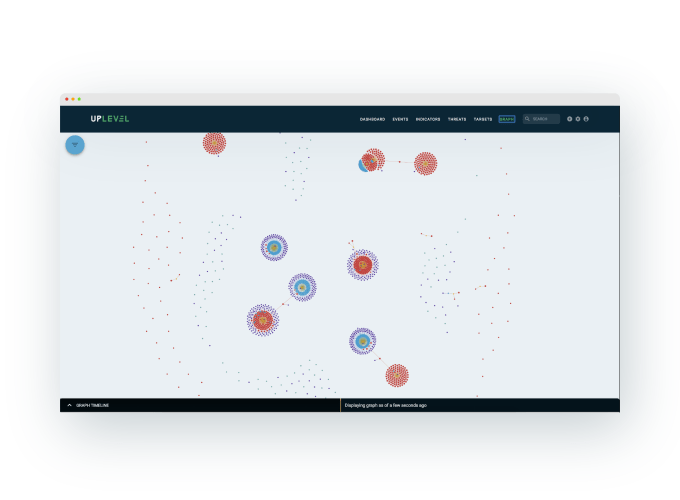
Photo: Uplevel
The company hopes that by providing a graphical view of the security data, it can help all levels of security analysts figure out the nature of the problem, select a proper course of action, and further build the understanding and connections for future similar events.
Maida said they took their time creating all aspects of the product, making the front end attractive, the underlying graph database and machine learning algorithms as useful as possible and allowing companies to get up and running quickly. Making it “self serve” was a priority, partly because they wanted customers digging in quickly and partly with only 10 people, they didn’t have the staff to do a lot of hand holding.
The founders of Security Scorecard met while working at the NYC ecommerce site, Gilt. For a time ecommerce and adtech ruled the startup scene in New York, but in recent times enterprise startups have really started to come on. Part of the reason for that is many people started at these foundational startups and when they started their own companies, they were looking to solve the kinds of enterprise problems they had encountered along the way. In the case of Security Scorecard, it was how could a CISO reasonably measure how secure a company they were buying services from was.

Photo: Security Scorecard
“Companies were doing business with third-party partners. If one of those companies gets hacked, you lose. How do you vett the security of companies you do business with” company co-founder and CEO Aleksandr Yampolskiy asked when they were forming the company.
They created a scoring system based on publicly available information, which wouldn’t require the companies being evaluated to participate. Armed with this data, they could apply a letter grade from A-F. As a former CISO at Gilt, it was certainly a paint point he felt personally. They knew some companies did undertake serious vetting, but it was usually via a questionnaire.
Security Scorecard was offering a way to capture security signals in an automated way and see at a glance just how well their vendors were doing. It doesn’t stop with the simple letter grade though, allowing you to dig into the company’s strengths and weaknesses and see how they compare to other companies in their peer groups and how they have performed over time.
It also gives customers the ability to see how they compare to peers in their own industry and use the number to brag about their security position or conversely, they could use it to ask for more budget to improve it.
The company launched in 2013 and has raised over $62 million, according to Crunchbase. Today, they have 130 employees and 400 enterprise customers.
If you’re an enterprise security startup, you need to be where the biggest companies in the world do business. That’s in New York City, and that’s precisely why these three companies, and dozens of others have chosen to call it home.
Powered by WPeMatico
There used to be two cultures in the enterprise around technology. On one side were software engineers, who built out the applications needed by employees to conduct the business of their companies. On the other side were sysadmins, who were territorially protective of their hardware domain — the servers, switches, and storage boxes needed to power all of that software. Many a great comedy routine has been made at the interface of those two cultures, but they remained divergent.
That is, until the cloud changed everything. Suddenly, there was increasing overlap in the skills required for software engineering and operations, as well as a greater need for collaboration between the two sides to effectively deploy applications. Yet, while these two halves eventually became one whole, the software monitoring tools used by them were often entirely separate.
New York City-based Datadog was designed to bring these two cultures together to create a more nimble and collaborative software and operations culture. Founded in 2010 by Olivier Pomel and Alexis Lê-Quôc, the product offers monitoring and analytics for cloud-based workflows, allowing ops team to track and analyze deployments and developers to instrument their applications. Pomel said that “the root of all of this collaboration is to make sure that everyone has the same understanding of the problem.”
The company has had dizzying success. Pomel declined to disclose precise numbers, but says the company had “north of $100 million” of recurring revenue in the past twelve months, and “we have been doubling that every year so far.” The company, headquartered in the New York Times Building in Times Square, employs more than 600 people across its various worldwide offices. The company has raised nearly $150 million of venture capital according to Crunchbase, and is perennially on banker’s short lists for strong IPO prospects.
The real story though is just how much luck and happenstance can help put wind in the sails of a company.
Pomel first met Lê-Quôc while an undergraduate in France. He was working on running the campus network, and helped to discover that Lê-Quôc had hacked the network. Lê-Quôc was eventually disconnected, and Pomel would migrate to IBM’s upstate New York offices after graduation. After IBM, he led technology at Wireless Generation, a K-12 startup, where he ran into Lê-Quôc again, who was heading up ops for the company. The two cultures of develops and ops was glaring at the startup, where “we had developers who hated operations” and there was much “finger-pointing.”
Putting aside any lingering grievances from their undergrad days, the two began to explore how they could ameliorate the cultural differences they witnessed between their respective teams. “Bringing dev and ops together is not a feature, it is core,” Pomel explained. At the same time, they noticed that companies were increasingly talking about building on Amazon Web Services, which in 2009, was still a relatively new concept. They incorporated Datadog in 2010 as a cloud-first monitoring solution, and launched general availability for the product in 2012.
Luck didn’t just bring the founders together twice, it also defined the currents of their market. Datadog was among the first cloud-native monitoring solutions, and the superlative success of cloud infrastructure in penetrating the enterprise the past few years has benefitted the company enormously. We had “exactly the right product at the right time,” Pomel said, and “a lot of it was luck.” He continued, “It’s healthy to recognize that not everything comes from your genius, because what works once doesn’t always work a second time.”
While startups have been a feature in New York for decades, enterprise infrastructure was in many ways in a dark age when the company launched, which made early fundraising difficult. “None of the West Coast investors were listening,” Pomel said, and “East Coast investors didn’t understand the infrastructure space well enough to take risks.” Even when he could get a West Coast VC to chat with him, they “thought it was a form of mental impairment to start an infrastructure startup in New York.”
Those fundraising difficulties ended up proving a boon for Datadog, because it forced the company to connect with customers much earlier and more often than it might have otherwise. Pomel said, “it forced us to spend all of our time with customers and people who were related to the problem” and ultimately, “it grounded us in the customer problem.” Pomel believes that the company’s early DNA of deeply listening to customers has allowed it to continue to outcompete its rivals on the West Coast.
More success is likely to come as companies continue to move their infrastructure onto the cloud. Datadog used to have a roughly even mix of private and public cloud business, and now the balance is moving increasingly toward the public side. Even large financial institutions, which have been reticent in transitioning their infrastructures, have now started to aggressively embrace cloud as the future of computing in the industry, according to Pomel.
Datadog intends to continue to add new modules to its core monitoring toolkit and expand its team. As the company has grown, so has the need to put in place more processes as parts of the company break. Quoting his co-founder, Pomel said the message to employees is “don’t mind the rattling sound — it is a spaceship, not an airliner” and “things are going to break and change, and it is normal.”
Much as Datadog has bridged the gap between developers and ops, Pomel hopes to continue to give back to the New York startup ecosystem by bridging the gap between technical startups and venture capital. He has made a series of angel investments into local emerging enterprise and data startups, including Generable, Seva, and Windmill. Hard work and a lot of luck is propelling Datadog into the top echelon of enterprise startups, pulling New York along with it.
Powered by WPeMatico